The Supreme Court of India recently declined to intervene in the case of a Sri Lankan Tamil national who is currently detained, stating that India cannot act as a shelter for refugees from across the globe.
During the hearing, Justice Dipankar Datta, who led the bench alongside Justice K Vinod Chandran, remarked that with a population of 140 crore, India cannot accommodate people from every country seeking refuge. “Is India to host refugees from all over the world? We are struggling with 140 crore. This is not a Dharmshala that we can entertain foreign nationals from all over,” he said, questioning whether the country should bear the responsibility of hosting global refugees.
The court was reviewing an appeal challenging a Madras High Court order that directed the petitioner—a Sri Lankan Tamil—to leave India immediately after serving a seven-year sentence under the Unlawful Activities (Prevention) Act (UAPA).
The petitioner’s lawyer argued that the man, who had entered India on a visa, feared for his life if returned to Sri Lanka. He further stated that the petitioner had been in detention for nearly three years with no steps taken toward deportation, and that his wife and children reside in India.
In response, Justice Datta asked what legal grounds the petitioner had to seek permanent residence in India, pointing out that the right to settle in India under Article 19 of the Constitution is reserved for citizens. He also clarified that there was no breach of Article 21 since the man’s liberty was curtailed in accordance with due legal procedure.
When the counsel emphasized that returning to Sri Lanka posed a serious threat to the petitioner’s safety, the judge remarked, “He can seek refuge in another country.”
This stance aligns with the Court’s earlier decision where it refused to halt the deportation of Rohingya refugees.
The petitioner had been arrested in 2015 by the Q Branch along with two others on suspicion of being members of the LTTE. In 2018, a trial court convicted him under Section 10 of the UAPA and sentenced him to 10 years in prison. The Madras High Court later reduced the sentence to 7 years in 2022 but ordered that he be deported after completing his term, and held in a refugee camp in the interim.
The petitioner contended that his past as an LTTE fighter had led to his name being blacklisted in Sri Lanka, making him vulnerable to arrest and torture if returned. He also cited his wife’s poor health and his son’s congenital heart condition as reasons to remain in India.
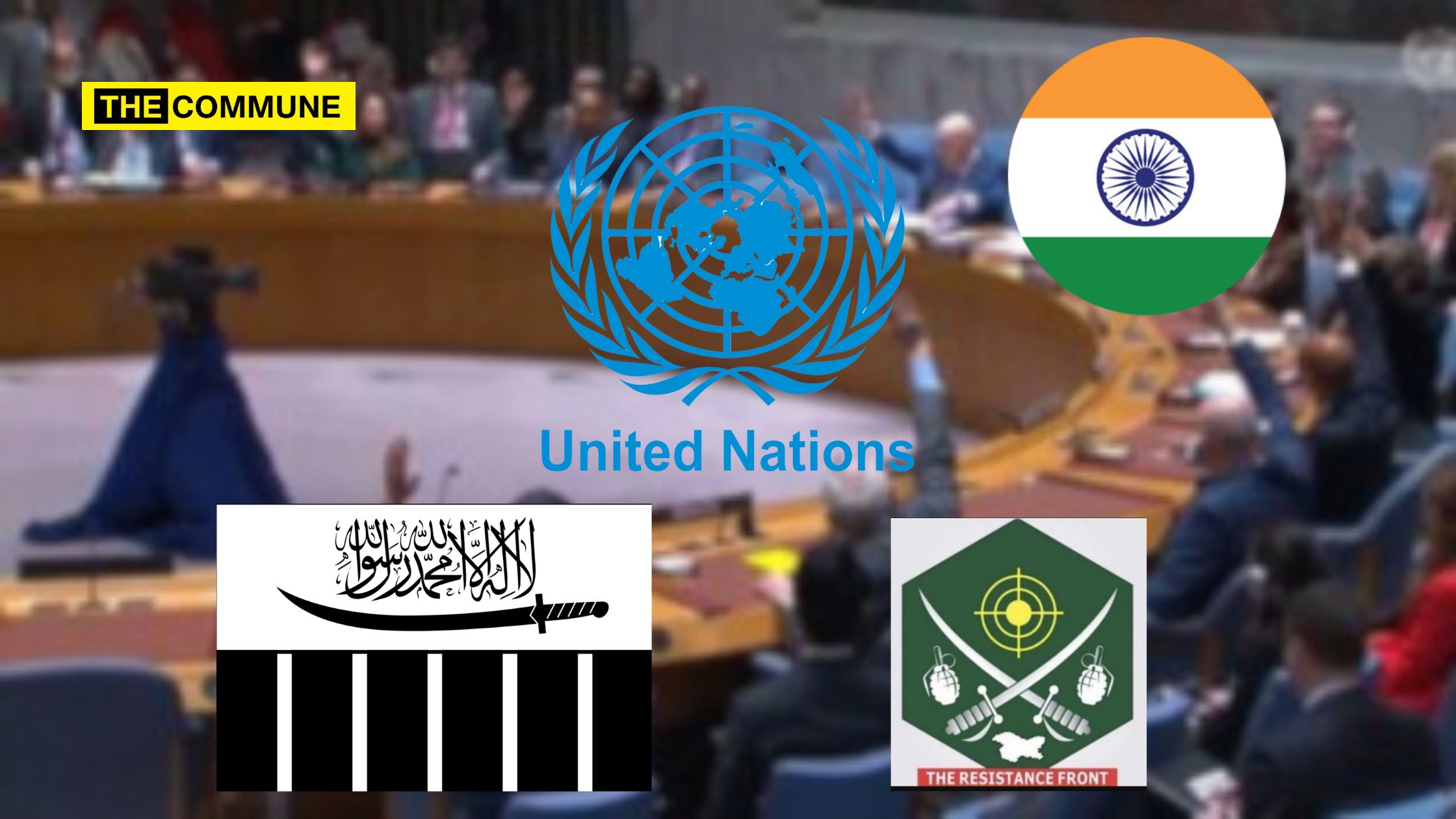
A delegation from India has met with the monitoring team of the United Nations (UN) Security Council’s panel that sanctions terrorists and provided it with evidence of The Resistance Front (TRF) carrying out the massacre in Pahalgam, according to sources. Pressing India’s case for imposing sanctions on the front organisation of the Lashkar-e-Taiba (LeT), the delegation from India shared documentary evidence with the monitors, the sources said on 19 May 2025.
The Council’s panel is known as the 1267 Committee after the resolution calling for action against the Islamic State or Da’esh and Al-Qaida, and groups and people associated with them. Its monitoring team of experts reports on terrorism and terrorists, and makes recommendations for additions to the terrorist list and for imposing sanctions.
The sanctions include freezing their assets and imposing travel bans on those associated with the groups. The 1267 Committee listed the LeT as an international terrorist organisation in 2005 and sanctioned three groups associated with it, including Pasba-e-Kashmir and Jamaat-ud-Dawa. The LeT operates under several names in attempts to evade sanctions, and the list includes 27 names under which it operates.
It has sanctioned about a dozen individuals associated with LeT, including its leader, Hafeez Mohammed Saeed. A source said that India had already reported the TRF’s terrorist activities to the UN and the delegation in the meeting with the monitoring team “reinforced that with documentary evidence.” India’s UN mission did not respond to requests for information about the delegation’s push for declaring the TRF an international terrorist organisation.
The media relations staff of the Council’s current President, Greece, did not respond either on the monitoring team’s meeting. As Council President, Greece heads the 1267 Committee as it does not have a chair because Pakistan wants to head it, and some other members oppose it. They had earlier listed an informal meeting of the 1267 Committee on the day’s programme.
The delegation from India, which included intelligence officials, met last week with the top UN counter-terrorism officials for a wide-ranging discussion on cooperation in fighting terrorism in the aftermath of the Pahalgam terror attack. Under-Secretary-General Vladimir Voronkov of the Office of Counter-Terrorism (UNOCT) and Assistant Secretary-General Natalia Gherman of the Counter-Terrorism Committee Executive Directorate (CTED) discussed with the Indian team cooperation, “particularly in support of implementing key Security Council counter-terrorism resolutions and the UN Global Counter-Terrorism Strategy,” the UNOCT said.
-IANS
Subscribe to our channels on Telegram, WhatsApp, and Instagram and get the best stories of the day delivered to you personally.
In the immediate aftermath of Operation Sindoor and the escalating tensions between India and Pakistan, Indian security agencies arrested six individuals, including a well-known YouTuber from Haryana, Jyoti Malhotra, on allegations of having links with Pakistan’s intelligence services. According to investigators, Malhotra had developed a close association with a staff member at the Pakistani embassy, through whom she is suspected of sharing confidential information related to India. She is currently under thorough investigation by the authorities.
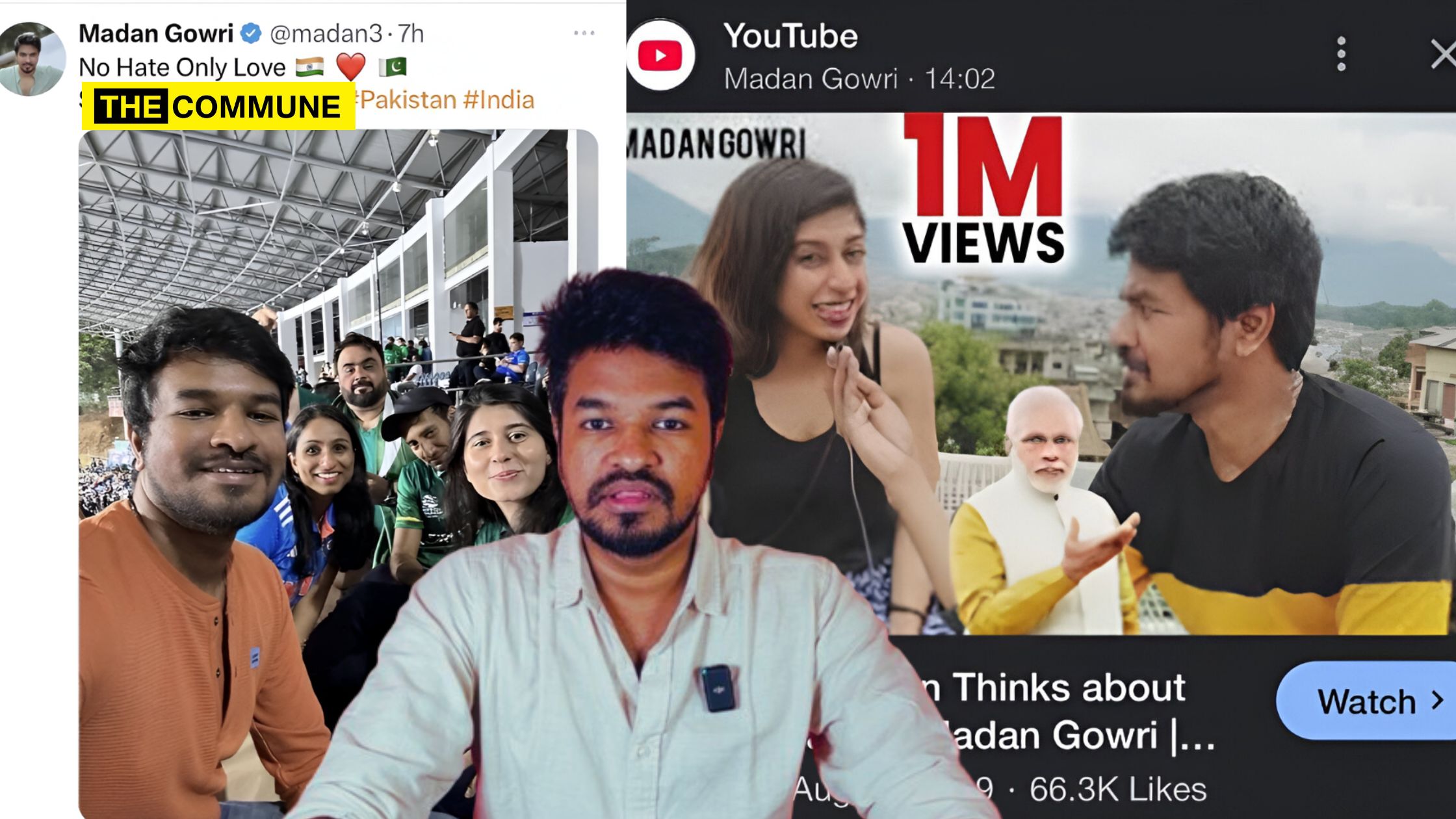
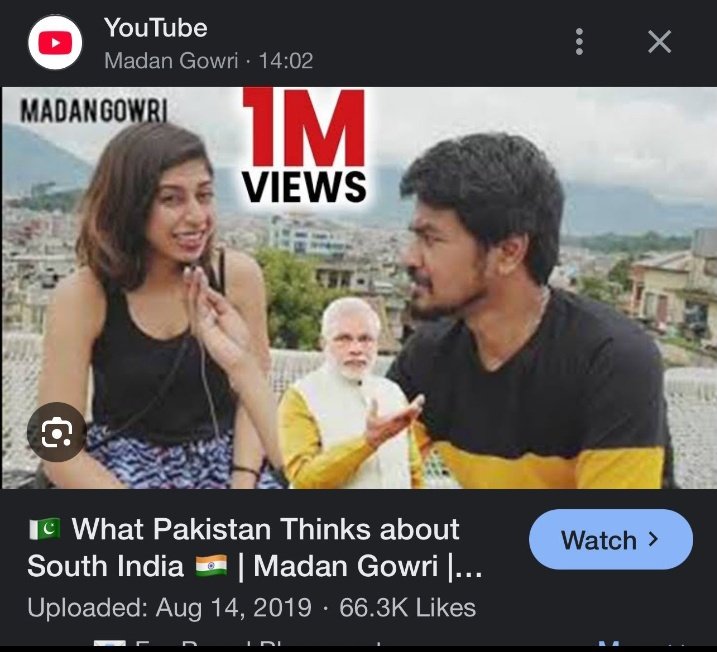
Meanwhile, another prominent content creator, Madan Gowri from Tamil Nadu, who has over 8 million subscribers on YouTube, has come under scrutiny with netizens that around six years ago, Gauri posted a video featuring a conversation with Pakistani citizens, aiming to highlight cross-border sentiments. He also shared posts on his X account stating that most Pakistani citizens admire India and are against hostility. He later released a YouTube video asking Pakistani people about their views on India.
In the current climate of heightened vigilance, some social media users have alleged that Madan Gowri, like Jyoti Malhotra, has Peddled pro-Pakistan propaganda through his social media channels. These allegations have led to growing demands online for an inquiry by the National Investigation Agency (NIA).
Furthermore, Gowri has been criticized for expressing biased opinions in issues related to the partition of India, with accusations that his content may encourage regional division between South and North India. These claims have fueled calls for legal action, with social media users urging authorities to investigate the matter thoroughly and even consider his arrest if necessary.
Madan Gowri Simping For Pakistan
Upon closer examination, it appears that Madan Gowri may have used misleading, clickbait titles for some of his YouTube videos suggesting he visited Pakistan, when in reality, he had only traveled to Nepal. However, the controversy surrounding him goes beyond just misleading content.
Critics have accused him of interacting with Pakistani male and female both from Karachi and promoting a sympathetic narrative towards Pakistani citizens, portraying them as friendly and peace-loving people.
In the same video, Madan Gowri asks the woman, “Are there Hindus in Pakistan?” to which she replies with a smile, “Yes, of course. I’ve met Hindus in Pakistan, studied with them, and hung out with them. They’re there.” He then asks, “So, there are temples in Pakistan?” and she responds, “There are temples though not as common as in India, but there are temples.” Madan Gowri follows up with another question: “So there are temples, they perform pooja, and do everything normally?” The woman answers, “Yeah, I mean yeah. I would hope so.” He then asks, “Are there temples in Karachi?” and she replies, “Yes. There is.” Based on this exchange, Madan Gowri appears to conclude implicitly that Hindus are safe in Pakistan and do not face persecution.
Madan Gowri then takes on the role of a peace advocate, promoting the narrative that ordinary Pakistani citizens desire peace, and that the real issues stem from governments and political agendas on both sides. However, he appears reluctant to acknowledge that Pakistan’s long-standing support for terrorism is a major obstacle to peace. Instead, he seems deeply fixated on the idea that Pakistanis are loving and peace-seeking people, often emphasizing that he shares those same sentiments.
In the video, Madan Gowri explains that he wanted to hear the opinions of ordinary Pakistani citizens on the ongoing issues between India and Pakistan — and he says he “loved” the response he received. One Pakistani woman responds “If it is between the civilians, or is it between governments and politicians? Because, I mean, you’re an Indian and I’m a Pakistani, and I don’t really feel any hatred toward you.” Madan Gowri interjects and says, “I don’t feel any hatred toward you too.” She continues, “I don’t think that’s (hate) there. Maybe there’s a sense of competition — may be cricket — that ignites the sense of patriotism, but besides that, I don’t see any reason for us to hate each other.”
In another part of the video, Madan Gowri interviews a Pakistani man who reflects on the time before the Partition of India. The man says, “We have been the same people throughout history. I feel that, for some xyz reasons, most people are not even aware of why they are fighting, but they are fighting nonetheless. I just hope that things become okay, and we can return to how we were before. When I listen to my grandmother’s stories, she tells me how her neighbors were her friends and describes her neighborhood.” Madan Gowri intervened and asked, “Are you talking about India and Pakistan before independence?” The Pakistani replied, “Yes, before partition, everyone lived like a family. My family has visited their old neighbors, and it feels like there is no difference. It’s all in our heads; we just need to stop it.” Madan Gowri responded, “Good, I hope that day comes when Pakistanis and Indians…” but the Pakistani interjected, “We are one strong region. I believe that everyone, both geographically and as people, shares a strong sense of community, family, and togetherness. Everyone around us feels a bit scared of us.” Madan Gowri concluded, “They can’t let the two countries come together.”
This portraying has drawn sharp criticism, especially in light of Pakistan’s own admission of past support for terrorism. In a recent interview with a British news outlet, Pakistan’s Defence Minister Khawaja Muhammad Asif acknowledged that the country had backed terrorist organizations for nearly three decades.
🚨 URBAN NAXAL MADAN GOWRI 🚨
5 வருடம் முன்பு பாகிஸ்தான் சென்று அங்கே இருக்கும் இந்துக்கள் Safe எனவும் தீவிரவாத தாக்குதல்களை Whitewash செய்த முதல் யூடியூபர் தான் இந்த கேடுகெட்ட @madan3.
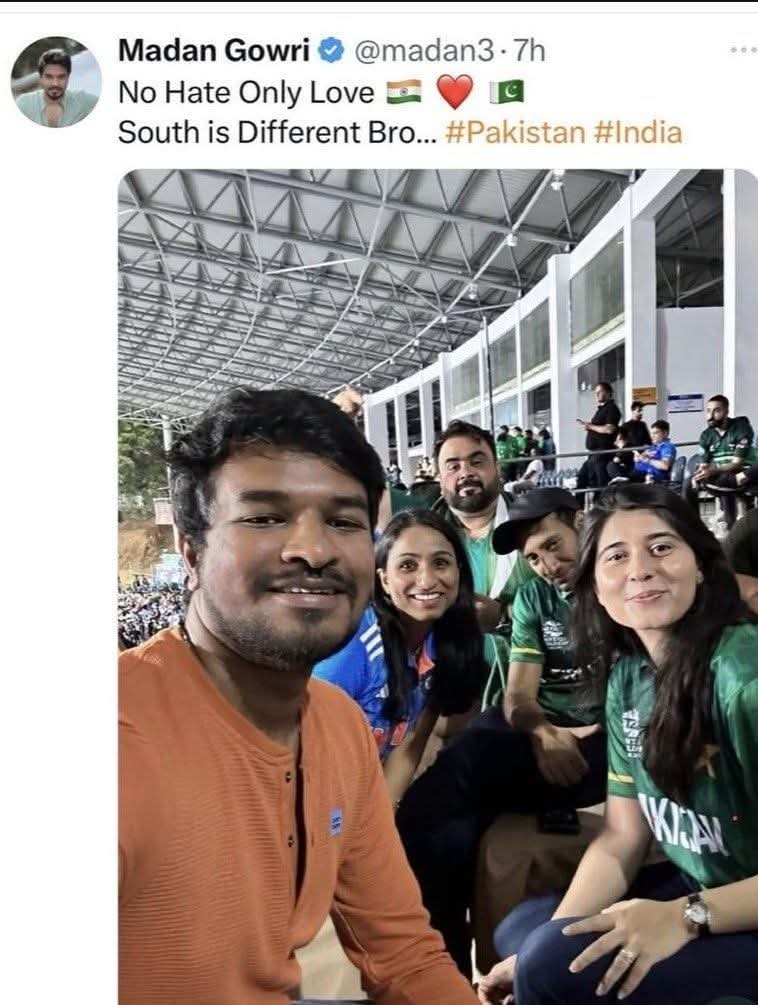
Madan Gowri Shares Selfie With Pakistani Cricket Fans
Adding to the controversy, another incident that drew criticism involved Madan Gowri posing for a photo with Pakistani cricket fans. In one of his older social media posts during ICC World Cup 2023, he wrote, “No hate, only love 🇮🇳❤️🇵🇰 South is different bro.. #Pakistan #India.” The post was seen by many as an attempt to stir up division between North and South India while also misleadingly implying that people from South India generally support Pakistan. The post, now being widely circulated online, was deemed by several users as tone-deaf and inappropriate, especially considering the ongoing tensions between India and Pakistan.
Madan Gowri’s 12-Minute Whitewash Of Pahalgam Hindu Massacre
In his Pahalgam video titled “PAHALGAM Issue EXPLAINED | Tamil | MG Squad”, Madan Gowri manages to talk for over 12 minutes about the murder of 28 civilians—without ever once naming the Islamic terrorist ideology behind the attack.
No mention of radical Islam. No mention of the Jihadist motive—despite survivors confirming the attackers asked people’s religion before opening fire. No mention of the terror organization that was behind the attacks, or its clear Pakistan-backed objective to “cleanse” Kashmir of non-Muslims. Not even the word “Muslim” or “Islamic” crosses his lips.
Instead, Gowri delivers a lecture on “unity” and “not dividing people”. That’s right: after an Islamist attack that explicitly targeted people based on their faith, he tells the victims not to be divided. That’s the equivalent of standing at the site of a lynching and telling the family of the dead to stay “calm and secular.”
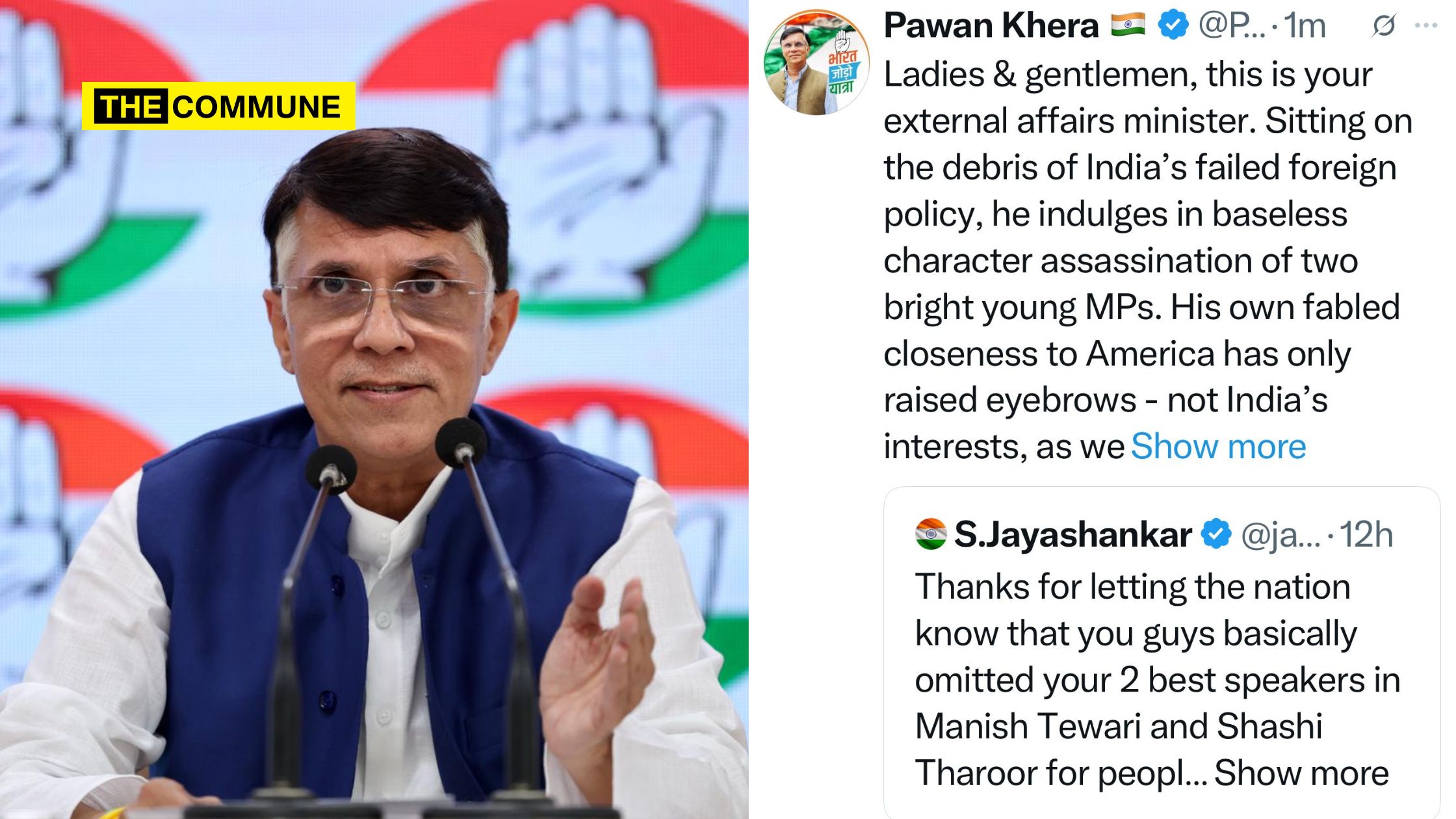
Congress leader and spokesperson Pawan Khera intended to criticize External Affairs Minister Dr. S. Jaishankar on social media platform X, but ended up targeting a BJP worker from Kerala—S. Jayashankar—mistaking him for the minister. The confusion came after Jayashankar criticized the Congress for the list of MPs it nominated to represent India in a diplomatic outreach programme countering Pakistan’s terrorism narrative.
On 17 May 2025, Congress General Secretary (Communications) Jairam Ramesh posted on X that, “Yesterday morning, the Minister of Parliamentary Affairs Kiren Rijiju spoke with the Congress President and the Leader of the Opposition in the Lok Sabha. The INC was asked to submit names of 4 MPs for the delegations to be sent abroad to explain India’s stance on terrorism from Pakistan. By noon yesterday May 16th, Leader of the Opposition in the Lok Sabha wrote to the Minister of Parliamentary Affairs giving the following names on behalf of the INC.
Shri Anand Sharma, former Union Cabinet Minister
Shri Gaurav Gogoi, Deputy Leader of Congress in Lok Sabha
Dr. Syed Naseer Hussain, Rajya Sabha MP
Shri Raja Brar, Lok Sabha MP”
Yesterday morning, the Minister of Parliamentary Affairs Kiren Rijiju spoke with the Congress President and the Leader of the Opposition in the Lok Sabha. The INC was asked to submit names of 4 MPs for the delegations to be sent abroad to explain India's stance on terrorism from…
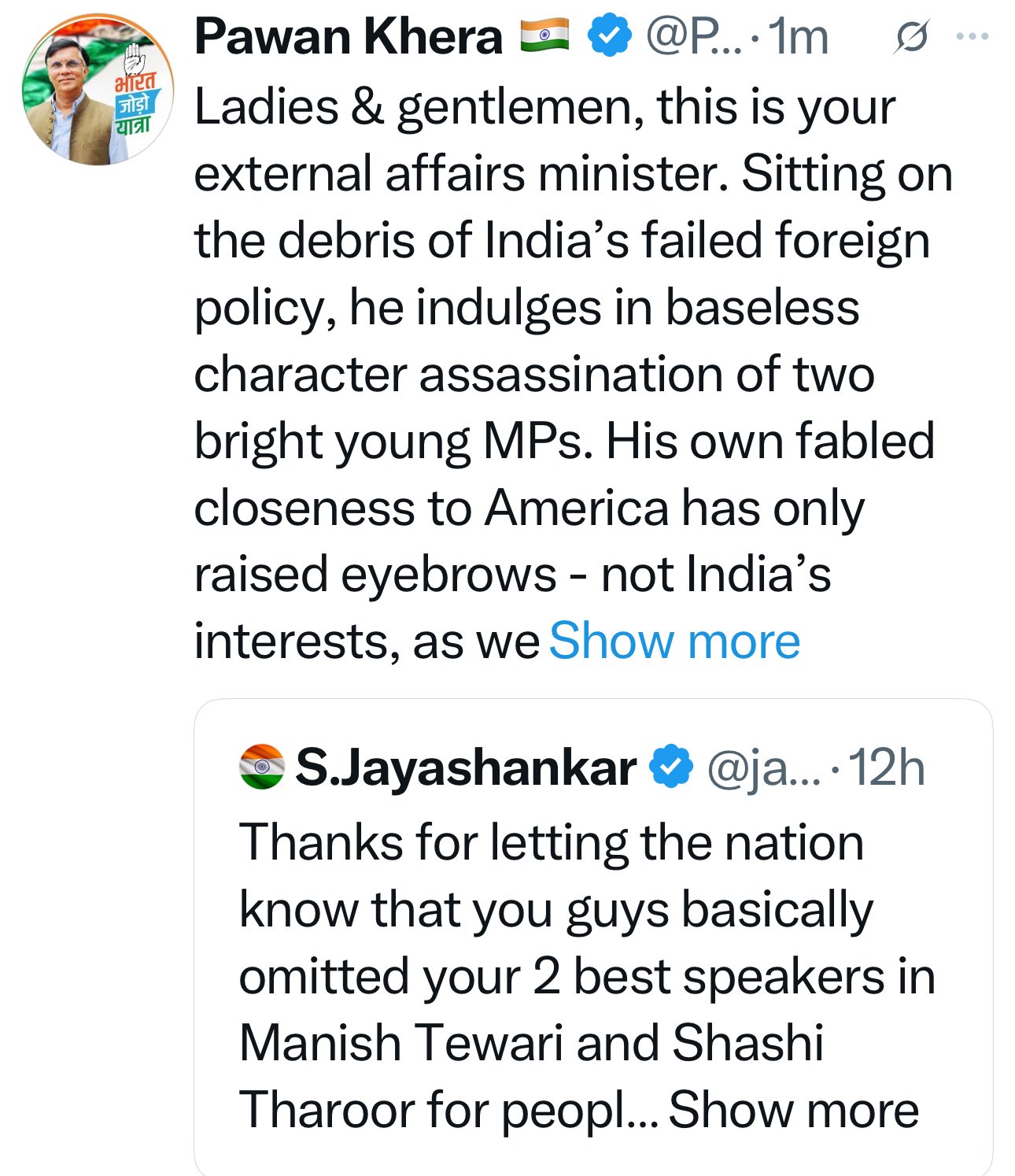
Soon after, BJP karyakarta S. Jayashankar responded with a scathing post, stating, “Thanks for letting the nation know that you guys basically omitted your 2 best speakers in Manish Tewari and Shashi Tharoor for people like Gaurav Gogoi who is known to have close ties with Pakistan and Syed Nassar Hussain whose victory resulted in “Pakistan Zindabad” slogans. Throughout the history, Congress has always favored Pakistan over India. Hence this list doesn’t come as a surprise.”
Thanks for letting the nation know that you guys basically omitted your 2 best speakers in Manish Tewari and Shashi Tharoor for people like Gaurav Gogoi who is known to have close ties with Pakistan and Syed Nassar Hussain whose victory resulted in "Pakistan Zindabad" slogans.… https://t.co/F4bR6fD524
However, the post was wrongly attributed to External Affairs Minister S. Jaishankar by Pawan Khera, who reacted with a blistering critique, “Ladies & gentlemen, this is your External Affairs Minister. Sitting on the debris of India’s failed foreign policy, he indulges in baseless character assassination of two bright young MPs. His own fabled closeness to America has only raised eyebrows—not India’s interests…”
Jayashankar, the BJP worker, hit back at the Congress leader in a now-deleted post with a mocking reply, “Dear @Pawankhera, The fact that you are not able to differentiate between a gray tick and blue tick shows how seriously we have to take your statements. And regarding your MPs, whatever I have stated is based on facts. So instead of indulging in character assassination it will be better if you can counter me on facts and also explain why your party prefers appeasement over merit.“
Dear @Pawankhera, The fact that you are not able to differentiate between a gray tick and blue tick shows how seriously we have to take your statements.
The entire episode triggered widespread ridicule on social media, with netizens mocking Khera for his blunder and highlighting the Congress party’s repeated social media missteps.
— Indhavaainko (இந்தாவாய்ங்கோ) 👊 (@indhavaainko) May 18, 2025
Ladies & gentlemen, this is Chairman of Media & Publicity Dept of @INCIndia, alleged Tapasvi @Pawankhera who doesn't know the handle of External Affairs Minister.
Oh dear @Pawankhera , This is the Pro Max of silly things you do. You are not even able to read properly & jumped to spew your usual venom.🤦🏽♂️ He is “Jai Shankar” I know it is difficult for u people to say, chant or read but that’s how u have to. pic.twitter.com/kxmWZxOpBj
Why did you delete this? You’re not able to differentiate between a grey tick and a blue tick and you expect people to take your party statements seriously? 😂 pic.twitter.com/Syou0cil0K
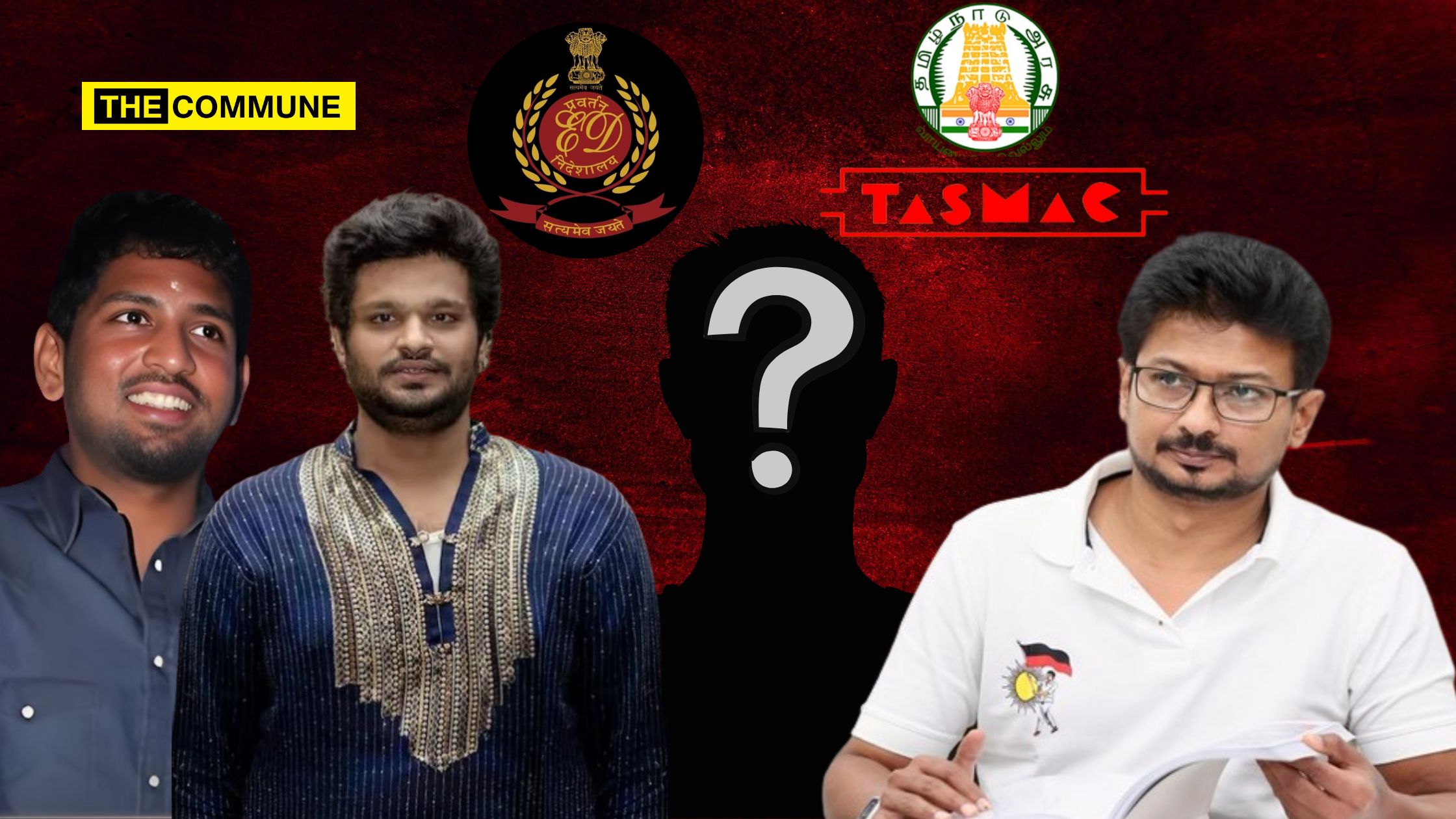
A major political bomb has been dropped on the ruling DMK in Tamil Nadu, following recent Enforcement Directorate (ED) raids linked to a ₹1,000 crore liquor scam involving the Tamil Nadu State Marketing Corporation (TASMAC). The probe has reportedly exposed a large-scale corruption network involving individuals allegedly connected to the DMK’s first family.
At the heart of the scandal are two individuals—Ratheesh and Aakash Bhaskaran—who are believed to have close ties to Deputy Chief Minister and DMK scion Udhayanidhi Stalin. Suspected WhatsApp conversations between Ratheesh and TASMAC Managing Director S. Visakan have raised serious questions about possible corruption and political influence in the functioning of the state-run liquor corporation.
Adding another layer to the controversy, a budding Kollywood film producer, who is reportedly related to the DMK’s first family and is working on a ₹400–₹500 crore film project featuring major stars, was also brought under the ED’s scanner. He was questioned over two days during the raids, further intensifying the political fallout from the ongoing investigation.
Who is Ratheesh?
Ratheesh, a longtime associate of Udhayanidhi Stalin, is reportedly considered a central figure in the DMK leader’s inner circle and is described by Enforcement Directorate (ED) sources as a behind-the-scenes power broker with significant influence.
During its months-long investigation into the alleged ₹1,000 crore TASMAC liquor scam, the ED reportedly discovered printed WhatsApp chat screenshots near the residence of the TASMAC Managing Director (MD) in Chennai. These communications appear to show Ratheesh issuing direct instructions to the MD.
The messages allegedly included detailed guidance on selecting liquor brands, such as ‘Erica Platinum XO Brandy French’ and ‘Erica VSOP Premium XO Brandy’, along with directives related to tender management processes. One particularly notable exchange involved Ratheesh sending the TASMAC MD a photo of the MD with Udhayanidhi Stalin, suggesting his deep access and authority within influential circles.
The revelations have sparked a political storm in Tamil Nadu, with the opposition AIADMK demanding answers. They referred to Ratheesh as “Who_Is_That_Brother?”—a nickname kept and called for the DMK leadership to clarify his role and connections in the alleged scam.
Meanwhile, Ratheesh has reportedly gone untraceable, with ED officials unable to locate him at his registered address in Chennai, adding to the mounting suspicions surrounding his involvement.
டாஸ்மாக் MD வீட்டின் அருகே கிழிந்த நிலையில் டாஸ்மாக் நிறுவனம் தொடர்பாக முக்கிய விவரங்கள் குறித்த வாட்சப் Chat Screenshots கிடைத்ததாகவும், இவை துணை முதல்வர் உதயநிதியின் நண்பர் ரத்தீஷிடம் பேசியது எனவும் செய்திகள் வருகின்றன.
— AIADMK – -SayYesToWomenSafety&AIADMK (@AIADMKOfficial) May 16, 2025
Who is Aakash Bhaskaran?
Much like Ratheesh, film producer Aakash Bhaskaran has also come under the radar of the Enforcement Directorate (ED). The young producer, who heads Dawn Pictures, is reportedly being scrutinized for simultaneously financing multiple big-budget films, with an estimated combined value between ₹400 and ₹550 crore.
A native of Tiruchirappalli (Trichy), Aakash comes from a business background—his father is the owner of a jewellery store. After completing his education, Aakash began his journey in the film industry by working as an assistant director under filmmaker Vignesh Shivan. It is noteworthy to mention that Vignesh Shivn had directed the Chess Olympiad promotional video featuring MK Stalin.
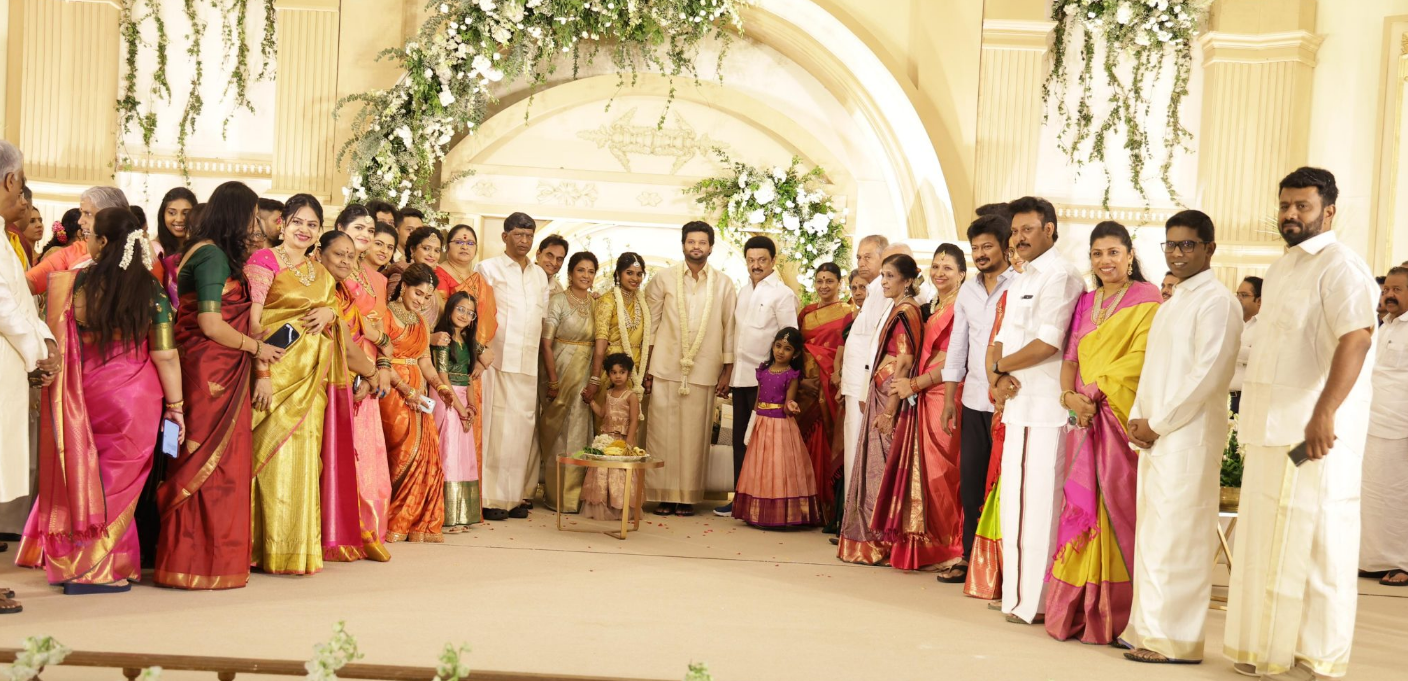
In 2024, Aakash Bhaskaran married Dharaneeswari, daughter of CK Ranganathan, the chairman and managing director of Cavinkare Pvt Ltd. Dharaneeswari’s mother, Thenmozhi, is the granddaughter of former Tamil Nadu Chief Minister and DMK patriarch M. Karunanidhi, linking Aakash to the powerful DMK political family. He is also said to have close ties with Tamil Nadu’s School Education Minister Anbil Mahesh Poyyamozhi.
His high-profile wedding in 2024 was attended by several notable figures from both the film industry and the DMK, including Cheif Minister MK Stalin, Deputy Chief Minister Udhayanidhi Stalin and Minister Anbil Mahesh Poyyamozhi.
Aakash has recently gained attention for producing high-value projects featuring leading Tamil stars such as Dhanush, Silambarasan TR, and Sivakarthikeyan, all under the Dawn Pictures banner. His rapid rise and simultaneous funding of several mega-budget films have raised questions that are now part of the ED’s ongoing investigation.
— AdmirerOfAnna – SayYesToWomenSafety&AIADMK (@Dilleepan) May 17, 2025
The ED’s probe has reportedly uncovered irregularities in TASMAC’s tendering processes, undeclared cash dealings, and a covert liquor trade allegedly worth ₹1,000 crore. Since the beginning of the year, the investigation has resulted in raids targeting TASMAC personnel, distilleries, and various corporate offices. In April, TASMAC MD S. Visakan and other top officials were summoned by the ED for questioning.
In response, the DMK has firmly rejected the allegations. Earlier this year, Minister V. Senthil Balaji stated that all TASMAC operations, including purchases and tenders, are conducted with full transparency. He accused opposition parties—including the BJP—of exaggerating the issue for political advantage.
The BJP has also taken a strong stance on the matter. Former state party chief K. Annamalai led a protest in March, during which several BJP leaders were detained by police.
TASMAC, which oversees the sale of liquor throughout Tamil Nadu, remains one of the state’s largest sources of revenue. However, it has frequently been a flashpoint in political debates, with both current and previous administrations facing accusations of using the organization to channel funds into electoral campaigns and party expenses.
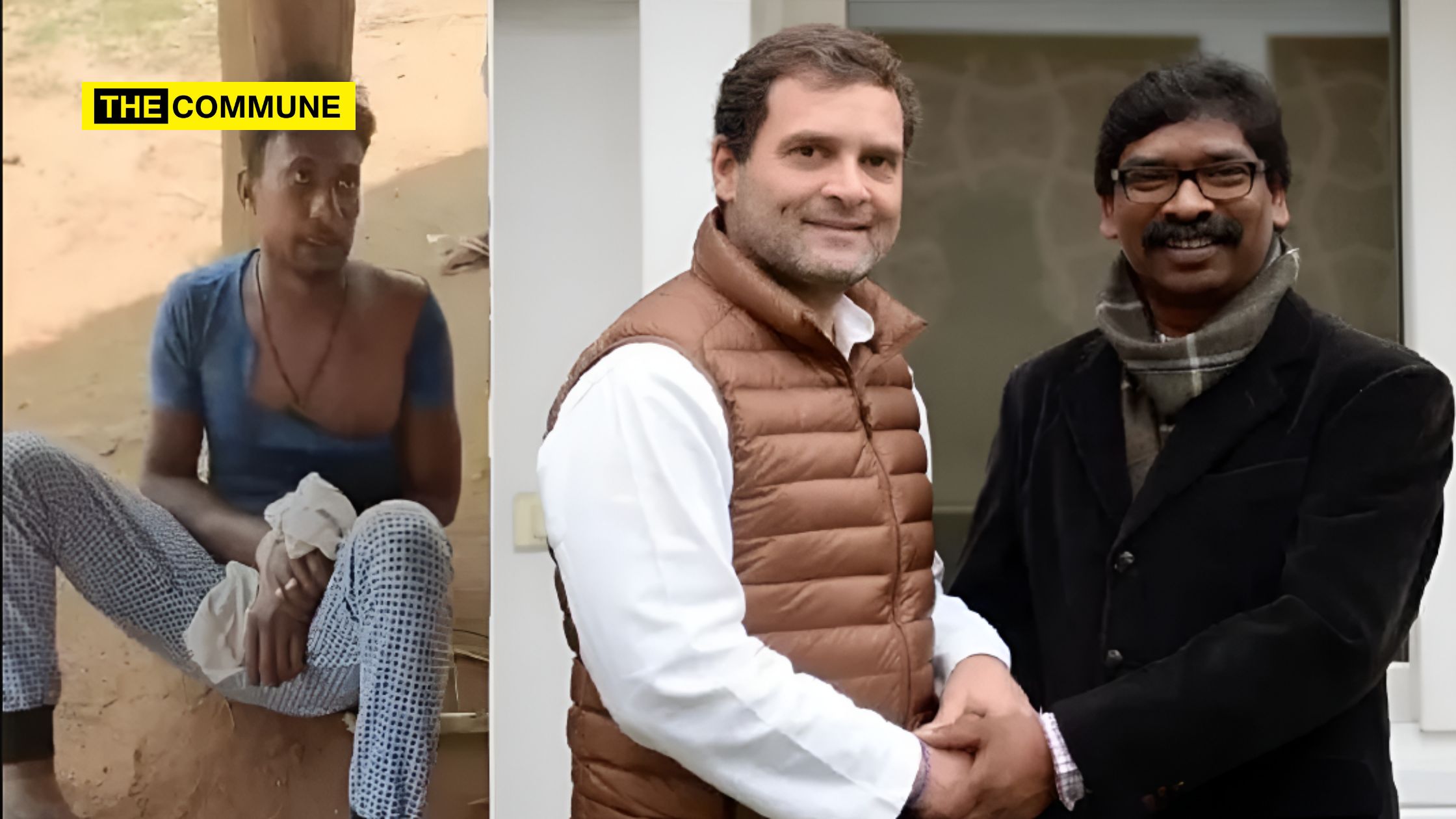
Congress leader Rahul Gandhi has announced financial assistance of ₹1 lakh for the family of Abdul Kalam, a 22-year-old construction worker who died after being allegedly beaten by villagers. Kalam was accused of sexually assaulting and attempting to rape a tribal woman while she was bathing. In addition, the Jharkhand government, led by Hemant Soren, pledged ₹4 lakh in compensation, a government job, and a house for his family.
The Siddiqui community also committed to providing ₹51,000 to Kalam’s family. State Health Minister and Congress MLA Irfan Ansari visited the victim’s residence and met with his mother, Rehana Khatoon, assuring her of continued support.
Incident Details
The incident reportedly occurred on 8 May in Kadrukhutta village, located in the Penk Narayanpur police station jurisdiction of Bokaro district. According to the First Information Report (FIR), Kalam allegedly approached the wife of a local resident, Mahavir Murmu, while she was bathing in a pond. He allegedly assaulted her from behind, touched her inappropriately, and attempted to rape her. The woman reportedly resisted, bit his hand, and screamed for help. Her cries alerted nearby villagers, who intervened and caught Kalam as he attempted to flee. He was allegedly tied to a pole and assaulted by the locals before the police arrived.
According to an FIR filed by Kalam’s uncle, Abdul was injured during the mob attack and later declared dead at Bokaro Thermal Hospital. His family claimed he was mentally unwell and under medical care. They argued that if he had committed a crime, legal proceedings should have been followed instead of vigilante justice. Four individuals—Rupan Manjhi, Baharam Manjhi, Sukhlal Manjhi, and Baleshwar Hansda—have been arrested in connection with the incident.
Bermo Sub-Divisional Magistrate Mukesh Machhua confirmed the state’s promise to provide ₹4 lakh, a government job, and a house to Kalam’s family. However, the family has reportedly declined the compensation, insisting on justice instead.
The incident has sparked divided reactions online. Some users criticized the Congress leadership and the state government for offering support to a man accused of a grave crime, labeling it an inappropriate use of public funds. Others expressed sympathy for Kalam, claiming he was mentally ill or targeted because of his religious background. Some labeled the incident a case of mob lynching, while others underscored the severity of the sexual assault allegations.
तबरेज़ अंसारी के तरह फिर एक बेटा मॉब लिंचिंग का शिकार हो गया।
झारखंड: बोकारो जिला के नावाडीह अंचल अंतर्गत नारायणपुर में मो. अब्दुल कलाम जो सेंटरिंग का काम करके अपनी बूढ़ी मां का सहारा बना हुआ था, उसे भीड़ ने बेरहमी से पीट-पीट कर मार डाला। 1/4#MobLynching#JusticeForAbdulKalampic.twitter.com/3rMMjaCkgp
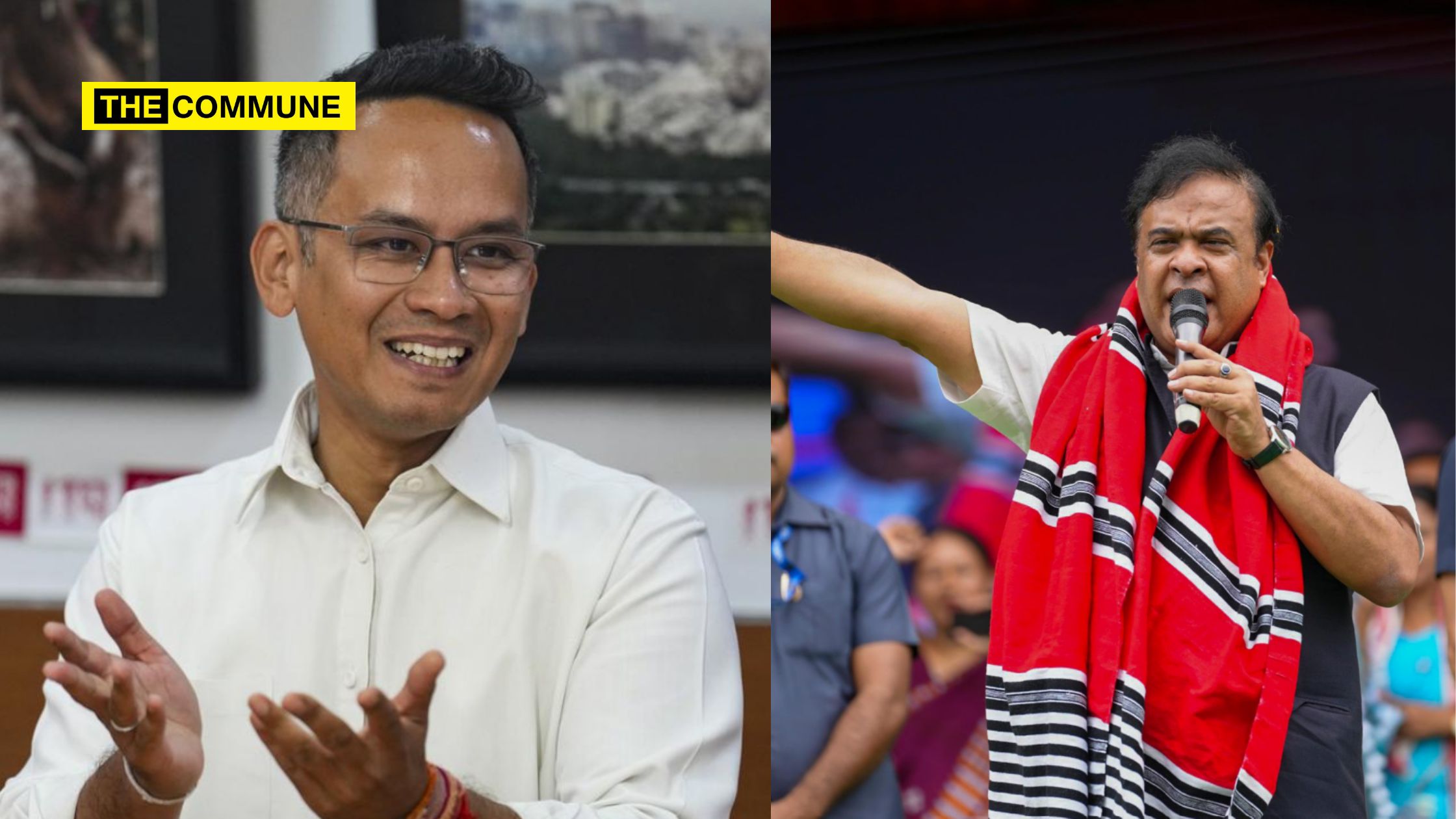
Assam Chief Minister Himanta Biswa Sarma has leveled serious allegations against Congress MP Gaurav Gogoi, claiming that the parliamentarian had traveled to Pakistan at the invitation of the country’s intelligence agency, the Inter-Services Intelligence (ISI). According to Sarma, Gogoi’s visit was for “training purposes,” and he asserted, “We have documentary proof of this.”
The Chief Minister elaborated further, stating, “Gaurav Gogoi had gone to Pakistan on invitation of ISI. For the first time, I want to say that he went to Pakistan at the invitation of ISI. We have that document. He went there to receive training. Gaurav Gogoi went there after receiving the letter from the Pakistan Home Department. He went there following the invitation of the Pakistan government. Not External Affairs, Cultural Ministry, he went there at the invitation of the Pakistan Home Department. It is a serious matter…more considerable action will be taken.”
श्री गौरव गोगोई ISI के निमंत्रण पर पाकिस्तान गए थे, और लौटकर Rafale की ख़रीद का भी विरोध किया था।
अगर मेरा एक भी शब्द ग़लत साबित हो जाए, तो मैं मुख्यमंत्री पद से इस्तीफा दे दूंगा। pic.twitter.com/fPyHeOjcaD
— Himanta Biswa Sarma (@himantabiswa) May 18, 2025
In light of his accusations, CM Sarma has urged Congress leader Rahul Gandhi to reconsider including Gaurav Gogoi in the list of four opposition MPs nominated for international outreach delegations aimed at explaining India’s stance on terrorism.
The Chief Minister further alleged that the MP from Assam, without directly naming Gogoi, had spent an extended period—reportedly two weeks—in Pakistan. He also claimed that credible evidence shows Gogoi’s wife was receiving a salary from a Pakistan-based NGO while employed in India.
He said, “One of the MPs named in the list ( from Assam ) has not denied his prolonged stay in Pakistan–reportedly for two weeks–and credible documents show that his wife was drawing salary from a Pakistan-based NGO while working in India.”
Sarma reposted the list, originally shared by Congress leader Jairam Ramesh on social media platform X, and warned against including Gogoi “In the interest of national security and beyond partisan politics, I urge leader of opposition Rahul Gandhi not to include this individual in such a sensitive and strategic assignment.”
The Hindu’ has long been recognized as an anti-Bharat media outlet. Both the publication and its journalists have repeatedly come under fire for publishing content that is not only openly hostile to India but also alarmingly aligned with China’s strategic interests. Over the years, the newspaper has solidified its reputation as a consistent mouthpiece for narratives that undermine India’s sovereignty, national security, and internal stability. Whether it’s border tensions, defense matters, or domestic policies, ‘The Hindu’ has habitually echoed adversarial positions—often mirroring China’s geopolitical agenda.
What makes this more dangerous is the blind and enthusiastic backing the paper receives from India’s liberal-left ecosystem. Despite clear evidence of its anti-national slant, this ideological cabal continues to defend and legitimize ‘The Hindu,’ enabling it to carry out its divisive agenda unchecked. Their uncritical support has only emboldened the newspaper to intensify its campaign against India’s national interest.
To expose this agenda, a comprehensive report has been compiled, highlighting 32 documented instances where ‘The Hindu’ has either directly supported China’s position or published content that attacks India’s armed forces, democratic institutions, and sovereignty. These cases offer undeniable proof of a deliberate, sustained effort to mislead the public and weaken the nation from within.
#1 The Hindu Publishes Distorted India Map Omitting Sikkim, Faces Backlash, Issues Apology Later
In a glaring and controversial oversight, The Hindupublished a map of India that completely omitted the state of Sikkim in its 13 May 2025 edition. The map accompanied an article titled “With a New Pope, an Understanding of Catholicism in India” and appeared in the newspaper’s Data Point section. The state’s boundaries were missing, effectively erasing Sikkim from the national map.
Following a wave of public backlash and criticism over this “grave error,” The Hindu issued an official apology the next day, on 14 May 2025. The editorial team acknowledged the mistake and attempted to downplay the incident as a technical glitch. Their corrigendum read, “Due to a data input error, the India map in the article, ‘With a New Pope, an Understanding of Catholicism in India’, which appeared in the Data Point section on May 13, 2025, was incorrectly presented with the contours of Sikkim State being shaded out. We apologise for the error. The map and the references have been removed from the story online and corrected in our e-paper editions.” — The Editor.
Due to a data input error, the India map in the article, “With a new Pope, an understanding of Catholicism in India”, which appeared in the Data Point section on May 13, 2025, was incorrectly presented with the contours of Sikkim State being shaded out. We apologise for the…
Despite the correction, the incident added to growing concerns about The Hindu’s editorial integrity and its recurring tendency to mishandle sensitive national subjects, reinforcing its image as a publication pushing questionable narratives under the guise of journalism.
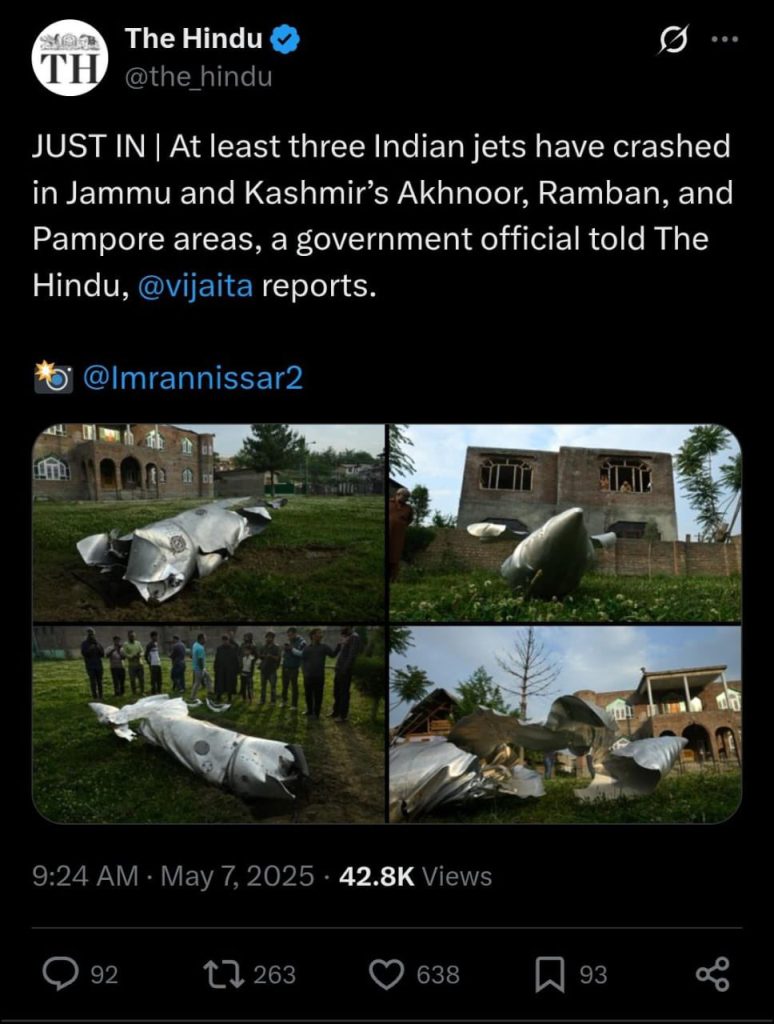
#2 The Hindu Spreads False Report on Crash of Three Indian Fighter Jets
On 7 May 2025, The Hindu published a misleading report falsely claiming that three Indian Air Force aircraft had crashed in different parts of Jammu and Kashmir — specifically in Akhnoor, Ramban, and Pampore. The report included photographs to support the claim, suggesting that the debris belonged to downed jets.
However, the images used by The Hindu were later revealed to be misleading — the so-called “crashed jets” were actually external fuel tanks, not aircraft wreckage. The publication failed to verify basic facts before running the story, leading to widespread confusion and panic.
Once the false claim was exposed, The Hindu quietly deleted the article from its platform and issued a weak clarification, merely expressing “regret” for the confusion caused.
We have deleted an earlier post about Indian aircraft involved in Operation Sindoor. There is no such on-record official information from India. We therefore decided to remove the post from our platforms. We regret that it created confusion among our readers.
This incident further solidified The Hindu’s growing reputation as a purveyor of unchecked and irresponsible journalism — a media house increasingly accused of spreading misinformation, especially when it involves India’s defense and security matters.
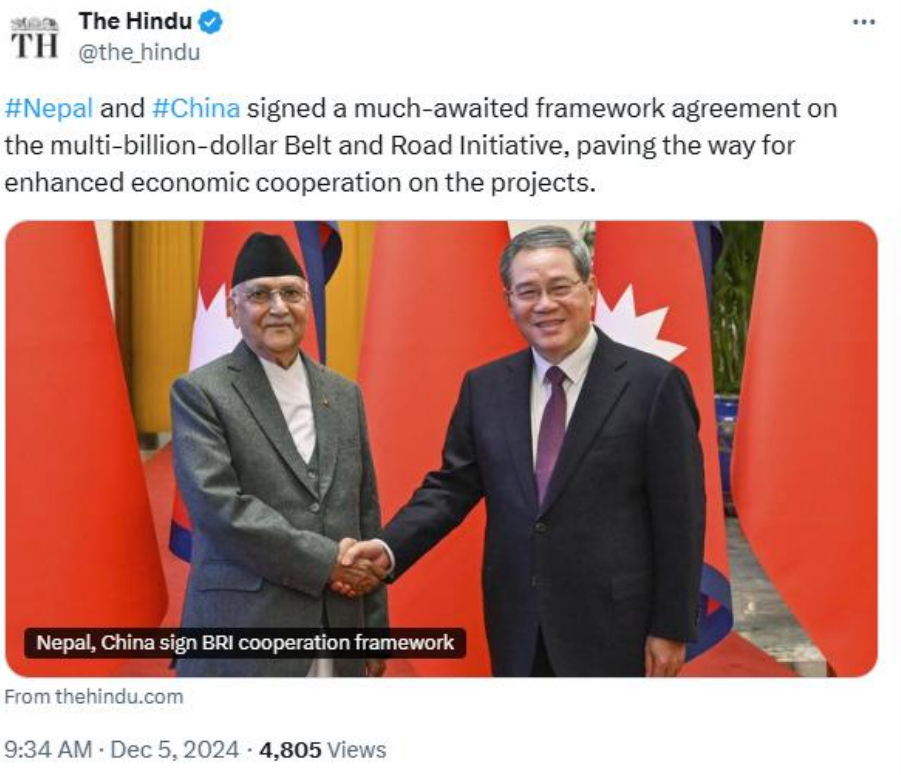
#3 Hindu Echoes Chinese Talking Points on BRI Deal with Nepal
On 4 December 2024, The Hindu published an article that openly praised China’s Belt and Road Initiative (BRI) following the signing of a cooperation framework between Nepal and China. Instead of offering a critical or balanced perspective, the piece amplified pro-China narratives, portraying the BRI as a game-changing opportunity for Nepal’s economic development.
The article highlighted supposed benefits of the BRI, including improved infrastructure and regional connectivity, while praising China’s influence in Nepal—particularly under the leadership of former Prime Minister KP Sharma Oli, known for his Beijing-friendly stance. It even echoed the Chinese propaganda line that BRI could help transform Nepal from a “landlocked” to a “land-linked” nation.
By uncritically promoting China’s strategic initiative—which many countries and experts have criticized as a debt-trap diplomacy tool—The Hindu once again demonstrated its inclination to align with China’s geopolitical agenda, further fueling concerns about its editorial loyalties and its role in shaping public opinion in favor of foreign interests.
#4 The Hindu Echoes Beijing’s Narrative on U.S. Sanctions Against China’s Chip Industry
On 3 December 2024, The Hindu published a report covering new U.S. sanctions targeting China’s semiconductor sector. Rather than providing a balanced analysis, the article leaned heavily in favor of China’s narrative, portraying Beijing as a resilient and technologically advancing nation unfairly targeted by Washington.
The report downplayed the strategic and security rationale behind the U.S. restrictions and instead framed American actions as unjustified aggression, painting China as a victim. The Hindu’s coverage praised China’s progress in chip technology and positioned it as bravely resisting Western pressure.
This framing is yet another example of The Hindu’s increasingly pro-China editorial stance, where it amplifies Chinese state talking points and casts suspicion on democratic nations, especially when their policies challenge Beijing’s expansionist or technological ambitions.
#5 The Hindu Glorifies Chinese Military Power After Warship Display in Hong Kong
On 21 November 2024, China showcased its growing naval strength by docking its advanced amphibious assault ship Hainan in Hong Kong—a move widely interpreted as a demonstration of Beijing’s military assertiveness and strategic signaling.
Rather than offering a critical or balanced view, The Hindu, in its article published the next day, amplified Chinese propaganda, framing the warship’s presence not as a threat, but as a justified act of self-defense. The report portrayed China’s military buildup as a necessary response to regional instability, downplaying concerns about Chinese aggression and expansionism.
By endorsing Beijing’s narrative and portraying its rising military power in a positive light, The Hindu once again aligned itself with China’s strategic messaging—defending the CCP’s militarization efforts under the pretense of maintaining “sovereignty” and “regional balance.” This coverage further cements The Hindu’s image as a publication sympathetic to foreign authoritarian interests over India’s strategic concerns.
#6 The Hindu Undermines India While Applauding China’s Healthcare System
On 18 November 2024, The Hindu published an article on India’s diabetes crisis that appeared to downplay India’s efforts while glorifying China’s healthcare model. Instead of focusing on India’s challenges and strategies, the piece leaned heavily toward praising China, presenting its healthcare response as a superior example.
The article suggested that China’s initiatives—such as improving healthcare access, curbing tobacco use, and increasing public awareness—were worth emulating, positioning Beijing as a global role model in diabetes control. It implied that India, in contrast, was lagging and struggling to meet the World Health Organization’s 2030 targets.
Once again, The Hindu chose to highlight China’s strengths while casting India in a negative light, subtly promoting the narrative that India should follow China’s lead—even in public health. This editorial choice reflects a pattern of undermining India’s achievements by constantly projecting China as the more competent and capable nation, thereby reinforcing the paper’s growing reputation as sympathetic to foreign agendas over national pride.
#7 The Hindu Promotes Nepal-China Alignment While Undermining India
In its 14 November 2024 coverage of Nepal Prime Minister K.P. Sharma Oli’s visit to China—his first foreign trip since taking office—The Hindu subtly endorsed Kathmandu’s growing proximity to Beijing, while downplaying India’s role in regional diplomacy.
The article emphasized Nepal’s request for a loan waiver from China for the Pokhara International Airport and drew attention to the stalled airspace negotiations with India, framing the narrative in a way that appeared sympathetic to Nepal’s pivot toward China.
#8 The Hindu Portrays India’s Foreign Policy as Weak Over U.S. Sanctions
In its 1 November 2024 article on the U.S. sanctions imposed on Indian entities for alleged links to Russia, The Hindu used the situation to implicitly criticize India’s foreign policy stance, portraying it as passive and ineffective.
The report emphasized India’s “silence” following the sanctions—despite being one of the most affected countries—as a sign of diplomatic weakness. Instead of contextualizing India’s strategic balancing between global powers, The Hindu framed the lack of a public response as a failure in asserting national interest on the global stage.
The article focused heavily on the U.S. Treasury Department’s decision to sanction nearly 400 entities, including several from India, over accusations of supplying “dual-use” technology to Russia. Yet, rather than analyzing the broader geopolitical landscape, The Hindu used the development to subtly question the Indian government’s foreign policy priorities, reinforcing a narrative that undermines India’s global diplomacy while aligning with Western criticisms.
#9 The Hindu Applauds China’s New Information Warfare Force
In its 19 April 2024 report, The Hinducommended China’s strategic move to establish a powerful new Information Support Force under President Xi Jinping, portraying it as a visionary step in modernizing China’s military infrastructure.
Rather than examining the potential global risks or regional threats posed by this expansion of China’s information warfare capabilities, the article framed the development in a positive, almost admiring tone, emphasizing the force’s role in supporting “military struggles” across all domains—cyber, space, land, sea, and air.
#10 The Hindu Portrays China’s Military Outreach in South Asia as Harmless Cooperation
In its 13 March 2024 article, The Hindu reported on a Chinese military delegation’s visits to Maldives, Sri Lanka, and Nepal, presenting the development as a benign push for regional stability and cooperation—rather than a calculated expansion of Beijing’s strategic influence in South Asia.
The article emphasized China’s “military assistance” agreement with the Maldives, framing it as part of a cooperative vision under President Mohamed Muizzu, who has openly aligned with Beijing. It also highlighted China’s defense ties with Sri Lanka and Nepal, portraying the strengthening of military relationships as positive bilateral progress.
Rather than scrutinizing the geopolitical and security risks of China’s deepening military presence in India’s immediate neighborhood, The Hindu cast these developments in a favorable light—further reinforcing its pattern of echoing Chinese strategic narratives while downplaying their consequences for India’s regional security and influence.
#11 Chinese Ambassador’s Visit to ‘The Hindu’ Headquarters Raises Eyebrows
On 1 June 2022, during a two-day trip to Tamil Nadu, Chinese Ambassador to India Sun Weidong paid a visit to the headquarters of the left-leaning English daily The Hindu. During his visit, he held a private meeting with Editor Suresh Nambath and engaged with other senior editorial staff.
Visited the headquarters of @the_hindu. Face-to-face communication leads to mutual understanding and trust. Welcome you all to explore and know more about a real, objective and 3-dimensional China. pic.twitter.com/MpJ3hWLYF3
The visit, which appeared more than just a courtesy call, raised serious questions about The Hindu’s proximity to Beijing. Given the publication’s editorial slant and its history of favorable coverage of Chinese interests, this interaction was widely seen as a reflection of the newspaper’s deep ideological and strategic alignment with China.
#12 The Hindu Echoes China’s Narrative on Galwan Clash
In its coverage of the deadly Galwan Valley clash, where 20 Indian soldiers were martyred in a brutal confrontation with Chinese troops, The Hindu appeared to amplify Beijing’s version of events rather than India’s official stance.
The article gave prominence to statements issued by the Chinese People’s Liberation Army (PLA) and the Chinese Ministry of Foreign Affairs (MFA), which accused India of breaching prior agreements and provoking the skirmish. It went so far as to reiterate China’s claim that “the sovereignty of the Galwan Valley has always belonged to China”—a position that India categorically denies.
Instead of fairly presenting India’s viewpoint or underlining the loss suffered by Indian forces, The Hindu seemed to minimize India’s position by focusing heavily on China’s diplomatic protests and its portrayal of the incident as a defensive response. This coverage reflected a pattern of favoring adversarial narratives over national interest, even in matters of national security and territorial integrity.
#13 The Hindu Sides with Beijing in Coverage of Galwan Valley Clash
Following the violent Galwan Valley clash on June 15, 2021, The Hindu published an article centered on the diplomatic fallout between India and China. Instead of presenting a balanced narrative, the report gave prominent attention to China’s official protest, in which Beijing accused Indian soldiers of crossing the Line of Actual Control (LAC) to carry out “illegal activities”, allegedly provoking the confrontation.
The article primarily reflected China’s version of events, portraying Indian actions as the trigger for the incident. This coverage echoed Beijing’s stance, framing the border clash as a reaction to Indian provocation, while downplaying India’s legitimate territorial concerns and the loss of its soldiers.
Such selective reporting again underscored The Hindu’s tendency to amplify Chinese perspectives on critical national security issues—at the cost of India’s own narrative and interests.
#14 The Hindu Echoes China’s Denial of LAC Violations in Ladakh
In its coverage of the ongoing tensions along the Line of Actual Control (LAC) in Ladakh, The Hindu published a report that prominently amplified China’s official stance, downplaying Indian concerns over border intrusions.
The article focused on China’s rebuttal of allegations that its troops had crossed into Indian territory to obstruct an irrigation project. Instead, it highlighted Beijing’s claims that its military personnel were operating strictly within Chinese territory and reiterated their position that no side should attempt to alter the status quo unilaterally.
Rather than critically assessing these claims or reflecting India’s perspective, the piece appeared to endorse China’s narrative, portraying it as a responsible actor advocating for peace—despite repeated instances of aggression on the ground. Once again, The Hindu’s coverage leaned toward normalizing China’s rhetoric in a sensitive national security context.
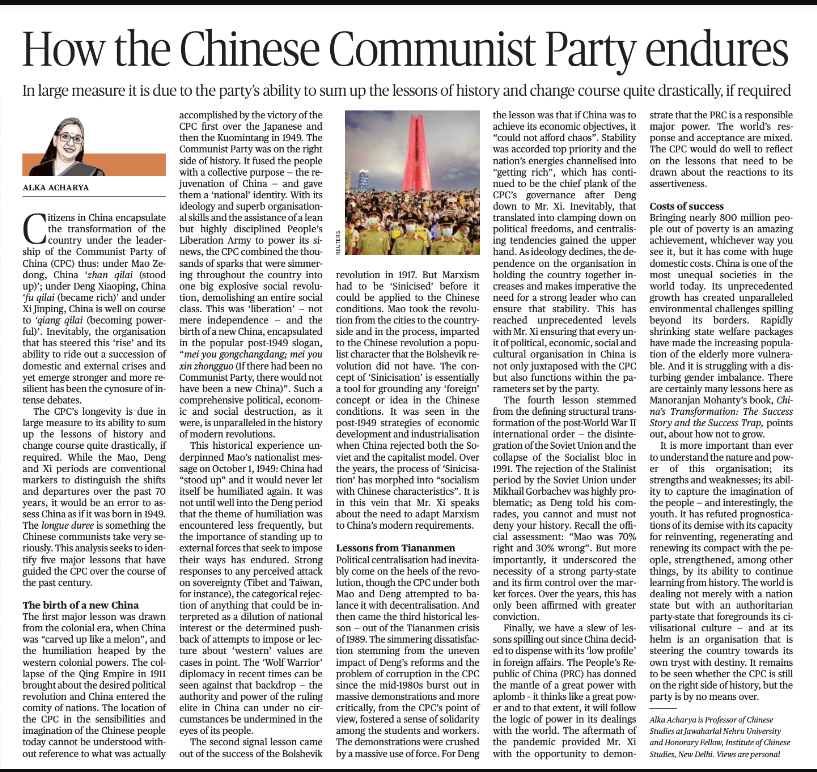
#15 The Hindu Glorifies Communist China on CPC’s 100th Anniversary
On the centenary of the Communist Party of China (CPC), The Hindu, a known left-leaning outlet, published a piece that read more like praise for Beijing’s authoritarian regime than objective journalism.
The article, authored by Alka Acharya, a professor of Chinese Studies at JNU and often presented as a “China expert,” lauded the CPC under Xi Jinping, describing it as Qiang Qilai—a “rising power.” She credited the Party for effectively overcoming internal and external challenges and positioning China as a global force to reckon with.
In the piece, Acharya celebrated the CPC’s role in shedding China’s so-called “colonial mindset” and promoted the narrative of a ‘resurgent China’ ready to challenge global powers—a vision tightly aligned with Beijing’s propaganda.
That The Hindu chose to publish such a glowing endorsement of China’s totalitarian regime on a landmark occasion for the CPC raises serious concerns about the outlet’s editorial leanings and its willingness to amplify Chinese state narratives.
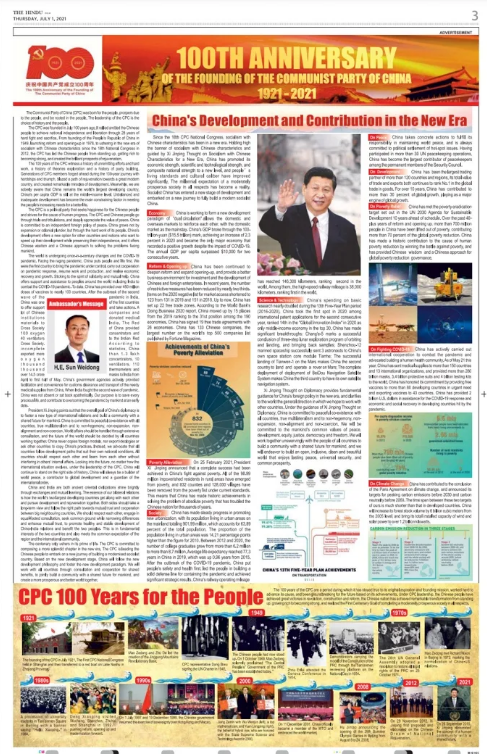
#16 The Hindu Runs Full-Page Chinese Advertorial Celebrating 100 Years of Communist Rule
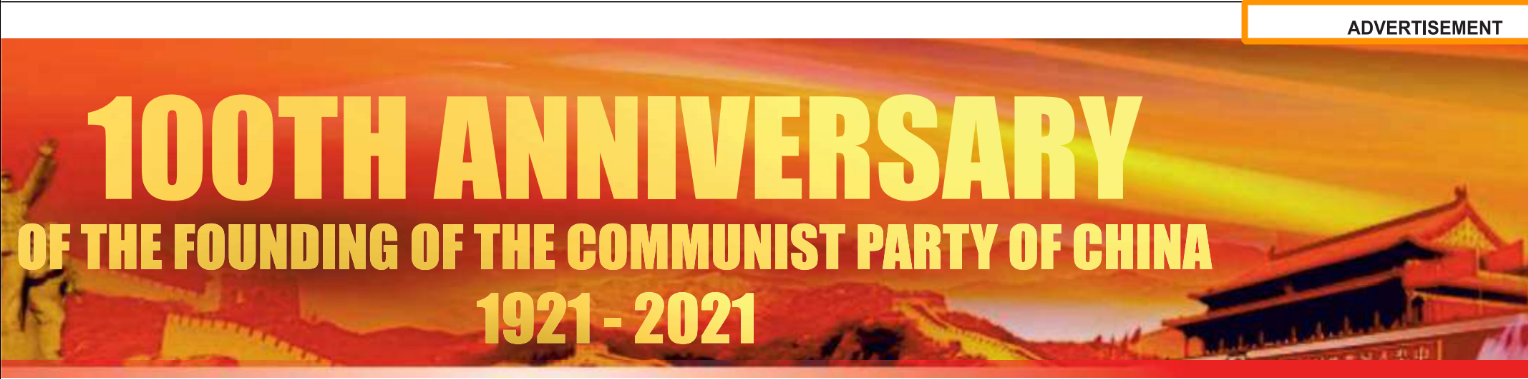
On 1 July 2021, The Hindu published what can only be described as a glaring example of soft propaganda—a full-page advertorial paid for by the Chinese government, marking the 100th anniversary of the Communist Party of China (CPC).
This sponsored content appeared on Page 3 of the newspaper, blending seamlessly with regular editorial content, making it difficult for casual readers to recognize it as a paid promotion. However, a closer look revealed that it was clearly planted by Chinese interests, designed to celebrate the CPC’s rise and present it in a flattering light.
Adding to this coordinated media push, The Hindu also released a podcast discussing the CPC’s achievements, growth, and global influence—further amplifying China’s narrative through a platform widely seen as sympathetic to left-wing ideologies.
By offering its space and credibility to Beijing’s state-funded propaganda, The Hindu raised serious ethical concerns about its editorial independence and willingness to serve foreign influence under the guise of journalism.
#17 The Hindu Glorifies China’s Political Evolution Under the Communist Regime
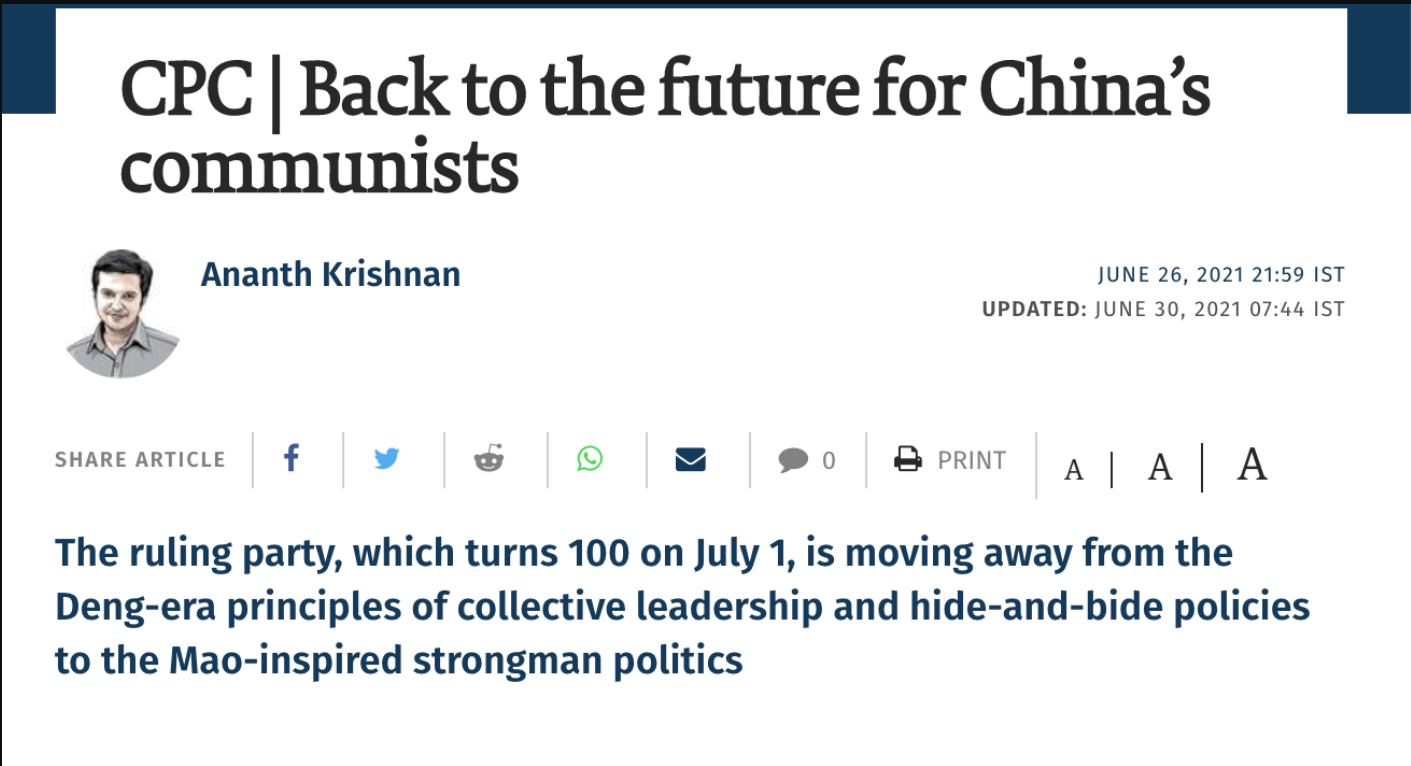
On 26 June 2021, The Hindu published an article titled “CPCBack to the Future for China’s Communists,” authored by Ananth Krishnan. The piece paints a glowing narrative of the Communist Party of China (CPC), portraying its political transformation as a sign of strength and adaptability.
The article highlighted how the CPC has shifted from the era of collective leadership under Deng Xiaoping to a centralized, authoritarian model under Xi Jinping, which the piece describes as a revival of Mao-style strongman rule. Rather than critiquing this consolidation of power, the article frames it as a natural and effective evolution of China’s political structure.
In simple terms, the article attempts to legitimize the CPC’s increasingly autocratic governance, presenting its journey from 1921 to the present as a model of resilience and strategic leadership—downplaying the lack of political freedom, human rights concerns, and international criticism surrounding China’s regime under Xi.
Once again, The Hindu appears to champion Beijing’s narrative, raising questions about its editorial intentions and alignment with Chinese interests.
#18 The Hindu Echoes China’s Narrative on LAC Tensions; Blames India
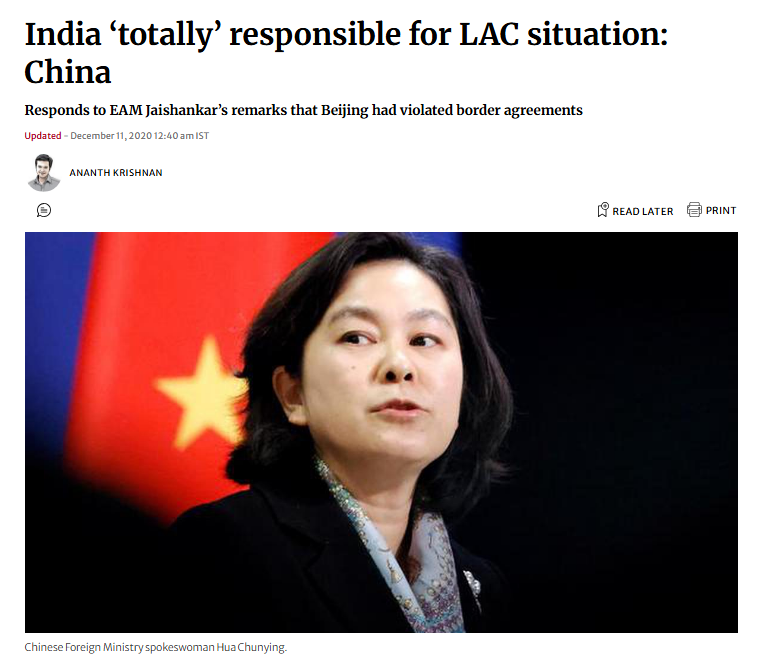
In an article published on 11 December 2020, The Hindu took a stance that seemed to closely mirror China’s official narrative regarding the ongoing border disputes between India and China. The piece prominently featured China’s Foreign Ministry spokesperson Hua Chunying, who asserted that India was solely responsible for the situation along the Line of Actual Control (LAC).
The article portrayed China’s position as advocating for a diplomatic solution to the standoff, with Hua Chunying emphasizing Beijing’s commitment to regional peace and stability. This stance was presented alongside India’s External Affairs Minister S. Jaishankar’s assertions that China had breached previous border agreements, particularly by deploying large military forces along the LAC.
By highlighting China’s perspective and framing India’s response in contrast, The Hindu appeared to amplify China’s narrative, subtly aligning with Beijing’s position in the ongoing border conflict.
#19 The Hindu Profits from Chinese Propaganda
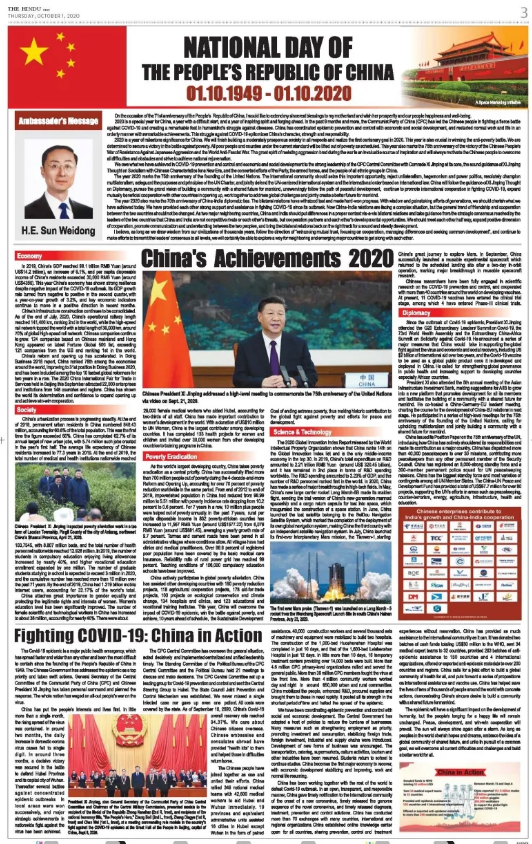
On 1 October 2020, The Hindu published a full-page advertorial sponsored by China to mark the occasion of China’s National Day. This paid content appeared on the third page of the newspaper. In a bid to make profits and promote Chinese Communist propaganda, The Hindu disregarded the sacrifices made by Indian soldiers, opting to publish the advertorial without any apparent hesitation.
Interestingly, while the advertorial was prominently featured in the print edition, it was notably absent from The Hindu’s digital platform, suggesting a selective approach to the content’s distribution.
#20 The Hindu Voices for China’s Defence Minister Claims
On 5 September 2020, The Hindu published an article that closely mirrored Chinese state rhetoric, quoting China’s Defence Minister, General Wei Fenghe. During a meeting with India’s Defence Minister, Rajnath Singh, in Moscow, General Wei firmly stated that India was entirely to blame for the ongoing tensions at the border. He emphasized China’s restraint and reiterated that Beijing was dedicated to resolving the dispute through diplomatic dialogue, in accordance with the agreement between President Xi Jinping and Prime Minister Narendra Modi.
#21 ‘The Hindu’ Echoes China’s Claims of Controlling 1,000 Sq. Km in Ladakh
On 31 August 2020, the Chinese Embassy in India released a statement regarding the recent confrontation along the LAC in eastern Ladakh. Hours before the embassy’s statement, The Hindu published a report suggesting that China controls 1,000 sq. km of land in Ladakh. The report claimed that intelligence provided to the Indian government indicated that China had gained control of this territory along the Line of Actual Control (LAC).
The Indian Army had earlier reported that on the night of August 29-30, 2020, the Chinese People’s Liberation Army (PLA) attempted provocative military actions aimed at changing the status quo. However, the Indian Armed Forces successfully preempted these movements along the Southern Bank of Pangong Tso Lake, thwarting China’s efforts.
#22 ‘The Hindu’ Amplifies China’s Narrative on India-China Border Tensions
The Hindu published an article that seems to echo China’s perspective regarding the tensions with India. The article delves into China’s internal discussions following the June 2020 clash along the Line of Actual Control (LAC). It primarily focuses on the views of Chinese strategists, who defend the confrontation as a response to what they perceive as India’s provocative actions, such as border infrastructure development and its growing ties with the United States.
This coverage appears to bolster China’s narrative, giving prominence to Beijing’s justification for the conflict while minimizing the broader context of India’s legitimate security concerns.
#23 ‘The Hindu’ Downplays Chinese Aggression in Ladakh, Shifts Blame to India
During the border standoff at the Line of Actual Control (LAC), India accused China of violating the 1993 peace agreement, particularly due to the military build-up. However, The Hindu emphasized in its article that India’s claims may oversimplify the situation. The piece argued that the border dispute between the two countries is complex and longstanding. It suggested that India’s military deployments and actions in the disputed areas may have triggered a defensive response from China. Furthermore, The Hindu suggested that India’s aggressive stance, including its counter-deployments, contributed to the escalating tensions.
#Ladakh | This is the first time the government has formally acknowledged the scale of the build-up along the #LAC since early May, and is a departure from previous statements that attributed the tensions to a “difference in perception” of the LAC.https://t.co/hf0Tg61mCM
Following the deadly clash between Indian and Chinese troops in the Galwan Valley, which resulted in the deaths of an Indian Army Commanding Officer and two soldiers, The Hindu newspaper’s coverage appeared to favor a more sympathetic view of China. The paper repeatedly highlighted China’s narrative and its calls for de-escalation, while downplaying India’s grievances. The Hindu seemed to place greater emphasis on diplomatic efforts with China, rather than addressing the provocations and losses faced by India.
#25 ‘The Hindu’ Echoes China’s Stance on LAC, Implies Support for Beijing’s Border Claims
In this article, The Hindu reflects a sympathetic stance toward China‘s consistent position on the ongoing border dispute with India. The piece underscores China’s longstanding desire to maintain the post-1962 status quo along the Line of Actual Control (LAC), dating back to the 1962 conflict. It highlights China’s transparency over the years regarding its territorial claims and its firm stance on these boundaries. By focusing on these points, the article seems to imply support for China’s demand that India respect the established border lines, presenting Beijing’s position in a more favorable light.
#26 Linking Article 370 to LAC Tensions
A report by Wang Shida, Deputy Director of the China Institutes of Contemporary International Relations (CICIR), highlighted the rising tensions along the Line of Actual Control (LAC) and connected them to India’s decision to revoke Article 370 and alter the status of Jammu and Kashmir. This viewpoint sharply contrasts with the stance taken by The Hindu, which seems to increasingly align with China’s position on territorial sovereignty. While The Hindu appears to support India’s actions, it overlooks the broader geopolitical dynamics, instead focusing on nationalist narratives that downplay the complexity of the situation.
#27 ‘The Hindu’ Celebrates 70 Years of China-India Relation Amid Agression
On 1 April 2020, The Hindu ran a paid advertorial celebrating 70 years of diplomatic ties between China and India, even as China continued to renege on its promises to India. The Chinese Embassy, which financed the piece, framed it as a “special page,” giving the impression that The Hindu had independently published the content to commemorate the anniversary of their diplomatic relations, disregarding the ongoing tensions and unresolved issues between the two nations.
#28 The Hindu Says “State-Breaking is Not Nation-Making” on Abrogating Article 370 aligning with China’s narrative
In 2019, the newspaper’s stance on issues like the abrogation of Article 370 and the downgrading of Jammu and Kashmir’s status appeared to align with China’s perspective on territorial integrity and centralized power. This alignment is both surprising and concerning, as The Hindu, a prominent Indian media outlet, seemed to support the consolidation of authority, a concept often linked with authoritarian regimes like China’s, which prioritize national unity over the importance of regional diversity.
Particularly worrisome is The Hindu’s endorsement of the abrogation of Article 370, which disregards the critical importance of regional autonomy in maintaining India’s diverse social fabric. This autonomy has been instrumental in preventing ethnic conflicts across the country, and its erosion could destabilize the very unity The Hindu seeks to uphold.
#29 The Hindu Says “The Idea of India” is Failing Aftermath Abrogating Article 370
In its 2019 article, The Hindu strongly criticized the Indian government’s revocation of Jammu and Kashmir’s special status under Article 370, portraying it as a major break from the foundational “Idea of India”—a vision rooted in constitutional values, pluralism, and regional diversity. The article argued that the move, carried out without meaningful public engagement or local consent, eroded the principles of federalism and dismissed the unique identity of Jammu and Kashmir. It also condemned the Modi government’s top-down, centralized strategy, drawing comparisons to historical authoritarian approaches, and cautioned that the decision could fuel long-term unrest, deepening alienation and triggering further instability in the region.
#30 The Hindu Praises China’s BRI as a Model for Global Progress
The Hindu published a piece that strongly endorsed China’s revamped narrative around the Belt and Road Initiative (BRI), emphasizing its supposed shift toward greater transparency and inclusivity. The article presented the BRI as a visionary project designed to enhance global collaboration and economic connectivity, largely echoing Beijing’s official stance.
While India opted out of the Belt and Road Forum (BRF) due to objections over the China-Pakistan Economic Corridor (CPEC), which runs through Indian territory, The Hindu framed China’s role as a constructive global leader. The article portrayed China’s efforts as a bold step in reimagining global governance, promoting economic interdependence, and leading the future of international development.
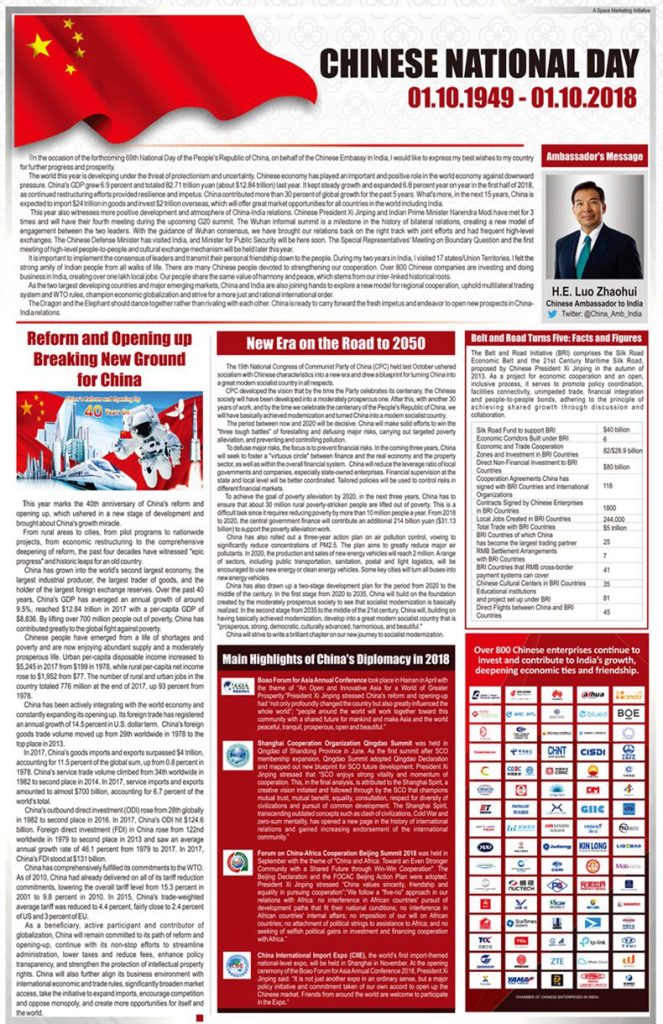
#31 The Hindu Promotes Chinese National Day with Full-Page Coverage
On 28 September 2018, The Hindu published an elaborate special page dedicated to the celebration of China’s National Day. The feature prominently included a message from Chinese Ambassador Luo Zhaohui, along with promotional content showcasing China’s major diplomatic milestones from 2018.
The page also highlighted China’s so-called achievements under 40 years of economic reform and opening-up, the expansion of the Belt and Road Initiative (BRI), and the Communist Party’s strategic plan to build a “modern socialist nation.” The tone and content reflected open support for China’s narrative, presenting the nation’s political and economic ambitions in an overwhelmingly positive light.
#32 The Hindu Justifies Chinese Crackdown on Religious Freedom
On 11 August 2018, The Hindu published an article that echoed Beijing’s justification for the planned demolition of the Grand Mosque in Weizhou, Ningxia. The piece closely mirrored the Chinese government’s narrative, asserting that “no religion is above the law.”
Rather than questioning the authoritarian move, the article appeared to rationalize the demolition as a legal issue, aligning itself with the tone of China’s state-run Global Times. By emphasizing regulatory compliance over religious freedom, the article effectively defended the Chinese state’s clampdown on Islamic places of worship under the guise of legal enforcement.
Subscribe to our channels on Telegram, WhatsApp, and Instagram and get the best stories of the day delivered to you personally.
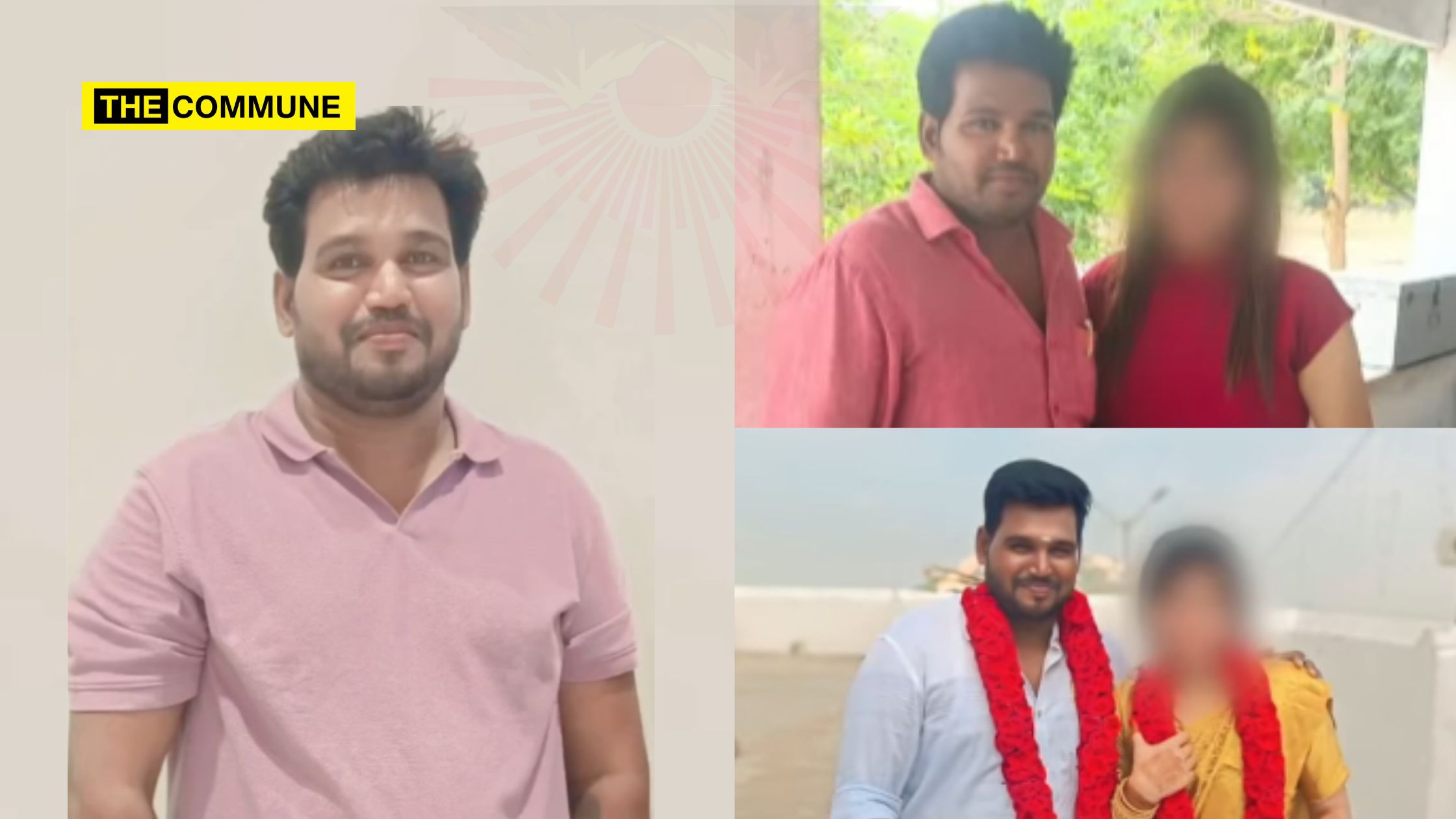
A 21-year-old second-year college student from Arakkonam in Ranipet district has come forward with serious allegations against a DMK functionary, accusing him of deceit and abuse under the pretense of marriage. Seeking justice, she reached out to multiple authorities but claimed her pleas were ignored.
On 10 May, during a birthday celebration for AIADMK General Secretary Edappadi K. Palaniswami held in Arakkonam, local AIADMK MLA Ravi was present at the event. The student approached him in public and, visibly distressed, submitted a petition detailing her ordeal and urged him to take action.
In her petition, she accused a man named Deiva Sayal, a resident of Kavanur and the deputy organizer of the DMK Union Youth Wing, of deceiving her into a relationship. Despite being married, he allegedly manipulated her into a second marriage at Karikkal Temple in Sholingar on 31 January. According to the student, the relationship appeared normal until March, after which Deiva Sayal allegedly attempted to exploit her by involving her with other influential DMK members.
When she resisted, she claimed he became violent and physically abusive on a daily basis. Unable to bear the harassment, she attempted suicide on 5 April. Her family intervened in time and she was admitted first to the Arakkonam Government Hospital and later transferred to the Thiruvallur Government Hospital for further treatment.
She also alleged that the police failed to investigate her suicide attempt. Furthermore, she stated that Deiva Sayal threatened to kill her parents if she did not comply with his demands. Eventually, she left his house, returned to her mother’s home, and resumed her studies.
Despite this, she claimed that Deiva Sayal continued to harass her. When she tried to file a complaint at the Arakkonam City Police Station, she was turned away on jurisdictional grounds. At the All Women Police Station, she was informed that the inspector was unavailable and advised to approach the Arakkonam Taluka Police Station. Receiving no proper support, she eventually took her grievance to the Ranipet District Superintendent of Police. Although her complaint was acknowledged, she said she was redirected yet again to the Arakkonam Deputy Superintendent’s Office, where she alleges her complaint was still not acted upon.
Appealing directly to MLA Ravi, she requested his help, expressing concern that the police were unwilling to act due to the accused’s political ties with the DMK. In response, the MLA reportedly assured her that he would support her and ensure justice is delivered.
Subsequently, a First Information Report (FIR) has been registered against Deiva Sayal by the Arakkonam All Women Police Station based on the student’s formal complaint.
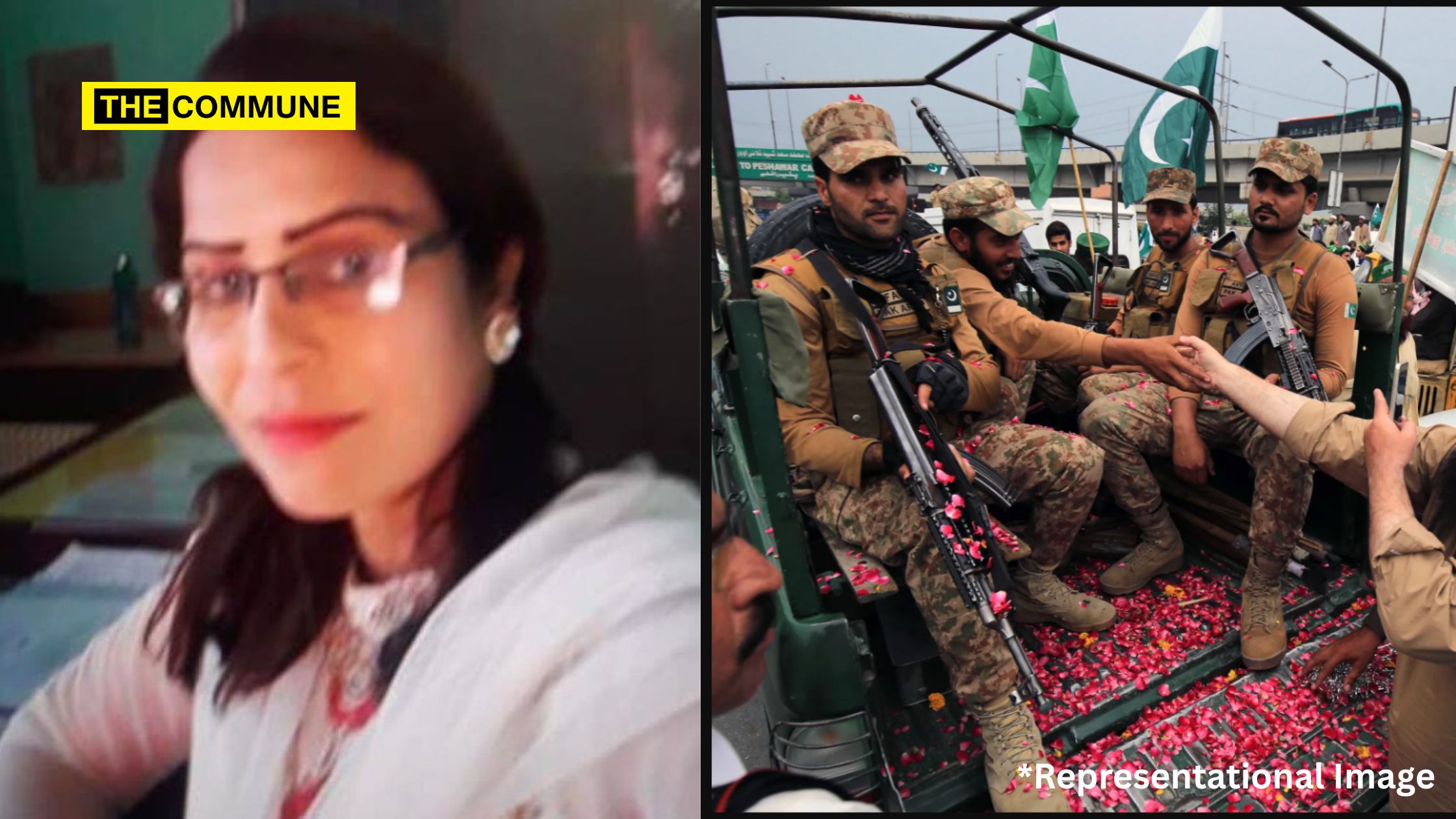
A government school teacher in Madhya Pradesh’s Sehore district has been dismissed from service after allegedly posting a video on social media in which she prayed for the safety of Pakistani soldiers during India’s recently conducted ‘Operation Sindoor’.
Operation Sindoor, an offensive targeting Pakistan-based terrorist camps, was launched in response to the Pahalgam terror attack in which 26 innocent civilians were killed. The teacher, identified as Shahnaz Parveen, was employed at a government higher secondary school in Mehatwada in Sehore, around 60 km from Bhopal.
The video, which she purportedly shared on her Facebook account, features her praying, “Allah, keep Pakistani soldiers safe.” After the video was circulated on social media, the Sehore district education department issued a termination order on Friday, stating that Parveen’s actions were in violation of Section 163 of the Bharatiya Nyaya Sanhita (BNS), 2023, and amounted to “negligence and indiscipline.”
The notice, signed by the District Education Officer (DEO), read: “Shahnaz Parveen’s act, as observed in the video circulated on social media, has been found to be in breach of the conduct expected from a government employee. Her statements are not only inappropriate but also detrimental to national sentiment during a sensitive military operation.”
It further cited that the teacher’s actions constituted a violation under Rule 9 of the Madhya Pradesh Civil Services (Conduct) Rules. “Based on the findings of a departmental inquiry, she has been terminated from service with immediate effect,” the notice stated. The incident has come at a time when Operation Sindoor has triggered a flurry of reactions and political controversy. Alleged disparaging remarks by certain BJP leaders about the armed forces have already stirred unrest in the state, adding to the charged atmosphere.
-IANS
Subscribe to our channels on Telegram, WhatsApp, and Instagram and get the best stories of the day delivered to you personally.