Islamo-Leftist propagandist Mohammed Zubair, cofounder of Alt News, faced backlash after an old tweet resurfaced and gained traction on X. In response to the controversy, he deleted the post and claimed it was being misinterpreted.
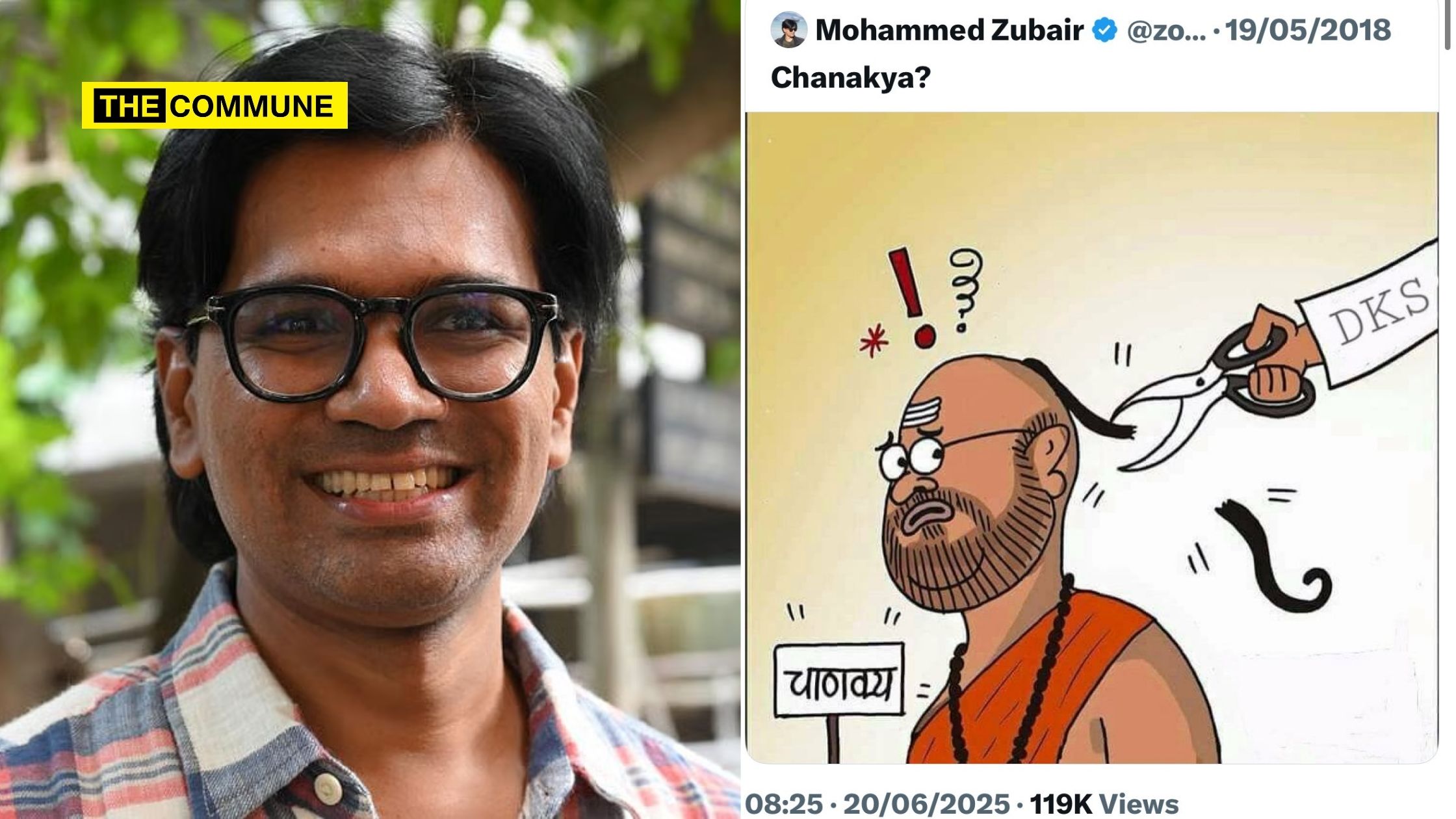
The tweet in question, originally posted in May 2018, featured a cartoon showing BJP leader Amit Shah portrayed as Chanakya, with his traditional Brahmin shikha (choti) being cut by a hand labeled ‘DKS’ holding scissors. Many online perceived the image as derogatory towards the Brahmin community. The post reignited criticism of Zubair, who has frequently targeted what he sees as communal sensitivities in Hindu beliefs while often downplaying similar concerns related to Islamic figures like Prophet Muhammad or historical figures such as Aurangzeb.
The tweet sparked widespread outrage, with several users demanding legal action. Lawyer Ashutosh Dubey called it a deliberate attempt to demean Brahmins and urged the Uttar Pradesh police to take notice by tagging their official handles.
Amid the growing criticism, Zubair took down the post and offered clarification, stating that he had merely shared a political cartoon by an independent artist. He said the cartoon was originally meant to reflect the political climate during the Karnataka elections of that year and is now being misrepresented.
Zubair further argued that the uproar was spreading misinformation and harming communal harmony. However, many countered that the real issue was the offensive depiction of a Brahmin symbol, as the act of cutting the shikha is seen as deeply disrespectful.
Ofcourse, if a visible muslim identity like beard were to be cut off in any cartoon similar to this, your kind will never give the excuse like it was merely “a commentary on the political scenario at the time.” You will instead howl for the blood of the cartoonist. https://t.co/xWQ0CsWIoUpic.twitter.com/6Ww3SlhtAR
HZ you tweeted it which means you have endorsed it! Cowardice why have you deleted it and closed comments off??? You use the same excuse every time when you get caught out!!! Shame on you! https://t.co/Ccq2T8G5dQpic.twitter.com/y2KUlhmIud
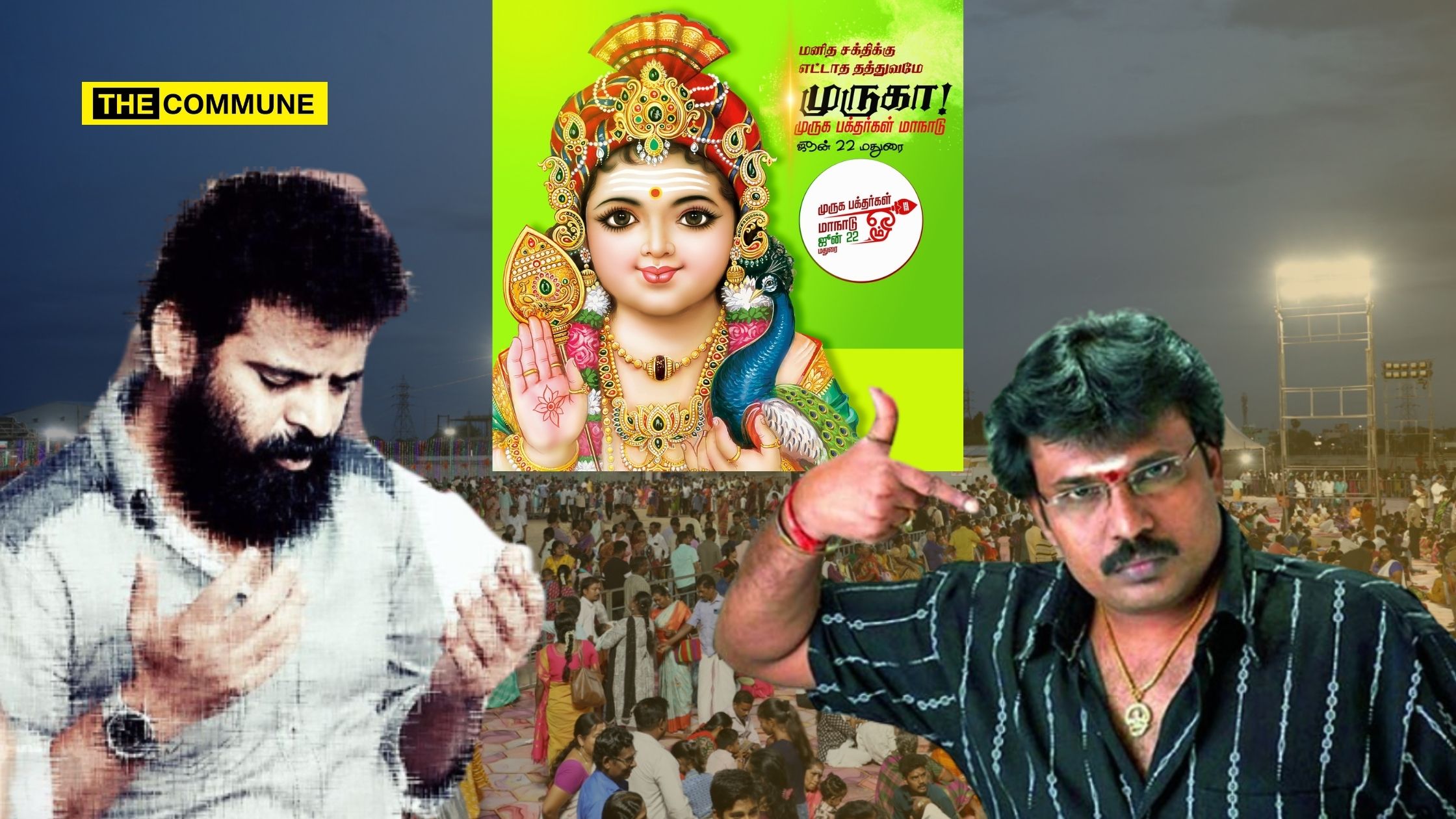
Tamil film director Perarasu has took a jibe at fellow Dravidian director Ameer Sultan for his comments regarding the upcoming Murugan Devotees’ Conference in Madurai. Perarasu questioned Ameer’s right to comment on Hindu religious matters, pointing out that Ameer, who follows a different faith, often aligns with DMK and its allies when criticizing Hindu practices under the guise of secularism.
Ameer, who recently participated in a human chain protest organized by the DMK’s ally VCK in Madurai, claimed the Murugan conference was an attempt to stir communal tensions. “Murugan is not our enemy; it’s those who exploit Murugan’s name for political gains who are the problem,” Ameer stated during the protest, emphasizing his opposition to what he called “Sanghi politics.”
In response, Perarasu, speaking to Tamil media, questioned Ameer’s authority to comment on Hindu religious affairs. “You are not a man to advice another religion and you should not. If you are a (practicing) Hindu with devotion to God, we might consider your perspective as a general opinion, but you follow a different religion and faith then what do you have to do Hindu matters?”
He also added that a Hindu who criticizes their own faith is considered an atheist. But someone who follows one religion and interferes in the practices or beliefs of another isn’t being secular they’re acting as a religious advocate with a bias. If there are issues within your own faith, speak about those. But offering unsolicited advice about someone else’s religion is unnecessary and inappropriate.
— PuthiyathalaimuraiTV (@PTTVOnlineNews) June 21, 2025
This remark was directed at Dravidianist filmmaker Ameer Sultan, who took part in a human chain protest in Madurai. The demonstration was organized by the Madurai Religious Harmony People’s Federation—a coalition comprising leftist groups, Islamic organizations, and human rights activists—in opposition to the Murugan Devotees’ Conference scheduled for 22 June in Madurai.
During the protest, Ameer stated, “Spirituality is something that always endures in people’s hearts. The religions may differ; it could be Hinduism, Islam, or Christianity. But that spirituality must remain with the people and should never fall into the hands of politicians. Murugan has been a deity long-revered by Hindu people. It’s dangerous for Sanghis coming from North India to try and appropriate the Murugan of Tamil Nadu. They’ve already designated a god for each state – Puri Jagannath, Ram, Hanuman, and various others. When you go to Kerala, it’s Ayyappan, and so on. They’ve already instigated religious riots in all those places. It hasn’t happened in Tamil Nadu yet, though they’ve tried and failed in some areas. Lastly, they’re trying to win over the people of Madurai, which is very dangerous. It’s our duty to state that Murugan belongs to the people, not to political parties.”
The Murugan Devotees’ Conference, scheduled for 22 June in Madurai, is being organized by the Hindu Munnani. Preparations are complete, and devotees have already begun to arrive. Prominent leaders including Uttar Pradesh Chief Minister Yogi Adityanath and Andhra Pradesh Deputy Chief Minister Pawan Kalyan are expected to attend.
Ameer’s comments during the protest have sparked controversy and attracted criticism online on religious boundaries and selective secularism. Perarasu’s sharp retort adds fuel to the ongoing ideological clash between nationalist and Dravidianist voices in Tamil Nadu’s cultural and political discourse.
Subscribe to our channels on Telegram, WhatsApp, and Instagram and get the best stories of the day delivered to you personally.
International and Indian investigative agencies have initiated a joint inquiry into the suspected deployment of high-powered microwave (HPM) or electromagnetic pulse (EMP) devices in a recent series of maritime disturbances in the Arabian Sea.
Recent advancements by Turkey in electromagnetic warfare technology, particularly HPM systems capable of disrupting GPS and electronic navigation on ships and aircraft, have drawn attention. Authorities are now examining whether such technologies may have played a role in the maritime anomalies. As part of the probe, investigators are tracking irregular patterns in power consumption in areas where sabotage is suspected.
One such suspected technology is the Alka–DEW, a directed-energy weapon developed by Turkish defense firm Roketsan. The mobile unit, approximately the size of a compact vehicle, operates at power levels between 2.5 and 5 kilowatts and is capable of disabling electronic systems at ranges of 1,500 to 5,000 meters.
These weapons are not only capable of scrambling electronics but can also emit electromagnetic energy strong enough to ignite chemicals, raising further concern about their potential role in unexplained maritime incidents.
The growing number of cargo ship disruptions has prompted alarm within the international maritime insurance sector. The Joint Marine Insurance Committee, based in the U.S., has cited signs of EMP-like activity in several recent cases.
In response, a delegation from a European consortium of maritime insurers recently visited Kerala to assess the situation and gather on-ground intelligence related to the suspected use of such technologies in the Arabian Sea.
Back-To-Back Ship Accidents
On May 25, 2025, the Liberia-flagged MSC ELSA 3, carrying 640 containers, including 13 with hazardous cargo and 12 with calcium carbide, capsized 38 nautical miles off Kochi after departing Vizhinjam. The vessel sank due to flooding in one of its compartments, leaking fuel and scattering containers, some of which washed ashore. All 24 crew members were rescued, but the incident triggered environmental concerns due to potential oil spills and hazardous materials threatening Kerala’s biodiverse coastline. The Kerala government banned fishing within a 20-nautical-mile radius of the wreck and issued coastal alerts.
Just two weeks later, on June 9, 2025, the Singapore-flagged MV Wan Hai 503, en route from Colombo to Mumbai, reported an internal container explosion 144 km off Kerala’s Beypore coast, sparking a massive fire. Eighteen of the 22 crew members were rescued, but four remain missing. The vessel, carrying 2,128 tonnes of fuel and hazardous cargo, including nitrocellulose and ethanol, continues to burn, with salvage efforts underway to prevent an ecological disaster. The Indian Coast Guard and Navy, supported by Singaporean teams, are battling the blaze, but containers have drifted toward the shore, heightening environmental risks.
These back-to-back incidents have raised suspicions of foul play, particularly targeting Vizhinjam’s growing strategic importance. Central and international agencies, including a European consortium of marine insurers, are probing whether high-power microwave (HPM) or electromagnetic pulse (EMP) devices, such as Turkey’s portable Alka-DEW developed by Roketsan, were used to disrupt ships’ GPS and navigation systems. The Alka-DEW, capable of disabling electronics from 1,500 to 5,000 meters, could cause malfunctions leading to accidents without leaving physical traces. The US-based Joint Marine Insurance Committee reported evidence of EMP-level activity linked to recent mishaps, fueling concerns of deliberate sabotage to disrupt trade routes or undermine Vizhinjam’s operations.
Investigators are monitoring unusual electricity fluctuations in suspected sabotage locations, and maritime insurers have expressed alarm over rising claims. The probe, described as a response to a “significant escalation in maritime threats,” is exploring whether state or non-state actors are involved. Social media posts on X reflect public unease, with users questioning the rapid succession of accidents and their impact on India’s economic zone.
Following the mysterious death of a Scheduled Caste youth in Kanyakumari, the Tamil Nadu BJP has called for an unbiased investigation, raising concerns over alleged political connections involving the deceased’s girlfriend’s family. The party urged the police to handle the case without favoritism, particularly in light of the reported links to the ruling DMK.
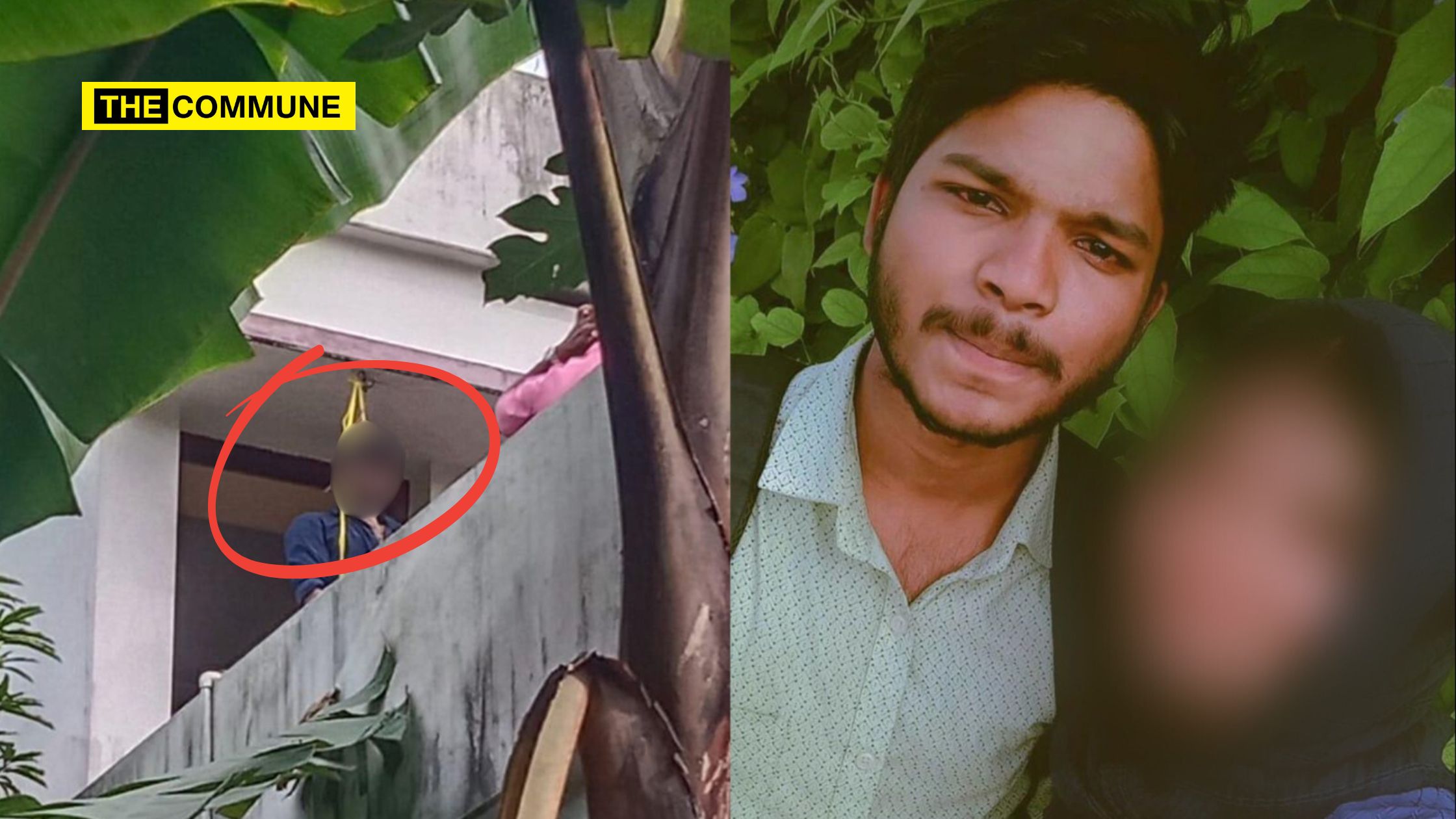
The young man, identified as Dhanush, was found hanging at the residence of a woman he was reportedly in a relationship with, in Kulasekaram on 19 June. Initial police reports suggest that the woman had recently ended contact with Dhanush, which may have played a role in the incident. Authorities have so far not found a suicide note at the scene.
Dhanush, who worked at an IT firm in Coimbatore, belonged to a Scheduled Caste community, while the woman was from allegedly Muslim community. Police say the family has not filed any formal accusations, and the investigation is ongoing.
However, BJP state president Nainar Nagendran has questioned the circumstances of Dhanush’s death, citing the woman’s alleged familial ties to DMK leaders. In a post on X, Nagendran emphasized the need for a fair and transparent probe, free from political influence.
He said, “A scheduled caste Hindu youth named Dhanush, who was in love with and about to marry a woman from a different religion in Kulasekharam, Kanyakumari district, has been mysteriously found dead, hanging. The fact that he was found hanging on the terrace of his girlfriend’s house has caused great suspicion and stir. Furthermore, with reports indicating that the woman’s close relatives are associated with the DMK, the question of whether this case will be properly investigated has arisen in everyone’s mind.
It is unbelievable that Dhanush, a well-educated young man working in an IT company in Coimbatore, would hang himself at his girlfriend’s house. Over the past four years, law and order in Tamil Nadu have deteriorated significantly, plumbing new depths. In particular, violence against Scheduled Caste individuals has reached brutal peaks under the current government. Therefore, it is the responsibility of the police to conduct a proper post-mortem examination in this case without any political interference and bring the truth to light. The Tamil Nadu police should not succumb to the DMK’s usual arbitrary approach given the close ties between the woman’s family and the DMK. The police should not act unilaterally with the intention of aiding the ruling party’s vote-bank politics. I urge the Tamil Nadu police to swiftly bring out the truth of this case without succumbing to the political pressure of the ruling DMK, with only a few months left until a change in government. I also want to state that @BJP4Tamilnadu will stand firmly with the family of the affected young man.”
கன்னியாகுமரி மாவட்டம் குலசேகரத்தில் மாற்று மதப்பெண்ணை காதலித்து திருமணம் செய்யவிருந்த இந்து பட்டியல் சமூக இளைஞரான தனுஷ் மர்மமான முறையில் தூக்கில் தொங்கிய நிலையில் சடலமாக மீட்கப்பட்டுள்ளார். அதுவும் அவர் காதலித்த பெண்ணின் வீட்டு மாடியிலேயே அவர் தூக்கிட்டிருப்பது மிகுந்த… pic.twitter.com/Hy0oRMHMwH
In response to widespread media coverage and social media discussions surrounding the death of a 22-year-old man named Dhanush, the Kanniyakumari District Police have issued a formal statement, confirming that a detailed investigation is in progress.
Dhanush, son of Duraisamy and a resident of Cheruppaloor kavu vilai colony under the jurisdiction of the Kulasekharam police station, was found dead on the morning of 19 June 2025. His body was discovered hanging inside the home of a woman he was reportedly in a relationship with. Acting on a complaint filed by his father, Duraisamy (49), a case of suspicious death has been registered at Kulasekharam police station.
Amid growing speculation and rumors circulating in the media and on social platforms, the police clarified that, according to witness statements and digital evidence, Dhanush and the woman had been romantically involved for several years. However, following a recent fallout between them, the woman chose to end the relationship. Preliminary findings suggest Dhanush was emotionally distressed over the breakup and had attempted to reconcile, which the woman declined.
A post-mortem examination was conducted on 20 June 2025, at Asaripallam Medical College Hospital. Based on both the post-mortem report and initial police findings, authorities stated that there is currently no indication of foul play. The police have urged the public and media to refrain from spreading unverified information or rumors while the investigation continues.
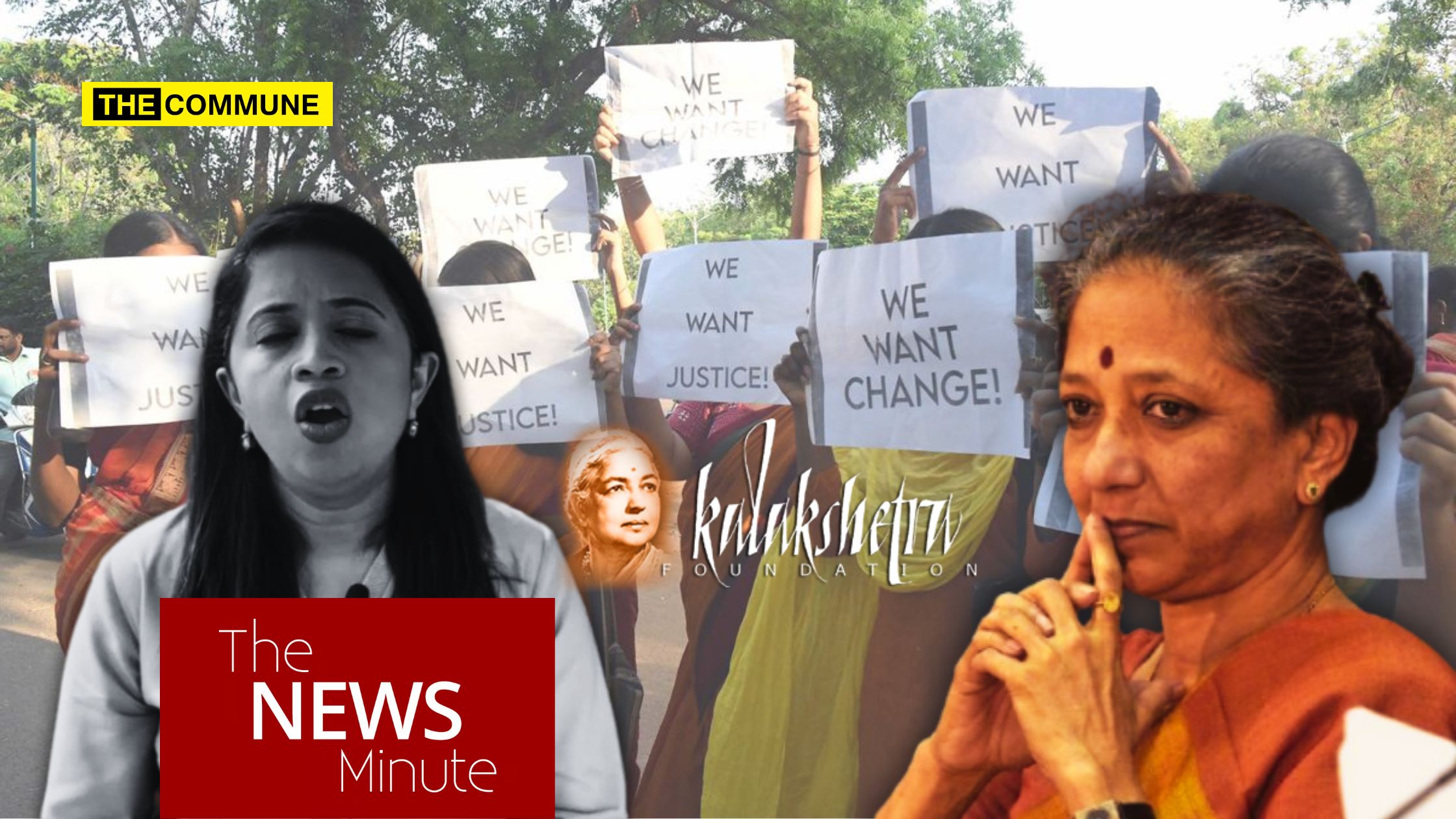
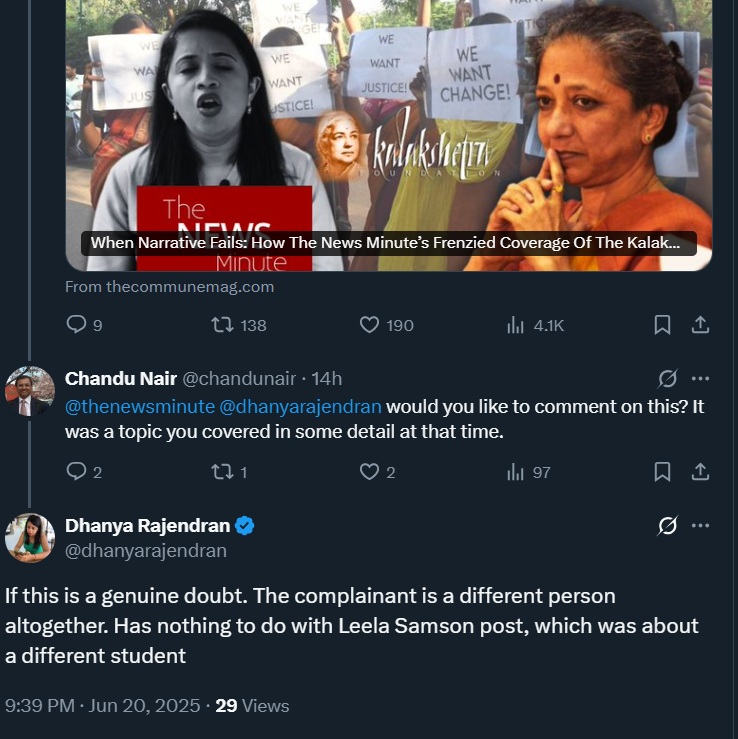
On 20 June 2025, The Commune called out the radio silence of Leftist-Dravidianist portal, The News Minute, on the Leela Samson ‘regret’ Facebook post for wrongly linking a female student with a male staff at Kalakshetra. When this was published on the X platform, a reader tagged TNM editor in chief, Dhanya Rajendran and asked, “would you like to comment on this? It was a topic you covered in some detail at that time.”
To this Rajendran replied, “If this is a genuine doubt. The complainant is a different person altogether. Has nothing to do with Leela Samson post, which was about a different student”
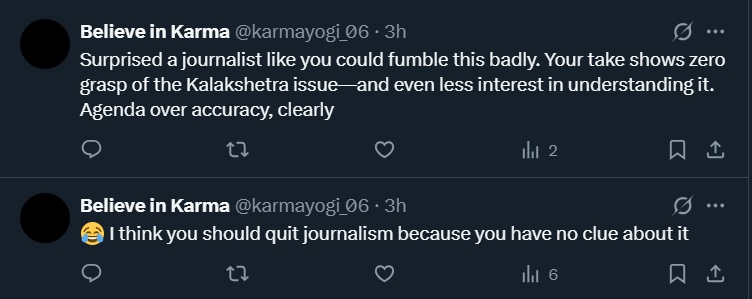
In response, another netizen who happened to be vocal during the time when the Kalakshetra issue was boiling over and the one who exposed the real reason why the accusations were being made, called out Rajendran’s lack of understanding. They wrote, “Surprised a journalist like you could fumble this badly. Your take shows zero grasp of the Kalakshetra issue—and even less interest in understanding it. Agenda over accuracy, clearly”. In another post, they wrote, “I think you should quit journalism because you have no clue about it.”
Maybe, we must educate Dhanya Rajendran once more and jog her memory.
How Is Leela Samson’s Regret Connected To The Kalakshetra Issue?
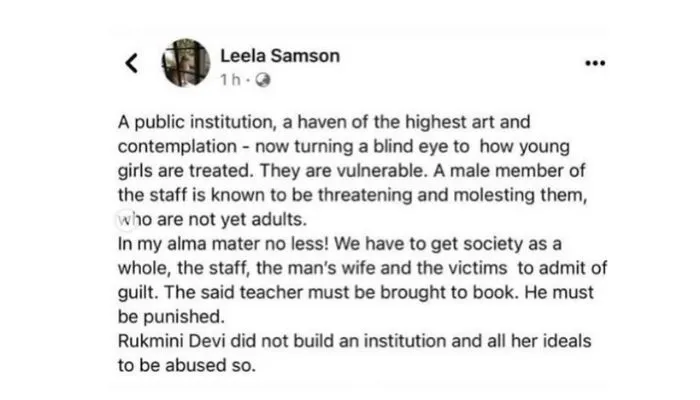
In December 2022, Leela Samson makes a Facebook post alleging sexual harassment by a male staff on minor students.
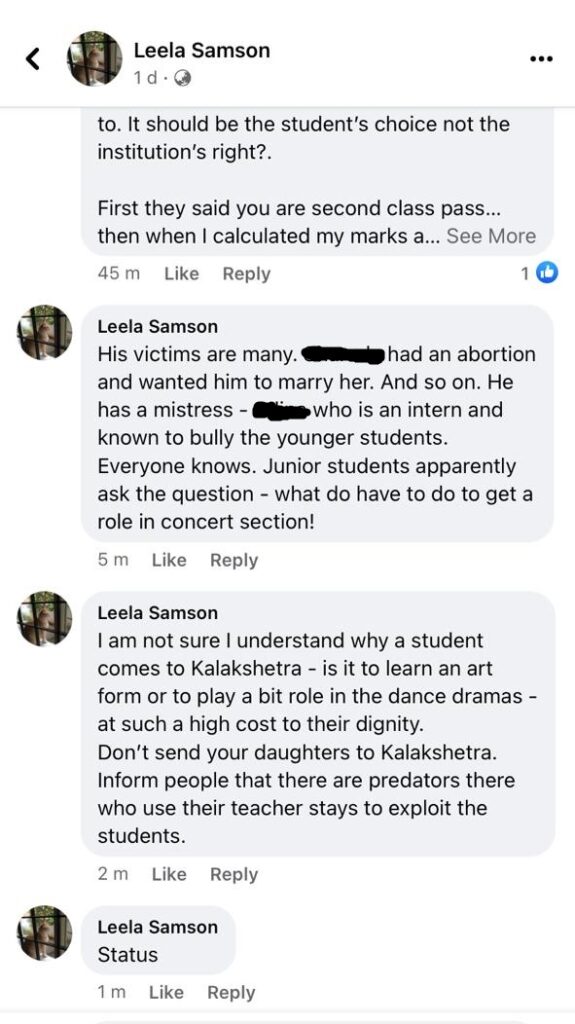
She continues to add comments in the same post dragging another student’s name into the mess. Soon after she deletes the post.
Now it is these additional comments where the real issue is hidden in – Leela unnecessarily drags a student (name masked) into the issue and defamed her needlessly.
While Samson deleted the post, the victim (the student whose name was mentioned in the original FB post) filed a defamation suit against her.
The Complaint
The complainant was a dance intern at the Rukmini Devi College of Fine Arts (“RDCFA”) and has been associated with the institution for the past 7 years. The FIR states that the complaint pertains to the post made by Ms. Leela Samson, former director of the Kalakshetra Foundation on her Facebook profile in December 2022.
The post has been deleted but the complainant claims that it has brought ill repute to her name and upheaved her personal and academic life. She also accuses Samson of having written the post with a highly vindictive agenda.
The post made by Samson alleged that a male staff member indulged in acts of sexual harassment inside the campus. The alleged male staff member mentioned therein is one Mr. Haripadman who happened to be one of the complainant’s mentors and he had trained her for years together.
In the comments section of the now-deleted Facebook post made on 23 December 2022 by Leela Samson, the complainant says that various comments were made about the alleged misdemeanours committed by Mr. Haripadman and that what was particularly disconcerting was that her name was linked in an uncharitable manner with Mr. Haripadman in one of those comments on the Facebook post.
The comments said, “His victims are many. (Name hidden) had an abortion and wanted him to marry her. And so on. He had a mistress who is an intern – (name hidden) known to bully the younger students. Everyone knows. Junior students apparently ask the question – what do have to do to get a role in the concert section!”
The comment on the Facebook post mentions the complainant’s name (removed for anonymity), although misspelled makes an explicit reference to her and the FIR says that it has given rise to an immense upheaval of her personal and academic life. The contents of the comment, at first glance, besides being false and baseless, are patently derogatory, disparaging, and vituperative, which projects the complainant in an extremely disparaging manner, the FIR said.
The context, tone and tenor of Leela Samson’s post gives away that she had used the word “mistress” with a sexual connotation.
The reference to the complainant as a “mistress”, the FIR said, was an attack against her dignity and an affront to her modesty and as such attracts the provision of Section 509 of the Indian Penal Code, 1860.
Now it is for this post that Samson posted a ‘regret’ message on her Facebook.
Leela Samson’s ‘Regret’ Post
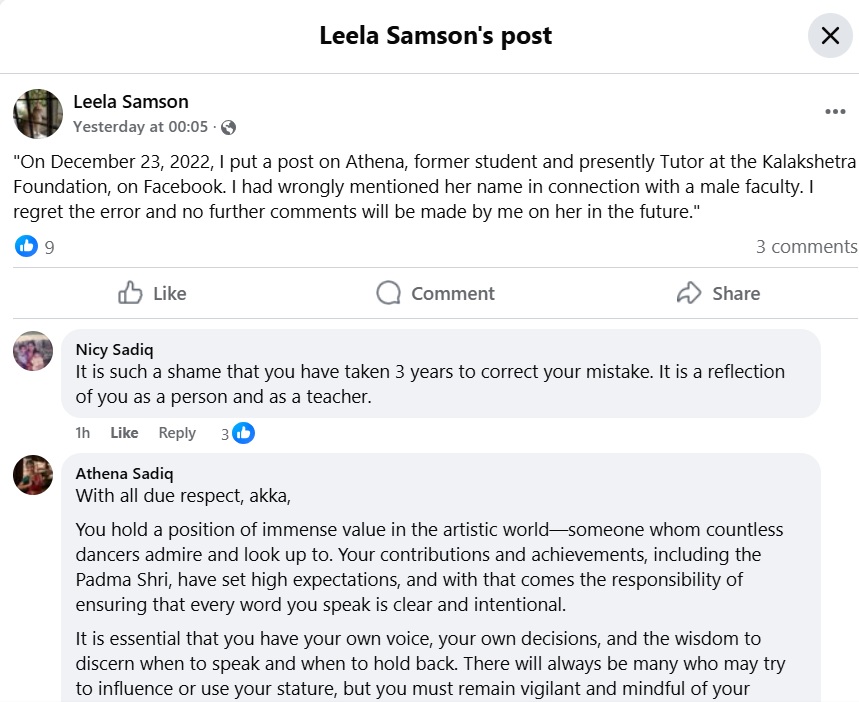
On 15 June 2025, in a brief statement on her Facebook page, Samson wrote: “On December 23, 2022, I put a post on Athena, former student and presently Tutor at the Kalakshetra Foundation, on Facebook. I had wrongly mentioned her name in connection with a male faculty. I regret the error and no further comments will be made by me on her in the future.”
Samson’s admission comes after nearly two years of controversy stemming from her initial post, which alleged misconduct by a male teacher — Hari Padman — and inadvertently drew a student, into a scandal that disrupted her life and career. The student later alleged that the mention of her name, and its subsequent circulation in media reports and social media, had caused immense distress, mental agony, and damage to her reputation.
This ‘regret’ post came after the dispute was resolved recently through a mediated settlement following both civil and criminal complaints. The dragging of the student into the issue prompted the filing of a civil suit and related criminal charges. During the subsequent mediation process, as told to The Commune, Leela Samson expressed regret for her actions and agreed to do whatever was needed to make amends. This included putting up a public post on Facebook as a form of apology. In exchange for this, the complainant agreed to withdraw both the civil suit and the criminal case, effectively putting the matter to rest.
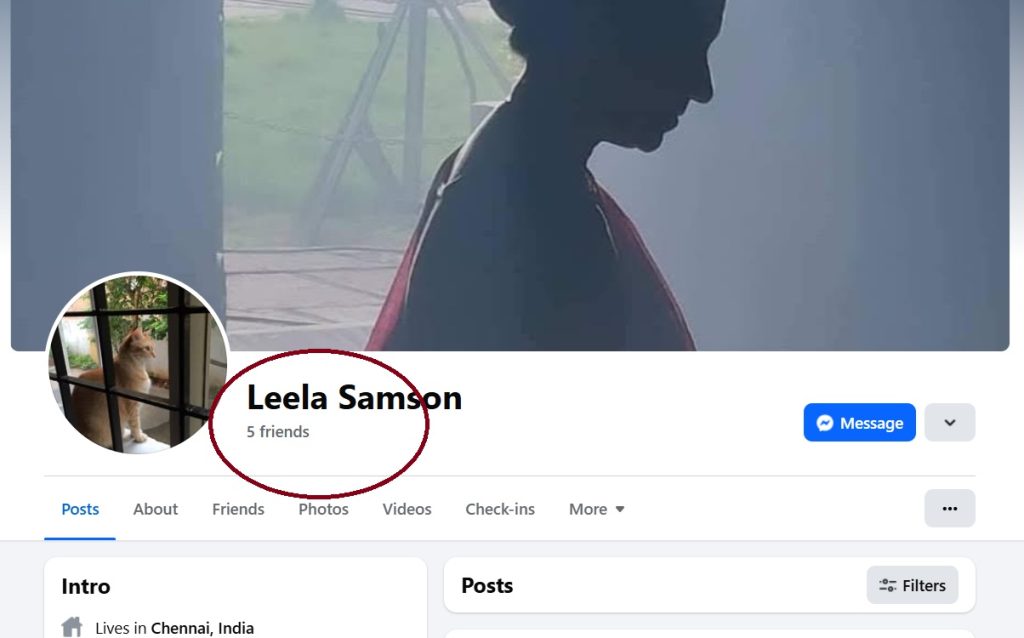
Before making the Facebook post, however, Leela took careful measures to control its visibility. She removed nearly all her friends from her account — reducing their number from approximately 2,000 down to just 5 — ensuring that the message would reach a limited and carefully curated viewership. Furthermore, as requested by the complainant, Leela made the post visible to the public while retaining this small number of friends. This tactic meant that the majority of her friends, and even many of her previous social media connections, remained oblivious to its content. In this way, the defendant was able to fulfill the terms of the agreement without broadly disclosing the details or drawing significant attention from her social circle.
As per the settlement, Leela Samson is to pay a total sum of ₹8 lakhs in two instalments — half upon withdrawal of the civil suit and the rest upon submission of a consent affidavit in the quash petition. The complainant also agreed to pursue quash proceedings before the Madras High Court.
The News Minute’s Coverage
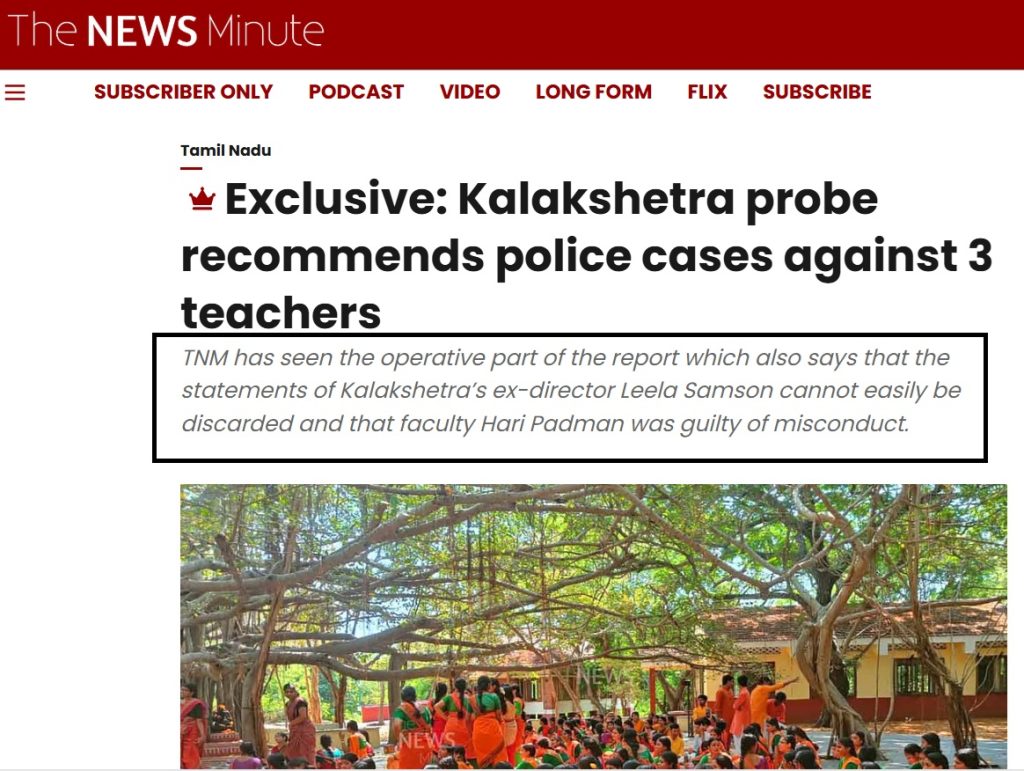
The News Minute which doggedly reported the issue, in a biased manner, did not bother to report on Samson’s regret post. Now, Dhanya claims there is no connection to the Kalakshetra issue in the first place. Here is an article they published on how Leela Samson’s deleted Facebook post “cannot easily be discarded and that faculty Hari Padman was guilty of misconduct.”
So pray tell us how are both not connected – especially when Samson herself linked the student to Haripadman, the accused in the case and how her comments are important to the case itself, allegedly.
Subscribe to our channels on Telegram, WhatsApp, and Instagram and get the best stories of the day delivered to you personally.
Israel’s Ambassador to India, Reuven Azar, firmly responded to senior news anchor and well-known Congress mouthpiece and ‘journalist’ Rajdeep Sardesai, after the latter attempted to equate Iran’s missile strike on an Israeli hospital with Israeli strikes on Hamas-controlled hospitals in Gaza.
Rajdeep, in his signature late-night virtue-signaling, posted on X stated, “Late night musing: when Iran attacks a hospital in Israel , it’s a ‘war crime’.. When Israel attacks a hospital in Gaza, it’s being justified because terrorists are supposedly hiding in hospital. Be it in Israel or Gaza or a Teheran tomorrow , any attack on a hospital that leads to civilian deaths is a war crime. Period.”
Late night musing: when Iran attacks a hospital in Israel , it’s a ‘war crime’.. When Israel attacks a hospital in Gaza, it’s being justified because terrorists are supposedly hiding in hospital. Be it in Israel or Gaza or a Teheran tomorrow , any attack on a hospital that leads…
Ambassador Azar wasn’t having any of it. In a pointed reply, he schooled Sardesai’s flawed comparison and misunderstanding of international law, stated, “You are wrong. Under international law, when a humanitarian facility is used for military purposes, it looses its immunity. Despite that, Israel has taken measures to clear civilians out of harm’s way even when the Hamas terrorists used hospitals to hide, before targeting.”
He further clarified that, “Israel doesn’t use hospitals to conceal military activities and therefore attacking them is a war crime.”
You are wrong. Under international law, when a humanitarian facility is used for military purposes, it looses its immunity. Despite that, Israel has taken measures to clear civilians out of harm’s way even when the Hamas terrorists used hospitals to hide, before targeting.… https://t.co/XQpSw1tqiI
Azar’s sharp rebuttal comes as a reality check for those drawing false equivalence between a nation defending itself from terrorists embedded within civilian infrastructure, and hostile regimes directly targeting civilian medical facilities. Once again, a foreign diplomat had to set the record straight—something left elites seem to struggle with.
Subscribe to our channels on Telegram, WhatsApp, and Instagram and get the best stories of the day delivered to you personally.
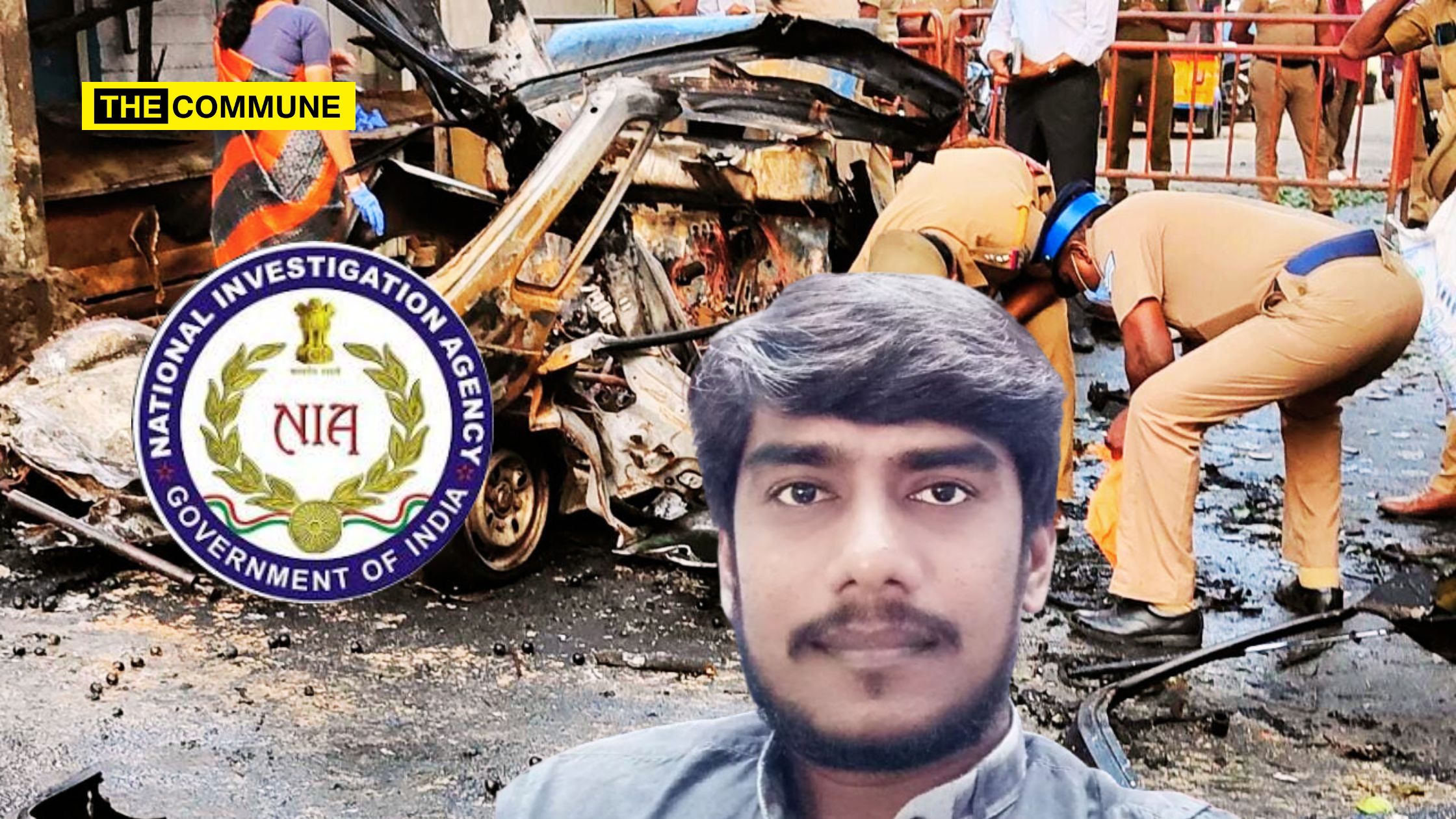
Raja Mohammed, a coconut trader from Palani, was recently arrested by the National Investigation Agency (NIA) in connection with the 2022 car explosion in Coimbatore. As part of the probe, the NIA searched his home in Neikkarapatti, located near Palani. The explosion, which took place near a temple, was carried out by a suicide bomber and tied to extremist ideology.
Previously on 14 February 2023, authorities searched Raja Mohammed’s residence between 5 a.m. and 11 a.m., reportedly in search of evidence linked to the bombing. Investigators have uncovered that some suspects allegedly financed the bomb-making materials using money from a fraudulent COVID-19 vaccine certificate scheme. The probe has also indicated the involvement of individuals influenced by Islamic State (IS) ideology.
Jameesha Mubeen, who died in the explosion, has been identified as a primary suspect, along with others believed to be involved in the planning, financing, and execution of the attack. The NIA continues to investigate the broader conspiracy, aiming to identify all those connected to the incident. Additionally, the agency is examining whether the bombing was a retaliatory act following the arrest of Mohammed Azharuddin, accused of spreading violent Salafi-Jihadi propaganda.
Subscribe to our channels on Telegram, WhatsApp, and Instagram and get the best stories of the day delivered to you personally.
The Supreme Court has stayed the demolition of a temple built within the premises of Visthara Residency in Madurai, Tamil Nadu, following allegations that it was constructed illegally on land designated as Open Space Reservation (OSR). The interim relief was granted by a bench comprising Justices Ujjal Bhuyan and Manmohan, who also issued a notice on the plea filed by the Visthara Welfare Association.
According to a Live Law report, Senior advocate Dama Seshadri Naidu, representing the petitioners, argued that the Madras High Court had passed its demolition order without giving the affected parties a chance to be heard or submit their responses. “Neither the petitioner nor respondents 1 to 8 were heard or allowed to file their pleadings,” the counsel stated.
Acknowledging this procedural lapse, the Supreme Court stayed the demolition and scheduled the matter for further hearing in eight weeks. The petition challenges a Madras High Court ruling that had found no valid authorization or permits for the temple’s construction on OSR land, concluding it was an illegal structure. Justice S.M. Subramaniam had ordered the Madurai Corporation to remove the temple within four weeks and ensure the land is maintained in line with the Tamil Nadu Town and Country Planning Act, 1971.
Subscribe to our channels on Telegram, WhatsApp, and Instagram and get the best stories of the day delivered to you personally.
On 20 June 2025, the Madurai bench of Madras High Court has annulled the earlier condition that required vehicles attending the Murugan Devotees’ Conference in Madurai to obtain mandatory passes.
The spiritual gathering, organized by Hindu Munnani, is scheduled for 22 June in Madurai. Initially, the police had approved the event with 52 conditions, one of which required vehicles to secure passes through their respective sub-division DSPs. Hindu Munnani filed a petition challenging six of these conditions, including the vehicle pass rule.
A single judge previously upheld the necessity of vehicle passes, reasoning that they help manage traffic congestion. The judge directed that such passes should be issued within 24 hours of application, and any refusal must be explained with valid reasons.
Later, a fresh plea was submitted requesting the implementation of an online e-pass system for attendees—similar to what is used for tourist vehicles in destinations like Ooty and Kodaikanal. However, the court declined this request but extended the deadline to apply for physical passes until 10 a.m. on 21 June.
Dissatisfied with this decision, Hindu Munnani approached the Supreme Court, seeking an order to implement the e -pass system for vehicles attending the conference. The Supreme Court declined to entertain the plea and advised petitioners to return to the High Court.
Subsequently, an appeal was filed again in the Madurai bench Madras High Court. A division bench consisting of Justices G.R. Swaminathan and Rajasekhar heard the case on 20 June. The counsel for Hindu Munnani argued that an Assistant Commissioner in Madurai’s Anna Nagar had issued an unauthorized order restricting vehicle entry without proper passes, which, they claimed, was not within his jurisdiction. The lawyer also pointed out that such restrictions are not typically imposed on political gatherings.
In response, the government argued that senior police officers are legally permitted to enforce conditions for managing large public events, and that the vehicle pass requirement was meant for crowd regulation, not restriction.
The bench questioned whether such conditions are uniformly applied to political party events. The government responded affirmatively, stating that all political conferences are subject to similar checks and that vehicles lacking required documentation are barred from entry and may be impounded.
After considering the arguments, the High Court bench ruled that the pass requirement for vehicles attending the Murugan conference would be revoked. Instead, police booths should be established at parking areas, where vehicle owners must present documentation such as insurance papers, driver’s license, Aadhaar card, and registration certificate. Only after verification and registration should vehicles be allowed into the event premises.
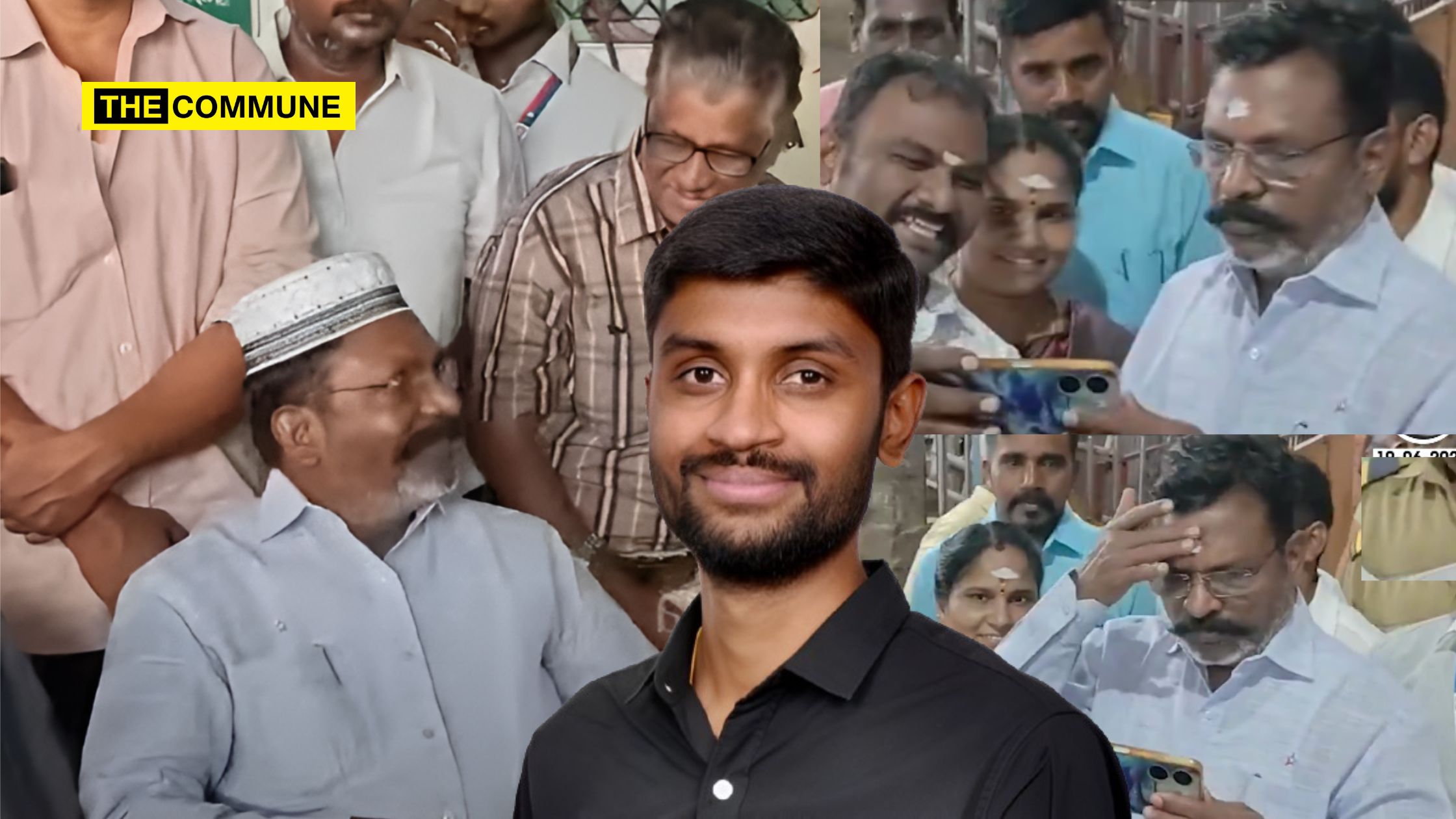
It was increasingly apparent that Viduthalai Chiruthaigal Katchi (VCK) leader Thol. Thirumavalavan’s actions were driven by a desire to stir controversy and reinforce his minority appeasement with a viral video showed him rubbing off vibhuti(sacred ash) from his forehead just as a couple approached for a selfie yesterday. Although he had earlier accepted the vibhuti and a sacred garland during a temple visit, he appeared to deliberately remove the ash in front of cameras—suggesting a calculated attempt to distance himself from overt Hindu symbolism.
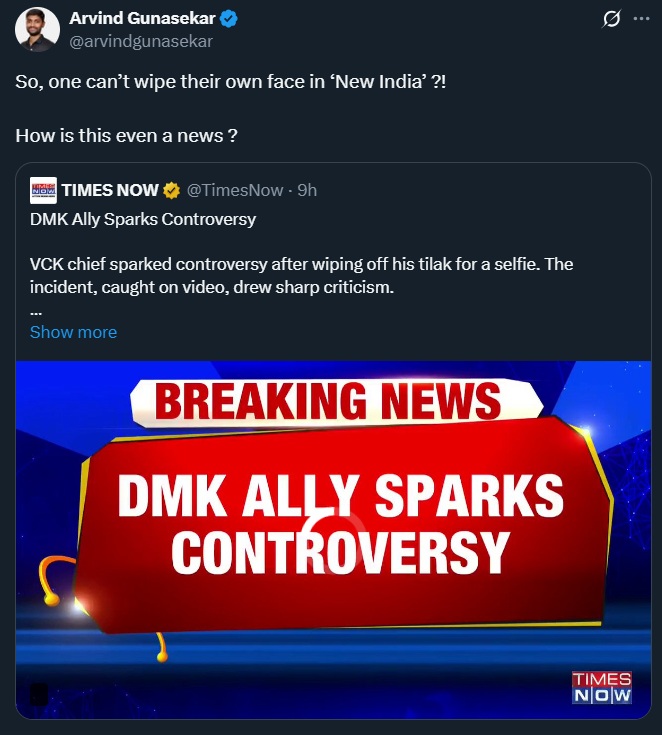
The video quickly gained traction online and was even picked up by national news outlets. However, in response, the Dravidian political ecosystem rallied to defend Thirumavalavan. Notably, pro-DMK journalist Arvind Gunasekar downplayed the issue, questioning, “So, one can’t wipe their own face in ‘New India’? How is this even news?” as a response to the news carried by Times Now.
Critics, however, pointed out the perceived double standards. While Thirumavalavan was seen visibly distancing himself from Hindu religious marks, he was later photographed at a dargah, smiling and wearing a skullcap, apparently without hesitation—prompting accusations of selective religious posturing for political gain.
"இதற்கு பெயர் தான் மதச்சார்பின்மையா"???🚨
இன்று மதுரை திருப்பரங்குன்றம் சென்றிருந்த திருமாவளவன்,
It appears that self-proclaimed journalist Arvind Gunasekar expects everyone in India to echo the Congress-DMK narrative, targeting the BJP while turning a blind eye to any criticism of his preferred political allies. Check what qualifies as “newsworthy” in the eyes of this hypocrite below.
Maharashtra makes Hindi general third language in schools under National Education Policy, 2020.
Precisely why Tamil Nadu Govt opposes NEP 2020 arguing NEP facilitates “backdoor Hindi imposition”.https://t.co/OVx7nj9pNp
Yet, Centre stops even that (meagre) contribution if PM Modi’s picture is not included in the posters / banners of the schemes ! https://t.co/4SolvOu12r