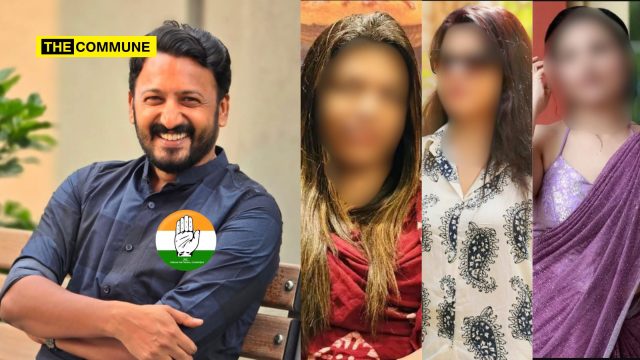
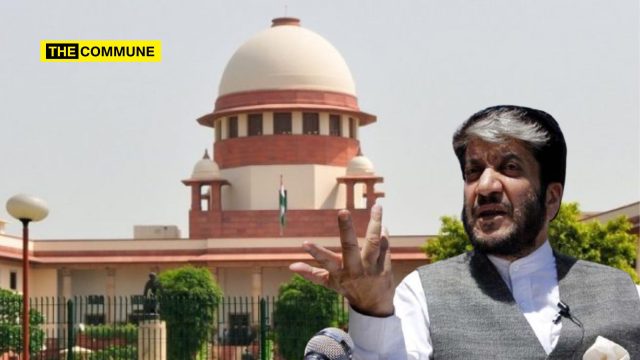
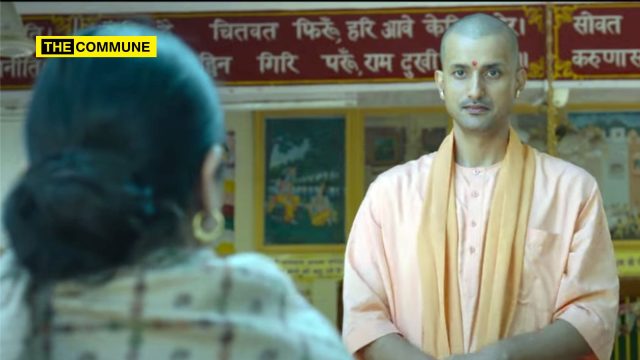
With just less than two weeks left for a fresh Assembly session in Kerala, the Crime Branch Police has filed an FIR against Youth Congress former state president and Palakkad MLA Rahul Mamkootathil in connection with multiple allegations of sexual harassment, stalking, and intimidation of women. The FIR was submitted before the Thiruvananthapuram Judicial First Class Magistrate Court.
According to the FIR, Rahul allegedly harassed women on social media, sent threatening messages, and even pressured one woman to undergo an abortion. He has been booked under BNS Section 78(2), Section 351 of the Police Act, and Section 120. The charges were filed based on complaints received by the State Police Chief. The case stems from complaints filed by five individuals, all of whom are third parties not directly connected to the alleged victims. While the women at the centre of the allegations have not yet lodged formal complaints, the Crime Branch has said their statements will be recorded if evidence is produced.
The agency has already taken the deposition of Advocate Shino, one of the complainants, and indicated that it will also question journalists who posted about the controversy on Facebook. Investigators have reportedly traced one of the alleged abortion incidents to a hospital in Bengaluru, from where information has already been collected.
The Crime Branch is preparing to record the statement of the woman said to have undergone the procedure. There are also indications that a second woman may have had an abortion, allegedly with assistance from a relative of the first. These claims, however, remain under verification. The FIR notes that the police took up the case suo motu, citing repeated harassment of women by Rahul on digital platforms. It also records allegations that he threatened women over the phone and sent coercive messages related to abortion.
With the case now before the court, the Crime Branch maintains that further action will depend on direct testimonies and corroborative evidence from the women allegedly involved. With Mamkootathil now suspended from the Congress party, all eyes are on how the party will re-engage with the issue especially amid growing concerns that the state government is targeting him for political gain. This comes at a time when the Congress-led opposition is gearing up to challenge the Vijayan government over its alleged mismanagement.
-IANS
Subscribe to our channels on Telegram, WhatsApp, and Instagram and get the best stories of the day delivered to you personally.
The wide-ranging GST reforms are set to improve the lives of citizens and ensure ease of doing business for all, especially small traders, thus strengthening the economy.
The changes in GST rates on services and goods other than cigarettes, chewing tobacco products like zarda, unmanufactured tobacco and beedi will be effective from 22 September, as per recommendations of the GST Council in its 56th meeting.
For the specified goods, namely, cigarettes, chewing tobacco products like zarda, unmanufactured tobacco and beedi, the existing rates of GST and compensation cess will continue to apply, and the new rates will be implemented at a later date to be notified, based on discharge of the entire loan and interest liabilities on account of compensation cess. There is no change in the threshold of registration required for goods under the CGST Act, 2017.
The IGST on imported goods will be the GST rates as notified in the rate notification, except where the IGST rate has been exempted separately, according to the Ministry of Finance. GST is levied on supply. Therefore, on goods supplied on or after the revised GST rates are notified, the new GST rates will be applicable on the outward supplies of goods/services or both.
All dairy milk, other than Ultra High Temperature (UHT) milk, was already exempt from GST. Hence, UHT milk has been exempted to provide the same tax treatment to similar goods. Plant-based milk drinks, except soya milk drinks, attracted 18 per cent GST while soya milk drinks attracted 12 per cent GST. The GST rate on plant-based milk drinks and soya milk drinks has now been reduced to 5 per cent.
The principle behind the recent rate rationalisation exercise is to keep similar goods at the same rate to avoid issues of misclassification and disputes. This has also been applied to ‘other non- alcoholic beverages’. “Food preparations not elsewhere specified will attract a GST rate of 5 per cent. Bread was already exempt, while pizza bread, roti, porotta, paratha, etc., attracted different rates. All Indian breads, by whatever name called, have been exempted even though only a few goods have been mentioned by way of illustrative example,” the ministry said.
The rate hike of carbonated beverages of fruit drink or carbonated beverages with fruit juice is because these goods attracted compensation cess in addition to GST. Since it has been decided to end the compensation cess levy, the tax has been increased to maintain the pre-rate rationalisation level of tax. Prior to rate rationalisation, paneer sold in other than pre-packaged and labelled form already attracted a nil rate. Therefore, the changes have been made only in respect of paneer supplied in pre-packaged and labelled form. Paneer is an Indian cottage cheese. This is mostly produced in the small-scale sector. The measure is intended to promote Indian cottage cheese.
The GST rate on agriculture machinery/equipment such as, sprinklers, drip irrigation system, Agricultural, horticultural or forestry machinery for soil preparation or cultivation; lawn or sports-ground rollers, harvesting or threshing machinery, including straw or fodder balers; grass or hay mowers, other agricultural, horticultural, forestry, poultry-keeping or bee-keeping machinery, composting machines, etc., which earlier attracted 12 per cent GST, has now been reduced to 5 per cent.
“The objective of the rate rationalisation is to maintain a balance between users and producers. While providing relief for the farmers, it is important that the domestic manufacturing does not get adversely impacted. If agriculture machinery is fully exempted, the manufacturers/dealers of these goods would not be able to claim input tax credit on the GST paid on raw materials and will have to reverse the ITC paid on the inputs,” explained the ministry.
This would increase their effective tax incidence and cost of production. This may, in turn, be passed on to farmers in the form of higher prices, which in turn would make the measure counterproductive. All drugs/ medicines have been prescribed a concessional rate of GST of 5 per cent, except those specified at a nil rate. “If drugs/medicines are fully exempted, the manufacturers/dealers would not be able to claim input tax credit on GST paid on raw materials and will have to reverse the ITC paid on the inputs. This would increase their effective tax incidence and cost of production. This may in turn be passed on to consumers/ patients in the form of higher prices, which in turn would make the measure counterproductive,” the ministry noted.
Moreover, the rate of 5 per cent applies to all medical devices, instruments, and apparatus used in medical, surgical, dental and veterinary uses; other than that are exempted specifically. The GST rate on all small cars has been reduced from 28 per cent to 18 per cent. For the purposes of GST, small cars mean petrol, LPG, or CNG cars with engine capacity up to 1200 cc and length up to 4000 mm and diesel cars with engine capacity up to 1500 cc and length up to 4000 mm. The GST rate on three-wheelers has been reduced from 28 per cent to 18 per cent.
All motor vehicles designed to transport ten or more persons, including the driver, and classified under HSN 8702, will attract a GST rate of 18 per cent. It has been reduced from 28 per cent. Motorcycles of engine capacity up to 350 cc attract a GST rate of 18 per cent, while motorcycles of engine capacity exceeding 350 cc attract a GST rate of 40 per cent. The new GST rate on mid-size and big cars will be 40 per cent with no compensation cess. The GST rate has been reduced to 5 per cent on bicycles and their parts from 12 per cent.
The 40 per cent special rate is applicable only on a few select goods, predominantly on sin goods and a few luxury goods and therefore is a special rate. Most of these goods attracted Compensation Cess in addition to GST. Since it has been decided to end the Compensation Cess levy, the Compensation Cess rate is being merged with GST so as to maintain tax incidence on most goods. On other goods and services, the special rate has been applied as these were already attracting the highest GST rate of 28 per cent.
Currently, cotton attracts GST on a reverse charge basis. This means that agriculturists do not have to pay GST when they supply raw cotton. The reason for taxing cotton in GST is to avoid breakage in the input credit chain, and the GST paid on cotton is available as input tax credit for the textile industry. This will ultimately benefit the consumers. The new GST rate on a toilet soap bar is 5 per cent. This is intended to lower the monthly expenditure for the lower middle class and the poorer sections of society.
The reason for reducing GST on face powder and shampoos is that these goods are daily-use items for almost all segments of the population. The GST rate has been reduced to 5 per cent only on certain goods that are daily-use items for most segments of the population. GST Council recommended a reduction in the GST rate to 5 per cent on toothpaste, toothbrush and dental floss, which are the basic dental hygiene goods. The GST rate on renewable energy equipment/devices that were at 12 per cent has been reduced to 5 per cent.
“These goods already faced an inverted duty structure. While reducing the GST rate to 5 per cent will deepen inversion, a mechanism for refund arising out of the inverted duty structure is available. In addition, process reforms will ensure expedited refunds. The objective is to promote renewable energy goods,” said the ministry.
GST on air conditioners and dishwashers has been reduced from 28 per cent to 18 per cent. Earlier TVs and monitors up to 32 inches attracted 18 per cent GST, while larger TVs and monitors attracted 28 per cent GST. Now all TVs and monitors will be uniformly taxed at 18 per cent. “The policies covered under the exemption recommended on life insurance are all individual life insurance policies, including term, ULIP, and endowment plans and reinsurance services thereof. The policies covered under the exemption recommended on health insurance are all individual health insurance policies, including family floater plans and senior citizen policies and the reinsurance services thereof,” the ministry informed.
-IANS
Subscribe to our channels on Telegram, WhatsApp, and Instagram and get the best stories of the day delivered to you personally.
Ahead of the festive season, the GST Council, led by Union Finance Minister Nirmala Sitharaman, has announced significant reduction or tax exemption on several food items, packaged food and daily essentials.
UHT milk, paneer, pizza bread, rotis, and khakhras will now have zero tax after GST 2.0, reduced from 5 per cent. Parathas and parottas, previously taxed at 18 per cent, are now in the nil bracket. GST on key dairy items like butter, ghee, and cheese has decreased from 12 per cent to 5 per cent. Prices for condensed milk and various packaged foods, including jams, sauces, pickles, and fruit juices, will come down.
Dry fruits and nuts, including almonds, cashews, pistachios, and dates, will now be taxed at 5 per cent instead of 12 per cent. Biscuits, cakes, chocolates, cornflakes, soups, and ice cream will also see a tax reduction to 5 per cent from 18 per cent. The move was announced by the GST council even as inflation is cooling, with headline retail inflation dropping to 1.55 per cent in July, the lowest since June 2017.
Food inflation has also slipped into negative territory (–1.76 per cent), the lowest since January 2019. Families are expected to benefit from relief after experiencing volatile household expenses earlier this year due to changes in vegetable prices. Packaged food manufacturers are set to quickly pass on the benefits. Executives announced that grammage in ₹5 and ₹10 packs, which have been reduced in recent years due to rising input costs, will be restored. Analysts predicted that snack makers will benefit significantly, as GST on these products is expected to decrease from 12 per cent to 5 per cent. The move by GST council is expected to boost the consumption sector, which rose 7 per cent in the June quarter due to stronger rural demand.
-IANS
Subscribe to our channels on Telegram, WhatsApp, and Instagram and get the best stories of the day delivered to you personally.
The Supreme Court on 4 September 2025, declined to order the immediate release of Kashmiri separatist leader Shabir Ahmed Shah on interim bail in an alleged terror funding case. However, a Bench of Justices Vikram Nath and Sandeep Mehta sought the National Investigation Agency (NIA)’s opinion on a special leave petition (SLP) filed by Shah seeking bail.
The Justice Nath-led Bench appeared unconvinced by senior Advocate Colin Gonsalves’s submission that Shah’s “very sick” condition warranted his release on interim bail.
Earlier, the Delhi High Court had rejected Shah’s bail plea, stating that the possibility cannot be ruled out that, as Chairman of an unlawful organisation, he would not indulge in similar unlawful activities and may attempt to tamper with evidence or influence witnesses yet to be examined.
“Although the appellant (Shah) has been in custody for five years, the charges have already been framed, and the trial is underway. There is no delay on the part of the prosecution for not examining its witnesses,” said a Bench of Justices Shalinder Kaur and Navin Chawla, rejecting his plea for release on bail on the ground of delay in the trial.
Further, the Justice Kaur-led Bench said there was no question of considering Shah’s alternative plea for house arrest, given the serious allegations against him and the sensitivity and gravity of the issues involved.
Shah was arrested in June 2019 and is alleged to have played a significant role in establishing a separatist movement in Jammu and Kashmir. He is also accused of ‘honouring’ the families of deceased terrorists, receiving funds through hawala transactions, and raising money via LoC trade to support subversive and militant activities. The NIA has claimed that several individuals accused of conspiring to raise funds to destabilise Kashmir and wage war against the Indian government were involved. Shah’s name was included in the second supplementary charge sheet filed by the NIA on 4 October 2019.
-IANS
Subscribe to our channels on Telegram, WhatsApp, and Instagram and get the best stories of the day delivered to you personally.
The makers of “AJEY: The Untold Story of a yogi” unveiled the trailer of the upcoming film and it showcases the extraordinary journey of a young man from humble beginnings to a spiritual seeker.
The film is inspired by Shantanu Gupta’s bestselling book The Monk Who Became Chief Minister. Slated to release on 19 September, the film stars Anantvijay Joshi, Paresh Rawal, Dinesh Lal Yadav and Ajay Mengi.
The trailer begins with shots of Garhwal, glimpses of Ajay’s family, and early friendships, leading up to his life-changing decision to take sanyas. It sparks his spiritual journey in a land ruled by gangsters and bahubali politicians. Peace soon gives way to conflict as he challenges a corrupt system, moving from spiritual rituals to decisive leadership and reform.
The trailer captures both the turbulence of an unruly land and the depth of Ajay Anand’s inner journey. The film traces the personal sacrifices and ideological evolution that shape Ajay’s transformation, blending drama, inspiration, and spiritual essence. Directed by Ravindra Gautam and produced by Ritu Mengi, AJEY is written by Dilip Bachchan Jha & Priyank Dubey and the stirring music is by Meet Bros.
The director of photography is Vishnu Rao, production designer is Udai Prakash Singh and associate producers are (Suuraj Sinngh) B-Live Productions and Itihasa Academy. Ravindra Gautam said: “AJEY is a story of transformation, resilience, and vision, capturing the journey of a simple young man from the hills of Uttarakhand to a life devoted to service and leadership.”
Producer Ritu Mengi shared that the film “explores conviction, sacrifice, and leadership, showing both the public and private life of the protagonist and the choices that shaped his journey.” The Monk Who Became Chief Minister is a biography of Yogi Adityanath, the 22nd Chief Minister of Uttar Pradesh. It is written by Shantanu Gupta, an Indian author and political analyst. The book came out on 25 August 2017.
-IANS
Subscribe to our channels on Telegram, WhatsApp, and Instagram and get the best stories of the day delivered to you personally.
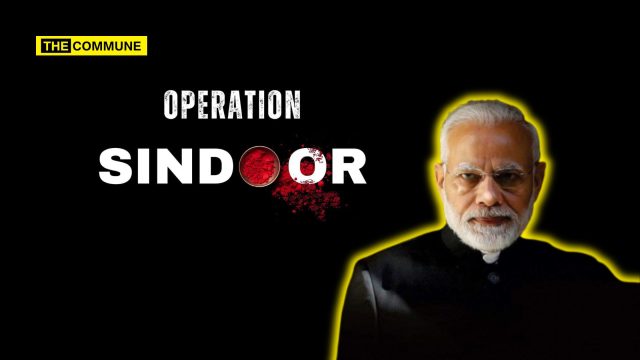
As the Vālmīki Rāmāyaṇa, Yuddha Kāṇḍa, Sarga 36, Verse 13 says, our beloved PM Narendra Modi rushed back to Bharat in the middle of his Saudi Arabia visit after a deadly terrorist attack in Pahalgam, Jammu and Kashmir, in which 26 Bharatiyas were killed based on their religion.
PM Modi returned to strategically plan and successfully execute an operation that should put a full stop to future attacks and ensure the safety of fellow Bharatiyas.
The verse mentioned above states that Lord Rāma declares that he leads from the front, never abandoning his duty when the people are in danger.
Bharat launched Operation Sindoor and assigned our Sthree Shakthi, along with Foreign Secretary Vikram Misri, to lead the briefing of the entire operation, which targeted the nine terrorist bases in Pakistan and PoK. Even after this, Pakistan continued to use drones and shelling to target our religious sites.
In retaliation, we neutralised their air defence system. Our counteroffensive became a historic milestone when India successfully attacked, for the first time, the air bases of a nuclear-armed nation.
Pakistan also targeted medical centres and school premises near Indian air bases. They also shelled Rajouri town, caused property damage, and inflicted injuries on civilians in Ferozepur and Jalandhar. Pakistan continued drone intrusions and heavy artillery, mortar, and small-arms shelling at various locations in India. However, we planned our actions in a dharmic way to target only their terrorist bases, ensuring no civilians were harmed.
Here the dharma yuddha principle is followed as per Mahābhārata, Bhīṣma Parva, Chapter 13, Verses 12–18.
As Arthaśāstra Book 10 – “The Conduct of War states: Chapter 3 – Kinds of Warfare
This means the War is of three kinds: War by counsel (diplomacy), War by might (arms), and War by open declaration (legal). It is clear evident that our PM Modi followed the dharmic principles on all 3 ways.
Using Arms
Yuddhena hataḥ santi ca santi aparāṅmukhān Nāśastrapāṇinaṃ śastreṇa hanyād dharmaḥ sa niviṣṭaḥ
It means one must not attack fallen soldiers, those retreating, or those who are unarmed; this is the conduct of Dharma in war. We fought against our enemies with strength of arms.
Diplomatic Route
PM Modi took a diplomatic approach to share information about Operation Sindoor with key partner countries, members of the United Nations Security Council and the EU. We sent all-party delegations comprising 59 members, including 31 political leaders from the ruling NDA and 20 politicians from other parties who were assisted by former diplomats to convey India’s message of zero tolerance against terrorism. This way, we weakened Pakistan from the other side and acted according to war by counsel.
Legal Route
Apart from this, the Indian government also put in abeyance the Indus Waters Treaty – this has far-reaching consequences for Pakistan, closed the Attari-Wagah border. India also suspended all bilateral trade to impose immediate economic pressure, and revoked visas of all Pakistanis residing in India.
Mahābhārata, Śānti Parva, Chapter 59, Verse 61
Ir enaro hi sadā yuktaḥ prajāṁ ca hahataṁ vrajet। Ātmā ca tadā rakṣet samprāpte ca viśeṣataḥ॥
It means a king (leader) must always remain alert and actively work for the welfare of his people, especially being vigilant and present during times of crisis.
As stated above, our leader stayed with us during the crisis and redefined India’s policy against terrorism with swift decisions and actions. India’s stand is very clear that water and blood cannot flow together.
G. Prasanna Venkatesan writes on Bharathiya knowledge, Sri Vaishnavism, Puranic and Ithihasa themes, and stories centered on national and social development.
Subscribe to our channels on Telegram, WhatsApp, and Instagram and get the best stories of the day delivered to you personally.
In a significant development in Tamil Nadu’s entertainment industry, Inban Udhayanidhi, the 20-year-old son of Deputy Chief Minister and producer Udhayanidhi Stalin, has formally taken over his father’s production banner, Red Giant Movies. The announcement coincides with the banner securing the distribution rights for actor-director Dhanush’s upcoming film, Idli Kadai, which is slated to hit screens across Tamil Nadu on 1 October 2025.
Dhanush confirmed the news on his official X handle, congratulating Inban on his new role as the CEO of Red Giant Movies. He shared a poster of the film and wrote, “IdliKadai – releasing across Tamil Nadu by @RedGiantMovies_ Wishing Inban Udhayanidhi the very best on his new journey!”
Red Giant Movies, which began producing films with 2008’s Kuruvi and distributing movies from 2010’s Vinnaithaandi Varuvaaya, has grown into one of Tamil Nadu’s leading entertainment banners. The company recently co-produced Indian 2 and distributed films such as Vidaamuyarchi and Thug Life. Idli Kadai, Dhanush’s fourth directorial venture, stars Nithya Menen and Arun Vijay in prominent roles. Nithya Menen reunites with Dhanush after their hit Thiruchitrambalam (2022). The film’s music is composed by G.V. Prakash Kumar, with cinematography by Kiran Koushik and editing by Prasanna G.K. It is produced by Dhanush’s Wunderbar Films in association with Aakash Baskaran’s Dawn Pictures.
This step mirrors the trajectory of Inban’s father, Udhayanidhi Stalin, who transitioned from film production to politics and currently serves as Tamil Nadu’s Deputy Chief Minister.
Inban has already been actively involved in the family’s media ventures. On 3 June 2025, the birthday of DMK patriarch M. Karunanidhi, he formally assumed responsibilities in the management team of Kalaignar TV. Holding a degree in financial management from London, Inban works closely with the channel’s executives, including Chief Financial Officer Karthikeyan, managing day-to-day financial operations. Reports indicated he works from 11:00 AM to 5:30 PM at the Neelankarai office in Chennai, consulting regularly with key team members.
Industry insiders suggested in August 2025 that Inban was preparing to make his acting debut once he completed his education in London. He has been undergoing intense physical training, hinting at serious preparation for a film career. Prominent Tamil directors, including Mani Ratnam, Vetrimaaran, and Mari Selvaraj, have reportedly been approached to direct his launch film, with an official announcement expected soon.
With his formal takeover of Red Giant Movies, Inban Udhayanidhi seems to be now poised to follow in his father’s footsteps – from managing the production house to acting in films to entering politics – it is a fact that Udhayanidhi Stalin is now the Deputy Chief Minister of Tamil Nadu.
Despite geo-political uncertainties and tariffs, India is expected to clock GDP growth of 6.5 per cent this fiscal and reforms like GST 2.0 will surely have a positive impact on the long-term growth rate, Dr Arvind Virmani, Member, NITI Aayog, said on 4 September, adding that last five years have proved that the Indian economy is highly resilient to global shocks.
In an interaction with IANS here, the seasoned economist said the GST reforms are something he has personally worked on for a long time, and they will have a positive effect on the Indian economy. “There were a number of positive measures announced in the Union Budget, and the income tax reforms were an important part, which the Parliament has passed. The GST reforms are also part of that big plan to simplify the compliance and bring ease of doing business,” he noted.
“Of course, simplification takes time for its kind of efficiency and positive tax effects and compliance effects to come in, but I am sure those results will come,” the economist said. He stated that in anticipation of these, “markets will always say that this has already started having some effects”. On the GDP forecast, he said that many experts, including him, “have been saying from the beginning that GDP for this year would be at around 6.5 per cent plus or minus, there is a large band of uncertainty”.
According to Virmani, the 50 per cent US tariffs came as a shock, but impactful reforms like GST are crucial on both the policy and institutional fronts. “Many such reforms have taken place and others are in process,” the economist added. “So, on balance, I think we will still come out at 6.5 per cent growth this year. There is a huge range of uncertainty, so it can be plus or minus 0.5 per cent or even larger. The uncertainty has actually gone up,” he told IANS.
Economists have hailed the unprecedented GDP growth rate at 7.8 per cent in the first quarter of the current financial year (Q1 FY26), surpassing projections of 6.5 to 6.7 per cent by the RBI and other institutions.
-IANS
Subscribe to our channels on Telegram, WhatsApp, and Instagram and get the best stories of the day delivered to you personally.
In August 2025, police arrested an Indian individual for espionage. This was the fourth on such lines within a short period of time.
Let us take a look at the arrests and crackdown on spies in India over the past few months, especially in the backdrop of April 22 Pahalgam attack and Operation Sindoor.
#1 Jaisalmer Arrest Over Pakistan Links
On 20 August 2025, Rajasthan Police detained a 25-year-old man in Jaisalmer after discovering his regular communication with multiple Pakistani phone numbers. Authorities grew suspicious when he was caught speaking to these contacts, leading to his arrest. A preliminary investigation of his mobile device revealed several saved numbers linked to Pakistan. Officials suspect he was being prepared for possible recruitment by terror handlers. His detention highlights ongoing concerns over cross-border communication channels used for radicalization.
#2 ISI Spy Arrested in Rajasthan Amid Indo-Pak Tensions
Following the April 22 Pahalgam terror attack that killed 26, Indian agencies intensified operations against suspected ISI collaborators. On 1 May 2025, Rajasthan Intelligence arrested Pathan Khan of Jaisalmer for allegedly spying for Pakistan since 2013. Officials said Khan, initially recruited during a Pakistan trip, passed sensitive BSF-related information using fake SIMs and social media, and was paid through covert channels. Booked under the Official Secrets Act, he is accused of filming border zones. Meanwhile, villagers near the Rajasthan border expressed support for the Army, as Pakistan escalated military drills and ceasefire violations, further straining bilateral tensions.
#3 Rajasthan Govt Staffer Held for Espionage
In May 2025, NDTV reported that 49-year-old Rajasthan government employee Shakur Khan, detained in Jaisalmer on suspicion of spying for Pakistan, earlier worked as personal assistant to former Congress minister Shale Mohammad. Both hail from nearby villages, and Khan reportedly frequented visits to Mohammad’s late father, Ghazi Fakir. Officials said Khan had traveled to Pakistan at least seven times and maintained multiple bank accounts. His phone contained deleted data now under scrutiny. Authorities stressed it was premature to link Mohammad to the case. Since Operation Sindoor, seven individuals, including Khan, have been picked up in Jaisalmer for suspicious border activities.
#4 DRDO Guest House Manager Arrested in Jaisalmer for Spying for Pakistan
In August 2025, Rajasthan Police CID (Security) arrested Mahendra Prasad, 32, manager of the DRDO Guest House at Chandan Field Firing Range in Jaisalmer, on charges of espionage. Prasad, a native of Almora, Uttarakhand, was allegedly in contact with a Pakistani intelligence handler via social media and leaked details about DRDO scientists and Army officers visiting the site for weapon trials. His mobile analysis confirmed the security breach. Arrested after joint interrogation, Prasad is accused of passing sensitive defence information. Authorities are probing possible wider links, stressing vigilance amid heightened surveillance ahead of Independence Day celebrations.
#5 UP Man Held for Spying, Links to Pakistan’s ISI
Uttar Pradesh ATS has arrested a man named Shazad on charges of espionage for Pakistan’s ISI. Officials said he was under surveillance after intelligence inputs confirmed repeated travel to Pakistan, where he engaged in illegal cross-border trade used as a front for spying. Investigations revealed that Shazad maintained close ties with ISI operatives, supplied them confidential security information, and transferred funds to their agents in India. He also allegedly facilitated the movement of men from Rampur and nearby areas to Pakistan for recruitment, and provided Indian SIM cards to ISI handlers for covert operations.
12 Arrested in Pakistan-Linked Spy Network Across North India
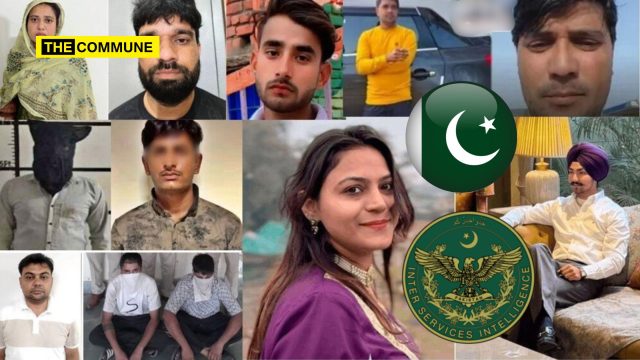
At least 12 people, including a YouTuber, were arrested from Punjab, Haryana, and Uttar Pradesh on espionage charges over the past two weeks. Police say investigations point to a Pakistan-linked spy network active in north India. The arrests, which followed the Pahalgam terror attack and Operation Sindoor, include six from Punjab, five from Haryana, and one from Uttar Pradesh. Officials confirmed that those arrested were allegedly passing sensitive information to Pakistani Intelligence Operatives (PIOs).
#6 Punjab: Falaksher and Suraj Masih
On 4 May 2025, Punjab Police arrested Falaksher Masih and Suraj Masih, both residents of Ajnala in Amritsar, for allegedly leaking sensitive information to Pakistan’s ISI. The duo were accused of sharing photographs of Army cantonment areas, BSF camps, and air bases with their handlers across the border. Police said the two were involved in collecting and transmitting crucial military details, including troop movements.
#7 Punjab: Guzala and Yameen Mohamad
On 11 May 2025, Punjab Police detained 31-year-old Guzala and Yameen Mohamad from Malerkotla. Investigators revealed that Guzala had been in direct touch with a Pakistani officer, Ehsan-ur-Rahim alias Danish, posted at the High Commission in New Delhi. She allegedly confessed to passing on confidential details about Indian Army activities in exchange for money, receiving ₹30,000 via UPI. Yameen was accused of assisting her in espionage-related activities.
#8 Punjab: Sukhpreet Singh and Karanbir Singh
Punjab DGP Gaurav Yadav announced on 19 May 2025 the arrest of Sukhpreet Singh and Karanbir Singh, both from Gurdaspur district. The duo were found leaking sensitive military information, including troop movements during Operation Sindoor, to ISI handlers. Police recovered three mobile phones and eight live cartridges of 0.30 bore ammunition from their possession. Authorities also linked the men to prior drug smuggling operations, which reportedly brought them into contact with ISI agents.
#9 Haryana: Nauman Ilahi
On 15 May 2025, Haryana Police arrested 24-year-old Nauman Ilahi from Panipat district for supplying sensitive information to Pakistan. Originally from Kairana, Uttar Pradesh, Ilahi worked as a factory security guard and was living with his sister and brother-in-law in Panipat. He was reportedly in contact with an ISI handler in Pakistan and had been sharing details through digital platforms.
#10 Haryana: Devender Singh
On 16 May 2025, Haryana Police arrested Devender Singh, a 25-year-old postgraduate student from Kaithal district. Singh, pursuing a master’s degree in political science, had allegedly established contact with Pakistani operatives during a pilgrimage to Pakistan in November 2024. He admitted to sending photographs of the Patiala cantonment from outside the premises. Police said Singh had uploaded photos with weapons on social media, raising suspicions about his links to PIOs.
#11 Haryana: Jyoti Malhotra (YouTuber)
On 16 May 2025, Hisar-based YouTuber Jyoti Malhotra was arrested for passing information to Pakistani operatives. Malhotra, who runs the channel Travel with JO with 3.77 lakh YouTube subscribers, was allegedly in touch with Pakistani staffer Danish from the High Commission. She had visited Pakistan multiple times, with her videos featuring titles such as “Indian Girl in Pakistan” and “Exploring Lahore.” Police said she was being “developed as an asset” during the India-Pakistan conflict following Operation Sindoor.
#12 Haryana: Armaan
On 17 May 2025, police in Haryana’s Nuh district arrested Armaan, 26, for allegedly spying for Pakistan. He was accused of sharing information related to Indian Army activities with PIOs via WhatsApp and social media platforms. Police said he had been providing information for a long period. Armaan was remanded in police custody for six days.
#13 Haryana: Mohammad Tarif
On 19 May 2025, Nuh Police, along with a central agency, arrested local quack Mohammad Tarif from Kangarka village. Tarif allegedly leaked intelligence on Indian military activities to Pakistan. He confessed to having supplied a SIM card to a Pakistani High Commission employee and had even traveled to Pakistan. A case was registered against him and two Pakistani nationals under the Official Secrets Act and the Bharatiya Nyaya Sanhita.
#14 Uttar Pradesh: Shahzad (Rampur)
On 18 May 2025, Uttar Pradesh’s Special Task Force arrested Shahzad from Rampur. He was accused of smuggling goods such as clothes, spices, and cosmetics across the border while passing sensitive security information to his ISI handlers. Shahzad had reportedly traveled to Pakistan multiple times. The STF alleged that his smuggling network served as a cover for espionage.
#15 Mohammad Murtaza Ali Arrested in Jalandhar for ISI Espionage
Punjab Police arrested Mohammad Murtaza Ali in Jalandhar on charges of spying for Pakistan’s intelligence agency, ISI. According to officials, Ali had allegedly developed a mobile application that he used to conduct espionage activities. Police seized four mobile phones and three SIM cards from his possession during the operation. Investigators believe the devices were used to pass sensitive information to his handlers.
#16 CRPF Insider: Moti Ram Jat
Moti Ram Jat, a CRPF employee, was arrested in Delhi by the NIA after being in contact with Pakistani intelligence officers since 2023. Despite being a low-ranking officer, Jat had access to sensitive operational details and allegedly passed classified information in exchange for money. His social media activity triggered internal alerts, leading to his dismissal. He remains in NIA custody, with investigations ongoing to determine the full extent of information shared with Pakistan.
#17 Honeytrap at the Dockyard: Engineer Ravindra Verma
Ravindra Verma, a 27-year-old mechanical engineer in Mumbai, was arrested by the ATS for sharing detailed naval sketches and operational information from the South Mumbai Naval Dockyard. Verma was lured into a honeytrap via Facebook profiles controlled by Pakistani agents. He reportedly shared diagrams, ship names, docking schedules, and audio notes in exchange for money. Investigations revealed he had been communicating with operatives since November 2024 and knowingly compromised national security despite restrictions on phones at the dockyard.
#18 Health Worker: Sahdev Singh Gohil
Sahdev Singh Gohil, a 28-year-old health worker from Kachchh, Gujarat, was detained for transmitting sensitive information about IAF and BSF installations to a Pakistani operative using a WhatsApp account under the alias Aditi Bharadwaj. Gohil also procured a new SIM card registered in his name to facilitate data transfers. He reportedly received Rs 40,000 for sharing classified images and videos. ATS investigations confirmed the misuse of digital channels to transmit information about newly constructed military infrastructure near the border.
#19 Digital Front: Kasim
Kasim, 34, from Deeg, Rajasthan, was arrested for supplying Indian SIM cards to Pakistani intelligence operatives. He had traveled to Pakistan twice between August 2024 and March 2025, assisting ISI agents in contacting Indians and soliciting military intelligence. Following nationwide arrests post-Pahalgam, Kasim deleted sensitive data, but forensic analysis of his devices and call records is ongoing to map his network.
#20 Unnamed Facebook/WhatsApp Asset
An individual in Thane, Mumbai, was arrested for sharing sensitive information with Pakistani operatives via social media between November 2024 and March 2025. Authorities are investigating the extent of data leaked and connections with broader espionage networks.
#21 Punjab Duo Arrested for Leaking Army Secrets
On 4 May 2025, Punjab Police arrested Palak Sher Masih and Suraj Masih for allegedly sharing sensitive information and photographs of Army Cantonments and Air Bases in Amritsar with Pakistani intelligence operatives. Rural Amritsar SSP Maninder Singh confirmed that the duo had been in contact with ISI agents and had leaked crucial data about strategic installations. Authorities recovered a significant amount of information from them. Singh also revealed that another accomplice, Harpreet, who facilitated their connection with the ISI, is in Amritsar Jail. Police plan to produce him on a warrant for further investigation.
Subscribe to our channels on Telegram, WhatsApp, and Instagram and get the best stories of the day delivered to you personally.
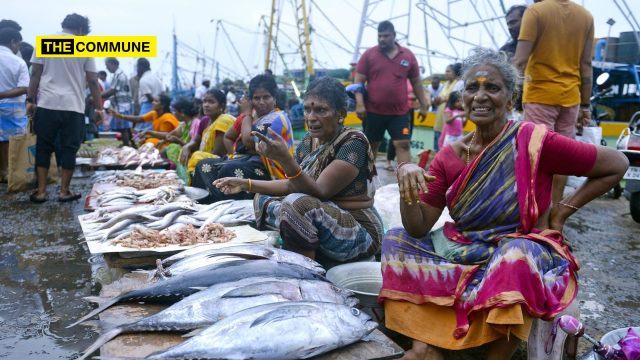
The fisheries sector has received a major boost under the latest GST reforms with a significant tax rate rationalisation which will help in the reduction of operational costs, enhance competitiveness in domestic and export markets, and directly benefit millions of fish farmers and other stakeholders dependent on fishing and aquaculture for their livelihoods in the country, an official statement said on 4 September 2025.
Under the revised structure, GST on fish oils, fish extracts, and prepared or preserved fish and shrimp products has been reduced from 12 per cent to 5 per cent, making value-added seafood more affordable for domestic consumers and enhancing the competitiveness of India’s seafood exports, said Ministry of Fisheries, Animal Husbandry and Dairying.
Diesel engines, pumps, aerators, and sprinklers, essential for aquaculture operations and hatcheries, will now attract only 5 per cent GST instead of the earlier 12 to 18 pe rcent, significantly reducing operational costs for fish farmers. Critical chemicals such as ammonia and micronutrients used in pond preparation and water quality management will also be taxed at 5 per cent, down from the earlier 12 to 18 per cent, cutting costs of feed, pond conditioning, and farm-level practices.
Reduced GST on preserved fish, shrimp, and molluscs will strengthen India’s seafood exports globally while promoting greater domestic consumption of safe and hygienically processed seafood. The GST rate on fishing rods, tackle, landing nets, butterfly nets, and gear has been reduced from 12 per cent to 5 per cent, benefiting both recreational, sport fishing as well as small-scale aquaculture and capture fisheries farmers. This will make essential gear more affordable, lowering input costs and supporting livelihoods in the sector. The decision further provides relief to processing units, with GST on job work services in food and agro-processing, including seafood, cut from 12 per cent to 5 per cent.
Composting machines, vital for producing organic manure and ensuring eco-friendly pond management, will now be taxed at 5 per cent, encouraging sustainable aquaculture practices, said the ministry. India’s fisheries and aquaculture sector has emerged as one of the fastest-growing in the world, contributing significantly to food and nutritional security, farmer incomes, rural livelihoods, and exports.
The sector today supports the livelihood of over 3 crore people and has positioned India as the second-largest fish producer globally with a production of nearly 195 lakh tonnes (2024-25). India is also the largest shrimp exporter in the world, with seafood exports crossing Rs. 60,000 crores in 2023-24, thereby earning valuable foreign exchange and strengthening the nation’s Blue Economy.
-IANS
Subscribe to our channels on Telegram, WhatsApp, and Instagram and get the best stories of the day delivered to you personally.