Home Blog Page 234

Dravidian Model Tamil Nadu Ranks Second In Revenue Deficit States, Yogi Model UP Tops Revenue Surplus List: CAG Report Reveals

TN Ranks Second In Revenue Deficit States, UP Tops Revenue Surplus List CAG Report Reveals

The Comptroller and Auditor General of India (CAG) has released its decadal report on state finances, highlighting a sharp contrast in fiscal health across the country. While 16 states ended 2022-23 with revenue surpluses, 12 others posted deficits, with Tamil Nadu ranking second-worst after Andhra Pradesh.

UP Tops Revenue Surplus List

Uttar Pradesh led the surplus states, reporting a revenue surplus of ₹37,000 crore in 2022-23, shedding its “Bimaru” tag. Madhya Pradesh also joined the surplus list, marking a turnaround for another state historically considered economically weak.

Other major surplus states included:

  • Gujarat: ₹19,865 crore
  • Odisha: ₹19,456 crore
  • Jharkhand: ₹13,564 crore
  • Karnataka: ₹13,496 crore
  • Chhattisgarh: ₹8,592 crore
  • Telangana: ₹5,944 crore
  • Uttarakhand: ₹5,310 crore
  • Goa: ₹2,399 crore

Several northeastern states – Arunachal Pradesh, Manipur, Mizoram, Nagaland, Tripura, and Sikkim – also figured in the revenue surplus category. Of the 16 surplus states, at least 10 are governed by the BJP, which the report notes may reflect political stability’s role in fiscal health.

TN Among Worst Deficit States

On the deficit side, Andhra Pradesh posted the largest shortfall of ₹43,488 crore, followed by Tamil Nadu at ₹36,215 crore. Other deficit states included:

  • Rajasthan: ₹31,491 crore
  • West Bengal: ₹27,295 crore
  • Punjab: ₹26,045 crore
  • Haryana: ₹17,212 crore
  • Assam: ₹12,072 crore
  • Bihar: ₹11,288 crore
  • Kerala: ₹9,226 crore
  • Himachal Pradesh: ₹6,336 crore
  • Maharashtra: ₹1,936 crore
  • Meghalaya: ₹44 crore

The CAG flagged that West Bengal, Kerala, Himachal Pradesh, and Punjab are increasingly dependent on Revenue Deficit Grants from the Centre to bridge gaps.

Central Assistance and Deficit Grants

In FY23, the Finance Commission allocated ₹1,72,849 crore in grants to states, of which ₹86,201 crore went specifically for revenue deficit financing. The biggest recipients were:

  • West Bengal: 16% of total grants
  • Kerala: 15%
  • Andhra Pradesh: 12%
  • Himachal Pradesh: 11%
  • Punjab: 10%

States Strengthening Own Revenues

Some states, however, have managed to fund most of their spending from their own tax and non-tax collections. The leaders were:

  • Haryana: 80%+ of revenue from own sources
  • Telangana: 79%
  • Maharashtra: 73%
  • Gujarat: 72%
  • Karnataka: 69%
  • Tamil Nadu: 69%
  • Goa: 68%

By contrast, northeastern states, Bihar, and Himachal Pradesh generated less than 40% of revenue internally, making them heavily reliant on central transfers.

Own Tax Revenue Patterns

The report further noted that six states – Haryana, Maharashtra, Telangana, Karnataka, Gujarat, and Tamil Nadu collected over 60% of their revenue from their own taxes.

Northeastern states such as Arunachal Pradesh, Manipur, Meghalaya, Mizoram, Nagaland, Sikkim, and Tripura recorded below 20% own tax revenue, underscoring their dependence on central support.

Other groupings included:

  • 60–70%: Karnataka, Tamil Nadu, Goa, Kerala
  • 50–60%: Andhra Pradesh, Rajasthan, Punjab, Chhattisgarh
  • 40–50%: Jharkhand, Madhya Pradesh, Uttar Pradesh, West Bengal, Uttarakhand

Key Revenue Sources

The CAG identified major streams of state revenue as:

  • State GST (SGST)
  • Value Added Tax (VAT)
  • Excise duties on alcohol, petroleum products, and electricity (outside GST purview)

(With inputs from Indian Masterminds)

Subscribe to our channels on Telegram, WhatsApp, and Instagram and get the best stories of the day delivered to you personally.

Kerala High Court’s Polygamy Verdict: A Sharia Sermon At Taxpayers’ Expense

Kerala High Court’s Polygamy Verdict - A Sharia Sermon At Taxpayers’ Expense

The Kerala High Court’s recent judgment in the case of a 46-year-old beggar seeking polygamy has left many Indians bewildered; both by the facts of the case and the reasoning of the bench. Instead of grounding its decision firmly in the Constitution and the law of the land, the court veered into interpreting the Quran, lecturing on monogamy, polygamy, and Muslim customary law. Last we heard, India was a secular republic and not a Sharia state. But with this judgement, it surely seems there are Sharia courts all around and Sharia law, rather than the Constitution, is what frames the basis of judgements!

If one reads through the judgement, one can conclude that milords have “virtually assumed the theological authority to determine which tenets of a faith are essential to any faith”, as observed by constitutional scholar Rajeev Dhavan.

What Was The Case About?

The facts are stark. A Muslim man who is blind, by his own admission a beggar, marries a second time and intends to marry a third time. When his wife approaches the court for maintenance, the court faces a simple question: Can a man with no means be allowed to evade his responsibilities by hiding behind religious custom? The answer, in any constitutional democracy, should have been a resounding no. Instead, Justice PV Kunhikrishnan embarked on a theological deep dive, interpreting the Quran to conclude that polygamy is an “exception” and that this particular beggar wasn’t following the “true spirit” of the holy text.

The job of the court was straightforward: apply constitutional and statutory law to decide whether a man with no means can shirk his duty of maintenance. Instead, Justice PV Kunhikrishnan chose to interpret the Quran, effectively treating religious scripture, not the Constitution, as the primary authority.

The Taxpayer Subsidy for Religious Choices

The judgment’s implications go further. The court directed the Social Welfare Department to provide the petitioner wives, victims of a man’s deliberate choices, with food and clothing. Wait a minute.

The court’s order effectively creates a perverse incentive: a Muslim man can marry multiple women with zero capacity to support them, and when his wives are left destitute, the state meaning you and I, will pick up the tab.

By directing the state to support the wives, the judgment socializes the costs of one man’s private choices. The message is perverse: a husband may contract multiple marriages without means to support them, while the taxpayer – Hindu, Muslim, Sikh, Christian alike is conscripted as a surrogate provider.

This judicial Solomon has essentially declared that when a Muslim man makes personal religious choices, the burden falls on the state and, by extension, on taxpayers who had no role in these matrimonial decisions! Welcome to Sharia Republic!

The husband in this case reportedly earns ₹25,000 monthly through various means including begging. If he possesses the financial capacity to sustain multiple marriages, a right his personal law ostensibly grants, why should the secular state subsidize the consequences? The court has effectively socialized the costs of religious practices, forcing Hindu, Sikh, Christian, and other taxpayers to fund the lifestyle choices permitted under Islamic personal law.

The court’s logic, that a blind beggar cannot be forced to maintain his wife, so society must step in – this is a dangerous inversion of accountability. The man, despite his claim of begging as livelihood, earns enough from various sources to support a modest lifestyle. If he is able to generate income, why should the state, funded by ordinary citizens’ taxes, subsidize his failure to uphold his marital obligations?

The Real “Robots” Would Have Followed the Constitution

The judge notably said, “judges are not robots.” True. But robots would have followed their core programming without deviation. In this case, the core programming for a judge is the Constitution. A truly courageous court would have done two things – upheld the supremacy of constitutional morality over religious personal law, especially in cases involving destitution and gender justice and enforced the husband’s liability by attaching his admitted earnings of ₹25,000, proving that no one, not even a beggar, is above the law.

Instead, the court took the path of least resistance – moralizing about the Quran and writing a blank check on the public exchequer. This judgment sets a dangerous precedent. It tells Muslim men that they can contract multiple marriages without the means to sustain them, and it tells women that their recourse is not against their husband, but a plea for alms from the state.

The Kerala High Court has not delivered justice. It has delivered an Islamic Sharia-compliant sermon, rewarded fecklessness, and punished the common citizen. If this is the new norm, we might as well replace the scales of justice with a begging bowl.

Subscribe to our channels on Telegram, WhatsApp, and Instagram and get the best stories of the day delivered to you personally.
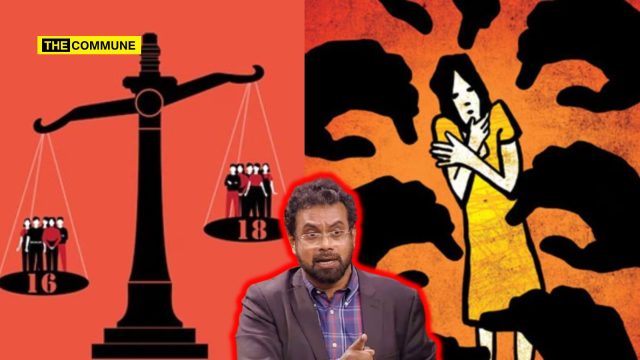
“We’ve To Give Him Rajya Sabha Seat Next”: Dravidianist Spokie Karu Palaniappan Hints At Vijay Joining DMK In The Near Future

vijay stalin dmk karu pazhaniappan kamal haasan rajya sabha

Dravidianist filmmaker and unofficial DMK spokesperson Karu Palaniappan has sparked controversy with his recent statement, saying he would not criticize actor Vijay, as he expects Vijay will also join the DMK in near future and be offered a Rajya Sabha seat. His comment, seen as both a sarcastic dig at Vijay and a veiled swipe at actor-turned-part-time-politician Kamal Haasan, who accepted a Rajya Sabha nomination through the DMK ticket by mortgaging his party Makkal Needhi Maiam (MNM) recently. The statement not only drew attention but also prompted a response from a DMK minister, who acknowledged that Palaniappan’s words had created ripples within the DMK alliance.

The controversial statement was made during a DMK public meeting held near the Anna statue in Tirupattur, Sivaganga district. Themed “I Will Not Let Tamil Nadu Bow Down” and “Oraniyil Tamil Nadu,” the event was chaired by DMK Minister for Cooperatives, K. R. Periyakaruppan.

Addressing the gathering, Karu Palaniappan claimed that over 5 lakh people from the Sivaganga district had joined the ‘Oraniyil Tamil Nadu campaign’. He noted that actor Vijay had recently voiced political opinions aligned against Hindi imposition a stance DMK has long championed and implied that Vijay may align with the DMK in the future hence he refuses to criticize him.

He said, “The Vijay who has come today is also starting by saying ‘we won’t allow Hindi.’ That’s what we’ve been saying. Why don’t you just come and stand with us? Why are you setting up a separate shop? You should only set up a separate shop if you’re selling a new item. We’ve been saying the same thing. Come here. Do you know why I don’t talk (criticize) about Vijay too much? I never talk about him anywhere. It’s because we have to give him a Rajya Sabha seat next time. He’ll be here. If he comes, we have to give him the Rajya Sabha seat. If we rush and talk about it now, it’ll be like the movie Paruthiveeran where, when he comes to eat next month, should we look down at the leaf and pour kulambu (curry)? Shouldn’t we be able to look at their faces and smile? That’s why we shouldn’t say anything in a hurry. You all come.”

Following Palaniappan’s remarks, Minister Periyakaruppan added fuel to the fire by invoking actor-politician Kamal Haasan. He stated that none of today’s actors could compare to Kamal, who once aspired to enter politics independently but eventually accepted a Rajya Sabha seat through the DMK a reference many interpreted as reinforcing Palaniappan’s veiled criticism.

Minister Periyakaruppan said, “Among the actors of today, Kamal Haasan is someone who has received many awards to the extent that one could say there is no other actor like him in this country. He also had a desire to start a political movement and so he started it. He made an attempt. It was only after realizing that his attempt could not achieve complete success that our leader embraced him and gave him the position of a Member of Parliament, a Rajya Sabha member. That’s what brother Palaniappan has so eloquently stated.”

The meeting concluded with Karu Palaniappan, Minister Periyakaruppan, DMK district leaders, and the gathered public reaffirming their commitment to the Tamil Nadu pledge under the “Oraniyil Tamil Nadu” campaign.

(With inputs from Puthiyathalaimurai News)

Subscribe to our channels on TelegramWhatsApp, and Instagram and get the best stories of the day delivered to you personally.
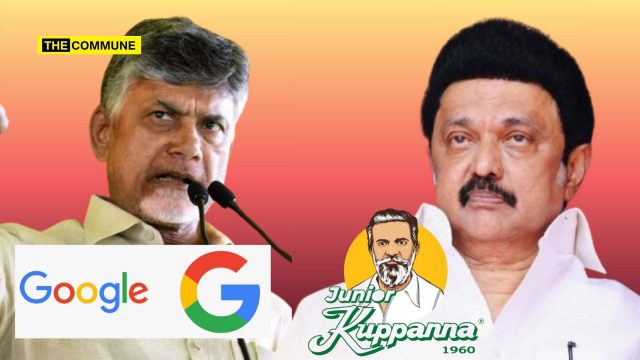
“How Many More Deaths Will Wake You Up?” : BJP Leader Annamalai Blasts DMK Over Trichy Sanitation Workers’ Death

annamalai dmk sanitation worker

BJP leader K. Annamalai has sharply criticised the DMK government following the tragic deaths of two sanitation workers in Trichy, who died of asphyxiation while cleaning a drainage system. In a strongly worded statement on social media, Annamalai questioned the state’s inaction on preventing such avoidable fatalities, asking Chief Minister M.K. Stalin, “How many more deaths will wake you up, Thiru @mkstalin?”

The two deceased Prabhu from Chinna Salem and Ravi from Thiruvappur in Pudukkottai were reportedly contract workers engaged in manual sewer cleaning when they were overcome by toxic gases. Prabhu collapsed first, and Ravi, in a desperate attempt to save him, also lost consciousness. Both were pulled out by firefighters but were declared dead at the hospital. The Thiruverumbur police have registered a case and are currently investigating the incident.

Calling the DMK government a “patchwork model,” Annamalai condemned its continued use of manual labour in hazardous conditions without adequate safety gear, despite manual scavenging being banned under the 2013 Prohibition of Employment as Manual Scavengers and Their Rehabilitation Act. He demanded immediate compensation of ₹40 lakh for each of the bereaved families and accused the government of prioritising publicity over public safety. He also criticised the state administration for failing to adopt robotic alternatives like HomoSEP and Sepoy, developed by IIT Madras to eliminate manual scavenging.

Full statement of K Annamalai read, “How many more deaths will wake you up, Thiru @mkstalin? The tragic death of two sanitation workers in Thiruverumbur, Trichy, due to poisonous gas while cleaning a sewer is deeply shocking. Extending my deepest condolences to their families and urge the DMK government to provide immediate compensation of ₹40 lakhs to each of the bereaved families. Under this patchwork model, publicity-driven DMK Government, TN leads the nation in such avoidable deaths, and continues to deploy workers without even basic protective gear. Nearly 50 lives have been lost in the past three years alone, while the government spends lavishly on publicity instead of safeguarding those at the frontline of public health. IIT Madras students have already developed robots like HomoSEP and Sepoy to eliminate manual scavenging. Why has the DMK government failed to adopt them? TN CM Thiru @mkstalin avl only finds time to build statues and fight legal battles for building statues for his father yet cannot allocate funds to protect sanitation workers.” 

The broader context of the criticism comes at the backdrop of national data that highlights the ongoing danger of manual scavenging. Between 2020 and 2024, 294 deaths related to sewer and septic tank cleaning were reported in India, with Tamil Nadu, Uttar Pradesh, and Delhi among the states with the highest numbers. Despite the legal ban, unsafe practices continue to endanger workers’ lives across the country.

Subscribe to our channels on TelegramWhatsApp, and Instagram and get the best stories of the day delivered to you personally.
“We Pay ₹20 For An Ice-Cream But Won’t Pay ₹1 More For A Kilo Of Wheat”: When Chidambaram As Finance Minister Justified Rising Inflation

BJP Mocks Chidambaram Article, Says 'No One except Congress Is Interested In His Knowledge'

For the past few days, old videos of former Union Home Minister P Chidambaram have been making the rounds on the internet. Be it is statements on the Maoists or the most recent one justifying inflation, they are an eye-opener for the incoming group of adults who know nothing about the UPA era regime.

In the video that is circulating, Chidambaram in 2012 is seen saying, “… the point of view of the middle class that most of the people belong to, there are many other sections. Yes, food inflation is high. Sometimes, I have written about this once, we are prepared to pay ₹15 for a bottle of water but we will not bear ₹1 increase in price of a kilo of rice or a kilo of wheat. We are prepared to pay ₹20 for an ice-cream cone but won’t pay ₹1 more for a kilo of wheat or a kilo of rice.”

Subscribe to our channels on TelegramWhatsApp, and Instagram and get the best stories of the day delivered to you personally.
Rahul Gandhi’s Aide Spills The Beans About Congress’ Sinister Plan Of Anarchy, Goes On Tweet Rant To Cover Up Blunder

Rahul Gandhi's Aide Spills The Beans About Congress' Sinister Plan Of Anarchy, Goes On Tweet Rant To Cover Up Blunder

In a stunning revelation that has sent shockwaves across political circles, Congress strategist and longtime Rahul Gandhi aide Yogendra Yadav (known as Salim to his friends) inadvertently exposed the real intentions behind the party’s infamous “vote chori” campaign.

During an interview with Arfa Khanum Sherwani on The Wire, released on 20 September 2025, Yadav admitted that the Congress-led campaign against the Election Commission and the BJP was never about evidence, affidavits, or legal recourse. Instead, he candidly revealed that the exercise was purely a psychological maneuver aimed at manipulating public perception and sowing doubt in the minds of Indian voters about Prime Minister Narendra Modi and the electoral system.

A Campaign Designed to Undermine Democracy

Yadav made it clear that submitting affidavits or going to court is “meaningless” because the purpose was not to prove facts but to influence public sentiment. He acknowledged that Rahul Gandhi’s persistent narrative had already shaped perception, even causing doubt among BJP supporters themselves. “Public perception is syncing with this, and to that extent, Rahul Gandhi has succeeded so far,” Yadav stated, confirming what political analysts have long suspected: the campaign was a strategic ploy to destabilize trust in India’s democratic institutions rather than a legitimate complaint.

This admission lays bare the Congress party’s modus operandi of leveraging the Election Commission, media channels, and orchestrated public rallies not to correct electoral errors but to deliberately tarnish reputations and create a climate of distrust. Yadav even claimed that anti-BJP and neutral voters were beginning to view the ruling party with skepticism, a direct objective of the campaign.

The Party Scrambles to Contain the Fallout

The fallout from Yadav’s candid disclosure has reportedly left the Congress high command furious. After this video became viral, Yadav launched a series of justifications and defensive statements on X to cover up the blunder, claiming misinterpretation and stressing “public discourse” rather than admitting to the strategic manipulation.

Analysts note that these reactive measures are unlikely to undo the damage, as Yadav essentially confirmed that the party has been using fabricated or unverified data to weaken democratic institutions.

Historical Context: Rahul Gandhi’s Agenda

This revelation is consistent with Rahul Gandhi’s infamous 2019 interview with India Today, where he openly stated, “I am going to rip that strength to pieces. I am going to take it and shred it,” referring to PM Modi’s credibility. The Congress party has continued in this vein, orchestrating campaigns, press conferences, and political rallies aimed at undermining the BJP and its governance without providing evidence to support their claims.

The “vote chori” campaign, with its relentless focus on alleged voter fraud, the Special Intensive Revision (SIR) drive in Bihar, and charges of voter disenfranchisement, is merely an extension of this strategy. Despite repeated requests from the Election Commission, neither Rahul Gandhi nor his allies, including Yadav, have submitted affidavits or proof, reinforcing the fact that perception management, not truth, drives the campaign.

By openly admitting that the campaign’s primary goal is to manipulate perception, Yadav has inadvertently revealed the Congress’ willingness to compromise democratic institutions for political gain.

Yogendra Yadav’s unguarded statements have pulled back the curtain on the Congress party’s “vote chori” campaign, exposing it as a calculated attempt to undermine trust in India’s democratic processes rather than a genuine concern about electoral fairness. In the wake of his accidental confession, the party is scrambling to control the narrative through social media defenses and public justifications, but the damage is already done. This only proves that the Congress’ strategy is no longer just political opposition but an orchestrated attempt to destabilize democracy, create anarchy, through manipulation and fear.

(With inputs from OpIndia)

Subscribe to our channels on Telegram, WhatsApp, and Instagram and get the best stories of the day delivered to you personally.
High Inflation Under UPA, Record-Low Prices Under NDA In 2025: India’s Economic Leap

High Food Inflation Under UPA, Record-Low Prices Under NDA In 2025 India’s Economic Leap

A 2012 video of former Union Home Minister is making the rounds on social media. In the video, he is seen saying, “… the point of view of the middle class that most of the people belong to, there are many other sections. Yes, food inflation is high. Sometimes, I have written about this once, we are prepared to pay ₹15 for a bottle of water but we will not bear ₹1 increase in price of a kilo of rice or a kilo of wheat. We are prepared to pay ₹20 for an ice-cream cone but won’t pay ₹1 more for a kilo of wheat or a kilo of rice.”

In 2012, Union Home Minister P. Chidambaram projected that India would soon return to a high growth trajectory, citing measures taken by the United Progressive Alliance (UPA) government to reboot the economy. At that time, India faced significant economic challenges, including high inflation rates and a sluggish growth outlook.

Inflation in 2012: A Pressing Concern

In 2012, India grappled with elevated inflation levels. For instance, the Wholesale Price Index (WPI) inflation stood at 7.52% in August 2012, indicating significant price pressures across the economy. In 2012, India’s annual inflation rate based on the WPI was 7.25% in June, 6.87% in July, and 9.65% in September.

The Consumer Price Index (CPI) inflation was also high, reflecting the strain on household budgets and the broader economy.

Economic Growth in 2012: A Mixed Picture

In 2011-12, the country achieved a GDP growth rate of 6.8%. However, Chidambaram admitted that a growth rate of 6.5% in 2011-12 was insufficient for a developing country like India, where millions of people remained in poverty. He stressed the necessity for higher growth rates, aiming for over 8% or even 9%, to create jobs and improve living standards.

Inflation in 2025: A Remarkable Turnaround

Fast forward to August 2025, and India has witnessed a significant decline in inflation rates.

The significant reduction in food prices, particularly vegetables, has alleviated the cost burden on consumers, leading to the lowest inflation rates in years. This improvement suggests that the measures implemented by the current government have effectively addressed the inflationary pressures that were prevalent during the UPA era.

In July 2025, retail inflation dropped to a record low of 1.55%, the lowest in over eight years, driven primarily by a significant reduction in food prices, including a 20.69% year-on-year decline in vegetable prices. This marks the first time in over six years that inflation has slipped below the Reserve Bank of India’s (RBI) target tolerance band of 2% to 6%.

The CPI inflation stood at a modest 2.07%, down from the highs of 2012. This decrease is attributed to various factors, including improved supply chains, effective monetary policies, and favorable global commodity prices.

The WPI inflation also reflected this positive trend, registering at 0.52% in August 2025. This indicates a stabilization in wholesale prices, contributing to the overall economic stability.

Economic Growth in 2025: Sustained Momentum

India’s economy has demonstrated robust growth in recent years. In August 2025, the core infrastructure sectors grew by 6.3%, marking the highest rate in 13 months. This growth was driven by strong performances in coal, steel, and cement production, signaling a recovery in key industrial sectors.

Additionally, the Reserve Bank of India (RBI) economists have supported a pause in policy rate adjustments, citing the recent decline in inflation and continued robust economic growth. This stance reflects confidence in the economy’s resilience and the effectiveness of current monetary policies.

The comparison between 2012 and 2025 indicates India’s remarkable economic transformation. From grappling with high inflation and sluggish growth under the UPA, the country has made significant strides toward economic stability and growth under the successive Modi governments.

(With inputs from NDTV)

Subscribe to our channels on Telegram, WhatsApp, and Instagram and get the best stories of the day delivered to you personally.
Axis Bank Tries To Christianize Navratri Celebrations By Inserting Santa Claus In Promo Video, Deletes Video From X Handle After Backlash

Axis Bank Tries To Christianize Navratri Celebrations By Inserting Santa Claus In Promo Video, Deletes Video From X Handle After Backlash

Axis Bank has sparked widespread outrage with its new advertisement campaign, Dil Se Open Celebration 2025, for featuring Santa Claus amid Navratri Garba celebrations and Diwali lights. The ad, released on the occasion of Navratri, shows a Garba dance in full swing when Santa Claus suddenly makes an appearance to promote Axis Bank’s credit card and EMI offers, running from Navratri through Diwali and extending to Christmas.

In the advertisement, Santa, typically associated with Christmas, appears in the midst of Hindu festivals, seemingly to convey a message of “festivals belong to everyone” and “celebrations should transcend religious boundaries.” Many viewers, however, saw it as an unwarranted insertion of a Christian symbol into Hindu traditions.

Critics argue that Axis Bank is following a familiar marketing playbook, using Hindu festivals as platforms to preach “secularism” while leaving other religious festivals untouched. Observers pointed out similar patterns in previous campaigns, such as Tanishq’s controversial 2020 Diwali ad, which drew backlash for highlighting interfaith relationships during Hindu celebrations.

Following the backlash, Axis deleted the video from their X handle.

Netizen Reactions

Netizens expressed their anger and frustration at Axis Bank for making such an advertisement especially during the holy festival of Navratri.

The campaign has triggered an online uproar, with social media users accusing Axis Bank of “Christianising” Hindu festivals and calling for the ad to be withdrawn. On Twitter/X, hashtags demanding a boycott of Axis Bank began trending.

 (With inputs from OpIndia)

Subscribe to our channels on TelegramWhatsApp, and Instagram and get the best stories of the day delivered to you personally.
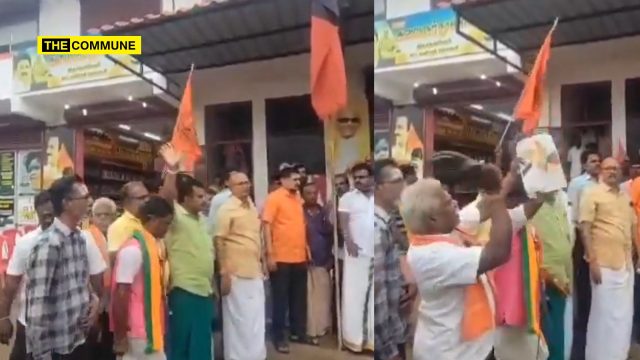
“Nastik Dramacharis”: BJP Leader Annamalai Blasts Kerala CM Pinarayi Vijayan And TN CM M.K. Stalin At Sabarimala Samrakshana Sangamam

Former Tamil Nadu BJP president K. Annamalai, launched a scathing attack against Kerala’s Chief Minister Pinarayi Vijayan and Tamil Nadu’s Chief Minister MK Stalin during his speech at the Sabarimala Samrakshana Sangamam, an event supported by thousands of Hindu devotees and various Hindu organizations.

In his speech, Annamalai accused both leaders of exploiting temple platforms while actively opposing Sanatana Dharma aka Hinduism. He also took aim at the communist government’s Global Ayyappa Sangamam and the DMK-led state’s Global Muruga Conference and labelled them as for vote bank politics.

“On September 20th, we all witnessed a surprising event. The Communist government of Kerala organized a festival called the Global Ayyappa Conference to unite Ayyappan devotees from all over the world. What was very surprising was who they invited as the chief guest for this event. The current Chief Minister of Tamil Nadu, M. K. Stalin, who wants to eradicate Sanatana Dharma, and his son Udhayanidhi Stalin, who, two years ago in Chennai, held an event where he compared Sanatana Dharma to dengue mosquitoes and said it should be eliminated. When the Chief Minister of Kerala, Pinarayi Vijayan, invited M. K. Stalin as the chief guest for this event, it was clear to us that this was not an event for Lord Ayyappan. It was an event organized to deceive people and gain votes in politics” Annamalai said.

Annamalai fiercely criticized the two leaders, labeling them as “nastik dramacharis,” accused them of exploiting platforms meant for devotees while simultaneously opposing Sanatana Dharma. He also recalled the attempts made by Pinarayi’s government in 2018-19 to force the Supreme Court’s ruling, which lifted the ban on women aged between 10 and 50 from entering the Sabarimala temple.

Annamalai took a pointed jab at Vijayan, saying, “What’s surprising is that a person who says there is no God, a person who does not believe in God, Mr. Vijayan, came to the stage and lectured us about the Bhagavad Gita. I thought, ‘What happens when communists in Kerala start reading the Bhagavad Gita?’ He read the 12th chapter of the Bhagavad Gita and quoted, ‘Adveshta sarva-bhutanam maitrah karuna eva ca.’

Vijayan is teaching us how a devotee should be. Who lectures us? Atheist Vijayan. But the problem is, he didn’t read beyond the 12th chapter. I would like to tell Vijayan something else from the Bhagavad Gita. Go beyond the 12th chapter, go to chapters 13, 14, 15, and 16, to the 21st verse. Vijayan should take out the Bhagavad Gita and read this verse again: ‘Trividham narakasyedam dvaram nasanam atmanah kamah krodhas tatha lobhas tasmat etad trayam tyajet.’ He should read this. It says that a person who wants to go to hell has only three paths: lust, anger, and greed. Lust will quickly take you to hell. Greed will quickly take you to hell. Anger will quickly take you to hell. These three things are present in Kerala’s Communist government today.”

Referring to the ancient Tamil poet Tiruvalluvar, Annamalai remarked that betraying the trust of one’s people and misusing authority was far more heinous than murder. “In 2018-19, the way Vijayan behaved in this region of Pandalam in Kerala, the way he treated the people… Just for the sole reason of having power, he created so many problems for lakhs of Ayyappa devotees. So, whether this applies to anyone else or not, it definitely applies to Vijayan,” Annamalai asserted.

He did not stop there, he also slammed Tamil Nadu’s HR&CE department saying, “You might have recently watched a Netflix series called ‘Scam 1992’ about how two people worked together to scam the Bombay Stock Exchange. Today in India, two people are doing something similar: one is Stalin and the other is Vijayan. In Tamil Nadu, Hindu temples are managed by the TN HR&CE (Hindu Religious and Charitable Endowments) Department. In 1985, the HR&CE had 525,000 acres of land. In 40 years in the 46,000 temples managed by HR&CE it has lost 125,000 acres of that land and right now we have 4 lakh acres. The Tamil Nadu government cannot find out what happened to these 125,000 acres. Our HR&CE Minister, Sekar Babu, came to this Ayyappan meeting on behalf of the Tamil Nadu government. He’s asking, ‘Just give us five acres of land in Pandalam.’ What’s surprising is that 125,000 acres of land are missing in Tamil Nadu, yet the minister who came to the Global Ayyappa Conference on September 20th is asking for five acres for Tamil Nadu. Why? To steal more? To add to the 125,000 acres of land? My dear friends, we need to carefully watch what is happening. A group is united and organizing this event just to deceive us. We need to ask the important question, who is politicizing God? Is it us, or is it the government, especially the Communist party?”

The event also featured prominent BJP leaders such as Tejasvi Surya, Rajeev Chandrasekhar, Kummanam Rajasekharan, and others from various Hindu organizations. The atmosphere was charged with chants in praise of Lord Ayyappa, the presiding deity of the Sabarimala Temple. P.N. Narayana Varma, former secretary of the Pandalam Palace Trust, played a key role as one of the organizers.

The gathering, supported by several Hindu organizations, served as a counter-event to the Communist governments’ Global Ayyappa Sangamam held at Pampa on 20 September 2025.

Subscribe to our channels on TelegramWhatsApp, and Instagram and get the best stories of the day delivered to you personally.
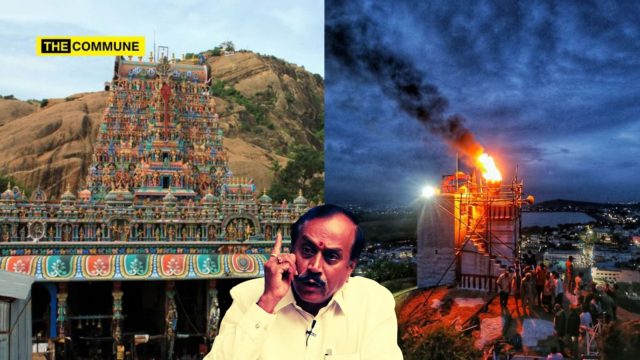
“Mutton Shop Organizing Welfare Programme For Goats”: BJP MP Tejasvi Surya Attacks Kerala Communist Govt On Global Ayyappa Summit

“Devil Quoting Scripture”: BJP MP Tejasvi Surya Attacks Kerala Communist Govt On Global Ayyappa Summit

Ayyappa devotees gathered at Pandalam on Monday in a counter-event to the Global Ayyappa Summit organised by the Kerala LDF government and Travancore Devaswom Board at Pamba. Led by the Sabarimala Karma Samithi, the Sabarimala Samrakshana Sammelanam was attended by political, spiritual, and Hindu organisational leaders. BJP figures including Karnataka MP Tejasvi Surya, former TN BJP chief K. Annamalai, and Union minister Rajeev Chandrasekhar accused Chief Minister Pinarayi Vijayan of hypocrisy, alleging attempts to hoodwink devotees and commercialise Sabarimala.

Speaking at the gathering, BJP MP from Karnataka Tejasvi Surya launched a scathing attack on the Kerala government, calling the Global Ayyappa Sangamam organised by the LDF regime and Travancore Devaswom Board “ironic” and “hypocritical.” He said that an atheist communist government holding an Ayyappa conference was equivalent to “the devil quoting scripture” or “a mutton shop organising a welfare programme for goats and chickens.”

Surya, who attended the event alongside former Tamil Nadu BJP chief K Annamalai, began his address by paying respects to the puja swamis on stage and the Ayyappa devotees present. Speaking on the first day of Navaratri, he described the occasion as the start of establishing a dharma samraajya in Kerala.

He said he was surprised to learn that the atheist, anti-Hindu communist government was organising a global Ayyappa conference and called it a “drama” aimed at hoodwinking devotees. Citing Karl Marx and Joseph Stalin’s description of religion as “the opium of the masses,” he argued that communists, by doctrine, opposed faith in God, and therefore had no moral right to organise a religious conference.

Surya claimed that photographs of the state-sponsored conference showed empty chairs, while the Pandalam event was filled with thousands of genuine devotees. He accused Chief Minister Pinarayi Vijayan of inviting Tamil Nadu Chief Minister M. K. Stalin to the Sangamam, and questioned why Karnataka Chief Minister Siddaramaiah was not invited. Surya remarked that had Siddaramaiah joined, the list of “anti-Hindu leaders” from the three southern states, Kerala, Tamil Nadu, and Karnataka would have been complete, calling them “the trimurtis of anti-Hindu politics.”

He drew parallels between the Kerala event and the recent controversy in Karnataka’s Dharmasthala temple, where allegations of mass burials were raised by a YouTuber and a masked former employee. Surya alleged that activists, lawyers, and journalists with communist leanings created a conspiracy to discredit the temple by demanding an SIT probe into claims of “1,000 murders.” He recounted that despite 16 days of police excavations across identified sites, not a single bone or skeleton was recovered. Tejasvi said that the Siddaramaiah government’s anti-Hindu mindset was exposed, and its subsequent attempts to portray devotion were merely political drama.

Extending the comparison to Sabarimala, he said that the same “duplicity” was at play in Kerala, where those who once attempted to destroy temples were now claiming to protect traditions. He stated that both he and Annamalai had come not as guests but as representatives of millions of Ayyappa devotees from Karnataka and Tamil Nadu.

Turning to infrastructure issues, Surya criticised the Kerala government’s 50-year master plan for Sabarimala. He said the temple receives donations of around ₹400 crore annually, yet the government had budgeted only ₹1,000 crore over five decades. He argued that in four years, donations would surpass that figure and accused the government of showing more urgency in scams than in providing basic facilities like clean toilets, a maintained Pamba River, and adequate dharmashalas for pilgrims.

He described the communists as “fraudsters” who mask themselves with words like “democratic” and “liberal” while being neither. He asserted that leaders such as Siddaramaiah in Karnataka, Stalin in Tamil Nadu, and Vijayan in Kerala were “wearing the same anti-Hindu mask” and needed to be exposed.

Surya demanded that before the Kerala government claimed moral authority to organise a global conference, it must first withdraw its affidavit in the Supreme Court opposing Sabarimala traditions and file a fresh one supporting them. He also called for the withdrawal of thousands of cases filed against devotees during the 2017–18 namajapa protests.

Concluding his address, Surya declared that without fulfilling these conditions, the “atheist communist and anti-Sanatana dharma government” of Pinarayi Vijayan had no right to speak about Ayyappa or his devotees. He pledged that the “dharma yudha” that began on Navaratri would continue until the communist government in Kerala was “booted out” and replaced by a BJP government that respects traditions, with the blessings of devotees.


Subscribe to our channels on Telegram, WhatsApp, and Instagram and get the best stories of the day delivered to you personally.