Home Blog Page 162

Nikki Haley Warns Trump Against Damaging US-India Ties Over Tariffs, Russia Oil
nikki haley trump russian oil tariffs

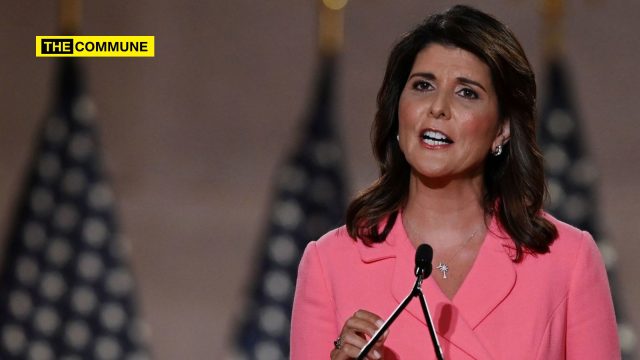
As tensions increase between Washington and New Delhi over US tariffs related to India’s purchase of Russian oil, former US Ambassador to the United Nations Nikki Haley has issued a firm warning.

She believes the bilateral relationship is at serious risk and called for a course correction, emphasising that strengthening ties with India is crucial if the US aims to counter China’s growing global influence. In an opinion piece published in Newsweek on Wednesday, Haley stressed that India should not be treated in the same category as China.

She cautioned the Trump administration against allowing disputes –such as tariff conflicts or the US role in India-Pakistan peace talks — to fracture the bond between two of the world’s largest democracies. The past few weeks have seen heightened strain in India-US relations.

The Trump administration recently imposed a 25 per cent tariff on India in response to its ongoing oil trade with Russia — this is in addition to existing duties on Indian imports. This move follows a period of growing disagreement, including India’s refusal to recognise a US role in mediating ceasefire efforts between India and Pakistan.

“To achieve the Trump administration’s foreign policy goals-outcompeting China and achieving peace through strength-few objectives are more critical than getting US-India relations back on track,” she wrote.

Nikki Haley criticised the Trump administration’s 25 per cent tariff threat on Indian goods and Russian oil imports, calling it counterproductive. “Trump is right to target India’s massive Russian oil purchases,” she noted, but warned that treating India like an adversary instead of a partner would be “a massive – and preventable – mistake”.

Though Haley has endorsed Trump for the 2024 election, she has continued to voice concerns when necessary. She noted that “India must be treated like the prized free and democratic partner that it is, not an adversary like China, which has thus far avoided sanctions for its Russian oil purchases, despite being one of Moscow’s largest customers.” “Scuttling 25 years of momentum with the only country that can serve as a counterweight to Chinese dominance in Asia would be a strategic disaster,” she warned.

She highlighted India’s role in diversifying global supply chains away from China, which is crucial for US economic resilience in the short term. “While the Trump administration works to bring manufacturing back to our shores, India stands alone in its potential to manufacture at a China-like scale for products that can’t be quickly or efficiently produced here, like textiles, inexpensive phones, and solar panels,” she wrote.

Haley also underlined India’s value in the defence sphere. Its deepening military ties with US allies, such as Israel, make India a key customer for American defence exports and a strategic asset for global security. India’s influence in the Middle East was also noted as significant.

As the US looks to reduce its military presence and expenditure in the region, India’s growing involvement could help stabilise the area. Additionally, India’s geographic position — critical to China’s trade and energy routes — adds to its long-term strategic importance, especially in the event of conflict.

“In the longer term, India’s significance is even more profound. Home to more than a sixth of humanity, India surpassed China as the world’s most populous country in 2023, with a young workforce that contrasts with China’s ageing one,” she wrote in Newsweek.

With the fastest-growing major economy, India’s ascent is shaping up to be the most geopolitically significant shift since China’s rise. Haley asserted that this growth presents one of the biggest challenges to China’s attempt to reshape the global order.

“Simply put, China’s ambitions will have to shrink as India’s power grows. Yet, unlike Communist-controlled China, the rise of a democratic India does not threaten the free world,” she added.

Earlier this month, on August 6, Haley also criticised the US for treating India unfairly while giving leniency to China. She argued that Washington should not risk damaging its relationship with a dependable ally. “India shouldn’t be buying oil from Russia, but China — our adversary and the leading buyer of both Russian and Iranian oil — received a 90-day break from tariffs,” Haley posted on X.

“Why penalise India while giving China a free pass?” Haley served as the US ambassador to the UN from January 2017 to December 2018 during Trump’s first term, becoming the first Indian American to hold a cabinet-level position in the US government. In 2023, she launched a bid for the presidency but ended her campaign in March 2024.

Her latest remarks come shortly after Trump criticised India as an unreliable trade partner and announced plans to impose significantly higher tariffs within 24 hours, citing India’s Russian oil purchases as support for the “war machine.”

However, on August 19, the Centre had said almost $50 billion worth of Indian goods will be affected once the 50 per cent tariff comes into effect on August 27. In a written reply to the Lok Sabha regarding a question on the impact of Donald Trump’s tariffs, Minister of State for Commerce and Industry Jitin Prasada said that around $48.2 billion of India’s merchandise exports will be subject to the additional tariffs.

-IANS

Subscribe to our channels on TelegramWhatsApp, and Instagram and get the best stories of the day delivered to you personally.

India Conducts Successful Agni-V Test, Validates Strategic Readiness

agni-v ballistic missile india success

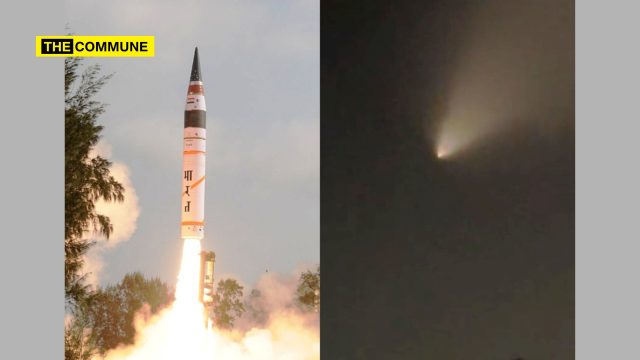
In a significant boost to India’s strategic defence arsenal, the nuclear-capable Agni-V intermediate-range ballistic missile was successfully test-fired on Wednesday from the Integrated Test Range (ITR) in Odisha’s Chandipur, the Ministry of Defence said.

In a statement, the ministry said: “The intermediate-range ballistic missile Agni-5 was successfully test-fired from Chandipur on August 20. The launch validated all operational and technical parameters and was conducted under the aegis of the Strategic Forces Command.” The missile tested on Wednesday is a variant of India’s indigenously developed ICBM Agni-V.

While traditionally reported to have a range of over 5,000 km, defence officials have noted that an upgraded version with a range of up to 7,500 km is currently under development by the Defence Research and Development Organisation (DRDO). The Agni-V missile is a cornerstone of India’s nuclear deterrent. This missile is equipped with Multiple Independently Targetable Re-entry Vehicle (MIRV) technology.

This technology allows the missile to carry and deploy multiple nuclear warheads across different targets, that too in a single launch. This capability was displayed during the missile’s maiden MIRVed test on March 11, 2024, which was conducted from Kalpakkam in Tamil Nadu. The missile can currently carry up to three nuclear warheads simultaneously.

This will enhance India’s second-strike capability and strengthen its no-first-use nuclear posture. Designed and developed by the DRDO, Agni-V has been tailored to meet India’s long-term strategic and security objectives. The missile is land-based and road-mobile, giving it high survivability and deployment flexibility.

Experts say that it is expected to serve as a credible deterrent against adversaries, no matter where they are, either in the immediate or extended neighbourhood. In addition to extended range and MIRV capabilities, future variants of Agni-V are expected to incorporate bunker-busting technologies, enhancing its effectiveness against hardened underground targets and fortified installations.

The Agni series of missiles, ranging from short-range to intercontinental systems, forms the backbone of India’s nuclear triad. With Agni-V, India has joined an elite group of nations—including the United States, Russia, China, France, and the UK—that possess ICBM capability with MIRV technology.

Prime Minister Narendra Modi had earlier praised the DRDO team following the March 2024 MIRV test, calling it a “technological milestone” in India’s defence journey. With Wednesday’s successful test, India has reaffirmed its position as a technologically capable and responsible nuclear power committed to strategic stability.

-IANS

Subscribe to our channels on TelegramWhatsApp, and Instagram and get the best stories of the day delivered to you personally.

All Eyes On Vijay As TVK’s 2nd State Conference Kicks Off In Madurai

vijay maanadu conference madurai tvk

With the 2026 Tamil Nadu Assembly elections only months away, political parties are gearing up for the contest, and all eyes are on the Tamilaga Vettri Kazhagam (TVK) led by actor-turned-politician Vijay.

The party, facing its first major electoral test, is holding its second state conference in Madurai on Thursday with elaborate arrangements in place. The grand event is being organised on a sprawling 506-acre venue at Parapathi along the Madurai-Thoothukudi National Highway.

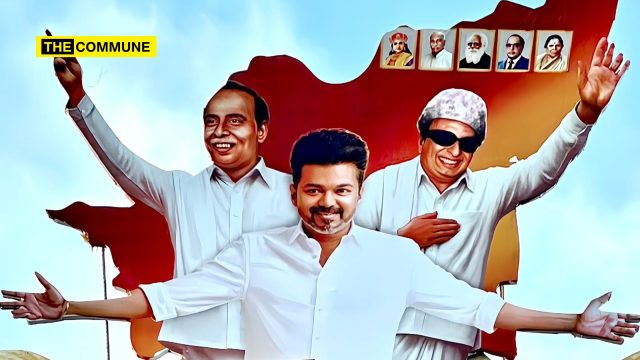
This follows the party’s maiden state convention held last year near Vikravandi in Villupuram district. The stage and venue have been designed to highlight the party’s aspirations. Large cut-outs of C.N. Annadurai, M.G. Ramachandran, and Vijay have been displayed prominently under the slogan “The history of voters returns”.

Seating has been arranged for nearly two lakh volunteers, with a specially built 300-metre ramp walkway ensuring they get a closer view of their leader. More than 40 spotlights have been placed along the ramp, and over 200 high-powered tower lights will illuminate the entire area. Special facilities have been added to distinguish the conference from other political events.

A large-scale underground water supply system has been laid across 8,000 metres, with multiple tanks set up to ensure easy availability of drinking water. Adequate parking arrangements have also been made to manage the large crowds.

Security has been organised at an unprecedented level. A two-layer system has been put in place with bouncers forming the first line and police forming the second. About 550 bouncers, including 50 women, are deployed alongside 2,000 private security personnel and 3,000 police officers.

Preparations faced a minor setback on Wednesday when a crane hoisting a 100-foot flagpole malfunctioned and the pole fell on a parked car, damaging it. Fortunately, no one was injured. Vijay, who reached Madurai from Chennai in the evening, visited the site, reviewed the arrangements with local authorities, and instructed party members to ensure volunteers faced no difficulties.

With thousands of supporters already gathered in Madurai, the conference marks a crucial moment in Vijay’s political journey as TVK attempts to stamp its presence in Tamil Nadu’s political arena.

-IANS

Subscribe to our channels on Telegram, WhatsApp, and Instagram and get the best stories of the day delivered to you personally.
NIA Arrests Kodaikanal Biryani Vendor Imtathullah For Sheltering Accused In PMK Leader Ramalingam’s Murder

ramalingam murder case pmk nia

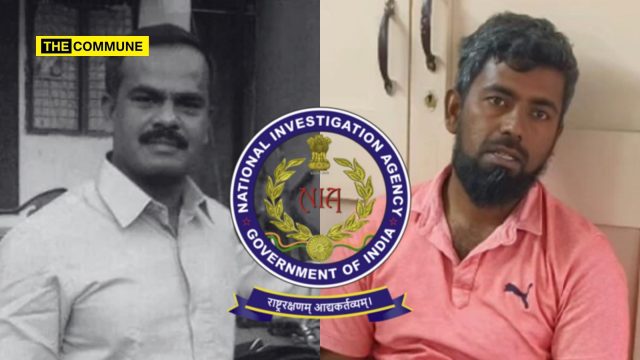
The National Investigation Agency (NIA) has arrested Imthatullah, a biryani vendor from Kodaikanal, for allegedly sheltering the killers of PMK lawyer and executive Ramalingam, who was brutally murdered in Thanjavur’s Thiruphuvanam in 2019 for resisting conversion attempts by Islamists.

Ramalingam’s murder, linked to religious extremism, is being probed by the NIA. Out of the 18 accused, 10 have so far been arrested, while 5 remain absconding. Earlier, the agency had arrested Mohammed Ali from Poombarai, who was also connected to the case.

In recent weeks, NIA teams carried out simultaneous raids across Tamil Nadu — including 8 locations in Dindigul and 5 in Kodaikanal. A three-hour search was also conducted at the Tenkasi home of Mohammed Ali, a former Popular Front of India (PFI) member now working abroad.

During these operations, NIA arrested Imthatullah, who allegedly provided shelter to key conspirators in the Ramalingam murder case, marking a significant breakthrough in the investigation.

(With inputs from News 18 Tamil Nadu)

Subscribe to our channels on TelegramWhatsApp, and Instagram and get the best stories of the day delivered to you personally

Class 9 Muslim Student Stabs Class 10 Hindu Student To Death At Seventh-Day Adventist School In Ahmedabad

A 15-year-old Class 10 student was stabbed to death by a Class 9 student at Seventh-Day Adventist School in Ahmedabad on Tuesday night. The victim, who belonged to the Sindhi community, was rushed to a hospital but succumbed to his injuries.

The accused, a student from the ninth grade, belongs to the Muslim community. The incident has sparked widespread outrage among the victim’s family, members of the Sindhi community, Hindu organizations, and activists from the Akhil Bharatiya Vidyarthi Parishad (ABVP).

Alleged screenshots of the stabber’s chat going viral on social media reveal he showed no remorse for his actions.

According to reports, blood-soaked Nayan was lying in the school compound for more than 20 minutes but the school management did not even bother to call an ambulance.

Early Wednesday morning, a large crowd of community members gathered outside the school, leading to protests that escalated into vandalism on the school premises. Reports indicate that some school staff were also assaulted during the demonstrations.

Police deployed a significant force to restore order, and clashes were reported between protesters and law enforcement. The accused student has been taken into custody, and authorities are proceeding under juvenile laws.

In the wake of the tragedy, parents and Hindu organizations have filed complaints against the school’s principal and management, seeking accountability for the incident.

Police have launched a detailed investigation into the case, and further updates are awaited.

(With inputs from India Today)

Subscribe to our channels on Telegram, WhatsApp, and Instagram and get the best stories of the day delivered to you personally.
Namakkal Woman VAO Assaulted By Sand Mafia Gang At Her Residence

namakkal sand mafia

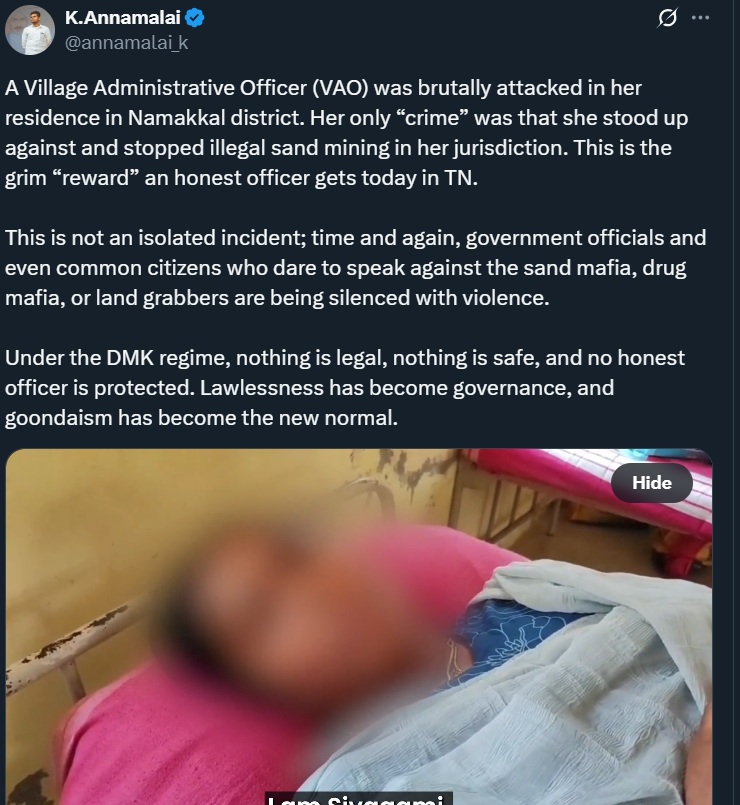
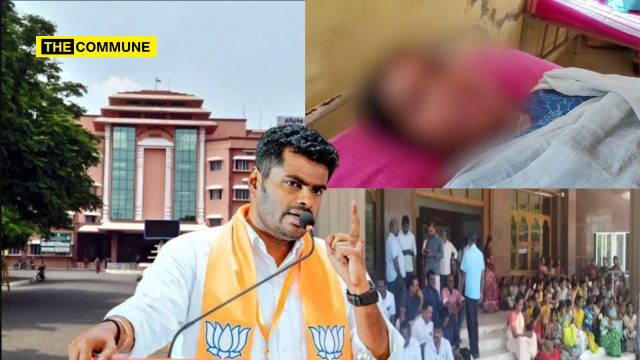
In yet another disturbing case, a woman Village Administrative Officer (VAO) was assaulted at her residence in Namakkal by members of the sand mafia. The attackers barged into her home but were restrained by neighbors after she cried out for help. She was later admitted to the hospital with injuries. Police have since confirmed the arrest of those involved.

According to reports, Sivagami had earlier received information about illegal sand smuggling in her jurisdiction and rushed to the spot to prevent the activity. Angered by her intervention, the smugglers alerted a man identified as Munjunur Srinivasan, who allegedly threatened the officer, declaring that he would continue sand mining and warning that she could be killed if she tried to stop them. Following the confrontation, Sivagami lodged a complaint with her Tahsildar.

Later that day, Srinivasan allegedly telephoned Sivagami’s husband, issuing fresh threats. He reportedly attempted to malign her character and warned that he would harm her if she did not “behave.” Hours later, he stormed into Sivagami’s residence, physically assaulted her by pulling her hair, pushing her, and kicking her in the chest. The attack left her with injuries to her hand, and she fainted due to high blood pressure before being rushed to the hospital.

Hearing the commotion, relatives and neighbors intervened, restrained Srinivasan, and handed him over to the police. The incident has sparked widespread condemnation across Tamil Nadu, highlighting once again the growing menace of the sand mafia and the vulnerability of government officers who take a stand against illegal mining.

This assault has drawn outrage across the state, as it comes amid a series of violent attacks in recent years on upright VAOs who attempted to curb illegal sand mining operations several of whom have even been brutally murdered in the line of duty.

From her hospital bed, VAO Sivagami narrated her ordeal, “My name is Sivagami. I work as a Village Administrative Officer (VAO) in Palamedu village, Thiruchengodu. Yesterday morning, while I was at work, I received information about illegal sand smuggling in my village. I went to the field and stopped them. The smugglers called Srinivasan from Munjunur and told him that the VAO has stopped them. He then threatened me, saying they would continue to smuggle sand and asked what I could do about it. He said, “I will do what I want. You can’t do anything to me. If you stop us, we will kill you by running you over with a vehicle.” We complained about this to our Tahsildar.

After I came home, Munjunur Srinivasan called my husband and said, “Your wife is not allowing me to dig out sand. I will kill her. Ask her to behave herself.” He knew he couldn’t do anything to me professionally, so he planned to devastate my personal life. He called my husband and spoke ill of me, trying to create a rift between my husband and me. He threatened my husband too. My husband informed me about this immediately and came home, fearing further consequences. As he expected, Munjunur Srinivasan came to our home and threatened us again. He held me by my hair and pushed me. He kicked me in the chest. My hand was injured. I fainted because of the high blood pressure. Then, I was admitted to the hospital. My relatives heard the commotion, caught him, and took him to the police station.”

The incident has triggered a storm of criticism. Former Tamil Nadu BJP president K. Annamalai condemned the DMK government in a strongly worded statement, saying, “A Village Administrative Officer (VAO) was brutally attacked in her residence in Namakkal district. Her only “crime” was that she stood up against and stopped illegal sand mining in her jurisdiction. This is the grim “reward” an honest officer gets today in TN. This is not an isolated incident; time and again, government officials and even common citizens who dare to speak against the sand mafia, drug mafia, or land grabbers are being silenced with violence. Under the DMK regime, nothing is legal, nothing is safe, and no honest officer is protected. Lawlessness has become governance, and goondaism has become the new normal.”

Subscribe to our channels on TelegramWhatsApp, and Instagram and get the best stories of the day delivered to you personally

Part-Time Politician Vijay Tries To Appropriate MGR

vijay maanadu conference madurai tvk

Part-time politician Vijay’s party, the Tamilaga Vettri Kazhagam (TVK), has sparked a fresh controversy by erecting banners featuring Vijay alongside images of late leaders Arignar Anna and M.G. Ramachandran at the party’s second state conference in Madurai, scheduled to take place on 21 August 2025.

The conference is being organized at a 506-acre site near the Eliyarpathi toll booth on the Madurai–Thoothukudi National Highway. Reports from Maalaimalar indicate that Vijay will hoist the party flag on a 100-foot pole during the event.

The inclusion of Vijay’s cut-out next to figures of such historic significance has sparked public debate, with questions about whether it is appropriate for an opposition leader’s image to be presented in this manner.

TVK Deputy General Secretary C.T.R. Nirmal Kumar defended the decision, calling Anna and M.G. Ramachandran “common leaders,” which he said justified featuring their images at the venue.

When asked about the absence of former DMDK leader Vijayakanth’s photograph a concern highlighted by a journalist citing Premalatha Vijayakanth, Nirmal Kumar clarified that “Vijayakanth’s photographs have not been used anywhere at the event.”

(With inputs from DT Next)

Subscribe to our channels on TelegramWhatsApp, and Instagram and get the best stories of the day delivered to you personally

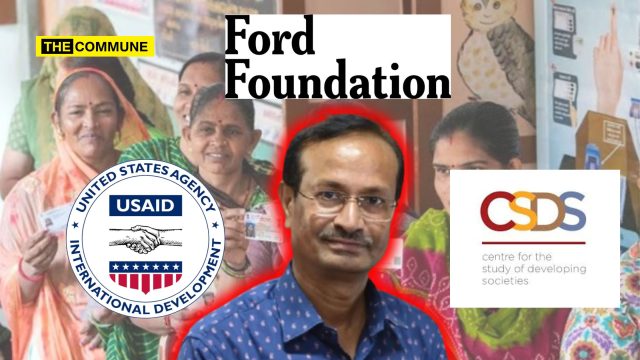
Lokniti-CSDS Co-Director Sanjay Kumar Admits Foreign Funding From Ford Foundation; Did USAID Also Fund Them?

sanjay kumar ford foundation lokniti csds usaid funding

In a fiery televised exchange, prominent psephologist Sanjay Kumar, Co-Director of the Centre for the Study of Developing Societies (CSDS), admitted that his organization has accepted foreign funding from Western agencies, including the controversial Ford Foundation. The admission came under intense questioning from Republic TV’s Arnab Goswami, who was investigating how erroneous data from Kumar was used by the Congress party to allege systematic “vote theft” and discredit the Election Commission of India (ECI).

The broadcast revelation directly ties CSDS to a larger, recently exposed network of US-government-funded NGOs, specifically the Consortium for Elections and Political Process Strengthening (CEPPS), which had a $21 million program to influence “voter turnout” in India before it was abruptly cancelled and scrubbed from the internet.

“Yes, We Have Taken Foreign Funding”: The On-Air Admission

The confrontation began with Goswami challenging Kumar on his erroneous data analysis, which showed a discrepancy between votes cast and voter turnout in certain constituencies, a claim the ECI had already dismissed as “absurd” and based on a “miscalculation.” Kumar apologized, calling it a “big mistake” and not part of any conspiracy.

The interview then took a sharp turn when Goswami questioned the source of Kumar’s institutional funding.

Arnab Goswami: “Has the Ford Foundation given you money?”

Sanjay Kumar: “Long back… Yes, long back, we have.”

Arnab Goswami: “So you do receive foreign funding?”

Sanjay Kumar: “If there is a project which we are doing and if there is a funding for that project, we do get some funding for the project which we do.”

Goswami pressed further, listing other potential donors like the Hewlett Foundation, Dutch agencies, the Gates Foundation, and the International Development Research Center (IDRC) of Canada. While Kumar could not recall all, he confirmed receiving project-based grants from foreign entities.

Ford Foundation Funded CSDS

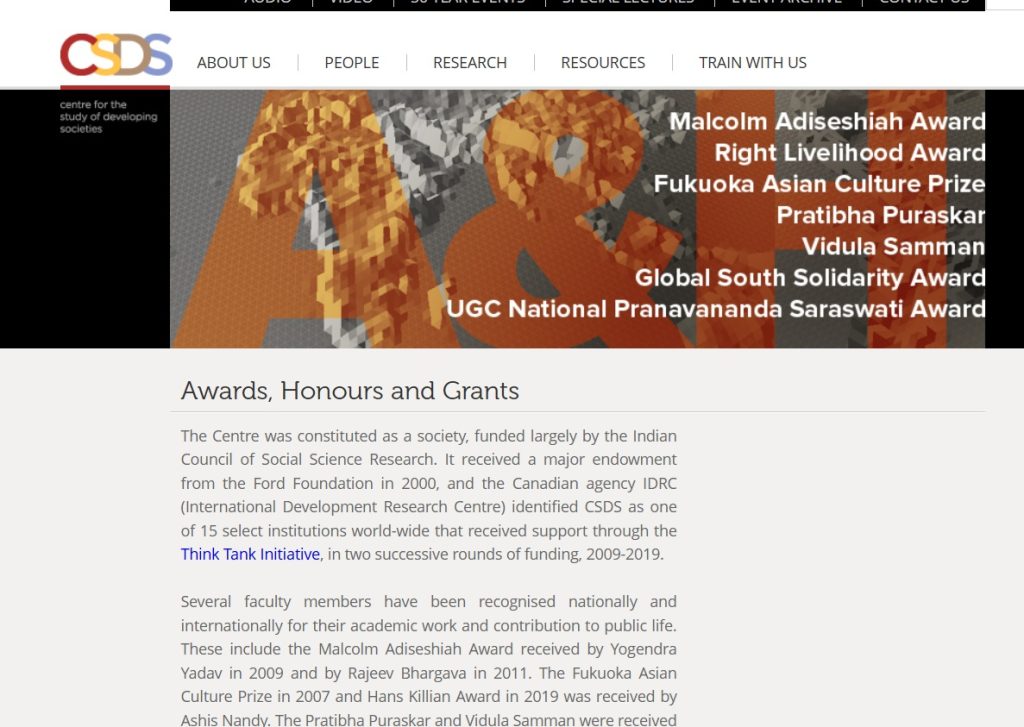
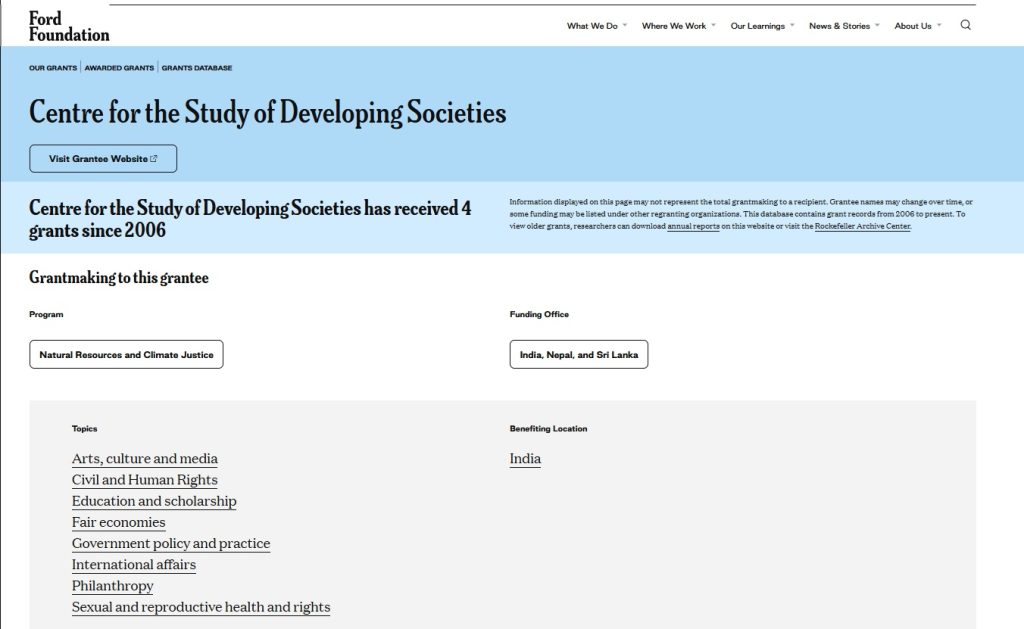
As claimed by Kumar on television, the CSDS website confirms the fact that they have received funding in the form of grants from Ford Foundation

The website reads, “The Centre was constituted as a society, funded largely by the Indian Council of Social Science Research. It received a major endowment from the Ford Foundation in 2000, and the Canadian agency IDRC (International Development Research Centre) identified CSDS as one of 15 select institutions world-wide that received support through the Think Tank Initiative, in two successive rounds of funding, 2009-2019.”

The Ford Foundation website states that Centre for the Study of Developing Societies has received 4 grants since 2006

Now let’s take a look at another funding received by CSDS that was reported earlier.

The CSDS-CEPPS-USAID Nexus: A Pattern of Foreign Influence

This on-air admission gives concrete, namesake evidence to a recent investigative report that exposed a deep-state plan to interfere in Indian elections. Our report during the USAID funding controversy details how:

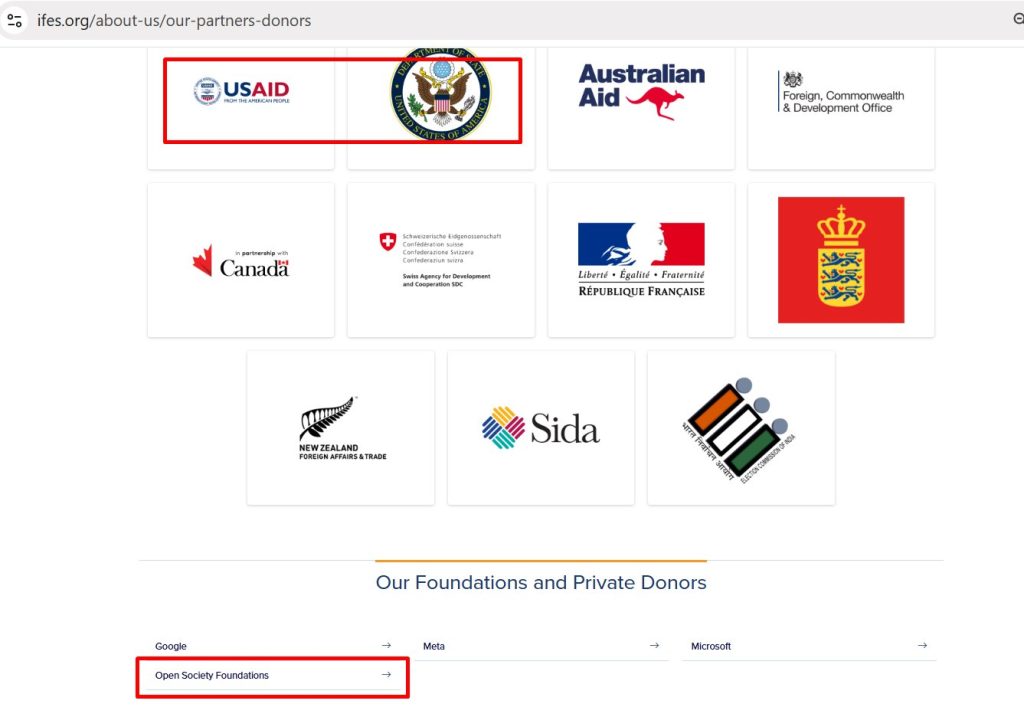
A $21 million USAID program, managed by CEPPS and funded by the U.S. Department of State, was created to influence “voter turnout” in India. The program was cancelled and its online presence scrubbed after being exposed.

CEPPS is a consortium comprising major American political NGOs and is a long-time vehicle for channeling U.S. taxpayer money to influence elections globally. It has historically partnered with organizations in India.

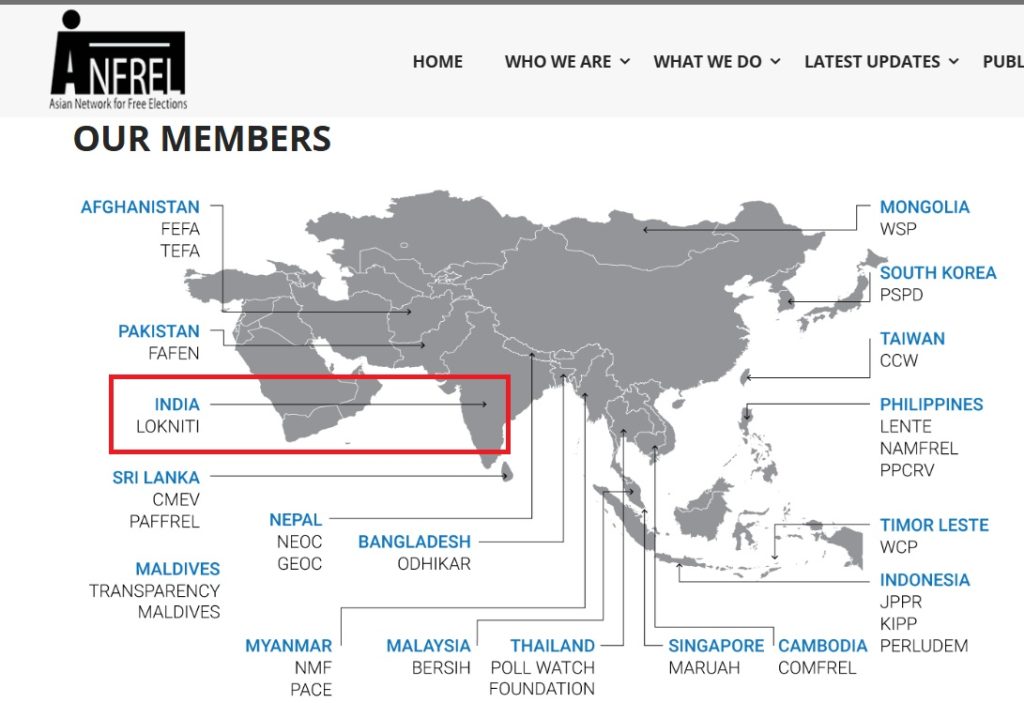
CSDS’s Lokniti programme is explicitly named as a “local partner” of CEPPS’s “Advancing Electoral Democracy in Asia” initiative. The same initiative partners with organizations like Bangladesh’s Odhikar.org, which has accused the Sheikh Hasina government of killings.

Image Source: ANFREL

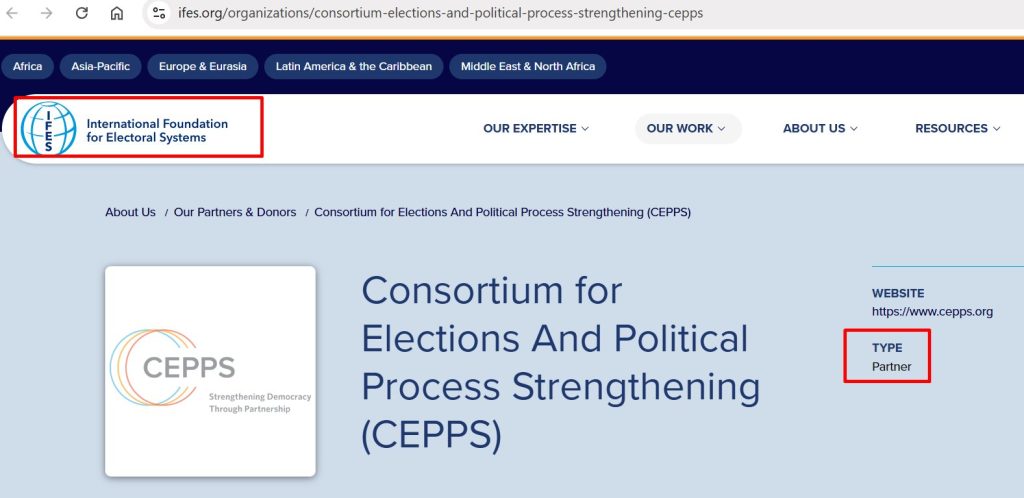
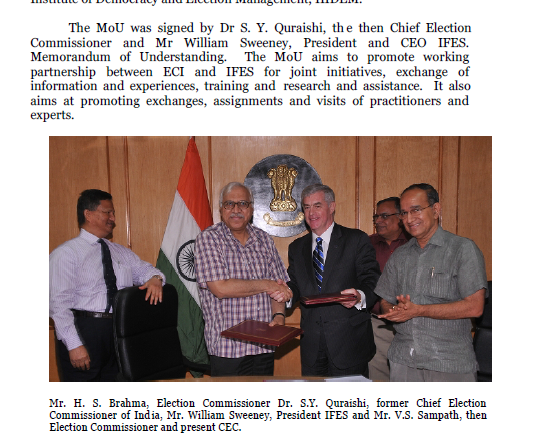
The investigation also revealed a 2012 MoU between the Election Commission of India (under then-CEC S.Y. Quraishi) and the International Foundation for Electoral Systems (IFES), a core member of CEPPS.

This MoU allowed for the exchange of data and research; a relationship critics say could provide foreign actors with a “gold mine” of sensitive Indian voter data.

Political Fallout: Erroneous Data and a Coordinated Narrative

The timing of Kumar’s data error is seen by many as suspicious. His incorrect figures were immediately seized upon by Congress leaders to build a narrative of a compromised election and “vote chori” (vote theft), creating significant political tension.

While Kumar has apologized and deleted the tweet, he agreed that the Congress party, which amplified his faulty data, should also issue an apology. He stated, “I think Congress party should have also said that this data… which they have used is wrong because they have used my data.”

Subscribe to our channels on Telegram, WhatsApp, and Instagram and get the best stories of the day delivered to you personally.

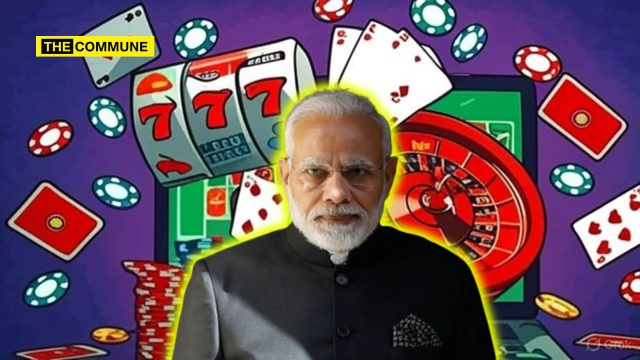
A Few Thousand Jobs Vs Millions Of Indians Gambling: Why Modi Govt Is Banning Online Money Gaming

online money gaming modi government govt bill

In a move set to reshape India’s digital entertainment landscape, the Modi government has introduced the Promotion and Regulation of Online Gaming Bill, 2025, paving the way for a blanket ban on online money games, including all betting and gambling services hosted electronically. The bill marks a decisive intervention in an industry that has exploded in popularity, drawing over 450 million Indian users into real-money gaming platforms, and has become a lightning rod for social and economic alarm.

Online Money Gaming: The Scale and Societal Costs

While employment generated by online gaming platforms is notable, policymakers argue that the number of jobs, estimated in the low thousands, pales in comparison to the “distress across households” now sweeping the nation because of gambling-induced debt and addiction. “There is a political depth of feeling across the aisle,” said a government official familiar with the drafting of the bill to MoneyControl. “The political class is getting its reading from the ground, and they feel strongly about societal harm and debt spiral.” State after state has attempted piecemeal bans, but these have been rendered toothless in the face of digital borderlessness and offshore operators, motivating calls for strong central control.

Jobs Vs. Social Harm: The Stark Divide

The government acknowledges the sector’s employment potential, especially in e-sports, educational, and social gaming segments. However, the bill’s architects maintain that this opportunity does not justify the rampant harm inflicted by real-money gaming apps. “There is a lot of money sloshing around, much of it targeting vulnerable and lower-income groups,” one official told reporters, pointing to aggressive, celebrity-driven marketing and opaque algorithms designed to maximize user losses.

Platforms often exploit addictive psychological mechanisms, leading to compulsive gambling, financial ruin, and severe mental health impacts. Reports link real-money gaming services to a surge in family breakdown, suicide attempts, and an overall erosion of public trust. “This has become a cause of distress across households,” noted the official.

Central Government Steps In

State-level bans have offered little protection, with offshore websites and payment processors routinely routing bets beyond local regulators’ reach. “State bans have been ineffective, which only reinforces the need for stronger central regulation,” said a senior official, reflecting the urgency behind the new legislation.

The bill envisions the creation of a national regulatory authority to distinguish between permissible games (like e-sports and educational software) and money games, and to police compliance and advertising. It categorically prohibits offering, promoting, facilitating, or advertising any online money gaming services, and makes financial transactions towards gambling platforms illegal, even criminally punishable with jail time and steep fines.

Foreign Investment: Stopping the Wrong Kind of FDI

Another sore point is foreign direct investment. With global investors flocking to Indian gaming startups, officials worry about an influx of “unproductive FDI”. “We need clarity on what kind of foreign investment and FDI we want in this space. This is not productive FDI. The industry is making outsized profits by preying on the Indian population,” a government source warned.

Not Just Regulation: Protecting Vulnerable Indians

The Promotion and Regulation of Online Gaming Bill aims to preserve the creative and competitive promise of India’s gaming sector, e-sports, educational and social games, while putting an end to what officials call the “predatory” real-money gaming segment. “Millions of Indians, especially youth and vulnerable groups, are being systematically targeted,” said an official. “The government cannot let a few thousand jobs come at the cost of societal welfare and financial security.”

With its sweeping scope and tough enforcement provisions, the bill sends an unambiguous message – when it comes to the social costs of online gambling, the Modi government is prepared to act.

Subscribe to our channels on Telegram, WhatsApp, and Instagram and get the best stories of the day delivered to you personally.
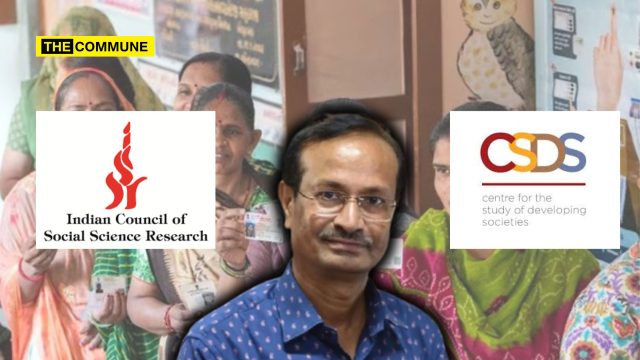
ICSSR Flags Grant Rule Breach, Pulls Up CSDS Over Sanjay Kumar’s Fake Voter Data, Terms It ‘Gross Violation’

icssr fake data csds sanjay kumar vote

The Indian Council of Social Science Research (ICSSR), an autonomous body under the Ministry of Education, has issued a show cause notice to the Centre for the Study of Developing Societies (CSDS) following what it described as a “gross violation” of grant-in-aid rules in connection with false electoral roll data circulated by CSDS fellow Sanjay Kumar.

In a statement on 19 August, ICSSR said that Kumar’s claims on Maharashtra’s electoral rolls, which were subsequently retracted, amounted to data manipulation and had been used to question the credibility of the Election Commission of India (ECI). The council stated that the incident had caused disrespect to both the institute and the electoral process.

ICSSR said the matter involved “biased interpretation” of the Sample Survey on Electors Register (SIR) exercise conducted by the ECI. It added that the act had undermined the sanctity of the Commission, which it described as a high constitutional body responsible for conducting free and fair elections in the country.

The controversy began on 17 August 2025 when Sanjay Kumar posted figures on social media suggesting abnormal changes in Maharashtra’s electoral rolls between the 2024 Lok Sabha and Assembly elections. He claimed that constituencies such as Nashik West and Hingna had recorded growths of over 40 per cent in voter numbers, while Ramtek and Deolali had seen sharp declines.

The data was amplified by Congress spokesperson Pawan Khera, who questioned the credibility of the ECI and alleged large-scale discrepancies. However, on 19 August 2025, Kumar apologised and retracted his claims, stating that his team had “misread rows” while comparing datasets. He said the post had been deleted and that there was no intent to misinform.

Official data from the ECI showed that the figures presented by Kumar were inaccurate. For example, Nashik West recorded a 6 per cent rise in electorate size between the two rolls, compared to the 47 per cent increase he had cited. Hingna recorded an increase of 6 per cent, while Ramtek and Deolali both showed small rises rather than the sharp declines claimed.

ICSSR said that the issue went beyond a technical error and was a breach of grant rules applicable to institutes receiving government funding. It added that the matter would be examined further following the notice to CSDS.

(With inputs from OpIndia)

Subscribe to our channels on Telegram, WhatsApp, and Instagram and get the best stories of the day delivered to you personally.