Home Blog Page 130

TVK Under Vijay: A ‘Theeyasakthi’ On Wheels – Chaos, Deaths, And No Accountability
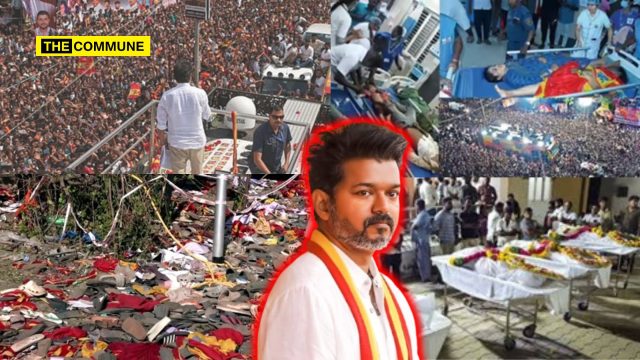
"Vijay Fled From Scene Of Occurrence, Party Has No Remorse", Madurai Bench Of Madras High Court Slams TVK For dmk Karur Stampede karur stampede dmk

Less than six months after 41 people died and nearly 100 were injured in the Karur stampede, the single deadliest incident at any political rally in Tamil Nadu’s history, TVK chief Vijay’s Sengipatti conference in Thanjavur on 4 March 2026 once again unfolded in scenes of dangerous disorder. Nothing has been learned. Nothing has changed. And that, by itself, is a damning indictment of a man who wants to govern over 80 million people.

Karur: 41 Dead, One Leader Who Fled

The facts of 27 September 2025 must not be allowed to fade. The TVK rally at Velusamypuram near Karur was permitted for 10,000 people. Between 27,000 and 35,000 had gathered since dawn. Vijay arrived six hours late, leaving women, children, and the elderly to bake in the sun with no water, no shade, and no exit route. When the crowd surged toward his convoy, 41 people including a two-year-old child, at least nine other children, and 18 women were crushed to death. Around 100 others were hospitalised.

What did Vijay do? He fled.

The Madras High Court was unsparing in its verdict: “This Court strongly condemns the conduct of Mr. Vijay, the organisers of the event and the members of the political party for fleeing from the scene of occurrence immediately after mishaps.” The court noted that TVK’s leadership “absconded from the venue, abandoning their own cadres, followers, and fans,” and that the party had not released any expression of responsibility – a posture the court said reflected a “disregard for human life and public accountability”. A Special Investigation Team was subsequently ordered by the court.

A filmy-style social media video uploaded three days later, not an in-person accountability moment, not a visit to the injured – this was Vijay’s response. The Supreme Court is now monitoring a CBI-linked probe panel into the Karur deaths.

Deaths At TVK Rallies – “Tragedies Waiting to Happen”

Karur was not TVK’s first brush with death. In August 2025, a 19-year-old BA Visual Communication student from Virudhunagar died of electrocution while climbing a structure to hoist a TVK party flag ahead of a public meeting in Madurai. He was not the last.

As recently as 24 February 2026, at the time of the Vellore event, a fan was filmed hanging from a crane in Vellore during Vijay’s visit to meet party workers in the Pallikondan and Arasarampatti areas, where only 4,900 people had been permitted. Despite Vijay having issued repeated public warnings urging fans not to perform risky stunts, the frenzy continued without consequence.

Also in February 2026, another death was reported at Vijay’s TVK Salem rally, alongside chaos. At Vijay’s earlier Tiruchirappalli campaign stop, police had imposed strict safety conditions for crowd management – most of which were violated, triggering a six-hour traffic jam.

Thanjavur, March 2026: History Repeating

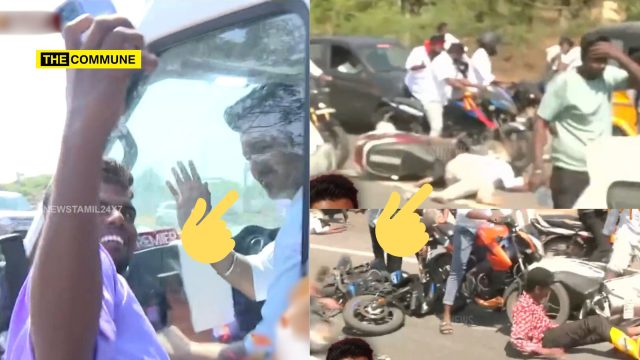
Five months after Karur, same story, different venue. Vijay’s convoy travelling from Tiruchirappalli airport to Sengipatti was chased at high speed by hundreds of two-wheelers. Three students on motorcycles collided with each other; one was admitted in critical condition. In separate incidents on the same route, at least two more supporters sustained head injuries and fractures and were hospitalised. Total injured: at least five.

Supporters dangerously followed Vijay’s convoy on two-wheelers, leading to multiple accidents. Around 11:30 AM, two youths, Vignesh and Arun, riding a Honda Activa, crashed into a road median, leaving Vignesh with serious head injuries and Arun with fractures.

At the venue itself, crowds broke through barricades at the entrance and surged toward the grounds. Visuals circulated on television and social media showed people pushing and jostling each other in a crowd surge alarmingly similar to the minutes before Karur’s collapse.

The Crane Climber, the Toll Booth, the Selfie and the Theeyasakthi Problem

The Vellore crane-hanging incident of 24 February 2026 was not isolated. Reports have also documented TVK supporters mobbing Vijay’s vehicle at a toll booth near Pudukkudi, with fans dangerously climbing moving vehicles and structures as his convoy passed. The pattern: two-wheelers racing at speed without helmets, fans dismantling barricades, stunts performed in full view of party leadership has become a fixture of every TVK public event. The party’s own social media has at times circulated these images as evidence of popularity rather than condemning them as lawbreaking.

In one instance from the Thanjavur event, a fan was seen climbing onto Vijay’s moving campaign vehicle and positioning himself to take a selfie. The man clung to the SUV while the convoy continued moving through a crowded road.

Vijay, who was visible inside the vehicle, appeared to notice the supporter but responded by smiling and waving rather than signalling security personnel to intervene or stop the vehicle. The gesture was interpreted by many observers as tacit encouragement of dangerous fan behaviour.

​Vijay calls everyone else a “Theeyasakthi” (evil force/power), but it is him who is gleefully enabling and seemingly enjoying such chaotic recklessness exhibited by his fans.

The Accountability Gap

After every incident, the script is the same: Vijay issues a verbal request for calm, the party blames police, media releases a social media video, and the next event is planned with identical non-existent crowd controls. The Madras High Court noted TVK showed “no remorse”. The CBI is investigating. Courts have ordered SITs. Yet on March 4, 2026, barricades were torn down again, fans raced convoys again, and young men ended up in ICU again.

A man who cannot, or rather will not, control a political rally, who flees when it turns fatal, who watches with apparent satisfaction as fans hang from cranes and race his convoy, is not a leader. He is a liability seeking office. Tamil Nadu has buried more than 50 of his supporters. It cannot afford to give him the keys to the state.

Subscribe to our channels on TelegramWhatsApp, and Instagram and get the best stories of the day delivered to you personally.
Temple Funds Misused? HR&CE’s Bhakti Book Project Ad Published In DMK Mouthpiece Murasoli

Temple Funds Misused? HR&CE's Bhakti Book Project Ad Seen In DMK Mouthpiece Murasoli

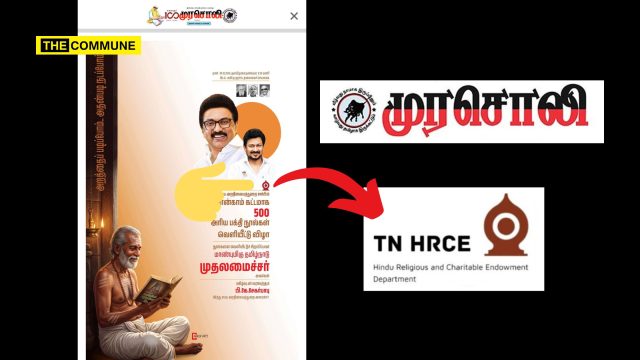
A full-page advertisement issued by Tamil Nadu’s Hindu Religious and Charitable Endowments (HR&CE) Department in the DMK mouthpiece Murasoli has triggered controversy after allegations were raised that temple funds were being misused for political promotion and unnecessary publication projects.

The advertisement, released by HR&CE Minister PK Sekarbabu, announced the publication of the fourth batch of rare Bhakti literature consisting of 500 devotional books, stating that Tamil Nadu Chief Minister MK Stalin would formally release them. The advertisement described the publication as being released “on behalf of the HR&CE Department.”

Allegations Over Use of Temple Funds

It is alleged that the claim in the advertisement is misleading and that the publication project is being financed through the Common Good Fund, a pool created from temple revenues and intended under law to support impoverished and dilapidated temples across Tamil Nadu.

Reportedly more than ₹100 crore from this fund has been diverted over the past several years for activities unrelated to temple restoration or direct religious services. It is alleged that the HR&CE Commissioner, an IAS officer responsible for administering the fund, sanctioned money for book publications that were not essential to temple administration.

It is argued that many of the texts being published are already available in digital form on public websites, suggesting that the department could have simply digitised and uploaded them for free rather than commissioning expensive print editions.

Questions Over Procurement and Distribution

The main point of criticism is the role of a publishing agency identified as Arasu Arts, which allegedly has repeatedly received orders for printing these books. It is alleged that the books are later supplied to major temples under HR&CE control and that temples with heavy footfall are instructed to sell them to devotees.

This system forces temples to purchase stock from the department before retailing the books, raising concerns about procurement transparency and the purpose of the publication exercise.

Political Imagery in Advertisement

Another point of controversy is the visual design of the advertisement itself. Alongside images of Chief Minister Stalin and his son Udhayanidhi Stalin, the poster includes portraits of prominent Dravidian movement leaders such as EV Ramasamy, CN Annadurai, and M Karunanidhi.

The inclusion of these figures in a government-funded advertisement promoting Hindu devotional literature raises ideological questions, if one considers the amount of criticism of Hindu scriptures and religious traditions expressed by leaders of the Dravidian movement.

Subscribe to our channels on TelegramWhatsApp, and Instagram and get the best stories of the day delivered to you personally.
Congress Surrenders: After Big Drama, Accepts DMK’s Offer To Contest Lesser Seats

congress dmk stalin rahul gandhi

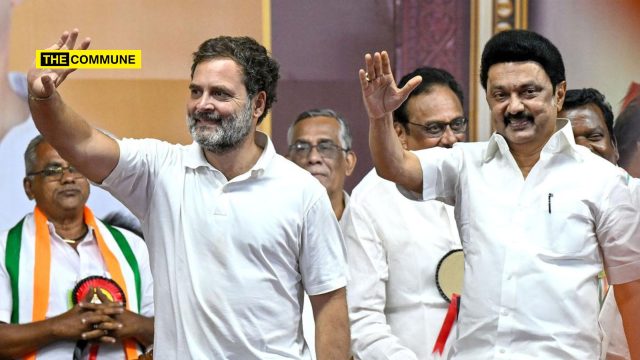
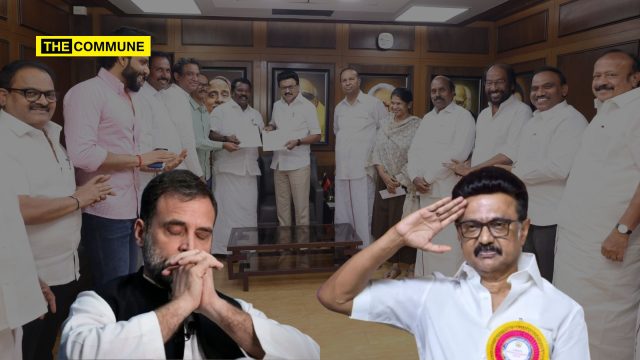
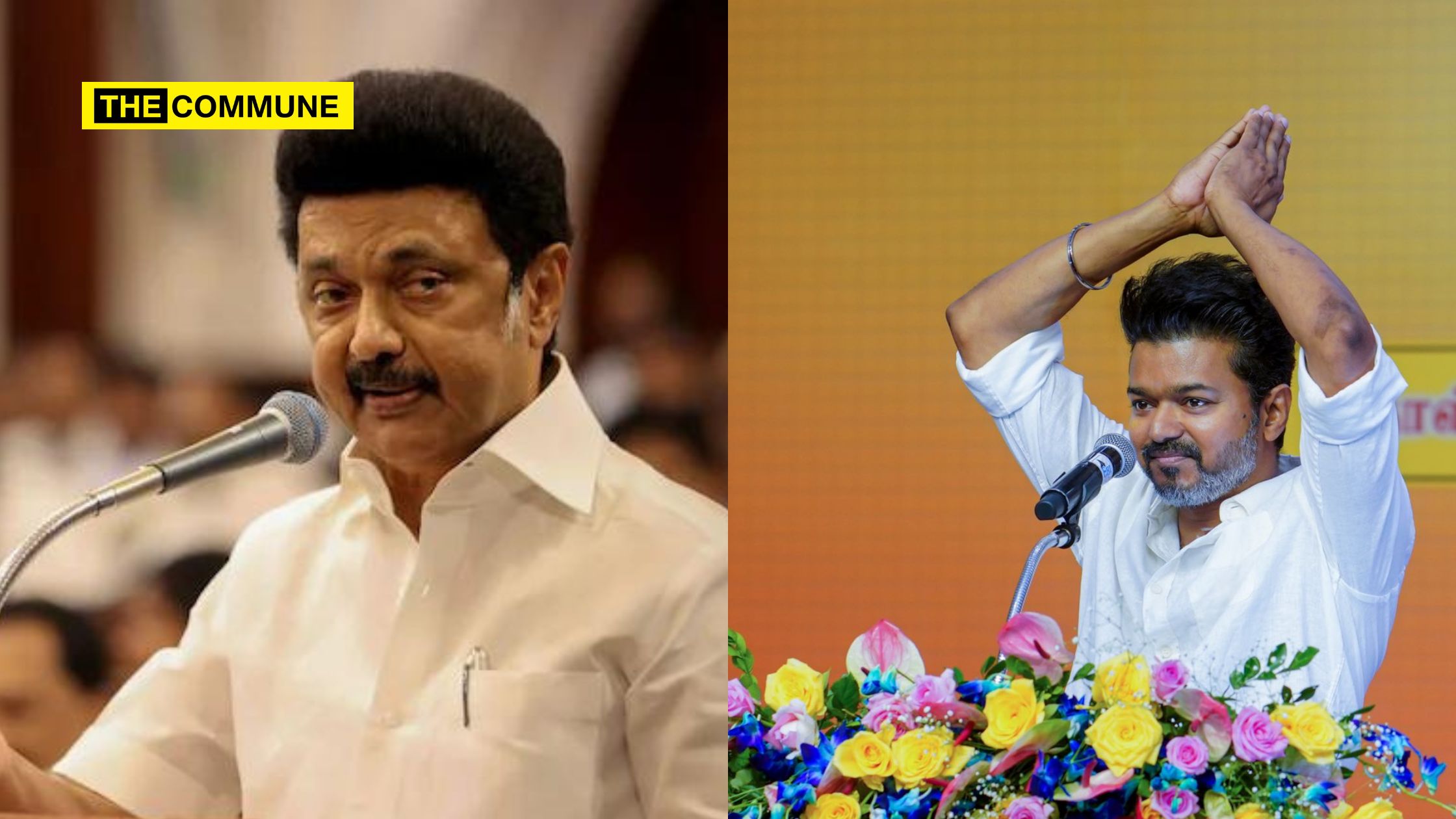
In a significant development that underscores the dominance of the Dravida Munnetra Kazhagam (DMK) in Tamil Nadu’s political landscape, the Indian National Congress has finally accepted a seat-sharing deal that falls well short of its initial aggressive demands. After days of high-stakes drama, public posturing, and behind-the-scenes interventions, the Congress has agreed to contest only 28 Assembly seats in the upcoming 2026 Tamil Nadu elections—three more than the 25 it fought in 2021 but far below the 35–41 seats it had pushed for.

The agreement, sealed on March 4, 2026, between DMK president and Chief Minister M.K. Stalin and Tamil Nadu Congress Committee (TNCC) president K. Selvaperunthagai, also includes one Rajya Sabha berth for the Congress. This comes as a compromise after prolonged stalemate, where the DMK held firm on limiting concessions to accommodate its broader alliance partners, including smaller parties like the IUML, MMK, VCK, and others.

The Build-Up to the Drama

Seat-sharing talks between the long-time allies had been fraught with tension since early 2026. The Congress, buoyed by its national role in the INDIA alliance and its performance in recent Lok Sabha elections, entered negotiations with high expectations. Party leaders initially demanded around 40–41 Assembly seats—roughly one per Lok Sabha constituency in Tamil Nadu—along with multiple Rajya Sabha seats and even a share in power if the alliance wins.

The DMK, riding high after its sweeping victory in 2021 and strong showings in subsequent polls, rebuffed these demands. Sources indicated the DMK was unwilling to dilute its control, emphasizing that Tamil Nadu has never had a coalition government and that Chief Minister Stalin opposed power-sharing arrangements. The DMK initially offered 25 seats—the same as in 2021—plus one Rajya Sabha seat, framing it as a “take it or leave it” proposal at points.

Negotiations hit a deadlock, with Congress leaders like AICC in-charge for Tamil Nadu Girish Chodankar publicly declaring the 25-seat offer “not acceptable.” Reports highlighted Congress’s push for at least 33–35 seats as a minimum, while the DMK signaled flexibility for only marginal increases, citing the need to allocate seats to other allies.

Intervention and Compromise

The breakthrough came through high-level intervention. Senior Congress leader P. Chidambaram, a key Tamil Nadu figure, met Stalin to bridge the gap. Backchannel diplomacy, combined with pressure from the Congress high command—including Mallikarjun Kharge—helped thaw the impasse.

The DMK gradually raised its offer: from 25 to 27 seats in some reports, then to 28 (or possibly 29 in varying accounts), plus the promised Rajya Sabha seat. The Congress, recognizing the risks of breaking the alliance—potentially weakening both parties against rivals like the AIADMK-BJP combine or emerging players like TVK—chose to accept rather than escalate.

This outcome represents a clear “surrender” for the Congress in the eyes of many observers. Despite the “big drama” of public statements, threats of hard bargaining, and demands for power-sharing (which the DMK firmly rejected), the national party settled for a modest increase over its 2021 allocation.

Implications for the Alliance and Elections

The deal ensures the continuation of the DMK-led Secular Progressive Alliance (SPA), which has delivered consistent wins in recent elections.

For the DMK, it reinforces its position as the big brother in the alliance. For the Congress, the lower seat count limits its direct electoral footprint and influence in the state Assembly. Given the soured relationship between the two, political observers suspect DMK to play spoilsport in Congress seats to cut it to size.

As Tamil Nadu heads toward polls expected in April–May 2026, this resolution removes a major uncertainty for the ruling alliance. However, it also highlights the asymmetric power dynamic: the DMK’s regional strength allows it to dictate terms, even to a national heavyweight like Congress.

In the end, after all the posturing and high drama, the Congress has blinked first – accepting fewer seats to preserve the partnership that has been electorally rewarding, if not always equitable.

Subscribe to our channels on TelegramWhatsApp, and Instagram and get the best stories of the day delivered to you personally.
Pakistan-Based Bot Network Found To Be Posting Misleading AI Videos Of Israel Being By Iranian Missiles

Pakistan-Linked Bot Network Found To Be Posting AI War Videos On Social Media Platform X

A senior executive at social media platform X has revealed that the platform recently uncovered a network of hacked accounts allegedly operated from Pakistan that were posting artificial intelligence–generated war videos under misleading identities.

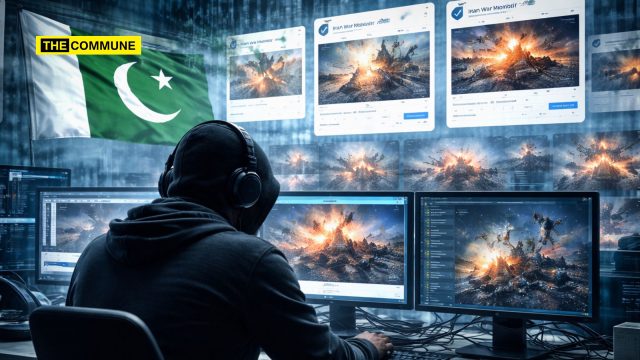
Nikita Bier, Head of Product at X, said in a post on the platform that the company had identified a single individual in Pakistan managing 31 accounts that were uploading AI-generated war footage. According to him, the accounts had been compromised and their usernames changed on 27 February 2026 to variations of “Iran War Monitor.”

Bier stated that the platform’s security teams are becoming much faster at detecting such coordinated behaviour, adding that X is also working to eliminate the incentives behind these activities.

The discovery highlights the growing use of bot accounts and AI-generated content in online information campaigns, where networks attempt to generate viral engagement by posting sensational war-related footage.

Analysts say such tactics have increasingly become part of modern information warfare on social media, where bot networks and coordinated accounts are used to amplify narratives or manipulate public perception.

Observers in India noted that similar patterns of bot-driven content amplification had previously been reported during periods of heightened geopolitical tension, including narratives circulated during Operation Sindoor, where multiple accounts pushed coordinated videos and posts to influence online discussions.

The exposure of the alleged Pakistan-linked network highlights the broader challenge faced by social media platforms in identifying AI-generated propaganda and coordinated bot activity, particularly during major geopolitical events when misinformation spreads rapidly online.

Subscribe to our channels on TelegramWhatsApp, and Instagram and get the best stories of the day delivered to you personally.
DMK Mouthpiece Sun News Uses Brahmin Woman Imagery To Mock TVK Vijay’s Ration Shop Promise

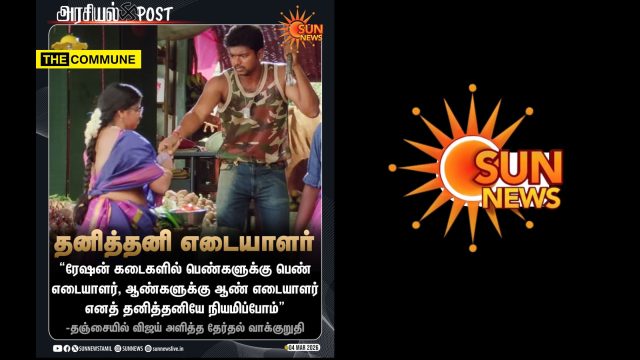
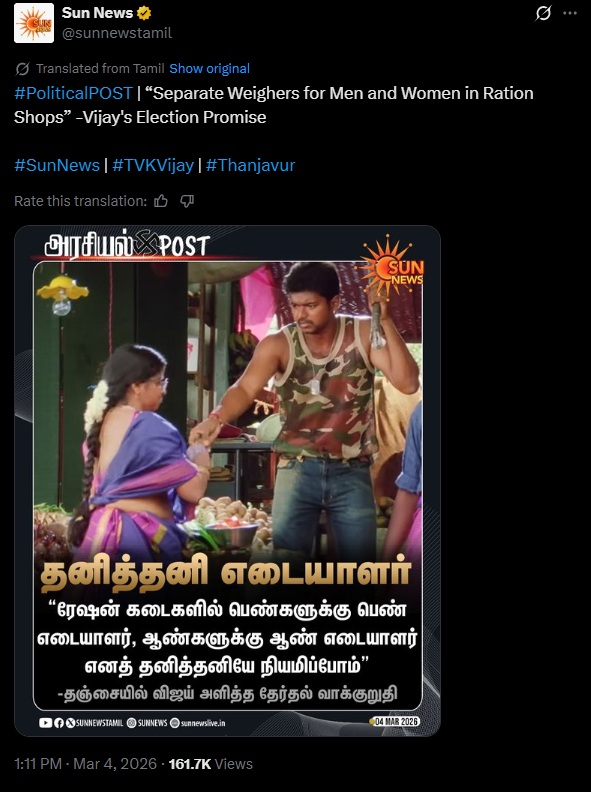
A social media post by Sun News has drawn criticism after the channel used imagery of a traditionally dressed Brahmin woman to illustrate a report about a campaign promise made by Vijay, president of the Tamilaga Vettri Kazhagam (TVK).

The post, published on the channel’s official X handle under its #PoliticalPOST segment, referenced Vijay’s election promise made during a political event in Thanjavur. The post was captioned, “Separate Weighers for Men and Women in Ration Shops” -Vijay’s Election Promise”

In his speech, Vijay said that if his party came to power, ration shops would appoint separate women weighers for women and separate men weighers for men, describing it as a measure aimed at ensuring dignity and comfort for women accessing the public distribution system.

However, instead of using a neutral visual such as a ration shop or public distribution outlet, the channel accompanied the post with a film still showing a traditionally dressed Brahmin woman standing at a shop counter opposite Vijay.

The use of a Brahmin woman’s image in this context appears to be a deliberate editorial choice meant to mock the promise. The image carries clear caste markers associated with Brahmin identity, including traditional attire and styling commonly used in Tamil cinema to portray Brahmin characters.

The choice of visual is an example of Dravidianist media framing, where caste-coded imagery especially against Brahmins is used in political coverage to send indirect ideological signals without making explicit statements.

The decision to illustrate a routine campaign promise with a Brahmin-character image reflects the true Dravidianist political messaging framed through symbolic caste imagery, especially when covering rivals of the political establishment.

Subscribe to our channels on TelegramWhatsApp, and Instagram and get the best stories of the day delivered to you personally.
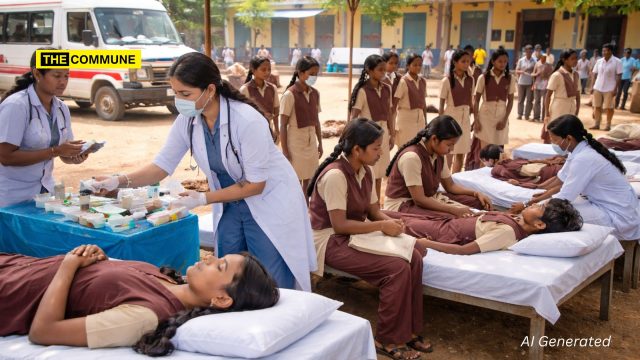
33 Students Fall Ill After Food Poisoning At Govt Model School Hostel Near Cuddalore; Medical Camp Set Up

33 Students Fall Ill After Food Poisoning At Govt Model School Hostel Near Cuddalore; Medical Camp Set Up

As many as 33 students of a government model school hostel near Thittakudi in Cuddalore district fell ill after consuming food served at the hostel, prompting authorities to organise a medical camp on the school premises.

The incident occurred at the model school hostel operating in M. Naruthiyur near Thittakudi. According to reports, several students complained of diarrhoea, vomiting and fainting after eating food at the hostel on Saturday.

Initially, nine students who developed symptoms after consuming lunch were taken to the Mangalur Government Hospital for treatment. After receiving medical care, they were later discharged and returned to the hostel.

Following the incident, health officials conducted a medical inspection at the hostel. A medical camp was organised at the school under the supervision of the Mangalur government hospital’s medical team to examine the students and monitor their condition.

Officials said that a total of 33 students who had eaten food at the hostel in M. Pottaiyur village experienced health issues. Authorities suspect that the illness may be linked to the food served at the hostel, which reportedly included moringa (drumstick) spinach for lunch and chicken curry in the evening.

As a precautionary measure, medical teams have begun examining students at the school premises, while officials are also looking into the possible cause of the suspected food contamination.

Subscribe to our channels on TelegramWhatsApp, and Instagram and get the best stories of the day delivered to you personally.
TVK Is The Real Theeyasakthi: Youth Indulge In Reckless Behaviour While Vijay Encourages And Watches With Glee

TVK Is The Real Theeyasakthi: Youth Indulge In Reckless Behaviour While Vijay Encourages And Watches With Glee

A series of disturbing incidents surrounding the movement of Tamilaga Vettri Kazhagam (TVK) chief Vijay during his recent political meeting at Thanjavur has raised serious concerns about the conduct of his supporters and the leadership signals being sent by the actor-turned-politician.

Vijay keeps constantly referring to the DMK as the ‘Theeyasakthi‘ or evil force and calls himself the ‘Thooyasakthi’ or pure force, but it turns out that TVK is the real Theeyasakthi given the reckless behaviour of Vijay’s fans turned cadre and the gleeful reactions of the leader himself.

Across multiple locations during his visit for party meetings in central Tamil Nadu, large groups of TVK supporters were seen engaging in reckless and dangerous behaviour – climbing vehicles, blocking toll plazas, mobbing convoys and racing motorcycles along highways in attempts to get closer to Vijay.

Instead of discouraging such conduct, Vijay’s response in several instances appeared to be one of indulgence, smiling and waving at supporters even when they performed risky stunts around his moving vehicle.

Supporter Climbs Campaign Vehicle for Selfie

In one instance, a fan was seen climbing onto Vijay’s moving campaign vehicle and positioning himself to take a selfie. The man clung to the SUV while the convoy continued moving through a crowded road.

Vijay, who was visible inside the vehicle, appeared to notice the supporter but responded by smiling and waving rather than signalling security personnel to intervene or stop the vehicle. The gesture was interpreted by many observers as tacit encouragement of dangerous fan behaviour.

Highway Accidents as Supporters Chase Convoy

The most serious consequences of the chaotic mobilisation emerged on a highway near Thanjavur, where groups of supporters riding motorcycles attempted to follow and keep pace with Vijay’s convoy.

The uncontrolled motorcade reportedly led to multiple collisions as motorcycles sped along the highway in dense clusters. Several riders lost control, resulting in a pile-up involving numerous bikes.

Visuals from the aftermath showed injured youths lying on the road while bystanders attempted to assist them. Ambulances were later deployed to the scene to transport the injured to hospitals, indicating the seriousness of the accidents.

Motorcycles were seen scattered across the road, some trapped between vehicles in the convoy as supporters struggled to move through the congested highway.

Toll Plaza Mobbed by Supporters

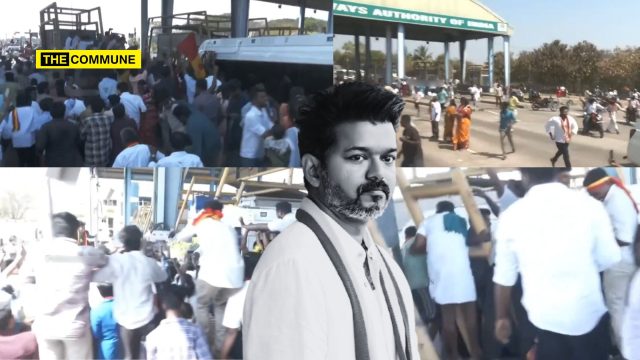
In another incident during the same visit, Vijay’s convoy struggled to pass through a toll plaza after hundreds of supporters surrounded the vehicles, blocking traffic and overrunning the area.

The crowd occupied the entire space around the toll structures, leaving virtually no room for movement. Vehicles attempting to pass through the checkpoint were boxed in by the mass of supporters waving TVK flags and shouting slogans.

Some individuals were even seen climbing public structures and ladders near the toll booth in an attempt to gain a better view of Vijay’s convoy. The gathering brought regular traffic movement at the location to a near standstill.

The scale of the crowd and the lack of visible crowd control raised concerns about how emergency vehicles or public transport could have moved through the area during the disruption.

A Pattern of Dangerous Devotion

The incidents have highlighted a growing pattern of hazardous behaviour among sections of TVK supporters, many of whom appear willing to take extreme risks in attempts to get close to Vijay.

From climbing vehicles and public structures to chasing convoys on highways, the behaviour has repeatedly disrupted traffic and created potential threats to public safety.

The problem is compounded by Vijay’s reactions during such moments. Rather than issuing firm warnings or halting the convoy when dangerous situations arise, he has often appeared relaxed and appreciative of the crowd’s enthusiasm.

When such risky actions are met with smiles, waves, or acknowledgment from the leader at the centre of the spectacle, it sends a powerful message to supporters that extreme displays of devotion will be rewarded with attention.

Public Safety Concerns Grow

The repeated incidents of convoy mobbing, toll plaza disruptions and highway accidents have triggered wider questions about whether adequate crowd management and security measures are in place during TVK political events.

Large political gatherings in Tamil Nadu have historically required strict coordination between organisers and law enforcement to ensure that traffic movement and public safety are not compromised.

In the case of Vijay’s recent tour, however, the combination of massive crowds and uncontrolled supporter behaviour has repeatedly pushed situations toward chaos.

Subscribe to our channels on TelegramWhatsApp, and Instagram and get the best stories of the day delivered to you personally.
Unruly TVK Crowd Causes Chaos At Toll Booth, Dangerously Climb Structures As They Surround Vijay’s Convoy

Unruly TVK Crowd Causes Chaos At Toll Booth, Dangerously Climb Structures As They Surround Vijay's Convoy

A video clipping circulating widely on social media from the feed of media channels tailing TVK chief Vijay as he approached the event venue for his meeting in Thanjavur has raised concerns over the conduct of supporters of actor-politician Vijay’s Tamilaga Vettri Kazhagam (TVK).

There is a large crowd overrunning what appears to be a toll booth and disrupting normal movement of vehicles.

The video shows hundreds of TVK supporters crowding the area, waving party flags, blocking vehicles and climbing public structures.

The visuals show a dense crowd of men occupying the entire space around the structure, leaving little room for movement. The crowd appears to have taken over the public area completely, bringing regular activity at the location to a halt.

Most of the individuals seem to be party cadre wearing white. TVK flags are visible across the crowd as supporters chant and celebrate in what appears to be a highly charged atmosphere.

One of the most concerning moments in the footage shows vehicles, especially that of Vijay, surrounded on all sides by the crowd, unable to move forward or backward. The vehicle is completely boxed in by supporters, raising concerns about how emergency vehicles or public transport could pass through the area during such gatherings.

Several individuals are also seen climbing a wooden ladder positioned against a glass-and-metal structure, seemingly attempting to gain a higher vantage point or cross physical barriers. Such actions pose potential safety risks both to the individuals involved and to people nearby.

Throughout the video, supporters are seen waving party flags, shouting slogans and jumping in celebration. However, no police officers or crowd-control personnel are visible in the clip, raising questions about whether adequate arrangements were made to manage the gathering.

Such uncontrolled mobilisations can easily spill over into disruptions of public order, particularly when they occur in locations such as highways, toll plazas or transit points where normal traffic movement is essential.

Despite the chaotic scenes in the video, the clip was circulated online by supporters in a celebratory tone, portraying the crowd as a show of strength for Vijay and the TVK.

Subscribe to our channels on TelegramWhatsApp, and Instagram and get the best stories of the day delivered to you personally.
‘Om Sakthi, Parasakthi, DMK Is A ‘Theeya Sakthi’ (Evil Force): TVK Chief Vijay Attacks DMK

tvk dmk vijay stalin

A meeting of party functionaries of Tamilaga Vettri Kazhagam (TVK), led by actor-turned-politician Vijay, held today in Sengipatti in Thanjavur district, has attracted significant attention in political circles. The meeting is said to have been organised with the aim of strengthening the party’s grassroots structure ahead of the 2026 Assembly elections.

As reported in Tamil Samayam, around 4,900 party functionaries from various Assembly constituencies in Thanjavur district are expected to participate in the event. For the meeting, the district police have imposed 32 strict conditions.

This meeting is seen as part of Vijay’s attempt to expand his influence in the Delta region, where the DMK has traditionally maintained a strong political base.

Addressing party functionaries, Vijay criticised the DMK government and said, “Even little children have begun saying, Om Sakthi… Parasakthi… DMK is a theeya sakthi (an evil force).”

He added, “They are also saying something else: “Is the Tamil Nadu team the same as the Delhi team?” Even in cricket, the Delhi team cannot even touch the Tamil Nadu team. When that is the case, the whistle that blows in cricket is from Tamil Nadu (CSK). For the upcoming elections too, the whistle will be blown by our TVK. Tamil Nadu is TVK, and TVK is Tamil Nadu. All this talk about this team, that team, the Delhi team, all of that will be shattered and broken. TVK will smash them.”

He claimed that the DMK had no chance of returning to power in Tamil Nadu and argued that the party had not historically managed to remain in power continuously. Vijay also alleged that both the DMK and the AIADMK were apprehensive about his entry into politics, claiming the two parties feared that “if Vijay comes, their political survival will end.”

Speaking about issues faced by fishermen, Vijay said merely writing letters or using emotional language would not solve their problems.

“What is the use of writing ‘Maane, Thene, Ponmaane’ letters?” he asked, adding that firm and practical measures were needed to address the concerns of fishermen. He said a situation must be created in which no injustice could be done to Tamil Nadu fishermen and asserted that if a TVK government came to power, steps would be taken to safeguard their livelihood and security.

During his speech, Vijay also spoke about agriculture, stating, “I honestly admit that I do not know much about agriculture.” However, he said he would not claim to be a “son of the Delta soil” merely to attract public sympathy, adding that making such statements to influence people’s emotions was not part of his political approach.

He also criticised what he described as contradictory political behaviour, saying that those who blame the central government in Delhi while in Chennai often approach the same Delhi when central agencies initiate investigations.

Vijay further raised the issue of illegal sand mining in the state and questioned whether Chief Minister MK Stalin could deny that sand mafia groups were receiving political support under the DMK government.

Warning that continued corruption and misuse of natural resources could lead to economic difficulties for Tamil Nadu; Vijay said the state could face serious problems if the current government continued in power.

Subscribe to our channels on TelegramWhatsApp, and Instagram and get the best stories of the day delivered to you personally.
Congress Surrenders: After Big Drama, Accepts DMK’s Offer To Contest Lesser Seats

Congress Surrenders: After Big Drama, Accepts DMK's Offer To Contest Lesser Seats

After days of negotiations and political brinkmanship, the Congress party has accepted the Dravida Munnetra Kazhagam’s (DMK) offer to contest 27 Assembly constituencies and receive one Rajya Sabha seat, bringing an end to the prolonged seat-sharing deadlock between the two allies ahead of the upcoming Assembly election.

The agreement is expected to be formally signed this afternoon at Anna Arivalayam in Chennai, in the presence of Chief Minister M.K. Stalin and senior leaders of both parties.

Congress had initially begun negotiations by demanding 41 constituencies and insisted that the party should be allotted at least one constituency in every district. The party had even submitted a list of more than 75 constituencies where it believed it had strong winning chances.

However, the DMK leadership remained firm that it could not allot more than the 25 seats given to Congress in the 2021 Assembly election. The party also reportedly presented data analysing Congress’s vote share and electoral performance, which is said to have influenced the negotiations.

The standoff escalated when Congress leaders publicly rejected the DMK’s offer of 25 seats. Congress leader Girish Chodankar had stated that the party could not accept the proposal and had even submitted a complaint to the All India Congress leadership, alleging that the DMK was unwilling to allocate additional constituencies.

As the negotiations dragged on, speculation intensified that Congress might exit the DMK alliance. Reports also suggested that one faction of Congress might consider contesting in alliance with Tamilaga Vettri Kazhagam (TVK), while another possibility being discussed was the formation of a splinter group within the Congress that could align separately with the DMK.

Despite the speculation, the Congress eventually agreed to the DMK’s revised offer of 27 Assembly seats and one Rajya Sabha seat.

Sources within the alliance indicated that Congress leaders recognised that the party’s electoral prospects in Tamil Nadu remain closely tied to its alliance with the DMK. It was also reportedly felt that breaking away from the DMK ahead of the Assembly election could weaken the party’s prospects in the 2029 parliamentary elections.

In the 2021 Assembly election, Congress had contested 25 seats as part of the DMK-led alliance and won 18 constituencies, giving the party its current strength of 18 MLAs in the Tamil Nadu Assembly.

From the DMK’s side, the leadership maintained throughout the negotiations that allocating more seats would be difficult because several additional parties had joined the alliance since the previous election. These include the Desiya Murpokku Dravida Kazhagam (DMDK), Kamal Haasan’s Makkal Needhi Maiam, Thamimun Ansari’s Manithaneya Jananayaga Katchi, Thaniyarasu’s Kongu Ilaignar Peravai, and Karunas’s Mukulathor Pulipadai, among others.

At one stage, the talks nearly collapsed, with Congress reportedly considering leaving the alliance and the DMK indicating that the party was free to exit the coalition if it wished.

The stalemate was broken after former Union minister P. Chidambaram met Chief Minister M.K. Stalin at his residence in Alwarpet, Chennai, along with Tamil Nadu Congress president Selvaperunthagai. During the discussions, the Congress leaders conveyed that the party’s central leadership preferred to continue the alliance but requested that additional constituencies be allotted.

Following the discussions, and amid pressure from leaders of the All India Congress, Stalin agreed to increase the allocation by two additional seats, raising the total to 27 constituencies.

Under the agreement, Congress will also receive one Rajya Sabha seat. In the DMK-led alliance, four Rajya Sabha seats are available, of which one has already been allotted to DMDK, another will go to Congress, while the remaining two candidates will be announced by the DMK.

With the agreement now finalised, the DMK–Congress alliance pact, which had remained in limbo for several days, is expected to be formally signed this afternoon following the breakthrough in talks mediated by P. Chidambaram.

Subscribe to our channels on TelegramWhatsApp, and Instagram and get the best stories of the day delivered to you personally.