Home Blog Page 1179

When Indira Gandhi Banned BBC For ‘Biased’ And ‘Derogatory’ Coverage

The central government recently invoked its emergency powers to direct YouTube and Twitter to remove links to the BBC documentary which has been “selective” with the truth about Prime Minister Narendra Modi’s role in the 2002 Gujarat riots.

But this isn’t the first time that BBC has earned the wrath of the Indian government.

Indira Gandhi when she was Prime Minister too cracked down on BBC for peddling propaganda.

The story behind Indira Gandhi banning the BBC for two years during the 1970s is quite interesting!

The BBC broadcast the UK premiere of Calcutta, a documentary film by acclaimed French director Louis Malle, on British television. The film, shot in and around Calcutta between 1968 and 1969, was by all accounts a visually rich, ‘impressionistic portrait’ of India’s second most populous city, and one of the world’s most intriguing socio-cultural centres.

Following a brief visit to Calcutta in 1967, Malle—who is now perhaps best remembered for films such as Pretty Baby (1978), the critically acclaimed Au revoir les enfants (1987) and Damage (1992)—had returned to India in 1968 and immersed himself ‘and his camera’ in the life of the intensely sprawling city. He concentrated on uncovering hidden existences within Calcutta; creating a sinuous visual narrative of the city in which people and street events became the subjects of the filmmaker’s attention.

Basically, he focused more on poverty than on the “working classes”. Of course, the Indira Gandhi government was not happy with this.

So, the Indian High Commission (HC) received complaints about the documentary being highly biased against India. It reached out to the UK Foreign Office (FO), which indirectly said they couldn’t interfere with BBC. The Indian HC asked the BBC to pull the documentary series from their schedule, and warned that their role would become superfluous if they continued to “vitiate the minds of the British people against India”.

Therefore, according to a research paper, on 29 August 1970, “the BBC was expelled from India by order of Indira Gandhi’s socialist government, under a hail of neo-imperialist criticism.” The BBC representative in New Delhi, Mark Tully, and correspondent Ronnie Robson were informed of the GoI’s decision to close the BBC office in the capital within the next 15 days.

Unlike now, there was near-unanimous political support for “taking the BBC to task” over their “anti-India sentiments”. A long series of biased coverage for years after Independence culminated in this ban.

The BBC had shown Dom Moraes burning his Indian passport (not surprised at all) during the 1961 Goa liberation movement. Similarly, their coverage of the 1965 war and the 1969 Ahmedabad riots (surprised there were riots before 2002) was “neither forgotten nor forgiven.”

In the 1950s while India had become a key player in the Non-Aligned Movement (NAM) Pakistan signed the CENTO pact with Britain, the US, and others. This defined how the BBC would approach India, and their relationship with All India Radio (AIR), on which they depended a lot, soured.

In 1954, Stanford Univ. surveyed 42 exchange students from India out of which 41 listened to BBC (and obviously AIR). So Stanford concluded that the BBC was popular in India for its objectivity, truth-telling, and authority. Sample size, or a bad sample, is not a new issue. It was this reach of the BBC, even through regional languages such as Hindi and Bengali, that made the GoI monitor its content.

With the Cold War causing a geopolitical alignment between Britain, the US, and Pakistan, the coverage in the 60s was especially biased against India. The opposition to the ban on the BBC came not much from political opponents, but from the print media.

The Statesman, The Hindustan Times, Indian Express, and The Hindu all opposed the government move in what they considered as selective censorship and a blow to media freedom. Of course, there was the Soviet angle – for India was quite close to the Soviets.

The BBC re-entered only in late 1971, and its reporting of the 1971 war was one of the reasons. And then came the 1975 Emergency imposed by our former Prime Minister Indira Gandhi. Of course, it had to find ways to come to India

Besides, a statement was also signed in the year 1975 by 41 Congress MPs accused the BBC of broadcasting “notoriously anti-India stories” and asked the government “not to allow the BBC to report again from Indian soil”. The BBC never missed an opportunity to malign India and willfully misrepresent the country, the statement said.

(This article was originally published in News Bharati and has been republished here with permission.)

Click here to subscribe to The Commune on Telegram and get the best stories of the day delivered to you personally.

Jagannatha Iyer: The Unsung Hero Of Indian Freedom Struggle Who Survived A 1000 Lashes

Countless people have given their lives in the struggle for India’s independence. We are all familiar with the histories of King Kattabomman, Oomaithurai, King Gopala Nayakar, Rani Velu Nachiyar, King Muthuvadukanathar, King Marudu Pandyars, King Theeran Chinnamalai, King Shakkanti Venkai Udeenanthevar, and King Muthuramalinga Sethupathi in Tamil Nadu.

During the time when King Muthuramalinga Sethupathi was imprisoned in Chennai by the British, there were other glorious leaders who fought the British in the Ramanathapuram region who rarely find a mention in history.

Rameswaram is considered to be one of the most sacred place for Hindus in the world. Sethupathi kings had been protecting the temples in Rameshwaram for years. One such king who protected Hindu Dharma was Vijaya Raghunatha Sethupathi alias Rebel Muthuramalingam, who came from that lineage.

On February 8, 1795, the British East India Company (EIC) which was gaining political power and opportunity in Tamil Nadu at the time, entered Ramanathapuram Fort for the second time and arrested the king. He was then sent back to Trichy Fort and imprisoned there.

Enter Jagannatha Iyer

Not much is known about the early life of Jagannatha Iyer. Recorded history tells that Muthu Karupappathevar and Maveerar Mayilappan along with Jagannatha Iyer and his friends Kumarathevar and Kannathevar took it upon themselves to protect the people of Ramanathapuram from foreign imperialism. They were worthy companions of Chithirangudi Mayilappan Servaikkaarar and were very brave and patriotic during the people’s revolt that began on 24 July 1799. Their ancestors were loyal to King Muthuramalinga Sethupathi. The trio of Jagannatha Iyer, Karuppathevar and Maveerar Mayilappan became household names because of their valour.

According to the request of Meenangudi Muthu Karupappathevar, through the efforts of Rajasingha Mangalam, Anju Kottai Oriyur, Khuththagainadu, a hundred carts bought from the money collected from the people of this area, were loaded with medicine (Karu Marunthu) and sent to Panchalankurichi in the South West. Along with the medicines, fifteen thousand Maravars were sent there to fight in the Paanchai War. They used to get their arms and ammunition from the Dutch in Sri Lanka during those times.

Paddy looted by the EIC army from Rajasingha Mangalam and Anumanthakudi areas was worth several lakhs. But Jagannatha Iyer and his friends weren’t spectators to the loot. They ensured that they raided and inflicted damages on the company’s forces. A few records of EIC note that the main reasons for the losses of the company’s forces were Jagannatha Iyer and Kumarathevar.

The Capture Of Jagannatha Iyer

The first task of General Miller, who came from Mudukulathur to Ramanathapuram was to capture Jagannatha Iyer and his associates. They raided the lanes of Rajasinghamangalam to look for the rebels.

After three months, one Vanniyathevan betrayed Jagganatha Iyer and disclosed the latter’s hideout and the British imprisoned him at the Ramanathapuram fort in Kamuthi. He was tied with huge chains and an order was passed to give him a thousand lashes with a whip. Kumaran and Kannanthevar, who were with him, were killed instantly. Despite all the blows, Jagannatha Iyer survived. His house and other properties were confiscated and was ordered to be banished to Penang Island.

British tortured Maravar land revolutionaries like Singam Chetty, Pottur Muthukaruppaillai, Thirukannath Devar, Kanaka Sabapathithevar, and Kumara Devan, and buried them alive.

When the British asked Jagannatha Iyer during the interrogation, ‘Did you try to kill Lusington?’ Jagannatha Iyer arrogantly stated that he had escaped from his hands.

Colonel Agnew recorded that he had no fear of being caught. Jagannath Iyer was imprisoned in the Tirumayam hill fort as a prisoner. After that they took him to Thoothukudi along with 72 others including Periya Udayanathevar, Jagannatha Iyer, and Sheikh Usain.

On 11 February 1802, he was transferred through Tuticorin port with King Maruthupandyar’s son Duraichami and 72 prisoners. Three of the prisoners, Panjalangurichi Chinnapichaithevar, Adanur Subramania Nayakar, and Viruppachi Appa Nayakar, died on the deck during the voyage.  After a difficult seventy-five-day voyage, they arrived on the distant island of Penang and were lodged in a prison near the Cornwallis Fort.

Ten people died within a few days of their arrival on Penang Island on 26 April 1802. Jagannatha Iyer, the Amaldar of Ramanathapuram, was the first to die on the day he arrived.

Jagannatha Iyer survived the 1000 lashes he received in Ramanathapuram, as well as a difficult journey in which the freedom fighters were only given one meal a day. He did this for the sake of India’s independence.

Today, Jagannatha Iyer remains buried in the pages of history.

BBC: Bunch Of Banal Colonialists With A History Of Faking

Recently, an online petition has demanded an independent probe into a “serious breach” by the BBC in its duties as a public broadcaster in the UK over the controversial documentary series on Prime Minister Narendra Modi. The petition stated, ‘Call for an Independent Investigation into the BBC over Modi documentary’ on Change.Org, which “strongly” condemns the British Broadcasting Corporation (BBC) for failing to meet the “highest standards of editorial impartiality”, has attracted over 2,500 signatures within a day since it went online. In this context this article will look in to this allegation of breach of media ethics by BBC and also analyses as to why this is not a first instance for BBC in its long existence.

What The Petition Revealed?

The recent petition has sought an independent probe against British Broadcasting Corporation (BBC), terming the documentary a “serious breach”. It also called out the BBC for “breaching” its duties as a public broadcaster. Condemning the documentary, the petition termed the two-part series a “sinister propaganda journalism that deliberately misinforms its viewers”. The petition further stated that, “We strongly condemn the BBC for failing to meet the highest standards of editorial impartiality in its two-part documentary ‘India: The Modi Question’. The timing for airing, some 21 years later, a so-called investigative report that has nothing new in it, but only shoehorns old allegations to fit the producers clearly predetermined conclusions in itself speaks volumes,”. The petition further states that, “Inexplicably, it comes at a time when India’s Supreme Court has, after a lengthy investigation and due process, completely absolved Prime Minister Modi from the very same allegations of complicity in the 2002 riots that the BBC now seeks to rake up after more than two decades,”. The petition has since gone viral and caught the eye of truth seekers who are keen to expose the propaganda machine of BBC.

Bunch Of Banal Colonialists Peddling Propaganda

This is not the first time BBC has indulged in cheap piece of propaganda to further its agenda. BBC has a history of making fake documentaries based on lies and getting caught and the latest Modi documentary follows a similar path. Let’s have a look at instances in which BBC has adopted a similar path.

For example, a documentary series put out by the BBC’s Turkish language news site about low-income households in Turkey has drawn intense criticism after a woman featured in its most recent episode who claimed to live below the poverty line has turned out to be living in the lap of luxury.

In another instance BBC was accused of faking a documentary on wild life. It was alleged that scenes shown on Sir David Attenborough’s acclaimed series Frozen Planet were filmed in a Dutch animal park and not in the wild. Even though BBC jumped to defend content of the series the faking of the work was apparent from the part of BBC.

It is apparent that faking scenes for views is an indulgence for BBC. In another instance BBC was caught faking a scene and in embarrassment the BBC has admitted that a scene from a television documentary series showing tribal people living high up in treehouses was faked by the makers of the programme.

In all these instances the ability of BBC to fake scenes just for ‘media minutes’ is very apparent and this pattern has been adopted in case of documentary on Modi also.

Colonialist And Hindumisic

BBC has an history of taking colonial and Hindu phobic attitude and with the latest ‘Modi documentary’ this attitude has again resurfaced. With its bigoted agenda, the BBC, which has all along attempted to isolate Hindus by selectively reporting crimes in which the alleged accused were reportedly Hindus and referred to it as a ‘hate crime’ has come up with a series that discusses PM Modi’s role in 2002 Gujarat riots.

 As British Indian Adit Kothari, founding member of the Indic Society, who recently organised a protest outside the BBC in London over its anti-India bias puts it, part of the purpose of the series seems to be to influence pockets of urban population in India in relation to the upcoming 2024 elections.

“Although the consumption of the BBC is very limited in India, it will nonetheless provide ammunition to the media and opposition to use BBC’s previous credibility to spin a narrative,”, he further stated that adding that “BBC is known for anti-India, anti-Modi campaigns. Domestically, this should be viewed as a direct assault on the Tory party and on Rishi Sunak by the Left-leaning liberal intelligentsia in the UK,”. 

Apart from colonial mentality of imposing the ‘western righteousness’ on Indians, BBC also has an history of taking anti-Hindu/anti-India stance more often than not. A Twitter user Darshan Pathak has collated a thread of BBC English, and BBC Hindi reports that show the standard of reporting it does. Varying from the ‘Sanatani way of peeing’ to ‘why men wear dirty underwear’.

To look at these instances, back in September 2015, BBC Hindi questioned people if they followed the Sanatani way of peeing. In August 2019, soon after the abrogation of Article 370 in Kashmir, BBC came up with a fake report claiming the Indian Army beat up and tortured the locals in the valley. The report’s title was “‘Beaten and tortured’ by the Indian army”. In September 2021, irked by the growth of the Indian economy, BBC published a report suggesting the jump in India’s GDP is problematic. In October 2022, BBC Hindi claimed that Diwali cleaning increased the burden on Indian women. In almost all the cases BBC has adopted blatant title hunting and click bait tactics by adopting ‘anti-Hindu’ and ‘anti-India’ stance. 

Neo-Colonialists Should Be Dealt With A Left Hand

BBC has a long history of mocking, shaming, conspiring and propagating anti-India especially anti-Hindu sentiments. They must be called out and face the consequences as required. BBC has also indulged in spreading ‘Hindumisic’ and ‘anti-India’ narrative. As citizens of the new India who won’t take beating lying down from colonialist publication, we must expose the agenda of this shameful and unethical publication in order to protect people from being misled.

BBC should instead look back in history and make a documentary on Bengal Famine called “UK: The Churchill Question”.

Click here to subscribe to The Commune on Telegram and get the best stories of the day delivered to you personally.

Without Economic Strength Nothing Can Be Preserved In The Country: Sadhguru At Isha’s Republic Day Ceremony

“If we are not economically strong, we cannot protect our culture and spirituality in our country,” said Sadhguru at the Republic Day celebrations held today (January 26) in Isha.

“Till 300 years ago our country India was the most economically prosperous country in the world. We are once again striving to regain that status. Without economic resilience nothing else can be preserved, whether it is culture, our values, or our very deep-rooted spiritual process, ”said Sadhguru.

Observing the common threat that existed in the country despite its apparent diversity, Sadhguru remarked, “We living in India are different in many ways like caste, religion, language, ethnicity, food habits and culture. Despite our differences, we have all lived together for hundreds of years. Before independence, our country was ruled by more than 600 feudal lords. However, all the outsiders called us by the single name of Hindustan or Bharat,”

Tweeting on Republic Day, Sadhguru said, “#RepublicDay – A reminder of the wonderful journey of our beloved Bharat, which has not only become a great democracy but also a symbol of a vibrant, diverse and united nation. Every citizen should continue to contribute to building a strong, inclusive and compassionate #Bharat,” he said.

The occasion was marked by beautiful cultural performances by students of Isha Samskriti and Isha Home School capturing the cultural depth, patriotic fervor, and diversity of the country. In another Republic Day celebration at Isha, Ikkarai Poluvambatti Panchayat Chairman Mr. Sadhanandham hoisted the national flag. Hundreds of local villagers including tribal people participated in the event.

Click here to subscribe to The Commune on Telegram and get the best stories of the day delivered to you personally.

Hindenburg Research Which Accused Adani Group Of Stock Manipulation And Fraud Is Under Probe For Collusion

US-based investment research firm Hindenburg Research, which had recently published a report alleging stock manipulation and accounting fraud by Adani Group, is itself under criminal probe for short-selling and collusion.

In its recent report on Adani conglomerate, Hindenburg Research said “We have uncovered evidence of brazen accounting fraud, stock manipulation and money laundering at Adani, taking place over the course of decades. Adani has pulled off this gargantuan feat with the help of enablers in government and a cottage industry of international companies that facilitate these activities,”.

The Hindenburg Research report came just two days before Adani Enterprises’ Follow-on Public Offer (FPO) of ₹20,000 crore, the biggest ever FPO in India, which is scheduled to open for subscription on 27 January 2023.

After the news of the report hit the headlines, Adani’s shares fell by up to 8% dampening the sentiments of the investors.

Adani group has rubbished the report terming it ‘malafide’ and is exploring legal action against Hindenburg.

“The maliciously mischievous, unresearched report published by Hindenburg Research on 24 Jan 2023 has adversely affected the Adani Group, our shareholders and investors.”, Jatin Jalundhwala, Group Head – Legal, Adani Group, said in a media statement.

‘Short-Seller’ Hindenburg

Hindenburg Research LLC is a firm based in New York City which has been called as an organization that specialized in ‘short-selling’.

Short-sellers are those investors who bet against a certain stock and borrow them from a party, ‘short’ them and later sell it at other exchanges to buy them back at a lower price to return to the lender, pocketing a profit in the process.

Hindenburg is under the criminal probe of US Government’s Department of Justice for this kind of short-selling and collusion with hedge funds.

The firm’s founder Nate Anderson reportedly specializes in identifying and profiting from corporate disasters. Hindenburg Research specializes in identifying (and profiting off of) corporate disasters.

Marc Cohodes, another short seller had alleged that Hindenburg sources information from large funds thus helping them in their ‘short’ trades.

In India, Hindenburg had earlier targeted Bollywood production company Eros alleging accounting irregularities.

The Adani Group has also said that Hindenburg Research, by their own admission, is positioned to benefit from a slide in Adani shares.

Click here to subscribe to The Commune on Telegram and get the best stories of the day delivered to you personally.

Chennai Metro Water Board Wishes “Indipendence” Day On Republic Day, Deletes Tweet Later

The official Twitter handle of Chennai Metropolitan Water Supply and Sewerage Board tweeted Independence day wishes on Republic day (January 26th).

However, the tweet was deleted after Chennai Metro water board was mocked by the social media users for its tweet. It should be noted that the Chennai Metro Water board misspelt Independence Day in the deleted tweet. They wrote ‘Indipendence Day’ instead of ‘Independence Day’.

After the image of the tweet went viral, a number of people began disseminating an old video of Tamil Nadu Chief Minister MK Stalin in which he referred to January 15 as Independence Day and December 25 as Republic Day.

Social media users also stated that if Tamil Nadu Chief Minister MK Stalin does not know the difference between Republic Day and Independence Day, it is unreasonable to expect the Chennai Metro Water Board, which is run by the DMK government, to tweet appropriate Republic Day greetings.

During a public meeting in Nellai when MK Stalin was the opposition leader, he stated, “We are not opposed to the Governor hoisting the national flag on December 25th, Republic Day. However, we are opposed to the Governor hoisting the national flag on January 15th, Independence Day.”

Click here to subscribe to The Commune on Telegram and get the best stories of the day delivered to you personally.


Kamal Haasan Extends His Support To Congress Candidate Who Abused Musical Maestro Ilaiyaraaja

Full-time actor, Bigg Boss Tamil host and part-time politician Kamal Haasan has thrown his weight behind EVKS Elangovan, the Tamil Nadu Congress candidate contesting the Erode East bypoll to be held on 27 February 2023.

The head of Makkal Needhi Maiam which the actor-politician touted as an alternative to the Dravidian and National parties as a ‘centrist’ party has now joined hands with the DMK-Congress alliance.

Addressing reporters after his party’s meeting, Kamal Haasan said that his party has unanimously decided to extend “unconditional support” to “his friend” Elangovan.

The Congress leader is contesting the bypoll after the seat fell vacant due to the untimely death of his elder son Thirumahan Eeveraa.

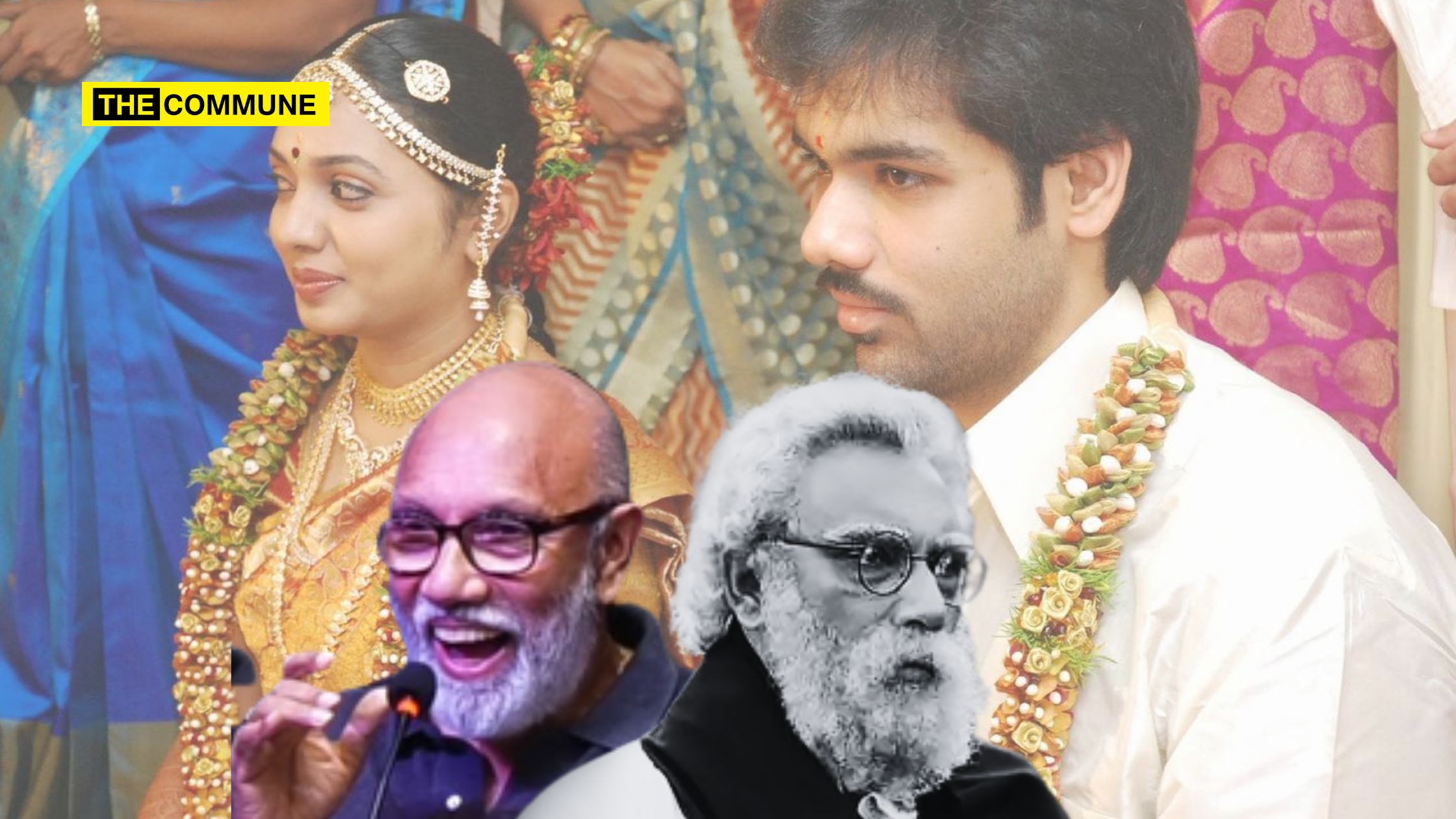
Elangovan is a controversial Congress leader and is the grandson of rabid anti-Hindu bigot E.V. Ramaswamy Naicker (hailed as ‘Periyar’ by his followers).

Recently he was in the news for abusing musical maestro Ilaiyaraaja with casteist remarks.

Speaking at an event organized by Dravida Kazhagam in Erode, the Congress leader in an indirect reference to Mr. Ilaiyaraaja said “There are certain elements in Tamil Nadu today claiming themselves to be ‘king of music’. Everybody knows who is the king of music.  Not everyone who plays the tabla can become a music composer”

“Those who accepted the Communist ideology when they had no means to afford food and were living below the poverty line are today, after getting money and fame, are considering themselves to be upper castes. You know who I am referring to.”, the Congress leader said referring to Mr. Ilaiyaraaja.

“Raja and that too ‘Ilaya’ Raaja it seems! He must be inching over 80 years of age and they call him ‘Ilaya’ Raaja”, the senior Congress leader said making personal caustic remarks about the ace music composer.

The senior Congress leader objected to Mr. Ilaiyaraaja comparing Prime Minister Modi with Dr. Ambedkar in the foreword written by him for a book.

It is worth noting that Kamal Haasan who has now extended his support to Elangovan did not even register his condemnation for the Congress leader’s tirade against Ilaiyaraaja.

Click here to subscribe to The Commune on Telegram and get the best stories of the day delivered to you personally.

Palam Kalyanasundaram: The Man Of The Millenium

Kalyanasundaram, a true humanitarian, was born in Melakarivelamkulam in Tamil Nadu’s Tirunelveli district, lost his father when he was a child, and was raised by his mother, Thaayammal, who inspired him to help others.

A gold medalist in library science, he also holds a masters degree in literature and history. During his 35-year-long career at Kumarkurupara Arts College at Srivaikuntam, he diligently and willingly donated his salary month after month towards charity and did odd jobs to meet his daily needs.

Even after retirement, he worked as a waiter in a hotel in exchange for two meals a day and a meagre salary so that he could continue to donate to orphanages and to children’s educational funds.

At the age of 23, he donated 8.5 gold sovereigns to the National Security Fund in response to then-Prime Minister Jawaharlal Nehru’s call for people to support the country during the war with China.

During the May Day celebrations in 1963, then Chief Minister Kamarajar highlighted his contribution to the National Security Fund.

He was amply rewarded for his service to humanity. Along with the award he also received an amount of ₹30 crores, which he donated to charity.

There are many awards and accolades received by P. Kalyanasundaram. He was given the BAPASI award for best librarian in 2012 and Lifetime Service Award from Rotary International in 2011.

The Government of India awarded him the ‘Best Librarian in India’ in 1990. Similarly, the Jawaharlal Nehru University (JNU), Delhi recognized him as ‘One of the top ten librarians of the world’. United Nations Organizations (UNO) honoured him as ‘One of the outstanding people of the 20th Century’.

An american association conferred him the title “Man of the Millennium”. The International Biographical Centre, Cambridge, honoured him as ‘one of the noblest of the world’.

‘Best Social Worker Award’ from Tamil Nadu Government, Punjab State government award for ‘Best Library Scholar’, ‘Best Educator’ from Manonmaniam Sundaranar University Tamil Nadu and ‘Being Human Being’ from Rotary International are some of the other honours that has been conferred on him. 

In recognition of his self-less service, the Government of India conferred the Padma Shri in 2023.

Former Indian President APJ Abdul Kalam stated on 6 July 2000, “A life without self-luxury is one called as living life in a purest form. The Supreme power has graced one such life to Shri.Kalyanasundaram. Under his able shadow there are many who are divine and blessed to travel in a righteous way.” 

Former President of USA Bill Clinton said that Kalyanasundaram has introduced a new method for strengthening relationship between the countries of the world and named it as “Kalyanasundaram Plan.”

Nelson Mandela, former South African Prime Minister, stated about Kalyanasundaram that “The progress of the country depends upon the children and the students of the country. In deed it is very great Mr. Kalyanasundaram has been doing yeomen services to this section of the society for the past 50 years and without publicity.”

Pandit Jawaharlal Nehru called Kalyanasundaram as “Light of India.”

He was one of the two persons former US President Bill Clinton wanted to meet personally on his visit to India and superstar Rajinikanth has adopted him as his father.

The Incident That Changed Kalyanasundaram

When Kalyanasundaram visited a slum in Triplicane, Chennai, during his graduation ceremony, he was deeply disturbed by the living conditions of the children and decided to establish the Triplicane Slum Children Welfare Organization. The organisation was responsible for the education, cleanliness, and hygiene of the children of the triplicane slum. Soon after, a large wave of assistance arrived for Kalyanasundaram to run the organisation, which grew to become a pan-India organisation known as the Indian Children’s Welfare Organization. Through his contacts at Chennai University, the Indian Children’s Welfare Organization began assisting children in common wealth nations, and the organization’s name was changed to World Children’s Welfare Organization.

Palam Kalyanasundaram worked for the upliftment of Arundhathiars, one of the most disadvantaged and the oppressed even amongst the oppressed communities. He also worked for the the upliftment of Scheduled Caste people of four villages in Padmanabamangalam in Srivaikundam, where he worked in Sri Kumara Gurupara Swamigal Arts College, through Padmanabamangalam Villages Development Sabha.

During 1970s, his life hit rock bottom when he took to the streets to live as a platform beggar and then as a hotel server, but this did not shake his determination to serve the children of the world.

The Man Of The Millenium

This retired librarian has given away all his earnings to the poor over the past 36 years. This man of no possession has, however, given away all his award money, salary, and pension for charity. The amount he has given away over the past four decades for the cause of humanity sums up to ₹30 crore. He gave away his share of the family property worth several lakhs of rupees to people in his village. Palam did not get married because he wanted to spend his income to help the poor instead of his own family. 

Palam Kalyanasundaram is truly a man of the millenium!

Click here to subscribe to The Commune on Telegram and get the best stories of the day delivered to you personally.

Hindu Munnani Demands White Paper On DMK Min Sekarbabu’s Claims Of Recovery Of Temple Land

Hindu State President Munnani Kaadeshwara Subramaniam has demanded Tamil Nadu HR&CE Minister PK Sekarbabu to publish a white paper with supporting data for his assertion that the DMK government has recovered 1000 acres of encroached temple land worth ₹3943 crores.

While speaking at an event laying the foundation stone for reconstruction of the dilapidated Chozha era Mangala Lakshmi Azhaguraja Perumal temple at Thakkolam, next to Arakkonam in Ranipet district, Minister Sekarbabu said that 1000 acres of temple property worth ₹3943 crores have been recovered from the encroachers.

With regards to this claim, Hindu Munnani state president Kadeshwara Subramaniam has questioned the authenticity of the claim of the DMK minister.

In a press release dated 24 January 2023, the Hindu Munnani President stated,”DMK Minister Sekarbabu has developed a habit of stating that ‘so much land has been recovered’ each time he gives a press conference. People are sceptic of his claim of recovery since during a press conference with Chennai Mayor Priya, he instructed Mayor Priya to tell whatever number comes to her mind as data (‘Summa Adichu Vidu’). People in Tamil Nadu have suspicions that he is behaving similarly here.”

The press release added,”Therefore, the Hindu Munnani has been insisting that DMK minister Sekarbabu should issue a white paper on behalf of the HR&CE department regarding all the agricultural lands, buildings, shops, halls, water bodies and other immovable and movable properties that have been recovered from the occupation so far.”

It futher said,”Through this, people are likely to have confidence in the reports and publications issued by the HR&CE department. Therefore, the Hindu Munnani insists that the Tamil Nadu government should release the White Paper without any further delay.”

Click here to subscribe to The Commune on Telegram and get the best stories of the day delivered to you personally.

11 Crore Rural Households In India Now Have Access To Tap Water Connection

jal jeevan mission

Over 11 Crore rural households of the country have access to tap water connection. 123 districts and more than 1.53 lakh villages of India have reported ‘Har Ghar Jal’ which means every household has access to clean drinking water through tap. Despite several disruptions in previous years, States/ UTs have worked relentlessly to ensure tap water inevery rural home. Jal Jeevan Mission was announced by the Prime Minister Narendra Modi on 15 August 2019 to provide every rural household with tap water connection by 2024. At the time of the launch of the Mission in 2019, out of 19.35 Crore rural households, only 3.23 Crore (16.72%) had access to tap water. As on date, within a short span of about three years of the life changing mission, over 11 Crore (56.84%) rural households have tap water supply in their homes.

Prime Minister Narendra Modi praised the achievement of 11 Crore Tap water connections under Jal Jeevan Mission.

The Union Minister for Jal Shakti Gajendra Singh Shekhawat, tweeting about the achievement said “The vision of our PM Sh. Narendra Modiji, the relentless pursuit of the goals set out for Jal Jeevan Mission by the ministry and the effort of our team on ground has made this mega milestone possible”. The Union Minister further said “11 crore homes are now assured of health and well-being with this elixir of life reaching their doorsteps”.

Regular tap water supply relieves people, especially women and young girls,from carrying heavy bucket loads of water to meet their daily household needs thereby reducing age-old drudgery. The time saved from collecting water is used for income generation activities, learning new skills and supporting children’s education.In those villages where the Jal Jeevan Mission(JJM) has reached, the adolescent girls no longer drop-out of school to help their motherwalk long distance and get water to quench their thirst. It goes a long way in empowering and educating the girl child.

With focus on health and well-being of children, in 2020 on Gandhi Jayanti, a campaign was launched to provide tap water connectionin all schools, anganwadicentres and ashramshalas (tribal residential schools) for drinking, cooking mid-day meal, hand washing and use in toilets. As on date, tap water supply has been provided in 8.84 lakh (85.79%) schools and 9.14 lakh (81.75%) anganwadi centres.2 States (Goa andKerala) and 3 UTs (A&N Islands, D&NH and D&D, J&K, Puducherry)are now providing 100% tap water connectivity in its schools and anganwadicentres and16 States/ UTsare in the range of 90% or more, and moving fast to achieve saturation.

Following the bottom-up approach, JJM is being implemented as a decentralized, demand-driven community-managed programme with the aim to provide all rural households with adequate quantity (55 lpcd) water of prescribed quality in adequate pressure, on regular and long-term basis.So far over5.20 lakh PaniSamitis/ Village Water and Sanitation Committees(VWSC) formed under Jal Jeevan Mission to manage, operate and maintain in-village water supply infrastructure. On the front of Water Quality, more than 17 lakh women are trained for testing water samples using Field Test Kits (FTKs), which has led to the empowerment of women in rural areas.

(Published from PIB)

Click here to subscribe to The Commune on Telegram and get the best stories of the day delivered to you personally.