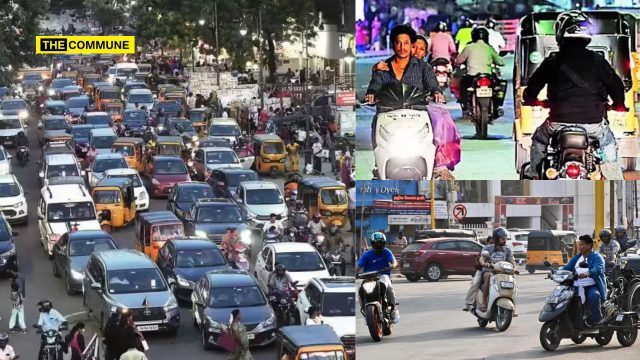
Traffic violations and poor traffic management continue to make commuting across Chennai increasingly difficult, with motorists facing wrong-side driving, chaotic lane changes, badly managed junctions and congestion even on roads with adequate infrastructure.
One of the most common violations is wrong-side driving. Two-wheelers and autorickshaws routinely enter one-way stretches from the wrong end or travel against traffic to save a few minutes. The practice has become particularly common on busy roads, putting motorists and pedestrians at risk, as reported in Times of India.
Several stretches have emerged as regular trouble spots, including Anna Salai, Velachery 100 Feet Road, Pallavaram-Thoraipakkam Radial Road, Rajiv Gandhi Salai and Jawaharlal Nehru Salai. Vadapalani junction, Little Mount, Guindy flyover, Venkatanarayana Road, Poonamallee High Road-Nolambur junction, Arumbakkam Metro junction and Basin Bridge have also been identified as problem areas.
Motorists say the road layout itself sometimes encourages violations. Widely spaced U-turns, long medians and congestion at designated turning points make some commuters take the wrong side rather than travel a longer distance to reach a legal turning point.
But convenience has come at a heavy cost.
In November 2025, a 50-year-old man was killed near Kottivakkam after a motorcycle ridden by a 16-year-old travelling on the wrong side collided head-on with his vehicle. In June this year, a 21-year-old college student died after her two-wheeler collided with a moped travelling on the wrong side of Vandalur-Walajabad Road near Mannivakkam.
Wrong-side driving has reportedly claimed at least 300 lives in Chennai over the past five years.
Despite the scale of the problem, enforcement remains inconsistent. Traffic activists and motorists have pointed out that violations often resume once police personnel leave a particular stretch. This has allowed wrong-side driving to become routine rather than an occasional violation.
The traffic police have introduced technology-based enforcement, with smart barricades fitted with cameras deployed at several locations to identify offenders. The Greater Chennai Traffic Police said 1.89 lakh cases had been booked against motorists for wrong-side driving in the eight months preceding September.
Yet the sheer number of cases highlights the scale of the problem rather than demonstrating that it has been solved.
The problem is not limited to violations. Traffic management itself remains inadequate at several important corridors.
The Madhya Kailash-IIT-Madras stretch of Sardar Patel Road is a striking example. Despite its wide carriageway and the presence of a flyover, the road remains congested through much of the day. The corridor handles at least 11,000 vehicles an hour, but changing traffic arrangements, conflicting vehicle movements and last-minute lane switching regularly create bottlenecks.
The IIT-M flyover has become a particular point of confusion. The flyover operates as one-way during certain periods and two-way at others. Motorists approaching the junction often have to change lanes at the last moment to access it, creating conflicts with vehicles continuing straight.
At the IIT-M junction, vehicles waiting to turn towards Kotturpuram frequently occupy the carriageway and obstruct traffic moving towards Guindy. In the opposite direction, vehicles approaching the flyover from the left also have to cross lanes, further slowing movement.
The presence of traffic personnel has done little to completely resolve these problems. Motorists have complained that personnel are often concentrated at junctions rather than deployed at the precise points where traffic movements begin to conflict.
Police have said four to five personnel are deployed along the Sardar Patel Road stretch and that corrective measures are taken when complaints are received. However, recurring congestion suggests that reactive measures are not enough.
Urban planners have pointed to relatively simple changes that could improve traffic flow. These include removing the signal below the IIT-M flyover for regular vehicular movement and activating it briefly at intervals for pedestrians. Other suggestions include allowing traffic between Raj Bhavan and Madhya Kailash to use both flyover lanes and permitting certain movements to proceed without stopping at the IIT-M signal.
The broader problem is that Chennai’s traffic management continues to rely heavily on enforcement after violations occur instead of preventing conflict points in the first place.
Wrong-side driving flourishes where road design makes legal turns inconvenient. Congestion worsens where lanes are poorly managed. And junctions become choke points when traffic personnel are not positioned where movements actually conflict.
Technology-driven enforcement can generate lakhs of cases, but fines alone cannot fix a traffic system that continues to produce the same violations every day.
For Chennai motorists, the result is a familiar cycle: chaotic driving, inconsistent enforcement, confused lane movements and hours lost in traffic — even on roads that should have enough capacity to keep the city moving.
Traffic menace in #Chennai has become bad and active policing seems to have taken a back seat. Wrong-side driving, helmet-less pillion riders seen in all key spots. Are we seeing cops actively fining people in junctions for violations? pic.twitter.com/6FDW1ZRxup
— Omjasvin M D (@omjasvinMD) September 5, 2026
Subscribe to our channels on WhatsApp, Telegram, Instagram and YouTube to get the best stories of the day delivered to you personally.