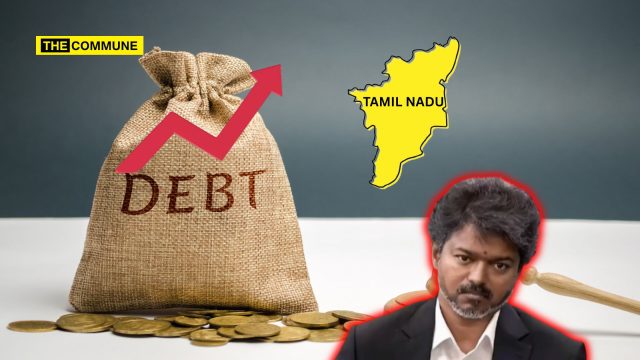
Tamil Nadu’s debt trajectory should set off alarm bells. The State’s debt-GSDP ratio is around 27%, significantly above the 23% sustainable level suggested by the State government’s own economic consultant, as reported in The Hindu.
Economist K.R. Shanmugam has argued that Tamil Nadu needs to bring its debt burden down to 23%. The figure is itself higher than the 20% prudent debt-GSDP ratio recommended for States by the Fiscal Responsibility and Budget Management (FRBM) Committee headed by former civil servant N.K. Singh.
Shanmugam has suggested that Tamil Nadu could be allowed an additional three percentage points because of its relatively stronger macroeconomic performance. Even with that relaxation, however, the State’s current ratio remains well above the suggested sustainable level.
The Bigger Problem Is How The Borrowed Money Is Used
Borrowing, by itself, is not necessarily a problem.
A State can borrow to build roads, infrastructure, industrial projects and other productive assets that generate economic activity and future revenue. Such borrowing can support growth and improve the State’s capacity to service its debt.
The concern arises when borrowing increasingly goes towards expenditure that does not create corresponding productive assets.
That is where Tamil Nadu’s finances raise questions.
The State’s fiscal deficit is around 3% of GSDP, while its revenue deficit is around 1.4%. According to Shanmugam, this effectively means that nearly half of the State’s borrowing is being used to finance consumption rather than investment.
This creates a more serious fiscal problem. If debt continues to rise while a large portion of fresh borrowing is used for consumption, the State has fewer productive assets and additional revenues to show for the increased liabilities.
With Tamil Nadu’s outstanding debt already around ₹10 lakh crore, the concern is that rising debt-servicing costs could eventually crowd out expenditure on development and productive investment.
Debt Has Remained Elevated Since The Pandemic
Tamil Nadu’s debt-GSDP ratio has also remained significantly higher than its pre-pandemic level.
The ratio stood at 22.78% in 2019-20. It shot up to 28.67% during 2020-21 amid the COVID-19 pandemic.
Although the ratio has moderated from its pandemic peak, it has continued to remain in the 26–28% range.
The persistence of the elevated ratio is significant. The pandemic may explain the sharp increase, but the State has not yet brought the ratio back to the levels seen before COVID-19.
Shanmugam’s assessment therefore points towards the need for sustained fiscal consolidation rather than relying on economic growth alone to reduce the debt burden.
Tamil Nadu Is Not The Worst, But The Benchmark Matters
Tamil Nadu is not the only State facing elevated debt levels.
In fact, nine States have debt-GSDP ratios higher than Tamil Nadu — Andhra Pradesh, Bihar, Kerala, Madhya Pradesh, Punjab, Rajasthan, Telangana, Uttar Pradesh and West Bengal.
However, only three States — Gujarat, Maharashtra and Odisha — have managed to keep their debt-GSDP ratios below the 20% benchmark suggested by the FRBM Committee.
The comparison does not make Tamil Nadu’s position comfortable. A State’s fiscal position has to be assessed against its own revenue capacity, expenditure commitments and ability to service debt.
For Tamil Nadu, the government’s own economic consultant has placed the sustainable level at 23%.
The current 27% ratio is therefore not a marginal deviation.
Growth Alone Will Not Be Enough
Bringing the ratio down will require a combination of economic growth and fiscal discipline.
Shanmugam has estimated that Tamil Nadu could bring its debt-GSDP ratio down to 23% by around 2050-51 if it maintains 15% nominal growth annually while keeping the fiscal deficit at 3%.
There is also a faster route.
If the State manages 14% nominal growth while reducing the fiscal deficit to 2.5%, the 23% debt-GSDP level could potentially be reached by 2033-34.
That puts the focus squarely on expenditure control.
Welfare Expansion Needs Greater Scrutiny
Shanmugam has strongly advocated expenditure rationalisation, including the removal of outdated or unproductive welfare schemes.
The issue becomes particularly important when governments consider expanding existing welfare commitments.
Tamil Nadu is already carrying a debt burden of around ₹10 lakh crore. Expanding large recurring expenditure commitments before fiscal consolidation could make it harder to bring the debt ratio down.
The proposed expansion of the Magalir Urimai Thogai from ₹1,000 to ₹2,500 for all women up to the age of 60 would therefore add another major recurring burden to the State’s finances.
The larger question is not whether Tamil Nadu should spend on welfare. It is whether the State can continue expanding recurring expenditure while simultaneously borrowing heavily and trying to bring down its debt-GSDP ratio.
Tamil Nadu’s debt problem is not simply about a large number on a balance sheet.
The warning lies in the trajectory: debt at around ₹10 lakh crore, a debt-GSDP ratio of 27%, a revenue deficit of 1.4%, and nearly half of borrowing going towards consumption rather than investment.
Unless borrowing is brought under control and expenditure is rationalised, debt servicing could increasingly compete with the very productive spending needed to sustain Tamil Nadu’s future growth.
Tamil Nadu’s debt trajectory should set off alarm bells.
TN’s debt-GSDP ratio is around 27%, well above the 23% sustainable level suggested by the State’s own economic consultant. And it is far above the 20% prudent benchmark recommended by the Fiscal Responsibility and Budget… pic.twitter.com/j2nFuPhjBn
— Prasanna Viswanathan (@prasannavishy) September 5, 2026
Subscribe to our channels on WhatsApp, Telegram, Instagram and YouTube to get the best stories of the day delivered to you personally.