The BBC has once again attempted to turn a local controversy into a sweeping story about Japan’s national identity, claiming that the country is being forced to confront whether it can preserve its “identity and cohesion” while becoming more diverse.
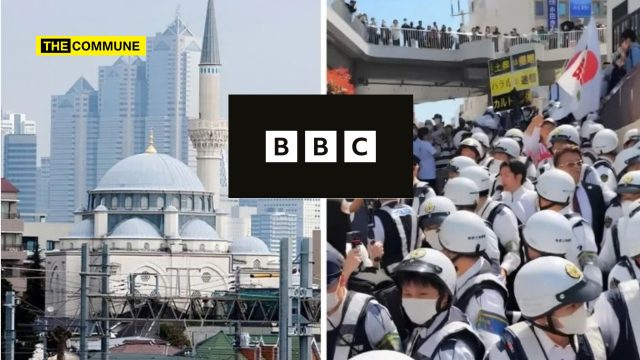
In a July 2026 report titled “A Japanese town wrestles with identity after protests over its first mosque,” BBC Tokyo correspondent Kurumi Mori used the construction of a mosque in Fujisawa, Kanagawa, as the starting point for a broader narrative about immigration, Islam and Japan’s future.
🇯🇵 No, BBC. We are not “struggling with our identity” in Japan. It is you who is struggling with your identity.
We know who we are. We are Japanese. We are not Muslims. We have temples and shrines. We do not have mosques.
We will never forget who we are even if you do. https://t.co/UGudPXZuqA
— 鈴森はるか 『haruka suzumori』 🇯🇵 (@harukaawake) October 4, 2026
But there is a fundamental problem with that portrayal.
The truth is Japan does not appear to be “wrestling with its identity”, but it is the BBC that appears to be wrestling with what it thinks Japan’s identity should be.
Japan is Japan. It has its own history, traditions, religious practices, social customs and national culture. The fact that a growing foreign population is creating new debates over immigration and religious institutions does not automatically mean that the Japanese people have suddenly forgotten who they are.
The BBC nevertheless presents the Fujisawa mosque controversy as a question that “goes to the heart of how Japan sees itself” and later asks whether Japan can become more diverse while preserving the identity and social cohesion it values.
That is a considerable leap from the facts actually presented in the report.
The BBC speaks to Fujisawa resident Noriko Izumizawa, who says she worries about how the community might change following the construction of the mosque. Yet later in the same report, Izumizawa admits that she has never had a negative experience with a Muslim neighbour and says, “maybe I just fear the unknown.”
In other words, the article itself provides evidence that the anxiety it is describing is not necessarily rooted in lived experience.
There is certainly a real debate in Fujisawa. Anti-mosque demonstrations took place at a local train station, and some residents objected to the proposed mosque being larger than a nearby Shinto shrine. The report also mentions abusive calls and emails directed at mosques and counter-protests organised by anti-hate groups.
But reporting a protest is different from constructing an overarching narrative that Japan is undergoing an identity crisis.
The BBC also places the Fujisawa dispute within the context of Japan’s declining population and increasing reliance on foreign workers. According to the figures cited in the report, Japan had roughly 4.2 lakh Muslims at the end of 2024, up from about 2.3 lakh in 2019, while the foreign-resident population exceeded four million in 2025.
But demographic change does not automatically mean an actual cultural surrender, nor does the arrival of new religious communities mean that the host society has to redefine its identity.
Japan has a distinct cultural and historical identity that predates the current immigration debate by centuries. Its Shinto shrines, Buddhist temples, festivals, language, customs and social traditions are not suddenly erased because a new mosque is being constructed in Fujisawa.
In fact, the report itself contains an important counterpoint to its own framing.
Shakeel Mohamed, who represents a mosque in Saitama, says that Muslims living in Japan should respect Japanese rules, including proper waste disposal, parking regulations and bicycle laws. He also stresses the importance of courtesy and greeting neighbours.
Another Muslim resident, Mohamed Mohideen, even acknowledges that Muslim communities themselves have a responsibility to make greater efforts to explain who they are and become part of Japanese society.
That is a perfectly legitimate conversation: how can newcomers integrate into an existing society while respecting its laws, customs and traditions?
But that is different from suggesting that the existing society is somehow confused about its own identity.
The BBC, however, wants to present the issue differently. A local dispute over the construction of a mosque becomes “Japan wrestles with identity.” A resident expressing uncertainty becomes evidence of a country confronting its future. Immigration statistics become a question of whether Japan can remain itself.
Perhaps the more appropriate question is not whether Japan knows who it is.
It is whether Western media outlets are going above and beyond to manufacture a narrative.
Japan can debate immigration. Japanese citizens can debate the construction of mosques. They can discuss integration, population decline, foreign workers and social cohesion.
But those debates do not mean Japan has forgotten its identity.
Japan knows who it is. It is Japanese.
And it does not need the BBC to redefine that identity for it.
Subscribe to our channels on WhatsApp, Telegram, Instagram and YouTube to get the best stories of the day delivered to you personally.