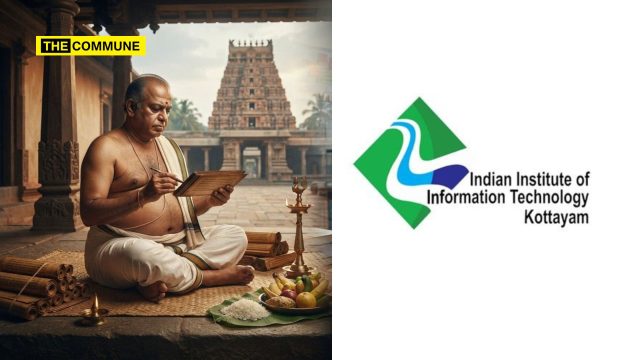
A research paper published in the Journal of Gender Studies has claimed that the historical image of Brahmins with pot bellies symbolised caste privilege and elevated social status, presenting body size as a marker of caste hierarchy in India.
The paper, titled “Fragile Fat Masculinities: The Narrative Construction and Masculine Negotiation of Fatphobia in Malayalam Cinema,” was authored by Sony Jalarajan Raj of MacEwan University, GR Gayathri of Indian government-aided IIIT Kottayam and Adith K. Suresh of MacEwan University. It was published online in June 2025.
The study examines representations of fat male characters in Malayalam cinema, particularly the films Uncle Bun (1991) and Da Thadiya (2012). It explores fatphobia, masculinity, body image and the way cinema constructs perceptions of the male body.
Brahmins having pot bellies is a caste privilege and elevated social status.
IIIT Kottayam is doing great research on Fragile Fat Masculinities.
Humanities for such critical thinking…. on our tax funds. https://t.co/spUp7gpF2z
— Gems of Indian Academia (@GemsofAcademia) October 4, 2026
However, in its discussion of the historical perception of fatness in India, the paper makes a specific claim about caste.
The authors state that “the image of Brahmins with pot bellies has historically symbolized their caste privilege and elevated social status within the Indian hierarchy.” They further describe this physical characteristic as a supposed visible marker of dominance, linked to access to resources and authority.
The paper also argues that, in pre-colonial India, muscular bodies were not necessarily treated as aesthetic ideals and that sinewy bodies were associated with manual labour and, by extension, lower castes. It then presents fatness as historically associated with excess and privilege, while linking thinness with deprivation and lower social standing.
The researchers draw on earlier works by scholars including Sudhir Kakar, Devdutt Pattanaik and Mubarki to make the broader argument that body size historically carried social and cultural meanings in India. The paper cites Pattanaik as observing that, in historical Indian representations, “the rich had potbellies.”
The study subsequently moves into the colonial period, arguing that Western ideals of thinness and bodily control came into conflict with earlier Indian associations between fatness and prosperity. It discusses the emergence of bodybuilding and wrestling organisations during the colonial period and connects them to changing ideas of masculinity and resistance to British rule.
While the paper’s primary subject is fat masculinity in Malayalam cinema, the discussion therefore extends into claims about caste, social hierarchy and historical Indian body ideals.
The research also highlights how academic discussions of body image can intersect with questions of caste and social power — in this case, placing Brahmin pot bellies within a framework of caste privilege and elevated status.
The paper was published in the Journal of Gender Studies, with G. R. Gayathri listed as an Assistant Professor in the Department of Computational Science and Humanities at IIIT Kottayam, an institute of national importance.
Humanities research funded through public institutions is expected to examine society critically. But the claim that a particular caste’s physical appearance historically represented its privilege raises questions of its own about the evidence, generalisations and assumptions being brought into such academic research.
Subscribe to our channels on WhatsApp, Telegram, Instagram and YouTube to get the best stories of the day delivered to you personally.