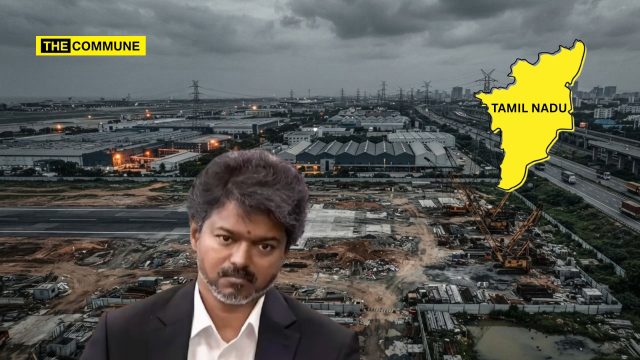
Tamil Nadu has long been one of India’s strongest industrial states: a hub for automobiles, electronics, textiles, and aerospace. Since the Tamilaga Vettri Kazhagam (TVK) government took power in April 2026 under Chief Minister C. Joseph Vijay, the state’s industrial trajectory has come under serious strain.
Three interlocking problems define the current landscape:
- A scrapped mega-infrastructure project that threatens to push major investors to neighbouring states.
- Recurring power instability that has rattled manufacturing belts and slowed industrial clearances.
- A fiscal model tilted toward welfare spending, with revenue collection showing weakness even as the government touts cost-cutting as an offset.
The Parandur Airport Cancellation – Setting Back TN By Decades
The most consequential TVK decision so far has been the cancellation of the Parandur greenfield airport.
On 24 August 2026, Chief Minister C. Joseph Vijay announced in the Assembly that the proposed second airport at Parandur would be abandoned. The project, estimated at around ₹27,000–27,400 crore, had been planned across roughly 5,700 acres in Kancheepuram district. It had faced sustained protests from farmers and residents concerned about agricultural land, wetlands and livelihoods.
The government has said Chennai still needs a second airport and will identify an alternative site with less impact on agriculture and habitation. But finding a similar site that will not affect one living being or nature is almost next to impossible to find.
The problem for industry is the time lost.
Chennai’s airport infrastructure is not merely about passengers. Chennai and its surrounding industrial belt are home to automobile manufacturers, electronics companies, aerospace suppliers, logistics firms and export-oriented factories. A second airport was intended to become part of the infrastructure supporting that expanding economic ecosystem.
The industrial consequences are severe. Scrapping the hub pushes large-scale tech, electronics, and aerospace multinationals toward Andhra Pradesh and Karnataka, and Chennai risks falling a decade behind Bengaluru and Hyderabad as aviation and logistics centres.
Roughly 1,700–1,802 acres, about 48% of the intended site had already been acquired. The Industries Department has examined possibilities including industrial use, agriculture-linked activities and potentially a SIPCOT estate. However, as recently as September, a Revenue Department official said that no final decision had been taken on the future use of the land.
The alternative, expanding Meenambakkam with a new Terminal 5 targeting 55 million annual passengers, is a terminal upgrade, not a capacity transformation. An elevated bypass connection to Tambaram does not replace a greenfield hub designed for scale.
For aerospace, electronics, and advanced logistics investors making 10–15 year location decisions, this is the signal that matters. The state that once promised a new aviation era has now told them to look elsewhere.
Power Constraints Are Beginning To Worry Industry
One of the immediate problems is electricity.
Tamil Nadu saw substantial pressure on its power system as demand rose sharply during September 2026. Data tracking the state grid show that Tamil Nadu recorded peak demand of 21.7 GW in July 2026, while September saw periods in which demand went unmet. The wider Indian power system also experienced its highest power shortages in more than three years during September.
For industries, however, the bigger concern is not merely the availability of electricity but whether companies can reliably source it at competitive prices.
High-tension industrial consumers normally have the option of buying electricity directly through the open-access mechanism, including from the Indian Energy Exchange. But industrial representatives told The New Indian Express that the State Load Despatch Centre had stopped issuing standing clearances for such purchases since June. They said this forced industries that would otherwise have purchased around 1,000 MW through open access to depend on TNPDCL instead: a bureaucratic delay that has hit major industrial hubs hard. Renewable-energy developers also complained that completed projects were waiting for grid connectivity.
The Tamil Nadu Power Distribution Corporation Limited (TNPDCL) has been forced into expensive short-term power purchases to bridge the gap, a cost that ultimately lands on industrial tariffs or state finances. In Parandur itself, residents have blockaded TNEB substations over frequent outages and voltage fluctuations disrupting small businesses. TNPDCL has additionally proposed a surcharge of 63 paise per unit on HT consumers purchasing electricity through open access for October 2026 to March 2027.
For an industrial state competing with Karnataka, Andhra Pradesh, Telangana and Maharashtra for factories and data centres, electricity needs to be not only available but predictable and competitively priced.
The trend line is clear: demand surged roughly 20–25% year-on-year, and the state is buying expensive short-term power to keep the lights on. For energy-intensive manufacturers, that is a cost and reliability risk, not a one-off.
Welfare Expansion At The Cost Of Productive Investment
The TVK government’s welfare agenda is another part of the industrial-growth debate.
The government has expanded the free-bus programme for women under the Vettri Payanam scheme to additional categories of government buses. The expansion took effect from 2 October 2026, with the state allocating ₹6,000 crore for the programme. Other draining schemes include the monthly ₹1,000 for women and the Thaimaaman Gold Ring Scheme, also launched a few weeks ago.
The fiscal question is therefore not whether welfare spending exists, but whether Tamil Nadu can continue expanding recurring commitments while simultaneously funding the infrastructure required for long-term growth.
The state’s finances already face structural pressure. Tamil Nadu’s own-tax revenue had fallen from 5.93% of GSDP in 2021–22 to 5.45% in 2025–26, according to the Governor’s address to the Assembly. The 2026–27 budget estimates own-tax revenue at 5.6% of GSDP.
The state is not facing a simple revenue collapse. The 2026–27 budget estimates total revenue receipts at ₹3.50 lakh crore and own-tax revenue at ₹2.27 lakh crore. But a state whose industrial ambitions require enormous spending on roads, ports, airports, electricity, logistics and urban infrastructure cannot indefinitely rely on expanding expenditure without improving the efficiency of revenue collection and public spending.
GST Collections: The Gross Decline Nobody Wants to Talk About
The fiscal picture is more nuanced than anyone wants to admit, but the underlying weakness is real. Gross domestic GST collections attributed to Tamil Nadu fell 2.9% year-on-year between April and August 2026, a shortfall of roughly ₹1,606 crore, while September 2026 gross collections dropped approximately 5% to ₹10,188 crore.
View this post on Instagram
Tamil Nadu’s post-settlement GST revenue rose 16% to ₹36,947 crore during the April–August block, with cumulative receipts reaching ₹44,266 crore by September. Because GST is a destination-based tax, these figures indicate robust internal household consumption across the state. That is a genuine and important point, but it does not refute the gross collection decline. It simply shows that money collected elsewhere is being consumed in Tamil Nadu, not that the state’s own industrial base is generating more tax.
That distinction matters because it points to the deeper problem already visible in the state’s own-tax trajectory: a long-term erosion of fiscal capacity that will not be fixed by a strong consumption quarter or a favourable settlement cycle.
Tamil Nadu Cannot Afford To Lose Its Industrial Edge
Tamil Nadu’s industrial strength was built over decades, but maintaining that advantage requires more than welfare expansion and short-term cost savings. The cancellation of Parandur, uncertainty over its replacement, power-sector concerns and delays in industrial electricity access have introduced fresh risks for investors. At the same time, weakening own-tax revenue as a share of GSDP raises questions about how the state will finance the infrastructure needed for future growth. GST settlements and procurement savings provide some fiscal cushion, but they do not erase these structural concerns. If TVK fails to resolve them quickly, Tamil Nadu could lose investments to faster-moving neighbouring states.
Subscribe to our channels on WhatsApp, Telegram, Instagram and YouTube to get the best stories of the day delivered to you personally.