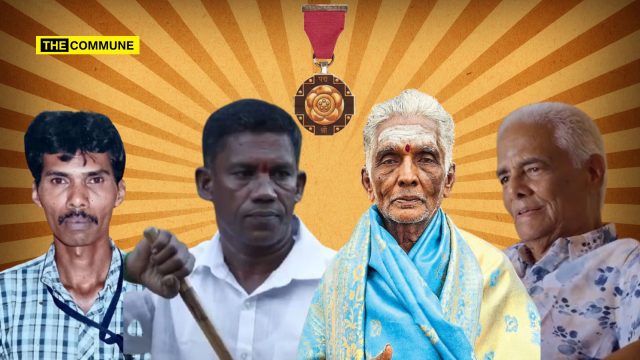
For decades, they lived outside television studios, political power corridors and elite cultural circuits. They were not backed by corporations, foundations or celebrity endorsements. They worked in forgotten villages, temple corridors, forest settlements and dusty training grounds – carrying on traditions older than many modern nations, often in poverty and near-total obscurity.
Now, four such cultural guardians from Tamil Nadu and Puducherry have finally been recognised with the Padma Shri 2026, one of India’s highest civilian honours. Their stories are not stories of fame. They are stories of survival, sacrifice and civilizational memory.
K. Pajanivel – The Man Who Refused To Let Silambam Die
Among the awardees is 66-year-old K. Pajanivel, a man who spent his childhood cleaning buses for just ₹3 a day after losing his father at the age of 13.
Born in Pooranankuppam village near Puducherry, Pajanivel grew up in crushing poverty under the care of his single mother. Yet it was in the middle of that hardship that he discovered Silambam – the ancient Tamil martial art believed to date back thousands of years.
Under the guidance of Master Rajaram, Silambam became more than a martial discipline. It became his reason to endure life itself.
Even while working as a commercial driver to feed himself, Pajanivel spent over three decades travelling through villages and conducting free Silambam camps for poor children and rural youth. He founded the Mamallan Silambam Academy and fought to preserve not just mainstream Silambam but dying sub-traditions including Kuthu Varisai, Kalari Pattu, Puliyattam and ancient sword-fighting forms that were rapidly disappearing from Tamil society.
His skills eventually earned him international recognition, including victory at the International Silambam Competition in 2002. Yet despite the awards and applause, Pajanivel’s lifelong demand remains painfully simple: he wants Silambam taught in schools before India’s indigenous martial knowledge disappears forever.
View this post on Instagram
The Moment That Moved The Nation
During the Padma awards ceremony at Rashtrapati Bhavan, Pajanivel performed a full traditional “dandavat pranaam” by lying flat on the floor before Prime Minister Narendra Modi. In an unusual breach of official protocol, Modi rose fully from his seat and returned the gesture. The image spread rapidly across the country.
K. Pajanivel, Known As The Silambam King From Puducherry, Was Honoured With The Prestigious Padma Shri At Rashtrapati Bhavan For His Lifelong Contribution To Preserving And Promoting The 5,000-Year-Old Tamil Martial Art Of Silambam. Before Receiving The Award, He Paid A… pic.twitter.com/G9b1yfsMDx
— SURAJ (@SURAJ_624) May 26, 2026
Othuvar Tiruttani Swaminathan – The Voice That Kept Temple Hymns Alive
Another newly honoured figure is Othuvar Tiruttani Swaminathan, a man who spent more than half a century ensuring that the ancient Thirumurai hymns of Tamil Shaivism did not disappear into silence.
Born into a poor Vaishnavite farming family in Alathur village under the name Sarangapani, Swaminathan was forced to drop out of school after class eight because of poverty. His extraordinary singing voice eventually led him to the Pichai Kattalai Estate Thevara School, before he underwent rigorous spiritual and musical training at the Dharmapuram Adheenam. It was there that the pontiff renamed him Swaminathan – marking a complete transformation of his life and identity.
In 1975, he became a full-time Othuvar at the Tiruttani Murugan Temple, where he rendered highly complex Pann Isai melodies daily until his retirement in 2000. Over his lifetime, he memorised nearly 9,000 sacred Tamil hymns entirely through oral tradition – a feat almost unimaginable in the age of smartphones and artificial intelligence.
Even after retirement, Swaminathan refused to allow the tradition to die. He dedicated himself to training young boys at Chidambaram and Dharmapuram patasalas, helping create a new generation of Othuvars serving in temples across the world. Today, despite his age, he reportedly continues teaching 49 students.
View this post on Instagram
Dr. R. Sreedhar – The Scientist Who Gave Villages Their Own Voice
The Padma Shri list also includes Dr. R. Sreedhar, widely regarded as the father of India’s community radio movement.
Unlike conventional scientists who remained confined to laboratories and academic journals, Sreedhar spent decades trying to bring knowledge directly into the hands of ordinary people.
Raised by a Tamil scholar grandfather and inspired by his visually impaired maternal uncle, Sreedhar entered broadcasting during the 1970s as All India Radio’s first dedicated science reporter, despite earning a PhD in chemistry and dreaming of a standard academic professorship.
He went on to revolutionise Indian broadcasting. His programme “Manav Vikas” became one of the world’s longest-running science radio series for children. Using INSAT-1B satellite technology long before digital media became fashionable, Sreedhar brought interactive educational broadcasts to some of India’s most isolated regions, including Antarctica, Leh and Lakshadweep.
In 2004, operating with virtually no financial backing, he established India’s first community radio station at Anna University. His model rejected flashy commercial radio culture. Instead, he handed microphones to villagers themselves – allowing rural communities to discuss farming, health, education and local problems in their own voices. Today, India reportedly has over 550 community radio stations, many built on the foundations laid by Sreedhar’s work.
Even in retirement near Perur in Coimbatore, Sreedhar continues pushing new ideas such as “visual radio” and has publicly warned that radio must evolve rather than become obsolete in the AI era.
View this post on Instagram
R. Krishnan “Kitna” – The Tribal Artist Who Died Before India Noticed Him
Perhaps the most heartbreaking story among the Padma Shri awardees is that of R. Krishnan (Kitna) – the Nilgiris tribal artist who received the honour posthumously.
Known affectionately as “Kitna,” Krishnan belonged to the Alu Kurumba tribe, classified as a Particularly Vulnerable Tribal Group (PVTG). For centuries, the tribe documented rituals, forest life and spiritual beliefs through rock and cave art traditions dating back nearly 3,000 years, including at the Ezhuthu Paarai site in the Nilgiris. But modernisation pushed this fragile tradition to the edge of extinction.
For more than 30 years, Kitna dedicated his life to saving it.
Using pigments made from forest bark, leaves and natural resins, he painstakingly recreated ancient tribal visual traditions on cloth and canvas. He refused to commercialise the art aggressively or mass-produce his work because he feared exploitation of tribal identity and intellectual heritage. Through over a thousand paintings, he documented the spiritual imagination of the Nilgiri forests.
Yet the man who preserved one of India’s oldest surviving indigenous art traditions died in poverty.
President Droupadi Murmu confers Padma Shri in the field of Art on Shri R. Krishnan Kitna (Posthumous). He was a distinguished Ajile Bottu artist from the Alu Kurumba community of Vellaricombei village, Tamil Nadu. Shri Krishnan began painting in early childhood, inspired by… pic.twitter.com/4X5jE4LMr2
— President of India (@rashtrapatibhvn) May 25, 2026
The Dream He Never Lived To See
Before his death, Kitna’s greatest dream was not personal fame but securing a Geographical Indication (GI) tag for Alu Kurumba art so that outsiders could not exploit or counterfeit his community’s heritage.
Today, his widow Susheela reportedly survives by earning around ₹300 a day through hard agricultural labour and collecting betel nuts in Kotagiri. Experts have warned that fewer than 10 master artists remain alive who still know how to extract the traditional organic pigments required to sustain the art form.
India’s Cultural Memory Survived Because Ordinary People Refused To Let It Die
For years, India’s loudest cultural conversations were dominated by celebrity influencers, imported trends and commercial entertainment industries worth thousands of crores.
Meanwhile, people like Pajanivel, Swaminathan, Sreedhar and Kitna quietly carried civilizational burdens on their backs – preserving martial arts, sacred music, tribal memory and public knowledge systems without institutional wealth or elite visibility.
The Padma Shri recognition may have finally brought them national attention. But their stories also expose an uncomfortable truth: some of India’s oldest cultural inheritances survived not because of governments, markets or academia, but because a handful of ordinary people refused to let them die.
Subscribe to our channels on WhatsApp, Telegram, Instagram and YouTube to get the best stories of the day delivered to you personally.