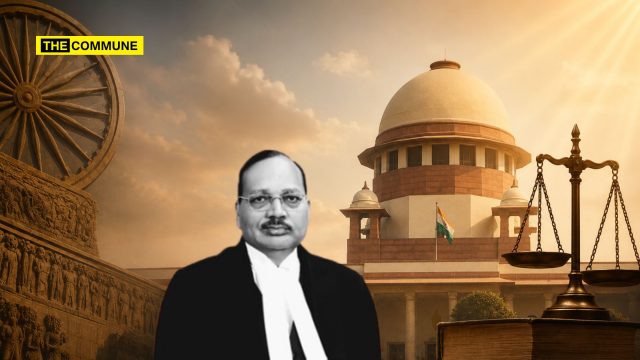
Rejecting the notion that the Rule of Law and judicial independence are concepts borrowed from the West, Chief Justice of India (CJI) Surya Kant on Monday asserted that the supremacy of Dharma over personal, political and dynastic power has been a defining feature of Indian civilisation for thousands of years, long before the emergence of the common law tradition, as reported in LiveLaw.
The CJI made the remarks while delivering the keynote address on “Safeguarding the Rule of Law: Experiences from India and Sweden” at an event organised by International IDEA in Sweden.
Addressing an international audience, Justice Surya Kant challenged the widespread academic perception that constitutional principles such as judicial independence and the Rule of Law were post-colonial concepts introduced to countries in the Global South.
“It is frequently presumed by many academics and legal scholars that the Rule of Law and Judicial Independence are purely Western, post-colonial imports gifted to the Global South. In the Indian consciousness, institutional integrity and the absolute supremacy of Dharma, which comprises the cosmic, ethical, and legal order, over personal or dynastic power, are ancient principles with roots stretching back thousands of years before the arrival of the common law,” Chief Justice of India Surya Kant said.
Mahabharata Illustrates India’s Ancient Judicial Ethos
To illustrate his argument, the CJI recounted an episode from the Mahabharata involving King Prahlada, his son Virochana and the scholar Sudhanva.
According to the narrative, King Prahlada was called upon to adjudicate a life-and-death dispute involving his own son. Despite the personal consequences, the king ruled in favour of Sudhanva after concluding that truth and justice took precedence over familial loyalty.
“The sages remarked that when a judge abandons the truth, it is not merely a litigant who suffers, but also the very moral order upon which the entirety of civil society rests,” the CJI said while narrating the episode.
Justice Surya Kant said the incident demonstrated that Indian civilisation had recognised the necessity of insulating judges from personal, political and dynastic pressures long before modern constitutional doctrines such as the separation of powers or judicial independence were formally articulated.
Judicial Review Is A Constitutional Duty
The Chief Justice stressed that judicial review is not merely a constitutional power but an obligation imposed upon the judiciary by the Constitution.
He said the Indian judiciary has consistently ensured that the Rule of Law remains “not an abstract constitutional promise but a lived and undeniable reality for every citizen.”
According to the CJI, India’s constitutional framework clearly distributes responsibilities among the Legislature, Executive and Judiciary, with the judiciary serving as the principal constitutional safeguard against excesses by the other two branches.
“Courts, by definition, cannot be mere spectators in the constitutional order. They must remain vigilant guardians of constitutional supremacy, ensuring that no exercise of public power escapes the sustained discipline of law,” he said.
He added that judicial review functions as a corrective mechanism whenever any constitutional organ departs from its assigned constitutional role, while emphasising that maintaining the Rule of Law requires a careful equilibrium among all three branches of government.
Basic Structure Doctrine A Landmark Constitutional Contribution
Justice Surya Kant described the Basic Structure Doctrine, evolved by the Supreme Court in the landmark Kesavananda Bharati judgment, as one of the Indian judiciary’s most significant constitutional contributions.
According to him, the doctrine established that the Constitution possesses a fundamental identity which cannot be destroyed even through constitutional amendments, with the principle of separation of powers forming an inseparable part of that identity.
The Chief Justice also referred to the Supreme Court’s judgment in S.R. Bommai, noting that it elevated federalism and democracy to the status of basic structure principles and laid down that an elected government cannot be dismissed unless it loses its majority on the floor of the House.
Constitutional Safeguards Protect Judicial Independence
Highlighting the constitutional architecture that protects judicial independence, Justice Surya Kant pointed to several institutional safeguards embedded within the Constitution.
These include the separation of the judiciary from the executive, constitutional protection preventing legislative criticism of judges for their judicial conduct, and financial autonomy secured through the Consolidated Fund of India.
He also referred to the evolution of the Collegium system, under which appointments to the higher judiciary are predominantly made by judges themselves.
PIL Revolution Expanded Access To Justice
The CJI highlighted the transformative role played by Public Interest Litigation (PIL) in democratising access to justice.
Tracing its evolution from the landmark S.P. Gupta judgment, he said the Supreme Court liberalised the traditional doctrine of locus standi, enabling public-spirited individuals to approach courts on behalf of disadvantaged and marginalised sections of society.
He further referred to the Court’s practice of exercising epistolary jurisdiction, under which letters and even newspaper reports have been treated as writ petitions in appropriate cases.
Landmark Judgments Strengthened Fundamental Rights
Surveying the Supreme Court’s constitutional jurisprudence over the decades, Justice Surya Kant referred to several landmark decisions that have expanded the scope of fundamental rights.
These included:
- Hussainara Khatoon, which recognised the right to a speedy trial;
- Maneka Gandhi, which expanded the doctrine of due process;
- Francis Coralie Mullin, affirming the right to live with dignity;
- Olga Tellis, recognising the right to livelihood;
- Bandhua Mukti Morcha, addressing bonded labour;
- Union of India v. K.A. Najeeb, where the Court held that prolonged incarceration violating the right to a speedy trial could justify granting bail despite statutory restrictions.
Court Also Advanced Environmental Protection And Electoral Reforms
Justice Surya Kant also highlighted the Supreme Court’s contribution to environmental jurisprudence, noting that it developed important legal doctrines such as absolute liability, polluter pays, the precautionary principle, and the public trust doctrine.
He further referred to judgments that strengthened India’s electoral democracy by mandating greater disclosure by candidates and recognising free and fair elections as an integral component of the Constitution’s basic structure.
On gender justice, the Chief Justice cited the Court’s recent directions aimed at increasing women’s representation in Bar Councils, the landmark Vishaka guidelines against workplace sexual harassment, and judgments expanding women’s reproductive autonomy.
Judicial Activism Must Be Balanced By Judicial Restraint
Concluding his address, Justice Surya Kant emphasised that while the judiciary has an obligation to protect constitutional values, judicial activism must always operate within constitutional limits.
“The Supreme Court has consistently recognised that the Rule of Law is preserved only when the Judiciary honours its own institutional boundaries while holding other branches to theirs. The Court does not sit as a second appellate authority or a super-executive over the complex technical and socio-economic choices made by any of the other organs of the State,” he said.
The Chief Justice concluded that the preservation of the Rule of Law depends not only on the judiciary’s willingness to uphold constitutional principles but also on its discipline in respecting the constitutional boundaries that define its own role within India’s democratic framework.
Subscribe to our channels on WhatsApp, Telegram, Instagram and YouTube to get the best stories of the day delivered to you personally.