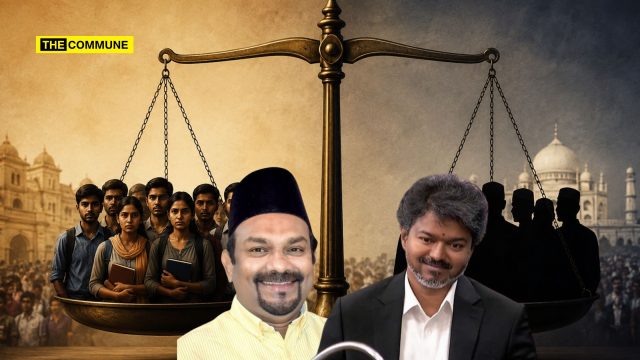
The proposal by TVK government’s Minorities Welfare Minister, A.M. Shahjahan of the IUML, to increase the Muslim sub-quota within the Backward Classes (BC) reservation category from 3.5% to 5% exposes a fundamental contradiction at the heart of identity-driven politics: every percentage point granted to one group must come from somewhere else.
In Tamil Nadu’s tightly packed reservation system, there is no free lunch.
Despite being presented as a measure of minority welfare, the proposal effectively asks socially and educationally backward Hindu communities to surrender a portion of their already limited share of educational seats and government jobs. It is not an expansion of opportunity. It is a redistribution of scarcity.
The Inconvenient Mathematics
Tamil Nadu’s reservation structure operates within a fixed framework. The BC category accounts for 30% of total reservations.
Under the current arrangement:
Hindu and other non-Muslim BC communities: 26.5%
Muslim sub-quota: 3.5%
Under the proposed arrangement:
Hindu and other non-Muslim BC communities: 25%
Muslim sub-quota: 5%
The arithmetic is brutally simple.
Every additional seat allocated to the expanded Muslim quota must be deducted from the remaining BC pool. There is no separate reserve from which these seats can be drawn. No new opportunities are being created. Existing opportunities are merely being transferred.
For thousands of BC Hindu students competing for college admissions, professional courses, scholarships and government jobs, the proposal translates into fewer seats, fewer vacancies and lower chances of advancement.
Reservation Was Never Intended To Be A Religious Entitlement
India’s reservation system was conceived as a corrective mechanism for historical social and educational backwardness, not as a tool for religious bargaining.
Backward Muslim communities already receive reservation benefits because they have been classified as backward based on socio-economic criteria. The existing framework already accommodates them within the broader reservation architecture.
The demand for an enlarged religion-specific quota therefore raises a fundamental question:
What new empirical evidence justifies this increase?
Has there been a fresh socio-economic survey? Has a new commission documented extraordinary deprivation requiring additional allocation? Has any comprehensive data been placed before the public?
So far, the answer appears to be no.
Instead, the demand risks transforming affirmative action from a policy rooted in measurable backwardness into a political instrument shaped by community negotiations and coalition compulsions.
Coalition Politics Should Not Determine Social Justice
The timing of the proposal is impossible to ignore.
The demand comes from a minister belonging to the Indian Union Muslim League, a key ally within the TVK-led government. Unsurprisingly, one wonders whether the proposal is driven by social justice considerations or by coalition management.
If reservation percentages begin expanding or contracting based on political leverage rather than objective data, the entire credibility of the system comes under threat.
Social justice cannot become a reward for political support.
Nor can reservation policy become a bargaining chip exchanged across coalition tables.
Creating New Fault Lines
Reservation works only when competing communities believe the system is fundamentally fair.
The moment one group is perceived to be receiving additional benefits without transparent justification, resentment inevitably follows.
The chain reaction is predictable: Expansion of a religion-specific quota → Reduction of the common BC pool → Perceived discrimination among other BC communities → Erosion of faith in the reservation system → Increased social friction
Those who bear the cost are often the least politically influential sections within the BC category – families that depend on government colleges, public sector employment and reservation-based opportunities for social mobility.
For them, this is not an abstract policy debate. It directly affects their future.
TVK Faces Its First Major Test
The TVK government came to power promising fairness, transparency and a break from vote-bank politics.
Minister Shahjahan’s proposal now presents the administration with a crucial test.
Will the government defend a data-driven model of affirmative action rooted in measurable backwardness? Or will it allow reservation policy to drift toward increasingly explicit religious allocations designed to satisfy coalition partners?
If the objective is genuinely to uplift disadvantaged communities, the answer lies in expanding educational access, improving school quality, creating jobs and accelerating economic growth.
What it cannot mean is taking opportunities away from one backward community and handing them to another under the banner of social justice.
Because social justice ceases to be justice when it becomes a zero-sum political transaction.
The TVK government must reject any quota expansion that lacks fresh empirical justification and ensure that reservation policy remains anchored in objective backwardness rather than religious identity or coalition arithmetic. The future of Tamil Nadu’s social justice framework depends on it.
Subscribe to our channels on WhatsApp, Telegram, Instagram and YouTube to get the best stories of the day delivered to you personally.