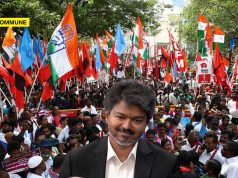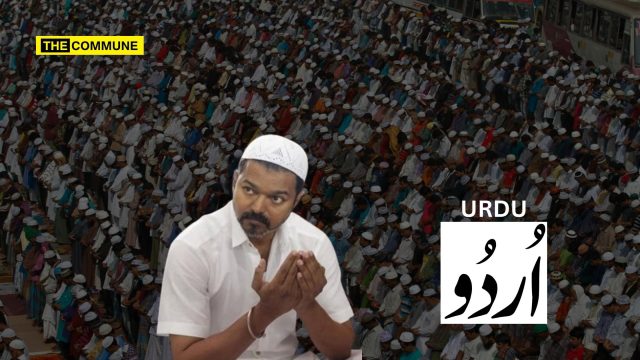
The TVK government headed by Chief Minister C. Joseph Vijay has allocated ₹1 crore for the development and promotion of the Urdu language acceding to the request of the Tamil Nadu State Urdu Academy, as reported in Dinamani.
The allocation has drawn attention, particularly coming shortly after Vijay made an emphatic pitch for Tamil in the State Legislative Assembly, describing the language as not merely a language but a culture, civilisation, thought and emotion.
This comes at a time when Joseph Vijay has expressed his opposition to the three-language policy of the central government.
₹1 Crore For Urdu Development
According to a resolution passed by the Trichy Urdu Association’s executive committee on August 28, the association thanked the Tamil Nadu government and Chief Minister Joseph Vijay for allocating ₹1 crore for the development and growth of Urdu.
The association said the allocation was made following a request from the Tamil Nadu State Urdu Academy.
The executive committee also thanked those who participated in the association’s Meelad-un-Nabi Urdu poetry event and resolved to increase membership and strengthen the organisation.
Vijay’s ‘Tamil Is Our Life’ Rhetoric
The allocation assumes significance in light of Vijay’s recent rhetoric on Tamil.
While moving a resolution in the Assembly earlier this month making Tamil Thai Vazhthu mandatory at government and institutional programmes, Vijay said, “Tamil is not just a language; it is our life, our soul, and our emotion.”
Vijay had also projected Tamil as central to the State’s culture, identity and civilisation, promising that his government would protect Tamil and Tamil Nadu’s linguistic rights.
Against this backdrop, the decision to allocate ₹1 crore specifically for Urdu raises questions about the government’s priorities.
Opposing Three-Language Policy, But Funding Urdu
The ₹1 crore allocation also assumes significance in the context of Vijay’s opposition to the Centre’s three-language policy.
Vijay and the TVK have portrayed the three-language formula as an attempt to introduce Hindi and Sanskrit into Tamil Nadu, arguing that it could undermine the State’s linguistic identity and Tamil pride.
Vijay has repeatedly maintained that Tamil must retain the foremost place in Tamil Nadu and that the mother tongue should not be pushed into a “third position”. He has also indicated that his government would consider legislative measures to protect Tamil’s primacy if necessary.
The TVK has also linked its opposition to the three-language policy with its broader position on educational equity. Vijay has argued that restricting the State’s education policy to Tamil and English would prevent students, particularly those from underprivileged backgrounds studying in government schools, from being placed at a disadvantage.
Yet, against this backdrop of strongly defending a two-language approach centred on Tamil and English, the TVK government has now made a dedicated ₹1 crore allocation for the development and promotion of Urdu.
The issue is not that the government is supporting an additional language. The question is whether the TVK’s stated position on language is being applied consistently.
Following The DMK’s Minority Appeasement?
The decision also brings back into focus the previous DMK government’s spending on projects catering to minority communities.
In March 2025, then Chief Minister M.K. Stalin announced a ₹65 crore Tamil Nadu Haj House in Nanganallur near Chennai Airport.
The announcement was made as part of six new projects announced for Nagapattinam district. Stalin highlighted the importance of Nagore Dargah and said the Haj House would bring happiness to the Muslim community.
The proposed Haj House was to be built with ₹65 crore from public funds.
The DMK government’s decision had itself raised questions over the use of public money for facilities associated with a particular religious community.
Now, the TVK government has announced a separate ₹1 crore allocation for Urdu development.
Is public money increasingly being directed towards initiatives that can help governments cultivate support among specific minorities?
Why Urdu? What About Tamil And Other Indian Languages?
The choice of Urdu for a dedicated ₹1 crore allocation raises another question: why Urdu specifically?
India is home to dozens of major languages with rich literary and cultural traditions. Tamil, Telugu, Kannada, Malayalam, Marathi, Bengali, Assamese, Odia and several other Indian languages have deep historical roots in different parts of the country.
Tamil Nadu is home to a diverse linguistic population, while India itself has a vast range of languages with centuries-old literary and cultural traditions. If the objective is genuinely to promote linguistic diversity, the government could have adopted a broader policy for supporting Indian languages rather than making a specific ₹1 crore allocation for Urdu.
Urdu is not a language indigenous to Tamil Nadu. Pakistan, meanwhile, adopted Urdu as its national language after its creation in 1947.
So why has the TVK government chosen to earmark ₹1 crore specifically for Urdu development? Why not announce comparable funding for the promotion of other Indian languages spoken by communities across Tamil Nadu?
Subscribe to our channels on WhatsApp, Telegram, Instagram and YouTube to get the best stories of the day delivered to you personally.