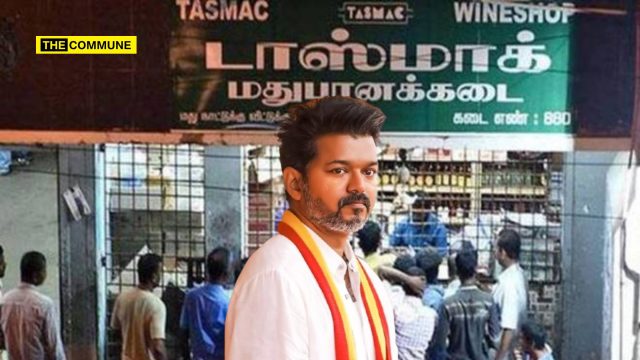
Despite repeated assurances from the TVK government that the long-standing issue of overcharging at TASMAC liquor outlets would be addressed, consumers across Tamil Nadu continue to report being charged above the Maximum Retail Price (MRP), with excess collections allegedly ranging up to ₹40 per bottle, as reported in The New Indian Express.
The government had recently launched a statewide crackdown against MRP violations, suspending nearly 200 TASMAC retail outlet employees accused of collecting amounts above the prescribed price. Prohibition and Excise Minister K. Vignesh had also conducted surprise inspections at several TASMAC outlets and godowns, directing employees to strictly adhere to MRP and refrain from overcharging customers.
However, complaints from consumers indicate that the practice remains widespread despite the enforcement drive.
According to a field survey conducted by The New Indian Express across Chennai, Tiruchy, Coimbatore, Salem, Tiruppur and Tenkasi districts, several TASMAC outlets were allegedly found continuing to collect amounts above the printed MRP.
In Alangulam, Tenkasi district, customers reportedly alleged that all four TASMAC outlets operating in and around the town continued to collect an additional ₹5 per bottle. Consumers also complained about a private liquor outlet allegedly misusing its FL2 licence by charging ₹20 extra on bottles priced below ₹200 and ₹40 extra on bottles costing more than ₹200.
Similar complaints were reported from Salem district, where consumers said that although a few outlets had stopped collecting excess amounts following recent inspections, most shops continued the practice.
S. Prabakaran, a resident of Rayapuram in Tiruppur, told the newspaper that some outlet employees waived the additional charge only after customers questioned them by pointing to the MRP printed on the bottle. He alleged that in certain instances, ₹10 was refunded only after customers returned the bottle.
Consumers in Coimbatore reportedly shared similar experiences, stating that obtaining a waiver of the additional ₹10 often required arguments with outlet staff, making such confrontations a routine occurrence at several shops.
K. Thiruselvan, General Secretary of the CITU, alleged that officials responsible for supervising TASMAC operations had escaped accountability despite persistent complaints. He pointed out that deputy collectors and district managers had been appointed to monitor outlet operations, but no action had reportedly been initiated against officials overseeing the continued MRP violations.
A senior TASMAC official told The New Indian Express that discussions had been held with the Excise Minister regarding concerns raised by employees, including expenses related to shop rent, electricity, transportation and damages.
Meanwhile, addressing reporters in Coimbatore on Sunday, Prohibition and Excise Minister K. Vignesh said the government was preparing a separate law governing TASMAC operations. He stated that liquor would be sold strictly at MRP and that the existing refundable ₹10 bottle deposit would be merged into the MRP itself to prevent misuse.
The minister explained that under the existing system, if a bottle was priced at ₹140, customers were charged ₹150, with the additional ₹10 refunded upon returning the empty bottle. However, he said the government had no effective mechanism to monitor the refundable amount when bottles were not returned or to audit the number of empty bottles collected.
He stated that under the proposed system, the refundable deposit would no longer be collected separately. Instead, the entire MRP would be credited directly to the government, including any amount that previously remained unclaimed when bottles were not returned. According to the minister, this would ensure that all such collections are accounted for in the government treasury rather than being retained by private individuals.
The minister further claimed that the government was working to recover nearly ₹1,000 crore annually that he alleged had previously been diverted from TASMAC operations to political parties. He also alleged that private bars had earlier paid political funds and claimed that such collections had now been stopped and would instead accrue to the government.
Subscribe to our channels on WhatsApp, Telegram, Instagram and YouTube to get the best stories of the day delivered to you personally.