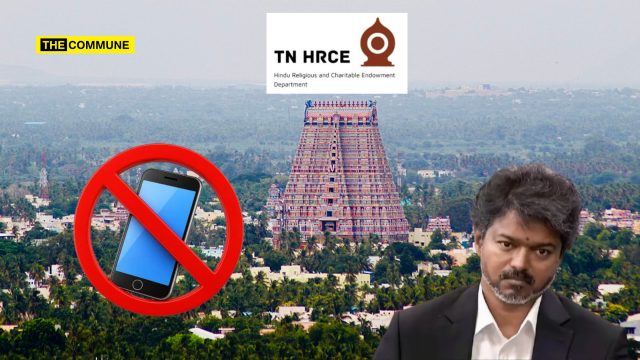
The Joseph Vijay TVK government’s ban on camera-enabled mobile phones inside 52 major temples came into effect on 1 September 2026. The Hindu Religious and Charitable Endowments (HR&CE) Department says the move is aimed at preserving the sanctity of temples and preventing photography, videography, selfies and reels inside temple premises.
There is little argument against preventing people from turning temples into photography and social-media spots.
But the manner in which the ban is being implemented raises a different question.
Is the government making a simple temple visit unnecessarily difficult for lakhs of ordinary devotees?
Devotees carrying camera-enabled phones have to deposit them at designated counters before entering. A ₹5 charge is collected for each phone. Reports from temples have already highlighted long queues at these counters, with devotees having to wait just to deposit their phones and obtain tokens.
As the ban on smartphone use in 52 major #temples across #TamilNadu comes into force today (Sep 1), devotees at Arunachaleshwarar Temple in #Tiruvannamalai queued up to handover their mobile phones at a deposit counter on Tuesday.
📹&📸: C. Venkatachalapathy (@venkathin) pic.twitter.com/llhgykLbPK
— The Hindu – Chennai (@THChennai) September 1, 2026
At bigger temples, this creates an additional layer of waiting even before devotees reach the queue for darshan.
For a person living close to the temple visiting a temple almost on a daily basis, this is an inconvenience.
For elderly devotees, families with children, people travelling long distances and those visiting during crowded festival days, it can become a genuine burden.
The government has said that additional counters will be arranged wherever required and that the ₹5 charge is meant to meet the expenses of staff, lockers and related infrastructure rather than generate revenue.
But the question remains: why should devotees have to bear the consequences of poor implementation when the problem is essentially the misuse of phones by a section of visitors?
Punishing Everyone For The Conduct Of A Few
The objective of stopping photography inside sanctums and preventing reels and videos inside temple premises is understandable.
But there are several ways to achieve that objective.
Strict enforcement against those taking photographs or recording videos. Better security. Clear restrictions at sensitive areas. Confiscation or penalties for violations. Adequate infrastructure at entry points.
Instead, a blanket system requiring devotees with smartphones to deposit their devices risks turning temple entry into another administrative exercise.
A devotee comes to a temple seeking darshan and peace.
Instead, the first experience could now be a queue, a token, a payment and the anxiety of ensuring that a valuable personal device is safely returned.
The government itself has acknowledged concerns over queues and has directed temple administrations to increase the number of counters where necessary.
That raises another basic question. Why was adequate infrastructure not ensured before the restriction was rolled out across 52 major temples?
Attempt To Discourage Temple Visits?
Temple administration should facilitate worship.
Rules are necessary. Discipline is necessary. Protecting the sanctity of temples is necessary.
But rules should not become barriers.
If an elderly devotee has to stand in another queue just to deposit a phone, if families have to spend additional time at the entrance, or if visitors begin thinking twice before making a temple visit because of the inconvenience, the policy risks defeating the larger purpose.
One cannot create such hardship for lakhs of devotees merely because a smaller section misuses smartphones.
Is this simply poor planning and implementation? Or is there a sinister plan to make ordinary devotees averse to visiting temples?
Temple rules should make worship easier, safer and more peaceful.
They should not create so many hurdles that devotees begin asking whether visiting the temple is worth the trouble.
Subscribe to our channels on WhatsApp, Telegram, Instagram and YouTube to get the best stories of the day delivered to you personally.