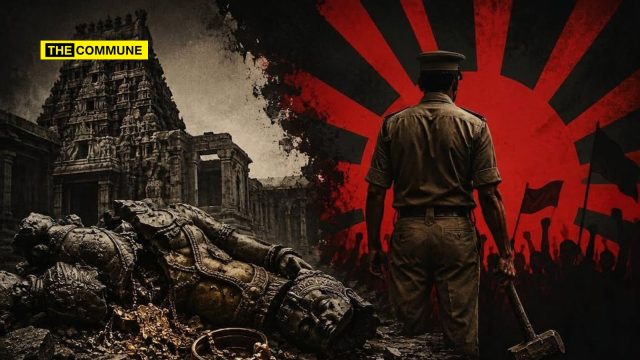
Viduthalai Rajendran, a prominent Dravidian ideologue and writer, has narrated an extraordinary story about a police inspector from Mannargudi who, according to him, was a staunch Periyarist and atheist and allegedly entered a temple in uniform, broke an idol and threw its jewellery into a well to “prove” that God had no power.
What makes the account particularly striking is not merely the alleged act itself, but the manner in which Rajendran narrates it gives the alleged act an almost heroic quality, as an example of atheist conviction.
There is, however, one important caveat. Rajendran himself admits that there is no documentary record of the incident and that he heard the story orally from senior comrades.
“One man said, in Mannargudi, there was a police inspector named Ramaiah who was a Periyarist and an atheist. He was very staunch in his atheism. In order to prove there is no God, the police inspector went to a temple, took the idol, the jewels and broke the idol, that is, he looted the temple. He even wore his uniform when he went to the temple. There are no records for this but I have heard this orally from senior comrades and sharing it with you. I am just sharing the information with you. He entered the temple wearing the uniform. He even placed constables outside for protection. He went in, broke the idol, threw the jewels into the well.”
Rajendran further claims that the inspector was arrested, prosecuted and sentenced to three years in prison. According to the account, the inspector told the court that he had committed the act to demonstrate that God had no power.
“The judge responded saying he may believe that this act was done to prove something but since it was a criminal offence, he is given a 3-year imprisonment.”
The story then takes another extraordinary turn.
Rajendran says that around the same period, actor M.R. Radha was performing a play near Tiruvaiyaru. He claims there was an attempt to implicate Radha on the grounds that the police inspector had been influenced by his play. Rajendran also claims that while the inspector was in prison, his three daughters were married and that M.R. Radha personally bore the expenses.
“When this incident was happening, at a place near Tiruvayyaru, two days prior, actor MR Radha’s play is being staged. This incident took place after that play and owing to this, there is alleged to be an attempt to include MR Radha in the case because they claimed the police inspector was influenced by MR Radha’s play. When the police inspector was in prison, his three daughters who have beautiful Tamil names got married and the entire expenses was taken care of by MR Radha himself.”
In Mannargudi a police inspector Ramiah was committed to Dravidian ideals. In full uniform barged into a temple took the idols and jewels and broke them on the road. Two constables waited outside. Attempt to implicate MR Radha’s incendiary prop failed. #CrimesAlongTheCauvery pic.twitter.com/5AIsjIMWTo
— Reality Check India (@realitycheckind) August 18, 2026
The most revealing part of Rajendran’s narration, however, may be his disclaimer: “there isn’t a record of this incident, I am just narrating a legend”
When a Crime Becomes a Legend
That disclaimer is important. If there is no documentary record and the story is only an oral account passed down by “senior comrades”, it cannot be presented as established history. But it raises a more interesting question: why is this particular story remembered and narrated at all and why is an alleged criminal act presented in the language of ideological courage?
A similar pattern appears in material published within the Dravidian ideological ecosystem. Keetru has carried accounts from Murasoli and Periyar Muzhakkam, including writings on the “Madirimangalam Revolution” and Madirimangalam–Konerirajapuram that describe attacks on religious practices and symbols in the Cauvery delta in the context of political mobilisation.
Why would you exaggerate a crime ? Isnt it bizarre??
Unless that is valorized in their universe —
it is like a mountaineer exaggerating ‘i free solo’ while he uses ropes. It is a “Passion” => “Fantasy” arc. But in crime. pic.twitter.com/84SLdShRFr
— Reality Check India (@realitycheckind) August 18, 2026
None of this, by itself, proves that every incident occurred exactly as narrated. But it does show that these stories are not inventions of outsiders trying to caricature Dravidian politics. They exist within its own ideological literature.
But what happens when the fantasy follows the curve of crime?
When the alleged achievement being exaggerated is breaking idols, looting temples or attacking religious symbols, it raises a very different question: what makes such an act worthy of being remembered as ideological courage in the first place?
That is what makes Rajendran’s “legend” worth examining. Whether the Mannargudi story ultimately proves true, exaggerated or entirely unsubstantiated, the fact that it is preserved and retold in this manner raises questions about what an ideological culture chooses to remember and how it chooses to remember it.
Subscribe to our channels on WhatsApp, Telegram, Instagram and YouTube to get the best stories of the day delivered to you personally.