India does not need a generation that merely knows its rights; it needs young citizens who understand that freedom, dignity and dissent must coexist with duty, discipline and respect for the nation.
The debate triggered by the viral Ladakh tourist incident should not become another lazy generational argument about whether Gen Z is arrogant, impatient or disrespectful. That would miss the larger issue. The real problem is not Gen Z. The real problem is entitlement masquerading as activism, individualism masquerading as freedom, and ignorance of national responsibility masquerading as the courage to “speak truth to power.”
One young person’s conduct should never be used to indict an entire generation. India has millions of young people who serve in the armed forces, volunteer during disasters, build startups, work in villages, study science and technology, participate in public life and dedicate themselves to the country’s progress. They represent a very different face of Gen Z, confident, ambitious and deeply invested in India’s future.
Yet the Ladakh controversy has exposed something worth discussing.
There is a growing cultural tendency, particularly in sections of urban and digitally influenced youth culture, to interpret every inconvenience through the language of personal rights. The moment an individual encounters a restriction, an authority figure or an institutional rule, the instinct is sometimes to demand an explanation—not as a citizen seeking clarity, but as a consumer demanding compliance.
That distinction matters enormously in a country like India.
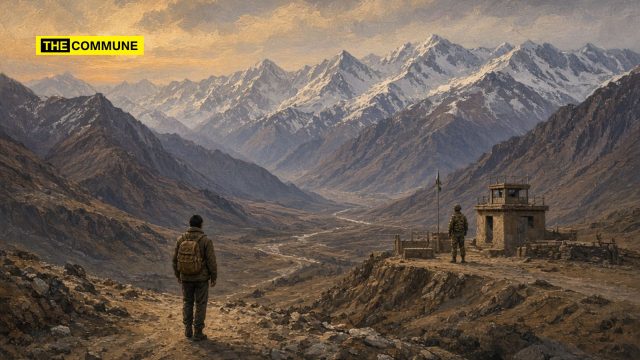
Ladakh is not simply another tourist destination. It is a strategically sensitive frontier region. It sits close to India’s contested borders and has enormous significance for national security. A military checkpoint is not a hotel reception desk. A security restriction is not necessarily an infringement of personal freedom. And a soldier performing his duty should not be expected to justify every operational decision to a tourist carrying a smartphone.
National security cannot be subordinated to personal convenience.
This principle should be beyond partisan politics.
India has spent decades learning that its borders cannot be taken for granted. The soldiers stationed in high-altitude areas endure conditions that most civilians can scarcely imagine. Extreme cold, oxygen deprivation, isolation and constant operational pressure are not abstractions to them. When ordinary Indians travel through such regions, they do so because someone else is standing guard.
The least we owe those soldiers is respect.
This does not mean that citizens should blindly accept every decision made by every authority. A democracy requires questioning. Governments must remain accountable. Security institutions must operate within the law. Citizens have every right to seek explanations and challenge wrongdoing.
But there is a difference between questioning authority and insulting the institution that protects the nation.
The distinction appears increasingly blurred in the age of social media.
For some, activism has become a performance. The objective is no longer necessarily to solve a problem but to create a moment. A confrontation becomes a video. A video becomes outrage.
Outrage becomes followers. And followers become social capital.
The language of Gen Z activism can then become a convenient armour. “I know my rights.” “You cannot tell me what to do.” “I am speaking my truth.” “This is my freedom.”
All of these statements can be legitimate in the appropriate context. But democracy does not consist exclusively of rights.
Rights without duties produce entitlement. Freedom without responsibility produces chaos. And dissent without discipline produces noise rather than reform.
India’s civilisational tradition has never celebrated freedom as an excuse for irresponsibility. The Indian understanding of duty has historically been inseparable from individual conduct. The concept of dharma, stripped of its narrow religious interpretation, speaks fundamentally to responsibility, order and the obligations attached to one’s position in society.
Modern India may speak the language of constitutional rights, but it cannot afford to forget the culture of duty.
The Constitution guarantees fundamental rights, but it also recognises fundamental duties. Respect for the nation, protection of its sovereignty and integrity, and the promotion of harmony are not decorative suggestions. They are part of the constitutional vision of citizenship.
Unfortunately, public discourse often remembers only the first half.
Everyone wants freedom of expression. Fewer want responsibility for what they express.
Everyone wants rights. Fewer want duties.
Everyone wants to question the State. Fewer want to understand why the State sometimes has to act decisively in defence of national interests.
That imbalance needs correction.
And this is precisely where the conversation about Gen Z should become more serious.
Young Indians should absolutely question outdated systems. They should challenge corruption, demand transparency, expose injustice and insist that institutions serve citizens. India needs fearless young people. It needs innovators who refuse to accept limitations and citizens who refuse to tolerate wrongdoing.
But fearlessness is not the same as arrogance.
A truly confident Indian does not need to demean a soldier to demonstrate independence. A genuinely empowered citizen does not confuse rudeness with courage. And a mature activist understands that the people enforcing a rule may themselves be operating under orders designed to protect thousands of others.
The nation is larger than the individual.
That sentence has become uncomfortable in an age of extreme individualism, but it remains indispensable.
India is not merely a marketplace where citizens consume services from the State. It is a civilisation, a constitutional republic and a collective national project. Every generation inherits something from the previous one and has an obligation to leave something stronger for the next.
The young therefore have a responsibility that extends beyond personal success.
They inherit a country whose borders require protection, whose infrastructure requires development, whose institutions require reform and whose civilisational confidence requires renewal. They cannot afford to see India merely through the lens of personal convenience.
The answer is not to suppress Gen Z activism. It is to give that activism a stronger national purpose.
Let young Indians protest when injustice occurs. Let them challenge politicians. Let them question bureaucrats. Let them expose institutional failures. Let them demand better governance.
But let them also understand that patriotism is not merely waving a flag on Independence Day. It is respecting the soldier at a checkpoint. It is following a reasonable security instruction. It is protecting public property. It is paying taxes honestly. It is refusing corruption. It is contributing to society. It is building something that makes India stronger.
Patriotism, ultimately, is not an aesthetic.
It is a discipline.
The Ladakh episode should therefore not become an excuse to attack an entire generation. Instead, it should become an opportunity to redefine what empowerment means.
The most empowered young Indian is not the person who believes that nobody has the right to question them.
It is the person who understands that with greater freedom comes greater responsibility.
India does not need a silent generation. It needs a fearless generation.
But it needs that fearlessness to be anchored in discipline, constitutional responsibility and national consciousness.
Gen Z should not be told to stop questioning.
It should be taught to question better.
It should not be told to stop demanding rights.
It should be reminded that rights exist alongside duties.
And above all, it should never be encouraged to believe that individual entitlement is superior to the national interest.
Because at the end of the day, the soldier at the border does not have the luxury of treating duty as optional.
Neither should citizenship.
Dr. Prosenjit Nath is a techie, political analyst, and author.
Subscribe to our channels on WhatsApp, Telegram, Instagram and YouTube to get the best stories of the day delivered to you personally.