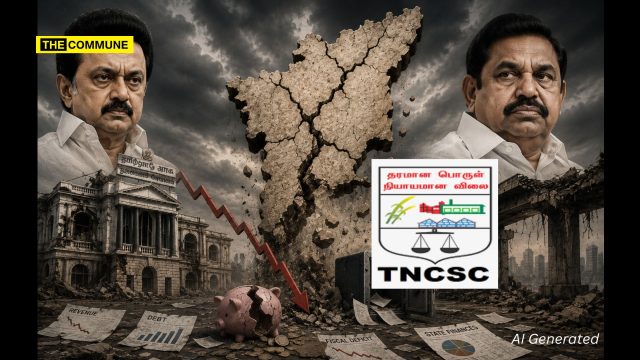
Years of welfare populism and election-season cash handouts under successive AIADMK and DMK governments have pushed the Tamil Nadu Civil Supplies Corporation (TNCSC) into a debt burden of ₹27,181 crore, according to the White Paper on Tamil Nadu’s finances released by the TVK government, as reported in The New Indian Express.
The report reveals that bank borrowings used to fund Pongal cash gifts, gift hampers and subsidised Public Distribution System (PDS) schemes have accumulated into a massive liability, with governments repeatedly failing to fully reimburse the corporation for expenditures incurred on their behalf.
TNCSC, the state agency responsible for procuring essential commodities and implementing food subsidy schemes, has increasingly relied on loans to finance welfare commitments as budgetary allocations failed to keep pace with rising costs.
According to the White Paper, TNCSC’s outstanding debt rose sharply from ₹17,500 crore in 2021-22 to ₹27,181 crore as of March 2026.
The report attributes the growing financial strain to two major factors: the mounting subsidy burden under the special PDS scheme and repeated Pongal cash assistance programmes rolled out by successive governments.
Between 2016 and 2026, Tamil Nadu spent ₹24,023 crore on Pongal cash assistance and gift hampers alone. The report notes that except for 2015, 2021 and 2025, Pongal cash assistance and gift packages were distributed almost every year.
The size of the payouts increased significantly over time. In 2019, the cash assistance component was raised from ₹100 to ₹1,000. In January 2022, gift hampers containing 21 items were distributed to beneficiaries.
Cash assistance of ₹1,000 was again provided in both 2023 and 2024.
The highest expenditure came in January 2026, ahead of the Assembly elections, when the state spent ₹6,688 crore to distribute ₹3,000 each to 2.23 crore ration card holders.
Similarly, ahead of the 2021 Assembly elections, the distribution of ₹2,500 to rice ration card holders resulted in an expenditure of ₹5,560 crore.
The White Paper argues that while welfare commitments expanded, the state failed to adequately compensate TNCSC for the resulting expenditure, forcing the corporation to bridge the funding gap through borrowings.
More than 90% of TNCSC’s total liabilities are owed by the state government, while the remainder relates to dues from the Union government.
The report also highlights the growing burden created by Tamil Nadu’s special PDS scheme, under which tur dal and cooking oil are supplied at heavily subsidised rates through ration shops.
When the scheme was launched in 2007, tur dal was procured at around ₹50 per kilogram and cooking oil at ₹45 per litre. These were supplied to beneficiaries at subsidised rates of ₹30 per kilogram and ₹25 per litre, respectively.
Today, procurement costs have more than doubled. Tur dal is now purchased at around ₹109 per kilogram, while cooking oil costs approximately ₹143 per litre.
Despite the dramatic rise in procurement costs, selling prices under the scheme have remained unchanged.
As a result, the annual subsidy burden on these two commodities alone has increased to nearly ₹4,800 crore per year, according to the report.
The growing dependence on loans has also sharply increased TNCSC’s interest obligations.
The White Paper states that the corporation’s annual interest burden has surged from ₹736 crore in 2021-22 to ₹1,795 crore in 2025-26.
“The interest burden has grown from ₹736 crore in 2021-22 to ₹1,795 crore in 2025-26. Interest now consumes a significant and rising share of TNCSC’s annual payments – a cost that is entirely unproductive,” the report noted.
Officials cited in the report said TNCSC routinely borrows funds to procure paddy from farmers on behalf of the Food Corporation of India (FCI), paying farmers within ten days and later receiving reimbursement from the Union government.
However, they noted that reimbursements from the Centre are sometimes delayed or partially paid, with a portion carried forward to subsequent years.
At the state level, officials acknowledged that TNCSC’s expenditure on food subsidies and cash distribution schemes has not always been fully reimbursed.
According to the report, instead of increasing budgetary support proportionately, successive governments directed the corporation to finance the shortfall through borrowings, causing the debt burden to accumulate year after year.
The White Paper identifies this pattern as part of a broader deterioration in Tamil Nadu’s finances.
It notes that the state’s fiscal position has worsened significantly in the post-Covid period, with outstanding liabilities approaching ₹10 lakh crore, revenue deficits reaching record levels, and Tamil Nadu’s own tax collection effort declining relative to Gross State Domestic Product (GSDP).
The report argues that while the pandemic represented a one-time shock, much of the subsequent fiscal deterioration stemmed from policy decisions taken by successive administrations.
The state currently bears the subsidy cost for supplies distributed to approximately 1.11 crore Non-Priority Household (NPHH) ration card holders, while the Centre fully funds food grains distributed to around 1.17 crore Priority Household (PHH) ration card holders.
During 2025-26, the Tamil Nadu government allocated approximately ₹17,500 crore to the Food Department, including around ₹14,300 crore towards food subsidy.
However, according to the White Paper, the gap between welfare commitments and budgetary support has continued to widen, leaving TNCSC saddled with a mounting debt burden that the TVK government now says is one of the clearest examples of the fiscal legacy inherited from both AIADMK and DMK administrations.
Successive state govts in #TamilNadu have failed to fully reimburse the food subsidy & Pongal cash distribution expenditure to the state-run TNCSC, the agency responsible for procuring commodities & raising loans to fund these schemes.
According to the White Paper, a total of Rs… pic.twitter.com/5TFlvN5x4k— Anto T Joseph (@AntoJoseph) June 18, 2026
Subscribe to our channels on WhatsApp, Telegram, Instagram and YouTube to get the best stories of the day delivered to you personally.