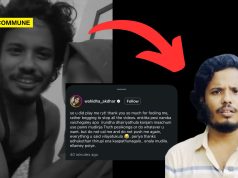
Saurav Das, who positions himself as a transparency crusader and has built a public persona around wielding the Right to Information Act against public authorities, now finds himself on the other side of the accountability lens.
Upon reviewing publicly available electoral records and court documents, it appears to reveal inconsistencies in the activist’s official documentation, specifically concerning his voter registration in Puducherry, his parentage as recorded in different legal forums, and potential questions around citizenship status.
Das, who frequently interrogates public officials on issues of documentation and procedural propriety, has not yet responded to our queries. But the records examined raise questions that merit public scrutiny, given the activist’s own relentless pursuit of transparency in others’ affairs.
The Puducherry Enrolment
The electoral roll for the Union Territory of Puducherry, as revised during the Special Intensive Revision of 2026, appears to carry Das’s name as an enrolled voter.
The first question that arises is straightforward: when precisely was Das first enrolled in Puducherry, and have there been subsequent modifications, corrections, or amendments to his electoral entry?
The documentation that established his “ordinary residence” in Puducherry, a requirement under electoral law, remains unclear. This becomes particularly puzzling given Das’s well-documented professional associations with Delhi, where he has been visibly active in RTI-related work and public advocacy.
What constitutes ordinary residence under the Representation of the People Act, 1950, is a matter of settled legal interpretation. The Act requires a person to be ordinarily resident at the address from which they seek registration. If Das maintains professional and social presence in Delhi, what documentary basis was provided to the electoral registration authorities in Puducherry to establish his ordinary residence there?
The Parentage Puzzle
The discrepancies deepen when examining Das’s parentage as recorded in different official forums.
The Puducherry electoral record appears to name “Subir Das” as the father. However, a Madras High Court order in W.P. Nos. 5369, 5372, 5374, 5377 and 5378 of 2022 describes Das differently as “S/o. Seema Chhetri” and references a Puducherry address.
This is not a minor clerical variation. In Indian administrative and legal practice, the name of the father is a primary identifier, appearing across everything from birth certificates to passport applications. A divergence between a court record and an electoral roll on this fundamental detail requires explanation.
Further complicating matters, the same Puducherry address appears to feature another name: Seema Chhetri. The question of whether this person has a familial relationship with Das, and if so, what that relationship is, remains unanswered by the public record.
What do Das’s official birth records state? What do his school leaving certificates reveal? What name appears in the “father’s name” or “mother’s name” column of his passport application? These are questions of elementary administrative consistency.
Origin, Nationality, and Citizenship
Perhaps the most sensitive area of inquiry concerns questions of origin and citizenship.
Has Das ever publicly or privately stated that either or both of his parents were of Nepali origin? If such statements have been made, the context and precise wording become material. “Nepali origin” could refer to ancestry, place of birth, nationality, or citizenship, categories that Indian law treats with distinct legal consequences.
The Citizenship Act, 1955, and the rules framed thereunder draw sharp distinctions between citizenship by birth, by descent, by registration, and by naturalisation. The Foreigners Act, 1946, and the Indo-Nepal Treaty of Peace and Friendship of 1950 further complicate the legal landscape for persons with connections to Nepal.
Was any declaration, affidavit, or other document concerning Indian citizenship submitted in connection with Das’s electoral registration? If so, what factual basis underlay that declaration?
The question of whether Das has ever held, applied for, or claimed Nepali citizenship or any legal status in Nepal on the basis of parentage is not an idle one. The Citizenship Act, 1955, specifically addresses the circumstances under which a person may lose Indian citizenship upon acquiring the citizenship of another country. Section 9 of the Act deals with this contingency explicitly.
The Rent Agreement That Won’t Surface
Das’s Puducherry residency claim is not the only address drawing scrutiny. Political commentator Abhijit Iyer-Mitra has alleged, across a series of public statements including an X thread and a Sunday Guardian podcast appearance, that Das occupied a ground-floor property in Greater Kailash-1, South Delhi, reportedly worth ₹9–12 lakh a month in rent, and that no valid rent agreement bearing Das’s own name has been produced. Iyer-Mitra claims the property’s ownership records list a deceased individual as owner, that the estate remains unmutated, and that the only person publicly claiming to possess a copy of the tenancy agreement is AAP MLA Saurabh Bhardwaj — who has not released it, instead countering by demanding Prime Minister Modi’s academic degree.
As of 31st July 2026 in Delhi’s land registry, ownership remained with Rupinder Anand (deceased 2023). So who signed the rent agreement? Police verification without ownership documents? Why is GK1 police “unable” to find the verification?
FYI: Saurav Das lived in a slum in 2023 https://t.co/SxEnLhjlr4 pic.twitter.com/0cgHsCpmsh
— Abhijit Iyer-Mitra (@Iyervval) August 9, 2026
CJP spokesperson Ashutosh Ranka pushed back, calling the claims misinformation; Das has separately alleged that journalists and YouTubers trespassed on the property to film it, and has sought police intervention over the matter. Neither the rent agreement, the identity of its signatories, nor Das’s income source in relation to the reported rent has been independently verified or produced by any party as of this writing. Das has not responded to queries on the matter.
The Burden of Transparency
No conclusions are being drawn about anyone’s citizenship, parentage, or nationality merely from these apparent differences in official records. Clerical errors, adoption or guardianship arrangements, regional naming conventions, or other legitimate circumstances could well explain the discrepancies.
But here is the rub: Saurav Das has built his public identity on demanding accountability from others. He has used the RTI Act as a scalpel to dissect government decisions, financial transactions, and administrative processes. He has repeatedly insisted that public officials must be transparent about their records, their decisions, and their personal qualifications.
The principle of symmetry demands that those who seek transparency must themselves be transparent. The questions we raise are precisely the kind that Das himself would not hesitate to pose to a public servant whose records showed inconsistencies.
Das has not yet responded to our requests for clarification.
These are not trivial technicalities. In a country where questions of citizenship, electoral integrity, and official documentation have profound legal and political consequences, consistency in public records matters.
If there is a legitimate explanation: a clerical error, correction, adoption, guardianship, naming convention, or other circumstance, it should be straightforward to clarify. The public record, however, currently contains what appear to be material inconsistencies that an activist of Das’s prominence should be able to address.
This article is based on an X thread by The Chronology.
Subscribe to our channels on WhatsApp, Telegram, Instagram and YouTube to get the best stories of the day delivered to you personally.