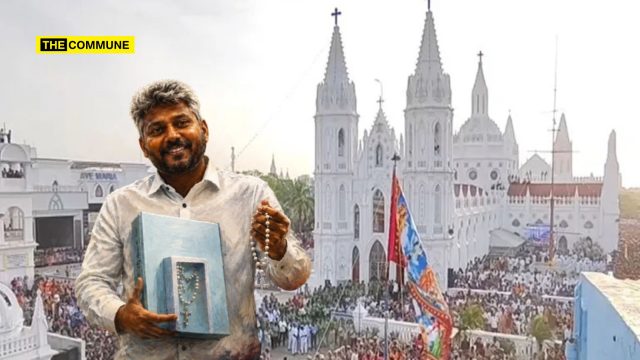
TVK Finance Minister N. Marie Wilson recently undertook a foot pilgrimage to the Velankanni Basilica. A month ago, he identified himself as a Christian in the Tamil Nadu Assembly. Wilson has reportedly also been undertaking the pilgrimage for several years.
His pilgrimage assumes significance in light of a study that documents the caste-based organisation of the Velankanni festival and the incorporation of several local Hindu practices into Catholic worship.
The study, Māriyamman-Mariyamman: Catholic Practices and Images of Virgin in Velankanni (Tamil Nadu), was written by researcher Brigitte Sébastia and published in 2002 as Issue No. 27 of the Pondy Papers in Social Sciences series of the French Institute of Pondicherry. The 73-page study examines the social and economic relations between different castes and communities at Velankanni, the organisation of the festival and the indigenisation of Catholicism in the shrine.
Hindu Practices Incorporated Into Catholic Pilgrimage
According to Sébastia’s study, pilgrims who travel to Velankanni on foot as part of their vows follow practices resembling Hindu pilgrimage traditions.
Pilgrims from outside Velankanni traditionally wear clothing of a particular colour, including blue, green or saffron. They observe a 40-day fast, walk barefoot and abstain from alcohol, smoking, non-vegetarian food and sexual relations.
On reaching Velankanni, pilgrims are expected to bathe, wear new clothes and only then proceed to the church for worship.
Sébastia notes that these practices resemble Hindu religious customs. Their incorporation into Catholic worship had historically generated opposition.
The Malabar Rites Controversy
The study traces this to the broader controversy surrounding the practices adopted by Jesuit missionaries of the Madurai Mission.
The missionaries had adopted certain Hindu customs and even accommodated aspects of the Hindu caste hierarchy, believing that disturbing established social and religious practices could hinder conversions.
The practice was strongly opposed by the Capuchin missionaries based in Pondicherry. The dispute became part of what is historically known as the “Querelle des Rites Malabar”, or the Malabar Rites controversy.
The dispute eventually spread beyond India and reached the Vatican, with the Pope intervening in the controversy.
Sébastia also records an attempt by priests to prevent devotees from following the practice of ritual bathing before entering the shrine.
According to the study, priests regarded bathing before entering a place of worship as a Hindu practice and at one point attempted to prevent devotees from bathing in the church tank by covering it with cement slabs.
The devotees, however, began bathing in the sea instead.
Caste-Wise Mandagapadi At Velankanni
The more significant issue raised by the study is the organisation of the annual festival according to caste and community identities.
Sébastia documents a community-wise mandagapadi system, in which different caste groups, families and communities are associated with specific days of the festival.
The schedule cited in the study is:
- August 29 – Arya Nattu Chettiar
- August 30 – Agamudayar, Thevar
- August 31 – Panai Mar Nadar
- September 1 – Thennai Mar Nadar
- September 2 – Karunganni Parish
- September 3 – Udaiyar
- September 4 – Anglo-Indian family
- September 5 – S.M. Anthony family, Tiruchi
- September 6 – Velankanni Arya Nattu Chettiar
- September 7 – Nagapattinam Arya Nattu Chettiar
- September 8, 9 and 10 – Night procession involving the Mary Joseph family, Asari, Thachar and others.
The French Institute’s catalogue itself describes Sébastia’s study as examining the social and economic relations between different castes and communities, the organisation of the festival and the representations of the Virgin at Velankanni. It specifically lists Pattanavar among its research keywords.
The study also examines the precedence of the Pattanavar community in the organisation of the festival.
வேளாங்கண்ணி மாதா கோயிலில் சாதிய வழக்கம்: அமைச்சர் மரிய வில்சன் அதை மாற்றுவாரா?
– ரவிக்குமார்தமிழ்நாட்டின் நிதி அமைச்சர் திரு மரிய வில்சன் வேளாங்கண்ணி மாதா கோயிலுக்கு நடை பயணமாகச் செல்வது ஊடகங்களில் செய்தியாகியிருக்கிறது.
பாண்டிச்சேரியில் இருக்கும் ஃப்ரெஞ்ச் இன்ஸ்டிட்யூட்… pic.twitter.com/dkEkf8cA9R
— Dr D.Ravikumar MP (@WriterRavikumar) September 2, 2026
If Christianity Rejects Caste, Why Does Caste Survive At Velankanni? Does Marie Wilson Endorse This?
Christianity speaks of equality and rejects caste discrimination. Yet caste identities and caste-based precedence appear to remain embedded in the practices at Velankanni. If Christianity rejects caste, why does caste survive here? Did people leave Hinduism but fail to leave their caste behind?
And if these practices continue, does Finance Minister Marie Wilson, who regularly undertakes the Velankanni pilgrimage, endorse them or will he question and oppose them?
Subscribe to our channels on WhatsApp, Telegram, Instagram and YouTube to get the best stories of the day delivered to you personally.