A growing controversy has emerged over the disappearance of several mainstream media articles from the UPA era, with users reporting widespread “404 errors” while attempting to access archived reports.
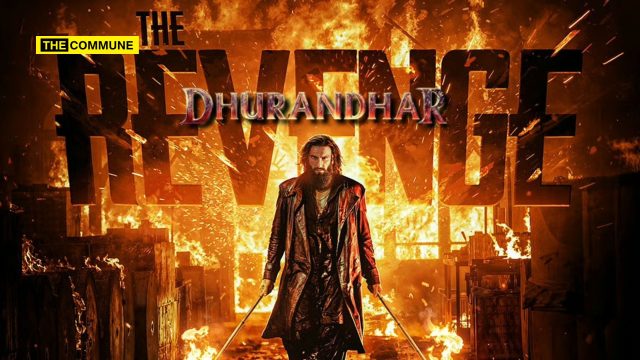
The issue gained traction following renewed public interest triggered by the film Dhurandhar 2: The Revenge, which prompted social media users to revisit news coverage from the early 2010s. As older reports began circulating online, users claimed that multiple links from established publications were no longer accessible, raising concerns about the integrity of the public record.
What makes this controversy impossible to dismiss as a technical glitch is the nature of the content going dark. The inaccessible links do not belong to small blogs or defunct news portals — they trace back to established national media organisations including Hindustan Times and NDTV. These are platforms with dedicated IT infrastructure and institutional memory. Server errors do not selectively target UPA-era political reporting.
The pattern is too consistent to be coincidental. Article after article covering on-record statements by senior Congress leaders are now returning 404 errors. These are not niche footnotes. These are mainstream, widely read reports that shaped public discourse during the UPA’s decade in power.
The timing is the tell. This digital housecleaning has accelerated precisely when Dhurandhar: The Revenge reignited mass curiosity about Congress’s governance record. Netizens began connecting past statements to present accountability, the corresponding documentation began vanishing. That is not coincidence – that is damage control.
The unavoidable question is: who benefits? The BJP has every political incentive to keep this content alive and circulating. The Congress has every incentive to ensure it does not. When the party that stands to lose the most from historical documentation is also the one with the deepest connections to India’s English-language media establishment, the “speculation” about deliberate removal stops being speculation and starts being the only rational explanation.
Subscribe to our channels on WhatsApp, Telegram,Instagram and YouTube to get the best stories of the day delivered to you personally.
A few days ago, leftist ‘journalist’ whose propaganda pieces are published in portals such as Frontline, Article 14 shared a lengthy thread on X. Interestingly, it was reshared by none other than former Delhi CM, liquor scam accused Arvind Kejriwal.
In a lengthy post, Saurav Das made some ‘shocking’ allegations but one glance at the post tells us that he is framing his opinions as facts.
Saurav begins by raising a series of allegations and concerns about possible bias, conflict of interest, and institutional credibility in the handling of the Delhi liquor policy case, particularly focusing on Justice Swarana Kanta Sharma of the Delhi High Court. But essentially, he is building a case against Justice Swarana Kanta Sharma, with not with hard he constructs an argument from selective facts and biased interpretation.
He begins with the discharge of Arvind Kejriwal and others, the CBI’s challenge, and the fact that Justice Sharma is hearing the matter. He also cites court records, listing patterns, and past judgments. However, the moment he moves from describing these facts to assigning meaning to them, the argument becomes subjective.
For instance, he claims the judge showed “unusual speed” in this case compared to others. But speed, by itself, does not indicate bias – courts frequently fast-track politically sensitive or high-stakes matters. Without proving that such urgency violated procedure or was selectively applied with intent, the claim remains speculative.
He also argues that the judge’s previous orders in related cases show a pattern of alignment with the prosecution. This is again an interpretation. Judges often make prima facie observations at stages like bail or interim hearings, and strong language in such orders does not automatically establish prejudice. In fact, many such observations are routinely revisited or overturned at later stages — that is part of the judicial process, not evidence of bias.
Saurav further attempts to show inconsistency by comparing the judge’s approach in cases involving opposition leaders with another case involving a BJP leader. But this comparison ignores a basic legal reality: no two cases are identical. Differences in evidence, charges, and procedural posture can justify different outcomes. Presenting this as selective treatment is, again, an inference, not a fact.
The most serious insinuation relates to the empanelment of the judge’s children as government lawyers. Here, Saurav stops short of alleging wrongdoing but strongly suggests a conflict of interest. However, he provides no evidence of any direct link between these appointments and the judge’s decisions. Government panel appointments, while open to debate, are not illegal, and without proof of influence, this line of argument rests entirely on perception, not substance.
Ultimately, his central claim, that there is a “reasonable apprehension of bias”, is itself an opinion, not an established conclusion. It depends entirely on how one chooses to interpret the same set of facts. A different observer could look at the same material and see nothing unusual at all.
In essence, Saurav is presenting a prosecutorial-style narrative against the judge, stitching together disparate facts to suggest a pattern. But the leap from pattern to bias is not proven – it is argued. That distinction is crucial.
#ImportantNews: The controversy over the alleged Delhi liquor-scam case before Justice Swarana Kanta Sharma is no longer confined to courtroom conduct alone. Now more troubling questions of proximity, patronage, conflict-of-interest, and the appearance of bias have come to light.… pic.twitter.com/cQbYjqRxoS
In this lengthy post, he adds links to judgements, how own tirade, and what not – but they prove nothing – no link between this specific judge and such appointments, no wrongdoing by Swarana Kanta Sharma nor any connection between her decisions and her children’s positions. It is entirely how he wants to perceive the issue and how he wants the public to perceive the judge.
So, Saurav Das tries to build a case against the judge to create a favourable media narrative for his favourite Arvind Kejriwal and the post is also shared by the same Kejriwal – was it to win brownie points and prove his loyalty to the accused?
Let us take a look at the love Saurav Das has for Arvind Kejriwal and how it manifests.
Delhi’s pollution levels were spiking last year, thanks to stubble burning. And people are upset, rightly so. But are they calling out the true perpetrators? The stubble burners? A section of the public instigated by “influencers” went out to protest in Delhi without permission and have been detained.
Why did they protest? For clean air, yes clean air is every citizen’s right. No doubt about that. But are the people who are instigating them, pointing to the actual culprits?
No, they all blame the present BJP government. Among them is Saurav Das – a self-proclaimed ‘investigative journalist’ who has often been seen peddling propaganda laced in fine language.
Das, who recently amplified calls for urgent action on Delhi’s deteriorating air quality under the new BJP-led administration, has been accused by several social media users of remaining silent on the issue during AAP’s tenure in Delhi and Punjab.
While he routinely commented on national governance and investigative matters, he avoided public criticism of Delhi Chief Minister Arvind Kejriwal or the Punjab government over their handling of pollution and stubble burning.
This is just unacceptable. After 8 years, Delhi govt says there is no official data on what is causing pollution in Delhi. Was 8 years not enough to put a system in place, despite Delhi having all the top institutes/eminent persons? One excuse before AAP won Punjab was that the… https://t.co/lr6ImQPc8r
Saurav Das routinely writes for leftist publications like Article 14, Frontline, The Caravan magazine, Al Jazeera, The Wire, The Hindu etc.
While Das has not demanded or protested so vehemently about Delhi’s polluted air in the past, this time around since the BJP is in power, he wants clean air instantly. Nor did he protest the “unclean” Yamuna River at that time!
However, following the recent change of government at the Centre, he has begun sharing and supporting protests demanding immediate solutions to Delhi’s air crisis.
Das’s detractors argue that this shift amounts to “performative activism” and question why similar pressure was not applied to the AAP government during its tenure. They have also pointed out his continued social media criticism of Uttar Pradesh Chief Minister Yogi Adityanath’s advertising expenditure, contrasting it with his silence when the then-Delhi CM spent significant amounts on publicity campaigns rather than pollution control measures.
– A certified Kejriwal Paglu
– Was dick Riding Lavnasur for last 5 Years
– 0 Protests against Kejriwal on Yamuna and Air Pollution in the last 5 Years
– No word on Punjab Govt against Stubble Burning
– Questions Yogi on Ads but kept mum when Kejriwal… https://t.co/Dd2RE2y2vBpic.twitter.com/jcqLqg7OFx
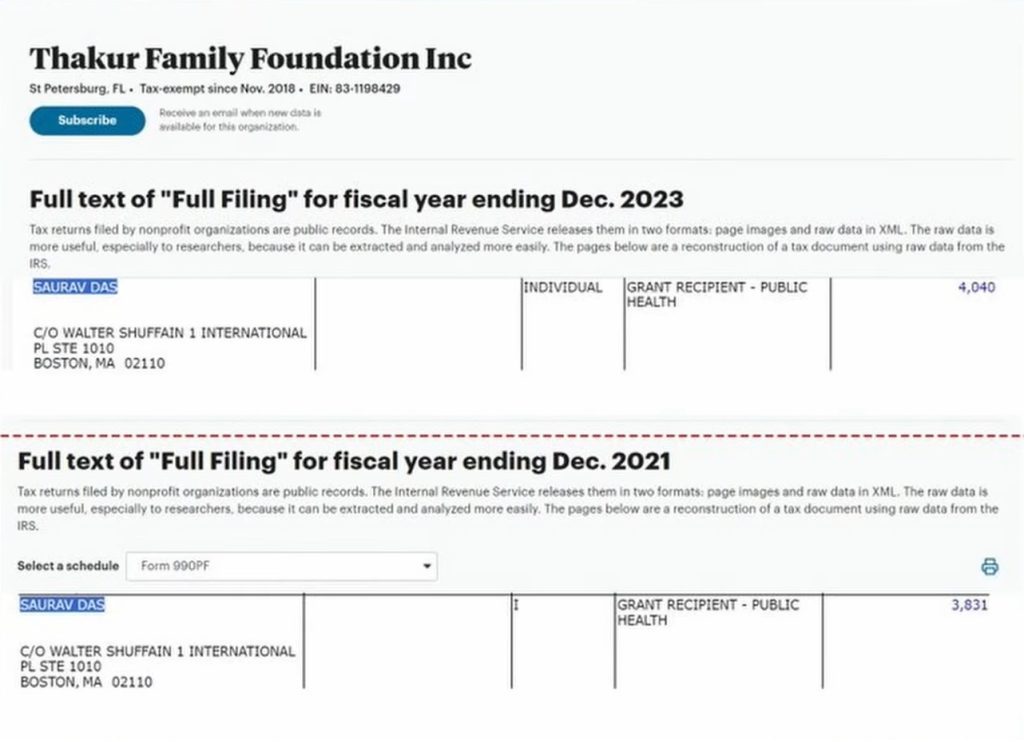
Das has earlier faced scrutiny for funding links to foreign and non-governmental foundations. A 2023 exposé by The Pamphlet showed that he received support from the Thakur Family Foundation for public health reporting, though his published articles reportedly extended to political topics beyond health policy.
Image Source: The Pamphlet
The Thakur Family Foundation (TFF), which presents itself as an organisation promoting “public health and civil liberties,” has funded multiple Indian media outlets and journalists, including individuals associated with Alt News, The Wire, and Moneylife Foundation, under the banner of health-related reporting. These grants coincided with the publication of articles critical of India’s pharmaceutical industry, traditional medicine systems, and domestic COVID-19 response, while appearing to favour Western vaccine and corporate narratives.
TFF has also been linked to the US-based testing firm Valisure, which released reports questioning the quality of Indian-made drugs. The pattern of financial support, editorial influence, and timing of campaigns indicates an organised effort to erode confidence in Indian generics and Ayurveda. During the COVID-19 pandemic, TFF-funded content appeared in The Wire and Alt News, amplifying narratives that portrayed India’s pandemic management and indigenous pharmaceutical initiatives in a negative light.
Saurav Das who seems to write on “public health” only wrote articles that were critical of the government policies in this space and not otherwise.
Additionally, when India banned anti-Hindu website Hindutva Watch, Saurav Das published a propaganda piece in Article 14 about India’s ‘censorship rules’.
Subscribe to our channels on WhatsApp, Telegram,Instagram and YouTube to get the best stories of the day delivered to you personally.
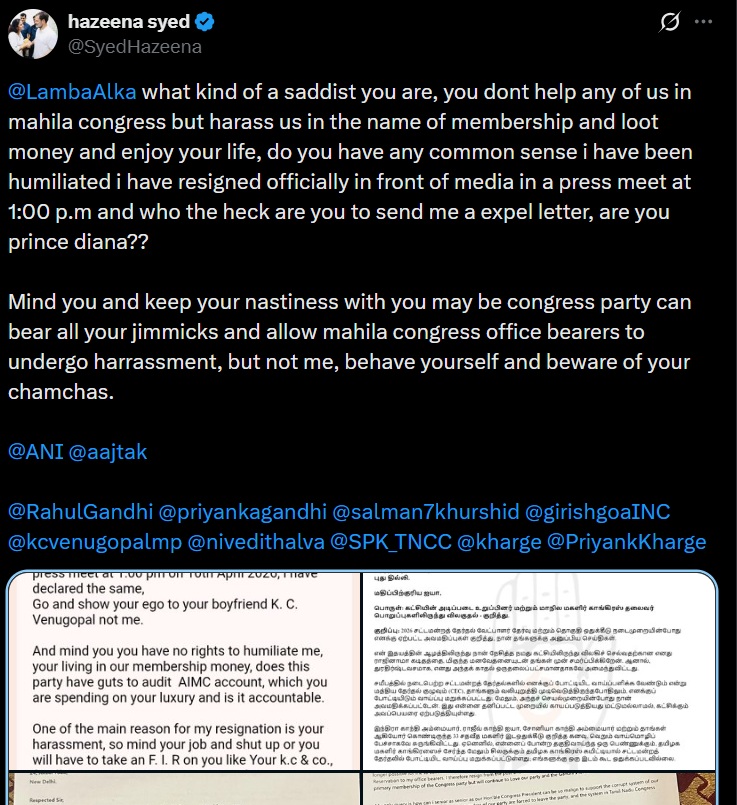
In a dramatic sequence of events that has exposed deep fault lines within the Tamil Nadu Congress, M. Hazeena Syed, the outgoing President of the Tamil Nadu Pradesh Mahila Congress, has launched a scathing public attack on All India Mahila Congress (AIMC) President Alka Lamba, accusing her of harassment, financial misconduct, and abusing organisational power, after Lamba issued an expulsion notice against her for “anti-party activities.”
The Resignation That Came First
Hazeena Syed, a three-decade Congress loyalist who rose from the student wing through the Talent Hand programme of 2008, officially tendered her resignation on April 10, 2026 at a press conference at 1:00 PM. In letters addressed to Rahul Gandhi and Congress President Mallikarjun Kharge, she stated that despite the Congress’s own Central Election Committee (CEC) and Rahul Gandhi personally pushing for her to receive an assembly ticket in the 2026 Tamil Nadu elections, she was denied the opportunity to contest and was “humiliated in the process”. She resigned from the post of State President of Tamil Nadu Mahila Congress and from primary membership of the Congress party.
In her letter to Rahul Gandhi, she pointedly stated: “Despite the decision of CEC and your good self’s insistence on giving me a ticket for the recent Assembly Elections, I was denied the opportunity to contest, and was humiliated in the process. This has not only hurt me personally but also brought disrepute to the party.”
She named multiple functionaries as responsible for the injustice, including TNCC President Selvaperunthagai, former Tamil Nadu in-charge Srivella Prasad, AICC Secretary Pushpa Raj (associated with Sam Pitroda), and Tamil Nadu in-charge Girish Chodankar.
The Expulsion Notice That Triggered the Firestorm
Hours after her public resignation, Alka Lamba issued a formal order expelling Hazeena Syed from the post of Tamil Nadu Pradesh Mahila Congress President, citing her involvement in “anti-party activities” and stating that the action was taken “in the interest of maintaining organisational discipline and integrity.” The expulsion came after Hazeena’s supporters had staged a protest at the TNCC headquarters on March 1, with some reportedly carrying petrol canisters and threatening self-immolation if she was not given a seat.
Hazeena’s Counterattack: Harassment, Fraud, and a Sharp Personal Rebuke
The issuance of the expulsion letter, which arrived after Hazeena had already publicly resigned, triggered an explosive response.
In an email dated April 11, 2026, at 12:30 AM, sent to tamilnadu.congress@gmail.com and addressed to Alka Lamba, and in a parallel post on her X handle @SyedHazeena, Hazeena unleashed a point-by-point set of allegations against the AIMC President.
In the email she wrote, on the expulsion notice itself, she dismissed it as legally and morally redundant: “Do you have any common sense – I have already resigned yesterday, in the official press meet at 1:00 PM on 10th April 2026, I have declared the same.”
On financial misconduct, she raised the most serious allegation that Alka Lamba had been using membership funds for personal luxury, writing: “Your living on our membership money – does this party have the guts to audit the AIMC account, which you are spending on your luxury and is it accountable?” She further added: “You will have to take an FIR on you like your K.C. & Co., for illegitimate account transaction for membership fraudulence – for which I have legal proofs.”
On harassment, Hazeena was direct: “One of the main reasons for my resignation is your harassment – so mind your job and shut up.”
On Alka Lamba’s political background, she attacked Lamba’s credibility within Congress, writing: “You have jumped from Aam Aadmi Party to ruin Congress – mind you and stay quiet, else I will fix you.”
In a strongly worded post on X, Hazeena directly attacked Lamba, alleging systemic harassment under the guise of party processes. “what kind of a saddist you are, you dont help any of us in mahila congress but harass us in the name of membership and loot money and enjoy your life, do you have any common sense i have been humiliated i have resigned officially in front of media in a press meet at 1:00 p.m and who the heck are you to send me a expel letter, are you prince diana??”
@LambaAlka what kind of a saddist you are, you dont help any of us in mahila congress but harass us in the name of membership and loot money and enjoy your life, do you have any common sense i have been humiliated i have resigned officially in front of media in a press meet at… pic.twitter.com/BlxPovXNJ3
Alka Lamba’s political career has been marked by a string of controversies spanning over a decade. Perhaps the most damaging came in 2012, when she was serving on a National Commission for Women fact-finding team investigating the Guwahati molestation case – she held a press conference and publicly revealed the identity of the sexual assault victim, a move widely condemned and one that led to her removal from the NCW committee.
In August 2015, while serving as AAP MLA from Chandni Chowk, CCTV footage caught her leading a mob armed with lathis and cricket bats to vandalise a liquor shop in the Kashmere Gate area of Old Delhi, reportedly because the shopkeeper, a BJP supporter, had objected to her party’s posters on his windows. Her tenure with the Aam Aadmi Party itself ended in controversy in 2019, when she was disqualified from the Delhi Assembly by the Speaker for violating anti-defection rules after she quit AAP to rejoin Congress.
More recently, in July 2024 just months after being appointed AIMC President, a fresh controversy erupted at a Madhya Pradesh Mahila Congress meeting, where a party worker alleged that Lamba told aides to “shoe her out of the meeting” (“Jute maar ke bahar kar do”). It is this pattern of high-handedness toward her own party’s women workers that Hazeena Syed has now cited as central to her resignation, alleging that Lamba’s conduct at the national level has made life difficult for state-level Mahila Congress functionaries across the country.
Hazeena Syed’s exit marks the end of a 30-year association with the Congress that began with the student wing. Appointed as Tamil Nadu Mahila Congress President in 2024, she also served as a national secretary of the women’s wing. The confrontation, now playing out publicly across email and social media, is widely seen as symptomatic of deeper organisational dysfunction in the Tamil Nadu Congress ahead of a critical state assembly election.
Subscribe to our channels on WhatsApp, Telegram,Instagram and YouTube to get the best stories of the day delivered to you personally.
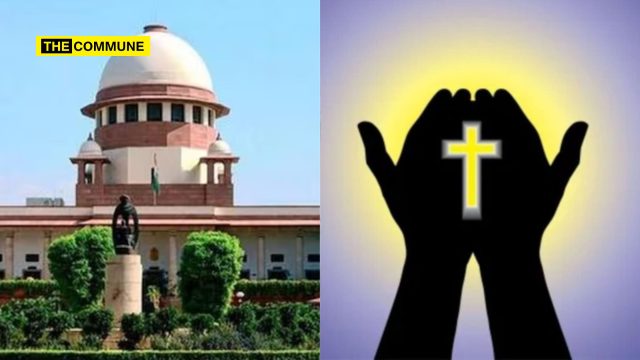
The Supreme Court of India on Friday, 10 April 2026, stayed criminal proceedings against a Christian priest who was booked by the Uttar Pradesh Police for allegedly stating that Christianity is the only true religion, as reported in Bar and Bench.
A Bench of Justices Vikram Nath and Sandeep Mehta issued notice to the Uttar Pradesh government on the priest’s plea challenging the criminal case registered against him.
The Court directed that during the pendency of the challenge, the trial proceedings against the priest will remain stayed.
The case pertains to allegations that the priest made statements during a prayer meeting asserting that Christianity is the only true religion, which allegedly outraged the religious sentiments of Hindus.
Earlier, the Allahabad High Court had refused to quash the proceedings against the priest. Justice Saurabh Srivastava had held that it was inappropriate for any individual to claim that their religion is the only true religion, observing that such assertions amount to disparagement of other faiths.
“By bare perusal of the narrations made in the FIR wherein it has been mentioned that in his prayer meet, applicant frequently states that there is only one religion which is Christian and also hurts the sentiments of a particular religion i.e. Hindu, whereas India is a land where people of all faiths and beliefs in secular state as defined by Constitution of India, live together, therefore, it is wrong for any religion to claim that it is the only true religion as it implies a disparagement of other faiths,” the High Court had said.
The High Court had further noted that Section 295A of the Indian Penal Code prohibits deliberate and malicious acts intended to outrage the religious feelings of any class of citizens, and held that the actions alleged against the priest fall within the ambit of Section 295-A IPC.
The priest has challenged both the chargesheet filed against him and the trial court order taking cognizance of the offence.
With the Supreme Court now issuing notice and staying the proceedings, the matter will be taken up for further consideration after responses are filed by the Uttar Pradesh government.
Subscribe to our channels on WhatsApp, Telegram,Instagram and YouTube to get the best stories of the day delivered to you personally.
The Supreme Court of India on Friday, 10 April 2026, declined to grant divorce to a 54-year-old man who has been paying ₹15,000 per month as maintenance to his estranged wife for the past 16 years, and instead asked him to come forward with a reasonable proposal for permanent alimony, as reported in Times of India.
A Bench comprising Justices Vikram Nath and Sandeep Mehta told the petitioner that his plea for divorce could only be considered if he indicated what he was willing to offer as permanent alimony.
During the hearing, the petitioner argued that even ₹15,000 was a significant burden on his monthly income of ₹65,000. Responding to this contention, the Bench remarked, “Rs 15,000 is hardly anything these days…If you came up with an offer for permanent alimony we could have still considered (granting divorce)…(Else) Shaanti se baitho, dete raho 15,000, khush raho”.
The Court was hearing the man’s challenge to an earlier order of a high court that had dismissed his plea for divorce.
The Bench also questioned why the couple could not resume cohabitation. “Keep your wife with you. What is the problem?” the Court asked during the proceedings.
Appearing for the petitioner, counsel submitted that the couple had been living separately for nearly 16 years and that multiple attempts at mediation had failed due to continuing differences between them. However, the Court noted that the only ground of cruelty cited by the petitioner was his wife’s insistence on accompanying him wherever he was posted.
Counsel for the wife informed the Court that she was not seeking permanent alimony and was willing to resume living with her husband.
The matter came up before the apex court following the petitioner’s appeal against the high court’s refusal to grant divorce, with the Bench indicating that any reconsideration of the plea would depend on a concrete proposal regarding permanent alimony.
Subscribe to our channels on WhatsApp, Telegram,Instagram and YouTube to get the best stories of the day delivered to you personally.
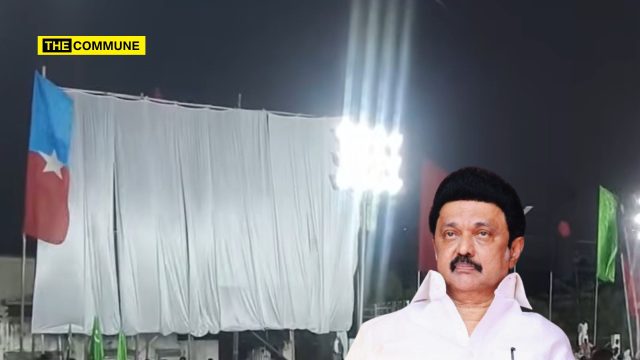
A major controversy has erupted after the Dravida Munnetra Kazhagam allegedly erected large screens during a campaign meeting at Thilakar Thidal in Thanjavur to block the view of the Brihadeeshwara Temple from Chief Minister MK Stalin.
The incident took place during an Assembly election campaign rally where Stalin addressed a gathering in support of eight constituency candidates from the district. A large number of party functionaries and cadre had assembled from across Thanjavur for the event.
The Brihadeeshwara Temple, a world-famous and historically significant monument located close to the venue, was covered from the Chief Minister’s line of sight using massive screens erected at the site. The act has triggered sharp reactions and widespread criticism.
The temple seems to have been deliberately hidden from Stalin’s view. The move has caused shock among sections of the public present at the venue and has quickly snowballed into a political controversy.
The incident has also reignited discussions around a long-standing belief that politicians visiting the temple risk losing their position. One wornders that if the screening was done based on such a belief, it contradicts the DMK’s stated opposition to religion and superstition, and this can be called the “height of superstition.”
Social activists have strongly condemned the move, stating that concealing a monument of such cultural and historical importance undermines Thanjavur’s heritage and identity, and amounts to an insult to the people of the district.
Subscribe to our channels on WhatsApp, Telegram,Instagram and YouTube to get the best stories of the day delivered to you personally.
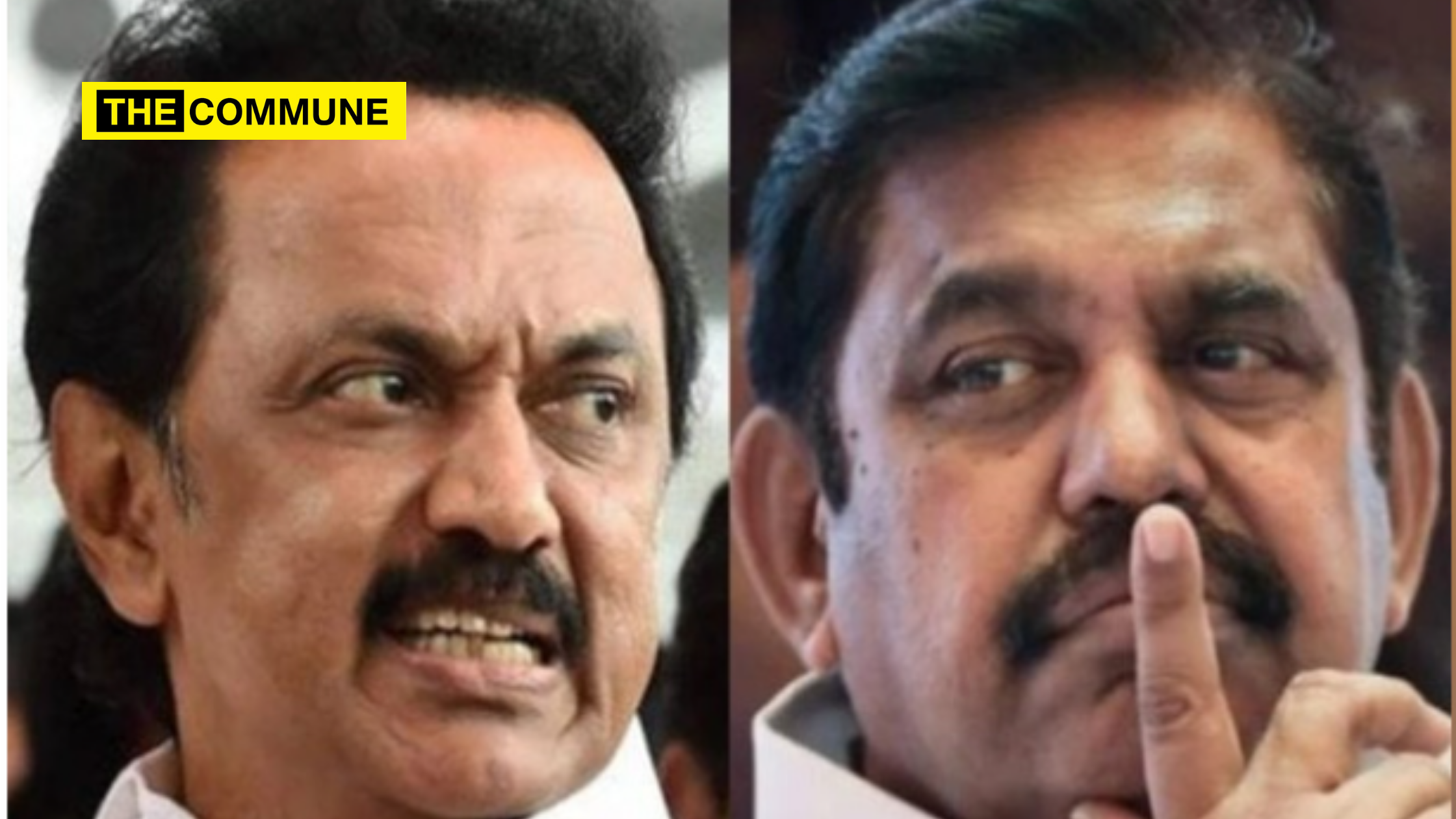
Edappadi K. Palaniswami on Saturday took sharp aim at Chief Minister MK Stalin, citing what he described as a “confused” moment during the latter’s recent public meeting in Tiruvannamalai.
Referring to Stalin’s speech at the rally, Palaniswami alleged that the Chief Minister appeared uncertain about the candidate he was endorsing. At the Tiruvannamalai event, Stalin is seen asking the candidate, “What is your symbol? What is the symbol? It is the Rising Sun symbol – okay, votes must be cast for the Rising Sun symbol.”
Addressing a public meeting, the AIADMK leader said Stalin had “forgotten his own candidate” while speaking. He stated that the Chief Minister had nominated a candidate without clarity on the party’s election symbol and questioned how a leader could be unaware of such basic details.
Palaniswami further stated that he had watched the clip on television after party cadres brought it to his attention. He said he initially assumed it might involve a candidate from another party, but later realised that the person in question was a candidate of the Dravida Munnetra Kazhagam, whose election symbol is the Rising Sun.
He said, “I thought, ‘What is this?’ – maybe some other party’s leader, maybe someone from another party had contested, and that’s why he was asking what the symbol was. But no, the person contesting is a DMK party candidate, and when asked what the party’s symbol is, he said it is the Rising Sun symbol.”
Palaniswami further escalated his criticism, stating, “This is the kind of Chief Minister who is ruling Tamil Nadu. That is exactly what I said – a puppet Chief Minister, an incompetent Chief Minister.”
The Madras High Court on Friday (10 April 2026) dismissed two public interest litigation (PIL) petitions seeking to prevent the continued screening of Dhurandhar: The Revenge, starring Ranveer Singh, in Tamil Nadu until the declaration of results of the Assembly elections, as reported in The Hindu.
A Division Bench comprising Chief Justice Sushrut Arvind Dharmadhikari and Justice G. Arul Murugan observed that the petitioners had neither challenged the certification granted to the film by the Central Board of Film Certification (CBFC) nor pointed out any specific portions of the film as objectionable.
The court, noting the absence of substantive grounds in the petitions, declined to grant the relief sought and dismissed both PILs.
Subscribe to our channels on WhatsApp, Telegram,Instagram and YouTube to get the best stories of the day delivered to you personally.
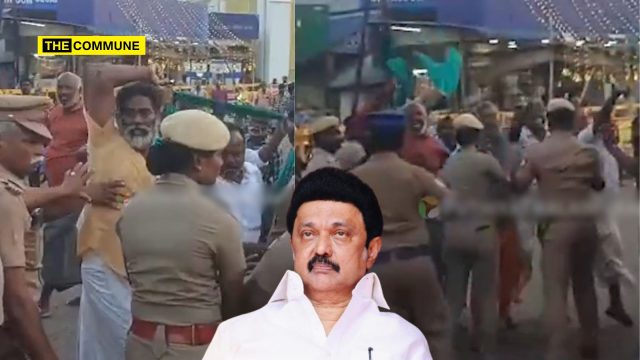
A long-running dispute involving sugarcane farmers and the now-defunct Thiru Arooran Sugar Mill escalated into a flash protest on the day Chief Minister MK Stalin visited the district, with police detaining protesting farmers and confining them inside a private wedding hall.
The Thiru Arooran Sugar Mill, located in Thirumandankudi near Papanasam in Thanjavur district, had been operational for several years before shutting down permanently in 2018. According to the farmers, the mill management failed to pay approximately ₹115 crore in dues owed to sugarcane cultivators between 2015 and 2018.
Farmers have also alleged that the mill management fraudulently secured loans worth around ₹300 crore from nationalized banks in their names. As a result, many farmers now face civil liabilities and are unable to access fresh credit from banks.
Following its closure, the Thiru Arooran Sugar Mill was later acquired by another company, which is currently operating the unit.
The affected farmers have been demanding that the Tamil Nadu government clear the pending ₹115 crore dues along with interest, repay the loans allegedly taken in their names, and take over the mill to run it under direct government control. Despite submitting repeated petitions, farmers state that no action has been taken so far.
They have been engaged in a continuous agitation for nearly 1,500 days over these demands.
Amid this backdrop, Chief Minister MK Stalin arrived at Thilakar Maidan in Thanjavur to participate in a public meeting in support of candidates contesting the Thanjavur district assembly constituencies.
In protest against the Chief Minister’s visit, the agitating sugarcane farmers staged a sudden demonstration near the Thanjavur Railway Station, leading to commotion in the area.
Police, however, preemptively detained the protesting farmers, bundled them into vans, and transported them to a private wedding hall, where they were locked inside. The action further escalated tension at the scene.
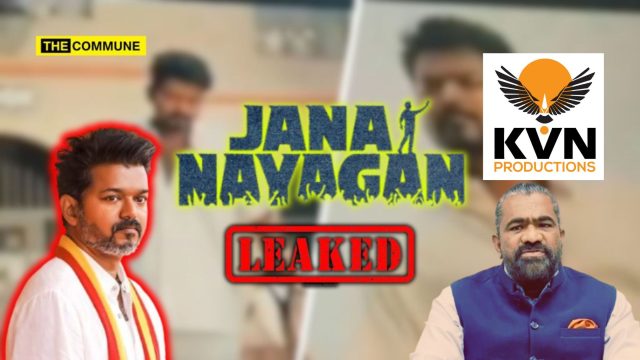
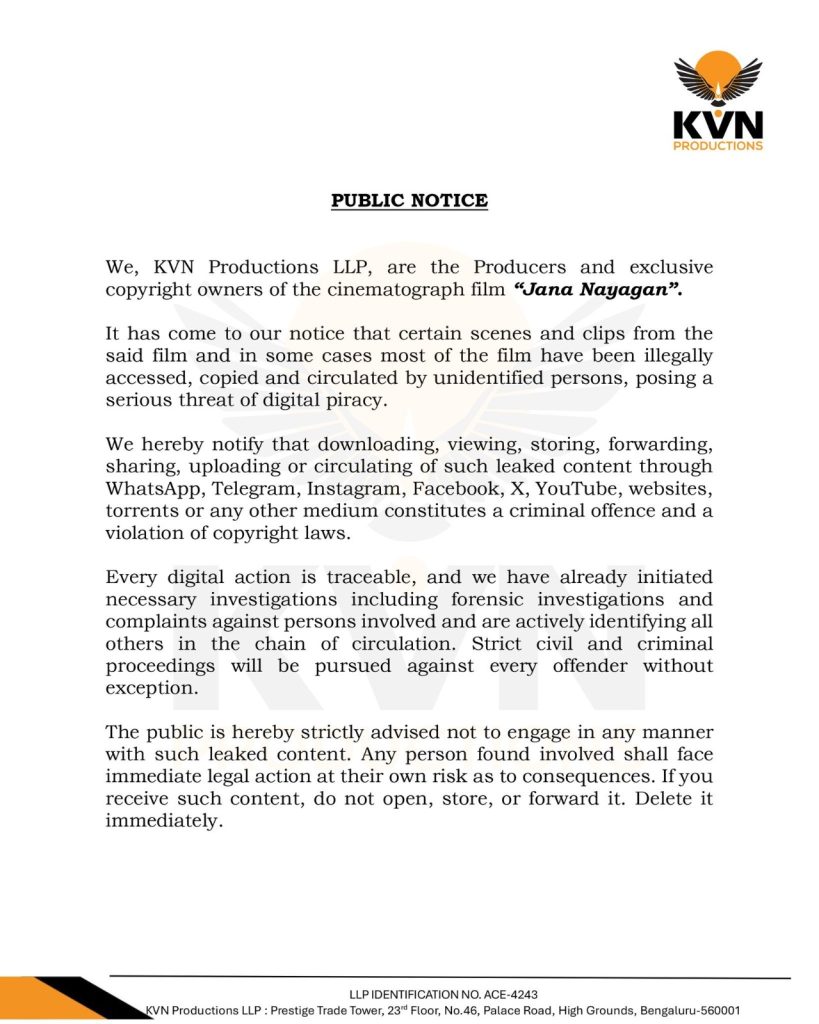
Actor-turned-politician Joseph Vijay’s much-anticipated final film as an actor, Jana Nayagan, was reportedly leaked online ahead of its theatrical release, triggering widespread concern within the Tamil film industry and also a memefest on social media.
The film, which was initially slated for release on 9 January 2026, has remained in limbo for nearly three months after failing to secure clearance from the Central Board of Film Certification (CBFC). The latest development has further complicated the film’s release prospects.
In response to the leak, the film’s producers, KVN Productions, issued a strongly worded public notice warning against the circulation of pirated content.
The statement read, “We, KVN Productions, LLP, are the producers and exclusive copyright owners of the cinematograph film, Jana Nayagan. It has come to our notice that certain scenes and clips from the said film and in some cases, most of the film have been illegally accessed, copied, and circulated by unidentified persons, posing a serious threat of digital piracy.”
The production house further stated, “We hereby notify that downloading, viewing, storing, forwarding, sharing, uploading, or circulating the leaked content through platforms such as WhatsApp, Telegram, Instagram, Facebook, X, YouTube, websites, torrents, or any other medium is a criminal offence and violates copyright laws.”
The statement threatened, “Every digital action is traceable, and we have already initiated necessary investigations, including forensic investigations, and complaints against persons involved and are actively identifying all others in the chain of circulation. Strict civil and criminal proceedings will be pursued against every offender without exception.”
Issuing a caution to the public, the producers concluded, “The public is hereby strictly advised not to engage in any manner with such leaked content. Any person found involved shall face immediate legal action at their own risk as to consequences. If you receive such content, do not open, store or forward it. Delete it immediately.”