Home Blog Page 7

‘Thooya Sakthi’ Joseph Vijay’s TVK Cause Public Inconvenience With Banners Of His Face Across Chennai

Thooya Sakthi' Joseph Vijay's TVK Cause Public Inconvenience With Banners Of His Face Across Chennai

Joseph Vijay’s Tamilaga Vettri Kazhagam came to power promising clean, alternative politics, but on Chennai’s streets, many residents are seeing something far more familiar: giant banners, illegal cut-outs, roadside posters, and flagpoles celebrating him and his party men at the cost of ordinary people’s movement and safety. For a party that spoke the language of change, TVK’s visual takeover of public spaces is beginning to look less like public enthusiasm and more like old-style political nuisance in a new colour scheme.

Across parts of Chennai, residents have complained that TVK banners and posters have mushroomed on roadsides, sidewalks, medians, and walls, creating inconvenience and defacing public spaces. A ground report by The New Indian Express said a huge cut-out in Royapuram blocked pedestrian access on a footpath, effectively pushing people onto the road, while several flagpoles were seen along the centre median in Velachery and massive cut-outs were also reported near Thiruvanmiyur on ECR.

When flagpoles and flex structures crowd public stretches, they narrow usable space, distract traffic, and increase risk in a city already struggling with congestion, encroachments, and weak civic enforcement. Chennai has seen this pattern before, and the Madras High Court has repeatedly made it clear that banners cannot obstruct pedestrian or vehicular movement and that the public must not be inconvenienced.

That is why the hypocrisy charge sticks. TVK and Vijay marketed themselves as a moral-political correction to the old Dravidian style of power display, yet residents quoted in recent reporting have asked why a leader with such immense fame needs illegal publicity structures at all. The criticism is not coming only from rivals; even supporters and online well-wishers urged Vijay to intervene and stop the defacement.

A truly ‘Thooya Sakthi’ would begin with clean public conduct. It would not allow cadres, local strongmen, or newly empowered legislators to occupy pavements and medians with the leader’s face. It would show discipline from day one, because public ethics are tested not only in assembly speeches but also in how a ruling party behaves on the street corner outside a marriage hall, a market road, or a busy junction.

The larger problem is that Tamil Nadu’s banner culture has long thrived on the idea that political visibility matters more than civic order. Courts have repeatedly intervened because unauthorised banners and hoardings obstruct roads, inconvenience pedestrians, and can become safety hazards, yet parties continue to behave as though public space is partisan property for temporary occupation.

If Vijay wants to protect the reformist image of TVK, this is one of the easiest tests before him. He does not need another speech. He needs one public order to his cadre: no illegal banners, no cut-outs on footpaths, no flex boards on roads, no political vanity at the expense of citizens. Until that happens, every oversized poster of his smiling face in Chennai will stand not as a symbol of victory, but as evidence that TVK is learning the oldest political habit in the state – public inconvenience as spectacle.


Subscribe to our channels on WhatsAppTelegram, Instagram and YouTube to get the best stories of the day delivered to you personally.

TCS In Big Trouble: NCW Report Flags “Pervasive Sexual Harassment”, Religious Intimidation, And Systemic Bullying At Nashik Office

Hindu Gods Mocked, Namaz Forced, Beef Force-Fed How A Muslim Grooming Gang At A Famous IT Firm Targeted Hindu Female Colleagues

The National Commission for Women (NCW) has submitted a 50-page fact-finding report to Maharashtra Chief Minister Devendra Fadnavis confirming serious allegations of sexual harassment, stalking, religious intimidation, workplace bullying and POSH Act violations at the Nashik unit of Tata Consultancy Services (TCS), intensifying pressure on the company as the Special Investigation Team (SIT) continues its probe into multiple FIRs linked to the case, as reported in The New Indian Express.

The NCW said it had taken suo motu cognisance of complaints made by several women employees at the TCS Nashik office and constituted a fact-finding committee under the direction of NCW Chairperson Vijaya Rahatkar. The committee comprised retired Bombay High Court judge Justice Sadhna Jadhav, former Haryana DGP B.K. Sinha, Supreme Court advocate Monika Arora and NCW senior coordinator Lilabati. The panel visited Nashik on April 18 and 19, where it interacted with victims, members of the POSH Internal Committee, police officials and other witnesses before preparing a report containing over 25 recommendations.

According to the report, the committee found what it described as a “deeply disturbing and toxic workplace environment” marked by “pervasive sexual harassment” and abuse of authority. The report stated that the accused had effectively taken control of the TCS Nashik office and allegedly targeted “young and vulnerable girls”, subjecting them to sexual, emotional and mental harassment. The committee said complainants had faced sexual harassment and attempts of molestation.

The report also documented allegations of religious intimidation and anti-Hindu commentary inside the workplace. According to the findings, female employees were allegedly bullied through repeated denigration of Hindu mythology, beliefs, traditions and practices, while being told that Islam was a “far superior religion” to Hinduism. The committee observed that repeated anti-religious commentary created a coercive atmosphere, particularly affecting younger employees, including members of Generation Z.

The NCW further described the case as a “typical case of sexual harassment at the workplace” involving stalking, demeaning comments, humiliating conduct and sustained mental harassment. Women employees allegedly feared lodging complaints because of social pressure, stigma and fear of professional retaliation. The report stated that employees who raised their voice risked transfer, termination and other professional consequences.

The committee alleged that the Nashik office was effectively controlled by individuals identified as Danish, Tausif and Raza Memon, while naming Ashwini Chainani as having allegedly endorsed the conduct “through her silence and insensitivity”. According to the findings, employees lacked confidence in the system and feared repercussions if they complained.

The report also flagged major compliance failures under the Sexual Harassment of Women at Workplace (Prevention, Prohibition and Redressal) Act, 2013. The committee stated there was “zero compliance” with the POSH Act at the Nashik unit. It found that the Internal Committee for Pune and Nashik offices was common, which it said violated legal requirements. The panel further noted that there were no employee awareness programmes, no orientation sessions for Internal Committee members and no visible POSH-related communication within the office.

The committee also criticised the functioning of the Internal Committee, stating there was “no expression of empathy or sympathy” for affected female employees and highlighted failures under Section 19(C) of the POSH Act. It termed the situation not merely a compliance lapse but a broader “governance deficit”.

Among the infrastructural failures highlighted by the panel was the absence of functional CCTV surveillance. The report stated that CCTV cameras installed at the office were non-functional, raising concerns over workplace monitoring and employee safety.

The NCW recommended strict enforcement of Sections 19, 25 and 26 of the POSH Act, stronger grievance redressal mechanisms, witness protection measures under the Witness Protection Act, 2017, and safeguards to ensure complainants do not suffer professionally for filing complaints. The report also suggested examination of offences under various provisions of the Bharatiya Nyaya Sanhita, including Sections 75, 78, 79, 299 and 68(a), including provisions dealing with deliberate acts intended to outrage religious feelings.

Meanwhile, in a major development in the criminal investigation, accused Nida Khan was on Monday remanded to 14 days judicial custody by a Nashik court after her police custody ended. Since the police did not seek further custody, the court sent her to Nashik Road Central Jail.

Khan had been arrested on 7 May 2026 from Chhatrapati Sambhajinagar after allegedly remaining absconding following the emergence of complaints from employees of the TCS Nashik unit. She has been booked under provisions of the Bharatiya Nyaya Sanhita for sexual harassment and defamation, along with provisions of the Scheduled Castes and Scheduled Tribes (Prevention of Atrocities) Act. The complainant, a Scheduled Caste woman, alleged coercion, forced religious conversion, molestation, mental harassment and hurting of religious sentiments.

The Special Investigation Team is currently probing nine FIRs connected to the case, including one registered at Deolali Camp police station and eight at Mumbai Naka police station. Investigators are examining allegations of exploitation, attempted forced conversion, molestation, workplace intimidation and religious harassment.

Khan had earlier sought anticipatory bail after being named in the Deolali Camp FIR, claiming innocence and citing her pregnancy. However, the sessions court rejected her plea on 2 May 2026, observing that there appeared to be a “systematic plan” to influence the complainant.

Subscribe to our channels on WhatsAppTelegram, Instagram and YouTube to get the best stories of the day delivered to you personally.
TANGEDCO Moves Supreme Court Against CBI Probe In ₹397 Crore Transformer Scam; BJP Leader Annamalai Urges TVK Govt To Withdraw Appeal

TANGEDCO Moves Supreme Court Against CBI Probe In ₹397 Crore Transformer Scam; BJP Leader Annamalai Urges TVK Govt To Withdraw Appeal

The Supreme Court on Monday, 11 May 2026, heard appeals filed by Tamil Nadu Generation and Distribution Corporation (Tangedco) and its former Finance Controller V. Kasi against the Madras High Court order directing a Central Bureau of Investigation (CBI) probe into the alleged ₹397-crore transformer procurement scam linked to the tenure of former Electricity Minister V. Senthilbalaji. The matter was listed before Justices Vikram Nath and Sandeep Mehta.

The controversy stems from a 29 April 2026 order of the Madras High Court, which directed the CBI to conduct a de novo investigation into alleged irregularities in transformer procurement between 2021 and 2023. The Division Bench comprising Chief Justice Sushrut Arvind Dharmadhikari and Justice G. Arul Murugan observed that the Tamil Nadu government’s handling of the case created a “reasonable suspicion” of attempts to shield senior officials and political figures.

Anti-corruption organisation Arappor Iyakkam had lodged a complaint on 6 July 2023 against Senthilbalaji, former Tangedco chairman Rajesh Lakhoni, and former Financial Controller (Purchase) V. Kasi, alleging corruption in transformer procurement contracts. The Directorate of Vigilance and Anti-Corruption (DVAC) later sought government approval in January 2024 to conduct a detailed inquiry. However, the High Court noted that permission was granted only in September 2025 and restricted solely to a preliminary inquiry against Kasi.

The Bench criticised the 20-month delay and observed that the DVAC had effectively carried out a full-fledged investigation without registering an FIR. The court pointed out that the agency examined 44 witnesses and 68 documents before filing a 73-page closure report on 4 April 2026 stating that there was insufficient evidence against Kasi. The judges held that such an extensive probe exceeded the scope of a preliminary inquiry and raised concerns about procedural integrity.

The High Court subsequently ordered the DVAC to transfer all case-related records to the CBI within two weeks and directed the State government, Tangedco and the DVAC to cooperate fully with the investigation. At the same time, the Bench clarified that its observations were limited to deciding whether an independent investigation was warranted and should not be treated as findings on the merits of the allegations.

Responding to the High Court order earlier, Senthilbalaji denied any wrongdoing and maintained that the procurement process followed established rules and procedures that had been in practice since 1987. He stated that contracts were awarded to the lowest bidders and quantities were distributed among firms when multiple bidders quoted identical prices. He also alleged that the complaints were politically motivated.

Meanwhile, K. Annamalai questioned why Tangedco had approached the Supreme Court against the CBI probe order. He urged the newly formed TVK government in Tamil Nadu to withdraw the appeals and restore general consent for CBI investigations in the State, which had been withdrawn by the previous DMK government. He also referred to other pending corruption-related complaints awaiting FIR registration by the DVAC.

Supreme Court Refuses To Halt CBI Probe

The Supreme Court on Monday, 11 May 2026, refused to interfere with the Madras High Court’s order directing a CBI probe into the alleged ₹397-crore transformer procurement scam, as reported LiveLaw. A Bench of Justices Vikram Nath and Sandeep Mehta dismissed the plea filed by a TANGEDCO official challenging the probe. Senior Advocate Siddharth Dave argued that there was no prayer seeking a CBI inquiry before the High Court and called the case politically motivated. The Supreme Court, however, held that courts could order such probes based on circumstances and directed that the investigation proceed independently.

Subscribe to our channels on WhatsAppTelegram, Instagram and YouTube to get the best stories of the day delivered to you personally.
Did IUML Agree To Support TVK After Congress Assured Role In Kerala Cabinet?

Did IUML Agree To Support TVK After Congress Assured Role In Kerala Cabinet?

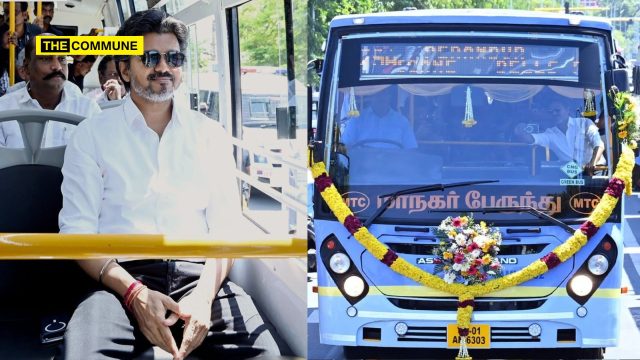
Questions are being raised over the circumstances under which the Indian Union Muslim League (IUML) eventually extended support to Tamilaga Vettri Kazhagam (TVK) during the Tamil Nadu government formation process, with reports alleging that political negotiations involving the Congress may have played a key role behind the scenes.


View this post on Instagram


A post shared by Tamil Janam (@tamiljanam)

According to the report, Congress is said to have stepped in and held negotiations with IUML at a crucial stage, attempting to secure the party’s support for TVK in Tamil Nadu. The central claim is that a political assurance may have been offered during these talks: if IUML supported TVK in Tamil Nadu, the party could be accommodated with a place in the Kerala cabinet.

The allegation gains attention because IUML had, in the early phase of the government-formation exercise, publicly maintained distance from TVK and indicated that it was not prepared to immediately extend support. Earlier reports showed IUML leaders signalling reluctance and stressing their existing political alignment, making the later shift in position politically significant.

That abrupt change has now led to sharper questions over what exactly happened behind the scenes. Was the support purely a political decision taken in the interest of Tamil Nadu’s government formation, or was it the result of a wider bargain that linked Tamil Nadu politics with Kerala power-sharing calculations?

The Kerala angle has drawn particular interest because IUML’s role in government formation and ministerial representation in that state was already a live political issue at the time. Reports from Kerala indicated that discussions around cabinet representation for IUML were part of the broader conversation, which has only added weight to speculation that the Tamil Nadu decision may not have been isolated from parallel negotiations elsewhere.

What is clearly established is that IUML first held back, then shifted, and that the shift came at a politically decisive moment. The real question now is not merely why IUML supported TVK, but whether that support was part of a larger inter-state political arrangement brokered through the Congress.

Subscribe to our channels on WhatsAppTelegram, Instagram and YouTube to get the best stories of the day delivered to you personally.
Congress Mocks PM Modi’s ‘Avoid Buying Gold’ Appeal; Had Made Similar Gold Warnings In 2013 Without Any Global War

Congress Mocks PM Modi’s 'Avoid Buying Gold' Appeal; Had Made Similar Gold Warnings In 2013 Without Any Global War

Prime Minister Narendra Modi on Sunday 10 May 2026 urged citizens to avoid buying gold for a year and postpone foreign travel as part of a broader appeal aimed at conserving foreign exchange amid growing global uncertainty.

Addressing a BJP rally in Hyderabad on Sunday, PM Modi called on citizens to reduce non-essential foreign exchange outflows, including gold purchases and overseas travel, while stressing the importance of collective public participation during the ongoing global crisis.

The Prime Minister’s remarks came against the backdrop of escalating tensions in West Asia, rising energy prices and global supply-chain disruptions, developments that are increasing pressure on import-dependent economies such as India.

A day later, the Congress launched a sharp attack on the Prime Minister, accusing him of shifting the burden of economic challenges onto ordinary citizens.

The opposition party said the “compromised PM” was no longer capable of running the country and urged him not to place the responsibility for “12 years of failures” on the shoulders of the Indian public.

Congress leader and Leader of the Opposition in the Lok Sabha Rahul Gandhi said PM Modi’s remarks were “evidence of failure”.
“Yesterday, Modi Ji called upon the public to make sacrifices – do not buy gold, do not travel abroad, consume less petrol, cut down on fertilisers and cooking oil, take the metro, and work from home,” Gandhi said in a post on X in Hindi.

Modi’s argument was rooted in foreign exchange conservation. With oil prices climbing and gold imports adding to dollar outflows, the government has signalled that reducing non-essential imports could help cushion external pressure during a volatile geopolitical and economic period.

The message was framed as a public appeal for restraint during a moment of international uncertainty.

But the Congress forgot something. Just 13 years ago, when the United Progressive Alliance (UPA) was in power, the then-Finance Minister P. Chidambaram made a strikingly similar appeal to Indians – asking them not to buy gold because of the strain gold imports were placing on the economy.

In June 2013, Chidambaram publicly urged citizens to avoid gold purchases and linked excessive imports directly to India’s widening current account deficit and pressure on the rupee. Speaking to the press, he said, “Please resist the temptation to buy gold. And we can have it for six months, one year. Almost minimal gold imports into the country, it will dramatically change the situation of the current account deficit.”

The Times of India quoted him as saying, “If I have one wish which the people of India can fulfill is don’t buy gold,” while other reports noted that he said a one-year reduction in gold imports could dramatically alter the economic situation.

Chidambaram did not stress on this just once. At another event, he said, “Last year’s monthly average was 70 tons of gold. This year in the first two months, the average is 152 tons of gold. How is this sustainable? How can we finance these gold imports? Therefore, both the Reserve Bank and the government have no option but to take stronger measures. The Reserve Bank announced a few measures a couple of days ago. And yesterday, government is obliged to once again increase the import duty. We raised it by 2% in the beginning of the year in February, and we’ve raised it again to 8%. Banks have a role to play in dampening the enthusiasm for gold. I think the Reserve Bank has advised banks that they should not sell gold coins. The Reserve Bank has put in place regulations that gold can only be imported on a consignment basis. It has increased the margins to 100%. And I would urge all banks to please advise their branches that they should not encourage their customers to invest or buy gold. I hope a day will come when we regard gold as any other metal. It just shines a little more than copper or brass.”

There was not even any global war or crisis going on but it was centered on the current account deficit and rupee weakness. For this, the Congress kept telling the people to stop buying gold.

But unlike 2013, India in 2026 is facing a far more volatile global environment marked by war-related instability, soaring oil prices and record-high gold prices. The government’s appeal is being framed in the context of protecting India’s economic resilience and reducing external vulnerability during a period of global uncertainty. Despite this, the Congress chose to attack PM Modi’s appeal instead of acknowledging the broader geopolitical and economic pressures confronting the country.

Subscribe to our channels on WhatsAppTelegram, Instagram and YouTube to get the best stories of the day delivered to you personally.
How Vijay’s TVK Used Fan Networks, AI Media And Viral Content To Break Tamil Nadu’s Dravidian Party Duopoly

How Vijay’s TVK Used Fan Networks, AI Media And Viral Content To Break Tamil Nadu’s Dravidian Party Duopoly

Actor-turned-politician Vijay’s Tamilaga Vettri Kazhagam (TVK) stunned Tamil Nadu politics after winning 108 of 234 assembly seats in the 2026 election, ending decades of dominance by the DMK and AIADMK and becoming the biggest political disruptor in South India.

The result can be described as an “algorithm election,” pointing to TVK’s heavy use of digital campaigning, viral short-form content, AI-generated media and online fan mobilisation.

It is reported that TVK’s electoral strategy operated through a three-layer structure combining traditional fan-club networks with modern computational amplification.

Fan Clubs Became Political Distribution Networks

The first layer was built on Vijay’s long-standing fan infrastructure. Vijay has maintained organised fan clubs under the banner of “Vijay Makkal Iyakkam” since 2009. By the time TVK was launched in February 2024, the network reportedly consisted of nearly 85,000 fan clubs spread across Tamil Nadu.

These networks already functioned through local coordinators, WhatsApp groups and neighbourhood-level mobilisation structures. The campaign did not create these systems from scratch but instead transformed an existing cinema fandom network into a political communication machine.

This model can be seen as an evolution of Tamil cinema’s traditional MGR-style fan-club culture, updated with digital tools and social media infrastructure.

AI Images, Holograms And Reels Dominated Online Campaigning

The second layer of the campaign involved generative media and aggressive exploitation of short-form platform algorithms.

AI-generated portraits, edited videos and stylised campaign clips featuring Vijay circulated widely across Instagram, X, WhatsApp and YouTube Shorts during the election period. Much of the content reportedly spread without clear disclosure that it had been digitally generated or manipulated.

One of the campaign’s most widely circulated moments involved a hologram projection of Vijay at a rally in Kumbakonam. The hologram itself was less important than the way clips of it were rapidly remixed into memes, edits and short-form videos that spread across social media platforms.

The campaign also reportedly adopted an intentional scarcity strategy. Unlike traditional Tamil Nadu campaigns centred around nonstop television appearances and large-scale media outreach, Vijay rarely gave extended interviews or appeared frequently on television during the election cycle.

This approach increased the online value of every speech clip, visual appearance or short campaign moment, making each fragment more likely to gain high engagement on algorithm-driven platforms such as Instagram Reels and YouTube Shorts.

Allegations Of Fake Accounts And Inauthentic Activity

The third layer involved allegations of coordinated inauthentic online behaviour.

Reports alleged that supporters of TVK had created fake social media accounts impersonating media organisations and fictitious news outlets in order to spread defamatory or misleading content targeting journalists.

The virtual warriors kept spreading fake covers of Frontline, India Today, and Vikatan.

Such activity fits definitions of “computational propaganda” used by institutions such as the Oxford Internet Institute, particularly where coordinated deceptive behaviour and fake digital identities are involved.

However, these people involved can be described as “supporters” rather than officially linked party operatives. Similar plausible-deniability structures have been observed globally in digitally driven political ecosystems, where unofficial supporter networks carry out aggressive online activity while formal political organisations maintain distance from them.

It remains unresolved whether the activity was centrally coordinated or emerged organically from supporter ecosystems.

A New Political Campaign Model

TVK’s campaign can be increasingly viewed as an example of how synthetic media, fandom culture and algorithmic distribution can reshape electoral politics.

Rather than relying primarily on conventional party machinery or legacy media dominance, the campaign appeared to combine emotional fan loyalty, decentralised digital communities and high-velocity meme circulation to create political momentum.

The TVK experiment may become a case study in how pre-existing entertainment fandoms can rapidly evolve into digitally amplified political movements capable of challenging entrenched party systems.

Subscribe to our channels on WhatsAppTelegram, Instagram and YouTube to get the best stories of the day delivered to you personally.
Before TVK-Congress Alliance, Vijay Tried To Join Congress In 2009, Was Asked By Rahul Gandhi To “Prove Himself” In Youth Polls

Before TVK-Congress Alliance, Vijay Tried To Join Congress In 2009, Was Asked By Rahul Gandhi To “Prove Himself” In Youth Polls

Tamil Nadu Chief Minister C Joseph Vijay had reportedly explored joining the Congress party as early as 2009, but the move did not materialise after Rahul Gandhi advised him to first prove himself by contesting internal Youth Congress elections, according to a report by Hindustan Times. Ironically, today Congress is in an alliance with the TVK in the state.

It is reported that Vijay, accompanied by his father and filmmaker SA Chandrasekhar, had travelled to Delhi along with Congress leader Gopinath Palaniyappan, who was then serving as national secretary of the National Students’ Union of India (NSUI).

When contacted by Hindustan Times, Palaniyappan declined to discuss the matter in detail. The developments reportedly took place shortly after the United Progressive Alliance returned to power in 2009 under then Prime Minister Manmohan Singh, at a time when Rahul Gandhi was focused on restructuring the Youth Congress and NSUI.

According to a Congress leader quoted anonymously in the report, Vijay’s intention at the time was modest and limited to becoming a member of the All India Congress Committee. The leader reportedly said Vijay had neither sought an election ticket nor demanded any political position. The source also claimed that SA Chandrasekhar’s ideological inclination toward the Congress had influenced the actor’s interest in joining the party.

The report further stated that Rahul Gandhi’s emphasis on recruiting and building leadership through the Youth Congress structure did not appeal to Vijay. Some within Congress reportedly believed that the DMK, then an ally of the Congress, had also discouraged Vijay’s induction into the party.

As a result, the actor did not join Congress despite the discussions. The report added that Gandhi and Vijay nevertheless remained in contact over the years through intermediaries.

An aide of Rahul Gandhi was quoted as saying that it may ultimately have worked in Vijay’s favour that he did not join Congress in 2009, arguing that he could otherwise have become “lost in the party” instead of emerging as a major political force independently.

The report also referred to recent remarks made by SA Chandrasekhar after TVK’s electoral performance, in which he reportedly urged Congress to ally with Vijay and claimed that such an alliance could restore the power the party had lost in Tamil Nadu.

Meanwhile, Congress leader Ragini Nayak shared an old photograph on social media showing Vijay alongside former NSUI office-bearers including Hibi Eden, Gopinath Palaniyappan, Ashok Basoya and herself.

In her post, Nayak reportedly suggested that those surprised by the present-day proximity between Congress and Vijay should look at the years-old photograph as evidence of earlier political interactions between the actor and the party leadership.

The Hindustan Times report stated that Congress leader Pawan Khera was contacted for comment but had not responded at the time of publication.

Subscribe to our channels on WhatsAppTelegram, Instagram and YouTube to get the best stories of the day delivered to you personally.
“It’s Bullshit”: Novelist/Screenwriter Manu Joseph Calls Out Vijay’s Poverty Bluff

“It’s Bullshit”: Novelist/Screenwriter Manu Joseph Calls Out Vijay’s Poverty Bluff

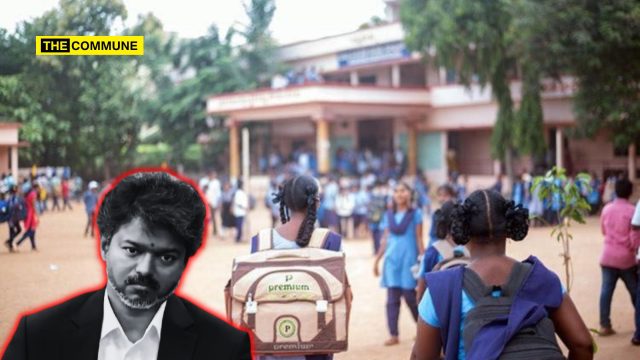
A day after Tamil Nadu Chief Minister C Joseph Vijay declared during his swearing-in speech that he “knew hunger” and came from humble beginnings, journalist and novelist Manu Joseph publicly challenged the narrative, accusing the actor-turned-politician of falsely projecting poverty.

Vijay, who became the first chief minister since 1962 outside the DMK-AIADMK duopoly, had used his inaugural address to position himself as someone who understood deprivation firsthand. Speaking before a massive gathering in Chennai, he said he was not born into privilege or a “royal family,” but was instead the son of an aspiring assistant director who had experienced hardship and hunger.

However, journalist, novelist and screenwriter Manu Joseph, writing in Mint and later posting on X, disputed those claims directly, saying he had studied with Vijay in the third standard at Loyola School and remembered him as a wealthy child from an influential film family.

Joseph described Vijay as someone who stood out among classmates because of his affluence and background. He recalled seeing Vijay at church wearing clothes that appeared “too fancy” for ordinary students and accompanied by a mother who looked “distinguished.” He also wrote that classmates understood Vijay to belong to an important and well-off family.

In his X post, Joseph was even more blunt. He stated that Vijay’s claim about growing up in poverty was “bullshit” because Vijay had studied at Loyola School and came from a filmmaker’s family. Joseph acknowledged that Vijay’s father may have gone through temporary financial struggles, as many in the film industry do, but argued that such phases were not comparable to the kind of structural poverty faced by ordinary Tamil families.

Joseph further wrote that Vijay’s rise in cinema was heavily aided by his privileged starting point. According to him, Vijay’s father, filmmaker SA Chandrasekhar, had already planned and built a path for his son’s film career. He argued that Vijay’s success represented the advantage of a “head-start,” not the story of someone who rose from deep deprivation.

He contrasted Vijay’s background with that of many of their former classmates, whom he described as children from modest and even illiterate households struggling through school without guidance or privilege. Joseph wrote that several classmates succeeded despite severe odds, unlike Vijay, who had access to opportunities unavailable to most aspiring actors.

Joseph’s intervention has drawn attention because it directly attacks one of the core emotional themes of Vijay’s early political messaging that he understands the struggles of ordinary people because he personally lived through them.

Subscribe to our channels on WhatsAppTelegram, Instagram and YouTube to get the best stories of the day delivered to you personally.
“If They’re Fascism, You’re Payasam?”: Case Booked Against Netizens Who Criticized Joseph Vijay’s TVK While His ‘Virtual Warriors’ Abused TN Governor

The Cyber Crime Wing of the Tamil Nadu Police has issued an urgent notice to social media platform X directing the removal and blocking of 18 specific URLs accused of disseminating “unlawful content.”

The notice, dated 8 May 2026, was issued under Section 79(3)(b) of the Information Technology Act, 2000, read with Rule 3(1)(d) of the Information Technology (Intermediary Guidelines and Digital Media Ethics Code) Rules, 2021.

According to the notice, the identified posts contained “provocative and politically sensitive remarks” that authorities claimed were capable of inciting public unrest and disturbing public tranquility.

The Cyber Crime Wing further stated that the posts could encourage unlawful assemblies, adversely affect the maintenance of law and order, and potentially lead to loss of life and damage to public property.

Police also cited alleged violations relating to “decency or morality” and “defamation” categories under the IT Rules.

Sources indicated that many of the X accounts listed in the notice had been posting short videos, memes, and political commentary critical of Tamilaga Vettri Kazhagam (TVK) and its leaders.

In the notice addressed to X Corp’s Safety and Legal Policy division, authorities directed the platform to immediately remove or disable access to the identified URLs and take proactive measures to prevent further dissemination of the content.

The notice warned that failure to act could result in the loss of intermediary liability protections available under Section 79 of the Information Technology Act.

The Cyber Crime Wing also instructed X Corp to suspend or block the identified accounts and submit a compliance report within three hours of receiving the notice, describing the matter as “urgent.”

What Do These Posts Contain?

While most of the posts have been deleted, these posts were critical of a TVK supporter who abused and spoke derogatorily against TN governor Rajendra Arlekar.

The person in the video who seems to be a Sri Lankan Tamil said, “Dear Honorable Tamil Nadu Governor Rajendra Vishwanath Arlekar, this video is for you. If I use any disrespectful word toward you in this video, I am really asking your pardon. Friends, please share this video with all the people of Tamil Nadu – share it with everyone. Hey worthless (poramboke) Rajendra Vishwanath Arlekar dog, are you fit to be Governor? If someone is standing as the leader of the majority party, with 113 seats, you should give him the chance and send him to Parliament form the government. You have no ‘hair’ right to control or block that. Why are you doing this? Hey poramboke dog. You are working after taking money from the BJP, poramboke dog. Hey you, do you know the law on this? Do you remember the S.R. Bommai judgment of 1994? I will teach it to you again ‘mayirandi’, put it in your head. Earlier, Governors used to decide on their own whether a state government had a majority or not, and they would dismiss governments. That had happened in the past. Then, in the case filed by former Karnataka Chief Minister SR Bommai challenging this, the Supreme Court delivered a historic judgment. The main point of that judgment is this: the legislative assembly is the proper arena. Whether a party has a majority or not should not be decided from the Governor’s residence. It must be proved on the floor of the Assembly through a floor test and voting. That is one. Second, the Governor is only a referee. He is only a referee, ‘mayirandi’ on this field. A Governor must function like a neutral umpire, not like the leader of a political party. Third, judicial intervention – if the Governor’s decision is wrong, the court can step in and restore the government. So I am asking you poramboke dog: Hey TVK has 113 seats, right? They have the majority. What does anyone else have? What exactly are you trying to do? Just like Stalin and the others, they create some side issue, start a controversy, wave the TVK towel, create a problem there, create another distraction here, and then say, ‘Look, TVK has stirred trouble here, TVK is roaming around there, how will these people run a party, they have not even come to power yet, how will they govern?’ Then they create cases, divert attention, and use this gap to do their work. Hey poramboke dog, hey Governor pannadai (scumbag), what right do you have to reject the decision taken by the people? I am telling the people of Tamil Nadu today: if you come out onto the roads and fight for your rights, and if someone born somewhere else comes here, this poramboke dog sits as Governor in Tamil Nadu, and says that the decision you made is wrong, will you just stand and watch? Think about it carefully. Why was the previous Governor changed? Why was he replaced? All this is the work of the BJP, done together with the DMK. I am telling you – look at Sri Lanka. However strong the lines and fortifications were, they were broken. Gotabaya’s fort was brought down. That is what happened there. What is this hair Governor then?”

Among the links identified are those of YouTuber Maridhas who had shared the said video and captioned it, “Their mental instability has worsened to the point where they are posting videos abusing the Governor with vulgar language. This should not be allowed to grow further; they must be immediately arrested and suppressed. The one who instigated this is the broker Jagadeesh.”

Another handle condemned the person speaking in the video and wrote, “I strongly condemn the extremely vile and derogatory remarks made against Mr. @lokbhavan_tn, which are fundamentally anti-democratic in nature. I urge the concerned authorities—@tnpoliceoffl, @ECISVEEP, @TNelectionsCEO, and @mygovindia—to take appropriate action.”

Another wrote, “This TVK fellow is speaking disgracefully, calling a Governor a “scoundrel”; he must be arrested.”

It is not clear why these handles were targeted for sharing condemnations against the person in the video. Instead of taking action against the person in the video, the cybercrime has instead targeted civilians calling out the person who is derogating the office of the Governor of our country.

Fascism & Payasam 

In 2024, when actor Joseph Vijay launched his political party, Tamilaga Vettri Kazhagam (TVK), he positioned himself as a critic of the Dravidian establishment and what he described as fear-based politics. Speaking at a massive rally at V. Salai near Vikravandi in Villupuram district, Vijay not only outlined his party’s ideological direction but also sharply indicated who he saw as his political adversaries.

Targeting the DMK and the larger Dravidian political ecosystem indirectly, Vijay said that there is a “crowd” that tries to assign a colour to anyone entering politics.

“There is a crowd here that for sometime has been singing the same paeans. Anybody who comes into the politics is given ‘one particular colour’. They keep fearmongering people and cheat them. But ‘these people’ (indirect reference to DMK) will put underground dealing with ‘them’ (indirect reference to BJP). During elections, they will give statements and give sounds. For them, it’s always ‘fascism’, ‘fascism’, ‘fascism’. Among the people who are united here, they fearmonger by splitting people as majority-minority and keep putting a full-time scene with it. I’m asking you – If ‘they’re fascism’, are you ‘payasam’? You’re no better than them. You call this anti-people government as a ‘Dravida Model’ government and cheating people”, Vijay blasted the DMK.

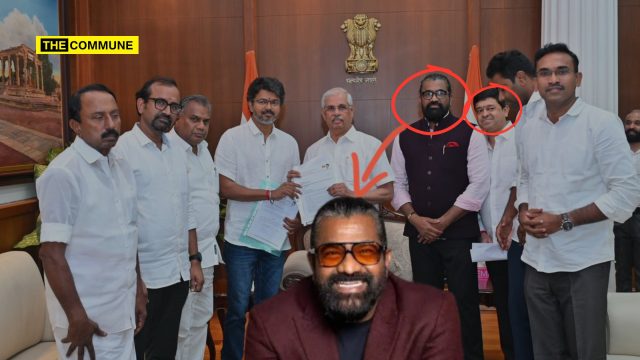
Two years later, in the post-result political climate of 2026, one wonders if the TVK is another form of the DMK that cannot resist any criticism and will use state machinery to target civilians for posting content critical of the party.

Subscribe to our channels on WhatsAppTelegram, Instagram and YouTube to get the best stories of the day delivered to you personally.
DMK Ally IUML Uses Three Languages Other Than Tamil On Official Letterhead While Opposing Three-Language Policy

The Indian Union Muslim League (IUML), a key ally of the DMK-led alliance in Tamil Nadu, came under criticism after an official party document surfaced online showing the organisation’s name displayed in three languages viz English, Hindi and Urdu while Tamil was absent from the top banner.

The document, issued as a press release by IUML national president Prof. KM Kader Mohideen, quickly went viral on social media and triggered debate because the DMK alliance has consistently opposed the Centre’s three-language formula and projected the issue as a defence of Tamil identity.

Former CM Stalin and DMK leaders over the past 5 years have repeatedly declared that the state would never accept the three-language policy, accusing the Union government of attempting Hindi imposition through the National Education Policy.

Against that backdrop, one wonders how an alliance partner opposing the three-language formula could itself officially operate with a three-language masthead featuring English, Hindi and Urdu.

Several social media users accused the alliance of political hypocrisy, arguing that multilingual representation appeared acceptable in practice while being attacked politically during election campaigns and public speeches.

Subscribe to our channels on WhatsAppTelegram, Instagram and YouTube to get the best stories of the day delivered to you personally.