Home Blog Page 556

The Marie Antoinette Of Tamil Nadu’s Stinking Dravidian Model Elitism

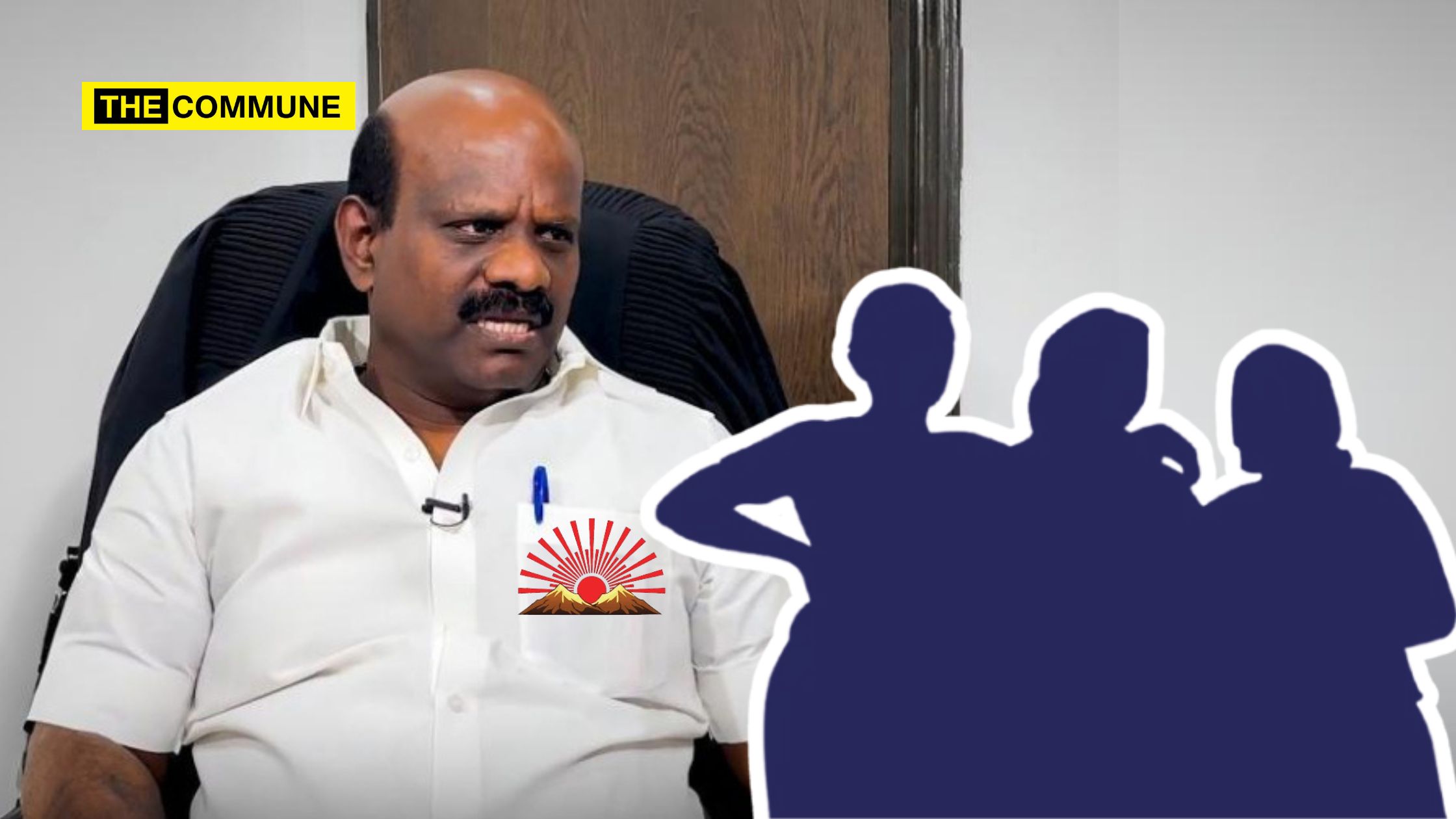
Sumathy—yep, that’s her real name—literally means “good-minded” in Sanskrit. And here’s where the irony goes full circus act: she’s part of a party that foams at the mouth at the very mention of Sanskrit.

Classic DMK—ranting against something while secretly embracing it. Maybe the name change was her first lesson in the art of double standards. But let’s be real—nothing about Thamizhachi Thangapandian’s latest meltdown over an airline seat screams “good-minded.” If anything, it reeks of elite entitlement and a VIP attitude gone rogue.

In a moment that could only be described as the modern-day equivalent of Marie Antoinette wailing about cake, Sumathy alias Thamizhachi threw a royal fit on social media after being downgraded from Business Class to (brace yourself) Premium Economy on an Air India flight. Like a pampered aristocrat forced to step into the bustling streets of 18th-century Paris, she cried foul.

Oh, the horror! The sheer trauma of sitting slightly closer to the masses must have been unbearable. The entitlement dripping from her post is thick enough to smear on a crispy kal dosai. One has to wonder: If the people of South Chennai can navigate flooded streets, pothole-riddled roads, and crumbling infrastructure daily, surely their MP can survive a few hours in a slightly less luxurious seat?

What makes this tantrum even funnier? The fact that she’s demanding luxury travel on the taxpayers’ dime—while those very taxpayers battle real issues she’s too busy to address. Central ministers like Nirmala Sitharaman and Piyush Goyal routinely fly Economy without making a fuss. Maybe Air India was just being practical – downgrading her performance as an MP before she even landed?

The DMK’s hypocrisy is now a running joke. They lecture others on austerity while throwing tantrums over Business Class seating. Dayanidhi Maran grandstands in Parliament about Sanskrit interpretation costs, but his party colleagues expect five-star treatment without a second thought.

While Thamizhachi weeps over her airline seat, South Chennai continues to fall apart. Roads are in shambles, floods are an annual tradition, and the people she supposedly represents are left fending for themselves. But why should Her Highness care? She’s too busy posting angry tweets about airline seating.

Since 2019, her tenure has been a masterclass in neglect, topped with a generous helping of elitist arrogance. The DMK’s mask is slipping, revealing exactly what they are—a privileged dynasty pretending to be the voice of the people. This whole episode sums up the DMK’s true nature—hereditary elites who play the part of revolutionaries while enjoying every privilege of the ruling class.

Our Sanskrit-named Sumathy alias Thamizhachi (oh, the irony!) finds it beneath her dignity to travel like ordinary citizens. What’s next? Demanding an in-flight throne and golden cutlery? The DMK has officially transformed from a political party into a royal court of entitled dynasts.

Their leaders, wrapped in luxury, have become the very aristocracy they once claimed to fight against. Much like Marie Antoinette, Thamizhachi seems completely out of touch with reality. But instead of “Let them eat cake,” she’s practically saying, “Let me fly Business Class!” Maybe it’s time someone reminded her that being an MP isn’t about ruling from above—it’s about actually serving the people. And sometimes, that means sitting among them. Buckle up, Your Majesty. Welcome to the real world.

Subscribe to our channels on Telegram, WhatsApp, and Instagram and get the best stories of the day delivered to you personally.
“If There Are Many Languages, India Will Be One Country; If There Is Only One Language, Many Countries Will Be Born”, NTK Chief Seeman Makes Secessionist Comment On 3-Language Policy

"Sanghi Means Friend, Dravidian Means Thief", Says NTK Co-ordinator Seeman

Naam Tamilar Katchi (NTK) chief coordinator Seeman strongly opposed the imposition of a single language in India, warning that it could lead to the disintegration of the nation.

Addressing a press meeting in Tiruppur, he asserted, “For any nationality, there can only be one policy language – their mother tongues. English can be a connecting language. A language of necessity can be any language – Hindi can be among them. But if you force the language, I am repeating this, you think I am a small boy who is ranting something. Had I been sitting in place of MK Stalin, do you know what will happen? If there are many languages, India will be one country. If there is only one language, many countries will be born. No one can stop this. You have every right to say your mother is beautiful but you have no right to derogate mine. If we wish, we will learn any other language, but we will also learn our language for our race to thrive. If states refuse to accept the New Education Policy, it is a welcome move. But if the central government decides to withhold funds as punishment, that is tyranny and arrogance. That is not right. If you ask the central government where the money comes from, what will they say? What justification do they have?”

Continuing his attack on the Centre, Seeman highlighted Tamil Nadu’s financial contributions to the country and criticized the alleged disparity in resource allocation. “Don’t say you are giving us money. We (the state) is the one giving you money. Before me (TN), Maharashtra gives it. After that, Karnataka gives it. Tamil Nadu is one of the top contributors to the nation’s economy. We generate substantial income from our industries and businesses. We are in the second place when it comes to revenue generation. If you take our money and then tell us that you will not give anything back, how do you justify that?”

Seeman questioned the fairness of the Centre’s revenue distribution model and emphasized Tamil Nadu’s economic significance. He warned that forcing a single language and withholding financial support would fuel discontent, reinforcing his stance that linguistic and economic justice must be upheld to maintain national unity.

Subscribe to our channels on Telegram, WhatsApp, and Instagram and get the best stories of the day delivered to you personally.
Was TMC MP Mahua Moitra’s Voter Suppression Speech In Parliament Tied To US Funding?

The Department of Government Efficiency (DOGE) in the United States recently published a post on X, revealing a list of funding initiatives that were stopped or canceled. Among these, one particular allocation has drawn significant attention in India. According to DOGE’s post, $21 million was specifically allocated for ‘voter turnout’ in India—equivalent to ₹182 crores as per today’s exchange rate.

Now, what is more intriguing is that Trinamool Congress Lok Sabha MP Mahua Moitra had recently spoken about “voter turnout” in parliament. On 13 December 2024, at a Lok Sabha session, she said, “Voter disenfranchisement has reached epic proportions in India. In the past general elections as well as in the recent by-polls in many BJP-ruled states, there were widespread documented – caught on television cameras, caught on mobile phones – instances of voter suppression from names missing on electoral rolls, by police used to threaten, beat and intimidate voters. We saw it in Rampur, we saw it in Sambal, entire localities were being forced to stay home. Another aspect is the largely targeted exclusion of a hated minority by a prejudiced majoritarian state.”


Another important point that has come to light is that Moitra was the recipient of the East Asia Security Fellowship offered by the US State Department earlier.


It is noteworthy that in 2023 Moitra was expelled from the Lok Sabha after the Ethics Committee found her guilty of unethical conduct and contempt of the House. BJP MP Nishikant Dubey accused her of accepting bribes from businessman Darshan Hiranandani to ask parliamentary questions favoring his business over rivals like Adani Group.

The committee’s report, adopted by a 6-4 majority, alleged that Moitra shared her login credentials with Hiranandani, compromising national security. It claimed 50 of her 61 questions benefited his business. The panel urged a legal probe into her alleged financial misconduct, citing a lack of technical expertise to track the money trail. Moitra denied the accusations, calling them lies fueled by a “jilted ex” and dismissing the inquiry as a “kangaroo court.”

She also accused the committee of conducting a biased and humiliating hearing. Despite her objections, the Lok Sabha passed a motion to expel her, paving the way for a further government investigation.

Subscribe to our channels on Telegram, WhatsApp, and Instagram and get the best stories of the day delivered to you personally.
USAID, CEPPS, And IFES: Unraveling The Web Of Foreign Electoral Funding In India

The Department of Government Efficiency (DOGE) in the United States recently published a post on X, revealing a list of funding initiatives that were stopped or canceled. Among these, one particular allocation has drawn significant attention in India. According to DOGE’s post, $486 million was given to the Consortium for Elections and Political Process Strengthening (CEPPS), with $21 million specifically allocated for ‘voter turnout’ in India—equivalent to ₹182 crores as per today’s exchange rate.

What Is CEPPS?

Established in 1995, CEPPS describes itself as a coalition of nonprofit, nonpartisan, and nongovernmental organizations dedicated to promoting democratic institutions and governance worldwide. According to its now defunct “About Us” page, the organization is composed of three leading international groups: the International Foundation for Electoral Systems (IFES), the International Republican Institute (IRI), and the National Democratic Institute (NDI). These entities serve as operational fronts for CEPPS in different countries.
CEPPS claims to support democratic development by collaborating with political parties, election management bodies, parliaments, civil society organizations, and democracy activists. It has reportedly operated in over 140 countries, delivering extensive democracy, rights, and governance (DRG) programming. CEPPS primarily works with USAID and other international donors, securing large-scale funding for its initiatives.

Notably, CEPPS has received over $2 billion in funding from USAID since its inception. However, in a curious development, CEPPS’s official website became nonfunctional after 23 January 2025. The last known archive of its website was recorded on archive.org on that date, raising questions about the organization’s sudden disappearance from public access.

CEPPS’s Role In Election Interference

A document titled Review of the Fiscal Year 2024 United States Agency for International Development Budget, dated 26 April 2023, explicitly states that USAID has provided $2 billion to CEPPS for its Elections and Political Processes (EPP) programs. In the 2021 financial year alone, CEPPS received 66% of USAID’s EPP funding.

While CEPPS presents itself as a promoter of democracy, a deeper look at the documents suggests that it plays a far more active role in influencing elections worldwide. CEPPS does not just assist election commissions; it actively engages with political parties, civil society groups, and election monitoring bodies. This raises concerns about potential foreign interference in elections under the guise of democracy promotion.

The Democratic Elections and Political Processes (DEPP) program, through which CEPPS operates, appears structured to provide funding and support to selected political groups, potentially tilting election outcomes in their favor. A 2019 USAID Inspector General report even warned that relying on a single entity like CEPPS for political party assistance exposes USAID to significant risks, including credibility loss and allegations of election interference. Despite this, CEPPS continued receiving a dominant share of USAID’s election-related funding, securing 66% of its budget in 2021.

CEPPS In India

CEPPS operates through its three constituent organizations—IFES, IRI, and NDI. According to audit reports, CEPPS allocated $318,614 for its activities in India in FY 2018, with funding funneled through IFES.

Image Source: OpIndia

A key development in CEPPS’s engagement with India occurred in May 2012, when the Election Commission of India (ECI) signed a Memorandum of Understanding (MoU) with IFES in New Delhi. The agreement was signed by then-Chief Election Commissioner SY Quraishi and IFES President and CEO William Sweeney. The MoU aimed to facilitate knowledge exchange, joint training programs, research, and capacity-building initiatives via the India International Institute of Democracy and Election Management (IIIDEM), an ECI-established body.

Image Source: OpIndia

While IFES is officially funded by USAID, it also receives financial support from various private entities. A review of IFES’s “Our Partners & Donors” section reveals that its funding sources include USAID, the U.S. Department of State, Australian Aid, and the Election Commission of India itself. However, a more concerning revelation is IFES’s backing from corporate and private donors, including Google, Meta, Microsoft, and Open Society Foundations (OSF)—the latter being owned by billionaire George Soros, who has been accused of funding anti-India activities.

Image Source: OpIndia

The involvement of an organization linked to Soros in India’s electoral processes has raised serious concerns about the extent of foreign influence over Indian elections. Given its financial backing from both public and private entities with potentially conflicting interests, IFES’s real role and motives in India warrant closer scrutiny.

The Election Commission of India’s partnership with IFES did not end with the 2012 MoU. The collaboration has persisted through IIIDEM and International IDEA, a global intergovernmental organization. While the Indian government is not directly engaging with IFES, ECI’s independent dealings with IIIDEM suggest that foreign-backed electoral collaborations continue to exist.

(With inputs from OpIndia)

Subscribe to our channels on Telegram, WhatsApp, and Instagram and get the best stories of the day delivered to you personally.
New FASTag Rules Aiming To ‘Streamline’ Toll Payments May Cause Chaos: Extra Penalties For Low Balance/Blacklisted Tags, No On-Spot Recharges

New FASTag rules, imposing extra penalties on users with low balance, delayed payments or blacklisted tags, will come into force from Monday (17 February 2025).

The National Payments Corporation of India (NPCI) and the Ministry of Road Transport and Highways have issued some key changes to the FASTag ecosystem, aiming to streamline toll payments, reduce disputes and curb frauds.

Starting February 17, new FASTag rules will affect users who delay payments or have blacklisted tags.

If a FASTag has been inactive for more than 60 minutes before the vehicle crosses the toll and remains inactive up to 10 minutes after passing, the transaction will be declined.

The system will reject such payments with “error code 176”. This rule is set to be implemented from February 17.

Apart from this, there are also changes in terms of the Chargeback process and cooling period as well as transaction rejection rules to streamline toll payments and reduce disputes.

According to new guidelines, FASTag users may incur additional charges if their toll transactions are processed beyond 15 minutes from the time the vehicle passes the toll reader.

According to updated National Electronic Toll Collection (NETC) guidelines, if a transaction is delayed and the user’s FASTag account has insufficient balance, the toll operator will be held responsible.

However, if the amount is deducted, users can dispute the charge, but only after a mandatory 15-day cooling period. Users can ensure sufficient balance in the FASTag wallet before travelling, monitor transaction times to check for delays in deduction, and stay informed about FASTag status to prevent rejections due to inactivity.

As per the NPCI circular published on January 28, the FASTag balance validation will follow a stricter schedule. Previously, users could recharge their FASTag at the toll booth and still pass through. Because of this, users must verify their FASTag status well in advance.

According to latest NPCI data, FASTag transactions grew by 6 per cent in December last year to 382 million, against 359 million in November. The value also increased by 9 per cent to Rs 6,642 crore in December against Rs 6,070 crore in November.

So, to put it in a nutshell:

a) Blacklisted FASTags: If a FASTag is blacklisted when the vehicle arrives at a toll booth, the toll payment will not be processed. Additionally, payments will be declined if the tag was blacklisted at least 10 minutes before being scanned.

b) Grace Period: Users will have a 70-minute window to resolve their FASTag status before passing through toll plazas.

c) Impact of Blacklisting: Vehicles with a blacklisted FASTag at the toll will be required to pay double the toll fee. However, if the tag is recharged within 10 minutes of scanning, users can apply for a penalty refund.

d) Transaction Delays: If a toll payment is processed more than 15 minutes after a vehicle crosses the toll reader, users may be subject to additional charges.

e) Chargeback Policy: Banks can initiate chargeback claims for incorrect deductions due to blacklisted or insufficient balance FASTags only after a mandatory 15-day cooling period.

The new FASTag rules could create confusion, especially among users who are not fully aware of the changes. Here’s why:

  1. Strict Inactivity Rule – If a FASTag remains inactive for over an hour before crossing a toll and up to 10 minutes after, the transaction will be declined. Many users might not realize this and face unnecessary toll refusals.

  2. New Penalties & Delays – Additional charges for delayed transactions (beyond 15 minutes) might frustrate users, especially if delays are due to technical issues rather than their fault.

  3. Cooling Period for Disputes – Users must wait 15 days before raising a dispute if an incorrect amount is deducted. This could lead to dissatisfaction, as they have to wait to resolve issues.

  4. No Last-Minute Recharges – Previously, users could recharge at the toll booth itself, but now, balance validation is stricter. Those unaware of this might get stuck at toll gates.

  5. Error Codes & Rejections – The introduction of error codes like “176” for declined transactions adds another layer of complexity that could confuse non-tech-savvy users.

While these rules aim to improve efficiency and reduce fraud, poor communication and lack of awareness could lead to frustration among users. A strong awareness campaign is needed to prevent chaos at toll booths starting February 17.

Subscribe to our channels on TelegramWhatsApp, and Instagram and get the best stories of the day delivered to you personally.

Congress Moves Adjournment Motion After Guardian Report On Adani Project

Congress MP Manickam Tagore has moved a motion for the adjournment of the Business of the House in the Lok Sabha to discuss the relaxation of national security protocols for the Khavda Renewable Energy Project in Gujarat, located near the India-Pakistan border. The move has triggered a heated political debate, with allegations of cronyism and foreign influence surfacing in the discourse.
Tagore, in his notice, raised concerns about the location of the project, stating, “The Khavda Renewable Energy Park Project, led by the Adani Group, is situated just one kilometre from the sensitive India-Pakistan border in the Rann of Kutch, a region with a history of conflicts between the two nations.”

The Congress leader further accused the Modi government of overriding military concerns to push the project forward. “The government went so far as to create exceptions for this project, and potentially others, near India’s borders with Pakistan, China, Nepal, Myanmar, and Bangladesh. This is a direct assault on the integrity of military advice and national security protocols. The Modi government’s cronyism, with its clear favouritism toward the Adani Group, is a threat to the sovereignty of our nation. The decision to award such a high-risk project to Adani raises severe concerns about conflicts of interest and transparency in governance,” he said.

While the Congress party’s allegations are not new—having long accused the BJP government of neglecting India’s military interests—the timing of this particular motion has raised eyebrows. Critics argue that the move appears to be influenced by a foreign narrative, especially given that it comes just a day after British news portal The Guardian published an article making similar claims against the project.

Foreign Influence Allegations

The Guardian’s article, titled “Tycoon profited after India relaxed border security rules for energy park,” was authored by Hannah Ellis Petersen and Ravi Nair. The report alleged that Adani Group benefitted from the relaxation of security protocols, citing a US attorney’s case against the conglomerate. However, critics of the article pointed out that the attorney’s case was politically motivated and flimsy, raising concerns about a targeted smear campaign against India’s largest energy conglomerate.

Image Source: OpIndia

Petersen has previously been accused of anti-India and anti-Hindu activism under the guise of journalism, while Ravi Nair is linked to the Organized Crime and Corruption Reporting Project (OCCRP), a Left-leaning organization funded by George Soros and USAID, which has frequently targeted Adani and major Indian infrastructure projects.

The article, while raising concerns about security protocol amendments, failed to substantiate why such changes would pose a significant risk. Critics argue that amending regulations to facilitate infrastructure projects is a sovereign decision, especially in a barren, sparsely populated desert region like the Rann of Kutch.

Strategic Importance Of Khavda Project

The Gujarat government, in coordination with the central government and the Ministry of Defence, cleared the Khavda Renewable Energy Project, which aims to produce 30 gigawatts of clean energy. This project, once operational, is expected to power millions of homes, including supplying electricity to Google’s cloud services in India. When fully developed, the plant is projected to generate 81 billion units of clean energy annually, powering 16 million households—more than the total number of homes in Poland and Canada. Additionally, it is expected to create over 15,200 ‘green’ jobs.

Critics of Congress argue that the development of border areas is crucial for national security. Historically, India’s border regions have been left underdeveloped, making them vulnerable to security threats. Infrastructure projects like the Khavda energy park contribute to improved connectivity, economic opportunities, and a stronger military presence in these regions.

Defence analysts suggest that a high-profile energy plant supplying power to millions of households and global companies like Google would naturally be equipped with state-of-the-art security systems. “Leaving border areas barren and undeveloped is a strategic mistake,” one expert noted. “A thriving border region with roads, connectivity, and surveillance infrastructure strengthens national security, not weakens it.”

Congress And Its History Of Parliamentary Disruptions

The adjournment motion over the Khavda project has also reignited criticism of the Congress party’s tendency to disrupt parliamentary proceedings based on foreign media reports. Earlier, Prime Minister Narendra Modi had remarked that this Budget Session would be the first in years not triggered by a ‘foreign spark’—a reference to Congress’s pattern of picking issues championed by Western media outlets and creating political turmoil in Parliament.

In recent years, Congress has seized upon various foreign-origin controversies, including Pegasus, Rafale, and Hindenburg reports, to attack the Modi government. Critics argue that the party continues to ignore pressing domestic issues while engaging in political theatrics to align with narratives pushed by Western media and organizations.

As the political battle over the Khavda Renewable Energy Project unfolds, it remains to be seen whether Congress’s motion will gain traction or be dismissed as another attempt to stall parliamentary proceedings. Meanwhile, the government is expected to defend the project as a critical step toward India’s energy security and strategic border development.

(With inputs from OpIndia)

Subscribe to our channels on Telegram, WhatsApp, and Instagram and get the best stories of the day delivered to you personally.
‘Why One Rule For Hindus, Another For Muslims?’ Hindu Munnani Slams DMK Govt Over Permitting Muslims To Distribute Food During Thai Poosam While Restricting Hindus

The Hindu Munnani has called out the perceived bias of the DMK government for allowing Muslims to distribute food and other items to devotees on the Padha Yatra to Murugan temples during the ‘Thai Poosam’ festival, while imposing strict regulations on Hindus by requiring them to obtain food standard and quality certificates.

For years, it has been a longstanding tradition for Hindus to offer ‘Annadhanams’ to devotees undertaking the foot pilgrimage to Murugan temples, showing their devotion, often through fasting or wearing malas. Many Hindus devote their time and resources during the season to serve the pilgrims, believing that serving devotees is equivalent to serving the divine. However, this year, the DMK government banned such practices, citing food quality control, despite no reports of food-related issues or complaints. Meanwhile, reports surfaced that Muslims were allowed to distribute water, buttermilk, and medicines to the same devotees, sparking accusations of political stunt.

In response, Hindu Munnani questioned the DMK government and HR&CE Minister PK Sekar Babu through their official account, saying, “Why are only Hindus banned from providing food to Murugan devotees, while Muslims are allowed to distribute medicines, tablets, and food items? It is reported that Muslims have provided water, buttermilk, and medicines to those on the foot pilgrimage to Palani. The Tamil Nadu government has banned the longstanding practice of providing Annadhanam to devotees during the Karthigai Deepam festival in Tiruvannamalai and now requires a Food Control Quality Certificate from the government to provide Annadhanam to Murugan devotees at Thaipusam in Palani. Failure to comply will result in a fine. Has the Indian Medical Council or the Food Standards Agency approved the distribution of medicine, tablets, water, buttermilk, and food to devotees at Thaipusam? No right! Has the Tamil Nadu government given special permission to Muslims? Is it one form of justice for Hindus and another for Muslims? Tell me Hindu Religious and Charitable Endowments Department Minister Sekar Babu…”

Subscribe to our channels on TelegramWhatsApp, and Instagram and get the best stories of the day delivered to you personally.

Former US Official Alleges US Interference In India’s 2019 Elections And Bangladesh’s Politics Through Media, Tech, And Funding

Former US State Department official Mike Benz has alleged that the United States actively interfered in the domestic politics of multiple nations, including India and Bangladesh, through media influence, social media censorship, and funding of opposition movements. According to Benz, US-backed agencies have used democracy promotion as a cover to influence elections, destabilize governments, and align foreign administrations with Washington’s strategic interests.

Allegations Of US Interference In India’s 2019 General Elections

Benz claims that elements within the US foreign policy establishment, including USAID, think tanks, and major technology companies, manipulated online discourse to influence India’s 2019 general elections against Prime Minister Narendra Modi and the BJP. He asserts that these groups collaborated to shape the election narrative by promoting the idea that Modi’s political success was driven by misinformation, creating the basis for widespread censorship.

According to Benz, US-backed entities framed Modi’s supporters as purveyors of fake news to justify intervention in India’s digital space. He alleges that multiple organizations, including those linked to USAID, worked with major international media outlets and digital forensics groups to produce reports portraying India as facing a severe misinformation crisis. This, he argues, provided the pretext for restricting pro-Modi narratives on social media.

Benz further claims that the US State Department exerted influence on major tech companies such as Facebook, WhatsApp, YouTube, and Twitter to curb pro-Modi content. He points specifically to WhatsApp’s decision in January 2019 to limit message forwarding in India as a deliberate move to curb the BJP’s voter outreach efforts, as the party heavily relied on the platform for mobilization.

He also alleges that USAID and US-linked think tanks played an active role by funding counter-misinformation programs designed to suppress nationalist movements like the BJP. According to Benz, organizations such as the Atlantic Council and the Global Engagement Center pushed for greater content moderation under the pretext of tackling misinformation while targeting pro-Modi messaging.

Furthermore, Benz suggests that anti-Modi efforts within the US government were led by factions within the State Department operating independently of the Trump administration. Despite Trump’s strong relations with Modi, he claims that entrenched bureaucratic elements overseeing cyber policies coordinated censorship efforts with Big Tech, advising social media platforms on content moderation strategies that sought to weaken nationalist political movements globally, with Modi’s BJP being a major target.

While Benz does not confirm direct coordination between US-backed entities and Indian political groups, he asserts that many counter-misinformation initiatives within India were likely funded by USAID or other US foreign policy arms. He suggests these organizations received financial and strategic backing to counter BJP’s digital outreach, influencing political discourse ahead of the elections.

Allegations Of US Destabilization Efforts In Bangladesh

Beyond India, Benz claims that the US also sought to influence Bangladesh’s political landscape, particularly by attempting to weaken Prime Minister Sheikh Hasina’s government. He suggests that Washington viewed Bangladesh’s growing economic and strategic partnership with China as a challenge to US regional influence.

Citing leaked documents, Benz alleges that US-funded organizations such as the National Endowment for Democracy (NED) and its affiliates devised plans to destabilize Bangladesh’s political situation. These strategies allegedly included recruiting activists, mobilizing minority groups, and leveraging cultural and ethnic tensions to create societal divisions.

One of Benz’s more unusual claims is that US taxpayer money was used to fund Bangladeshi rap music aimed at promoting anti-government sentiment. He suggests that these songs were strategically targeted at students and youth activists to encourage mass protests.

Benz argues that these actions align with previous US-backed movements in other countries, where soft power tactics, media influence, and funding of civil society groups have been used to create conditions conducive to political change.

Who Is Mike Benz?

Benz is a former US State Department official who served as Deputy Assistant Secretary for International Communications and Information Technology from 2020 to 2021. In this role, he was responsible for shaping US cyber policies and working closely with Big Tech companies. Before his government service, he worked as a White House speechwriter for President Donald Trump and practiced business law.

After leaving government service, Benz founded the Foundation for Freedom Online (FFO), a nonprofit dedicated to exposing digital censorship and the manipulation of online narratives by governments and corporations. Through his work with FFO, he began investigating USAID, the National Endowment for Democracy (NED), and other US-backed agencies accused of influencing political systems abroad. His research, based on leaked documents and insider knowledge, has positioned him as a whistleblower on how these entities allegedly engage in covert influence operations worldwide.

Broader US Influence In Other Nations

Benz situates these actions within a broader pattern of US influence operations worldwide. He claims that similar tactics have been used in countries where Washington sought to install or maintain governments aligned with its foreign policy objectives. He points to US involvement in Ukraine’s political upheaval, support for opposition leaders in Venezuela, and interventions in the Middle East and North Africa as examples.

According to Benz, these efforts typically involve a combination of media narratives, digital censorship, financial support for opposition groups, and diplomatic pressure. He suggests these actions are often justified under the guise of democracy promotion but ultimately serve strategic interests such as countering China’s influence, securing military footholds, or ensuring economic access.

Claims Of Independent Factions Operating Within US Foreign Policy

One of Benz’s key assertions is that these operations are frequently carried out by factions within the US foreign policy establishment that operate independently of the elected government. He alleges that Trump had little control over rank-and-file officials in the State Department, many of whom pursued policies contradicting his administration’s stance.

He suggests that these factions use a network of think tanks, media partnerships, and social media platforms to execute their strategies, sometimes without direct oversight from political leadership. According to Benz, this explains why efforts against Modi and Hasina were pursued even when Trump maintained good relations with both leaders.

If Benz’s allegations are accurate, they point to a pattern of US foreign policy that prioritizes strategic interests over the sovereignty of other nations. The claims suggest that under the banners of democracy promotion and misinformation control, the US may be influencing elections, destabilizing governments, and pushing for regime change when leadership does not align with Washington’s goals.

(With inputs from Times of India)

Subscribe to our channels on Telegram, WhatsApp, and Instagram and get the best stories of the day delivered to you personally.
What The Dravidian Stocks Won’t Tell You About Tamil Nadu Being Cradle Of Iron Age

The recent declaration by Tamil Nadu Chief Minister M.K. Stalin that the Iron Age began in the region has sparked controversy, not for its supposed groundbreaking discovery, but for its glaring lack of scientific rigor. Chief Minister M.K. Stalin’s announcement, which was widely publicized through a state-sponsored book titled Antiquity of Iron—Recent Radiometric Findings from Tamil Nadu, is now facing scrutiny.

As highlighted by renowned writer P.A. Krishnan in his Outlook article, this claim appears more rooted in political posturing than in archaeological credibility. Let’s take a look at what Dravidianists won’t tell you about TN being the ‘cradle of Iron Age’.

Iron Age: A Global Perspective

The Iron Age is traditionally understood as the period when iron replaced bronze for tools and weapons, triggering significant advancements in agriculture, urbanization, and warfare. The earliest evidence of ironworking dates back to around 1200 BCE in the Middle East and Europe, and around 600 BCE in China. However, evidence suggests that smelting and limited use of iron predate these eras in various parts of the world. For instance, as published in Science in 2009, researchers have identified iron smelting in Africa as early as 3600 BCE, though these findings remain contested within the academic community.

Flawed Methodology and Unreliable Findings

In Tamil Nadu, the government-backed book Antiquity of Iron—Recent Radiometric Findings from Tamil Nadu presents findings from sites such as Mangadu and Thelunganur, where iron objects were reportedly discovered. However, these sites were disturbed, compromising their stratigraphic integrity. The dating of these artifacts is unreliable, with one sample yielding an absurdly wide range—from 2900 BCE for the hilt to 1435 BCE for the blade of the same sword. Such inconsistencies alone should invite skepticism from any serious archaeologist.

The Case of Sivagalai: Extrapolating Beyond Evidence

The Sivagalai site, which forms the basis of the government’s claim, presents even greater inconsistencies. A paddy sample from a burial urn was dated to 1155 BCE, while a nearby charcoal bit was dated to 3259 BCE, and a ceramic piece to 2427 BCE. The Tamil Nadu government has cherry-picked the oldest available date and extrapolated it onto iron objects found in the same trench, which measures merely 10m x 10m. Such dating methods would not be accepted by any reputable archaeological journal without rigorous scrutiny.

Furthermore, no iron furnaces or smelting sites were discovered in Sivagalai. The earliest known furnace in Tamil Nadu, found in Kodumanal, dates only to the 5th century BCE. Without evidence of large-scale iron production, the assertion that Tamil Nadu pioneered the Iron Age is premature and misleading.

The Absence of Supporting Evidence

If Tamil Nadu had truly mastered iron technology 5,000 years ago, it should have led to significant societal and infrastructural changes. However, there is no evidence of advanced urban centers, large-scale agriculture, or iron furnaces from this period. The earliest known iron furnace in Tamil Nadu, discovered in Kodumanal, dates only to the 5th century BCE, centuries after the supposed Iron Age claimed by the government.

The Unanswered Questions

A few critical questions remain unanswered:

  • If Tamil Nadu was the cradle of the Iron Age, why are there no major cities or large-scale constructions predating the Common Era?
  • Why is there no evidence of significant agricultural advancements linked to early iron use in Tamil Nadu?
  • Why have no iron furnaces from 3000 BCE been discovered in Tamil Nadu?
  • Why were these findings not published in an international peer-reviewed journal?

Science or Political Mythmaking?

The assertion that Tamil Nadu is the ‘cradle of the Iron Age’ follows a pattern of politicized historical narratives aimed at cultural identity reinforcement. As Krishnan notes, genuine archaeological findings are typically published in peer-reviewed journals, not in government-funded books designed for political messaging.

Such claims not only distort history but also undermine genuine scientific efforts. Instead of rushing to make grand declarations based on unreliable data, the Tamil Nadu government should encourage rigorous academic research without political interference. Otherwise, it risks turning archaeology into a tool for jingoism rather than a pursuit of truth.

When ideology overshadows evidence, science suffers. Tamil Nadu’s claim to the Iron Age throne may serve a political purpose, but it holds little weight in the realm of genuine archaeological scholarship.

(With inputs from Outlook)

Subscribe to our channels on Telegram, WhatsApp, and Instagram and get the best stories of the day delivered to you personally.
Sivachariyars Protest After HR&CE Officer Allegedly Insults Tiruvannmalai Arunachaleswarar Temple Head Priest

A protest broke out at the Tiruvannamalai Arunachaleshwarar Temple after the Joint Commissioner of the Hindu Religious and Charitable Endowments (HR&CE) Department allegedly verbally abused the head priest for permitting VIP darshans, sparking controversy among the temple staff and devotees.

The Tiruvannamalai Arunachaleshwarar Temple, a popular pilgrimage site in South India, attracts thousands of devotees daily, with large crowds during weekends, holidays, Amavasya, and full moon days. On 12 February 2025 (Thai Pournami), lakhs of devotees waited for over five hours to get a glimpse of Lord Annamalaiyar before heading to Girivalam.

Amidst the large crowd, HR&CE Joint Commissioner Jyothi allegedly verbally insulted P.T. Ramesh, the hereditary chief priest, by asking, “Are you working as a broker here?” This remark, made in reference to allowing VIP darshan as per the HR&CE temple procedures, was considered a derogatory insult, as the term used in Tamil indirectly implies a “pimp.”

The insulted chief priest, feeling disrespected, halted all temple rituals, prompting the Shivacharyas to gather in protest in front of the temple’s Yaga-shala. On special occasions with large crowds, it is the responsibility of the HR&CE department and the police to maintain order, not the priests. However, the Joint Commissioner’s abusive remark was directed at the priest, leading to the tense situation.

In response, temple staff and police held discussions with the temple trustees for over an hour to resolve the issue and pacify the protesting Shivacharyas. The priests expressed their anger, stating, “If this is happening to the chief priests, what will happen to the ordinary priests? We are not interfering with the administration of the Joint Commissioner, we are only asking for our rights.” They further asserted that the large crowds were a result of the pujas they performed.

After the talks, the temple trustees assured the Shivacharyas that they would be provided with the necessary information and responses, and agreed to continue the pujas for the time being. The Shivacharyas then temporarily ended their protest.

(With inputs from Tamil Mani)

Subscribe to our channels on TelegramWhatsApp, and Instagram and get the best stories of the day delivered to you personally.