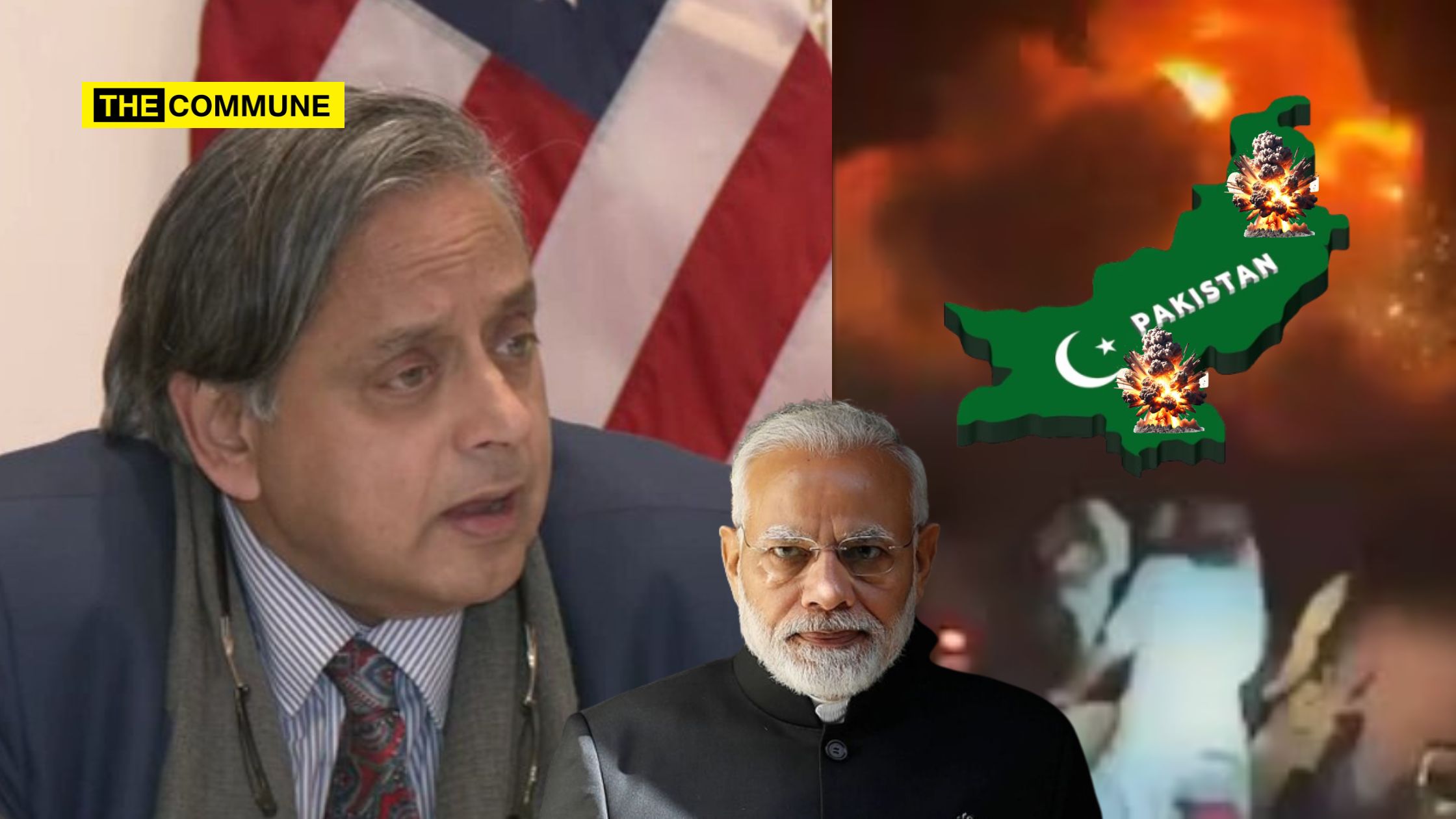
Congress MP Shashi Tharoor, heading a parliamentary team as part of the Operation Sindoor diplomatic outreach, commended India’s recent strikes on terror camps in Pakistan and Pakistan-occupied Kashmir (PoK), describing the action as both forceful and strategic.
Speaking at an event at the Indian Consulate in New York, Tharoor remarked, “As someone from the opposition, not the government, I had previously argued for a strong yet measured response. I’m glad to see India took exactly that approach.”
He noted that the strikes on May 7 were “carefully targeted and precise,” hitting nine identified terrorist sites, including operational bases and launchpads in Pakistan and PoK.
Tharoor emphasized the need for a “new threshold” in India’s approach to Pakistan, highlighting past diplomatic efforts that had yielded little due to Pakistan’s continued denial and inaction. “There have been no real convictions or dismantling of terror infrastructure,” he said. “When there are persistent safe havens, retaliation becomes inevitable.”
He asserted that India’s recent action demonstrated its capability to respond with accuracy, while underlining that India has no interest in conflict. “We do not want war. Our focus is on economic growth and preparing our people for the 21st century,” he added.
Tharoor criticized Pakistan for not respecting the status quo and seeking Indian territory through non-conventional methods. “Terrorism cannot be an acceptable tool to achieve political aims,” he stated.
The parliamentary delegation led by Tharoor is scheduled to visit five countries — the United States, Panama, Guyana, Brazil, and Colombia — and includes MPs from various parties, including the BJP, LJP (Ram Vilas), TDP, Shiv Sena, and JMM, along with former Indian Ambassador to the US, Taranjit Singh Sandhu.
Subscribe to our channels on Telegram, WhatsApp, and Instagram and get the best stories of the day delivered to you personally.
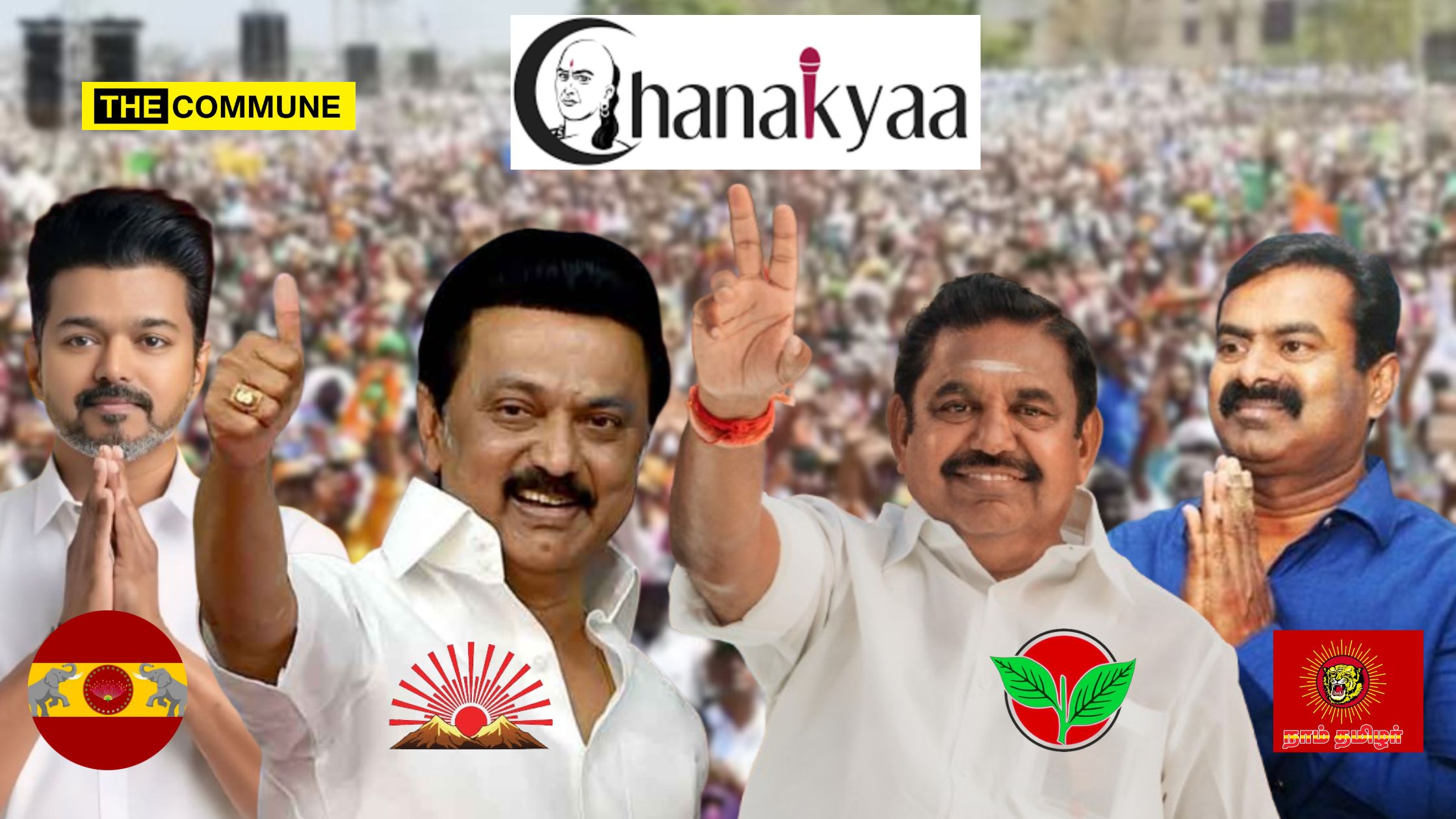
With just 11 months remaining for the 2026 Tamil Nadu Assembly elections, a recent opinion poll conducted by veteran journalist Rangaraj Pandey through his Chanakyaa Tv has offered key insights into the current political climate across the state. The survey, which covered 40 major legislative constituencies between April and May, indicates a potential shift in voter sentiment and suggests a highly competitive four-way contest on the horizon.
The poll reveals that the ruling DMK is facing growing anti-incumbency, with its popularity appearing to decline compared to the last election cycle. Meanwhile, the opposition AIADMK seems to be regaining strength and emerging as a primary contender. Interestingly, Seeman’s Naam Tamilar Katchi (NTK) has maintained its voter base, and actor-turned-politician Vijay continues to enjoy significant trust among the public.
According to Rangaraj Pandey, the survey was conducted independently, without external influence or the involvement of third-party agencies. A total of 3,065 respondents from across forty various constituencies—including Chengalpattu, Nagapattinam, T.Nagar, Madurai West, Salem and others—shared their views.
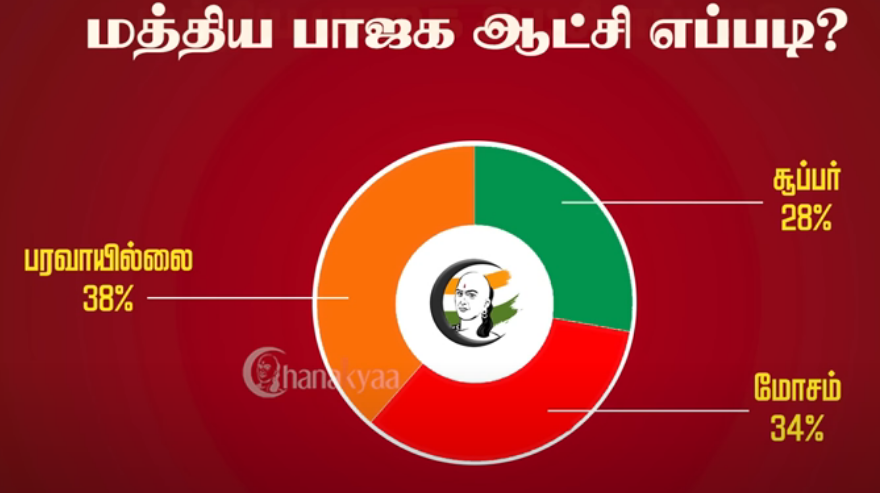
Performance Of The BJP-led Central Government:
28% rated it as good
38% felt it was average
34% as poor
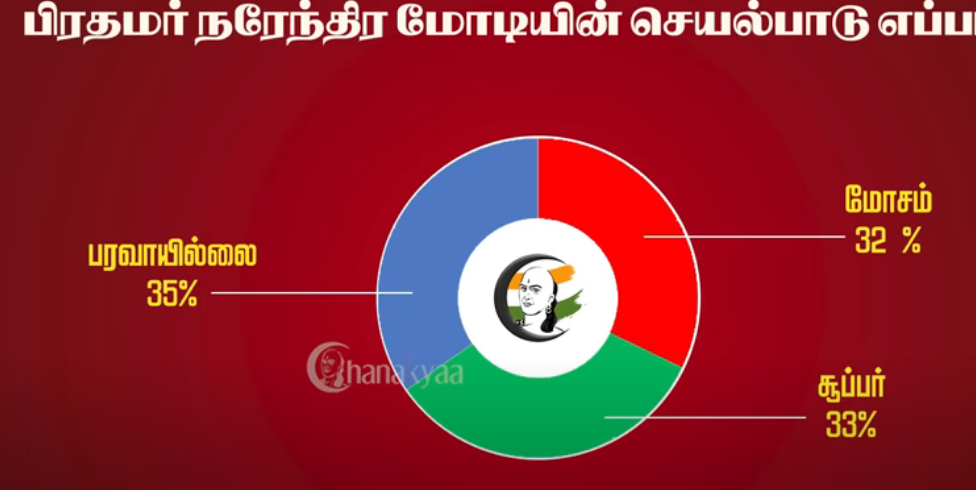
Regarding The Performance Of Prime Minister Narendra Modi:
33% rated it as excellent
35% said it was alright
32% considered it poor
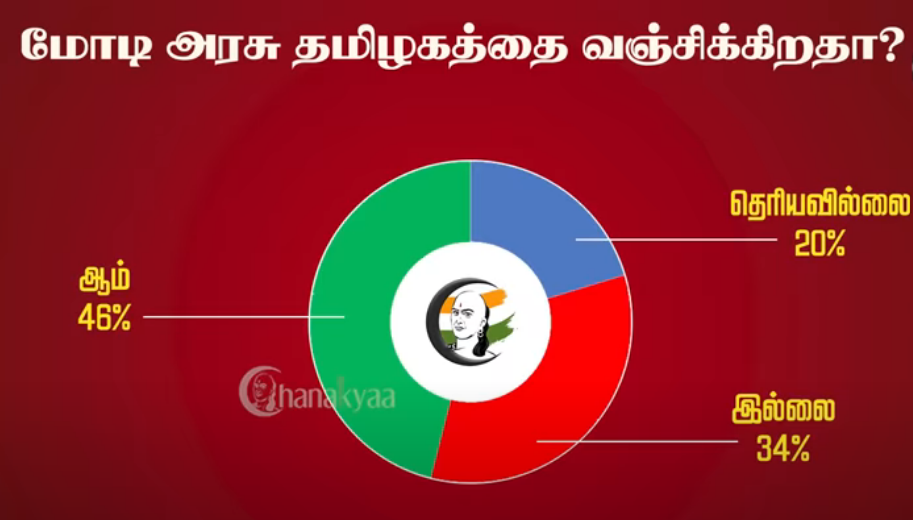
Regarding The Modi Government’s Approach Towards Tamil Nadu,
46% felt the state was being betrayed
34% disagreed
20% were unsure
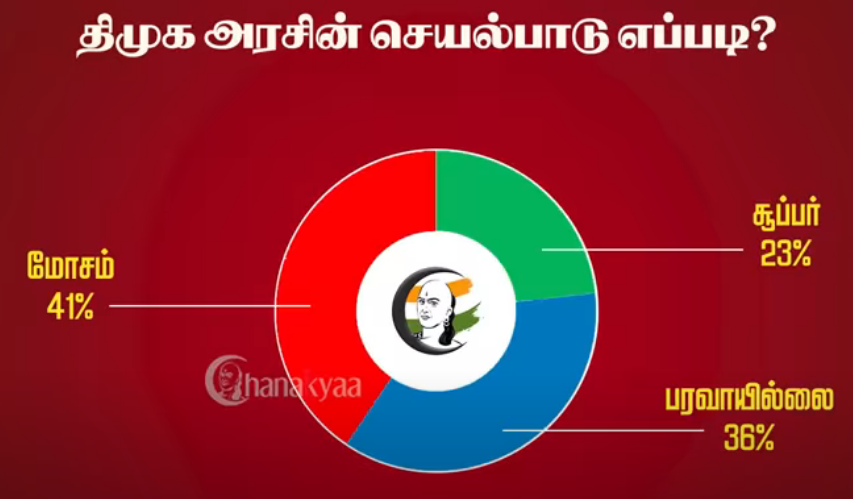
DMK Government’s Performance:
23% rated it as excellent
36% said it was average
41% considered it poor
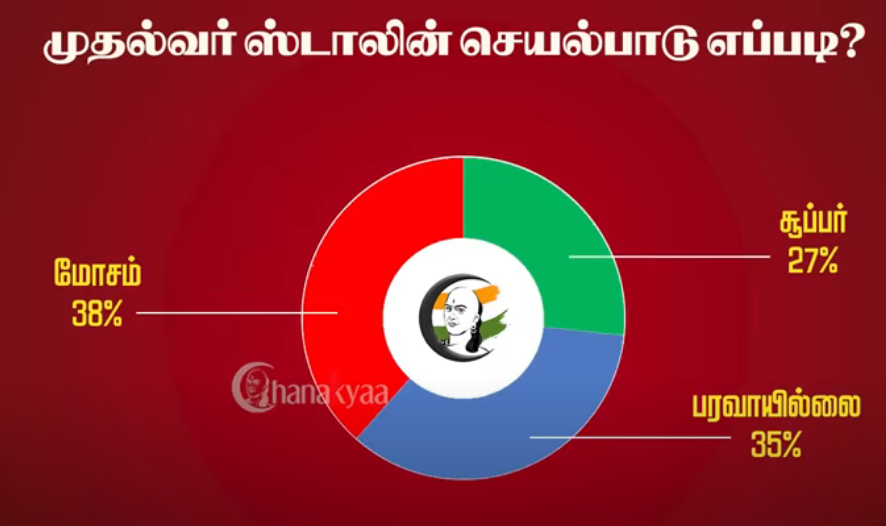
Evaluating Chief Minister M.K. Stalin:
27% said his leadership was excellent
35% called it average
38% rated it as poor
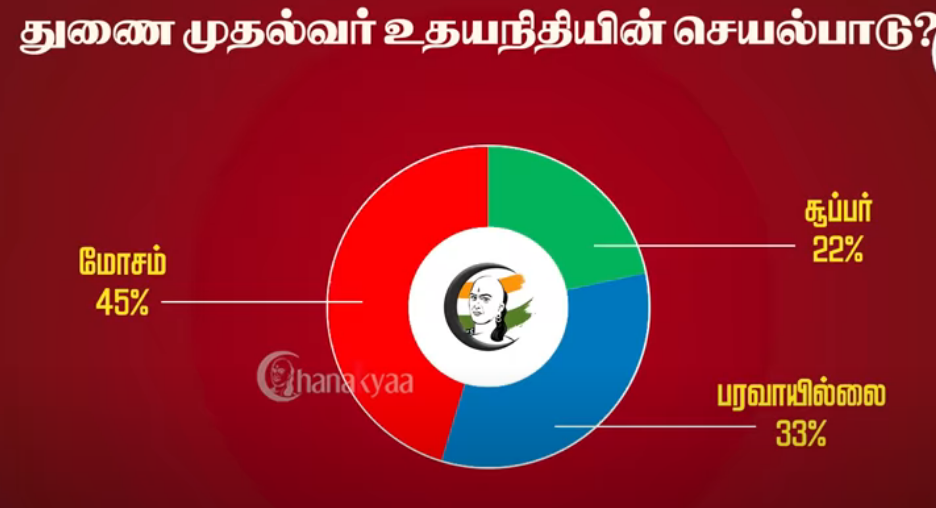
Evaluating Deputy Chief Minister Udhayanidhi Stalin:
22% said his leadership was excellent
33% called it average
45% rated it as poor
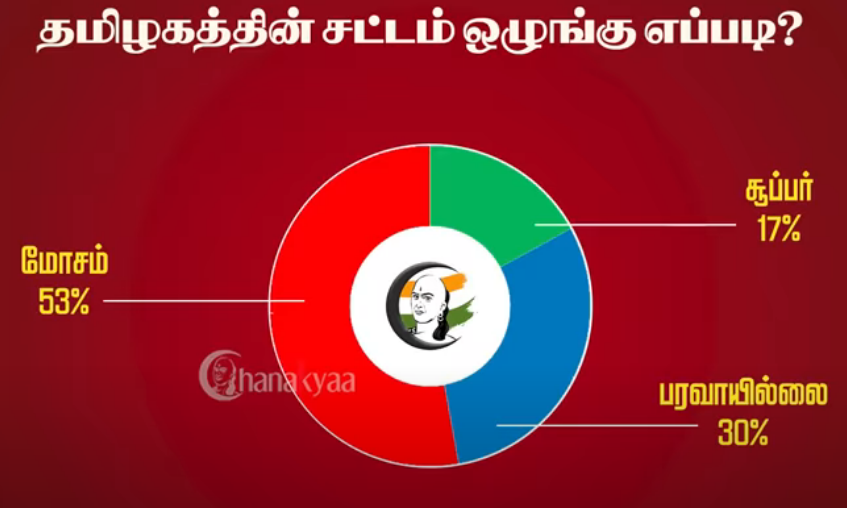
While assessing the Law and order received low marks, with 53% rating it poorly and only 17% marking it as excellent.
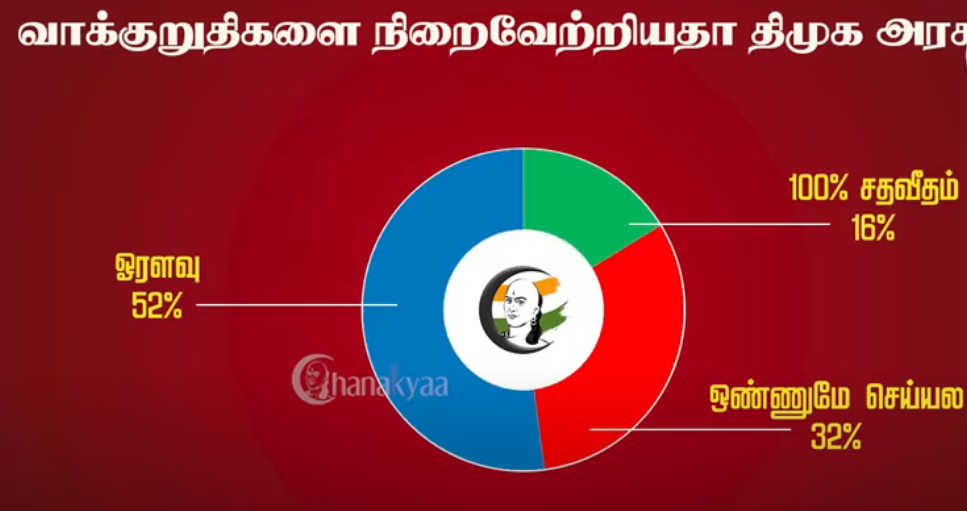
Regarding the DMK’s election promises:
16% said they were fully fulfilled
52% believed they were partially fulfilled
32% said they were not fulfilled at all
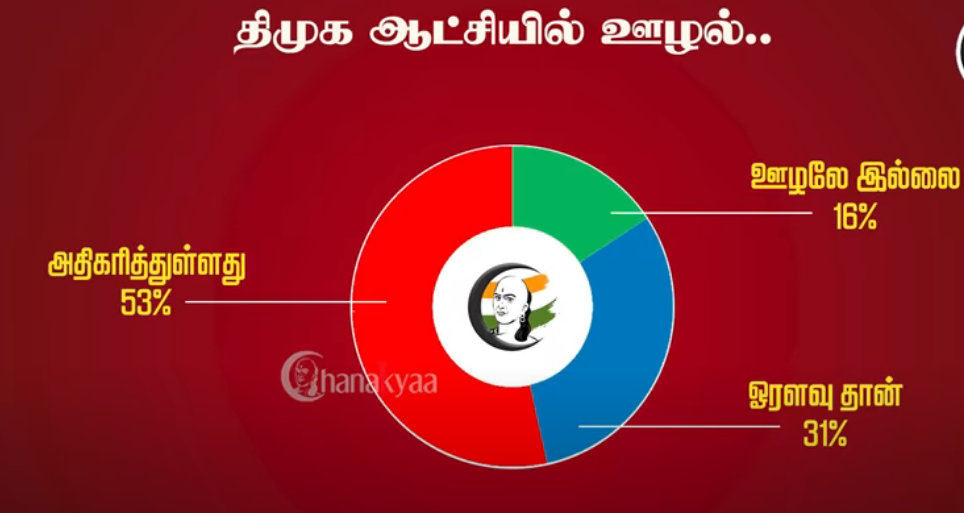
When respondents were asked about corruption under the DMK government, 53% felt that corruption had increased, 31% believed there was some level of corruption, while only 16% opined that the government was free of corruption. Regarding the central agencies’ actions—such as ED and IT raids on DMK ministers—47% considered them legitimate and warranted, whereas 32% perceived them as politically driven.
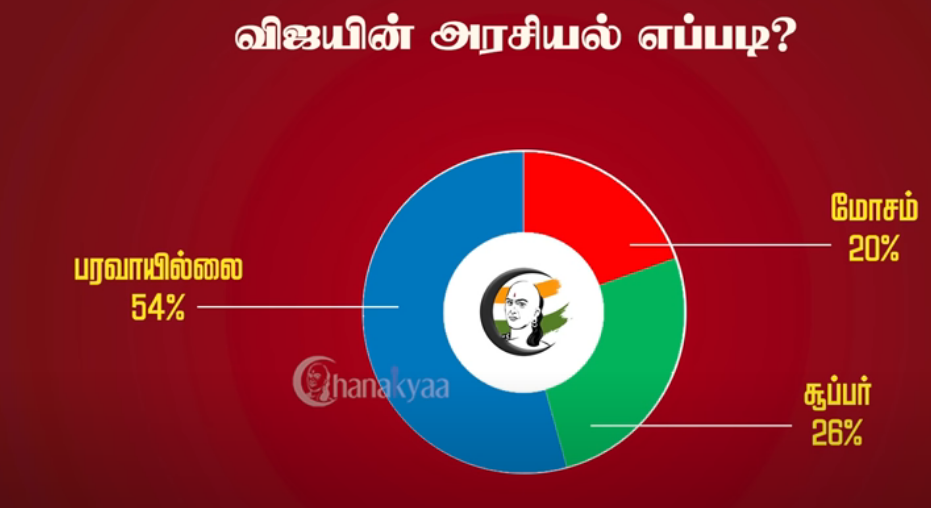
Public Opinion On Part-Time Politician Vijay:
26% believed his politics were good
54% considered his political performance average
20% rated it as poor
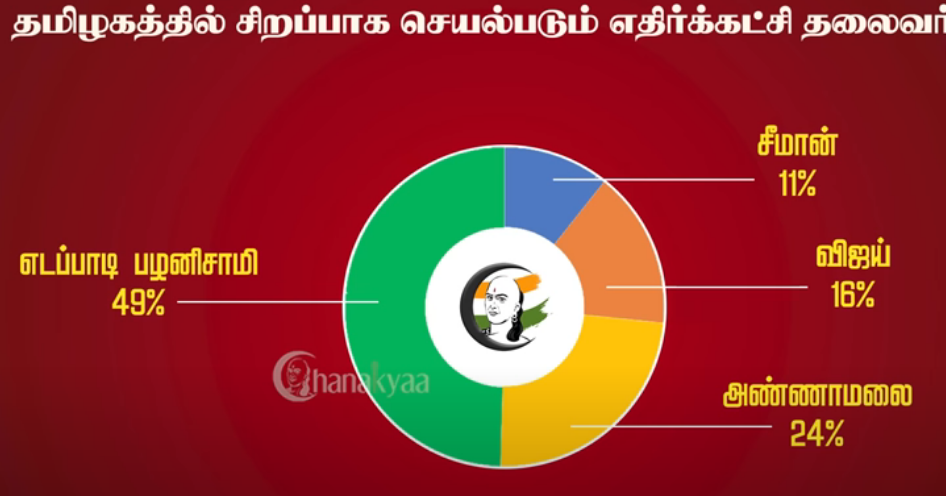
Best Performing Opposition Leader:
Edappadi K Palaniswami 49%
K Annamalai 24%
Vijay 16%
Seeman 11%
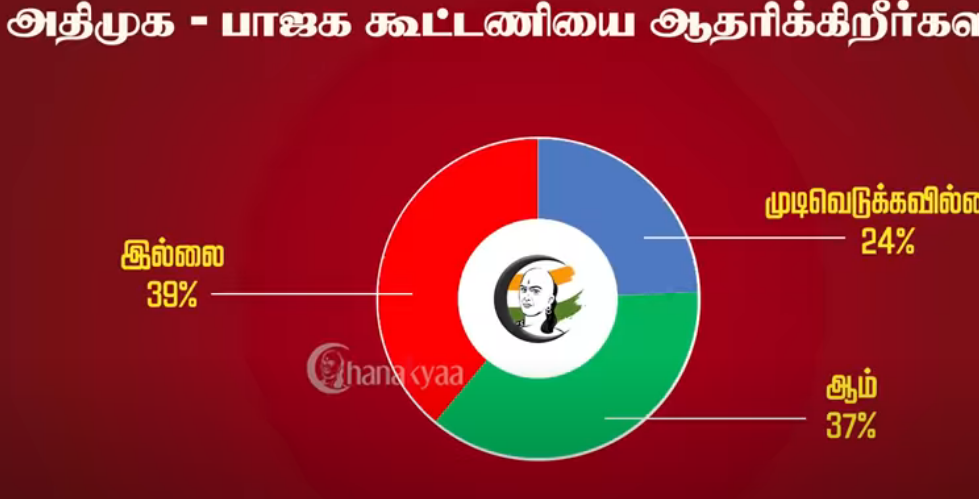
Public Response On The AIADMK-BJP Alliance:
37% said Yes, they welcome the alliance
39% said No, they do not support it
24% said they are undecided
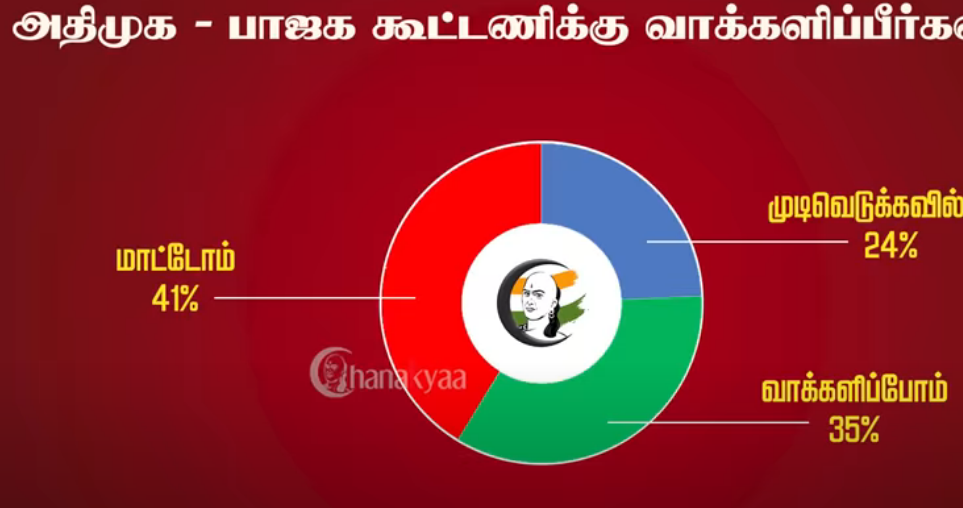
Voter Intention For The AIADMK-BJP Alliance:
35% said Yes, they would vote for the alliance
41% said No, they would not support it
24% said they are undecided
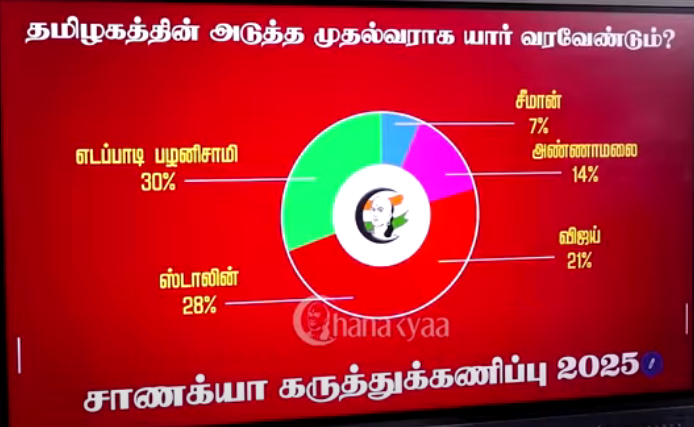
Preference For Next Chief Minister of Tamil Nadu:
Edappadi K. Palaniswami (AIADMK) – 30%
M.K. Stalin (DMK) – 28%
Vijay (Tamilaga Vettri Kazhagam) – 21%
K. Annamalai (BJP) – 14%
Seeman (Naam Tamilar Katchi) – 7%
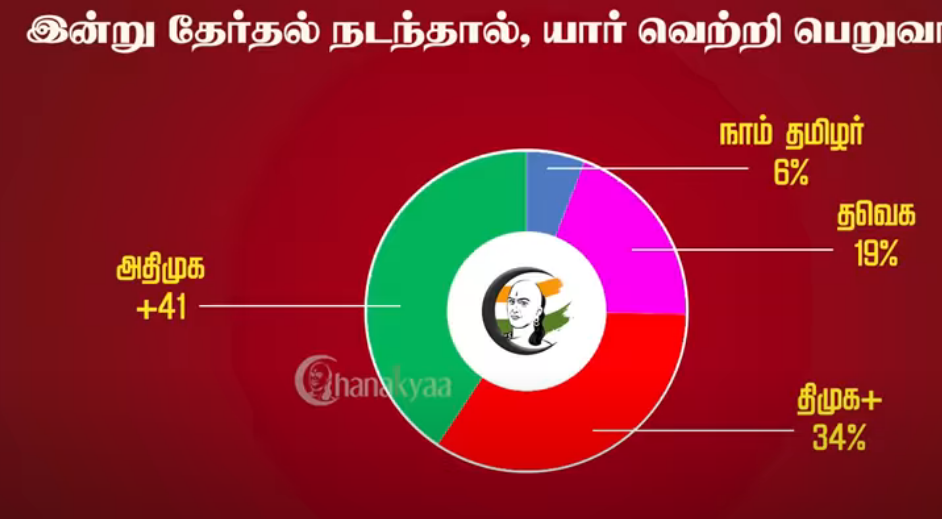
If Elections Were Held Today, Who Would Win?
AIADMK – 41%
DMK – 34%
TVK (Tamizhaga Vettri Kazhagam) – 19%
Naam Tamilar Katchi (NTK) – 6%
Overall, the survey indicates a noticeable drop in approval for both Chief Minister Stalin and his deputy, Udhayanidhi Stalin. With multiple parties gaining traction and voter sentiments shifting, the 2026 Tamil Nadu Assembly elections are shaping up to be a closely fought battle.
Subscribe to our channels on Telegram, WhatsApp, and Instagram and get the best stories of the day delivered to you personally.
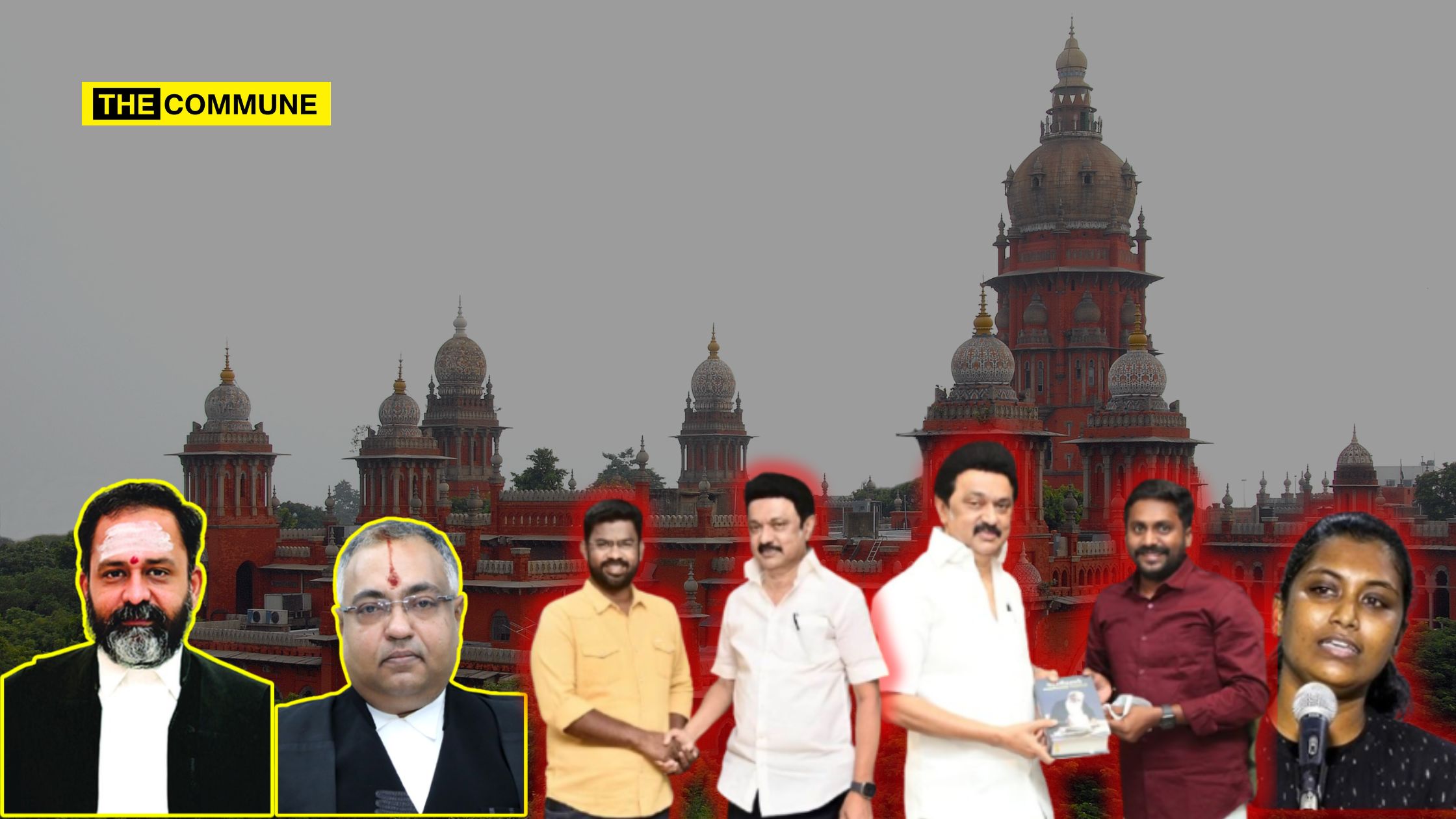
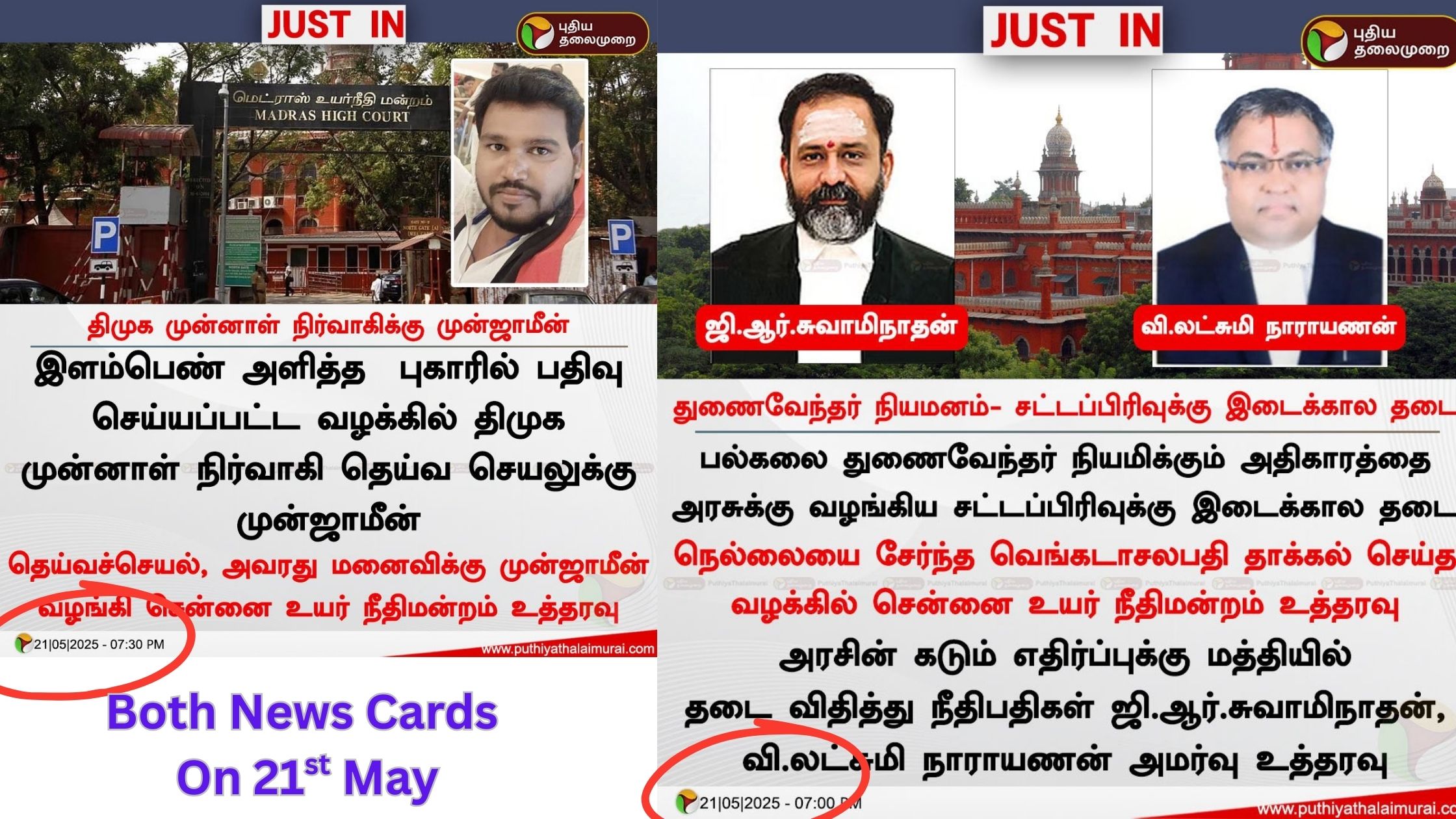
The vacation bench of the Madras High Court on 21 May 2025, comprising Justice G.R. Swaminathan and Justice V. Lakshminarayan issued an interim stay on the Tamil Nadu government’s amendments that removed the Governor’s authority to appoint Vice-Chancellors to state-run universities. The ruling came as a setback to the DMK-led government and triggered a wave of backlash from the Dravidianist ecosystem.
A deeply troubling pattern, a coordinated outburst on social media platforms, largely from self-identified Dravidianists and Periyarist sympathizers (followers of anti-Hindu demagogue EV Ramasamy Naicker), including party cadres and activists. Instead of engaging with the legal reasoning behind the judgment, the outrage targeted the personal identities of the judges—especially their caste backgrounds.
The vitriol was particularly directed at Justices Swaminathan and Lakshminarayan, with Dravidianist media highlighting them as Brahmins with their traditional appearance, such as wearing vibuthi or kungumam. This trend of highlighting a judge’s caste—especially when rulings go against the DMK—has been repeatedly observed in certain sections of Tamil Nadu media and social commentary.
One prominent example is Puthiya Thalaimurai, a media outlet known for its DMK leanings. While it typically avoids mentioning judges’ names in routine cases, it prominently displayed the names and photos of the judges in this particular instance when ideological or political interests are at stake.
This episode has raised serious concerns about how social media and sections of the mainstream media are being used to target sitting judges, undermining the judiciary’s independence and fueling identity-based hostility.
Below are some notable examples of social media posts from Dravidianist and Periyarist accounts targeting the judges in question.
M. Mathivathani, Deputy General Secretary of Dravidar Kazhagam, invoked the words of E.V. Ramasamy Naicker, to mock the judgment, implying that when Brahmins preside over the courts, rulings tend to reflect such biases. She stated “A country where the Paapan (derogatory slur denoting Brahmins) becomes the judge and the ruler is like a jungle inhabited by a ferocious tiger. That is why we are engaged in a tiger hunt. When the tiger leaps, one or two people are bound to get hit! – Thanthai Periyar”
பார்ப்பான் நீதிபதியாய், ஆட்சியாளராய் இருக்கும் நாடு கடும்புலி வாழும் காடேயாகும். ஆதலால், நாங்கள் புலிவேட்டை ஆடுகிறோம். புலி மேலே பாய்ந்ததில் ஒருவர் இருவர் அடிபட வேண்டியதுதான்!
DMK student wing secretary R. Rajiv Gandhi ridiculed the judgment using Brahmin-associated slang terms like “Ivaaluku” and “Avaaluku,” mockingly highlighting the judges’ castes while commenting on their verdict, stating, “Swaminathan @ Lakshminarayanan!!! No matter what the Constitution says, no matter what the Supreme Court says, no matter what laws the Legislative Assembly passes —whatever he says alone is the law, justice, and dharma!”
சுவாமிநாதன் @ லட்சுமிநாரயணன்!!!
இவாளுக்கு அரசியலமைப்புச் சட்டம் என்ன சொன்னாலும்,உச்சநீதின்றம் என்ன சொன்னாலும்!! சட்டமன்றம் என்ன சட்டம் இயற்றினாலும்!!
அவாள் வச்சது தான் சட்டம்,நீதி,தர்மம் எல்லாம்!! 😡😡😡😡
Another DMK sympathizer named Kabilan cited E.V. Ramasamy’s words to mock the Brahmin identity of the judges responsible for the judgment. He said, “When we fight and bring in laws, the Paapan will have already taken control of the courts. – Periyar.”
நாம் போராடி சட்டங்களை கொண்டு வரும் போது பார்ப்பான் நீதிமன்றங்களை கைப்பற்றி இருப்பான் ~ பெரியார் pic.twitter.com/1Cq2POAyN5
Another Periyarist named Varavanaisenthil remarked that the timing of the verdict—delivered by Brahmin judges—was the “right moment” to instill anti-Brahmin sentiment among the younger generation. He said, “There is no need to worry too much about the stay of the verdict. The Supreme Court will definitely slipper them. But for the younger generation, this will be an event that shows to what extent Brahminism will go to protect its power even in this era. This is a wonderful opportunity for the younger generation to expose Brahmin terrorism!”
தீர்ப்புக்கு தடை குறித்தெல்லாம் பெரிதாய் கவலைப்பட தேவையில்லை. கண்டிப்பாக உச்சநீதிமன்றம் செருப்பாலடிக்கும்.
ஆனால் இளைய தலைமுறைக்கு இந்த காலத்திலும் பார்ப்பனியம் தன் அதிகாரத்தை பாதுகாத்து கொள்ள எந்த எல்லைக்கும் செல்லும் என்பதற்கான நிகழ்வாக இது இருக்கும். இளம் தலைமுறைக்கு…
Another DMK sympathizer named Selva said, “Parpana Lobby”
Parpana Lobby🤔
— Annanagar Selvakumar DMK (@Selva_Annanagar) May 21, 2025
Another Dravidian sympathizer, known by the name Athiradhi Ashok, made a highly offensive remark, stating, “The Brahmin scoundrel who stayed the Supreme Court verdict 1 G R Swaminathan 2 Lakshmi Narayan. Both of them were lustful and cruel people who r*p*d their own mothers.”
உச்சநீதிமன்றத் தீர்ப்புக்கு தடை விதித்த பார்ப்பன அயோக்கியனுக 1 ஜி ஆர் சுவாமிநாதன் 2 லட்சுமி நாராயணன் ஆகிய இருவரும் பெற்ற தாயை வன்புணர்ந்த காமக் கொடூரன்கள் . pic.twitter.com/7PqjrBeg3J
Another DMK sympathizer said, “There are three lowly BJP slave Brahmin Sangi judges in the Madras High Court: Swaminathan, Lakshmi Narayan, and Anand Venkatesh. All three of these are cruel and poisonous snakes.”
சென்னை உயர்நீதிமன்றத்தின் கீழ்த்தனமான பாஜக அடிமை பார்ப்பன சங்கி நீதிபதிகள் மூன்று பேர் இருக்கிறார்கள் சுவாமிநாதன், லட்சுமி நாராயணன், ஆனந்த் வெங்கடேஷ். இந்த மூன்று பேரும் கொடூர நச்சுப் பாம்புகள் pic.twitter.com/8xb38r9iRl
— Mansoor MADURAI DMK (@arib_mansoor) May 22, 2025
Another Dravidian sympathizer said, “A paapan called GR Swaminathan.”
He continued to rant, saying “Standard of anti-DMK, anti-Dravidians “judge” GR Swaminathan of #MadrasHighCourt #Modi govt made him ASG in 2014, judge in 2017. So, it is payback time for GRS. Servility towards #BJP…”
Another DMK symphathizer named Malligai Manalan said, “It’s like a street gang-style kangaroo court in session! Can the vacation bench of the judiciary be used for judges to hand down rulings based on their own caste prejudices? On a petition filed by a BJP leader, how much money must have changed hands to secure an interim stay without even seeking the state’s opinion?”
பேட்டை ரௌடிகள் போல் கட்டப் பஞ்சாயத் நடக்கிறது! நீதிபதிகள் தங்களது சொந்த சாதி வெறுப்புகளை தீர்ப்பாக கொடுக்க, விடுமுறை நீதி மன்றத்தை பயன் படுத்த முடியுமா! ஒரு பாஜக தலைவர் தாக்கல் செய்த மனு மீது, மாநில அரசிடம் கருத்துக் கேட்காமல் இடைக்காலத் தடை வாங்குவதற்கு எவ்வளவு பணம் கை மாறியதோ? pic.twitter.com/6H6JINHNXu
— மல்லிகை மணாளன் (தமிழ் குடும்பம்) (@Jasmine01737661) May 22, 2025
Another Dravidian stock ranted, “There has been gross abuse of power. Is this a court BJP Karyakarta’s advisory board? Why should there even be a court for this? Well go to a bhajan center instead. The BJP is the only political party in the world that seems to have its own judges wing.”
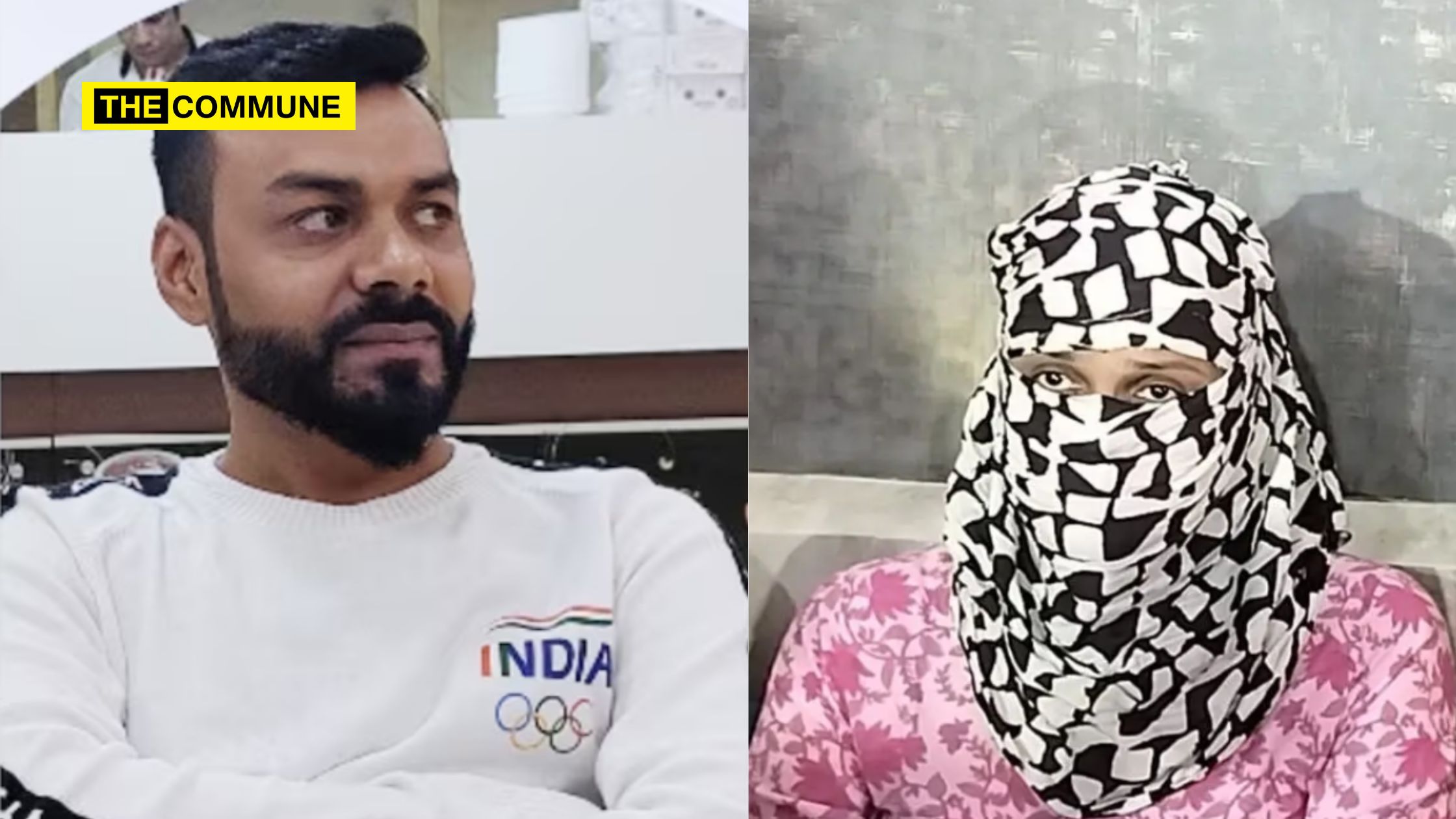
Mohsin Khan, a shooting coach from Indore and the owner of the Dream Olympic Shooting Academy in Madhya Pradesh, has been arrested after several former students and a former staff member accused him of sexual exploitation. Among the complainants is at least one minor, prompting police to take immediate action.
The first complaint was filed on 22 May at the Annapurna police station by a 20-year-old shooter, accompanied by members of a right-wing organization. According to her statement, she joined Khan’s academy in 2021 at the age of 16 and trained there for two years. During that time, she alleges, Khan repeatedly touched her inappropriately under the guise of coaching.
When she resisted, Khan allegedly threatened to expel her from the academy. Traumatized by the experience, she eventually dropped out and remained silent for nearly two years. Although she confided in her mother, fear of social stigma initially prevented her from going to the police.
However, upon learning that Khan was allegedly continuing his misconduct with other students, she decided to come forward. A formal complaint was filed, and Khan was arrested under the Protection of Children from Sexual Offences (POCSO) Act and relevant sections of the Bharatiya Nyaya Sanhita (BNS). He was produced in court the next day and remanded to judicial custody.
On the same day, 22 May 2025, two more women came forward—one a 24-year-old former student, and the other a 32-year-old former employee. Assistant Commissioner of Police Shivendu Joshi confirmed that a case of rape has been registered based on the 24-year-old’s statement. She alleged that Khan raped her under the pretext of advancing her sports career. After her marriage, he reportedly blackmailed her, threatening to reveal their relationship to her husband if she refused to continue meeting him.
In the wake of Khan’s arrest, the Bajrang Dal—a Hindu nationalist group—claimed the case is part of a broader pattern of predatory behavior. The group alleged that Khan targeted Hindu girls specifically and cited digital evidence from his mobile phone, which they claim could point to over 150 potential victims.
Police officials also confirmed the recovery of several explicit videos from Khan’s phone, allegedly showing him in compromising situations with multiple female students. The investigation remains ongoing as authorities work to identify additional victims and determine the full extent of the alleged abuse.
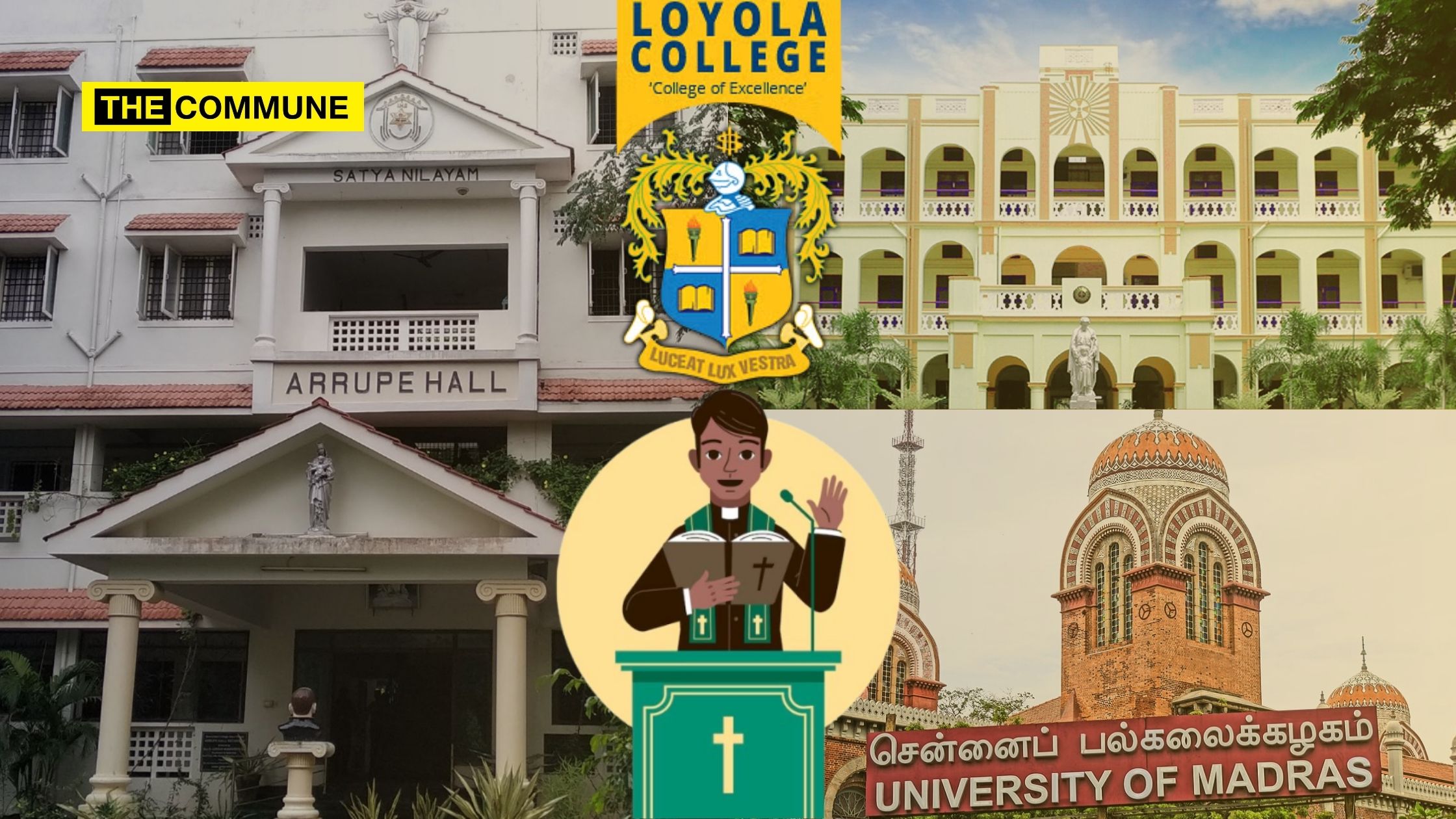
The National Human Rights Commission (NHRC) has issued a stern communication to the Registrar of the University of Madras and the Chairman of the University Grants Commission (UGC), demanding an Action Taken Report (ATR) by June 2, 2025, in connection with serious allegations of religious discrimination of non-Christians in Loyola College, Chennai.
The case stems from a complaint submitted by Legal Rights Protection Forum, a Hyderabad-based rights group. . The complaint alleges that Loyola College is conducting its M.A. Philosophy program at an off-campus Jesuit institute, Satya Nilayam, without proper authorization. The program allegedly excludes non-Christian students, thereby violating Articles 15(1) and 29(2) of the Indian Constitution, which prohibit discrimination on religious grounds.
Further, the complainant has accused the institution of issuing degrees under false affiliation claims, using the University of Madras’ name and logo without due approval—charges that, if proven, amount to serious violations of academic integrity and human rights.
The NHRC, in its earlier directive dated April 7, 2025, had directed both the University of Madras and the UGC to investigate the allegations and submit an ATR within four weeks. However, the Commission noted with concern that no report has been filed to date.
In the latest communication, the Commission, has reiterated its demand, stating that failure to comply may lead to coercive action under Section 13 of the Protection of Human Rights Act, 1993.
Subscribe to our channels on Telegram, WhatsApp, and Instagram and get the best stories of the day delivered to you personally.
India has effectively been able to fulfil its objectives by Operation Sindoor in more than one ways. First of all, India has clearly communicated that any forthcoming sub-conventional attacks (that involves non state actors & terror groups) will be met with a conventional response (militarily). It emphasizes that now Pakistan has a duty to avert any sub-conventional assaults if it seeks to avoid conventional retaliation from India. So effectively, India has blurred the line between the non-state actors and the Pakistani establishment by holding the latter responsible for the acts of formal and even being complicit.
Also, while Pakistan has consistently tried to internationalise the Kashmir issue, India has maintained that Kashmir is a bilateral dispute. American mediation and President Trump mentioning the K word (Kashmir) in his social media posts suggests that Pakistan has been successful in weaving the narrative, but one must remember that the ceasefire agreement between the two countries does not address India’s choice to suspend the IWT. Pakistan used to get a lion’s share of water from the IWT (more than 80%), it needs water for its agriculture and other purposes. India on the other hand, targets Pakistan sponsored terrorism. As a result, the new framework for bilateral discussions will require India to demand that Pakistan halt its terrorist activities as a condition for the reinstatement of the IWT, rather than India agreeing to engage in discussions about Kashmir in exchange for Pakistan’s promise to combat terrorism. So the stakes for Pakistan have been remarkably raised.
Earlier, Indian attempts to thwart terrorist attacks sponsored by Pakistan have not yielded the desired results. India tried to create strong defences to prevent the success of terror operations backed by Pakistan, but defence alone can’t guarantee complete security. It’s like expecting to win a football match with strong defenders & not formidable strikers – the ones who score the goal. Effective deterrence requires scoring goals, which involves retaliating against Pakistan in response to terrorist acts. Also, solely depending on military responses is insufficient to significantly change Pakistan’s behaviour. India is aiming to create a framework of disincentives that makes Pakistan recognize that the advantages it derives from sub-conventional actions are greatly outweighed by the increased costs it incurs as a result of these actions. IWT would be an effective tool for India to establish this.
Operation Sindoor has further amplified India’s unwavering dedication to decisively combat terrorism, without caring about the consequences. Although Modi Government has expressed this determination for some time but through Operation Sindoor it has now established a new normal and changed the rules for engagement that any act of terror would be retaliated militarily & publically. This is in contrast to the covert operations of 2016 that were acknowledged after the operations. Now India has established a well-publicized deterrent framework that increases the stakes for Pakistan from breaching the boundaries. The visual order of this newly established framework would continue to haunt Pakistan for years to come. India’s objective is not only to carry out punitive actions but also to be seen as doing so.
Another ramification of Operation Sindoor would be seen on India’s ties with one of its strategic partners – the USA. The relationship between Trump administration & Modi administration have been very good but American attempts to end the Indo-Pak confrontation and his post on social media which mention ‘increasing trade with both these great nations’ has a patronising undertone. For years, global leaders have exercised caution against planning their visits to India at the same time as those to Pakistan. The United States has just tried to establish a misleading equivalence between the victim and the offender & while doing so it also attempts to reshape the understanding of the hyphenation between India and Pakistan in a global context.
Trump indicated that he threatened to suspend trade in order to impose a ‘ceasefire’ between India and Pakistan. Well, it’s a fact that the possibility of rolling back the tariffs does give US leverage over its allies and adversaries alike. Leading scholar of IR, Prof. John Mearsheimer didn’t rule out that Trump might have promised a ‘sweetheart deal to India’ if it ends the confrontation. But playing hard ball with India could backfire, particularly in defence procurement and the level of support India might provide to the US in a possible conflict with China! PM Modi is known to have a long memory. President Trump is opting to exacerbate India-US relations with inept diplomatic efforts, it is crucial for the White House to adopt a realistic approach. US needs India in Indo-Pacific to check a belligerent China but it seems that US also needs Pakistan to ensure that India doesn’t become a second China. India-US ties could be best described as ‘friends with benefits’.
Overall, the most significant message Operation Sindoor coveys is that India would respond disproportionately in case of any terror attack & not only it would respond but respond in a way that hits the heart of the well-oiled terror machinery nurtured by Pakistan as their State policy. In his address to the nation on may 12th, PM Modi clearly enunciated a new Indian doctrine related to the link between terrorism and nuclear option. No Indian PM has talked in such unmitigated & uncompromising way. Never before in history a nuclear power State has been hit at twelve of it’s military bases with such impunity, the nuclear blackmail is no longer feasible for Pakistan which it has often tried to use as a leverage against India. India’s response to the terror attack in Pahalgam would remain a profound moment of Indian security and strategic doctrine.
Kanishk Shekhar is a columnist, he also teaches students preparing for Civil Services Exam conducted by the UPSC.
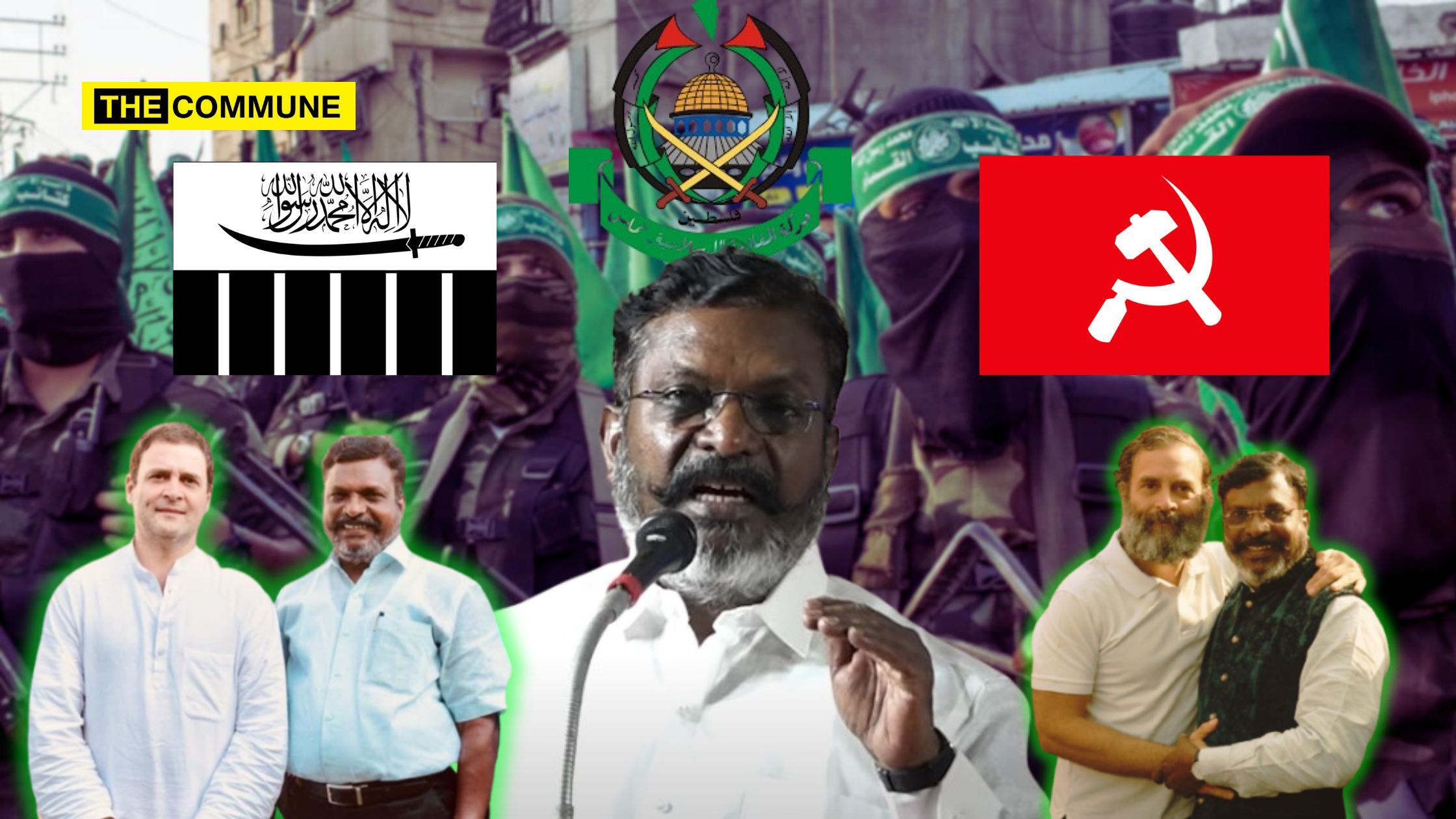
In a controversial statement that sparked widespread backlash, Viduthalai Chiruthaigal Katchi (VCK) leader and Chidambaram MP Thol. Thirumavalavan appeared to offer a justification for terrorism, suggesting that such acts were directed against the government and not civilians. This comment came in reference to the Pakistan-based terrorist group Lashkar-e-Taiba (LeT), which was responsible for the recent brutal Pahalgam attack that left 26 tourists dead—25 of them Hindus. The perceived attempt to downplay the group’s religiously motivated violence has ignited a firestorm, particularly as Thirumavalavan’s party is an ally of the DMK.
The controversy arose during the “Tamil Nadu! Stop the concentration of central power! Fight for state autonomy!” seminar held at Kamaraj Arena in Chennai, organized by the notorious anarchist organization Makkal Athikaram (People’s Power). This is the same organization that instigated the Sterlite riots in Thoothukudi.
During his speech, Thirumavalavan launched a scathing critique of the Central Government, particularly targeting the BJP and RSS for what he sees as an erosion of secular values. He condemned moves like the abrogation of Article 370 and amendments to the Waqf Act, portraying them as part of a broader agenda to turn India from a secular nation into a Hindu Rashtra.
Thirumavalavan argued that defending secularism is today’s most urgent challenge. He described secularism as the lifeblood of the Constitution and accused right-wing groups like the RSS of systematically trying to dismantle it. According to him, these groups are engaging in “modern fascism” — manipulating legal and democratic frameworks to undermine constitutional principles.
“The RSS and its affiliates aim to replace India’s pluralism with a majoritarian ideology,” he said. “They are misusing democracy to implement undemocratic changes, such as scrapping Article 370 under the guise of constitutional legitimacy. This is fascism in a new form.”
He called for unity among secular forces, including alliances with parties like the Congress, despite ideological differences, to collectively oppose what he referred to as “Sanatan forces.” He even described these forces as engaging in “ideological terrorism,” asserting that their long-term goal is to replace the Constitution with a theocratic, majoritarian state.
What Thirumavalavan said in his speech was deeply shocking — he appeared to casually legitimize terrorism by framing it as “counter-terrorism” against the government. This was the most controversial and alarming part of his address. Thirumavalavan stated, “Comrade mentioned one thing in his speech, ‘civil war.’ Terrorism, in fact, originates from the state itself. The struggles led by Maoists or the armed attacks by others are merely reactions. This is ‘counter-terrorism’. Terrorism, generally and by nature, originates from those in power. State terrorism is the original (form of terrorism). Whether it is Hamas or the Lashkar-e-Taiba in Pakistan — they are not ruling powers. They are reacting against state terrorism. In places like Chhattisgarh, Odisha, and Telangana, those comrades hiding in the forests — the Maoists — take up arms to protect mineral resources, to protect land rights, to protect tribal people, and to stop caste atrocities. They stand armed in the field alongside those people. This is a reaction. This is a counter-reaction. But today, these people are also labeled as terrorists by them, and helicopters are used to drop bombs and massacre innocent civilians and tribals in the name of Maoists. How can this be stopped?”
Thirumavalavan’s controversial remarks, which appeared to legitimize brutal acts of terrorism that target innocent civilians by whitewashing them as ‘counter-terrorism’ against the government, have drawn widespread and severe criticism.
This isn’t the first instance where Thirumavalavan and his party, Viduthalai Chiruthaigal Katchi (VCK), have shown a tendency to glorify individuals and groups widely recognized as terrorists by portraying them as “freedom fighters.”
Following the Pahalgam Massacre of Innocent Hindu Tourists in Kashmir
Following the brutal massacre of 26 tourists—25 of them Hindus—in the recent terrorist attack in Pahalgam, Jammu and Kashmir, Thirumavalavan issued a formal statement condemning the violence. While he expressed strong disapproval of the killings, but also used the tragic moment to push a political narrative, shifting focus toward the BJP-led central government’s policies.
In his two-page statement, Thirumavalavan refrained from naming Pakistan or The Resistance Front (TRF), the terror outfit linked to the attack and widely believed to be a proxy for the Pakistan-based Lashkar-e-Taiba (LeT). Instead, he blamed the revocation of Article 370 and the alleged withdrawal of 180,000 troops during the COVID-19 period as contributing factors to the security lapse. He also demanded the resignation of Union Home Minister Amit Shah.
காஷ்மீரில் பயங்கரவாதத் தாக்குதல் – படுகொலை : ———————— உள்துறை அமைச்சர் அமித்ஷா அவர்கள் பதவி விலக வேண்டும்!
விடுதலைச் சிறுத்தைகள் கட்சி அறிக்கை! ————————#காஷ்மீர் பஹல்காம் பகுதியில் தீவிரவாதிகள் நடத்திய தாக்குதலில் சுற்றுலாப் பயணிகள் 26 பேர்… pic.twitter.com/gjSQnAHWbZ
— Thol. Thirumavalavan (@thirumaofficial) April 23, 2025
In his two page statement, there was not a single mention of Pakistan or the terror outfit The Resistance Front (an offshoot of Lashkar-e-Taiba).
Netizens quickly highlighted past instances where VCK members, including MLA Aloor Shanavas, had referred to Kashmiri militants as “freedom fighters.“A video resurfaced in which Shanavas praised Thirumavalavan for acknowledging the Kashmir conflict as a struggle for freedom rather than terrorism.
Following the brutal assault on Hindu tourists in the Pahalgam region of Jammu and Kashmir, Thirumavalavan issued a formal statement via his official account, saying, “I strongly condemn the horrific terrorist attack on innocent tourists in Jammu and Kashmir. Such acts of terror have no place in a democratic and civilized society. The perpetrators of this heinous crime must be identified, brought to justice, and punished with the utmost severity. I urge the Union Government to convene an all-party meeting to demonstrate that the entire nation stands united in rejecting terrorism and upholding peace and democracy.”
I strongly condemn the horrific terrorist attack on innocent tourists in Jammu and Kashmir. Such acts of terror have no place in a democratic and civilized society. The perpetrators of this heinous crime must be identified, brought to justice, and punished with the utmost…
— Thol. Thirumavalavan (@thirumaofficial) April 22, 2025
Glorifying S.A. Basha – Mastermind Of The 1998 Coimbatore Blasts
Following the death of S.A. Basha, founder of the banned terror outfit Al-Ummah and the chief conspirator behind the 1998 Coimbatore bomb blasts that killed 58 and injured over 230 people, several Dravidian parties, including VCK, offered tributes that were seen as blatant appeasement of extremist elements.
Thirumavalavan took to social media to pay tribute, portraying Basha as a martyr for the Muslim community. He wrote that Basha, who had spent over 25 years in prison, remained steadfast in his beliefs and that his death was a significant loss for Muslims. He further stated that party leaders, including Deputy General Secretary Vanni Arasu, attended Basha’s funeral to offer their respects, calling it a “heroic tribute.”
He wrote, “Kovai Basha has lost his life after being in prison for more than a quarter of a century. Not only him, but also some of his relatives including his son Siddique were imprisoned and lost their lives. Even when his family was imprisoned to protect the interests of Muslims, he did not lose heart and lived with determination without wavering in his principles. It is sad that he died as a prisoner. However, it has become a history. His demise is a great loss for Muslims. Many leading comrades including Deputy General Secretary Vanni Arasu participated in his last rites on behalf of the party and paid him a heroic tribute. Salute to Kovai_Pasha.”
கால் நூற்றாண்டுக்கும் மேலாக சிறையில் தனது வாழ்வைப் பறிகொடுத்தவர் கோவை பாஷா அவர்கள். அவர் மட்டுமின்றி அவரது மகன் சித்திக் உள்ளிட்ட உறவினர்கள் சிலரும் சிறைப்படுத்தப்பட்டு வாழ்வை இழந்தனர். இசுலாமியர்களின் நலன்களைப் பாதுகாப்பதற்காக தனது குடும்பமே சிறைப்படுத்தப்பட்ட நிலையிலும் அவர்… pic.twitter.com/IuNNjuuksu
Thirumavalavan’s controversial comments aren’t new. He has previously drawn parallels between globally designated terrorist organizations—like Hamas, Hezbollah, and the Houthis—and movements for self-determination, portraying them as justified resistance forces. He has even defended the LTTE, a banned terrorist outfit, suggesting they resorted to arms only after democratic processes failed them.
In an October 2024 speech, Thirumavalavan argued that militant groups in Palestine emerged in response to Israeli aggression, comparing them to the LTTE’s evolution in Sri Lanka. He claimed Palestinians, having lost the majority of their land to Israel, had no choice but to form groups like the PLO and later, Hamas, in self-defense.
Thirumavalavan said, “Generally they will say it as a terrorist organization, militant organization, then why was LTTE formed? Even after 25 years of struggle under the leadership of Selva in democratic way, the Sinhalese did not accept their demand. As there was need to speak in their language, armed groups appeared. Then what will the neighboring Islamic countries do without helping them? It will help them.”
He stated that initially, Palestinians ceded 40-45% of their land, but now Israel has taken over 90%, leaving only a small portion in the West Bank and Gaza. He then posed a question to the audience, “Now tell me, on whose side should we stand? Can you support Israel or the Jewish group that have driven out the Palestinians and occupied their land?”
He went as far as to draw a controversial comparison between the displacement of Dalits in Chennai and the plight of Palestinians. Referring to the Marwari business community in Sowcarpet, Chennai, Thirumavalavan likened their economic expansion to Israeli settlement, implying that the original residents of Chennai were being pushed out like Palestinians in Gaza and the West Bank.
“What did the Jews do? They (Palestinians) gave them a piece of land and asked to stay within that. If we ask him (Marwaris) to stay within Sowcarpet, he should stay there. What will happen if they expand to other areas like Anna Nagar and encroach entire Chennai? The Dalits, poor and the marginalized, those who stay on the banks of Cooum River are being shifted to Ottiyambakkam, Thoraipakkam, Semmenchery. This is called displacement. The natives of Chennai were shifted away to 40-50 kms saying that you’re being affected because of rains and floods. This is being done by the government itself. What happened there (Israel) was, as he (Jews) came, these people (Palestinians) had to flee. They attacked. Thousands of them were killed.“, he said.
பாலஸ்தீனம், லெபனான், சிரியா ஆகிய நாடுகளில் இனப்படுகொலை செய்யும் இஸ்ரேல் அரசின் பயங்கரவாதத்தை கண்டித்து விடுதலைச் சிறுத்தைகள் கட்சியின் சார்பில் தற்போது சென்னை வள்ளுவர் கோட்டத்தில் நடைபெற்ற ஆப்பாட்டத்தில் ஆற்றிய கண்டன உரை… pic.twitter.com/glH25XzAfZ
On multiple occasions, including on 31 October 2023, Thirumavalavan has participated in large-scale demonstrations supporting Palestine, aligning himself with various Muslim political organizations. These events often included inflammatory rhetoric against Israel and vocal support for groups like Hamas. He criticized India’s neutral stance at the UN and urged the global community to condemn Israeli actions.
Thirumavalavan spoke in an inflammatory fashion and supported Hamas in this war. Here is a transcript of his speech. “Israel is carrying out a brutal war of aggression. Israel must stop this war. The nations across the world, democratic countries are voicing their support for Israel to stop this brutality against the Palestinians.”
Resolution Against India Abstaining From Voting Against Israel
He said, “Recently at the UN Assembly, Jordan proposed a resolution, and 120 nations voted in favour of it. 14 nations voted against it. 45 countries including India abstained from voting. Even if we count the countries that abstained and those who voted against the resolution, it is only 60 countries. But those who supported the resolution make up 120 countries. The world makes us realise the truth. That the war carried out by Israel on Palestine and the Gaza Strip is unjust, cruel, and terrible and this war needs to stop immediately. This is the voice of the world, the voice of all the democratic nations of the world. As a means to support that voice, today we have congregated here in the thousands.” He added, “When asked why we abstained from voting, they said that in the Jordan Resolution, there is no mention of Hamas, they have not spoken about the attack they carried out. So we abstained, said Yojana Patel, the Indian representative.”
Called Israel An Occupier Nation
He called Israel an occupier nation and said, “Israel has occupied Palestine, that is the historical truth. They were chased out of Germany and several other European countries. They entered Palestine with banners saying Germans stabbed us, don’t destroy our hope. The same people are the ones who created Israel and terrorising and suppressing people, they are the Jews.“
He added, “Keeping aside the history of why they were chased out of Germany, the Jewish race is one which has only developed enmity with most of the countries in the world. Israel is not their ancestral land. Israel is not their motherland. With the help of superpowers like America, they occupied territory and created a country of their own and are killing and bringing about the genocide of the same Palestinians who gave them refuge.”
Comparing The Eelam War With That Of Palestine
Thirumavalavan compared the Srilankan Tamil issue with that of the Palestinians. He said, “Even in Eelam, the Singhalese are not the natives of that land. They went from India. But history has been hidden from all. They caused the genocide and massacre of the natives of that land, the Tamils. It continues to this day. The same thing has happened here (Palestine).”
He added, “In 2001, I attended a conference in Durban in South Africa. It was about opposing apartheid. Several Palestinians came there with banners. Even though I do not understand their language, I would stand with the Palestinians during their protests. I came across a flyer that was in English. They constantly spoke for freeing their land and requested the countries of the world to support them. Yasser Arafat, the leader of the Palestinian Liberation Movement would conduct exile Parliament and stress on these requests, same like how Eelam Tamils are having one.”
Hamas – A “Defence Force”
He called Hamas a defence force. He said, “We know that Hamas emerged as a contradictory movement of the Palestinian Liberation Movement. But that movement is the only one that protects the Palestinians. It is not a war-frenzy movement. It is not an occupier-frenzy movement. It is not a movement that hates other races. It did not start an attack on Israel unjustly. Hamas is a defence force that is there to protect Palestinians and Palestine’s land. It is being called a terrorist organisation and extremist organisation by the Sanathana forces in the United Nations Assembly.”
Justifying The Creation Of Hamas
Thirumavalavan also justified the reason for the creation of Hamas. He said, “What is the reason for the emergence of Hamas? Which country has been aggressed against/occupied by Hamas? On 7 October 2023, they carried out rocket strikes. It is not a war of aggression. It is a war against aggression. Shouldn’t India realize this? Shouldn’t America realise this? Is the attack carried out by Hamas a terror attack? or is the attack carried out by Israel a terror attack? Did the Palestinians occupy the Jewish nation or did the Jews occupy the Palestinian nation? Shouldn’t we know the answer to this question? It is a fact that the world knows. It is a historical fact that the Jews occupied the Palestinian nation.”
He also added, “Israel is an occupier nation created by the Jews with the support of America. Who is carrying out the terror attack here? Weren’t the Palestinians the ones who helped them when they came to Palestine raising their banners? Who is carrying out such a terrible attack with cluster bombs and phosphorus against the Palestinians who welcomed them? We are not gathered here on the basis of religion. We are united asking for justice. We are here to question the conscience of the countries of the world. Whenever there is a war between Israel and Palestine, America always comes forward to support Israel blindly.”
Condemning India’s Stand On The War
He called India’s stand on the war something that was influenced by “Sanathana forces”. He said, “Today, our Indian nation has become a subordinate of America and has come forward to support Israel blindly. They support America’s stand. Indian politics is based on justice but it is supporting injustice. It is supporting Jews who are an occupier nation. It is against the Palestinians who are the sons of the soil (natives). The BJP government is looking at the Palestinians as Muslims alone. It is not looking at the justice on their side. We want to accuse the BJP, RSS’s Muslim hatred politics has made us take a stand against the Palestinians. They are not looking at this problem, this problem between Hamas and Israel as a fight between occupiers and natives. Should the Palestinian people come back to Palestine or not? Should they not condemn the actions of Israel which is preventing Palestinians from returning?”
Gaza – Comparison With Chennai
Thirumavalavan compared Gaza to Chennai and complained about how Israel was torturing the citizens. He said, “Gaza which is under the control of Hamas is a small strip of land that is 10km wide and 41km long. 25 lakh people are living in a place which is not even a fifth of Chennai’s land area. More than 1 crore people live in Chennai. For the past 25 days, Israel has been carrying out brutal attacks via air and land. Countries like America and India are watching the spectacle. Where will this lead to? Even if these people think, let the people of Palestine find a solution to the problem, even then the Palestinians will win. If America does not intervene, if their supporters do not intervene, if their army doesn’t go, if they do not help with their weapons, if they do not help financially, Hamas will win and take over Israel.”
He also added, “In the name of destroying LTTE, India, and America supported the Sinhalese and took a stand against the Tamils. In the same way, they named Hamas a terrorist organisation, and in the name of destroying Hamas, they are killing innocent Palestinians. Dead bodies are being transported in containers. They are burying dead bodies en masse. Reports indicate that 50000 pregnant women are unsafe and in dangerous conditions. They cut off the electricity, oil, and water. This is not just a war against terrorism, it is a genocide.”
He called for a gathering, a show of support similar to the gathering of numerous people in Kerala to express support for Palestine. He said even in Tamil Nadu, millions of people stand in opposition to Israel’s brutal war, and that this conflict needed to be halted promptly. He condemned India’s stance and that it must be altered, and efforts will be made to exert pressure on India to raise its voice against the continuation of the war.
Subscribe to our channels on Telegram, WhatsApp, and Instagram and get the best stories of the day delivered to you personally.
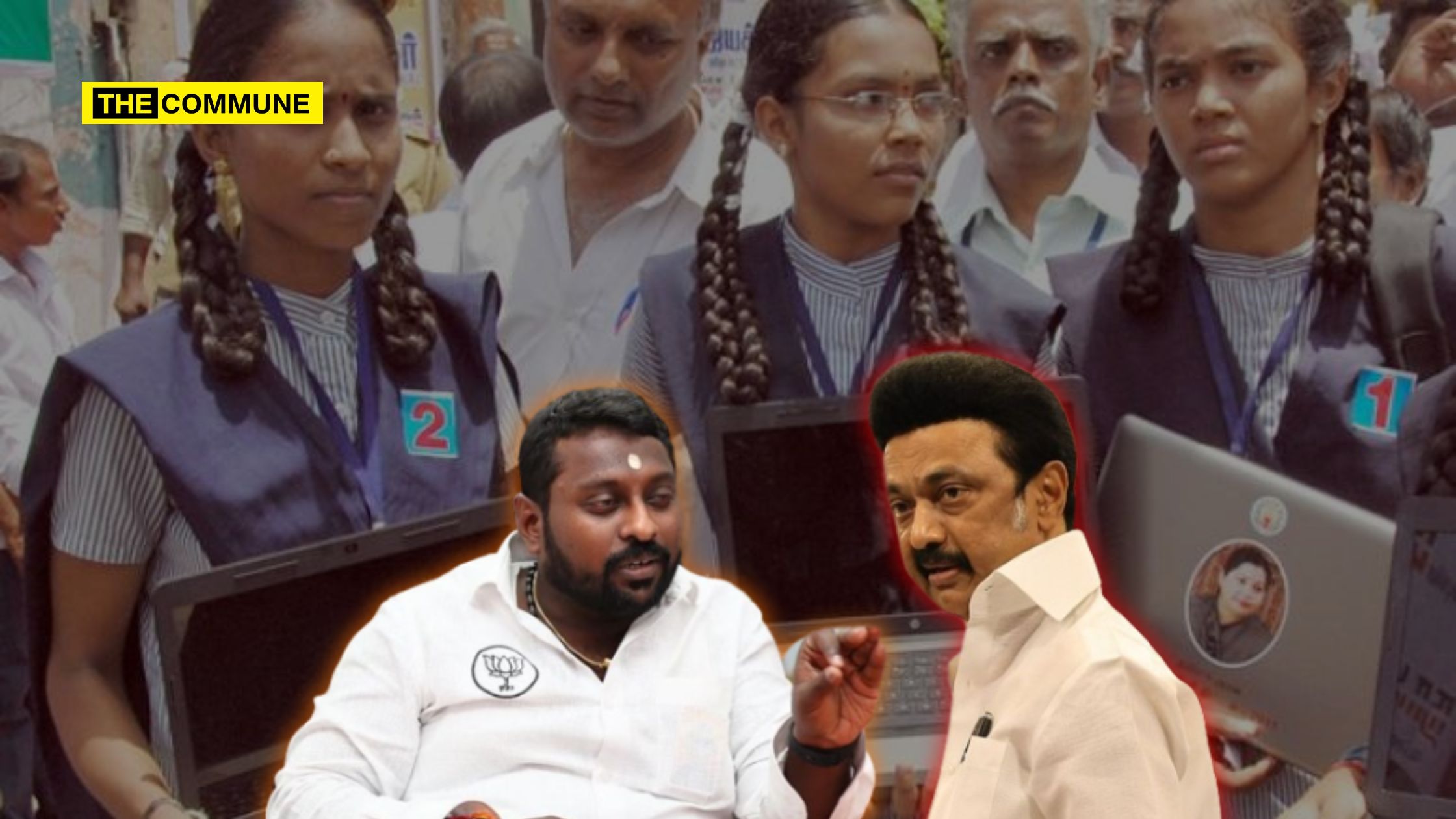
The DMK government in Tamil Nadu, led by Chief Minister M.K. Stalin, has announced the revival of the Free Laptop Scheme for students, as the state gears up for Assembly Elections in 2026. The decision has drawn sharp criticism from opposition leaders, who allege that the scheme is being reintroduced as an electoral tactic to lure first-time voters.
In a statement shared on X by Tamil Naud BJP State Secretary Dr. S.G. Suryah, the revival of the scheme was labeled a desperate move by DMK government.
The statement detailed the history of the Free Laptop Scheme and criticized the DMK for its inconsistent policies.
The Free Laptop Scheme was initially launched on September 15, 2011, under the All India Anna Dravida Munnetra Kazhagam (AIADMK) government led by then-Chief Minister J. Jayalalithaa. The scheme aimed to provide free laptops to students in Tamil Nadu to bridge the digital divide and enhance educational opportunities. It continued successfully until 2019, benefiting numerous students across the state and was discontinued temporarily during the COVID-19 pandemic when industries across the world were shut down.
Suryah said that the Stalin-led DMK government had stopped the scheme just because it was introduced during the AIADMK period.
The statement further highlighted that when the DMK came to power in 2021, it justified the discontinuation of the laptop scheme by stating that the government was instead providing ₹1,000 monthly assistance to students. Suryah pointed out that despite students, parents, parties and academicians urging the government to reintroduce the scheme, it fell on deaf ears with the DMK government pointing out the weak fiscal situation. However, four years later, in 2025, the DMK government has decided to restart the Free Laptop Scheme, a move that Dr. Suryah alleges is motivated by the upcoming elections rather than genuine concern for students’ welfare.
Suryah also pointed out item number 163 of the DMK in its 2021 Assembly Election manifesto which promised that tablets with internet facility would be provided to higher secondary and college students.
“But, Stalin remained mute to this for the last four years. Now this 2025-26 academic year also being an election year, the DMK government has announced the scheme and has also floated tenders for the same. After saying, ‘Instead of free laptops, we are giving ₹1,000 per month!’ the DMK has suddenly developed a newfound affection for students. The youngsters of Tamil Nadu have realized. The DMK has ‘restarted’ the free laptop scheme having realized that their ‘vidiyal’ gimmicks won’t work anymore. With just days left for the academic year to start, when will tender be out, when will the procurement happen and it is highly improbably that the students will get laptops.”, Suryah said.
“Be it first-time voters or veterans, they’re for sure to ‘shut down’ the Stalin government.”, Suryah said.
On 17 May 2025, Congress leader Rahul Gandhi accused the central government of compromising national security by allegedly informing Pakistan in advance about planned strikes on terror targets under Operation Sindoor. Terming the act a “crime,” Gandhi demanded accountability, asking, “Who authorized this?”
In a post on X, Gandhi, as Leader of the Opposition in the Lok Sabha, took a direct swipe at External Affairs Minister S. Jaishankar. He referenced a undated video in which Jaishankar appears to say that India had notified Pakistan before launching the operation. “Informing Pakistan at the start of our attack was a crime. EAM has publicly admitted that GOI did it. Who authorised it? How many aircraft did our airforce lose as a result?,” Gandhi claimed in his post. He also questioned the consequences of this move, asking, “How many Indian aircraft did we lose because Pakistan knew? This wasn’t a lapse. It was a crime. And the nation deserves the truth.”
EAM Jaishankar’s silence isn’t just telling — it’s damning.
So I’ll ask again: How many Indian aircraft did we lose because Pakistan knew?
This wasn’t a lapse. It was a crime. And the nation deserves the truth. https://t.co/izn4LmBGJZ
However, the Press Information Bureau (PIB) swiftly responded through its Fact Check Unit, stating that Jaishankar had been misquoted. According to PIB, the minister did not say that India had alerted Pakistan prior to Operation Sindoor, and any such claims were misleading.
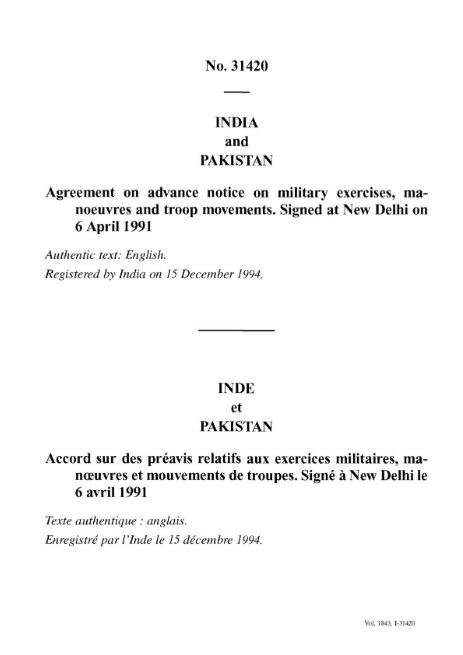
Rahul Gandhi may have forgotten or have chosen to hide this fact but on 6 April 1991, both countries signed an agreement in New Delhi aimed at preventing misunderstandings and potential conflict through prior notifications about military activities. This agreement was officially registered by India on 15 December 1994.
Who Authorized the Agreement?
The pact was formulated during the tenure of Prime Minister Chandra Shekhar, who led a short-lived minority government from 10 November 1990, to 21 June 1991. His administration, a splinter faction from Janata Dal, received outside support from the Indian National Congress. Interestingly, Chandra Shekhar was the first Indian Prime Minister with no prior experience in any government role. Although signed under his leadership, the agreement was officially registered during P. V. Narasimha Rao’s Congress-led government.
What was the Agreement?
The Agreement was on Advance Notice on Military Exercises, Manoeuvres, and Troop Movements between India and Pakistan was designed to ensure transparency and avoid unintended escalation
Key Provisions of the 1991 Agreement
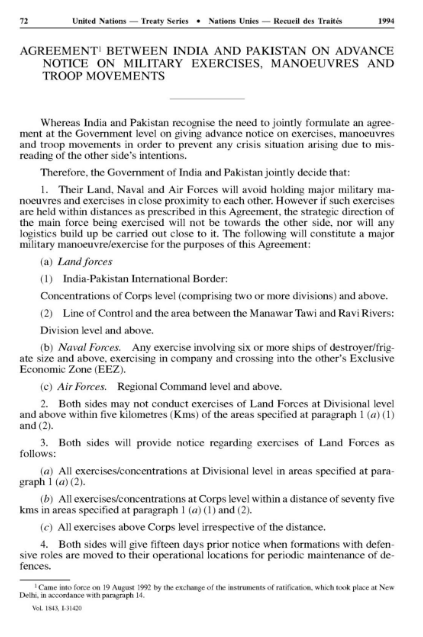
Avoiding Provocative Exercises: Both India and Pakistan agreed to avoid major land, naval, or air exercises near the border or the Line of Control (LoC). Exercises were not to be aimed strategically at each other or involve significant troop or logistics buildup near the border.
Definition of Major Exercises:
Army: Corps-level or larger near the international border; division-level near the LoC.
Navy: Exercises involving six or more destroyer/frigate-class ships crossing into the other’s Exclusive Economic Zone (EEZ).
Air Force: Regional Command-level exercises or larger.
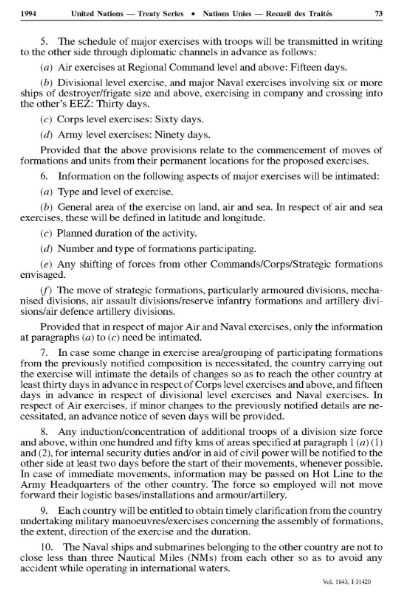
Prior Notifications:
15 days for divisional-level land exercises.
30 days for major naval exercises and divisional-level land exercises.
60 days for corps-level movements.
90 days for full-scale army exercises.
Specific Notification Requirements:
Details such as type and scope of the exercise, location (with geographic coordinates for air and naval operations), duration, and participating units must be shared in advance.
Any changes to previously notified exercises must be communicated at least 30 days in advance for corps-level or above, and 15 days for divisional-level or naval drills.
Emergency troop movements (e.g., for internal security) within 150 km of the border must be notified at least two days in advance or immediately via military hotline if urgent.
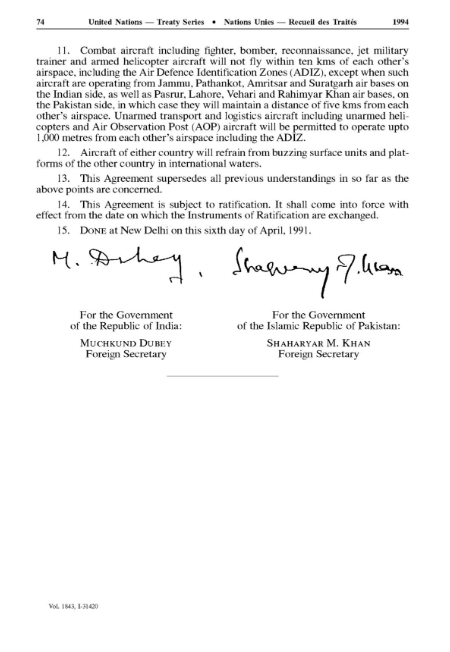
Operational Conduct:
Military aircraft must maintain at least a 10-kilometer distance from the other’s airspace, except under agreed conditions for certain bases.
Buzzing of ships or submarines in international waters was strictly prohibited.
Naval vessels were not allowed within 3 nautical miles of one another.
Supersession and Ratification:
This agreement replaced previous bilateral understandings related to military activities near the border.
It came into force once both countries exchanged instruments of ratification.
The 1991 agreement highlights that prior notification of troop movements between India and Pakistan was a policy supported by a Congress-backed government. Yet, in a seemingly contradictory stance, Congress leader Rahul Gandhi conveniently accuses the current government of committing a “crime” by allegedly informing Pakistan ahead of military action. However, if such transparency is now being labeled a crime, it raises questions about the Congress party’s own role in authorizing a similar policy in the past.
Rahul Gandhi's remote control is in Pakistan!
There is a pattern to Rahul wanting India to share operational details with Pakistan.
His party supported govt in 1991 had signed an agreement with Pakistan in 1991 to share information of troope and military movement with Pakistan… pic.twitter.com/pzIoquJfWN
— Pradeep Bhandari(प्रदीप भंडारी)🇮🇳 (@pradip103) May 23, 2025
Subscribe to our channels on Telegram, WhatsApp, and Instagram and get the best stories of the day delivered to you personally.
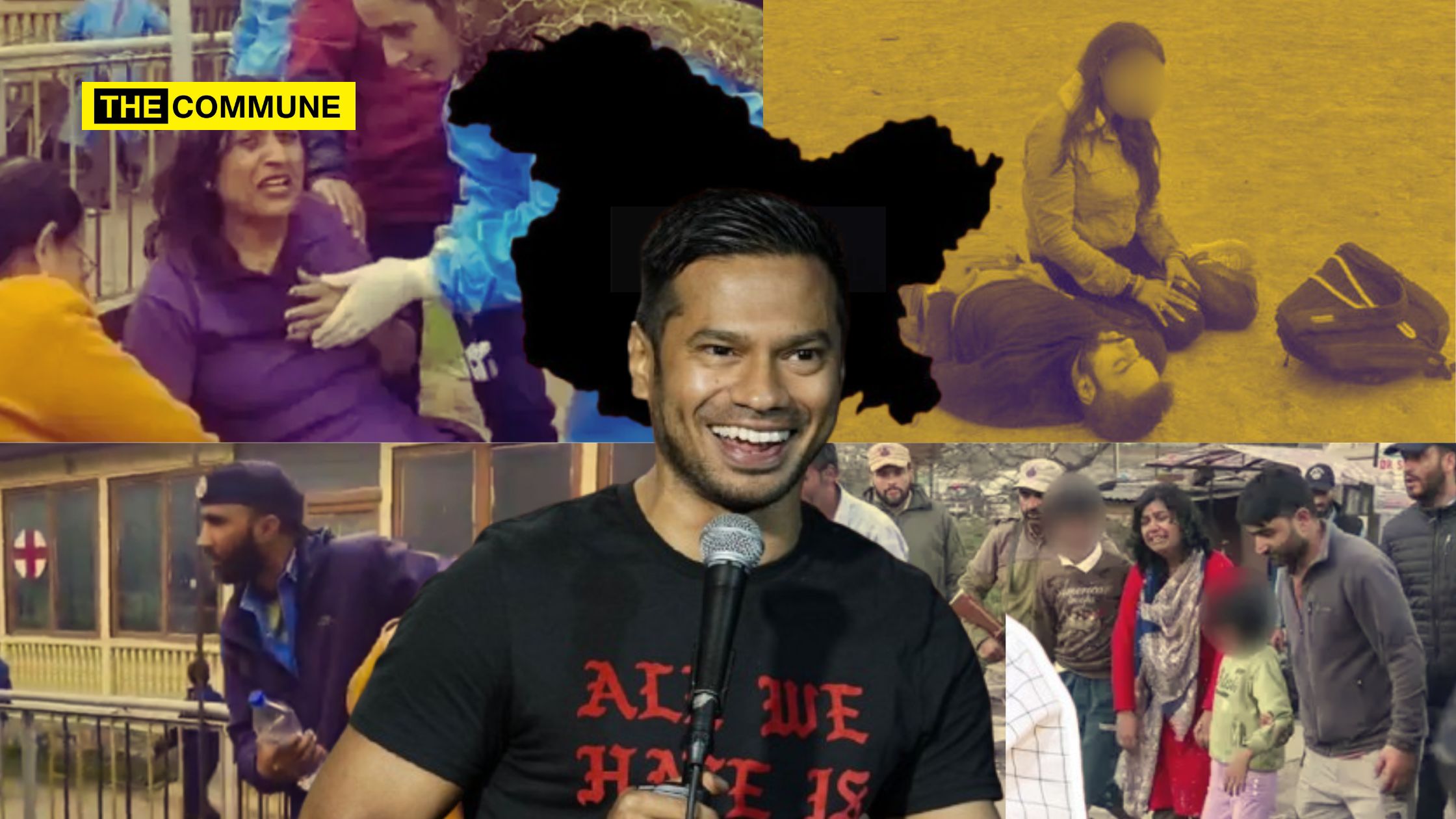
Self-styled ‘comedian’ Daniel Fernandes, who has previously been criticized for making controversial remarks targeting Hindu and Jain communities, has once again found himself at the center of a storm—this time for accusing Indians of harboring hate after a deadly terrorist attack in Pahalgam that claimed the lives of 26 innocent civilians.
In his new YouTube special titled“The Kashmir Terror Attack,” released on 22 May 2025, Fernandes appeared to equate public anger and calls for justice with hatred and bigotry, provoking sharp backlash. Many took issue with his mocking tone and insensitivity, especially as he framed Indians demanding accountability for the attack as being motivated by hatred towards Pakistanis.
In the video, Fernandes states, “Anger and fear are the two very powerful emotions and these emotions are very valid during a conflict. But the answer to how one must conduct themselves in times like these is located right in the middle. And that is what I felt was missing in our discourse. There was no middle ground. And if you are unable to find a middle ground between anger and fear, it will most likely turn into hate. And oh Lord, we don’t need more of that in this country, do we? India has too much hate already. Don’t you agree? We have a surplus of hate. India has so much hate right now. We can export it. We can export it to countries like Norway and Finland. Too much happiness over there, right? I think we need to just calm down with the hate, dude. Like today a lot of people are saying things like if you are a true Indian, you must hate all Pakistanis, which was very confusing for me because for the last 11 years, I thought you were a true Indian if you hated other Indians. I did not know that there was a software update. If you saw the rhetoric online, it was very aggressive, right? It was like Pakistan should be wiped out. Kill all of them. Destroy that entire country.”
Fernandes also drew criticism for his misogynistic joke, trivializing the situation by referring to the attractiveness of Pakistani women as a reason not to hate the country and also went on to sarcastically question the current definition of patriotism, “And I was like, but there are hot women there, right? A lot of them, you know, like I understand, okay, if Pakistan was full of uglies, I’ll be like, yeah, I’ll press the button. You know, but why, right? Like ladies, even you know what I’m talking about, right? A bunch of you are following a lot of these Pakistani men simply because they have fluorescent pink eyes or some like that right beautiful people need to live like I don’t understand how hating another country has become the barometer for patriotism.”
He concluded his monologue with a message that further angered many, equating online anger directed at Pakistan with terrorism, “I can unequivocally support the Indian army condemn the Pakistani army and their government for aiding and abetting terrorists without wishing for the death of innocent civilians on the other side. That is the textbook definition of empathy. Wishing for the death of innocent people and mass is the textbook definition of terrorism.”
Stand-up comedian Daniel Fernandes insults Indians by labeling them hateful. He didn't stop there — & went further to call Indians as terrorists for hating Pakistanis.
What shocked many even further was Daniel Fernandes characterizing the Indian Army’s response—following Operation Sindoor, which targeted terrorists and provoked retaliation from the Pakistani military—as a “military offense.” This framing drew widespread criticism for seemingly equating India’s counter-terror operation with aggression, rather than a legitimate act of defense.
In his own words, Fernandes stated, “I have very few friends, and I recently got into an argument with one of them about the same thing. We were discussing the conflict, and the conversation was about whether India should escalate or deescalate its military offense. My friend believed India should escalate. I was of the opinion that we should deescalate because I felt that with Operation Sindoor, we had already made our point.”
Daniel Fernandes further inflamed public outrage by making distasteful remarks about the victims of the terror attack, appearing to mock their deaths with an ill-judged joke about being “lucky” to have a Ghibli-style tribute.
During his performance, Fernandes said, “He was like, Dan, what if one of your family members was killed by a terrorist? Would you still want peace? And I thought to myself, who doesn’t have one or two family members they wouldn’t mind seeing shot… Obviously, I didn’t say that because it’s insensitive. I’m only sharing it with you because I trust you. But that is a very valid question and I think that is a question every Indian should ask themselves. What if one of your family members was killed by a terrorist?” He then added, sarcastically, “I would be heartbroken. I would be devastated. I would be a wreck. But if I was lucky, somebody would create a Ghibli image of my dead relative so I can have a memento—because who doesn’t like one during a tragedy, right?”
This attempt at dark humor, aimed at portraying grief through satire, was met with visible discomfort from the audience, who largely withheld laughter. Many critics have condemned the segment as insensitive and tasteless, accusing Fernandes of trivializing the pain of the victims’ families and using mockery in the face of national tragedy.
"Who doesn't have one or two family members they wouldn't mind shooting to death?"
Critics contend that Daniel Fernandes’ comments minimize the seriousness of terrorist threats and discredit the Indian Armed Forces’ legitimate actions by portraying their retaliatory response as unwarranted aggression rather than justified self-defense. Furthermore, his insensitive and crude jokes about the victims who lost their lives in the attack have been widely condemned as deeply disrespectful and in poor taste, with many accusing him of crossing the line between satire and sheer insensitivity.
Subscribe to our channels on Telegram, WhatsApp, and Instagram and get the best stories of the day delivered to you personally.

The Aftermath Of Operation Sindoor: India Redraws The Rules Of Retaliation
India has effectively been able to fulfil its objectives by Operation Sindoor in more than one ways. First of all, India has clearly communicated that any forthcoming sub-conventional attacks (that involves non state actors & terror groups) will be met with a conventional response (militarily). It emphasizes that now Pakistan has a duty to avert any sub-conventional assaults if it seeks to avoid conventional retaliation from India. So effectively, India has blurred the line between the non-state actors and the Pakistani establishment by holding the latter responsible for the acts of formal and even being complicit.
Also, while Pakistan has consistently tried to internationalise the Kashmir issue, India has maintained that Kashmir is a bilateral dispute. American mediation and President Trump mentioning the K word (Kashmir) in his social media posts suggests that Pakistan has been successful in weaving the narrative, but one must remember that the ceasefire agreement between the two countries does not address India’s choice to suspend the IWT. Pakistan used to get a lion’s share of water from the IWT (more than 80%), it needs water for its agriculture and other purposes. India on the other hand, targets Pakistan sponsored terrorism. As a result, the new framework for bilateral discussions will require India to demand that Pakistan halt its terrorist activities as a condition for the reinstatement of the IWT, rather than India agreeing to engage in discussions about Kashmir in exchange for Pakistan’s promise to combat terrorism. So the stakes for Pakistan have been remarkably raised.
Earlier, Indian attempts to thwart terrorist attacks sponsored by Pakistan have not yielded the desired results. India tried to create strong defences to prevent the success of terror operations backed by Pakistan, but defence alone can’t guarantee complete security. It’s like expecting to win a football match with strong defenders & not formidable strikers – the ones who score the goal. Effective deterrence requires scoring goals, which involves retaliating against Pakistan in response to terrorist acts. Also, solely depending on military responses is insufficient to significantly change Pakistan’s behaviour. India is aiming to create a framework of disincentives that makes Pakistan recognize that the advantages it derives from sub-conventional actions are greatly outweighed by the increased costs it incurs as a result of these actions. IWT would be an effective tool for India to establish this.
Operation Sindoor has further amplified India’s unwavering dedication to decisively combat terrorism, without caring about the consequences. Although Modi Government has expressed this determination for some time but through Operation Sindoor it has now established a new normal and changed the rules for engagement that any act of terror would be retaliated militarily & publically. This is in contrast to the covert operations of 2016 that were acknowledged after the operations. Now India has established a well-publicized deterrent framework that increases the stakes for Pakistan from breaching the boundaries. The visual order of this newly established framework would continue to haunt Pakistan for years to come. India’s objective is not only to carry out punitive actions but also to be seen as doing so.
Another ramification of Operation Sindoor would be seen on India’s ties with one of its strategic partners – the USA. The relationship between Trump administration & Modi administration have been very good but American attempts to end the Indo-Pak confrontation and his post on social media which mention ‘increasing trade with both these great nations’ has a patronising undertone. For years, global leaders have exercised caution against planning their visits to India at the same time as those to Pakistan. The United States has just tried to establish a misleading equivalence between the victim and the offender & while doing so it also attempts to reshape the understanding of the hyphenation between India and Pakistan in a global context.
Trump indicated that he threatened to suspend trade in order to impose a ‘ceasefire’ between India and Pakistan. Well, it’s a fact that the possibility of rolling back the tariffs does give US leverage over its allies and adversaries alike. Leading scholar of IR, Prof. John Mearsheimer didn’t rule out that Trump might have promised a ‘sweetheart deal to India’ if it ends the confrontation. But playing hard ball with India could backfire, particularly in defence procurement and the level of support India might provide to the US in a possible conflict with China! PM Modi is known to have a long memory. President Trump is opting to exacerbate India-US relations with inept diplomatic efforts, it is crucial for the White House to adopt a realistic approach. US needs India in Indo-Pacific to check a belligerent China but it seems that US also needs Pakistan to ensure that India doesn’t become a second China. India-US ties could be best described as ‘friends with benefits’.
Overall, the most significant message Operation Sindoor coveys is that India would respond disproportionately in case of any terror attack & not only it would respond but respond in a way that hits the heart of the well-oiled terror machinery nurtured by Pakistan as their State policy. In his address to the nation on may 12th, PM Modi clearly enunciated a new Indian doctrine related to the link between terrorism and nuclear option. No Indian PM has talked in such unmitigated & uncompromising way. Never before in history a nuclear power State has been hit at twelve of it’s military bases with such impunity, the nuclear blackmail is no longer feasible for Pakistan which it has often tried to use as a leverage against India. India’s response to the terror attack in Pahalgam would remain a profound moment of Indian security and strategic doctrine.
Kanishk Shekhar is a columnist, he also teaches students preparing for Civil Services Exam conducted by the UPSC.