A typical leftist who is also a woke feminist, singer Chinmayi, is once again in the news. This time she was caught red handed spreading fake news and despite multiple confirmations from other netizens, she did not delete her post on social media platform X.
What Was The Post About?
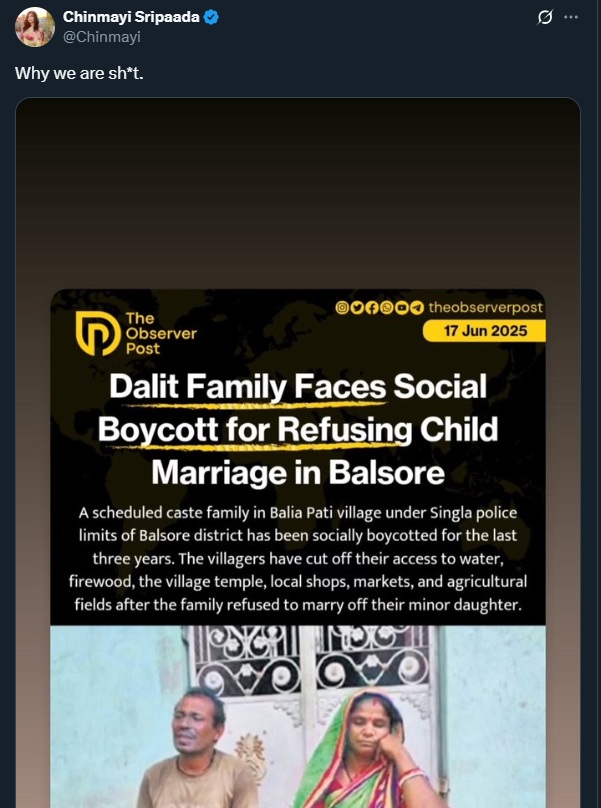
On 23 June 2025, Chinmayi shared a post about a Scheduled Caste (Dalit) family that was boycotted socially by the villagers in Balasore district in Odisha, after the family refused to marry off their minor daughter. Here’s what Chinmayi wrote as the caption to the news clipping – “Why we are sh*t.”
In short, Chinmayi had already made the assumption that it was “upper class” villagers who boycotted the family.
The post she shared was from The Observer Post, a known leftist handle.
What Was The Truth?
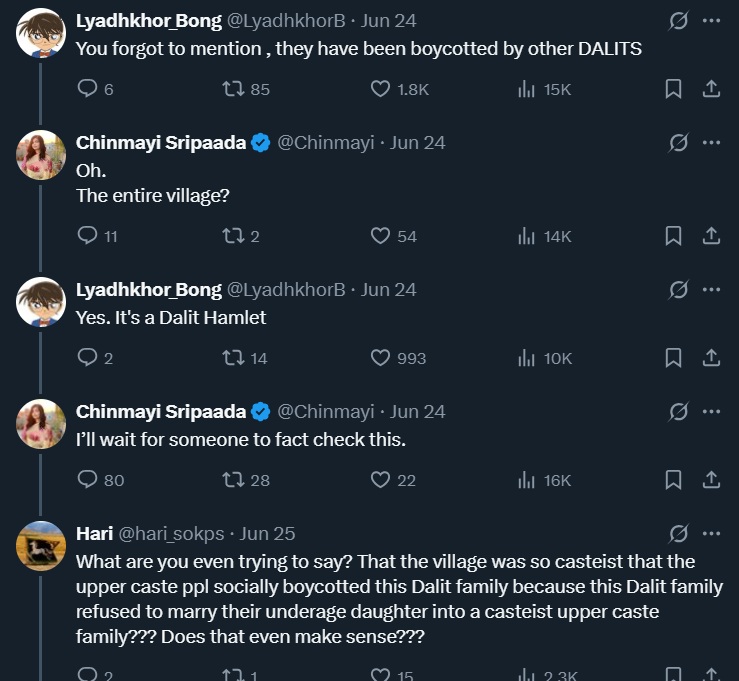
In reality, Chinmayi did not bother to find out or read further that the family was boycotted by other Dalits in the village which is a Dalit hamlet in the first place!
When netizens confronted her with the truth, she simply wrote, “I’ll wait for someone to fact check this.”
Some even shared news links about the village and the issue, however, she did not bother to take down her post nor fact check on her own.
As per a report in Siasat.com, the report read, “When Siasat.com reached out to the police, they denied all claims, saying the complaint was motivated by a recent dispute between Prasant and the head of the village. The police informed that Prasant used to take water from Pradeep’s water cellar for agricultural purposes, but refused to pay him money for it. The police also alleged that Prasant’s daughter, then 14, had eloped with the man willingly was not kidnapped. They also informed that the man is now married and has a son. The police say the boycott is only a few days old, unlike the three years as claimed by a few media reports.”
Another report claims, the issue is only 3 months old.
In toto, it was an internal dispute that was recent and blown up by the media to make it look like some caste discrimination by villainous upper caste villagers on the poor family. Discrimination based on caste is wrong, especially in today’s day and age, but that does not mean one can amplify fake news without doing a basic fact check.
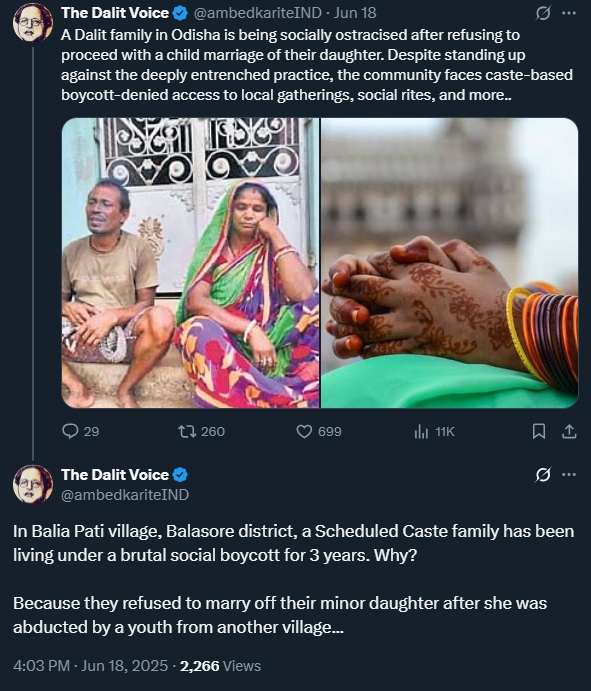
As expected, other self-proclaimed “Dalit” handles alone shared the news, as below:
Netizens slammed her for not checking before posting sensitive news such as these and called out her hypocrisy in hurrying to post anything about marginalized families while painting the upper castes as villains, when reality is otherwise.
Her post is still available on X, and we think it will take an eternity for Chinmayi to understand she has been factchecked multiple times over the past few days.
It is noteworthy that even in the Kalakshetra issue, Chinmayi was too eager to pin down all the blame on the alleged perpetrator – all the while basing her arguments on the flimsy allegation on a teacher in the institution.
Posting without verifying facts and letting such posts remain despite being fact checked is a hallmark of leftists, Chinmayi has morphed into a true-blue leftist – reminds us of the Rajinikanth dialogue in the film Chandramukhi where he tells his friend Saravanan (played by Prabhu) “Look at your wife Ganga, who has morphed fully into Chandramukhi, the dancer.”
Subscribe to our channels on Telegram, WhatsApp, and Instagram and get the best stories of the day delivered to you personally.
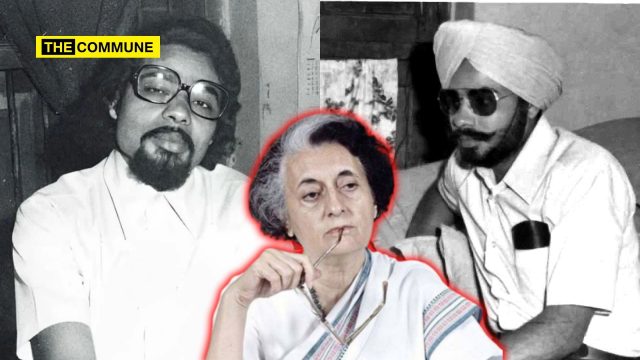
As the nation observes 50th anniversary of Emergency, imposed by the then Indira Gandhi government on June 25, 1975, it also marks a moment to recall the contributions and sacrifices of those who fought against the ‘murder’ of democracy and the suspension of civil liberties and fundamental rights of citizens for more than 20 months.
Modi Story, a popular social media handle on X, has documented some details of the darkest hours of Emergency and also how a young Narendra Modi struggled to defend democracy and safeguard the Constitution as a ‘ground worker’. The X handle also shared some inspiring instances from the dark era, when Narendra Modi juggled between different roles to strengthen people’s faith in democracy and rally students to stand up against the state oppression.
It shared videos of some ‘defenders of democracy’ who worked with young Modi and narrated stories of how he concealed his identity during the Emergency and kept rallying the students to stand up against the dictatorship. Vijay Rajpal, who met Modi for the first time in 1973 at the RSS office in Ahmedabad, recalled that Narendra Modi once took shelter at his house, and it was here that he learnt the art of wearing turban to avoid police lens.
“Narendra Bhai was under the watch of Gujarat police then because of his association with mass movement against Emergency. We went to Chandni Chowk area, where he bought turban and went to Gujarat disguising himself as Sardar,” he recalled. Prakash Mehta, an NRI citizen currently living in Australia, recalled the days of their resistance against Emergency under the banner of ‘Navnirman movement’.
“Police were not allowed inside the campus. We worked as underground workers from this place. Narendra Modi rallied students to stand up against the Emergency. He held secret meetings in hostels and encouraged them to spread the message through graffiti in public spaces. To evade police and act swiftly, he gave them an innovative idea — making steel stencils to spray ‘Emergency Hatao’ in just two minutes!” he recounted.
Daxesh Mehta, former Councillor in Gujarat, also reminisced the days of fightback against Emergency, where he along with young Narendra Modi worked to contribute to the movement against Emergency.
“During the peak of the Emergency, key documents and literature often had to be moved from the RSS office in Ahmedabad — which was under constant police surveillance. To avoid detection, Modi would send young boys to carry them, instead of older men, slipping past street checks unnoticed. A seemingly small task, but it reflected a young Modi’s foresight and strategic clarity even under intense pressure,” he shared in video message. Swami Govind Dev Giri Mahraj, a seer of Shri Ram Janambhoomi Tirth Kshetra Trust disclosed that not many know that during the Emergency, Narendra Modi spent several weeks in solitude, meditating at the Garudeshwar Mandir. One of the anecdotes refers to young Modi’s role as ‘food transporter’.
Nirmal Motwani, a resident of Surat recalled: “One of Narendra Modi’s key responsibilities during the Emergency was looking after the families of jailed karyakartas. On one occasion, the wife of an imprisoned karyakarta requested him to deliver some home-cooked food to her husband. Modi agreed — and despite the constant threat of arrest, he personally went to the jail and delivered the food!”
–IANS
Subscribe to our channels on Telegram, WhatsApp, and Instagram and get the best stories of the day delivered to you personally.
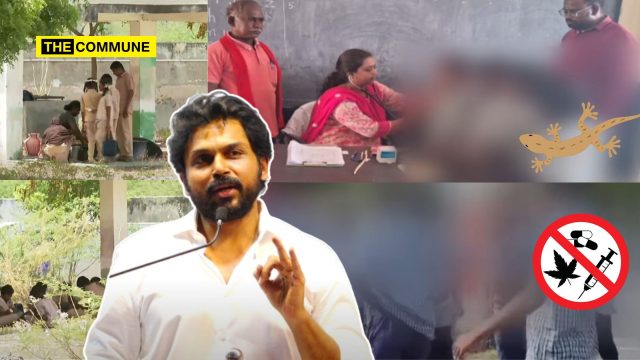
While Dravidianist actor Karthi, whose children reportedly go to elite international schools, showered praise on Tamil Nadu’s School Education Minister Anbil Mahesh portraying government schools as thriving under his leadership — his remarks appear more like political appeasement toward the DMK’s first family than a reflection of reality. On the ground, the condition of government schools in Tamil Nadu tells a very different story. In just the span of two days, multiple alarming incidents were reported across the state: students caught using drugs and even assaulting a teacher who tried to intervene; school toilets being used as kitchens to cook mid-day meals due to lack of infrastructure; and a breakfast program so poorly managed that children were served meals contaminated with lizards. These troubling events cast a harsh spotlight on the actual state of public education in Tamil Nadu far removed from the glowing endorsements of celebrity supporters.
In just two days, multiple disturbing reports have surfaced from different districts across the state.
One such incident took place at the Panruti Government Boys Higher Secondary School in Cuddalore district, where students were allegedly caught using drugs such as Ganja and created ruckus on campus. When a teacher tried to intervene, he was attacked with stones by the students. The shocking event has prompted the public to demand strict measures to curb drug use among students and to provide proper counseling services.
In another case from Ramanathapuram district, the Panchayat Union Higher Secondary School in Thirupalaikudi, R.S.Mangalam Taluk, faces a severe lack of basic facilities. Despite having thousands of students enrolled, the school lacks functioning toilets. Even more alarmingly, the space near the defunct toilets is being used as a kitchen to prepare midday meals. As a result, female students, especially, face serious discomfort and hygiene issues. Local residents have called on the authorities to immediately intervene and ensure that the school is operated under proper conditions, with adequate facilities for cooking and sanitation.
Speaking to the media, a social activist named Thangaraj said, “There’s a higher secondary school in Thirupalaikudi Panchayat, R.S.Mangalam Taluk. Thousands of students are studying there today, but if you see it lacks proper toilet facilities. The very place where students go for toilet is used to cook the midday meals. The cooking area is a toilet. This is causing a lot of hardship for the people, especially the girl students who don’t have proper restrooms. It’s not just the absence of toilets; the cooking area itself doubles as a toilet. We urge the local administration and officials to immediately address this issue and ensure the Thirupalaikudi Government Higher Secondary School operates properly. There are many shortcomings, and we request that they all be resolved.”
Meanwhile, in Anaivari village near Thiruvennainallur in Villupuram district, a deeply troubling food safety lapse occurred at the Panchayat Union Primary School. Over 50 students fell ill after consuming breakfast that allegedly contained a lizard. Several students started vomiting and fainted shortly after eating. They were promptly taken to the nearby Kalpattu Government Primary Health Centre for treatment. Following the incident, two temporary kitchen staff were dismissed, and an investigation has been launched by the School Education Department under the Assistant SSA Project Director.
These incidents collectively cast a grim shadow on the claims of excellence in Tamil Nadu’s public education system. Despite political praise and curated narratives, the lived experiences of students in government schools highlight systemic negligence, poor infrastructure, and lapses in student safety and welfare.
Subscribe to our channels on Telegram, WhatsApp, and Instagram and get the best stories of the day delivered to you personally.
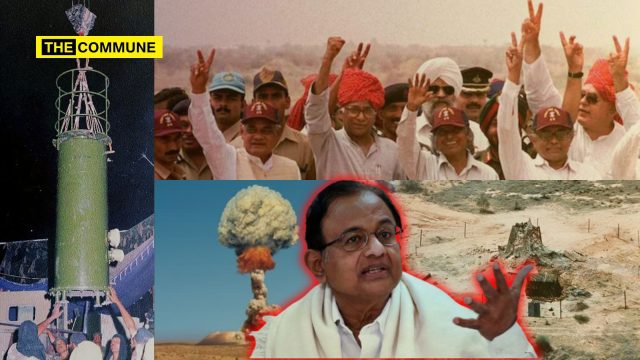
On 11 and 13 May 1998, India made history under the leadership of Prime Minister Atal Bihari Vajpayee by successfully conducting nuclear tests in Pokhran, Rajasthan. The event marked India’s formal emergence as a nuclear weapons state. However, interestingly, not everyone in Parliament welcomed the move. The Congress, especially, was totally against this move.
In a session in Parliament, Congress MP P Chidambaram makes a near half-hour speech urging the NDA government to “abjure weaponization”. He also said there was a “cynical manipulative agenda behind this testing”.
Let’s take a deeper look at his statements in Parliament.
“Vanity Project” and “Cynical Agenda”
In perhaps his harshest criticism, Chidambaram accused the Vajpayee government of triggering a dangerous arms race for electoral gains. He said, “India would have incurred an unbearable cost just to satisfy the vanity of a political party which is a quiet part after the election.”
He went on to suggest that the nuclear tests were a “cynical” ploy to generate nationalist sentiment before elections, not a well-thought-out defense strategy.
Congress Opposed Weaponization, Not Just Timing
While Congress claimed to support the scientific achievements behind the Pokhran tests, Chidambaram made it crystal clear that they opposed the weaponization of India’s nuclear capability. He said, “We are opposed to weaponization, we are opposed to building a nuclear arsenal, we are opposed to inducting nuclear weapons, we are opposed to taking India into an arms race.”
This is not a disagreement over process or transparency; this is a categorical rejection of the national security direction India chose under the Vajpayee government.
Fearmongering About Arms Race
Chidambaram argued that the tests would push India into a perilous arms race with Pakistan and China, claiming that, “You have made both your major neighbours sworn enemies as a result of what you did… and what will they do? They will acquire air defense systems… missiles… and even seek a nuclear umbrella.”
He likened India’s decision to the Cold War’s “Star Wars” arms race, ignoring that India was merely asserting its sovereignty in a volatile neighbourhood, not initiating global hegemony. He said, “You have made both your major neighbors sworn enemies as a result of what you did on lemons and the 13th of May and what will they do they will acquire air defense systems as a scientist can see some of your scientists think that we can get over their air different systems which means they will acquire air different systems which can get over your missiles which can get over your current air defense systems they will acquire surface-to-air missiles they will acquire air-to-air missiles they may even ask superpowers to provide them a nuclear umbrella and then what will you do you will then acquire missiles which can get over their new air defense systems precisely the kind of arms race which Mark the core this is precisely the scenario of Star Wars which the world debunked and criticized and condemned what you are doing in this South Asian theater is a smaller version of the Star Wars in which Russia Soviet Union and the U.S engaged for 30 years and which invited the condemnation of the whole world.”
Claimed 1974 Tests Different From 1998
Trying to prove that the nuclear tests under Indira Gandhi were different, Chidambaram said, “We don’t make a bomb and keep it the basement. Mr Jagmohan asked Mr Natwar Singh what was the difference between 1974 and 1998? The difference was this, Indira Gandhi tested, she did not utter the word weaponization’ you tested and before the mushroom cloud died down, your ministers were talking about weaponization, about mounting warheads and missiles, about an unfinished agenda, about Hot Pursuit, about a fourth War.”
Accusations of “Invented Threats”
Chidambaram even went as far as to accuse the Vajpayee government of manufacturing threats from China. He said, “China was no threat on the 18th of March, China was no threat on the 19th of March, China was no threat on the 8th of April, China was no threat on the 11th or the 13th of May, you have invented a threat in China”
He also said, “China was no threat to India; the last war with China was fought 36 years ago and the circumstances under which that War began and concluded are still surrounded in controversy; the last war with Pakistan was fought 27 years ago.”
This statement has not aged well. Today, with Chinese incursions in Galwan, Doklam, and the PLA’s military buildup in Arunachal Pradesh, Chidambaram’s dismissive tone about the China threat appears dangerously naïve. Additionally, Pakistani soldiers and militants infiltrated into Kashmir (beyond LoC) in 1999 and today, we have the ongoing Operation Sindoor apart from many other terrorist attacks that have been ably aided by the Pakistani Army.
He further said, “Weaponization, induction of this weapon into the Armed Forces, mounting weapons and missiles and aircraft developing missiles to deliver it into enemy territory, these are very serious subjects on which I do not believe your government has a mandate to take a unilateral decision.”
Undermining Strategic Autonomy
Rather than applauding India’s assertion of sovereignty in an unequal global nuclear order, Chidambaram argued, “Possessing nuclear weapons is simply inconsistent with the moral authority that India had acquired over the last 30 years to tell the world that our goal is a nuclear weapon-free state; if you’re seriously a weapon-free world, I urge you I most humbly urge you abjure weaponization until there is a full and proper debate in this country and this parliament of the need to acquire nuclear weapons and to induct them into the Armed Forces it is simply inconsistent it cuts at the very root of our commitment to a nuclear weapon-free state to acquire a whole arsenal of nuclear weapons.”
The Congress position ignored India’s decades-long struggle for recognition as a legitimate nuclear power and instead clung to abstract moralism, a luxury most sovereign nations, especially those surrounded by hostile neighbours, cannot afford.
Congress Wanted Delay, Not Deterrence
Chidambaram claimed that the government had “violated” its own promise of conducting a Strategic Defence Review before any nuclear decision. He mocked the decision to proceed with testing just weeks after Vajpayee assumed power, insinuating that politics and not national interest drove the decision. He said, “You have not discovered a new threat; you invented one.”
Yet, the need for credible deterrence wasn’t new. India had kept the nuclear option open since 1974, and the regional environment post-1998 vindicated Vajpayee’s urgency.
Congress Favoured Signing the CTBT
Chidambaram said he felt betrayed that the opposition was not taken into confidence with regard to the tests. He said, “My fear is that from this point of time this government can take one of three roads. One is a road to a local limited War and I think there are people in this government who would actively canvas to travel down that road. The other is the road to sign the CTBT, there are statements by a number of people including the principal secretary to the prime minister that we are willing to negotiate and accept aspects of the CTBT. I think we should have a full-scale debate on the meaning of that statement. The CTBT is not open to negotiation, it is only open to signature; 149 countries have already signed, and you can sign it up to September ’99. It does not provide for negotiation and who will you negotiate with, who was offered to negotiate CTBT with you. So, the second Road therefore means the road which France and China took; do a few tests acquire some political advantage and quietly sign the CTBT which means all the carefully constructed arguments of the last five years that we will not sign the CTBT will lie in a shambles. The Third Road is a road to elections. Since I do not believe that you have the courage to take us to a war and since I do not believe that you have the skills to negotiate a CTBT, I’m afraid you are cynically taking us to the road to an election. We’re not afraid, we’re only sad, if that is your real agenda say so.”
This would have permanently capped India’s nuclear posture and denied it a credible deterrent — a decision that would have severely impacted India’s long-term strategic parity with China.
A Divisive Stand
Perhaps the most telling line of Chidambaram’s speech was his closing remark, “For the first time in India’s history, India’s foreign policy and nuclear policy, which hitherto enjoyed unprecedented consensus, stand fractured.”
That fracture was caused by the Congress party, not by the tests. By refusing to rise above partisan calculations, Congress broke ranks on one of the most significant moments in India’s post-independence history.
The 1998 Pokhran tests were not just a technological triumph — they were a moment of civilizational assertion. In opposing them, the Congress Party revealed its discomfort with strong nationalist posturing and its preference for global approval over sovereign assertion.
Today, when many Congress leaders attempt to claim credit for India’s nuclear capabilities or wrap themselves in the tricolor of nationalism, their 1998 record speaks otherwise.
Did you know that former PM Rajiv Gandhi championed the cause of nuclear disarmament?
At a time when China had become a nuclear power and Pakistan was stealthily advancing its nuclear weapons programme with covert international support, Rajiv Gandhi chose to champion global nuclear disarmament.
In 1988, he presented an Action Plan for a Nuclear-Weapons-Free and Non-Violent World Order at the United Nations General Assembly. While idealistic in tone, the plan was seen by many as disconnected from India’s strategic necessities amid an increasingly hostile neighborhood.
“India remains convinced that its security would be strengthened in a nuclear weapon free and non-violent world order,” the plan stated. “We are prepared to negotiate a global No-First-Use treaty… Our proposal for a Convention banning the use of nuclear weapons remains on the table.”
While India’s moral commitment to non-proliferation was commendable, this disarmament push during an era of nuclear arms build-up in both China and Pakistan signaled strategic naïveté rather than pragmatic leadership. Critics say such posturing weakened India’s bargaining position and gave adversaries room to maneuver. Critics argue this emboldened Islamabad’s asymmetric warfare, culminating in Kargil (1999) and 26/11 (2008).
Subscribe to our channels on Telegram, WhatsApp, and Instagram and get the best stories of the day delivered to you personally.
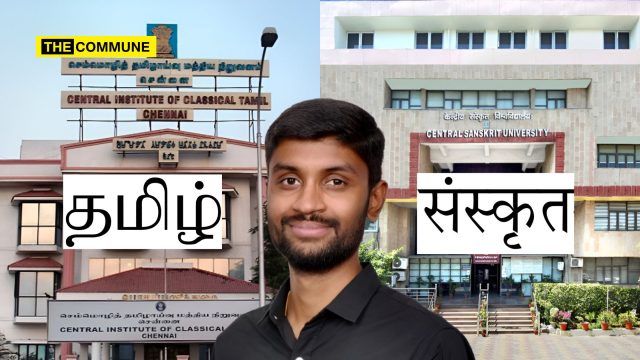
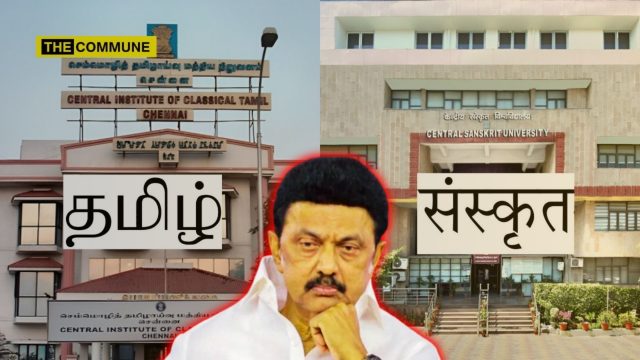
After the propaganda around Keeladi, the Dravidianists seem to be upping the ante on propaganda around Sanskrit and government funding.
An article in Hindustan Times stated that the central government spent “₹2532.59 crore on the promotion of Sanskrit between 2014-15 and 2024-25, 17 times the combined spending of ₹147.56 crore on the other five classical Indian languages – Tamil, Telugu, Kannada, Malayalam and Odia, according to the data obtained by Hindustan Times through a RTI application and from public records.”
The central government spent ₹2532.59 crore on the promotion of Sanskrit between 2014-15 and 2024-25, 17 times the combined spending of ₹147.56 crore on the other five classical Indian languages –– Tamil, Telugu, Kannada, Malayalam and Odia, according to the data obtained by… pic.twitter.com/dzpjbrZbtN
The truth, however, is that these numbers largely reflect the operational costs of three central Sanskrit universities, originally established during the Congress-led UPA era, with annual budgets of ₹150–₹200 crore. These universities alone account for over ₹1,500 crore of the total Sanskrit spending.
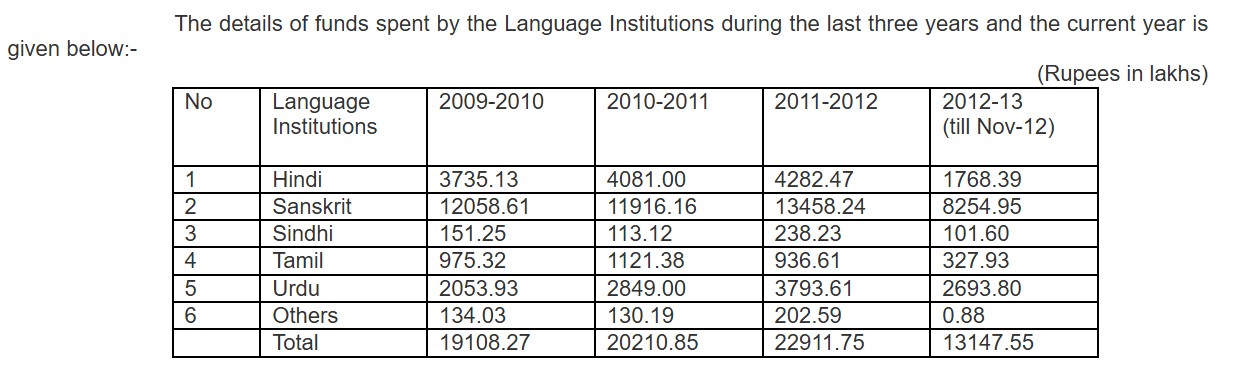
Unlike Sanskrit, regional language institutions are usually established and run by state governments, with central support extended through bodies like the Central Institute of Indian Languages (CIIL) and the Central Institute of Classical Tamil (CICT) in Chennai. Funding discrepancies are not a new phenomenon. Under the UPA, similar patterns existed: for instance, in 2009–10, Sanskrit received ₹120.58 crore while Tamil received ₹9.75 crore. In 2011–12, Sanskrit was allocated ₹134.58 crore versus ₹9.36 crore for Tamil, yet the DMK, with six ministers in the cabinet, did not protest the imbalance.
The Tamil University in Thanjavur remains the only dedicated classical Tamil institution in the state and was founded by M.G. Ramachandran, not the DMK. Despite this, Dravidian parties continue to demand increased central funding without initiating substantial academic infrastructure or programs themselves.
While accusations of central bias persist, the data suggests long-standing structural factors, not a targeted exclusion. Unless similar universities for classical Tamil and other languages are centrally established, the Sanskrit funding gap will remain. Critics argue that political rhetoric has overshadowed practical efforts to strengthen Tamil as an academic and economic asset.
Dravidianist Journo Peddles Same Propaganda
Amid this, Dravidianist and DMK supporting ‘journalist’ known for peddling their propaganda and lies also amplified this report. On his X handle, he wrote, “Centre spent ₹2532.59 crore on the promotion of Sanskrit between 2014-15 and 2024-25, 17 times the combined spending of ₹147.56 crore on the other five classical Indian languages –– Tamil, Telugu, Kannada, Malayalam and Odia.” and shared the article link.
Arvind Gunasekar – The Dravidianist Buttresser
Apart from peddling Pakistani propaganda during Operation Sindoor, he has always buttressed the DMK and amplified all types of fake news if it matters even a little bit to the ruling DMK. Here are a few instances where he did the same.
Twisted Facts To Defend DMK Govt Not Following SOP Of National Anthem
In the wake of Tamil Nadu Governor RN Ravi’s walkout from the Assembly over the omission of the National Anthem at the session’s start on 6 January 2025, journalist Arvind Gunasekar drew criticism for defending the state government’s stance. Gunasekar argued that the Assembly followed tradition by playing the state song, Tamil Thai Vaazhthu, first and the National Anthem at the end. However, Gunasekar was actually feigning ignorance to constitutional protocol, which mandates playing the National Anthem at both the beginning and end of the Governor’s address. The Governor’s office condemned the omission as disrespectful to national symbols. Gunasekar’s claims, including that the Speaker is the sole authority in the Assembly and that the Governor sought to boycott the session, were constitutionally incorrect and misleading.
Buttressed VCK MP Thirumavalavan Over His Rubbing Off Vibhuti From Forehead
A few days ago, a video of VCK leader Thol. Thirumavalavan wiping off vibhuti from his forehead in front of a camera, moments before posing for a selfie, sparked controversy online, with critics accusing him of calculated religious posturing to appease minority sentiments. Although he had accepted vibhuti and a garland during a temple visit, his deliberate removal of the ash drew sharp criticism, especially after photos emerged showing him at a dargah wearing a skullcap. Arvind Gunasekar defended Thirumavalavan, dismissing the backlash with a sarcastic remark: “So, one can’t wipe their own face in ‘New India’?” This response drew further criticism for his hypocrisy, with detractors accusing Gunasekar of acting as a spokesperson for the DMK-Congress-Left ecosystem while selectively targeting the BJP.
Hyped Up DMK Coimbatore MP Candidate As Doctorate In Journalism, Ph.D Thesis Was On Jayalalithaa
In April 2024, a video of an interview with DMK’s Coimbatore LS candidate Ganapathy Rajkumar was shared on social media. This prompted journalist Arvind Gunasekar to praise him as a “calm and composed” leader with a “PhD in Journalism.” However, this claim drew scrutiny from netizens, who discovered that Rajkumar’s doctoral thesis was actually titled “Emergence of Jayalalithaa as a Mass Leader.” Completed in 2015 at Bharathiar University, the thesis analyzed Jayalalithaa’s leadership through public perception surveys and praised her political acumen, even drawing comparisons to global female leaders. Rajkumar’s open admiration for the late AIADMK leader, including reportedly performing a Gaja Puja for her after completing his PhD, sparked online mockery, especially since he is now contesting as a DMK candidate against AIADMK. Gunasekar’s endorsement was ridiculous and exposed his sycophancy of both the thesis and his love for the DMK.
Buttressing Max For DMK Govt Even As People Suffered Amid Rains
In October 2024, as Chennai was grappling with waterlogging, and road closures following heavy rains, Arvind Gunasekar praised the DMK government’s handling of the deluge, calling it well-coordinated and crediting political leadership for improved preparedness. In a post on X, he claimed that flooding was less severe than in previous years and that people “should not be scared of NEM anymore.” However, many residents reported continued flooding, inundated homes, and poor drainage across key areas like Kolathur, Velachery, and Pallikaranai. Gunasekar’s enthusiastic praise ignored on-ground realities and served more to bolster the government’s image than reflect actual conditions. Despite the DMK’s claims of having spent ₹4,000 crore on stormwater systems, persistent issues highlighted chronic infrastructure failures and poor planning.
Subscribe to our channels on Telegram, WhatsApp, and Instagram and get the best stories of the day delivered to you personally.
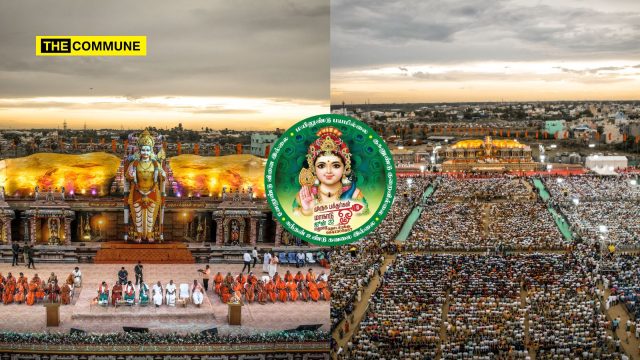
In a remarkable contrast to typical public gatherings especially in Tamil Nadu, the recently held Murugan Devotees Conference in Madurai organized by the Hindu Munnani has received widespread praise not only for its massive turnout but also for the discipline and cleanliness maintained throughout the event. What stood out even more was an unexpected observation from TASMAC employees that liquor sales remained unchanged during the conference, unlike the usual surge seen during political rallies or other public events.
Typically, large-scale political meetings in Madurai bring in thousands of people, many of whom are transported in buses and vans arranged by organizers. Often, such gatherings involve daily-wage attendees, mobilized by agents. These events usually lead to increased liquor consumption, evident in the heavy sales at TASMAC outlets, and leave behind a trail of litter plastic waste and empty liquor bottles scattered across the grounds.
However, during the recent Murugan Devotees Conference, things unfolded very differently. Despite a crowd of lakhs, the venue remained pristine. No liquor bottles, no plastic trash just a well-managed, clean space. Even after the event ended, volunteers from Hindu Munnani and other groups stayed behind to clean and organize the area. By the next morning, Amma Thidal, the venue was spotless, with all chairs neatly arranged and not a trace of the massive crowd that had gathered.
No TASMAC Sales?
TASMAC officials confirmed that they anticipated a spike in liquor sales, as is usually the case during such large gatherings. Shops in both divisions of Madurai—North and South—had stocked up in expectation. Yet, the sales data told a different story. On 14 and 15 June 2025 – 9,415 and 10,900 bottles were sold, respectively. On 21 and 22 June 2025, which coincided with the conference, the sales were 9,140 and 11,200 bottles—figures that show no significant increase.
TASMAC officials remarked, “Normally, political events lead to a noticeable jump in liquor sales in the surrounding areas. But during the Murugan devotees’ gathering, we saw no such spike. The devotees stayed away from liquor shops, reflecting the event’s spiritual focus and disciplined crowd. If this had been a political rally, the revenue from alcohol sales would have been substantially higher.”
Aside from TASMAC outlets, around 80 private establishments—clubs, bars, and hotels—operating in the Madurai district also reported no noticeable rise in liquor sales during the event.
This disciplined and dignified behavior by Hindu devotees has set a new benchmark for public gatherings, both in terms of crowd conduct and cleanliness. It has highlighted the difference between faith-driven events and typical political mobilizations, with the former emphasizing spiritual focus and social responsibility over indulgence.
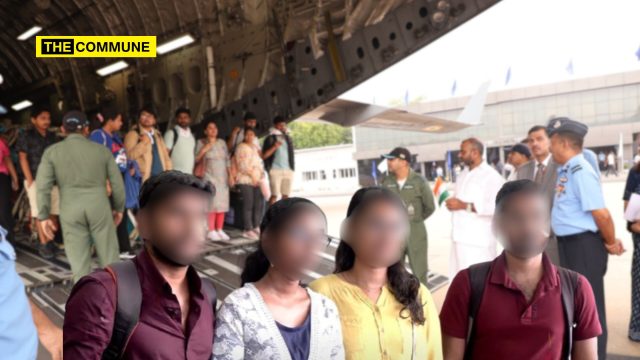
Students from Tamil Nadu who were evacuated from Israel under Operation Sindhu have voiced concerns that the Tamil Nadu state government failed to make any arrangements for their travel from Delhi to their respective hometowns.
Amid ongoing tensions between Iran and Israel, the Indian government launched Operation Sindhu to safely evacuate its citizens from the conflict zones. Among those rescued were five students from Tamil Nadu who had been pursuing their studies in Israel. These students expressed gratitude to the central government, particularly Prime Minister Narendra Modi, for ensuring their safe return to India.
However, they criticized the Tamil Nadu government for not assisting them with their onward journey from Delhi. According to the students, after arriving in the capital, they were left to fend for themselves without any state-supported arrangements, including the lack of flight tickets. After traveling for three days, they had to cover the cost of their own air travel to reach Coimbatore.
In their statements to the media, the students shared their frustration over the lack of support, highlighting the challenges they faced upon their return. The five students arrived at Coimbatore airport safely by flight 24 June 2025 evening.
One of the students speaking to the media said, “We reached Kuwait after a lot of difficulties. We arrived in Kuwait from Amman (Jordan). After we arrived, we were put on a flight from Kuwait and were on our way to Delhi when suddenly, Qatar’s airspace was closed. Because of that, we were sent back to Kuwait. From there, the Indian Ministry of External Affairs helped us a lot again. We are very grateful to the central government for that. Then, as soon as we arrived back in Delhi, the Tamil Nadu government came to pick us up. But the problem was, they weren’t able to help us properly this time. They said they would arrange train travel for us. However, our journey had started at 3 AM on a Sunday, and after all the hardships we faced, undertaking another train journey of three or four days was impossible for us. We were in a difficult situation, so we asked them to arrange flight tickets for us. But they couldn’t do that. They were unable to help us this time, and that’s a bit disappointing for us.”
He added, “Last Thursday, when we contacted the Indian Ministry of External Affairs in Israel, they immediately helped us. We were the first to be evacuated. The Indian central government greatly assisted us in crossing the borders from Jordan and Egypt.”
Another female student expressed appreciation for the Indian government while criticizing the DMK-led state administration, stating that they hadn’t received the same level of support as in previous years. She remarked, “A big thanks to the Indian government! However, the last time we came, the Tamil Nadu government had arranged flights from Delhi to Tamil Nadu. But this time, no one arranged anything. We had to book our own tickets after arriving here. Last time, there were about 50-60 of us from Tamil Nadu, and they even dropped everyone off at their homes. This time, the Tamil Nadu government did come to the airport, but they only offered to book train tickets if we wanted them. It would take three days to reach here from Delhi by train.”
Another student, recounting his experience of being stranded in the conflict zone, said, “Like our friends said, we were all quite scared because bombs were falling very close to where we were staying. We were always in bunkers, only coming out to eat or in emergencies. We were in a very difficult situation. Even though the Indian government rescued us and brought us out, it wasn’t easy at all; we faced many hardships. We spent a full day traveling through Jordan. Then, we went to Kuwait and faced many difficulties there as well. We’re happy to have finally made it back, despite everything we went through.”
Operation Sindhu
On 24 June 2025, India successfully evacuated over 1,100 citizens from Iran and Israel amid escalating tensions between the two nations, raising the total number of people brought home under Operation Sindhu to 3,170.
From Israel, 594 Indians were repatriated, with the Indian Air Force deploying C-17 heavy-lift aircraft to airlift more than 400 individuals who had first been transported by land to neighboring Jordan and Egypt. An additional 161 Indians who had reached Amman, the capital of Jordan, by road were flown back to New Delhi via a chartered flight.
In parallel efforts from Iran, India evacuated 573 citizens along with three Sri Lankan and two Nepalese nationals using two chartered flights, according to the Ministry of External Affairs (MEA).
With these latest operations, the total number of Indians evacuated from Iran alone has reached 2,576. Since the initiation of Operation Sindhu following the flare-up in hostilities between Iran and Israel, India has now rescued 3,170 of its nationals from both conflict zones.
Subscribe to our channels on Telegram, WhatsApp, and Instagram and get the best stories of the day delivered to you personally.
The unapologetic Dravidian camp continues to push narratives aimed at fueling resentment against the central government by repeatedly invoking Tamil identity and sentiments. This pattern began with accusations that the Centre was sidelining Tamil heritage, notably through a peer-reviewed article in a newspaper alleging that the Archaeological Survey of India (ASI) failed to properly recognize the Keeladi excavations — a claim that has since been discredited.
Now, their latest line of attack suggests that Sanskrit is receiving disproportionate funding compared to South Indian languages under the Ministry of Education. However, this claim omits key context: the funds in question are allocated to key 18 Central Universities including Central Sanskrit Universities (CSUs), established under the Central Sanskrit Universities Act, 2020, with campuses in New Delhi and Tirupati. Meanwhile, the Central Institute of Indian Languages (CIIL) in Mysuru continues its mandate to support and promote all Indian languages — including the four classical South Indian languages: Kannada, Telugu, Malayalam, and Odia.
A recent report has stirred controversy by revealing that the central government allocated ₹2,532.59 crore for the promotion of Sanskrit between 2014-15 and 2024-25 — a figure approximately 17 times higher than the combined expenditure of ₹147.56 crore for the other five classical languages: Tamil, Telugu, Kannada, Malayalam, and Odia. This information, sourced through a Right to Information (RTI) request and public records by Hindustan Times, was amplified by pro-DMK journalists such as Arvind Gunasekar, adding further fuel to the debate.
However, critics argue that this disparity needs to be seen in context. The central government runs three Sanskrit universities that were originally established in Congress era. Among the crucial three operating budgets for these institutions now range between ₹150 to ₹200 crore annually, accounting for nearly ₹1,500 crore over the past decade. Of the ₹2,345 crore reportedly spent on Sanskrit, this comprises the overwhelming majority.
In contrast, universities promoting regional languages are typically established and funded by the respective state governments, as Sanskrit is not the primary language in any of the states except Himachal Pradesh and Uttarakhand. The central government does provide limited financial assistance to such institutions, including support for specialized centers like the Central Institute of Classical Tamil.
Importantly, the trend of funding Sanskrit heavily is not new. During the Congress UPA administration (2004–2014), six Sanskrit universities were established in various states — including Assam and Andhra Pradesh, both governed by the Congress at the time. These institutions are state-run but affiliated with the University Grants Commission (UGC).
There is no substantial evidence to suggest a shift in funding policy under the current administration that disadvantages other classical languages. In fact, examining past budget allocations under the UPA dispels claims of bias. For example, in 2009–10, Sanskrit received ₹120.58 crore, while Tamil was allotted ₹9.75 crore and other classical languages received just ₹1.34 crore. In 2010–11, allocations stood at ₹119.15 crore for Sanskrit, ₹11.21 crore for Tamil, and ₹1.3 crore for the others. Similarly, in 2011–12, Sanskrit was granted ₹134.58 crore, Tamil ₹9.36 crore, and others ₹2.02 crore.
What’s more, during that very period, the DMK — which now vocally criticizes these funding patterns had six of its members serving as Union Cabinet ministers, yet raised no significant objections to the allocation disparities at the time.
In many years, Tamil alone received more funding than Kannada, Malayalam, and Telugu combined — a fact supported by data. Unless the government chooses to either shut down the three central Sanskrit universities or begins establishing and funding similar institutions for other classical languages, funding disparities will naturally remain. Curiously, there was little public outrage over this imbalance during the UPA era, particularly between 2004 and 2011 — a period when these policies were already in place.
Contrary to the claims made by the Dravidianist ecosystem—particularly the DMK—there is currently only one university in Tamil Nadu dedicated solely to the study of classical Tamil: Tamil University in Thanjavur. This public state university, focused on advanced research in the Tamil language, was established in 1981 not by the DMK, but by former Chief Minister M.G. Ramachandran during an AIADMK-led government.
Additionally, the Central Government has taken steps to promote Tamil through the establishment of the Central Institute of Classical Tamil (CICT), which operates under the Ministry of Education. The CICT, originally announced in 2006, is tasked with the development and promotion of classical Tamil at the national level.
Central Govt.runs 3 Sanskrit Universities all started in the 60's and 70's . The budget for running these 3 Universities has increased to ₹150-200 crore for all 3 together per annum and this alone is almost ₹1500 crore over 10 years. Of the ₹2345 crore spent on Sanskrit over… https://t.co/zG3Y7Umr9kpic.twitter.com/pF5NLPBKTi
Yet, despite these institutions already in place, Dravidian parties continue to demand more central funding—without taking concrete steps to establish new universities or programs that would make Tamil a viable academic and economic option for students, educators, and researchers. Rather than building meaningful infrastructure, the issue is often reduced to political rhetoric, framed in opposition to the Centre’s support for Hindi and Sanskrit.
Subscribe to our channels on Telegram, WhatsApp, and Instagram and get the best stories of the day delivered to you personally.
In a significant order touching upon religious and cultural sensitivities, the Madurai Bench of the Madras High Court has ruled that Thiruparankundram Hill shall not be referred to as either ‘Sikkandar Malai’ or ‘Samanar Kundru’, affirming that the hill must be referred to exclusively as “Thiruparankundram Hill.”
The verdict came as part of a batch of writ petitions involving disputes over religious rights, cultural identity, and animal sacrifice practices on the hill, which is home to both the historic Arulmigu Subramaniya Swamy Temple and the Sikkandar Badhusha Dargah.
Delivering her order, Justice S. Srimathy stated unequivocally in paragraph 43 of the judgment: “The Thirupanrankundram Hill shall be continued to call as Tirupanrankundram Hill alone. The Thirupanrankundram Hill shall not be called either as Sikkandar Malai or as Samanar Kundru.”
The court further emphasized the protection and preservation of the site, banning quarrying on the hill and imposing restrictions on any construction or renovation. “Any quarrying of the Tirupanrankundram Hill is hereby prohibited. For any construction or renovation work of Dargah, the Managing Trustee shall approach the Archaeological Department…”
In a split verdict on the issue of animal sacrifice at the Dargah, Justice J. Nisha Banu observed that such practices were traditional and not legally prohibited, noting that the Tamil Nadu Animals and Birds Sacrifices Prohibition Act, 1950 was repealed in 2004.
However, Justice Srimathy dissented, calling the announcement of animal sacrifice through pamphlets “mischievous and malicious” and held that the dargah must approach a civil court to establish whether such practices were prevalent before the 1920 civil court decree.
In light of this judicial divergence, the matter has now been referred to the Chief Justice for appropriate further orders.
The verdict also includes directions on amenities and site management. Notably, the court ruled that road, water, and toilet facilities on the hill would not be granted in order to prevent ecological damage. The court also ordered a comprehensive survey by the Archaeological Department to demarcate protected monuments, the temple, and the dargah.
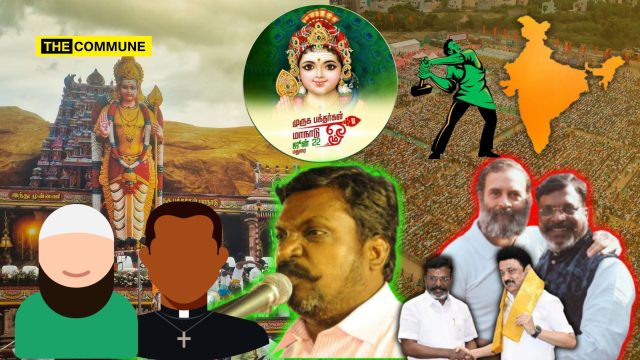
In a fiery and ideologically charged speech delivered on 24 June 2025, Viduthalai Chiruthaigal Katchi (VCK) chief Thol. Thirumavalavan launched a scathing attack on the recently held Murugan Devotees Conference, branding it a political ploy by the BJP and its allies to manipulate Tamil religious identity for Hindutva gains. Speaking at an event to honour ‘secular leaders and intellectuals’, Thirumavalavan warned of a growing attempt to ‘communalize Tamil Nadu’s public life’.
He began by describing why his party ideology and why Ambedkar’s dream were still a dream in our country and then he started attacking the Sangh parivar, the conference and all things Hinduism.
He proudly stated that the meeting held in Trichy earlier this month “pierced the belly of the Sanatana forces.” It is noteworthy that the meeting was to “uproot Sanatana Dharma”.
After praising the “blue organisations”, he continued praising how the VCK started working towards bringing Periyarism, Marxism, Communism with Ambedkarism – that their one goal is to uproot Aryanism.
He claimed that the number of seats contested in elections is something that VCK is not concerned about, but the party is working towards realising Ambedkar’s dream.
“Existing India Should Be Destroyed”
He claimed that secularism is getting sharpened and that is “thanks to the BJP”.
He further said, “We do not criticize, oppose, or hate the BJP on the basis of just being a political party and wanting to defeat them in the elections. The ideology that they promote and prioritize is the most important. Why did Ambedkar create this Constitution? Why did he state that we are going to build a new India? Why did he want to destroy the existing India? That is the question. A nation called India has already been formed here. It has been created by the white man. Even though it is scattered among various religions, a unity called India has already existed here and continues to exist. But that India should not continue, it must be destroyed. It should be destroyed. A new India should be built. It should be an India without caste discrimination. It should be an India without gender discrimination. Discrimination between men and women. The existing India is a discriminatory India. The India desired by revolutionary leader Ambedkar is one of equality. Why does India have discrimination? It exists because the caste social system persists. The ideology that men are superior and women are inferior is entrenched here. Therefore, if we want to build a new India where this discrimination is dissolved, the government established here should be a secular government. This is the problem here.”
Attacking BJP, RSS
Thirumavalavan reserved his harshest criticism for the BJP and RSS, framing them as enemies of Tamil identity and secularism. He said, “The Sangh Parivar’s ultimate goal is not to drive out Muslims or Christians. They know that Muslims and Christians are the original inhabitants of this land. None of them came from Arabia or Europe. They are not a group that occupied this land. They are the sons of this land. The original inhabitants have converted to Islam and are Christians. They (Sangh) know that but only if they sow hatred against them and unite the majority Hindus and retain power, can they overthrow the Constitution. They can destroy the dream of the revolutionary leader Ambedkar. This is the purpose of the Sangh Parivar. Don’t think that they are trying to grab the post of Chief Minister of TN, or that the post of Prime Minister is their ultimate goal and final destination. They want to continue in that position, to retain power, to have a government of their choice in all the states, and the reason for this is that the Constitution, formulated by the revolutionary Ambedkar, is creating a new India.”
He claimed, “One thing that cannot be destroyed by such nuclear weapons is the caste social structure in India. It cannot be destroyed by any weapons. Because it has an ideological form.”
State Religion Cannot Be Hinduism
On the topic of religion-based countries, he said, “They ask very simply, all countries have a religion, a state religion, why should it not be in India? The state religion is Buddhism for Sri Lanka, Islam for Pakistan, Christianity for America, Buddhism is the state religion in all South Asian countries, Christianity is the state religion in all European countries, Islam is the state religion in all Arab countries. Why should India not have a state religion? Good question. Logically, it is correct. This is correct on the basis of logic, but which religion can be made the state religion of India? Which religion is followed by the majority of the people here? Isn’t it a religion full of discrimination? It is the religion followed by the majority of the people here. That is what is said. At one time, this was not a form of Hinduism.”
Then he claimed that Lord Muruga had his own religion. He said, “Murugan himself had his own religion. The Lord Murugan we worship is called Kaumaram in the Sanskrit, and Kumaram in Tamil. There was a religion called Kumaram. That is the six religions – Shanmatham. Saivism, Vaishnava, Kanapathiyam, worshiping Ganapati, that religion is called Ghanapathiyam, Kaumaram, worshiping Murugan, Sauram, worshiping the Sun, Shaptham, worshiping Shakti. These are all the names of religions. In the northern language, these six religions are called Hinduism by combining them in Sanskrit. These are all separate religions. Saivism is another religion. Vaishnavism is another religion.”
Then he brought in Adi Shankara, he said, “Many people tried to bring all the religions together for many years, including Adi Shankara. Then there was no Hindu religion. The religion of the Brahmins at that time was the Vedic religion. Theirs was not Hindu. The Shaivism religion was not Hindu. The Vaishnavism religion was also not Hindu. No, all this happened after the arrival of the white man, in the early 1800s, in the 19th century, and now we have the 21st century. The change that occurred 200 years ago is that a religion called Hinduism never emerged. It is impossible to say who created this. The founder of Islam was the Prophet Muhammad. The founder of Christianity was Jesus. The founder of Buddhism was Gautama Buddha. The founder of Samanam (Jainism) was Mahavira. No one knows who created Hinduism. It is impossible to say who created [Hinduism]… There is no evidence for it.“
He continued, “If we say why this has not been declared as the state religion, then this religion is fundamentally a religion with discrimination. No religion in the world accepts superiority or inferiority based on birth. All religions have only brotherhood as their basic principle. The soul, this life-breathing principle, is fraternity.No matter which religion you choose, there is brotherhood in it. Let us be brothers and sisters. Let us cultivate love. That is what Buddhism says. In Buddhism, there is no God, no worship, no rituals, no traditions. It is the only religion that talks about individual morality and social morality. At that time, the followers of the Vedic religion spread it as an atheistic religion. That is why they destroyed Buddhism by calling it an atheistic religion. “
Hinduism Does Not Talk Of Brotherhood/Fraternity
Continuing his venomous speech, he said, “Buddhism talks about brotherhood. Islam talks about brotherhood. Jainism talks about brotherhood. Christianity talks about brotherhood. Does Hinduism talk about brotherhood? I could not enter the sanctum sanctorum. Those who are angry at me for rubbing off the vibhuti, are you ready to take me inside? Can you hold a protest to take me into the garba griha of the temple?”
He further said, “He is not able to accept me as his brother. He is trying to defeat you and me in hypocritical politics by saying that you are a devotee of Lord Muruga. Since there is no brotherhood in Hinduism, the Constituent Assembly debated extensively and took the position that this religion should not be officially declared as the state religion through the Constitution. Because if it is the state religion, the Constitution will approve this discrimination. The Constitution itself will recognize discrimination.”
Lord Murugan Lived Like Us
Moving on to the topic of Lord Murugan, he said, “You are calling me a Muruga devotee. Are there only Muruga devotees in Tamil Nadu? There are more Ayyappa devotees than that. If we have to talk about the story of Murugan, we will have to talk for hours. Our land is Tamil land with five types of land. In it, Murugan is the leader of Kurinji soil. Murugan is the leader of Kurinji millet. He was born like us, lived like us, led our people, is what our literature says. Tamil literature says that. Sangam literature says that. He is not a character that can be found in Puranas. We have literatures that mention that Murugan was born, grew up, lived, and ruled the people. They have made him Subramaniam. Comrades, you should know one truth no Brahmin would name his child Murugan. Are the RSS workers, these Murugan devotees ready to answer this comment? Bring any person and ask him if he is by caste Brahmin but his name is Murugan – is that possible? Maybe if he says that, he will call it Skandan. It is Kandan in Tamil and Skandan in Sanskrit; in North India this idea has gone there. What is his name there? Subramanian Su-Brahminian. The SUbramanian that they claim to be theirs does not fit in our story. That Subramanian is not the leader of Kurinji millet. Our Murugan is the leader of Kurinji Millet. That is there in our Sangam literature. There is only Arupadaiveedu (6 holy abodes) of Murugan in TN alone, which other state do you have it? That’s why I raised a question that some people couldn’t tolerate. If Murugan is a Tamil god, his father Shiva can also be a Tamil god. If Murugan is a Tamil god, then Shiva is Tamil man and Parvathi is a Tamil woman. If both of them are in Kailash, then Kailash is the land of Tamils. Then the whole of India is the land of Tamils. If Lord Shiva lives in Kailash, then Kailash also belongs to Tamils. From Kailash to Kanyakumari, Lord Shiva is a proof that Tamils lived. According to that story, Shiva was a Tamil and Parvati was a Tamil woman. So, Ganapati can also be a Tamil. Why doesn’t anyone call Ganesha a Tamil god? If he hears all this logically, he gets angry. Why are we the only ones being humiliated? These stories don’t exist in other religions. If there were such mythological stories in other religions, Tell me, let’s talk.”
He went on to claim that ‘they’ were stealing their identities and history, gave them new identities, gave new explanations, only to divide and destroy the Tamils.
Speaking to the plastic chair incident, he said, “I may suddenly say that I don’t want to go the electoral path, I may say that one day. These people are weighing us like an average. They think I am doing it for money or plastic chair, that is all their intelligence. If I am sitting on the floor, on a plastic chair, or on a sofa, it is not a big deal to someone who thinks that everything is the same. If I am sitting on a sofa, it is normal. If I am sitting on a big stool, it is nothing.”
Connecting EV Ramasamy Naicker & Ambedkar
Continuing his speech, he said, “They are trying to put a wedge in the Constitution itself. They will celebrate Ambedkar Jayanti. They will erect a statue of Ambedkar, touch his feet and worship him, but they are trying to destroy the constitution that was framed by him and making it watered down. To understand this, you need Ambedkar’s glasses, you need Periyar’s glasses. Periyar himself criticized Ambedkar himself at one point. There is a report that when Ambedkar died, Periyar reportedly said that Ambedkar should also be worshipped in the same way as Buddha, Jesus, Allah, etc. Periyar had such respect for Ambedkar that he put him in that row. That Periyar had to say that we will burn the Constitution written by Ambedkar. He organized that protest. Why did he organize it? It was not because he had any hatred for Ambedkar. The two men were so different, but they were close friends. If he came to Tamil Nadu, Ambedkar would definitely meet Periyar.”
Then he explained why EVR wanted to burn the Constitution. Thirumavalavan claimed, “What Periyar said is that the Constitution gives freedom to all religions and gives them the right to spread their views and beliefs. By giving that freedom, Hinduism also gets that right. Therefore, the Constitution itself gives them space to spread superstitions again and again. So Periyar raised a war cry against it and for that, he waged a struggle that destroyed that part of the Constitution. Ambedkar burned Manusmriti. The alternative to Manusmriti is the Constitution of India. The Manusmriti that was there then is what created the India of today, the discriminatory India we are seeing today which is made by Manusmriti. The India we are in was created by Manusmriti and to destroy it the revolutionary leader Ambedkar created the Constitution.”
Again, attacking Hinduism he said, “They claimed Muslims and Christians are deceiving the poor and simple Dalit people and converting them. How can someone be deceived and converted? Those who could not bear these atrocities converted themselves. All the Muslims in India may have been descendants of ancestors who suffered such atrocities at one time. On the basis of caste, everyone is a Dravidian, in their eyes, everyone is a Shudra, so they had atrocities. Caste atrocities are not only against SC, ST. The caste system is against every caste. Caste eradication is not a demand for SC, ST people. It is the demand of everyone who wants brotherhood, it is the demand of everyone who values democracy, it is the demand of everyone who wants equality.”
How Can One Talk Of Tamil Nationalism Without Periyar?
In what seemed like an attack on NTK chief Seeman, Thirumavalavan said, “Are any of the Tamil nationalists here talking about caste eradication? The bigger absurdity is that they are talking of Tamil nationalism by standing against Periyar. How can you be a force in support of Tamil nationalism when you cannot even identify who the real enemy of Tamil nationalism is? Those who speak Tamil nationalism are talking about fake Tamil nationalism. In reality, if there is something that is against the Tamil nationalism, it can only be Indian nationalism. How can Telugu be against Tamil nationalism? How can Kannada be against Tamil nationalism? Each should build their own nationalism. Each nationalism should unite and build a united front. They are creating Indian nationalism by flowing, which is the Hindu nationalism presented by the BJP today. There is religious nationalism. Without talking about all that, without opposing all that, without making fun of all that, without saying that they are the reason for all this, without talking about the big businessmen like Adani Ambani who are behind them, and if they say that they are going to oppose Periyar, then you should understand whose people they are.”
Attacking ADMK
He accused the ADMK of betraying Tamil politics by aligning with the BJP. He said, “ADMK is just thinking of political gain and today they are joining the Bharatiya Janata Party and justifying it and talking. If they were loyal to MGR and Jayalalithaa as they are, they would never have joined BJP. I have respect for Edappadi Palaniswami. You are making a huge historical mistake.You are converting all the ADMK cadre who have grown up learning social justice politics into people for the BJP. You are converting them into volunteers who can serve the Sangh Parivar.”
Not Murugan Devotees, They Are Modi Devotees
Attacking the Murugan Devotees Conference, he said, “Those who did not fight for basic issues are now holding Muruga devotees conferences without any devotee asking. They are not really Muruga devotees. Modi devotees. It is a conference of Modi devotees; it is not a conference of Muruga devotees. If it was a Muruga devotees conference, we should have gone too. We are all Muruga devotees. We do not think of him as God, but as our ancestors. Tamil Sangam literature tells us that he is also one of the ancestors.”
He further attacked the ADMK saying, “Don’t the ADMK leaders know what conspiracy they are hatching? How have you become so diluted that you can attend RSS programs? How can you watch videos of people insulting Anna while he is sitting in a Muruga devotees conference? Where will this end? You are talking like this because we are in the DMK group. You are not saying that. We are talking about this because we believe that ADMK is also a Dravidian movement. We are talking about this because we believe that the leaders and workers of the ADMK are from Periyar’s path, otherwise we are not going to talk about it, there is no need to talk about it.”
Attacking the BJP, he said, “Does the BJP have a history of fighting for land records? How many devotees of Muruga do not have land records? There are millions of people who do not have land records. In any country in the world, there is no one who is a landowner except India. In any country in the world except India, the children of the soil do not have land records. There are people lying in a house and a hut. What kind of struggles have you led for those people? Those who fought for land rights, the VCK, have demanded that land be given to all those who do not have land. We have been protesting and presenting five demands. A person who has never been to the field is sitting in a corner and writing on Facebook. He does not know what field experience is. He knows only if he has traveled a kilometer. He does not know how much struggle it is to travel from point to point in this caste-based social structure. Only those of us who are standing in the field know how big a battle it is to hoist a flag.”
Praises Jayalalithaa
Attacking the present leaders of the ADMK and praising its former leader, he said, “It takes a lot of courage to say that you are going to be partners with a specific person/party. Can anyone say that today? We are not worried about the losses we are facing in the political arena, about the electoral losses, about the temporary losses, how parties like ADMK are amused by the criticism of leaders like Periyar who have shaped this land ideologically and the talk of politics against them, even today, with a sense of camaraderie. I believe ADMK is still a Dravidian movement, so I am presenting this as a camaraderie movement. Jayalalithaa was born in the Brahmin community. She did not do it just as an election campaign. She said it sincerely that she has been deceived by the BJP and will never have any relationship with Modi again. Shouldn’t they fulfill the promise she made? MGR warned the RSS. MGR was not born in any caste belonging to Tamil soil. MGR was one who does not come under any list in this caste where one can say they are OBC or MBC or Scheduled Caste. But he had a special interest in this land, a special interest in these people, and he believed in the social justice politics that Periyar spoke about. He legalized the writing reform brought by Periyar.”
Conference To Divide People
Attacking the conference, he said, “Why did they hold this conference today? What demands did the Muruga devotees make? They are dividing people in the name of religion. They are trying to create social division here in the name of Hindus and non-Hindus. At one time, there was the idea of national division, but today social divisionism is happening here. Social divisionism is happening. The politics that can do this is the politics of the Sangh Parivar. This is Hindutva. Talking about Lord Shiva or talking about Mahavishnu is not Hindutva. That is Hinduism. Hinduism is completely different from Hindutva. Hindutva is the agenda of the Sangh Parivar. Hinduism is the faith of the people. It is a faith, a philosophy. Hindutva is the action plan of the Sangh Parivar. One of them is to overthrow the Constitution. To declare a state religion. To change the name of India or Bharat and declare it as Hindustan or Hindu Rashtra. What will happen if all this happens? India will go back to what it was. India will go the way it was 2000 years ago. Since there is a need to prevent that, we are telling the Sangh Parivar to be careful. That is why we are joining hands with the left-wing forces who have that opinion.” He further said, “If caste eradication is what we have to fight against, we should fight against the fascism of the Sangh Parivar.
Stop Freebies, Stop Alcohol Sale
Concluding his speech, he said, “When can you call a government become a good government – when it provides education free of cost. A government that provides medicine free of cost can be a people’s government. Both of these are very, very important. Stop all freebies. Close liquor shops. Control the drug trade. Can you do all this yourself? If you come to power, give it to me and I will show you. Like others, I am not asking to consider me also a “rowdy”. The revolutionary Ambedkar had that idea. It was because of that idea that he could write such a constitution.”
Subscribe to our channels on Telegram, WhatsApp, and Instagram and get the best stories of the day delivered to you personally.