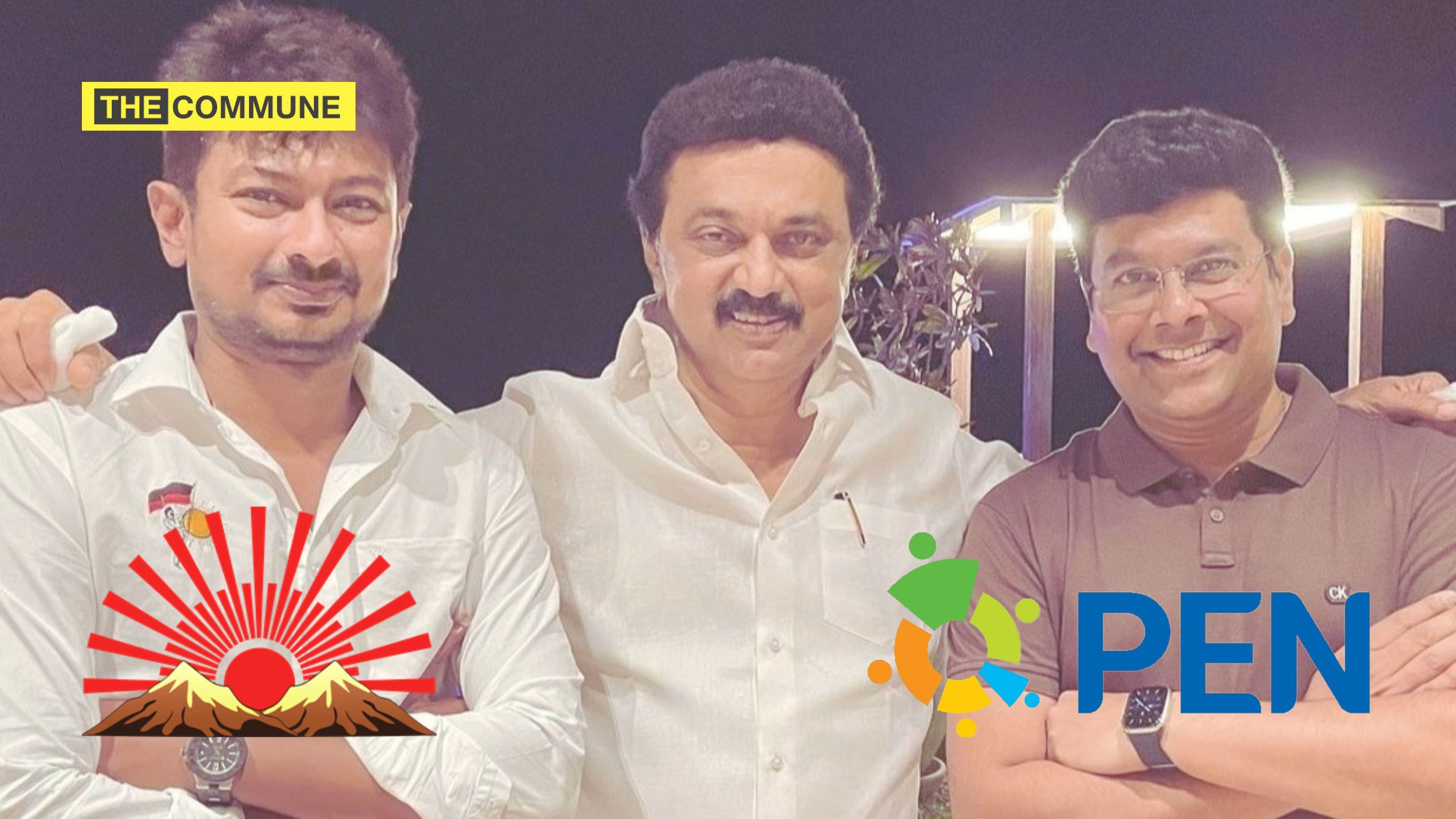
Populus Empowerment Network, better known as PEN, is reportedly scaling down massively and probably shut down, as per leftist rag The News Minute (also DMK’s mouthpiece).
Typed this out as an update yesterday and deleted as I couldn’t get my hands on the email sent out by PEN to many employees.
PEN media is scaling down.
From @thenewsminute ‘s Powertrip 👇 pic.twitter.com/eKM82mvzbf— Siddharth Prabhakar (@Sidprabhakar7) May 6, 2026
In its paid newsletter ‘Powertrip’, TNM states that around 100 contract employees have been terminated and more than 100 social media influencers, most of them active on social media platform X, have been told their contracts are over. The influencers were hired as recently as last year in the run up to the 2026 Assembly elections.
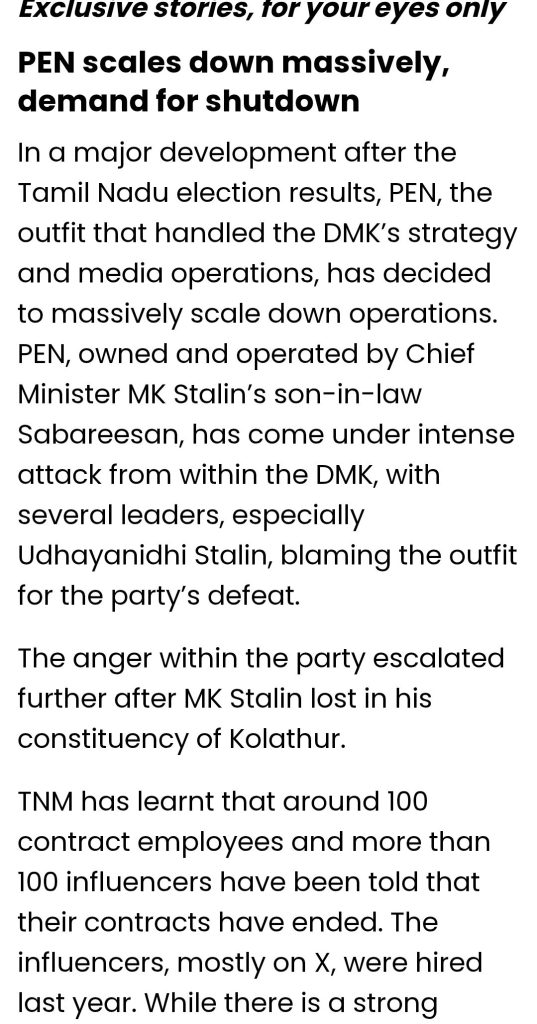
The news of scaling down comes directly in the wake of the DMK’s crushing defeat in the 2026 Tamil Nadu Assembly elections. Within the party, blame has quickly settled on PEN. Multiple senior DMK leaders, including Udhayanidhi Stalin, have reportedly pointed to the outfit’s operations as a key factor in alienating voters and contributing to the party’s fall, as per the newsletter.
The anger within the party reached its peak after MK Stalin himself lost his own constituency of Kolathur – this is something that made PEN’s failure impossible to ignore or defend.
It is reported that several PEN employees were already looking for work a month ago.
People from PEN started asking for jobs a month back. Couple came to me. https://t.co/MIyxomFwyi
— Shalin Maria Lawrence (@ShalinSpeaks) May 6, 2026
Since most of them were on a contractual role until April 2026, they knew that if a DMK government did not return to power, they had no jobs waiting for them.
PEN hired around 100-150 people for a contractual role till April. All of them knew that they couldn’t continue after April if no dmk govt https://t.co/3voo3yLFta
— Manoj Prabakar S (@imanojprabakar) May 6, 2026
Who PEN Was and What It Did
PEN was not just a political strategy firm. It was a family operation. Founded in November 2022, it was owned and run by V. Sabareesan, Chief Minister MK Stalin’s son-in-law. On paper, its mandate included data analysis, ground surveys, managing the ‘Makkaludan Stalin’ app, selecting TV debate spokespersons, and providing digital strategy support. In practice, it became the DMK’s most powerful and least accountable arm.
Its official directors are Manikandan Vasudevan and Prabhakaran Sekar, but V Sabareesan, son-in-law of Chief Minister MK Stalin, is said to exercise indirect control over the company.
PEN functions as DMK’s in-house digital and social media agency. It runs the Facebook page “Ellorum Nammudan” (596,000 followers), the Instagram handle “dmk_ellorumnammudan” (113,000 followers), and multiple other DMK-linked digital properties. It was also responsible for developing the “Makkalin Mudhalvar” app and game promoting the DMK’s “Dravidian Model” branding.
In 2024, then Tamil Nadu BJP president K Annamalai publicly accused DMK of spending ₹7.39 crore in social media ads through PEN, calling it “crony capitalism” and alleging that the Chief Minister’s family was directly profiting from state-funded political propaganda. The allegations, backed by public Meta Ad Library and Google Transparency Center data, triggered an Election Commission complaint but no regulatory action followed.
Sabareesan could be labelled as the “shadow CM of Tamil Nadu” – a man who held no elected office, answered to no electorate, and yet wielded influence across government policy and party strategy. When Tamil Nadu announced a Space Industrial Policy in 2024, Sabareesan had floated a space-tech startup just weeks earlier and stood to benefit directly.
Populus Empowerment Network Private Limited (PEN), incorporated in November 2022, emerged as India’s most aggressive state-level political digital advertiser, according to data drawn from Google’s Ads Transparency Center and Meta’s Ad Library. Its spending is verifiable; its ads are public and its links to the ruling DMK and Chief Minister M.K. Stalin’s son-in-law V. Sabareesan are documented.
PEN’s digital election spending operated at an extraordinary scale. Public ad transparency data shows the outfit spent ₹9.25 crore on Google Ads in 2024 alone, making it India’s second-largest non-government political advertiser on the platform. Between January and October 2025, PEN reportedly spent ₹4.1 crore on Meta platforms across over 1,000 ads, alongside ₹1.24 crore on Google Ads. Digital monitoring estimates place PEN’s combined 2025 ad expenditure at ₹14-17 crore. The spending intensified sharply ahead of the 2026 Assembly elections, with February 2026 alone seeing roughly ₹3.6 crore spent on high-volume ad campaigns reaching crores of viewers.
The Intimidation Machine
Beyond election strategy, PEN became known inside Tamil Nadu’s media circles for something more troubling: the systematic monitoring and intimidation of journalists.
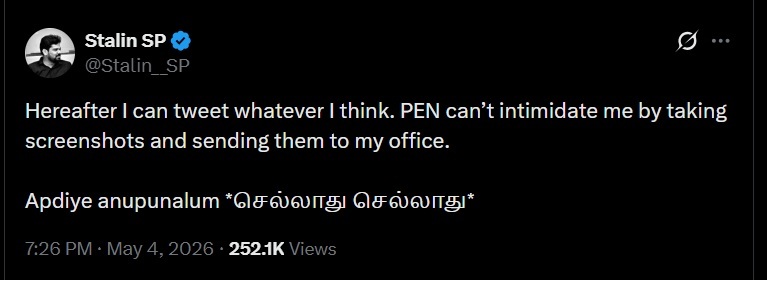
If a reporter posted a critical tweet that didn’t sit well with the government’s narrative, PEN operatives would reportedly screenshot the content and forward it directly to the journalist’s editors and management. The message was never explicit. It didn’t need to be. The implied threat was enough: keep writing this, and your job becomes difficult.
Stalin SP, Chief of Bureau at Puthiya Thalaimurai TV, broke his silence on election night itself. “Hereafter I can tweet whatever I think,” he posted. “PEN can’t intimidate me by taking screenshots and sending them to my office”.
The IT Wing: From Strategy to Organised Abuse
Alongside PEN, the DMK’s official IT Wing operated as the digital enforcement arm. Multiple journalists and commentators have come forward since the results to describe what they experienced.
Omjasvin MD, a Times of India journalist, wrote that the constant targeting of journalists critical of the government was “one of the worst downgrades of the DMK IT wing.” He noted that beyond abusive comments, dedicated online spaces were set up specifically to tarnish journalists’ reputations, and that those running these operations were closely linked to the top brass of the party.
The constant abuse and target of journalists writing critically against the govt was one of the worst downgrades of the #DMK IT wing in the last few years. Beyond comments, spaces were created for discussions to tarnish journalists. Many involved in these trolls and targeted… https://t.co/63XLJ6tW6A
— Omjasvin M D (@omjasvinMD) May 5, 2026
Political commentator Vinodh Arulappan went further, explicitly naming the turning point: when the IT Wing’s mantle shifted from PTR Palanivel Thiagarajan to TRB Rajaa. “Under PTR, abuse became organised,” Arulappan wrote. “A team existed solely to go after critics with slurs and threats. Earlier they were loafers, now, under TRB Raja they become thugs”.
Under PTR, abuse became organised. A team existed solely to go after critics with slurs and threats. I know exactly who they are. Earlier they were loafers, now, under TRB Raja they become thugs. https://t.co/P4HsOsE18K
— Vinodh Arulappan (@VinodhArulappan) May 5, 2026
Five Years, One Verdict
The scale of the current reckoning reflects how deeply the PEN-IT Wing machinery had penetrated Tamil Nadu’s public discourse. For five years, the Fact Checking Unit, also run by DMK lackeys such as Iyan Karthikeyan, controlled what needed to be fact-checked, PEN handled corporate pressure on newsrooms, and the IT wing patrolled social media with slurs and coordinated attacks. Together, they built a managed information environment designed to sustain the illusion of a popular government.
The 2026 election verdict dismantled both the government and the machine that propped it up. PEN is scaling down and probably disbanding. The influencers are off contract. The IT wing enforcers have lost their state backing.
Subscribe to our channels on WhatsApp, Telegram, Instagram and YouTube to get the best stories of the day delivered to you personally.