On 8 August 2025, the Madras High Court raised concerns about whether IAS officers are effectively running a parallel government in Tamil Nadu, expressing disappointment over the state government’s sudden reversal on its promise to allot houses to selected Tamil scholars under the ‘Kanavu Illam Scheme,’ as previously assured to the court.
Justice N. Anand Venkatesh observed that such decisions appeared to be driven by bureaucrats who failed to grasp the cultural and emotional value of the scheme. He added that former Chief Minister M. Karunanidhi would never have permitted such a move. The observations were made while hearing a petition filed by lyricist R. Vairamuthu, who challenged the cancellation of a house allotment granted to him under the scheme.
During the hearing, senior advocate Xavier Arulraj pointed out that in an earlier case filed by Tamil Nadu’s first woman IPS officer, Thilagavathy, the Advocate-General had assured the court that new restrictions in the scheme would apply prospectively, ensuring that all 10 pre-selected beneficiaries would still receive their houses. Instead of honouring this assurance, the state filed an appeal, and a division bench stayed the interim order of the single judge, he said.
Justice Anand Venkatesh remarked that such actions were typical of IAS officers who “run a parallel government” and treat sensitive cultural matters like allotting houses to eminent writers without emotional understanding, relying only on bureaucratic authority. He cautioned that allowing IAS and IPS officers to effectively run the state could lead to serious governance issues.
When the court resumed in the afternoon, Additional Advocate General J. Ravindran took strong exception to the judge’s remarks, stating that Tamil Nadu is governed by Chief Minister M. K. Stalin and not by bureaucrats.
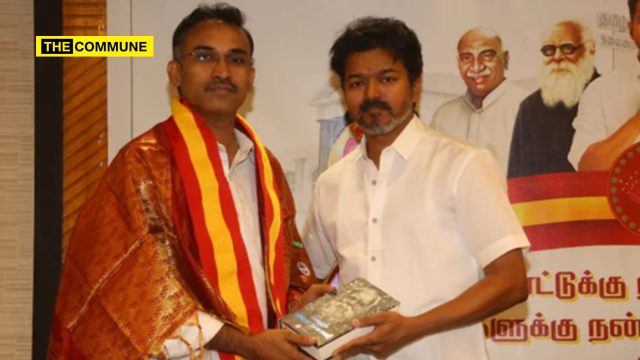
Arunraj, a former Income Tax Department officer once considered a close confidant of actor-turned-politician and Tamilaga Vettri Kazhagam (TVK) leader Vijay, is reportedly facing internal resistance within the party over his political ambitions.
According to party sources, Arunraj, who played a role in bringing key figures like strategist John Arogyaswamy and political aide Aadhav Arjuna into TVK, had been entrusted with the post of General Secretary for Policy and Publicity after resigning from his government service.
During his tenure in the Income Tax Department, Arunraj is said to have been aware of and indirectly supported the raids conducted at Vijay’s residence, while also reporting to senior officials about his proximity to the actor.
Now seeking to contest from his home district of Salem, Arunraj is allegedly encountering strong opposition from the local district secretary and other administrative leaders in Panayur, who are blocking his bid.
Once regarded as an influential insider within Vijay’s political circle, Arunraj is now described by associates as disheartened over the pushback, signalling growing tensions in TVK’s internal dynamics ahead of potential electoral moves.
Subscribe to our channels on Telegram, WhatsApp, and Instagram and get the best stories of the day delivered to you personally.
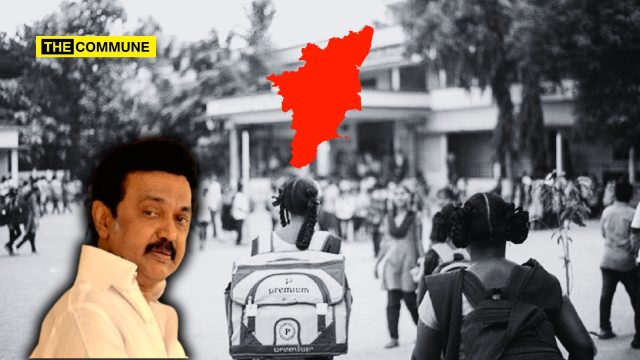
The DMK government’s freshly released Tamil Nadu State Education Policy 2025 is being touted as a “future-ready” blueprint by the Dravidian Stocks. But a closer reading reveals it to be an ideologically loaded, poorly conceived, and dangerous recipe for disaster that will worsen learning outcomes for lakhs of children.
Beneath the lofty talk of “equity” and “holistic learning” lies a toxic combination of failed experiments and recycled ideas from the National Education Policy (NEP) 2020 — ideas which the DMK has selectively borrowed while rejecting its workable solutions. The policy’s most glaring blunders are its retention of the No Detention Policy (NDP) up to Class 8, the scrapping of the Class 11 public examinations, and its obsession with political symbolism over academic rigour.
The Ghost Of Samacheer Kalvi Still Haunts TN
This is not the first time the DMK has pushed a sweeping education overhaul without considering ground realities. The Samacheer Kalvi (Uniform School Education) system introduced under the late M. Karunanidhi was sold as a measure to bring “quality” education to all. In reality, it diluted syllabus content to the lowest common denominator, eroding competitiveness and widening the gap between Tamil Nadu’s students and their peers from other states in national-level exams.
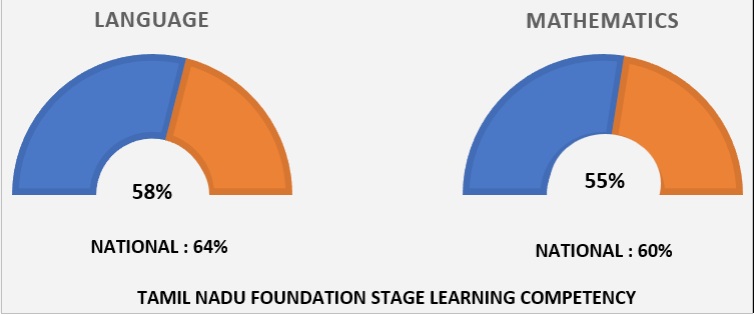
A decade later, survey data shows that the state is still struggling with poor foundational skills, especially in Mathematics and even in reading basic Tamil. Instead of learning from the Samacheer Kalvi debacle, the new SEP doubles down on similar “feel-good” policies that sound progressive on paper but sabotage rigour.
No Detention Policy: Proven Failure, Yet Retained
The No Detention Policy, retained for Classes 1–8, has been widely discredited. While the SEP dresses it up as “child-friendly” and “supportive,” the reality is that automatic promotion without mastery has devastated learning levels across India.
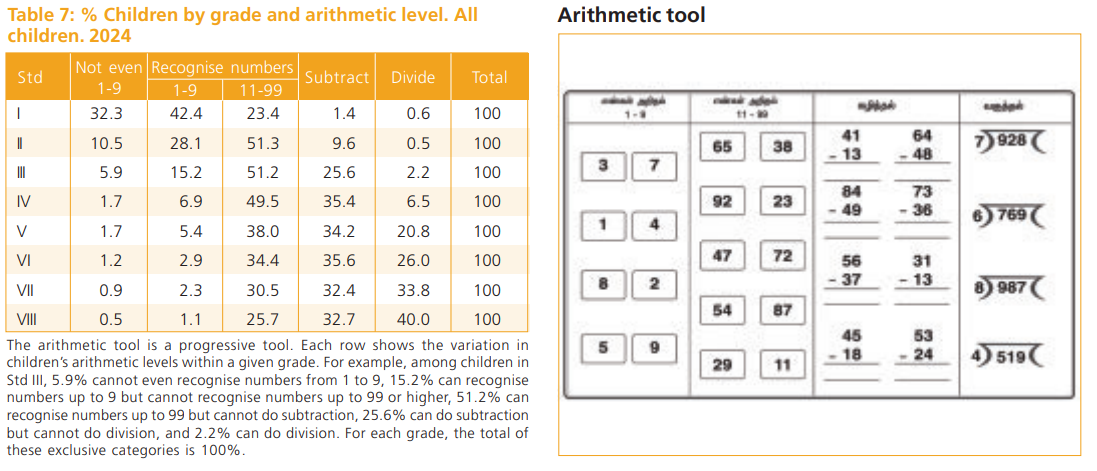
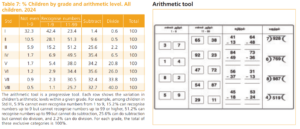
ASER 2024 found that only 43% of Class 5 children in Tamil Nadu could read a Class 2-level text; just 35% could do simple division.
NAS 2024 showed Grade 8 students in Tamil Nadu scoring below the national average in Mathematics and Science.
PARAKH’s latest competency data for TN reveals that in Class 8, only 40% achieved minimum proficiency in Mathematics, with rural and disadvantaged groups faring far worse.
Promoting students without holding them accountable for learning milestones has not “reduced stress” — it has locked them into a cycle of ignorance, making later remediation nearly impossible.
Scrapping Class 11 Boards: One More Nail In The Coffin
The decision to abolish the Class 11 public exam is another catastrophic move. The SEP calls Class 11 a “preparatory year” for Class 12, but in practice, it will encourage both students and teachers to skip serious learning in this crucial phase as the syllabus of Class 11 is crucial for competitive exams like NEET, JEE, etc.
With only Class 10 and 12 as “high-stakes” checkpoints, much of the Class 11 syllabus will be sidelined in favour of last-minute rote cramming for the Class 12 boards. This undermines subject depth, critical thinking, and analytical ability — skills already in short supply, as evidenced by Tamil Nadu’s Grade 9 NAS scores (Math: 32%, Science: 36%, Social Science: 35%).
High On Ideology, Low On Innovation
The policy repeatedly invokes “social justice” and “equity” — ideals worth upholding — but in practice, this rhetoric is used to justify watering down academic benchmarks. In fact, the so-called “innovations” in the policy are almost entirely lifted from NEP 2020: competency-based assessment, digital integration, vocational exposure.
What the DMK has added is a political framing that prioritises linguistic imposition (mandatory Tamil even for non-Tamil students) and ideological content over proven, evidence-based strategies to improve quality. Instead of addressing teacher accountability, classroom effectiveness, and syllabus standards, the SEP is preoccupied with cosmetic changes.
The Looming Disaster
The data is unambiguous: Tamil Nadu’s students are already slipping in national proficiency indicators. By retaining failed policies like NDP, removing critical exams, and focusing on political posturing instead of pedagogy, the DMK government is laying the groundwork for a generation of underprepared graduates.
If Samacheer Kalvi was the first major blow to Tamil Nadu’s academic competitiveness, this State Education Policy is poised to be the final, crushing hit. The state risks producing students with high pass percentages on paper, but woefully inadequate skills for higher education, employment, or national-level competition.
In short, the SEP is not a roadmap for educational excellence — it’s a recipe for disaster. And unless the government course-corrects, the real losers will be Tamil Nadu’s children, condemned to an education system that values optics over outcomes.
Vallavaraayan is a political writer.
Subscribe to our channels on Telegram, WhatsApp, and Instagram and get the best stories of the day delivered to you personally.
While Congress scion Rahul Gandhi launched a tirade, against the Election Commission of India (ECI), accusing it of colluding with the BJP to ensure his party’s defeat armed with poorly researched data from his team that was swiftly debunked by fact-checkers. Yet, he conveniently overlooks the fact that Congress itself has repeatedly been caught undermining India’s electoral process, indulging in the very malpractices he accuses others of.
The same congress faced accusations of widespread election fraud, including creating fake voter IDs, illegally seizing polling stations, and rigging the election. Below is a non-exhaustive record of such incidents:
Fabrication of 8.5 Lakh Fake Voter IDs in Telangana
In December 2024, former PCC General Secretary Bakka Judson exposed that Congress had created 8.5 lakh fake voter IDs in Telangana to sway local body elections. He alleged that such fraud was also happening in Kerala and Karnataka, calling it an act of sedition. Judson accused Telangana CM A. Revanth Reddy of orchestrating the scam, with the IDs created by morphing photos, altering phone numbers, and deleting genuine voters aged 18–35 from the rolls. He further claimed that Deputy CM Mallu Bhatti Vikramarka’s wife helped secure bail for the accused.
Booth Capturing in Bihar
In February 2019, senior Congress leader Kirti Azad admitted publicly that in Bihar, Congress workers routinely engaged in booth capturing for party leaders, including his own father and himself, before EVMs were introduced.
Rigging Youth Congress Organisational Elections in Kerala
In November 2023, Kerala Police investigated allegations that fake voter IDs were used in Youth Congress internal elections. State president Rahul Mamkootathil was questioned, and four aides were arrested. Laptops, phones, and 24 fake voter IDs were seized. The BJP and CPI(M) demanded a full probe and even a CBI inquiry into possible implications for general elections.
Lokayukta Action Against Former Congress MLA for Fake Voter IDs
In August 2022, the Lokayukta found former Sultanpur MLA Majra Jai Kishan guilty of creating fake voter IDs for non-residents using his own address. The Delhi LG directed police to register an FIR for damaging the integrity of the electoral process.
Massive Fake Voter ID Scandal in Karnataka
Just before the 2018 Karnataka polls, nearly 9,746 fake voter IDs were discovered in an apartment in the Raja Rajeshwari Nagar constituency. Congress MLA Munirathna and 13 others were booked after the Election Commission’s investigation. Two trunks of suspicious voter forms, laptops, and a printer were seized. While Congress initially accused the BJP of planting evidence, the FIR named the Congress MLA as a key accused.
— ಸಂಗೊಳ್ಳಿ ರಾಯಣ್ಣ🚩Sangolli Rayanna (@Prakash_Rayanna) August 8, 2025
Despite this documented history ranging from voter fraud to booth capturing Rahul Gandhi now attempts to portray himself as a victim of electoral malpractice. Yet, as history shows, Congress has long been a practitioner of the very tactics he decries, from Indira Gandhi’s authoritarian excesses to modern-day voter manipulation.
Viduthalai Chiruthaigal Katchi (VCK) leader and MP Thol. Thirumavalavan’s recent speech at a DMK-organised event in Ambattur has stirred intense political discussion, after he questioned why certain Tamil nationalist groups target former Chief Minister M. Karunanidhi but refrain from criticising other Dravidian stalwarts like M.G. Ramachandran (MGR), C.N. Annadurai (Anna), or J. Jayalalithaa.
Speaking on the occasion of the seventh death anniversary of Karunanidhi, Thirumavalavan accused some Tamil nationalist outfits of misdirecting their criticism, saying they avoid mentioning leaders such as Anna, while focusing solely on “Kalaignar” Karunanidhi. He said, “Have any of the various organizations that have recently emerged today, in the name of speaking about Tamil nationalism, without telling the people who the real enemy of Tamil nationalism is, to the extent of saying that the enemy of Tamil nationalism is DMK, Kalaignar, to the extent of saying that if a monument is erected to him, we will come and destroy it to the extent of expressing hatred, and repeatedly saying that this is the one who started the corruption, at least for one day, spoken about MGR, or about Jayalalithaa Ammaiyar, why… and I would like to say very specifically, have they spoken anywhere about Kalaignar’s teacher Anna? Have they criticized him? I don’t know why Anna is not criticized,
but why is Kalaignar being targeted, this raises a question.”
He further said, “Kalaignar is Anna’s younger brother, Anna Periyar’s child. Anna spoke the same politics that Periyar spoke, he didn’t say anything new. Anna was the one who reflected Periyar. But Anna’s Tamil was sweeter, Anna’s Tamil was deeper, Anna’s Tamil was more eloquent than Periyar’s Tamil. But Anna spoke what Periyar spoke. Furthermore, this greatness called Periyar was revealed only by Anna, otherwise it might have been hidden.”
In his address, the VCK chief alleged that MGR had introduced “Brahminical influence” into the Dravidian movement, and pointed out that Jayalalithaa, a Brahmin woman, had led the movement for years. However, he also acknowledged MGR’s role in preventing national parties like the Congress from gaining ground in Tamil Nadu, which, he argued, indirectly stopped the BJP from making inroads.
He said, “A national party benefitted by the emergence of MGR. MGR criticized Kalaignar, sowed the seeds for hate politics, was responsible for infiltrating Brahminism into the Dravidian movement, and even though there are criticisms that he paved the way for a Brahmin woman to become the leader of the Dravidian movement, one advantage that came out of it is that – national parties were prevented from gaining a foothold here.”
He further said, “This political environment, whether DMK or AIADMK, continued for more than 50 years. The Congress was not allowed to grow here, and more importantly, the BJP did not gain a foothold. Although there are many reasons, if the Congress had gained strength here, the BJP would have grown against it. Because, where there is a national party, the BJP will easily reach the same position as the Congress. People do not compare with state parties; they will compare only with national parties. The rise of MGR is one reason why the Congress did not gain strength here and has shrunk. The political contest here was whether it is MGR or Kalaignar, later changed to Jayalalithaa-Kalaignar. But Kalaignar has always been the central point, the central politics – This is the politics of Tamil Nadu.”
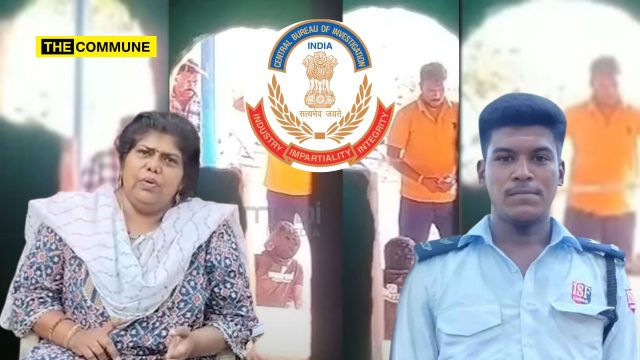
Fresh twists have emerged in the controversial custodial death case of 27-year-old temple security guard Ajithkumar, with the CBI’s probe revealing that the original theft allegations against him were unfounded. The agency’s findings reportedly show that Ajithkumar never left the temple’s parking area, and that members of a special police unit who assaulted him were aware that their brutal third-degree methods could prove fatal.
Ajithkumar was taken into custody following a theft complaint lodged by Dr. Nikitha, who claimed jewellery kept in a car parked at Madapuram had been stolen. During interrogation, special police personnel allegedly beat him with sticks and plastic pipes. He later died in custody, sparking outrage and protests across Tamil Nadu.
The case stemmed from an incident on 27 June 2025, when complainant Nikitha and her mother arrived at the Bhadrakali Amman Temple in Madapuram for worship. She reportedly handed over her car keys to Ajithkumar to park the vehicle. It is alleged that Ajithkumar gave the key to an auto driver Aravindh nearby to park the vehicle before the temple’s parking lot. CCTV and witness statements examined by the CBI indicate that Ajithkumar returned the keys within (5) minutes, and that the vehicle was never taken outside the temple premises afterward.
This contradicts Nikitha’s initial complaint, which alleged that Ajithkumar, along with an auto driver, and another person Arun had driven the car to Vadakarai. CBI checks of CCTV footage from key routes showed no such movement, instead recording Nikitha herself driving the car. The agency concluded that the vehicle remained at the temple until it was retrieved by her.
A CBI team, headed by DSP Mohit Kumar, has been investigating the case for the last 23 days.
More damningly, the CBI’s investigation revealed previously that five special police personnel identified as Raja, Anand, Sankara Manikandan, Prabhu, and Kannan took Ajithkumar into their custody, suspecting him of theft. When he denied involvement, they allegedly became enraged and subjected him to a severe beating, fully aware that such violence could lead to death.
According to the updated FIR signed by ADSP Sukumaran, Ajithkumar was first taken to the Thiruppuvanam Government Hospital, then to Sivaganga Hospital, and finally brought by Raja and Sankara Manikandan to Madurai Government Rajaji Hospital at 11:15 p.m. on 28 June 2025, where doctors declared him dead on arrival.
Following these findings, charges in the case were amended on 30 June from Section 196(2)(a) of the BNSS to Section 103(1) of the BNS. The original complainant, Kannan who was found to be an adversary in the case was removed, and direct eyewitness Naveen Kumar has been added as the new complainant.
Subscribe to our channels on Telegram, WhatsApp, and Instagram and get the best stories of the day delivered to you personally.
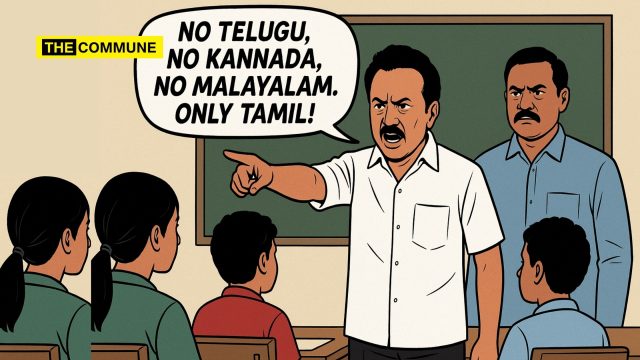
The Tamil Nadu State Education Policy 2025, unveiled by Chief Minister M.K. Stalin, has ignited fresh outrage among non-Tamil speaking communities in the state. Hidden behind the lofty rhetoric of “equity” and “inclusion” lies an unmistakable reality — the DMK government has doubled down on enforcing Tamil as a compulsory subject in all schools, effectively erasing the possibility for linguistic minorities to learn their mother tongue within the state education system.
Tamil Learning Act, 2006 — Now With Tighter Grip
The policy proudly reaffirms the Tamil Nadu Tamil Learning Act, 2006, making the study of Tamil from Class 1 to 10 mandatory across all schools — whether State Board, CBSE, ICSE, or international curricula.
This is not merely a symbolic requirement. Schools must ensure that every student can speak, read, write, and comprehend Tamil. The SEP frames this as “linguistic inclusion” and “cultural integration,” but for students whose home language is Telugu, Kannada, Malayalam, Urdu, or other tongues, it amounts to state-enforced linguistic assimilation.
Mother Tongue Sacrificed
While the National Education Policy (NEP) 2020 recommends a three-language formula allowing space for the student’s mother tongue, Tamil Nadu rejects this, sticking rigidly to a two-language formula — Tamil and English — for all. This means that in State Board schools, minority students are denied any formal opportunity to study their own mother tongue as a subject, even if it is their first language at home.
The SEP claims it will provide “bridge programmes” for migrant and tribal children. But for permanent linguistic minority communities — such as the lakhs of Telugu-speaking families in Vellore and Krishnagiri, Kannada speakers in Dharmapuri and Erode, or Malayalam speakers in Kanyakumari and Coimbatore — there is no structured pathway to retain their language academically.
Driving Minorities Out Of State Board Schools
By making Tamil compulsory while sidelining minority languages, the policy pushes non-Tamil speaking students towards CBSE and ICSE schools, where their mother tongue may still be offered as a second language. For economically disadvantaged families, this is not an option — they are forced to choose between losing their linguistic heritage or sacrificing quality education in their own tongue.
Constitutional Concerns
Article 29 of the Indian Constitution guarantees minorities the right to conserve their language, script, and culture. Education in one’s mother tongue is not just a cultural preference — it’s a constitutional safeguard. The DMK’s strict language policy raises serious questions on whether it violates this spirit, if not the letter, of the law.
Political Motives Disguised As Cultural Pride
The DMK frames this as a measure to protect Tamil identity and “integration with the local community.” But critics argue it is part of a political project to homogenise the linguistic landscape of Tamil Nadu — diluting the presence of long-established minority communities who have lived in the state for generations.
The Bottom Line
The Tamil Nadu State Education Policy’s two-language formula isn’t about inclusion — it’s about compulsion. For hundreds of thousands of Telugu, Kannada, Malayalam, and other minority students, it means their own languages will be absent from their classrooms, their textbooks, and their academic records. What the DMK calls “integration” may in practice become linguistic erasure.
If the government truly respected linguistic diversity, it would give minorities a genuine choice — not force them to assimilate through education policy.
Subscribe to our channels on Telegram, WhatsApp, and Instagram and get the best stories of the day delivered to you personally.
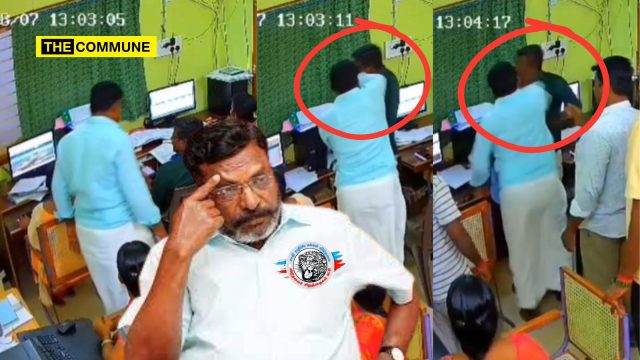
In a shocking case from Cuddalore district, a councillor of the Viduthalai Chiruthaigal Katchi (VCK), an ally of the ruling DMK in Tamil Nadu, was arrested for allegedly attacking a government employee inside the Bhuvanagiri Town Panchayat office. The incident, captured on CCTV, shows the councillor storming into the office and assaulting the staff member, with the footage quickly going viral and sparking public outrage.
According to reports, the incident occurred on 7 August when councillor Bharathidasan, also known as Kalimuthu, entered the panchayat office and insisted that a bill be issued to a contractor for works completed in his ward. The employee, Radhakrishnan, who was engaged in other official duties, requested time until evening to process the request. This reportedly led to a heated exchange, during which the councillor allegedly hurled verbal abuse, issued death threats, and punched the staffer in the face.
A senior police official confirmed the arrest, stating, “We have immediately arrested the VCK functionary on the basis of the government official’s complaint. There was an issue over payments. Investigation is on.”
The CCTV footage clearly depicts Bharathidasan physically assaulting Radhakrishnan, followed by a scuffle in which both men exchange blows. The attack has since triggered a political storm, with former Tamil Nadu BJP chief K. Annamalai posting the video on X and condemning the DMK-led government.
He wrote, “When public servants are attacked in their office, it is not just a breakdown of governance; it is a breakdown of trust in the very system meant to protect the people. In a shocking incident from Bhuvanagiri, a public servant was verbally abused and physically assaulted by a VCK Councillor, a member of the DMK Alliance. Threats of further attacks also followed this attack. This isn’t just an isolated act of lawlessness in the last 4 years in TN; it is a reflection of a political culture perpetrated by DMK that has normalised intimidation, violence, and absolute disregard for public institutions.“
When public servants are attacked in their office, it is not just a breakdown of governance; it is a breakdown of trust in the very system meant to protect the people.
In a shocking incident from Bhuvanagiri, a public servant was verbally abused and physically assaulted by a… pic.twitter.com/5zrzgwFctD
Following the assault, Radhakrishnan, who suffered facial injuries, was taken to Bhuvanagiri Taluk Hospital and later referred to Chidambaram Medical College Hospital. Kalimuthu also claimed that he was assaulted and received treatment at the same hospital before being taken into custody.
The VCK has not issued any public statement on the matter. Police have seized the CCTV footage and are continuing their investigation.
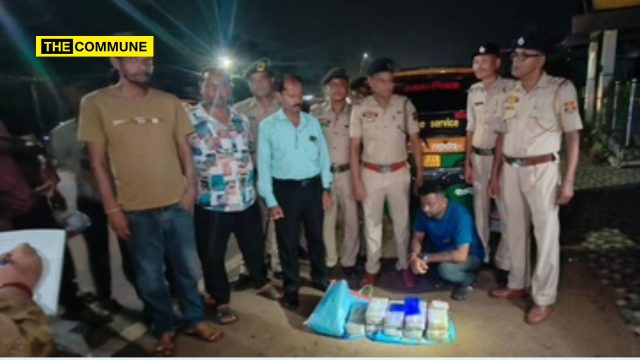
Security forces in Tripura and Mizoram have seized highly addictive banned methamphetamine tablets and foreign cigarettes worth over Rs 2.35 crore and arrested three persons, officials said on Friday.
A police official said that an auto-rickshaw driver was arrested with 90,000 methamphetamine tablets valued at Rs 1.35 crore from the Amtali areas on the outskirts of the state capital Agartala on Thursday night.
During routine patrolling, police chased an auto rickshaw coming from Khayerpur to Amtali and managed to intercept the auto-rickshaw and after a search the methamphetamine tablets, also known as Yaba or party tablets, were recovered. “The driver of the auto-rickshaw was arrested for carrying the drugs. An investigation is underway,” Superintendent of Police (SP), West Tripura district, Namit Pathak told the media. He said the police have intensified their close watch in different parts of the city and its outskirts after reports of illegal and drug related activities, and the seizure was the success of these efforts.
Chief Minister Manik Saha in a social media post on Friday, said, “During a search operation on the Amtali Bypass, Amtali police station recovered 90,000 yaba tablets, arrested one person, and seized an auto-rickshaw.”“We remain committed to building a drug-free Tripura, and our relentless fight against drug smugglers will continue with full determination,” Saha said.
Yaba, also called ‘crazy medicine’, is illegal in the country as it contains methamphetamine, a Schedule II substance under the Controlled Substances Act. In Mizoram, based on specific intelligence, Assam Rifles launched an operation on Friday to conduct a search operation at Tlangsam areas bordering Champhai district.
During the search operation, the troops recovered different types of foreign cigarettes valued approximately Rs 1 crore from a vehicle. Two persons, identified as H Ramengmawia and Zosangliana were also arrested. The recovered items, vehicle and individuals have been handed over to the Legal Metrology Department in Champhai.
Meanwhile, the Assam Rifles and Mizoram Police have seized heroin and foreign cigarettes worth more than Rs 9.47 crore and arrested one person in two separate operations in Mizoram’s same Champhai district on Wednesday night. Myanmar’s Chin State has emerged as a major hub for drug trafficking, wildlife smuggling, and other illicit activities.
The contraband is often routed through six districts in Mizoram — Champhai, Siaha, Lawngtlai, Hnahthial, Saitual, and Serchhip — which share unfenced borders of 510 km with Myanmar. Meanwhile, Assam Rifles have been conducting awareness campaigns like seminars and group discussions highlighting the bad effects of the drugs and drugs trafficking are a punishable offence under the Narcotics Drugs and Psychotropic Substances (NDPS) Act, 1985.
The Defence spokesman said that the aim of these awareness campaigns is to educate the local population, especially the youth, about the harmful effects of drug abuse and the serious legal consequences associated with drug trafficking and peddling.
-IANS
Subscribe to our channels on Telegram, WhatsApp, and Instagram and get the best stories of the day delivered to you personally.
A shooting on Emory University’s Atlanta campus in the US state of Georgia left the shooter dead and one officer injured, according to media reports.
There was a single shooter who is now dead, with no further threat to the campus or surrounding area, said NBC News, quoting the Atlanta Police Department.
A law enforcement officer was injured while confronting the shooter, according to reports. A shelter-in-place order was put into place and now has been lifted, said the latest post by the university, Xinhua news agency reported.
Georgia Governor Brian Kemp decried the shooting on social media platform X, noting it was the second high-profile shooting in the state this week. Five soldiers were shot and injured at the US Army’s Fort Stewart in southeast Georgia on Wednesday.
The suspect was identified as Quornelius Radford, an automated logistics sergeant, according to John Lubas, commanding general of the 3rd Infantry Division. Radford used a personal handgun to open fire on fellow soldiers at his assigned base.
“I can confirm it was not a military weapon. And we believe it was a personal handgun,” Lubas told a news conference on Wednesday (local time).
“We’re still not certain about the motivation, but again, he’s been interviewed by Army investigators, and we believe we’ll gain more information here shortly,” Lubas said. The shooter has been previously arrested locally for driving under the influence –
-IANS
Subscribe to our channels on Telegram, WhatsApp, and Instagram and get the best stories of the day delivered to you personally.