Home Blog Page 385

“Kids Less Than 18 Yrs Of Age Are Standing In Queues At De-Addiction Centres”, Archbishop Tharayil Sounds Alarm On Kerala’s Drug And Alcohol Crisis
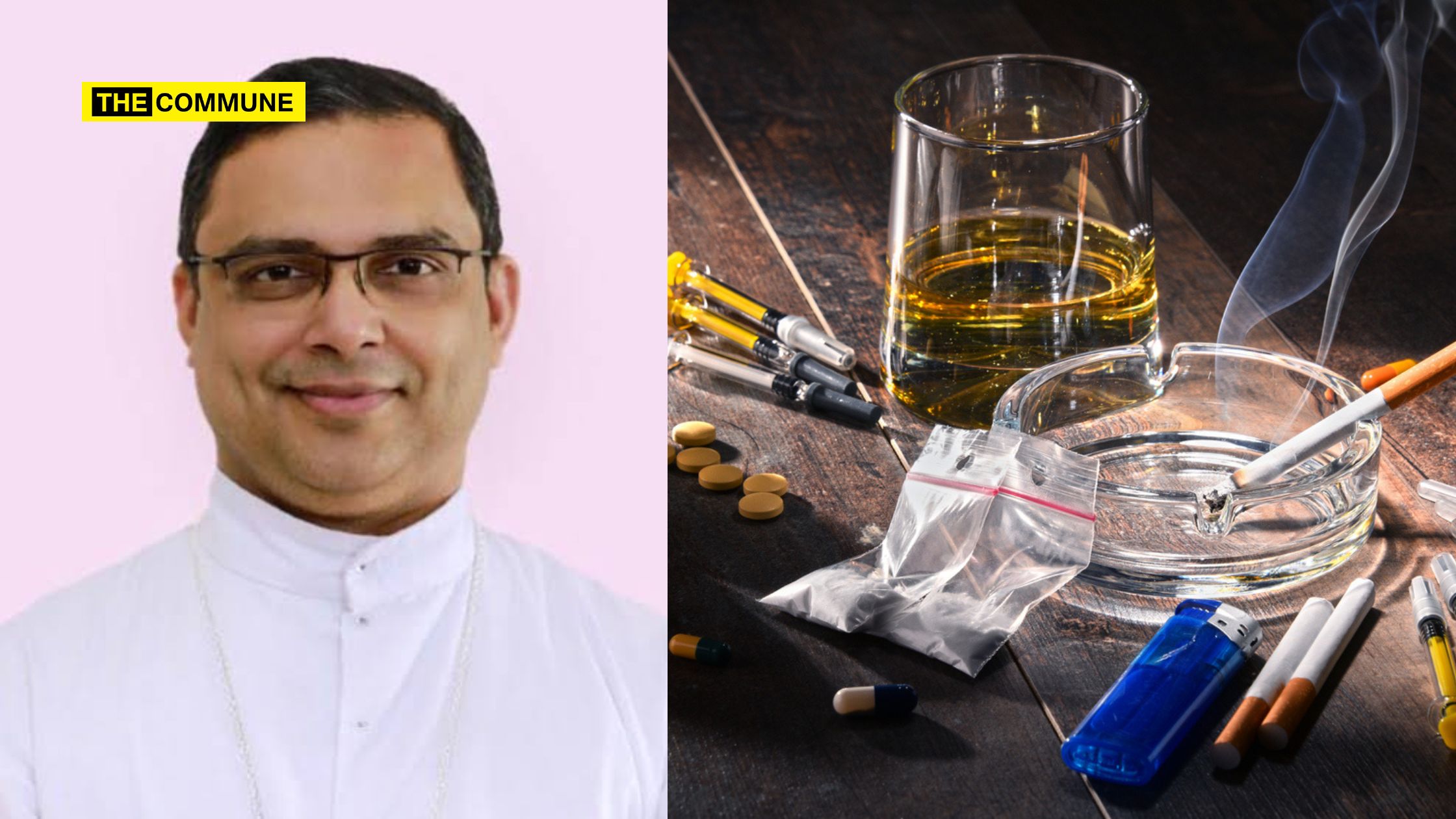
The 130th Maramon Convention, inaugurated by Theodosius Mar Thoma, Metropolitan of the Malankara Mar Thoma Syrian Church earlier this month, focused on combating drug abuse and Kerala’s rising crime rates. The Metropolitan highlighted the surge in juvenile crimes and substance abuse in schools and colleges, criticizing the government’s indifference and the proposed brewery in Palakkad.

Speaking at the anti-alcohol event organized by the Changannassery Diocese, Archbishop Mar Thomas Tharayil gave a powerful address where he highlighted the growing menace of drug and alcohol addiction in Kerala, urging the government, society, and the Church to take immediate and decisive action. The event, attended by a large gathering, saw the Archbishop emphasize the need for collective efforts to combat this crisis, which is destroying families and endangering the future of the youth.

Archbishop Tharayil lamented that the anti-alcohol movement is often dismissed by society, with those advocating for prohibition being mocked as relics of a bygone era. He recalled the contributions of leaders like Mahatma Gandhi and Kerala’s own Gandhians, such as M.P. Manmadhan and Sugathakumari Teacher, who championed the cause in the past. Today, he noted, the resistance to alcohol has weakened, with governments prioritizing revenue over public health by promoting alcohol and opening bars.

The Human Cost Of Addiction

Archbishop Tharayil stressed that the fight against alcohol is not just about opposing a substance but about upholding human dignity. He shared heartbreaking stories of families torn apart by addiction, including a woman who married at 18 to escape her alcoholic father, only to see her husband and son fall into the same trap. Her 15-year-old son, now addicted to alcohol, told her,I am my father’s son. I’ve been doing this for a long time.”

The Archbishop also highlighted the findings of a 2014 report by the State Planning Commission, which revealed that middle and lower-middle-class families are the most affected by alcohol addiction, with men being the primary consumers. Interestingly, the report noted that alcohol consumption is lowest among Muslims, while Christians have the highest percentage of users—a fact the Archbishop urged the community to address.

He pointed out that the Changannassery Diocese’s Social Service Society has recently established a new anti-drug and anti-alcohol centre there, the only one in Kerala for children under 18 and said,I asked Father why it was for children below 18 years of age. I asked him why we need one here and whether anyone will even want/there is a need for one such centre. I was skeptical that if we start one and if the government doesn’t give WiFi and we will have to burden that on our shoulders as well. But now there is no vacancy. These kids less than 18 years of age are standing in a queue at the deaddiction centre.”

Rising Drug Abuse Among Youth

The Archbishop expressed deep concern over the rise in drug addiction, particularly among the youth. He cited statistics showing that 10% of adults and 33% of adolescents in Kerala start drinking before the age of 14. Between January 2023 and June 2024, there were 41,531 registered drug-related cases in the state, with Ernakulam district recording the highest number at 8,567 cases.

He also criticized the normalization of violence in popular culture, pointing to the influence of Korean movies and Malayalam cinema, which often glorify brutality. During a recent Christmas release, a film depicting extreme violence was met with cheers from young audiences, a trend the Archbishop described as deeply troubling.

Government’s Role 

Archbishop Tharayil did not shy away from criticizing the government’s role in exacerbating the crisis. He accused the government of prioritizing revenue over public health by promoting alcohol and opening bars. Kerala, which once imported alcohol, is now producing its own, with the government imposing a 300% tax on alcohol. The Archbishop questioned the morality of taxing a substance that destroys lives, noting that the poor are spending their hard-earned money on alcohol while the government uses the revenue to build roads.

He also called out the lack of action against the drug trade, pointing to the seizure of 500 grams of drugs that made headlines while tons of drugs go unnoticed. He questioned why there is no accountability for the large-scale drug shipments entering Kerala and other parts of India, urging the government to take decisive action.

The Archbishop emphasized the Church’s moral responsibility to combat addiction, citing the work of the Kerala Catholic Bishops Council (KCBC) Anti-Alcohol Commission. He called on Christians to live lives of joy and abundance, as taught by Pope Francis, and to instill courage and resilience in the youth.

He also stressed the importance of strong family bonds, sharing the story of a college student from a loving family who spent weekends helping her parents and tutoring her siblings. Such children, he noted, are less likely to fall into addiction.

Archbishop Tharayil highlighted the need to address the mental health crisis among youth, attributing it to the lack of challenges in their lives. He criticized the education system for making life too easy for children, leading to increased stress and addiction. He called for reintroducing challenges to help children grow stronger and more resilient.

In his concluding remarks, Archbishop Tharayil urged all stakeholders to continue the fight against addiction. He called on the government to prioritize the health and future of the youth over political gains and urged families to build strong, supportive environments for their children.

Subscribe to our channels on Telegram, WhatsApp, and Instagram and get the best stories of the day delivered to you personally.

Adani Green Shoots Past Record 12,000 MW Renewable Energy Capacity

Adani Energy's Growth Story Intact, Stock Has Potential Upside Of 67%: Jefferies

Adani Green Energy Limited (AGEL), India’s largest renewable energy company, on Friday surpassed a record 12,000 megawatts (MW) operational portfolio with the commissioning of an additional 275 MW solar capacity at the world’s largest renewable energy plant at Khavda in Gujarat. AGEL is the first renewable energy company in India to reach this landmark.

The 12,258.1 MW portfolio consists of 8,347.5 MW solar, 1,651 MW wind and 2,259.6 MW wind-solar hybrid capacity, according to an AGEL statement. “The milestone underscores AGEL’s commitment to deliver 50,000 MW of clean, affordable and reliable power by 2030. The 12,258.1 MW operational portfolio will power more than 6.2 million homes and avoid about 22.64 million tonnes of CO2 emissions annually. The emissions avoided are equivalent to carbon sequestrated by 1,078 million trees,” the company said.

Adani Green Energy’s 12,258.1 MW contribution is the largest greenfield expansion in India’s RE sector which represents about 10 per cent of India’s installed utility-scale solar and wind capacity. This also constitutes over 13 per cent of India’s utility-scale solar installations. Adani Green Energy is developing the world’s largest renewable energy plant of 30,000 MW on the barren waste land at Khavda in Gujarat’s Kutch region. Built across 538 sq kms, the area of the project is five times the size of Paris and almost as large as Mumbai city. Once complete, it will be the planet’s largest power plant across all energy sources, the company said.

AGEL has operationalised a cumulative capacity of 2,824.1 MW renewable energy at Khavda so far. The accelerated progress at Khavda underscores AGEL’s commitment to India’s goal of 500 GW non-fossil fuel capacity by 2030, the company statement said.

Work at Khavda continues at a fast pace, with AGEL leveraging the project execution capabilities of Adani Infra, the manufacturing expertise of Adani New Industries Limited, the operational excellence of Adani Infrastructure Management Services Ltd. and the robust supply chain of our strategic partners, the statement said.

AGEL is recording the fastest greenfield renewable energy capacity addition in India and the rapid progress at Khavda and other project sites will sustain the growth momentum, the statement added.

–IANS

Subscribe to our channels on TelegramWhatsApp, and Instagram and get the best stories of the day delivered to you personally.

Other Countries Can Learn From India’s UPI Cxperience: Cambridge Professor

The Unified Payments Interface (UPI) provides an opportunity to other countries to learn from India’s experience and get ideas on how to adopt it in their own countries, said Professor Carlos Montes, Lead Innovation Hub, University of Cambridge Business School here.

Professor Montes, who is on a tour to India for attending and speaking at the NXT event in the national capital on Saturday, was briefed about the working and achievements of UPI system which recorded an all-time high of 16.99 billion transactions in January this year with the value exceeding ₹Rs 23.48 lakh crore.

Montes was glad to see the success of the UPI payment system. “The growth of UPI shows that the government is making sure that the technology that they develop is user friendly for citizens, and that there is a regular and constant innovation in the same which explains the high adoption rate of UPI in India,” the Cambridge Professor noted.

He further said that UPI also has potential for other countries to learn from the experience and get ideas on how to adopt it in their own countries. Sudhir Shyam, Economic Adviser at Department of Financial Services (DFS), said that India’s digital payments revolution is extending beyond its borders. UPI is rapidly expanding globally, enabling seamless cross-border transactions for Indians traveling abroad.

Currently, UPI is live in over 7 countries, including key markets such as UAE, Singapore, Bhutan, Nepal, Sri Lanka, France and Mauritius, allowing Indians to make payments internationally.

This expansion will further bolster remittance flows, improve financial inclusion, and elevate India’s stature in the global financial landscape. Sundar also said that some other countries have also shown interest in UPI.

While the volume of total online transactions have increased massively over the years, the share is taken by UPI mainly due to ease and low cost of the transactions. The government is focused on bringing new innovations that will help UPI expand in uncovered areas as well.

–IANS

Subscribe to our channels on TelegramWhatsApp, and Instagram and get the best stories of the day delivered to you personally.

DMK Fanning Separatism Again? Tamil Nadu CM MK Stalin Says “India Is Not One Country” But A “Subcontinent”

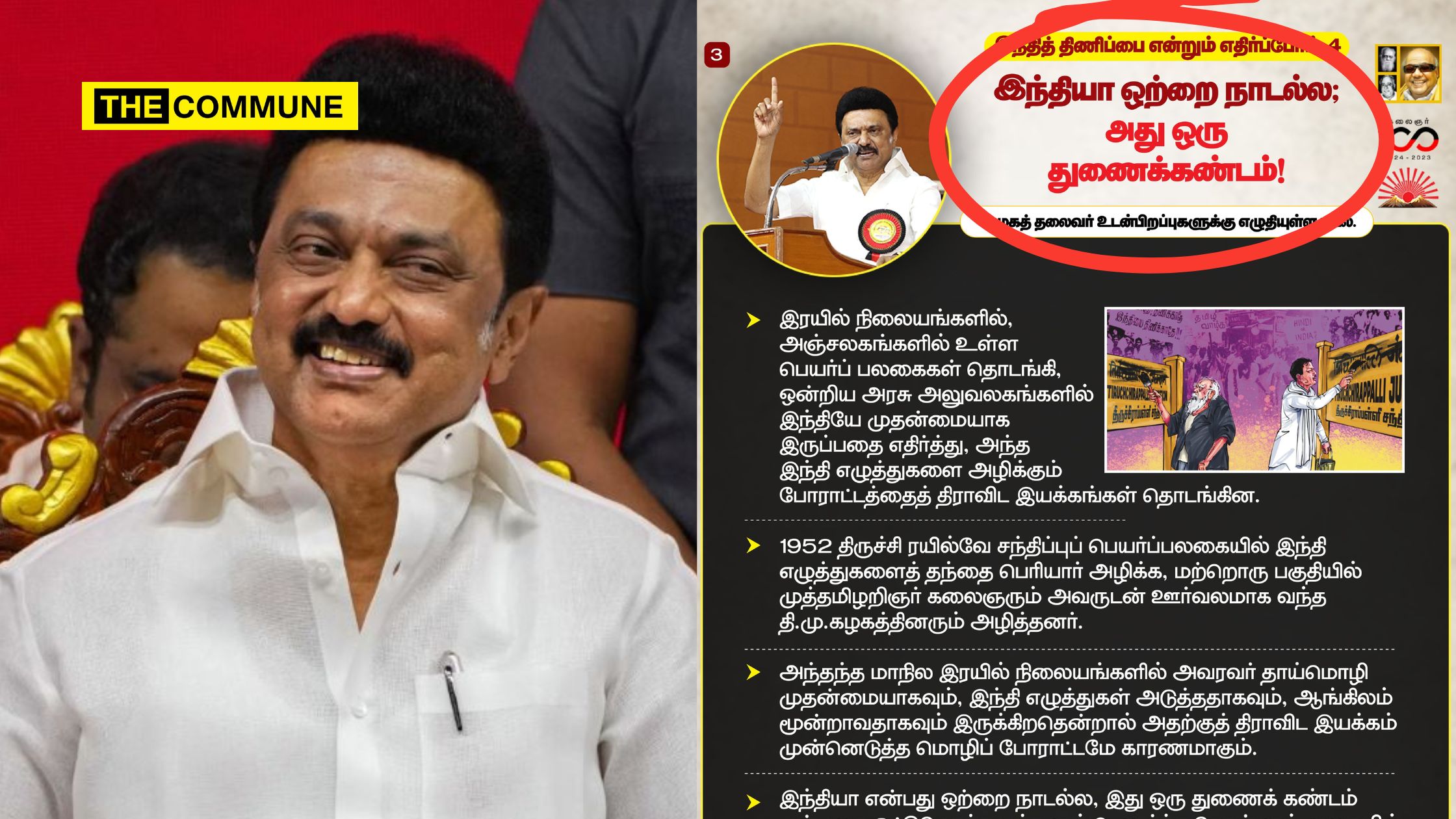
When all political strategies seem to fail, the ruling DMK has returned with a divisive stance, subtly promoting divisiveness and what can be called secessionism. This time, Chief Minister MK Stalin himself has claimed, “India is not one country, but a subcontinent,” a statement that lacks logic, is completely absurd, and goes against the very spirit of India’s constitution — a constitution that the DMK and its leader have long claimed to uphold.

In a recent social media post, Tamil Nadu Chief Minister MK Stalin criticized the BJP-led central government for what he described as the imposition of Hindi, stating, “BJP leaders advocating Hindi insist, “You must know Hindi to buy tea, pani puri, or use toilets in North India.” In the Age of AI, forcing any language as a third language in schools is unnecessary. Advanced translation technology already removes language barriers instantly. Students should not be burdened with extra languages. They should focus on mastering their mother tongue and English while gaining expertise in science and technology. If needed, they can learn any language later. True progress lies in innovation, not linguistic imposition. #தமிழ்_வாழ்க! #LetterToBrethren #StopHindiImposition.”

One of the images shared in the post included that the letter by leader to DMK cadres, in which the it stated, “India is not one country, but a subcontinent.”

MK Stalin said “DMK was the first to proclaim in Parliament and make people realize that India is not one country but a subcontinent.

This is the same rhetoric peddled by Congress’ crown prince Rahul Gandhi who has time and again said “India is not one nation” but a “union of states”.

While India is indeed a country, it is also part of the subcontinent, which encompasses a larger geographic region (Indian subcontinent), including countries such as Pakistan, Bangladesh, Nepal, Bhutan, Sri Lanka, and the Maldives. This makes it a distinct area within the Asian continent, with its own unique geographical and cultural characteristics.

Yes, India can also be referred to as a subcontinent which refers to a large landmass that is somewhat smaller than a continent and is distinguished by its unique political, geographical, or cultural identity.

The question then arises: What exactly is Chief Minister MK Stalin trying to convey to the DMK cadres? Secession in India? Is he hinting at Tamil Nadu as a separate nation?

According to Article 1(1) of the Indian Constitution, we know that “India, that is Bharat, shall be a Union of States.” The word “Union” was intentionally chosen over “Federation” to emphasize that the Indian Union is not a product of an agreement between states (which could be broken) and that the states have no right to secede. While states can be restructured or reorganized, India, as a union, cannot be broken. The central government can alter the names and boundaries of states without their consent. This is why Dr. B.R. Ambedkar described India as an “indestructible Union of destructible states.

This is not a new stance for the DMK, which had secessionist tendencies in the 1960s but later abandoned them. However, when faced with mounting criticism, the party often reverts to old, familiar rhetoric.

Subscribe to our channels on TelegramWhatsApp, and Instagram and get the best stories of the day delivered to you personally.

“If They Don’t Listen To Me, They Won’t Be There, I Can Change Them with A Letter” DMK Dharmapuri East Secretary Dharmaselvan Allegedly Warns Officers With Transfer

Dharmaselvan, who was recently appointed as the DMK’s East Secretary in-charge for Dharmapuri district, has sparked controversy by allegedly making threatening remarks towards district officials, including the SP and IAS officers.

At a DMK executive meeting held in Dharmapuri, Dharmaselvan told the cadres, “Not even a single officer can stay without listening to what I say then the officer will not be there. No one can interfere in this. You cannot change those people by telling them as you think. I can change them only by writing a letter. You should understand that, right? Collector should listen what I say, the SP should listen what I say. All the administration below me will listen to what I say. If they don’t listen, they will not be there. I will do this. No officer cand do things above me (here he used derogatory words on the officers). No one can play games. If he plays games, his game will be over. Right. I know what the leader told me. Whether it is an officer or whoever he is, he has told me to give me in a letter pad. This including the collector and I don’t want to talk about anything below. How did you do before this? Whether it was a BDO office, I want to know A to Z happenings. The union secretary should know. That’s how it happens. No one can fool around here. I don’t know how the previous (officer) behaved before. I’ll tell him clearly.”

A leaked audio of a DMK district secretary, who was appointed just a week ago, threatening to transfer top state officials has gone viral, attracting widespread attention as the state faces an unprecedented decline in law and order.

Subscribe to our channels on TelegramWhatsApp, and Instagram and get the best stories of the day delivered to you personally.

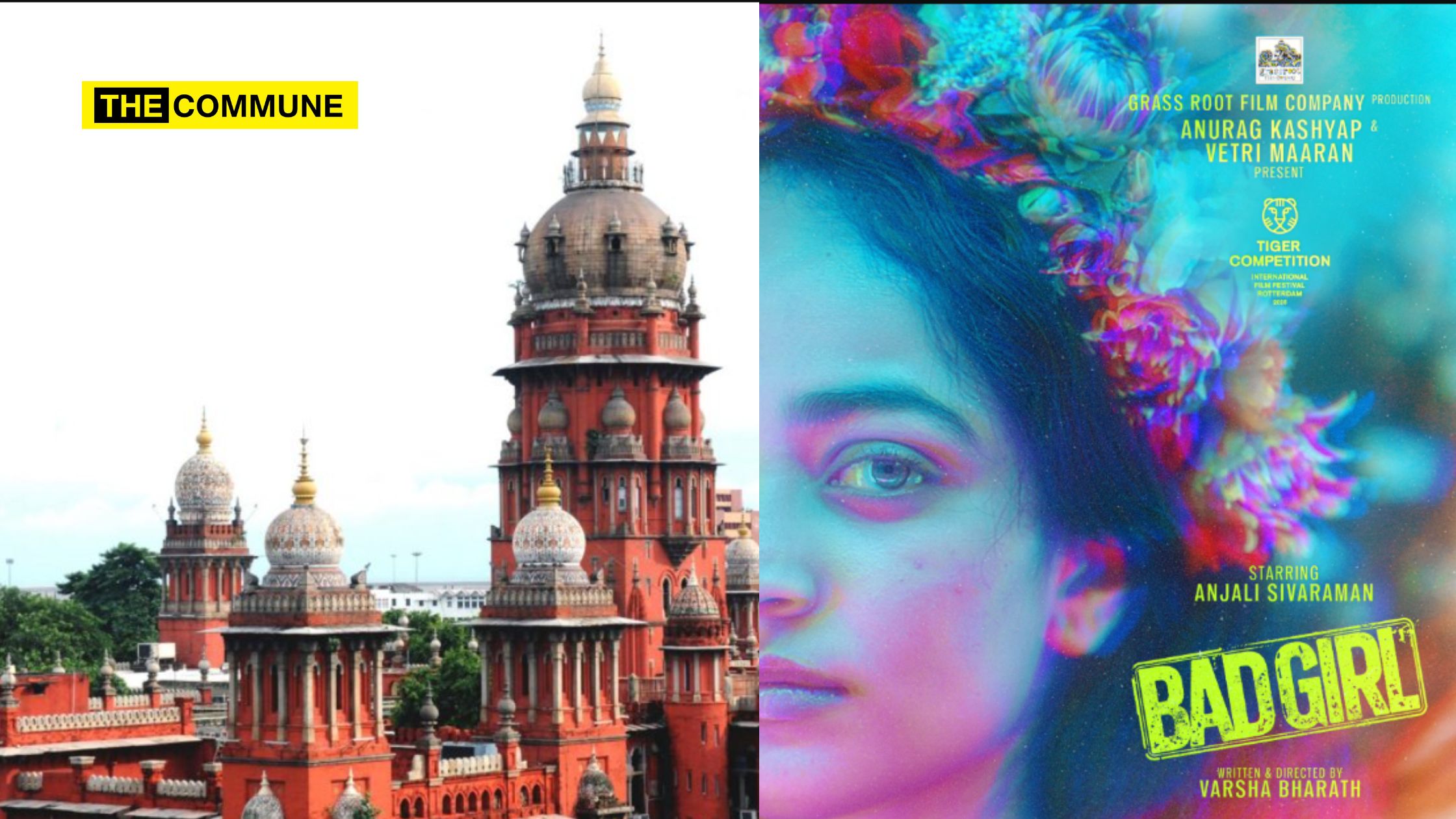
Madras High Court Rejects Petition To Withhold Certification For Tamil Film “Bad Girl”

The Madras High Court recently rejected a petition requesting that the Central Board of Film Certification (CBFC) refrain from certifying the forthcoming Tamil film Bad Girl.

Justice Bharatha Chakravarthy dismissed the petition, citing a statement from the CBFC that no application for the movie’s certification had been received as of that time. The court further noted that the CBFC was fully capable of carrying out its duties and would process any application for censorship in accordance with the law.

During the hearing, M. Rajesh Vivekananthan, the Deputy Solicitor General of India, clarified that no such film or certification request had been submitted. As a result, the petitioner’s request could not be considered at that time. The court also emphasized that the CBFC had the authority to assess the film and make a decision based on legal guidelines.

This petition was filed by the President of the Rashtriya Sanadhana Seva Sangam, an organization dedicated to promoting unity and support for economically disadvantaged communities, particularly Brahmins. The association argued that certain recent Tamil films had depicted the Brahmin community in a derogatory manner, through dialogues, scenes, and storylines that negatively portrayed them. They claimed that Bad Girl was one such film, where the protagonist, a Brahmin, was depicted as succumbing to modern social vices and exhibiting immoral behavior.

The organization alleged that the film’s director, Vetrimaran, intended to tarnish the reputation of the Brahmin community by falsely portraying the corruption of its culture and values. They also pointed out that the movie’s teaser had led to significant controversy on social media and television, further fueling debates about its negative portrayal of the Brahmin community.

The petitioners contended that the CBFC had the authority to deny certification to a film that disparaged any race, religion, or social group. They argued that since the teaser itself appeared to defame the Brahmin community, the CBFC should refuse certification for the film. The organization had submitted a formal request to the CBFC on 30 January 2025, asking for the film to be withheld from certification, but with no response received, they decided to take the matter to the High Court.

Bad Girl

The teaser of the film Bad Girl was released on 26 January 2025. Presented by filmmakers Anurag Kashyap and Vetri Maaran, the movie is penned and helmed by Varsha Bharath. The teaser introduces us to a young woman, portrayed by Anjali Sivaraman, who candidly shares her long-held desire to have a boyfriend. It then takes us back to her high school days, tracing a journey many young women may find familiar. As she navigates the challenges of puberty and the complex emotions it brings, her openness about her feelings provokes harsh judgment. Male classmates ridicule her, branding her with labels, while her female friends dismissively call her “desperate.” In college, when she enters a relationship, she faces the stark realities of a deeply ingrained “misogynistic” society.

Vetrimaaran produces Bad Girl under the Grass Root Film Company banner. Now this might look like an ordinary teaser release but when we examine the contents of the teaser, we realise it is yet another Dravidian anti-Brahmin propaganda film that is set to “delight” the ever-hungry Dravidianist’s appetite for such content.

The teaser introduces a Tamil Brahmin girl who is a rebel, defies societal expectations of being the “good girl” as she seeks to break free from the constraints of the usual trope of “Brahminical patriarchy“, and since this film is from the Dravidianist ideologue’s soil, it needs to show her embracing the identity of a modern, liberated woman. The final shot in the teaser shows the 2020 scenes of Thaali bajao during the Covid pandemic which has also been “meticulously” shot with precision to highlight those deemed regressive – Brahmins who are shown performing rituals with traditional symbols like the naamam. 

(With inputs from Live Law)

Subscribe to our channels on TelegramWhatsApp, and Instagram and get the best stories of the day delivered to you personally.

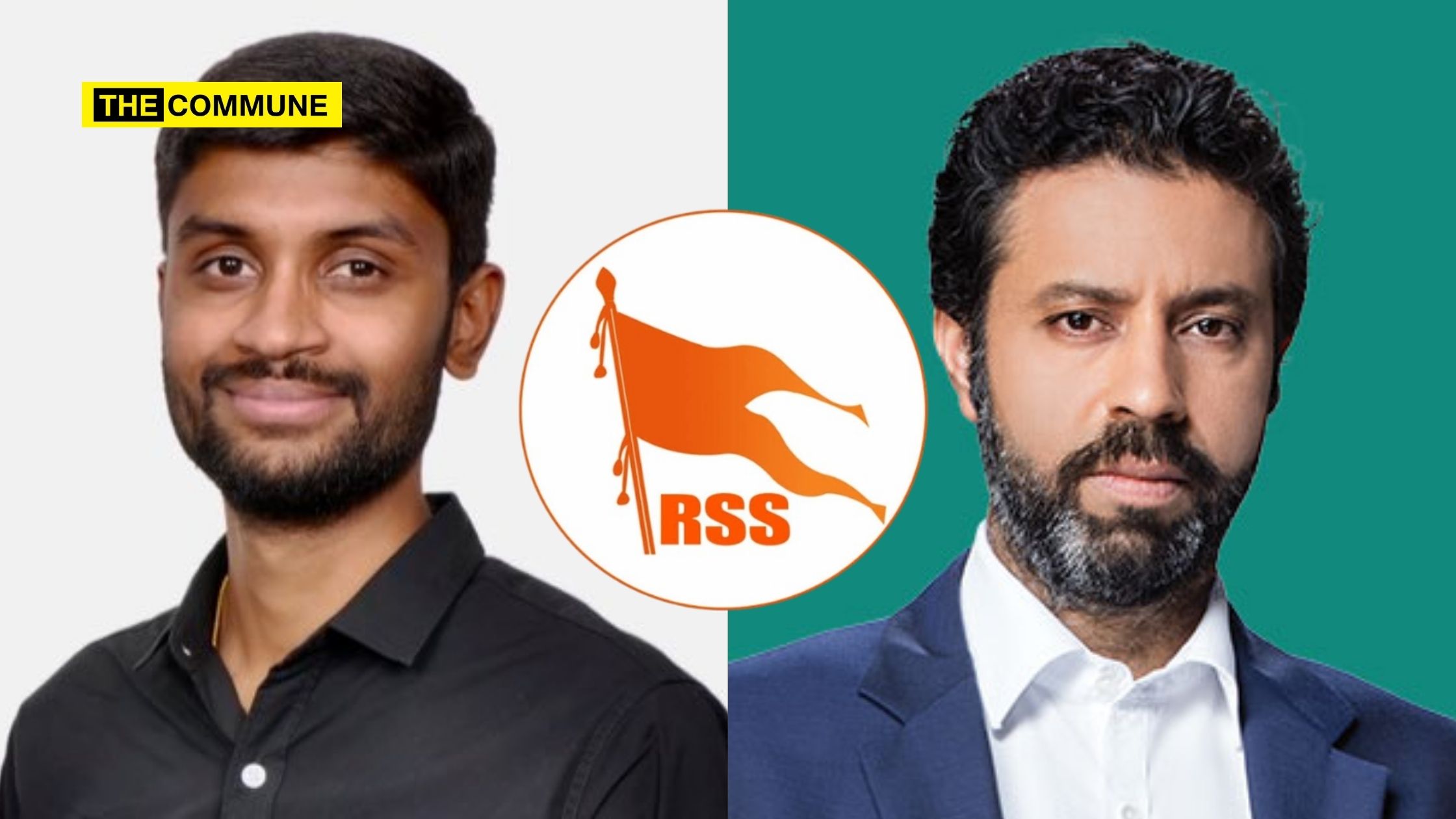
DMK-Buttressing Two-Bit Dravidianist Journo’ Arvind Gunasekar Uses ‘RSS’ Name To Peddle Fake Narrative Quoting Journalist Rahul Shivshankar, Chickens Out When Questioned

Unfounded claims about delimitation are being peddled by the Dravidianists, led by none other than Tamil Nadu Chief Minister Stalin. Having received the cue, Dravidianists and DMK buttressers in the garb of “journalists” had to act. One such example is Arvind Gunasekar – known for his impeccable “bending over backwards” attitude to his DMK masters.

Rahul Shivshankar, Consulting Editor at Network 18 made a post on delimitation following Union Home Minister Amit Shah’s speech in Coimbatore a few days ago. Shivshankar wrote on his X handle,

“Here is an examination of the arguments being made by DMK on the delimitation debate. The more one looks into the specifics the more the inconsistencies in DMK’s stand which prompt some data-backed questions:

1. Tamil Nadu’s Declining Population Growth vs. Representation Demand:

• Tamil Nadu’s population growth rate (2011 Census): 15.6% (2001-2011), much lower than Bihar (25.4%) and Uttar Pradesh (20.2%).

• Despite this, Tamil Nadu still holds 39 Lok Sabha seats, while Bihar (with almost twice the population) has only 40 seats and UP 80 seats.

• Q: If DMK believes in proportional representation for caste-based reservations, why does it oppose fair seat allocation based on population growth? No Jitni abaadi utna haq?

2. DMK’s Contradiction on Social Justice vs. Delimitation:

• DMK demands caste-based reservations based on population (Tamil Nadu has 69% reservation).

• North Indian states have higher SC/ST/OBC populations. Bihar (63%), UP (60%), MP (68%), all have large backward-class populations.

• Q: If DMK supports representation for OBCs and Dalits based on population, why does it oppose North Indian states getting more parliamentary seats based on the same principle?

3. Freezing Delimitation Benefited Tamil Nadu at the Cost of UP/Bihar

• In 1971, Tamil Nadu’s population share was 6.6% of India; today, it is just 5.96%.

• Still, it holds 39 seats out of 543 (7.2%), meaning Tamil Nadu is overrepresented in Parliament compared to its population.

• In contrast, UP has 80 seats for 16.5% of India’s population—underrepresented.

• Q: If DMK truly believes in democracy, why does it oppose the correction of this historic imbalance?

4. Internal Hypocrisy: Unequal Representation Inside Tamil Nadu:

• Chennai has 3.5% of Tamil Nadu’s population but gets 5 out of 39 Lok Sabha seats (~13%).

• Rural areas like Ramanathapuram and Virudhunagar are underrepresented.

• Q: If DMK is truly against unfair seat allocation, why hasn’t it demanded internal seat redistribution within Tamil Nadu itself? Last, DMK must remember that TN’s economic prospects have also benefited from the labour of economic migrants from the North. So playing South against North is a self-defeating argument.”

Now to jump into the limelight, Gunasekar had to quote some big media person who is on the opposite side of the spectrum as him. So quoting Shivshankar, Gunasekar wrote, RSS saysTamil Nadu is overrepresented in Parliament compared to its population”, irony, because states like Tamil Nadu strictly implementedNational Population Policy’. Should States like Tamil Nadu be penalised for implementing National Population Policy ? Also to questions on what basis parties like DMK are opposing Delimitation exercise ? 1

. By tagging Delimitation exercise with Women Reservation Act, BJP Govt has ensured Delimitation (increasing number of seats) will not be frozen (Vajpayee Govt froze it in 2002).

2. Section 8(a) of the Delimitation Act sayson the basis of Census figures…”. The existing law of the land says Census figures will be the basis of Delimitation exercise. Not hearsay nor anyone made a phone call to TN CM.

3. As per Article 82 of the Constitution, data of the Census taken after the year 2026 will be basis for Delimitation exercise, and so, decadal Census has been delayed till date just to comply with Article 82 ?!

4. Are parties like DMK fear-mongering ?, not really, the country witnessed Delimitation exercise carried out by this Govt in Jammu and Kashmir between 2020-2022. On the basis of 2011 census, number of seats in Jammu increased by 6 (37 to 43) while just one seat increased in Kashmir (46 to 47).

5. Even after all these, if BJP now says Census figures alone will not be the basis of Delimitation, let them walk the talk, amend Delimitation Act 2002, enacted by Vajpayee Govt and assuage the fears of the Southern States.”

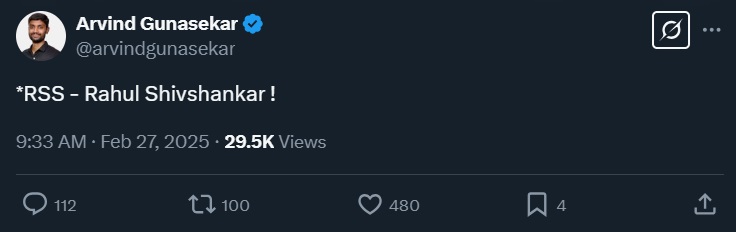
Instead of mentioning Shivshankar by his name, Gunasekar mentions him as “RSS“. He made this post on 26 February 2025 at 7.50 PM. Following the backlash, very slyly added a postscript (subsequent post in this context)

“*RSS – Rahul Shivshankar !”

He made this second post on 27 February 2025 at 9.33 AM.

Many people believed RSS, the organisation had actually made this statement. He neither apologised nor deleted/edited his tweet for the correction – no one would probably look at his second tweet for that matter and misinformation would continue to be spread.

Netizens called out his wanton mischief.

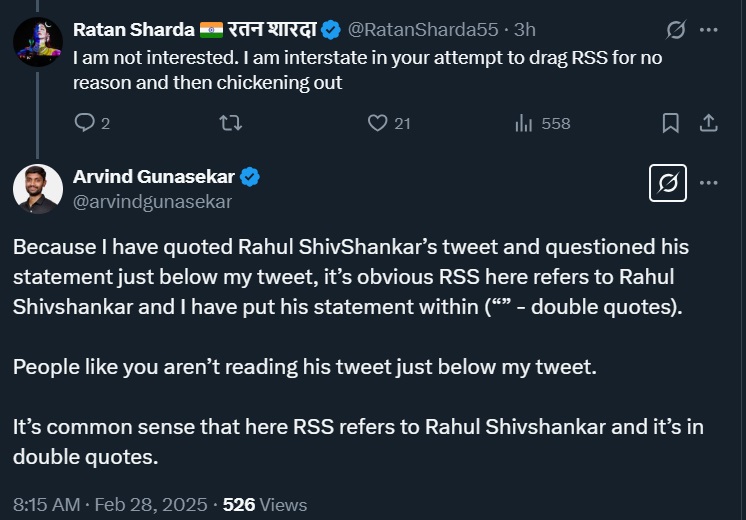
Later RSS ideologue Ratan Sharda called out his “wafer-thin defence” that RSS did not mean the organisation but the journalist Rahul Shivshankar.

Gunasekar continued to justify he did nothing wrong. He replied to Sharda saying, Still you have not read Rahul ShivShankar’s tweet I have quoted. I quoted Rahul ShivShankar’s tweet and questioned his statement “Tamil Nadu is overrepresented in Parliament compared to its population” (See Pic 2 – Point 3 (2)). It’s his statement that I have questioned. If you have a problem with that statement, you too have to question him.”

Sharda continued to call out his mistake and Gunasekar would not relent. He kept repeating that RSS was “obviously” referring to Shivshankar and not the organisation. He said, “Because I have quoted Rahul ShivShankar’s tweet and questioned his statement just below my tweet, it’s obvious RSS here refers to Rahul Shivshankar and I have put his statement within (“” – double quotes). People like you aren’t reading his tweet just below my tweet. It’s common sense that here RSS refers to Rahul Shivshankar and it’s in double quotes.”

This is not the first time Gunasekar has peddled fake news and buttressed the DMK.

The Dravidianist Face Of Arvind Gunasekar

Pretending to be an unbiased journalist, Arvind Gunasekar has time and again exposed his Dravidianist leanings over the years.

In August 2024, when the Kolkata rape and murder was hitting the headlines, Gunasekar downplayed the brutal rape and murder of the trainee doctor, despite substantial evidence pointing to the crime. While autopsy reports confirmed sexual assault and violent death, Gunasekar used the term “alleged” to describe the incident, casting doubt over its severity. It is noteworthy that Tamil news media did not bother to report this incident on their news channels, nor did they talk about any of the other rape incidents that occurred in the state.

He also posted a misleading post on his handle regarding the Uniform Civil Code (UCC) Bill passed in Uttarakhand. He shared an image of Schedule I from the UCC, highlighting prohibited relationships, and stated that marriages with an “Aunt/Uncle’s Daughter” would be restricted, implying this was a nationwide rule. However, in reality, many listed relationships are already prohibited under the Hindu Marriage Act and he forgot to mention the fact that the UCC applies only to Uttarakhand.

Like a typical Dravidianist, he also wanted to proclaim 30 January as “Gandhi Hatya Diwas”!

He even defended a Times of India article by Julie Mariappan, which claimed that the central government was discriminating against Tamil Nadu in allocating National Disaster Response Funds (NDRF). The article suggested that funds were being directed only to BJP-ruled states, despite Tamil Nadu’s requests for assistance. Arvind attempted to justify the claims by citing a Press Information Bureau (PIB) release. However, a PIB release indicated that additional assistance was allocated for natural disasters occurring between May and October 2021, while Tamil Nadu’s heavy rains occurred in November and December, making the article’s claims misleading.

During the Lok Sabha polls earlier this year, he even endorsed DMK candidate Ganapathy Rajkumar, describing him as a “calm and composed person” with a “proven administrative record” and a “Doctorate in Journalism”. However, Rajkumar’s Ph.D. was actually on the topic of “Emergence of Jayalalithaa as a Mass Leader,” not journalism. The doctoral thesis focused on assessing the leadership qualities of Jayalalithaa, a former AIADMK leader, through surveys in Tamil Nadu. Arvind’s endorsement faced criticism and mockery for inaccurately portraying the nature of Rajkumar’s degree and for endorsing a candidate with apparent political bias.

He also weighed in on the controversy surrounding AIMIM leader Asaduddin Owaisi’s “Jai Palestine” slogan during his Lok Sabha oath. In a post (that was also shared by alleged fact-checker Mohammed Zubair), Gunasekar claimed that members of the opposition alliance, I.N.D.I.A, had opposed a BJP member’s “Jai Hindu Rashtra” remark during the oath-taking, suggesting it went against the principles of the Indian Constitution. His post appeared to shift the narrative towards criticizing the BJP while subtly defending Owaisi’s statement.

In January 2025, he criticized Tamil Nadu Governor RN Ravi’s walkout from the Assembly over the omission of the National Anthem at the beginning of the session. He argued that the Speaker, not the Governor, controls Assembly proceedings and that both the Tamil Thai Vaazhthu and National Anthem were sung, as per Tamil Nadu’s practice. Gunasekar accused the Governor of using the controversy to avoid delivering the customary address. His comments dismissed the Governor’s constitutional role, downplayed the violation of protocol, and framed the issue as an attack on Tamil identity rather than a matter of national respect.


Subscribe to our channels on TelegramWhatsApp, and Instagram and get the best stories of the day delivered to you personally.

Tamil Nadu CM MK Stalin Openly Peddles Hate Against Brahmins

Tamil Nadu Chief Minister MK Stalin continues to keep the fire of the “Hindi imposition” drama simmering while the state is in doldrums. Giving this “protest” a push, he alleged the imposition of Hindi through the National Education Policy (NEP), threatened the survival of several regional languages. In a post on X, Stalin questioned the impact of Hindi on linguistic diversity across India and listed several languages that he claimed were “gasping for survival.” He wrote, “My dear sisters and brothers from other states, Ever wondered how many Indian languages Hindi has swallowed? Bhojpuri, Maithili, Awadhi, Braj, Bundeli, Garhwali, Kumaoni, Magahi, Marwari, Malvi, Chhattisgarhi, Santhali, Angika, Ho, Kharia, Khortha, Kurmali, Kurukh, Mundari and many more are now gasping for survival. The push for a monolithic Hindi identity is what kills ancient mother tongues. UP and Bihar were never just “Hindi heartlands.” Their real languages are now relics of the past. Tamil Nadu resists because we know where this ends. Tamil has awakened; Tamil culture has survived! Some languages ​​have given way to Hindi; they have disappeared without a trace!”

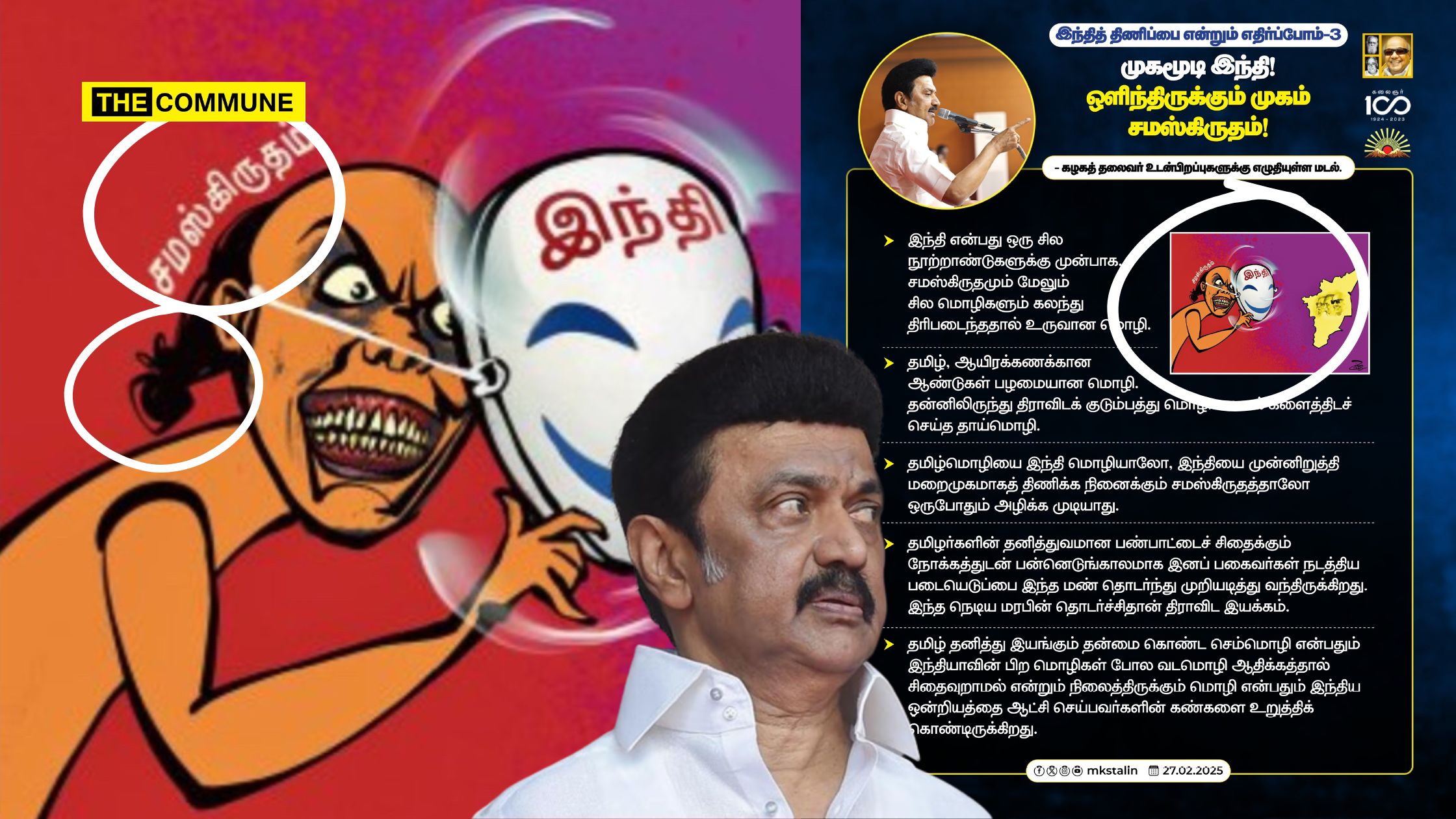
Reaffirming his party’s stance, Stalin stated in a letter to his cadre, “We will oppose Hindi imposition. Hindi is the mask, Sanskrit is the hidden face.”

However, the letter to the cadre very blatantly shows that MK Stalin is actually peddling hate against Brahmins under the guise of “opposing Hindi.”

The image in the letter shows a person who has a “Shikha” (tuft) indirectly indicating that Brahmins are pushing for Sanskrit “imposition” and people must oppose them.

The remarks come amid the Centre’s three-language policy, which the ruling Dravida Munnetra Kazhagam (DMK) has been opposing on the surface – it is noteworthy that schools run by DMK members and other Dravidianist party leaders offer Hindi as a subject in their schools and have implemented NEP 2020.

Stalin’s Brahmin Hate

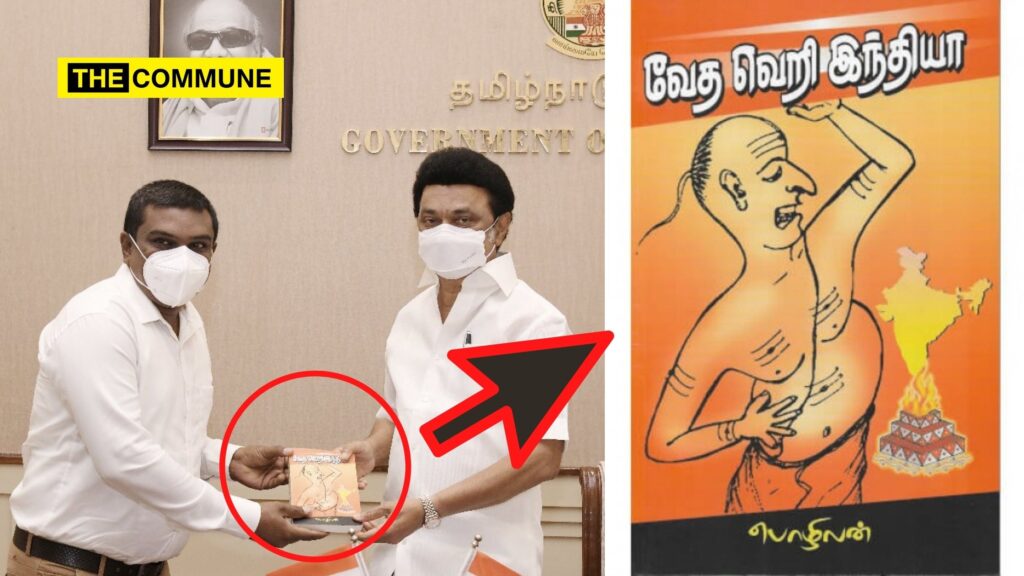
In 2021, he endorsed a book peddling Brahmin/Hindu hatred.

When he was the Opposition leader, Stalin had made obscene remarks on Hindu rituals and mocked the purohits while participating in a Muslim wedding function.

How Dravidianists Use Nazi-Style Cartoon Propaganda To Demonize Brahmins

Let us have a look at how Brahmins are depicted across Dravidian literature and “pop culture” through Nazi-style propaganda.

Basically, the caricatures of Tamil Brahmins are based on 3 points:

  • They are fat, unshapely, and ugly
  • They are scary
  • They are “powerful” yet harmless but evil in nature

So, pushing the point that if there is a Brahmin around you, look at them with fear in your eyes because they are going to devour you. If we compare this with the Nazi propaganda, Jews were also described as ugly, evil, money-minded, powerful, and scary, not to forget their flowing beards – they stereotyped Brahmins as those with Shikha (tuft).

Nazi-Style Propaganda

The Dravidianists have made use of what is known as the Picture Superiority Effect – a phenomenon in which imagery/pictures are remembered more than text or words.

Most of the Dravidian literature about Brahmins has a few things in common, especially on their cover images.

  • The brahmin has a near-tonsured head with a tuft of hair at the back.
  • He is fat, has a paunch, wears the dhoti, and of course, the janeu/sacred thread.
  • In some cases, depending on the title and the type of content, the Brahmin is shown just next to Satan in terms of being evil.

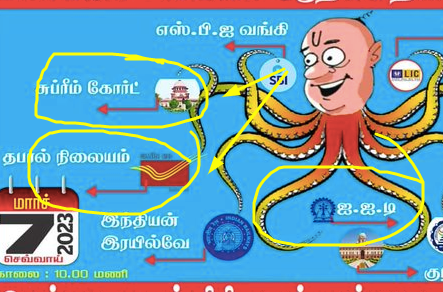
Some other methodologies used include zoomorphism – depicting brahmins as animals. In some cases, the brahmin is depicted as the 8-legged octopus. The inspiration seems to have come from (no prizes for guessing) the Nazi propaganda.

Image Source: https://x.com/realitycheckind/status/1633686952611577857

Let’s take a look at some examples.

The Dravidianists have been using such imagery and Nazi-style propaganda to villainze Brahmins and imprint this message in the minds of gullible people over the years. Chief Minister MK Stalin continues to do this to this day, in an age where he and his party men claim they have “eradicated” caste.

(With inputs from India Today)

Subscribe to our channels on Telegram, WhatsApp, and Instagram and get the best stories of the day delivered to you personally.
Poor Governance Will Never Be Hidden By Shallow Attempts To Divide Society: Ashwini Vaishnaw To Stalin

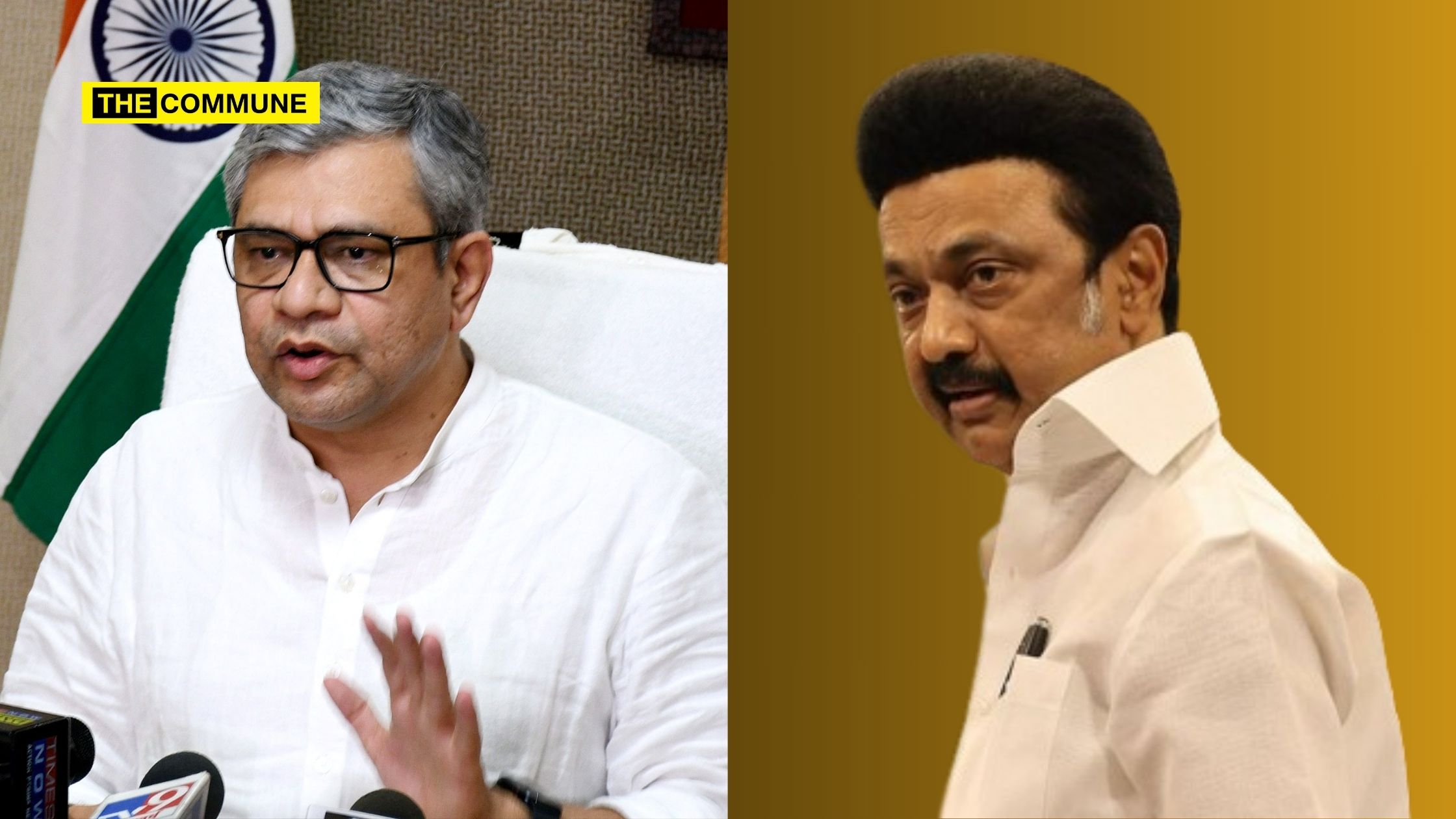
Union Railway Minister Ashwini Vaishnaw on Thursday lashed out at Tamil Nadu Chief Minister M.K. Stalin, saying that poor governance will never be hidden by shallow attempts to divide society.

In a post on the social media platform, ‘X’, Ashwini Vaishnaw said: “Poor governance will never be hidden by shallow attempts to divide society. It will be interesting to know what the Leader of the Opposition Rahul Gandhi has to say on this subject. Does he as MP of a Hindi-speaking seat agree?”

The senior BJP leader was responding to the Tamil Nadu Chief Minister‘s statement that how many Indian languages Hindi has swallowed. Stalin said that Hindi had swallowed, Maithili, Awadhi, Braj, Mundeli, Garwhali, Kumaoni, Magahi, Marwari, Malvi, Chattisgarhi, Santhali, Angika, Ho, Kharia, Khortha, Kurmali, Kurukh, Mandari and many more Indian languages.

In a letter to party cadres on Thursday, Stalin argued that several North Indian languages, such as Maithili, Brajbhasha, Bundeli, and Awadhi – spoken in Bihar, Uttar Pradesh, and Madhya Pradesh – have been suppressed by what he called the “hegemonic expansion” of Hindi. He claimed that more than 25 indigenous languages in North India have been lost due to the dominance of Hindi and Sanskrit.

Stalin credited the century-old Dravidian movement for safeguarding Tamil language and culture through continuous awareness campaigns and protests. He reiterated Tamil Nadu’s strong opposition to the NEP, accusing the Centre of promoting Hindi and Sanskrit under the guise of educational reforms.

Countering the BJP’s argument that the third language under NEP could be a foreign one, Stalin asserted that, in practice, only Sanskrit is being promoted in many states. He cited the example of BJP-ruled Rajasthan, where he said Sanskrit teachers are being appointed while Urdu instructors are being neglected. He warned that if Tamil Nadu were to adopt the trilingual policy, Tamil could eventually be sidelined, leading to increased Sanskritisation.

He pointed out that under NEP guidelines, while Sanskrit is being given prominence in schools, other Indian languages, including Tamil, are relegated to online learning.

“This clearly shows that the Centre is planning to sideline languages like Tamil and impose Sanskrit,” Stalin wrote.

Stalin reminded party members that Tamil Nadu’s two-language policy – Tamil and English – was first mandated by former Chief Minister C.N. Annadurai decades ago. Annadurai had strongly opposed the imposition of Hindi and the perceived influence of Aryan culture on Tamil identity. Stalin emphasised that the state has a long history of resisting Hindi imposition. He cited the anti-Hindi protests of 1937–39, during which leaders like Periyar (E.V. Ramasamy) and Justice Party members actively opposed efforts to make Hindi compulsory in schools under the then C. Rajagopalachari-led government. He also questioned the BJP’s criticism of blackened Hindi signboards at railway stations in Tamil Nadu.

He asked whether railway stations in Uttar Pradesh display Tamil or other South Indian languages for the benefit of passengers traveling from the South, particularly for events like the Kumbh Mela or Kashi Sangamam. He further inquired whether railway station announcements in Uttar Pradesh were made in other Indian languages. Stalin asserted that Tamil Nadu’s steadfast adherence to its two-language policy has contributed significantly to the state’s advancements in education, skill development, and employment opportunities.

He accused the BJP-led Central government of betraying Tamil Nadu and vowed to take all necessary measures to protect the Tamil language. “We won’t oppose if you don’t impose. We won’t blacken Hindi words in Tamil Nadu. Self-respect is the hallmark of Tamils, and we will not allow anyone, no matter who they are, to undermine it,” he declared.

–IANS

Subscribe to our channels on TelegramWhatsApp, and Instagram and get the best stories of the day delivered to you personally.
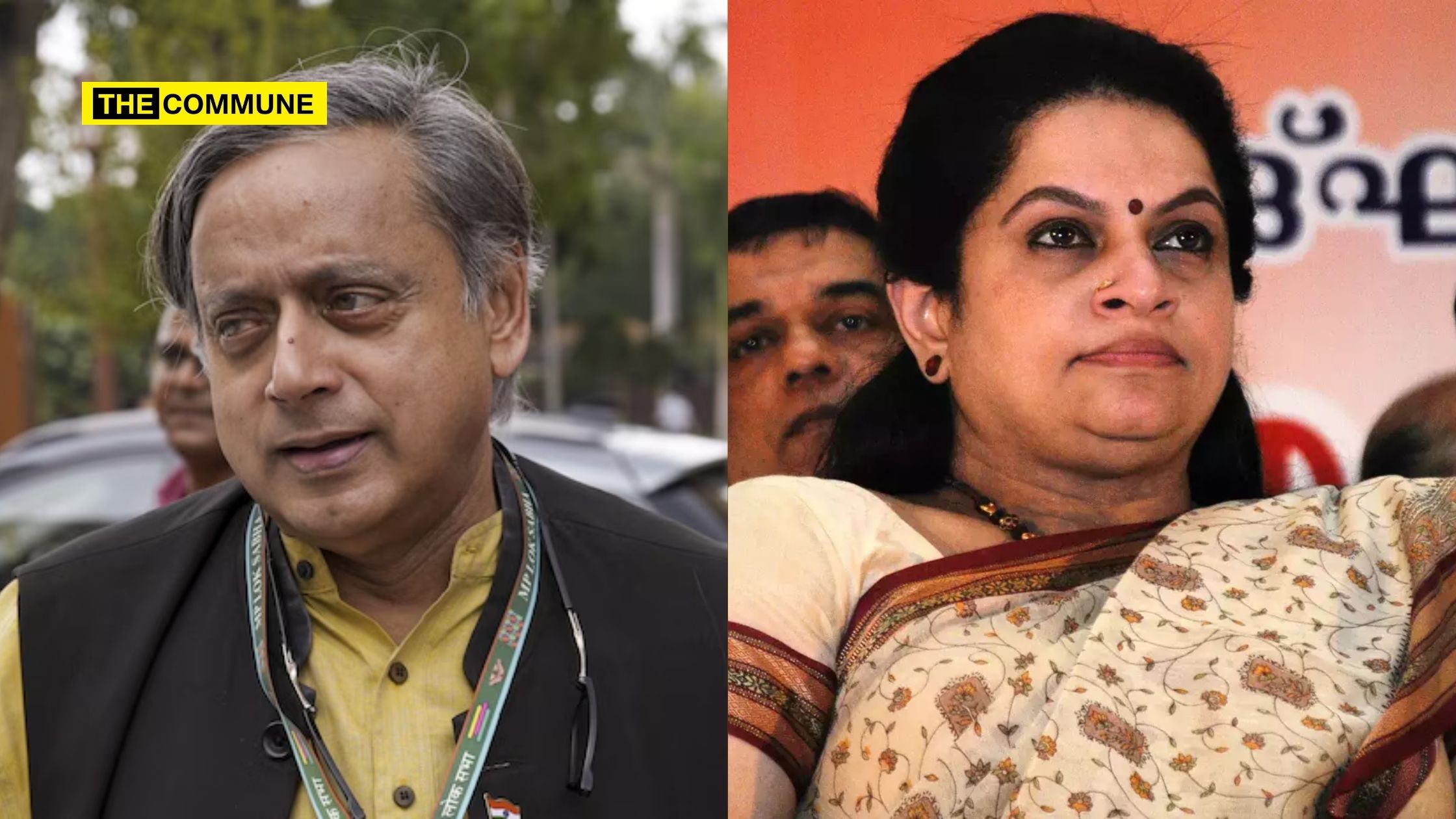
“I’ve Seen How Shashi Tharoor Was Sidelined By Party”, Claims 4-Time Congress CM Karunakaran’s Daughter

Padmaja Venugopal, the daughter of legendary four-time Congress Chief Minister K. Karunakaran on Thursday said Shashi Tharoor is welcome to join the BJP.

“There is no need to call him, as he knows how he is being treated in the Congress party. He is welcome to join the BJP. I used to see him during party meetings when in the Congress and I used to ask him, why is he not present for many meetings. He used to say he does not get the invite and hence doesn’t know of the meetings,” said Padmaja.

“I have always felt and seen how Tharoor was sidelined by the party. All what I said when I left Congress has just been repeated by Tharoor in the past few days. There is no future for him in the Congress party. I decided to leave the Congress party not for any posts or positions, but for peace of mind, which I now have. Nothing is going to happen in the state Congress leaders meeting in Delhi (Tharoor also is invited) called by the high command,” added Padmaja.

Of late Tharoor has come under fire from top state party leaders after his article in an English daily that praised PM Modi and Chief Minister Pinarayi Vijayan. However, Shashi Tharoor has already made his position clear that he will not join the BJP.

He was summoned by Rahul Gandhi last week and the two had a closed-door meeting. Speculations on Thursday have surfaced that Tharoor might be given the post of the Deputy Leader of the Lok Sabha.

Padmaja left the Congress party after former Defence Minister A.K. Antony’s son Anil Antony joined the Congress party. While Anil was given the Pathanamthitta Lok Sabha seat to contest, Padmaja failed to get one.

–IANS

Subscribe to our channels on TelegramWhatsApp, and Instagram and get the best stories of the day delivered to you personally.