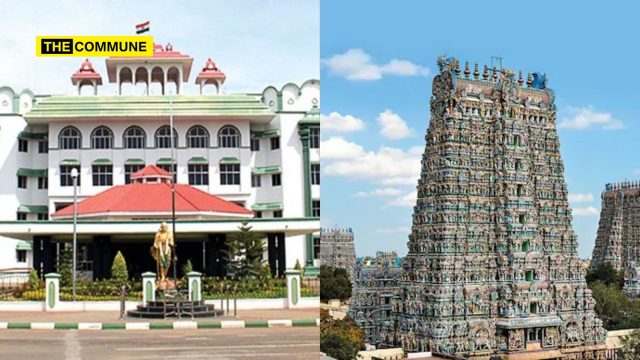
On 26 August 2025, the Madurai Bench of the Madras High Court invalidated a series of Government Orders that had sanctioned the construction of wedding halls using surplus funds from temples across various regions.
Earlier, during the state Budget session, Hindu Religious and Charitable Endowments (HR&CE) Minister P.K. Sekarbabu had informed the Assembly of a proposal to allocate ₹80 crore from the excess funds of 27 temples for the purpose of building community wedding halls. These venues were intended to be rented out for public use.
However, a Division Bench comprising Justices S.M. Subramaniam and G. Arul Murugan found the initiative to be inconsistent with the fundamental principles of Hindu charitable traditions. The court observed that the plan lacked a charitable component and, as such, could not be considered a “religious purpose” under the Hindu Religious and Charitable Endowments Act. Consequently, the Government Orders lost their legal standing.
The judges emphasized that temple assets both monetary and property are offered by devotees with religious intent and must be utilized strictly for temple-related needs such as maintenance, spiritual activities, and development.
The bench said, “It is unambiguous that the role of the Government in controlling the affairs of the Hindu temples across the State of Tamil Nadu under the Hindu Religious and Charitable Endowments Act is limited only to prevent, abuse, misutilization or misappropriation of temple funds and its properties. It is the duty of the Government to ensure that temple funds are utilized only for religious purposes as intended by the donors/devotees and under the provisions of the Act and Rules framed thereunder.”
The government, the court held, has no legal authority to divert these resources toward secular or commercial projects.
The Bench underscored that such funds are considered the legal property of the presiding deity of the temple. In legal terms, deities are regarded as minors, and it is the responsibility of the judiciary to act as the guardian of their interests. Thus, the court deemed it essential to protect temple resources from being misappropriated.
In its ruling, the court declared that constructing wedding halls for rent does not fulfill any religious or spiritual objective. As a result, the initiative was found to be in violation of the HR&CE Act and its associated regulations.
The Hon'ble Division Bench of Hon. Justice Shri S M Subramaniam and Hon. Justice Shri Arul Murugan in Madras High Court (Madurai Bench) has quashed 5 Government Orders issued by Tamil Nadu Govt approving construction of commercial Wedding Halls using Temple lands and funds.… pic.twitter.com/TuANj3WwxD
Based on these findings, the court accepted the group of petitions challenging the government’s decision and officially struck down the related Government Orders.
On 27 August 2025, police in Kerala registered a case against a school teacher accused of discouraging Muslim students from taking part in Onam celebrations. The incident took place at Sirajul Uloom English High School in Kadavallur, Thrissur.
The teacher, identified as Khadija, reportedly sent a voice message to parents advising them to prevent their children from participating in Onam, describing it as a festival belonging to another religion. In the recording, she emphasized that Muslims should follow Islamic principles and avoid engaging in what she described as polytheistic rituals.
She stated, “We should live according to the tenets of Islam. Celebrating Onam goes against our beliefs, and neither we nor our children should be involved. Participating in the customs of other religions could amount to ‘shirk’ (a serious sin in Islam).”
Khadija also remarked that young children must be raised in a strictly Islamic environment and shielded from religious practices that do not align with their faith. “Our children are still impressionable, and it’s important to instill in them the significance of avoiding such festivities. This year, we and our children will not be part of Onam,” she added.
Following a complaint from a member of the Democratic Youth Federation of India (DYFI), police in Kunnamkulam filed a case under Section 192 of the Bharatiya Nyaya Sanhita (BNS), which relates to incitement with the intent to cause unrest.
Onam, the state festival of Kerala, is widely embraced by people of all communities, regardless of religion.
This is not the first time issues of religious sensitivity have emerged during Onam. In 2022, a video circulated on social media showed Muslim girls in hijabs dancing at a school celebration of the festival. This sparked criticism from certain Muslim organizations. The All India Muslim Personal Law Board (AIMPLB) raised objections, claiming that dancing while wearing a hijab was inappropriate and contradicted the purpose of the Islamic dress code.
Muslim cleric Dr. Kalbe Sibtain Noori also commented on the matter, saying, “If those 600 girls chose to dance of their own free will, it’s their personal choice, which is protected in a democratic society. But if the school compelled them, that would be both unconstitutional and unlawful.”
He further noted that, under Islamic law, the hijab is a symbol of modesty and respect. “Dancing while wearing a hijab in front of non-related men is strictly forbidden in Islam according to Sharia,” Dr. Noori stated.
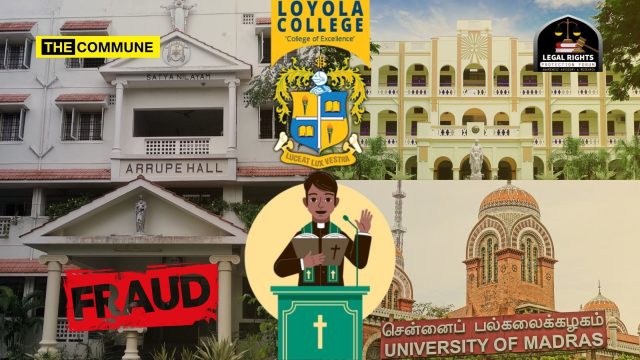
The University of Madras has confirmed serious irregularities by the Loyola College in Chennai after the university’s Inspection Commission reported that the Jesuit institution was conducting its M.A. Philosophy programme at the off-campus Jesuit centre Satya Nilayam in Thiruvanmiyur without approval. This action follows a series of complaints submitted by the Legal Rights Protection Forum (LRPF) to different constitutional bodies following The Commune’s report on the matter.
The detailed report submitted by the Madras University to the National Human Rights Commission (NHRC), flagged “gross violations” of affiliation rules by Loyola College, Chennai, in the conduct of its M.A. Philosophy programme.
This report from the Madras University came after the NHRC found Madras University evasive over Loyola’s illegal M.A. Philosophy course, and warned them with conditional summons.
From religious bias in admissions to flouting reservation norms and blatant non-compliance, here’s a detailed breakdown of the major violations flagged in the report.
Fake Departments And Missing Students
The inspection team discovered that Loyola’s so-called Philosophy Department is nothing more than a façade. There was no separate classroom, no faculty room, no departmental library, no signage, and—most scandalously—no students present at the time of inspection. Classes for both first and second-year students were being conducted in a common seminar hall, with no evidence of actual enrolment.
This is not just mismanagement — it is a direct violation of the Syndicate’s rules on infrastructure and affiliation, dating back to 2003.
Unqualified Faculty And Appointment Irregularities
The report exposes Loyola’s sham in faculty appointments. Many lecturers listed on the college website don’t even meet the basic UGC qualification rules. Even worse, some teachers are being counted as full-time staff at both Loyola and the Sathya Nilayam Research Institute, a clear cheat and violation of university rules. To top it off, the management hired staff—including the Principal—on its own, ignoring the mandatory university selection process. This blatant breaking of rules is nothing short of academic fraud and shows how Loyola ignores laws meant to keep education honest.
Violating Tamil Nadu Govt’s Reservation Norms
Perhaps the most serious violation is Loyola’s blatant disregard for Tamil Nadu’s reservation laws in student admissions. Despite multiple reminders, the management failed to provide the mandatory category-wise admission data for the M.A. Philosophy programme. This deliberate non-compliance undermines the Rule of Reservation, which is crucial to ensure equitable access and opportunities for marginalized communities. By both ignoring the submission of required admission data and bypassing the reservation policy, the management flagrantly violated legal and ethical standards designed to promote inclusion and fairness.
This is a violation of Government Order G.O.(D) No.110 (22.05.2024) and University Circular No.314 (24.06.2024). In short, Loyola has cheated the state’s social justice framework.
“In view of the above findings and based on the Madras University Act, 1923, and the University’s Statutes and Ordinances (2016), the University of Madras concludes that Loyola College has not complied with UGC guidelines, relevant Government Orders, and University norms in conducting the M.А. Philosophy Programme.“, the inspection report said.
Timeline Of Events
The inspection report, submitted in August 2025, follows a string of complaints filed since January alleging academic fraud, religious discrimination, and unauthorized operations at Satya Nilayam run by Loyola College. Let’s take a look at when the investigation began and how action was taken.
January 2025 – First Expose
In January 2025, The Commune published a report alleging that Loyola College was operating an unauthorized extension campus at Satya Nilayam under the guise of an M.A. Philosophy programme affiliated with the University of Madras.
The report highlighted that the programme primarily catered to Catholic seminarians and Jesuit missionaries, raising questions of religious discrimination since admissions were allegedly restricted to Christians.
Degrees issued to such students carried Loyola College’s and the University of Madras’ name, despite students never attending the approved Loyola campus.
Allegations also surfaced of financial misconduct, exorbitant fees, misuse of UGC funds, and funneling graduates into missionary activities.
YouTuber Maridhas also published a video of the investigation on his channel.
February 2025: Legal Rights Protection Forum Complaint To TN Governor
In February 2025, the Hyderabad-based Legal Rights Protection Forum (LRPF) lodged a formal complaint with the Governor of Tamil Nadu, who is also the Chancellor of the University of Madras, seeking revocation of Loyola’s autonomous status and Madras University affiliation, investigation into Satya Nilayam’s unauthorized operations, action against alleged academic fraud and discriminatory practices.
The petition alleged that Satya Nilayam was functioning under a separate Jesuit legal entity, yet Loyola College was granting degrees in its name, thereby misleading students and regulatory authorities.
March 2025: LRPF Appeals to Jesuit Superior General & FCRA Angle Raised
In March 2025, LRPF escalated the issue internationally by petitioning Fr. Arturo Sosa, S.J., Superior General of the Society of Jesus, urging internal Jesuit intervention. Allegations also expanded to include misuse of foreign funds under FCRA regulations, large-scale misappropriation of UGC grants, citing disclosures from former Loyola Principal Rev. Fr. Albert Muthumalai.
Evidence that Satya Nilayam’s official website was abruptly taken down after complaints, and later reappeared with all references to Loyola College scrubbed.
The Governor of Tamil Nadu, R.N. Ravi, formally intervened by directing the University of Madras to investigate, citing potential violations of university norms, secular education principles, and even national security concerns due to the presence of foreign seminarians.
Additionally, in March 2025, the Tamil Nadu Governor RN Ravi who also serves as the Chancellor of the University of Madras, sought an explanation from the University regarding the unauthorized operations of Loyola College’s off-campus center, ‘Satya Nilayam.’
March 2025: Loyola College Alters Website, Erases Links
Following complaints, Satya Nilayam’s website was abruptly altered to erase Loyola-University links, raising suspicions of cover-up. Despite repeated warnings, the University of Madras has failed to act decisively. The case highlights misuse of minority autonomy, systemic double standards, and demands urgent cancellation of affiliations and accountability.
March 2025: Complaint Filed With TN Governor Again
LRPF filed a complaint with the Tamil Nadu Governor against University of Madras Registrar Prof. S. Elumalai, accusing him of enabling large-scale academic fraud involving Loyola College. The complaint alleged Loyola unlawfully ran its M.A. Philosophy program at Satya Nilayam, an unapproved Jesuit centre, while issuing University of Madras degrees since 1998. It cited evidence of unauthorized off-campus operations, website manipulation, and even “lost” affiliation records. LRPF demanded cancellation of all such degrees, disciplinary action against the Registrar, and a criminal probe. Neither Loyola nor Madras University has responded.
April 2025: Complaint Filed With NHRC
LRPF petitioned the National Human Rights Commission against Loyola College, Chennai, alleging religious discrimination in its M.A. Philosophy program, affiliated with the University of Madras. The NGO stated that the course is reserved exclusively for Christian students, denying equal access to others and violating fundamental rights. This followed LRPF’s earlier complaint accusing Loyola of running the program illegally at Satya Nilayam, an unapproved Jesuit centre, while issuing Madras University degrees. Allegations include fraudulent certificates, lost affiliation records, and misuse of visas. Despite mounting pressure, Loyola and Madras University did not issue official responses.
April 2025: NHRC Steps In, Loyola Accused of Religious Discrimination
By April 2025, the National Human Rights Commission (NHRC) took cognizance of complaints that non-Christian students were being systematically denied admission to the M.A. Philosophy course.
The NHRC issued notices to the UGC and the Registrar of the University of Madras, seeking action taken reports. Complaints cited violations of Articles 15(1) and 29(2) of the Constitution of India. LRPF also accused Madras University of shielding Loyola by claiming that original affiliation orders from 1998 were “untraceable.”
Despite repeated notices, both Loyola College and the University of Madras failed to provide satisfactory explanations.
On 24 May 2025, NHRC reprimanded the Madras University Registrar and UGC for non-compliance.
On 24 July 2025, the Commission issued conditional summons to both authorities, requiring them to appear in person on 19 August 2025, unless detailed reports were submitted in advance.
August 2025: UGC Inspection
University Grants Commission (UGC) committee carried out inspections of both the Madras University and Loyola College on August 13–14, with both institutions cooperating.
On 16 August 2025, the University of Madras submitted a detailed report to the National Human Rights Commission (NHRC) confirming serious violations by Loyola (Autonomous) College, Chennai, in the conduct of its M.A. Philosophy programme. The inspection, conducted in response to complaints, found multiple breaches of affiliation rules, UGC norms, and state government directives.
Subscribe to our channels on Telegram, WhatsApp, and Instagram and get the best stories of the day delivered to you personally.
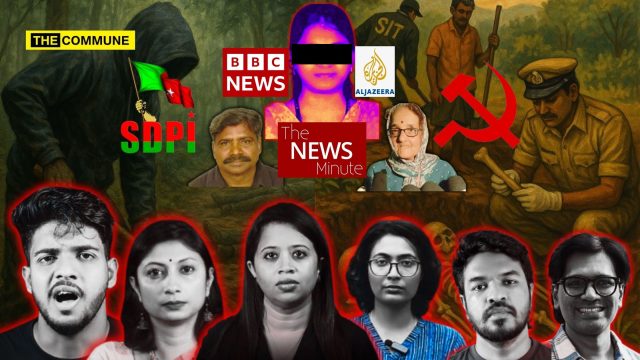
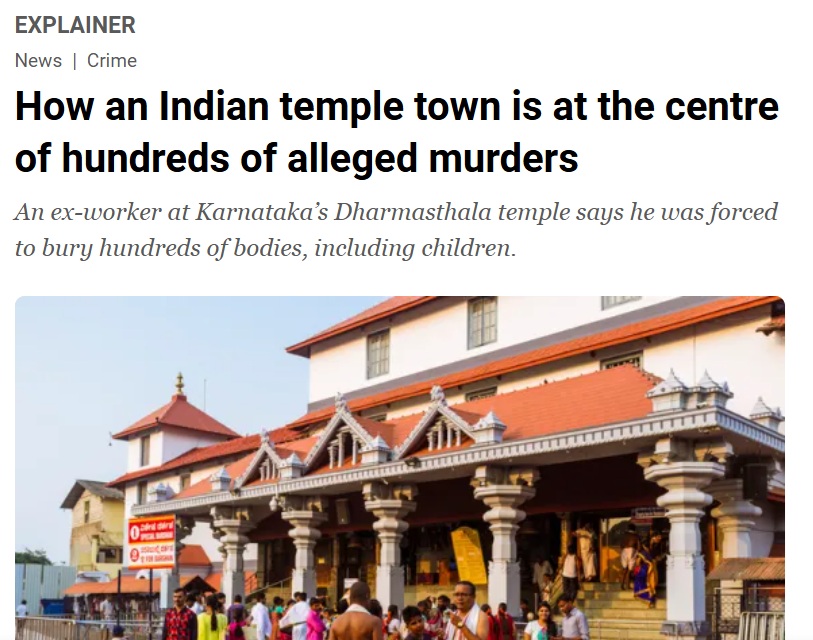
Dharmasthala, a sacred Hindu temple town in Karnataka, is a pilgrimage centre revered by millions, feeding lakhs of devotees daily. It is dedicated to Lord Manjunatha Swamy and regarded as a spiritual and cultural stronghold of Hinduism, especially among Kannadigas. The sacred institution became the subject of a highly orchestrated and systematic campaign of defamation and attack, primarily by Leftist media. Fingers have also been pointed towards a Congress MP from Tamil Nadu alleging that he is behind the orchestrated campaign targeting the temple town.
With their web of lies now collapsing like a pack of cards, let’s trace how various players, at different points in time, worked in tandem to manufacture and push this false narrative.
The Very Beginning – Sameer MD’s AI Video
It all began when a sanitary worker with a mask over his face came to the police with a few lawyers claiming he buried several 100s of girls and women who were allegedly sexually assaulted, burned with acid, and murdered over 2 decades.
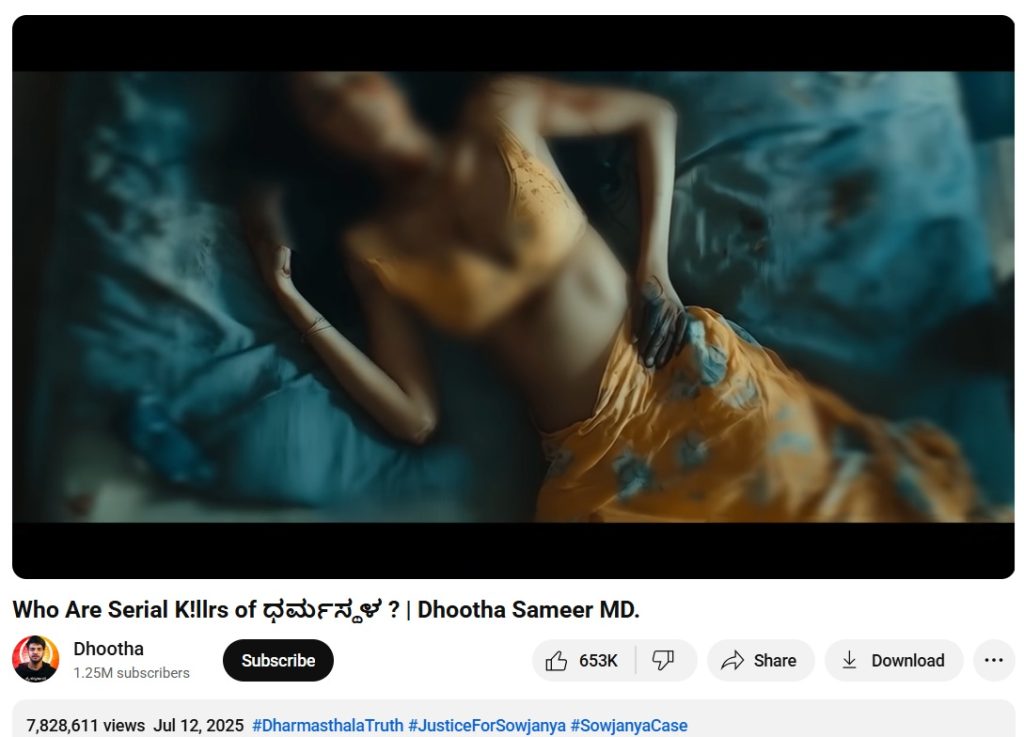
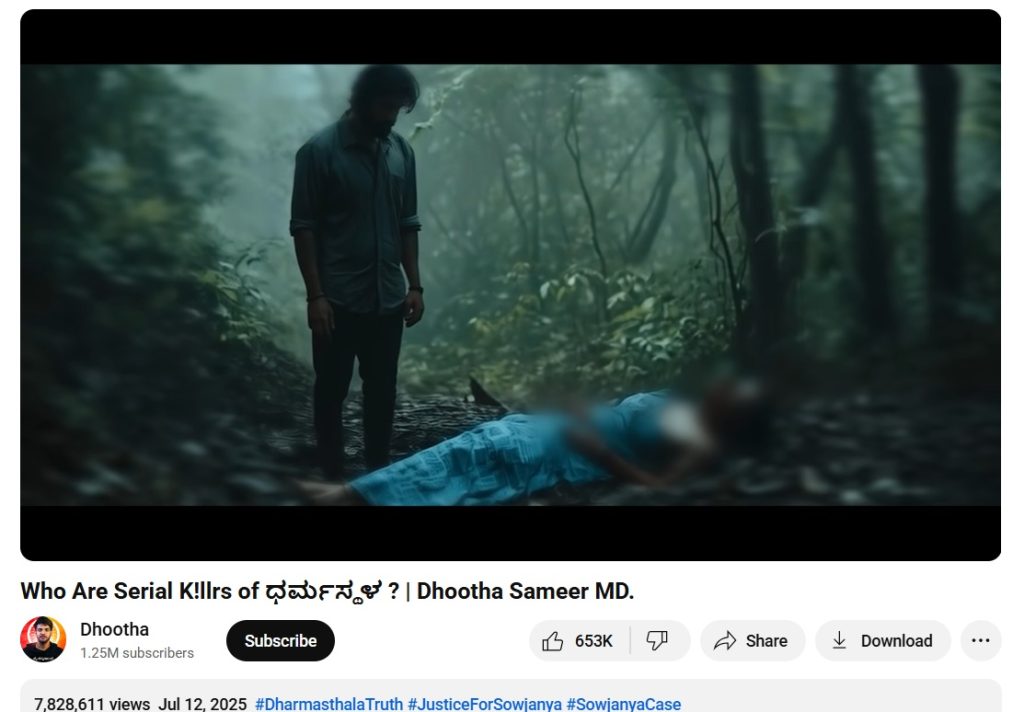
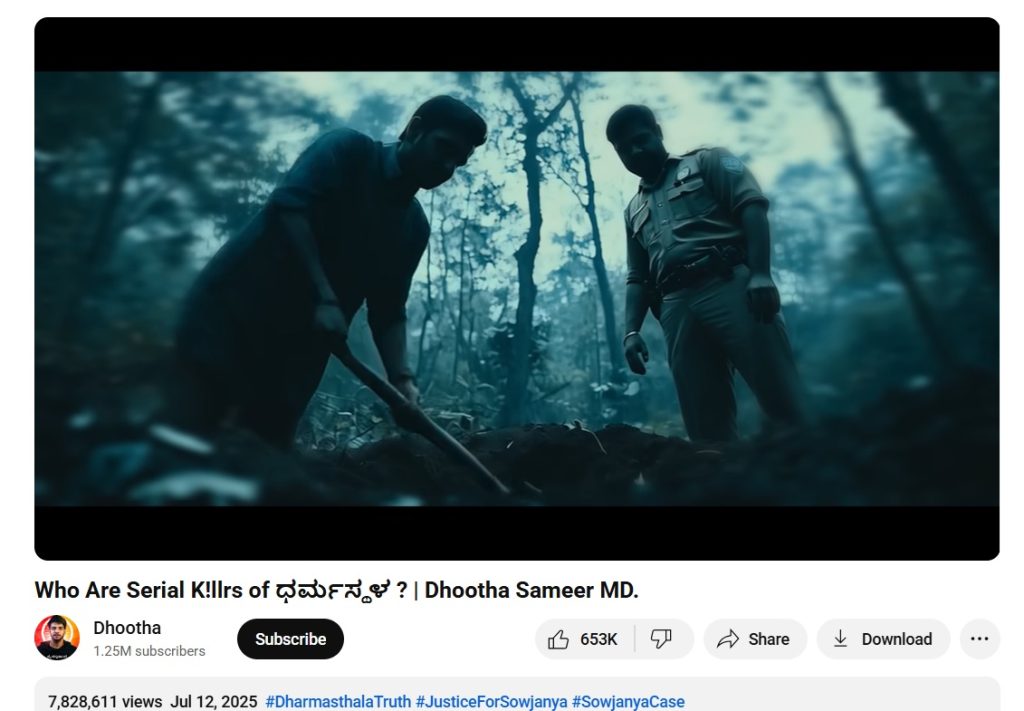
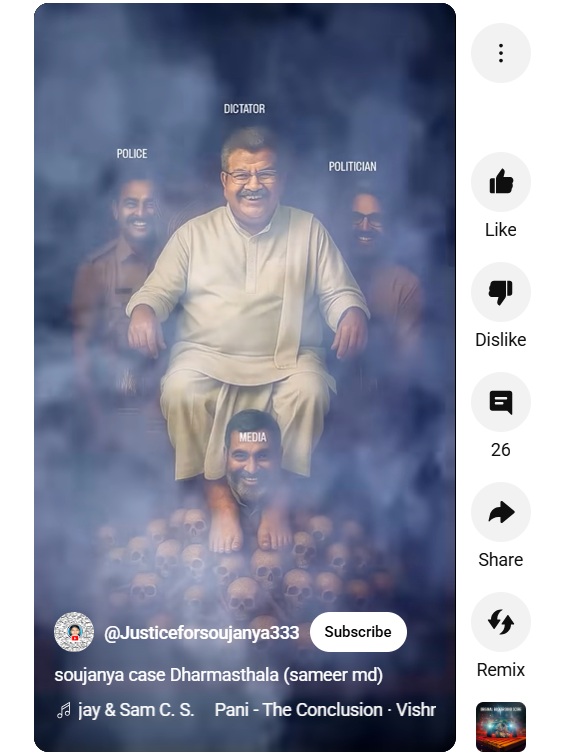
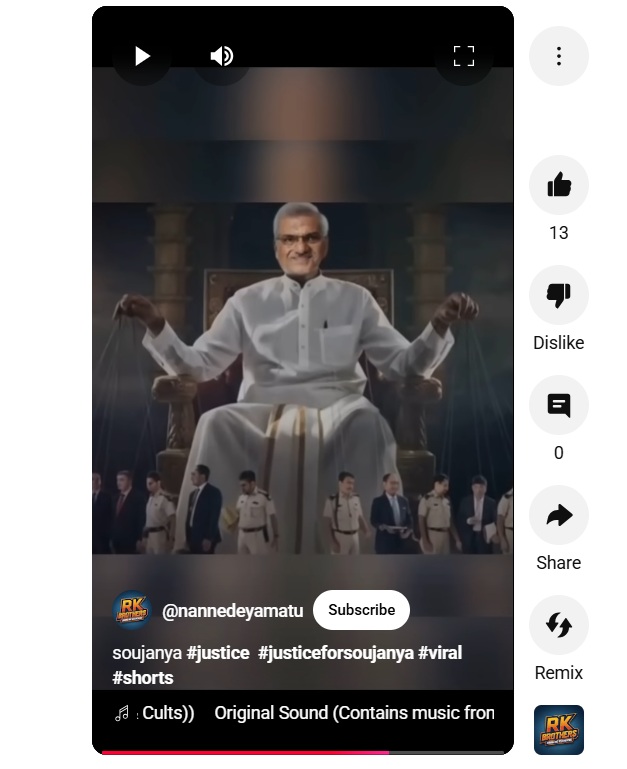
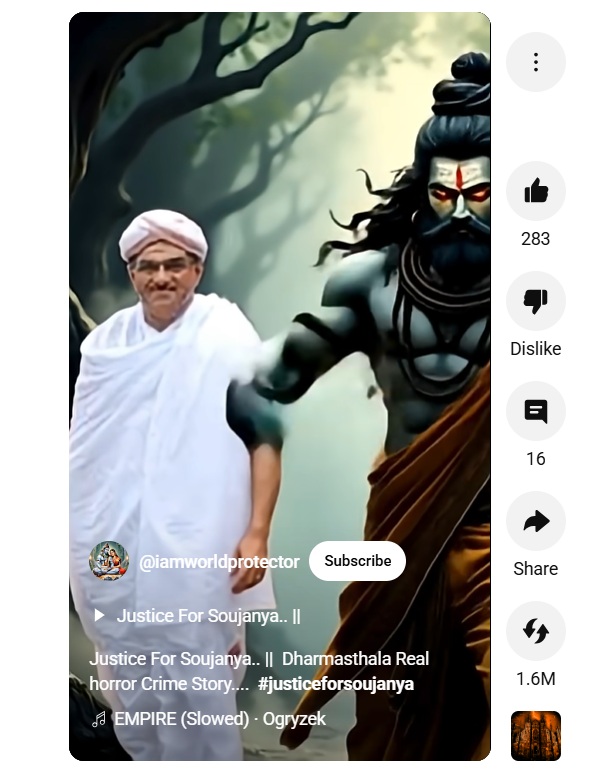
Sameer MD, a fairly unknown YouTuber, came up with an AI-generated video of the allegations. The masked man who he refers to as Bheema is the central character and based the entire video as if the allegations were “absolute truth”.
Police said the video, circulated on YouTube, contained fabricated content, not present in official complaints or court records, and could incite public unrest. Sameer has been charged under relevant sections of the Indian Penal Code and Bharatiya Nyaya Sanhita, including giving false information and fabricating evidence.
This video centers on the allegations made by the masked man who alleges he was forced to secretly bury – Sameer went on to state that “over 1,000 bodies were buried on the orders of his supervisors”, with the complicity of local police paid off by the temple’s management. The video claims most victims were women and underage girls who were raped and murdered, their bodies found in temple lodges.
Screenshot from Sameer’s videoScreenshot from Sameer’s video
A specific, graphic allegation is made regarding the disposal of the body of Soujanya, a previous rape and murder case victim, and the mysterious death of a key witness, Ravi Poojari.
Screenshot from Sameer’s video
He claimed these burials were done with police connivance.
Screenshot from Sameer’s video
The video is presented not as an allegation but as established fact, using highly emotional and provocative language (e.g., “Shiva Tandava,” “final war”). It directly accuses the temple head, Veerendra Heggade, and his family of being behind a vast criminal conspiracy of murder and cover-up.
Sameer narrates the entire “story” as if he had seen it happen in front of his eyes. Too many unverified claims, too many lies, and a cinematic and concocted story – this is basically what the video is all about. The language is deliberately inflammatory, designed to provoke outrage. He also calls for street protests saying, “You have to come to the streets and protest against this injustice. Everyone should raise their voice and if any scoundrel comes in between and tries to create Hindu-Muslim divide, beat that son of b**** with slippers.”
It is noteworthy that Sameer had his claim to fame when he posted a similar video about the Sowjanya murder case a few months prior. He was booked for that video which the Karnataka High Court ordered to be removed.
The News Minute’s Over The Top “Coverage”
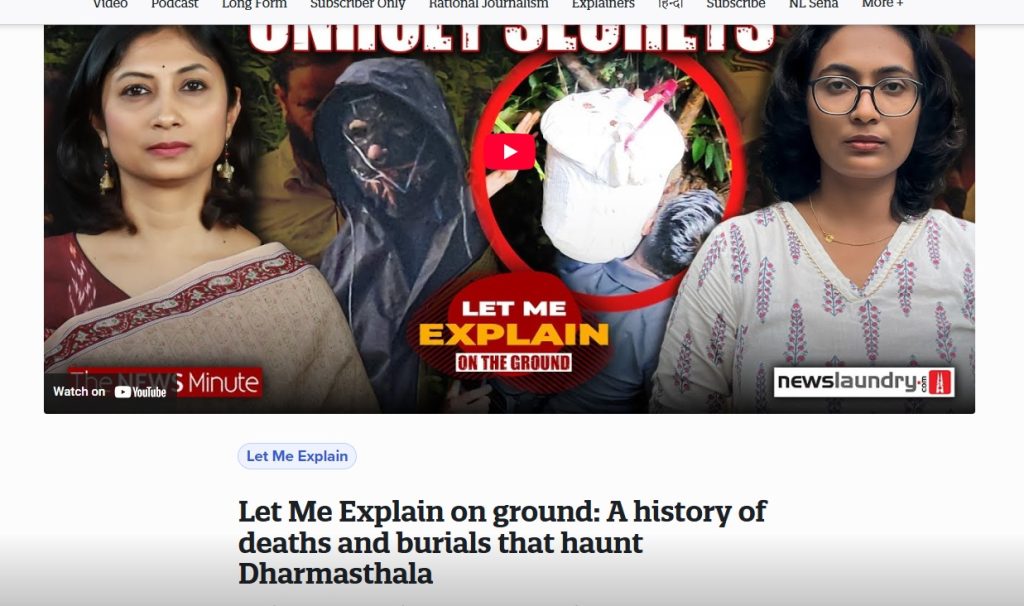
The News Minute abandoned all journalistic principles of neutrality and verification to actively promote an unverified, sensationalist narrative. They published over 20+ reports in a short period, treating the masked accuser’s extraordinary claims as established fact without demanding credible evidence. Their reporters, including Pooja Prasanna and Shivani Kava, used leading questions, dismissed plausible explanations from local authorities, and framed procedural caution by police as proof of a cover-up.
They strategically conflated the new allegations with decades-old, unrelated tragedies to create a false pattern and emotionally manipulate their audience. TNM’s interviews, particularly with the accuser’s lawyer, served to amplify the conspiracy theory while shifting the burden of proof onto the temple management. They weaponized legal gag orders, portraying them not as a complex legal matter but as definitive proof of guilt.
When partial skeletal remains were found, TNM immediately declared it a “major breakthrough” validating the entire narrative, despite the remains later being proven to belong to males who died long before the alleged events, completely contradicting the core accusation. Throughout, they solicited public donations to fund what was essentially a propaganda campaign, presenting advocacy as “independent journalism.” This entire effort has now collapsed after the accuser and key “witnesses” confessed to lying, exposing TNM’s reporting as a reckless and agenda-driven attempt to defame a revered Hindu institution.
Tamil YouTubers Show Their Loyalty To Anti-Hindu Cause
Several Tamil YouTubers played a central role in amplifying unverified claims, turning the issue into a spectacle of conspiracy and sensationalism. Channels such as Maayam Studios, Nakkheeran, Damodaran Prakash, Jeeva Today, Roots Tamil, Edison Vlogs, News I Tamil, Yoot Evidence, Ask Raghulan, Saravanan Decodes, Paari Saalan, and Sha Boo Three pushed narratives that blurred the line between speculation and fact.
Most of these creators presented the whistleblower’s allegations of mass burials and sexual violence as established truth, despite the absence of forensic or judicial confirmation. They routinely recycled decades-old, unrelated cases and wove them into sweeping conspiracy theories implicating the Dharmasthala temple administration, politicians, and police in systemic abuse and cover-ups. Graphic descriptions, exaggerated numbers, and horror-style presentation were used to provoke outrage, attract views, and monetize tragedy.
Some channels, such as News I Tamil and Saravanan Decodes, went further by violating gag orders and directly accusing individuals, thus crossing into defamation and contempt of court. Others, like Roots Tamil and Paari Saalan, injected political and communal undertones, portraying the issue as a Hindu institutional conspiracy tied to BJP and RSS, thereby polarizing the discourse. Meanwhile, influencers like Edison Vlogs and Ask Raghulan openly indulged in reckless sensationalism, even hinting at vigilante justice.
Other Indian Media & Fake News Experts Join The Bandwagon
Some mainstream news channels like Times Now and other YouTubers across the country joined the content creation spree by amplifying baseless claims.
Times Now Amplified False Claims
When the allegations came to light, Times Now also participated in the chaos to report from the site of the burials, showing the skull and what not. They had already named the case “Dharmasthala Secret Files”.
Dharmasthala ‘Secret’ Files
‘I was coerced into secretly disposing off multiple dead bodies…’- Former sanitation worker in K’taka’s Dharmasthala makes a sensational claim.
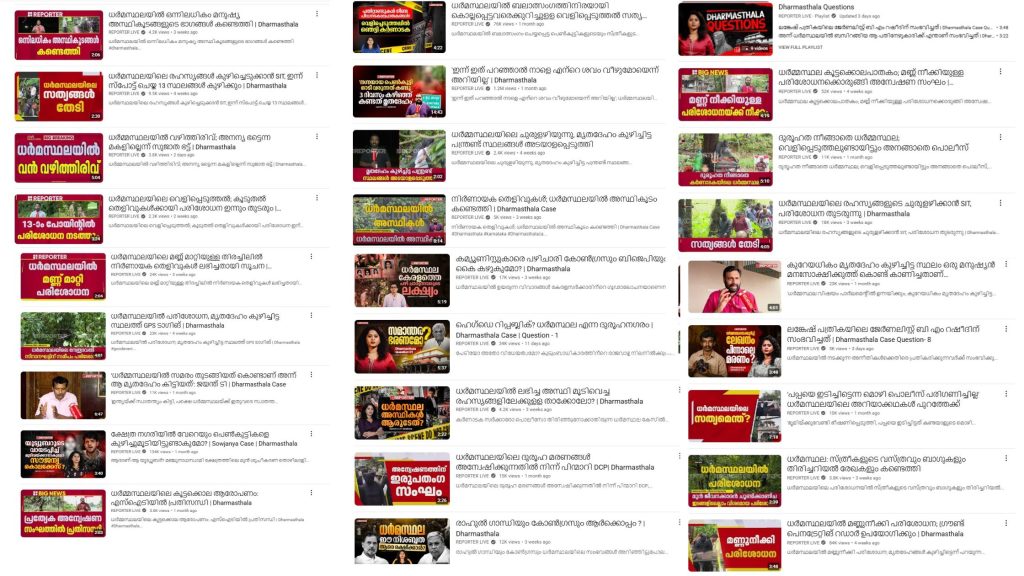
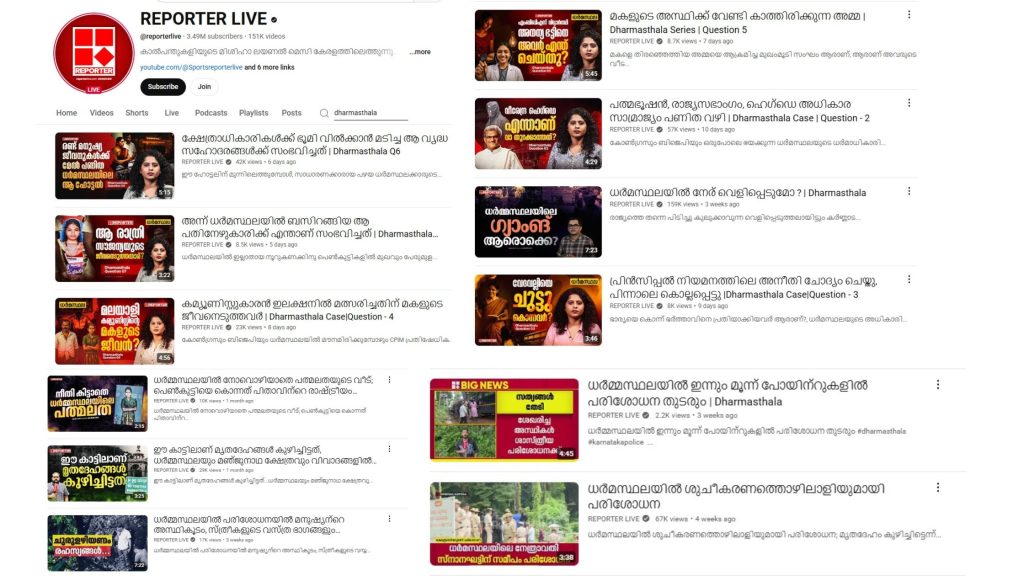
This Malayalam news channel which is heavily leftist in its reporting carried a malicious campaign against the Dharmasthala temple and administration. Here is a look at the extent of their coverage.
Kerala-based MediaOne
Media One, ran a show where panelists
claimed since accusation is against powerful people and are
close to power so investigation is not being held properly.
Newslaundry
Piggybacking on TNM’s reports, Newslaundry also maligned Dharmasthala temple and the administration. They followed TNM’s lead to connect all the deaths in the town to the mass burial case.
Manisha Pandey of Newslaundry cast
aspersions on Dharmasthala Administration Head
Veerendra Hegde for seeking a legal injunction to take
down content related to a case that is still under
investigation. She praised The News Minute for its
reporting on the Dharmasthala case.
Just watch how Manisha Pandey of NewsLaundry spreads innuendos and insinuations against Dharmasthala Administration Head Veerendra Hegde for pursuing a legal injunction to remove all content about a case THAT IS UNDER INVESTIGATION!
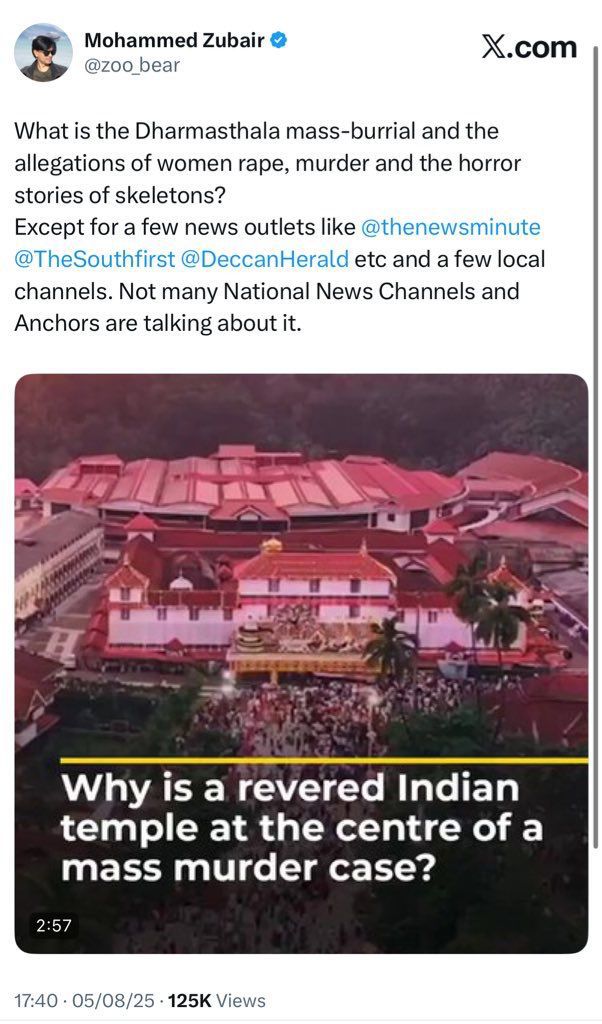
Mohammed Zubair amplified the Dharmasthala controversy by sharing and praising media reports, particularly from The News Minute, which portrayed Hindu institutions negatively. He used their coverage to bolster his own narrative, framing the temple and associated individuals as engaged in wrongdoing. However, once the SIT found no evidence and the whistleblower was arrested, Zubair quietly deleted his celebratory tweet without issuing any clarification, apology, or acknowledgment of error. He plainly used the strategy of aggressively highlighting alleged Hindu misdeeds while retreating silently when the claims are disproven, avoiding accountability and displaying selective engagement with similar incidents involving other communities.
SR Pay
The YouTube channel SR Pay pushed a
fake narrative about Dharmasthala temple, presenting the
masked man’s story and claims as if they were fully verified.
The video framed it as though a massive scandal was
unfolding inside the temple. As of today, this video has 1.4 million views.
Apart from the ones shared by Sameer MD, a few other Kannada and Hindi YouTube channels also did their “bit” to malign the institution. Here is an example.
Study IQ IAS
Study IQ IAS YouTube channel also made an elaborate video on the issue, but it was all nonsense that was propagated. This video is now private.
Look at how Study IQ IAS (19.9 million subscribers!!) covered the Dharmasthala Incident!
Quoting from the Description Section of the Video:
"In this gripping investigation, Varun Jauhari uncovers the chilling truth behind the Dharmasthala Mass Burial Case, where 400 women… pic.twitter.com/9fxp89Zgp2
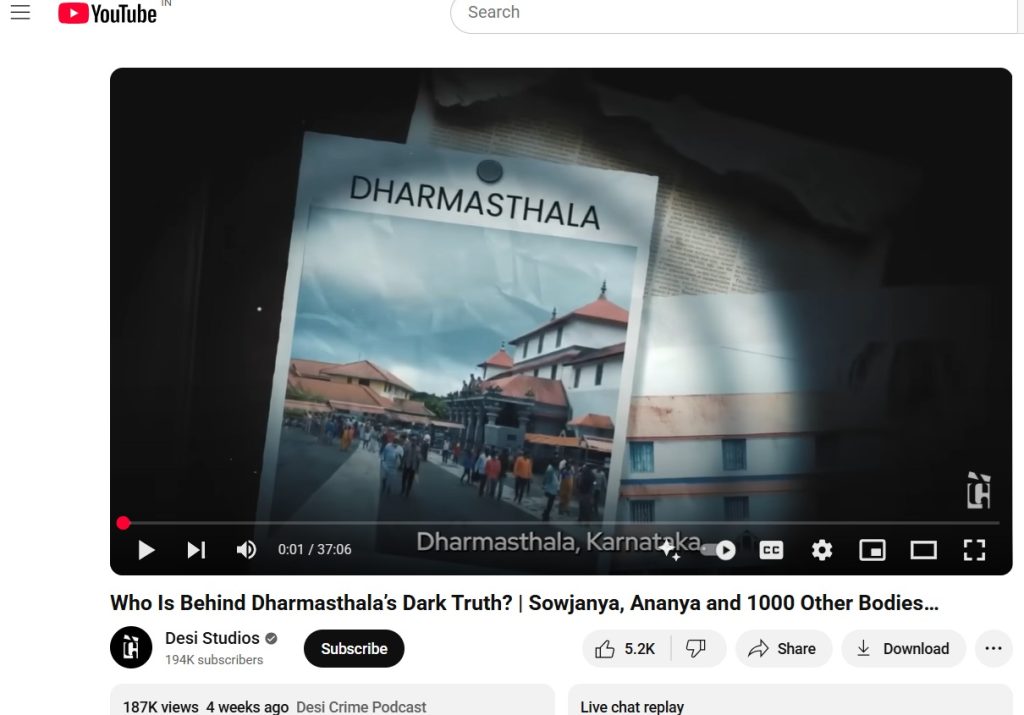
This channel shared a video titled “Who Is Behind Dharmasthala’s Dark Truth? | Sowjanya, Ananya and 1000 Other Bodies.” In the video, he also calls Dharamsthala a hub of political power and makes some more baseless claims.
SDPI & CPI Demand SIT Probe
The SDPI entered the Dharmasthala case by demanding a high court monitored SIT probe into claims by a former sanitation worker that he buried sexual assault victims’ bodies for over a decade. At a press conference, SDPI state president Abdul Majid accused Belthangady police of negligence, citing unsolved rapes, murders, and disappearances, and called for suspension of local officers. He demanded compensation and protection for families, as well as a public hearing for victims’ relatives. SDPI also announced a statewide agitation to mobilize support and pressure the government to act on the allegations.
CPI Rajya Sabha MP Sandosh Kumar urged Union Home Minister Amit Shah to hand over the Dharmasthala burials case to the National Investigation Agency (NIA). In his letter, he alleged a decades-long pattern of crimes in Dharmasthala targeting women, silenced through coercion, and concealed with impunity citing cases from 1979 to Soujanya’s 2012 murder. He said successive governments failed to ensure credible probes, with SITs and review committees never properly constituted. Highlighting intimidation of activists and families seeking justice, he argued that only an NIA probe could ensure truth and accountability, while safeguarding the spiritual sanctity of Dharmasthala.
SIT Formed Under Pressure, Not Evidence
The very formation of the SIT to probe into Dharmasthala “mass burial” allegations reveal how politics, not proof, set the agenda. Congress minister Dinesh Gundu Rao openly conceded that the Special Investigation Team was created not on the strength of credible evidence, but because of sustained agitation from Left-leaning activists. His admission laid bare that the SIT itself was a political concession rather than a fact-driven necessity.
Key agitators “activists” and other political parties were central in manufacturing this pressure. Some activists used the tragic Soujanya case as a rallying cry; they continually linked the incident to Dharmasthala and its Dharmadhikari, Dr. Veerendra Heggade, without presenting any substantiating proof. Instead of allowing the legal process to run its course, they sought to turn public anger into a weapon, feeding suspicion and hostility toward the temple administration.
Seen in this light, the SIT was never about fact-finding. It was about appeasing those intent on tarnishing a sacred Hindu institution. What emerged was not justice, but an agenda to weaken Hindu centers of worship under the convenient banner of “activism.”
Masked Man’s Lawyer Asks Kerala Govt To Intervene
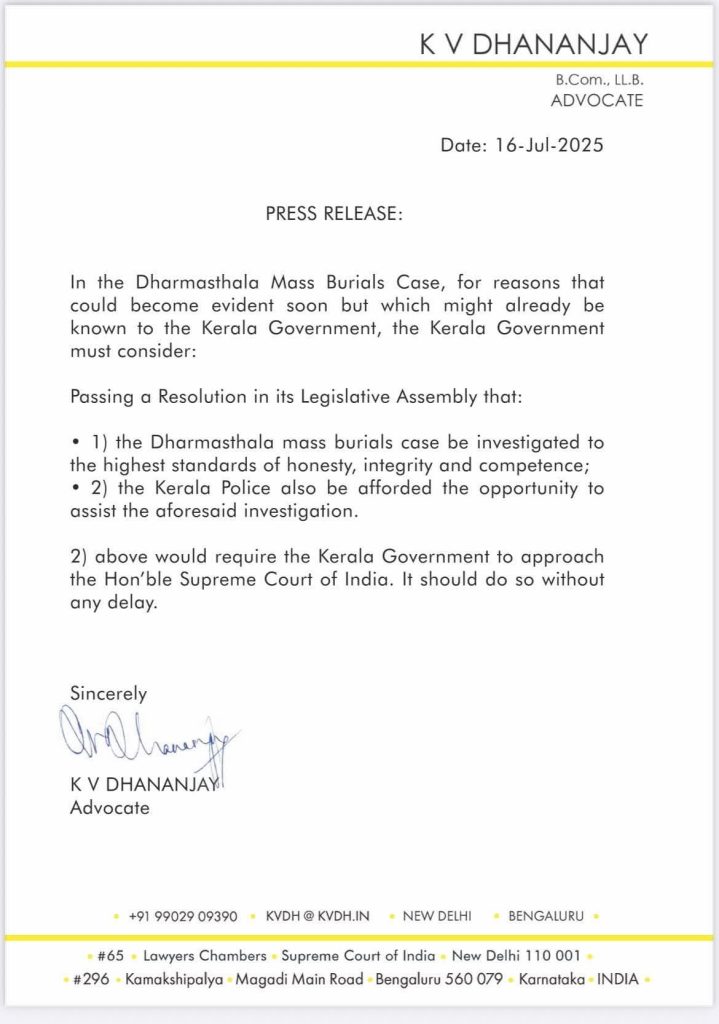
Supreme Court advocate KV Dhananjay on 17 July 2025 urged the Kerala government to pass a resolution in the Assembly seeking a high-standard probe into the Dharmasthala mass burials case. He suggested that Kerala Police be allowed to assist, which would require the state to approach the Supreme Court.
His appeal followed a complaint submitted to him by the whistleblower, including identity documents linked to Dharmasthala, to ensure the truth was preserved if anything happened to him.
He used The News Minute as a platform to shift the burden of proof onto the state, insisting that unless police “dig and disprove,” the whistleblower’s allegations must be accepted as truth. Dhananjay claimed the witness, born into a marginalized caste, was motivated by guilt and fear of God. He suggested “powerful people” were obstructing the probe and speculated that bodies could be moved during delays. Presenting these claims as prima facie true, he insisted they warranted serious investigation despite lacking corroborating evidence.
International Media Roped In
Joining the propaganda bandwagon was Al Jazeera and BBC – this came at a time when the leftists and other conspirators did not get the desired reaction from the public.
Al Jazeera
The Qatari government-funded propaganda outlet that is known for peddling anti-Hindu and anti-India narratives made even worse allegations than TNM and other leftist media. They first published an article on 22 July 2025, then went on to publish a video.
The video published on 25 July 2025 starts by framing the issue as “one of the worst serial killings in history.”
Then they shift to the “whistleblower” and identify him as “Dalit”, then they go on to say, “According to Hinduism’s caste system, the Dalits are at the bottom. They’re considered unpure and are often persecuted in India. As per tradition, temple administrators are from a higher caste.”
BBC – Tamil & Kannada
BBC’s video was in Kannada and they even interviewed Sujatha Bhat who recanted her statement saying she did not have a daughter, but she keeps making u-turns. BBC Kannada published the below video on 1 August 2025.
They published the Telugu version on the same date.
They published the same video in Tamil also, but 10 days later – on 10 August 2025.
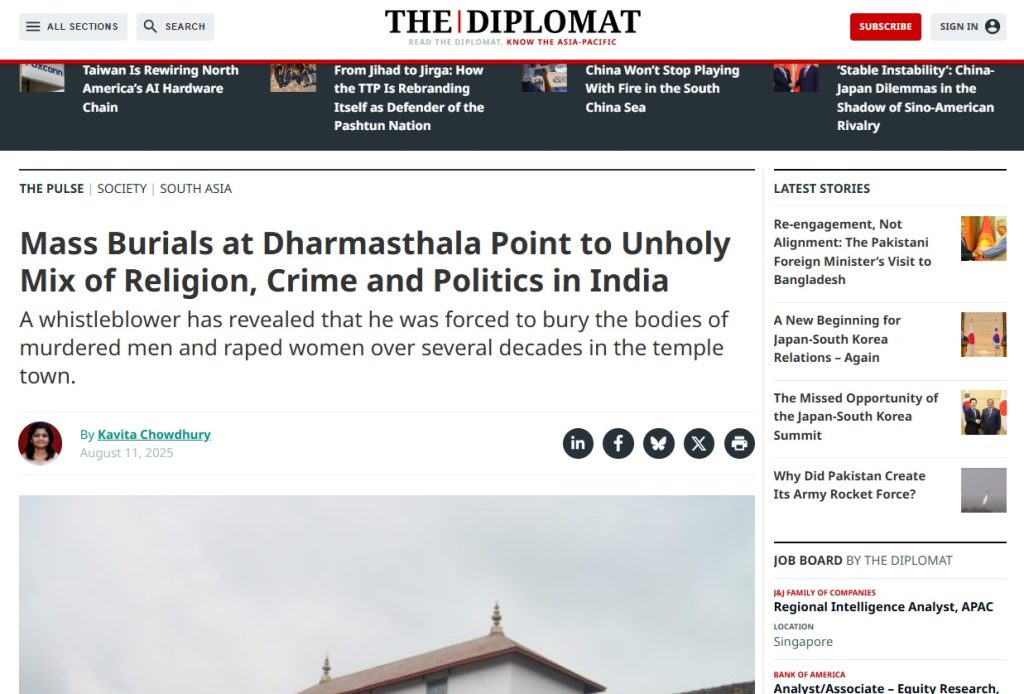
The Diplomat, an international current affairs magazine for the APAC region joined the “coverage on 11 August 2025 without any verification of facts.
Relying purely on sensationalism, The Diplomat, like its peers furthered the leftist narrative to tarnish the temple and administration.
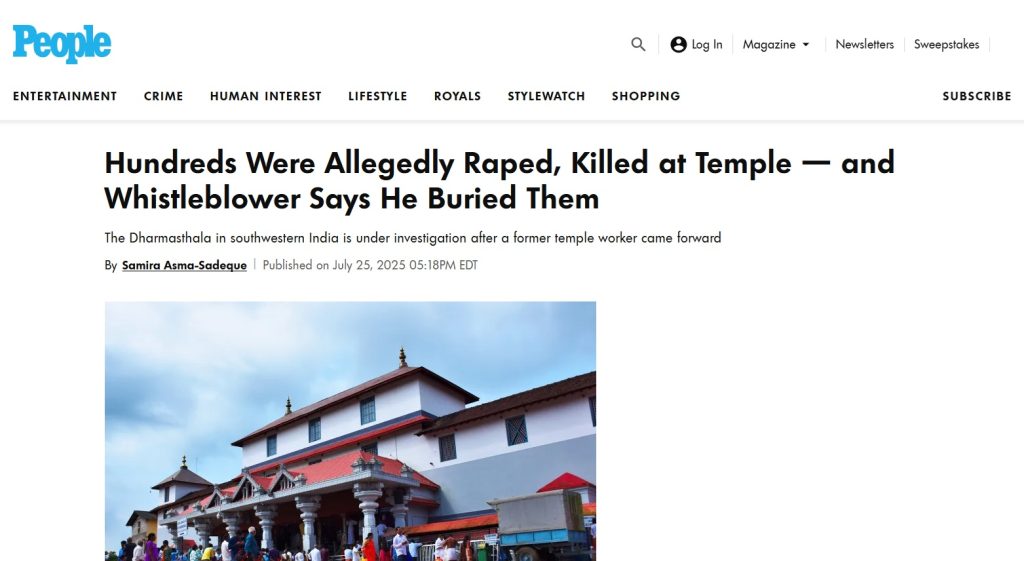
People.com
American weekly magazine People.com repeated the unverified claims of
the masked man about Dharmasthala temple with an article on 25 July 2025. Citing Al Jazeera, DW, and India Today, the report added graphic descriptions of corpses, threats, and killings while presenting the temple as
the center of horrific crimes. The article amplified the
allegations without balancing them with the SIT’s findings
or the temple’s stance, casting the institution in a deeply
negative light.
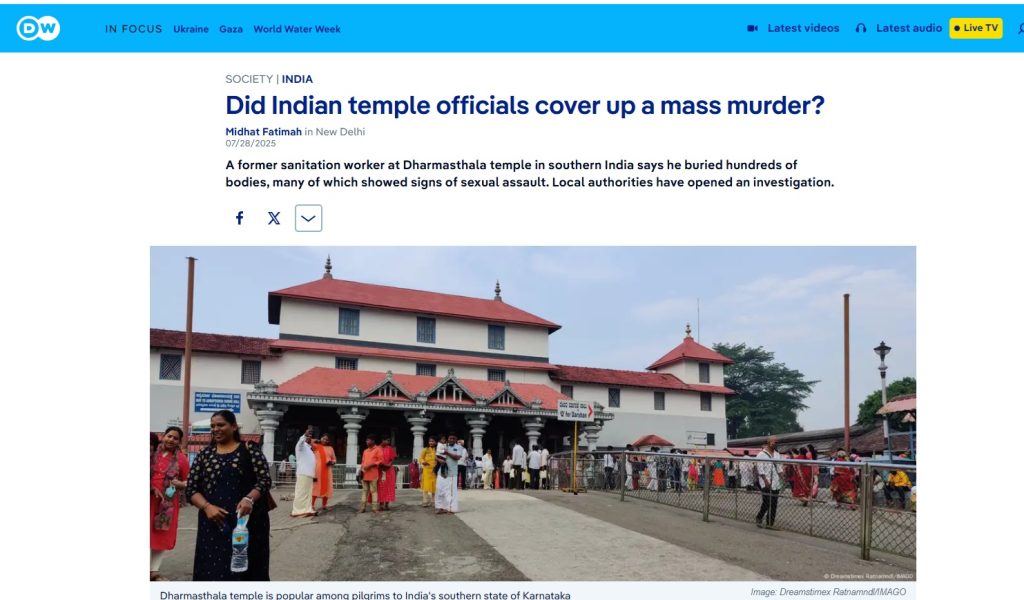
DW
German media house DW published an article on 28 July 2025 framing the Dharmasthala temple as the site of a horrific scandal. It amplified the claims of the masked man.
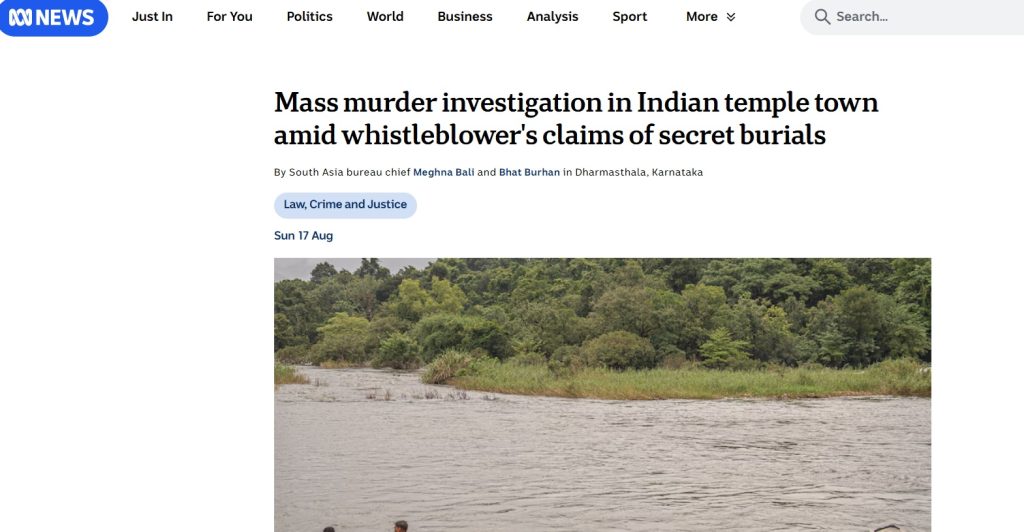
ABC News
Australian news outlet ABC News published an article on 17 August 2025 repeating the same lies.
“Activists” Thimarodi and Mattennavar’s Role In Defaming The Dharmadhikari
Amplifying this propaganda were “activists” Mahesh Shetty Thimarodi and Girish Mattennavar, campaigning under the Justice for Sowjanya banner, pressed for an SIT, gave legitimacy to the masked man’s allegations.
However, a series of leaked WhatsApp messages and sting recordings have revealed that self-styled activists involved in the Justice for Sowjanya campaign were openly plotting to target Dharmadhikari Dr. Veerendra Heggade of Dharmasthala. In one video, activist Somnath Nayak’s Civil Service Trust admitted that Heggade was their “target,” stating that they had already sent him a 210-page compilation of documents and court papers and demanded a press conference in Dharmasthala. The leaked chat makes clear that their campaign was not about establishing facts, but about ensuring that Heggade was forced to “bow to the law” and even “go to jail.” They expressed support for agitators like Mahesh Shetty Thimarodi and suggested using public sentiment, particularly the Soujanya case, to corner the temple administration.
The sting further exposed contradictions: while they admitted Heggade had no direct role in Soujanya’s murder, they insisted he tried to shield the accused, framing him as complicit. They also discussed selectively releasing interviews and videos to build a hostile narrative, admitting that their ultimate strategy was to exploit public emotions against Dharmasthala.
In another video, journalist Rakesh Shetty highlighted how these activists repeatedly shifted versions of events, named and dropped people inconsistently, and relied on speculation and cinematic exaggeration rather than evidence. He compared their tactics to a “KGF-style fairy tale,” pointing out how accusations kept changing and no cross-examination was ever allowed.
Political Conspiracy – Claimed By Dy CM DK Shivakumar
On 14 August 2025, the Karnataka government, through Deputy Chief Minister DK Shivakumar, announced it will take strict legal action against individuals responsible for spreading false propaganda and misinformation about the Dharmasthala pilgrimage centre in an alleged mass grave case. Shivakumar emphasized the government’s commitment to the rule of law and stated that no one will be protected from prosecution for making false allegations and defaming the revered religious institution.
Congress MP Sasikanth Senthil Allegedly Involved
On 19 August 2025, as per a Free Press Journal report, Congress MP from Tamil Nadu and former IAS officer Sasikanth Senthil was alleged to be the key conspirator. BJP MLA from Udupi, Yashpal Suvarna, and Independent MLA from Gangavati, G. Janardhan Reddy, have squarely blamed Senthil, who once served as Mangaluru DC, for allegedly orchestrating a plot to tarnish the Dharmasthala Temple’s reputation. Earlier, Belthangadi BJP MLA Harish Punja had also hinted at Senthil’s possible involvement, accusing him of leveraging the leftist and Islamist networks he had cultivated during his administrative tenure.
The two legislators minced no words in their charge: the so-called “masked man” who claimed to have unearthed a skull and handed it over to police was allegedly acting at Senthil’s behest, with the entire drama scripted in Tamil Nadu after Senthil quit the IAS.
How The Lies Fell Apart
The former sanitation worker, whose July 3 testimony before a magistrate ignited a national firestorm, has now provided a detailed confession to the Special Investigation Team (SIT). He stated that a gang approached him in Chennai in December 2023.
“They asked me how many bodies I had buried when I worked in Dharmasthala. I told them the truth: that I had legally buried the bodies of pilgrims who came for salvation, through the police and gram panchayat,” the masked man stated. “But the gang insisted that I should say that the bodies were buried illegally. They pressured me… they changed my mind.”
The complainant revealed that the gang brought him to Karnataka, trained him on what to say in court, and even provided him with the skull and bone fragments he submitted as evidence which forensic reports later confirmed belonged to a man who died 30 years ago. He further confessed that he was instructed to coordinate his false testimony with another complainant, Sujatha Bhat, who had filed a missing person report for her daughter.
The SIT has since confirmed that the skull and bone fragments were of men who had died decades earlier, undermining the complainant’s earlier claims. Excavations at 17 sites identified by him yielded no evidence of mass graves. At one site, partial skeletal remains were found but were confirmed to be male, dating back 30 years.
Sujatha Bhat also recanted her statement saying Ananya Bhat was not her daughter. She admitted she was lying but later said it was out of coercion.
The masked man was identified as Chinnaiah and was arrested by the police for perjury.
Questions None Of These “Activists” Asked
None of these so-called “champions of truth”, women’s safety crusaders, asked the questions that should have been asked in the first place. While the case has crumbled into dust, these questions should have been asked when the masked man made his first appearance.
Why did the masked man contact the lawyers in July 2025? What happened to him all these years?
Why did he bring pictures of the skull/remains instead of the original?
How did he manage to bury them in such difficult terrain when the excavators were finding it difficult to dig in the mountains?
How did he manage to dig deep pits all by himself when the excavators dug massive pits?
How did he manage to get the Supreme Court lawyers’ contacts?
How was he able to repeatedly transport and bury bodies in a busy pilgrimage town without ever being seen by pilgrims, other staff, or security?
How did he physically transport a body to these remote, difficult terrain sites seen, often alone?
He claims to have kept a skull as evidence. Why that one? What made that victim different?
How did the families not notice? How was there no outcry or investigation into such a massive number of disappearances?
But everyone took his statement as established facts and pushed the narrative against the institution.
Truth Always Wins
After running such a malicious campaign against a revered pilgrimage site of the Hindus, the leftists and the evil forces behind this entire conspiracy stand exposed.
Despite such a concerted attack, truth prevailed. The skull submitted as “evidence” turned out to be that of a male who died decades ago. The burial sites yielded no proof. The “whistleblower” confessed to being coached by a gang from Chennai. Sujatha Bhat admitted she lied. The house of cards built on lies, donations-driven activism, and sensationalist reporting has crumbled. The failure of this campaign reaffirms that Dharma cannot be defeated by propaganda.
Will the Karnataka government take strict action as promised against the conspirators and the able assistants in the form of TNM, YouTubers, other media houses?
Subscribe to our channels on Telegram, WhatsApp, and Instagram and get the best stories of the day delivered to you personally.
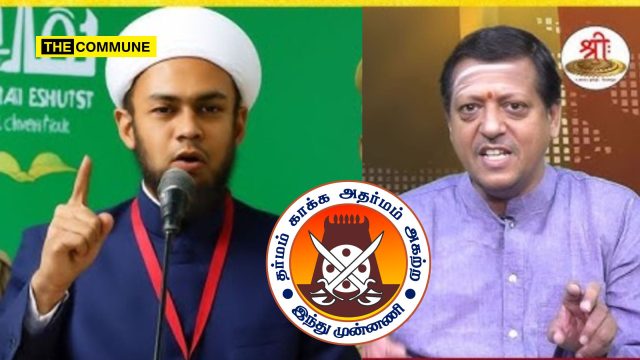
The Hindu Munnani has strongly denounced the filing of case against Shree TV director Bala Gowthaman, accusing the Tamil Nadu government of shielding extremist voices while targeting those who expose them. The controversy erupted after Gowthaman condemned a provocative speech delivered by Ustad Pir Muhammad Sadiq, a preacher from Theni, who allegedly called on Muslims to “invade India” and glorified terrorism.
In a statement, Hindu Munnani State President Kadeswara C. Subramaniam charged the DMK government with blatant vote-bank politics. He said, “While a Muslim is not charged for speaking of an invasion of India, a case is filed against the nationalist who condemned him – The DMK government’s approach. Terrorism that incites the destruction of India – Is the police a mute spectator?”
The organisation alleged that Sadiq’s inflammatory remarks, delivered during a Dawah Yatra organised by Muslim outfits including the Tamil Nadu Muslim Munnetra Kazhagam, directly incited communal hatred and disrupted public peace. Instead of initiating legal action against him, police booked Gowthaman on the basis of a complaint generated by a social media monitoring team.
Hindu Munnani criticised the move as one-sided and dangerous. “The police have ignored the Supreme Court’s directive to register suo motu cases against those who make hate-filled, anti-national statements. By protecting religious fanatics and targeting patriotic voices, the DMK is endangering national security,” the press release read.
The statement also recalled past terror-linked incidents in Tamil Nadu, including the Coimbatore blast carried out by a suicide bomber, warning that continued inaction against extremist speeches could pave the way for more terrorist activities. It accused the DMK of systematically filing cases against spiritual leaders, critical thinkers, and journalists, while deliberately ignoring radical elements for political gain.
Calling Bala Gowthaman a devout nationalist and a socially responsible speaker, Hindu Munnani condemned the charges against him as fabricated and politically motivated. The organisation also claimed intelligence inputs suggest terrorist training is ongoing in regions like Theni and Dindigul, yet the state government has chosen to clamp down on dissent instead of confronting such threats.
Hindu Munnani concluded its statement by demanding that the case against Gowthaman be withdrawn immediately and that legal proceedings be initiated against Ustad Pir Muhammad Sadiq for his hate-filled, anti-national rhetoric.
In his official press release, Kadeswara C. Subramaniam, State President of Hindu Munnani, remarked, “While a Muslim is not charged for speaking of an invasion of India, a case is filed against the nationalist who condemned him – The DMK government’s approach. Terrorism that incites the destruction of India – Is the police a mute spectator? – State President Kadeswara C. Subramaniam’s press statement.
Ustad Pir Muhammad Sadiq from Theni district has spoken in support of terrorism, stating that Allah will not send Muslims who invade India to hell.
He has incited religious fanaticism in a way that disrupts public peace in Tamil Nadu. He participated in a Dawah Yatra organized by groups like the Tamil Nadu Muslim Munnetra Kazhagam, Sunnat Jamath Students Federation, and Sunnat Jamath Balakar Sangam. The Tamil Nadu government and police are being negligent by failing to conduct a thorough investigation into this person who speaks with such religious fanaticism and incites the nation’s destruction. We point out that such acts of violence and hate speech in the past have led to communal riots. The police lack the sense of responsibility to arrest this cruel-minded Ustad who, while living in our own country, spoke of invading it. The Tamil Nadu police have not respected the Supreme Court’s direction that the police should suo motu register cases and arrest those who engage in such violent, anti-national, and hate-inciting speech. Instead, the police have filed a case against Bala Gowthaman, a journalist, the head of the Veda Vignana Research Association, and a great patriot, who warned the Tamil people about the danger of the Ustad’s speech.
In a situation where no one came forward to file a complaint on their own, a complaint was lodged through a social media monitoring team’s sub-inspector, and a case was registered. This is one-sided. The fact that the police are acting favorably towards anti-nationals is a painful truth. Does the Ustad’s speech, which tells Muslims to wage war on India, not affect social peace? Is it not a threat to the nation? But the police’s explanation that Bala Gowthaman’s statement—that the Ustad’s views are against our nation—affects social peace is a travesty.
In the four and a half years since the DMK came to power in Tamil Nadu, there has been a steady stream of terrorist-inciting speeches by Muslims. This brainwashes and prepares young Muslim men for terrorist acts. We should not forget the human bomb incident that happened in Coimbatore. The police must realize that failing to nip this danger in the bud will create opportunities for terrorist acts in the future. The public’s question is why the DMK government, which files false cases and imprisons those who even express opinions against the ruling party on social media, fails to take action against a terrorist-inciting speech. The Dravidian model’s policy seems to be to deliberately imprison spiritual speakers and good thinkers and journalists who do political criticism, while supporting those who express anti-national views.
Supporting those who speak of terrorism for minority vote-bank politics and remaining silent without taking legal action against those who destabilize the country’s security and sovereignty is an act of strangling the throat of democracy. The Tamil Nadu government is not prepared to take action against those who incite terrorism. If someone points this out and speaks about it, filing cases against them and harassing them is akin to a dictatorial rule. Speeches against God and our military personnel are steadily coming from the DMK and its allied party organizations. The ruling party is not prepared to take any action against them. Bala Gowthaman, the director of Shree TV, is a thinker who has been devoted to God and the nation since a young age. He is a great speaker who guides society on the right path. It is ridiculous that the police are seeking to arrest him by filing a false case.
News reports state that the intelligence department has received information that terrorists are training in areas like Theni and Dindigul. It is an act of uprooting the freedom of speech to choose to arrest Bala Gowthaman instead of monitoring and arresting these people. We once again remind the Tamil Nadu government and the police of the court order that the police should suo motu file cases against those who engage in hate speech. On behalf of the Hindu Munnani, we request that a case be filed against the Ustad who spoke with religious hatred and that the false case filed against Bala Gowthaman be withdrawn.”
கடவுள் மறுப்பு பேச்சுக்களும், நமது ராணுவ வீரர்களுக்கு எதிரான பேச்சுகளும், திமுக மற்றும் அதன் கூட்டணிக் கட்சிகளின் அமைப்புகள் சார்பாக வந்த வண்ணம் உள்ளன. அவர்கள் மீது எந்த நடவடிக்கையும் எடுக்க ஆளுங்கட்சி தயாராக இல்லை.
Calling it a true example of “Make in India, Make for the World,” Maruti Suzuki Chairman R.C. Bhargava on Tuesday said the company’s Gujarat plant is being developed into a global hub as Prime Minister Narendra Modi flagged off the first batch of the company’s electric SUV, ‘e-Vitara’, and inaugurated India’s first lithium-ion battery cell plant at Hansalpur here.
Speaking to reporters, Bhargava said the Prime Minister’s encouragement has infused fresh energy into the company. “Today is a truly proud and historic occasion for us as PM Modi has inaugurated two landmark steps for India’s future,” he said.
The Prime Minister flagged off the company’s first electric SUV, ‘e-Vitara’, and also inaugurated the lithium-ion battery plant at Hansalpur, Gujarat. The plant rolls out 7.5 lakh cars every year. He highlighted that the e-Vitara will not only serve Indian customers but will also be exported to more than 100 countries.
“The e-Vitara will not only serve Indian customers but also be exported worldwide. Gujarat will emerge as a global manufacturing hub under the Make in India, Make for the World vision,” Bhargava added. Maruti Suzuki’s Senior Executive Officer Rahul Bharti echoed the sentiment, calling the moment a major milestone in India’s journey toward self-reliance.
“We are building advanced battery electric vehicles for over 100 global markets. At the same time, our subsidiary TDSG Lithium-Ion Battery Gujarat Private Limited has achieved deep localisation — moving from battery packs to cells and now electrode manufacturing,” Bharti said. He added that watching young engineering students and skilled associates at the Hansalpur plant demonstrate their work before the Prime Minister was an emotional and proud moment for the company.
The company also confirmed that the e-Vitara will be manufactured exclusively in Gujarat as part of a single-location global production strategy. The SUV will be launched in several markets in the coming financial year, though pricing and exact launch timelines are yet to be disclosed.
-IANS
Subscribe to our channels on Telegram, WhatsApp, and Instagram and get the best stories of the day delivered to you personally.
Chinese President Xi Jinping‘s recent visit to Tibet confirms that Beijing is striving to cultivate advantages there that give it the upper hand in the balance of power and border negotiations with India, a report said.
China’s Premier Li Qiang’s announcement on July 21 that the Medong county dam will begin construction and now, Xi’s veiled instructure to accelerate its development, makes it almost clear that the dam will be a flashpoint in India-China security dynamics, Rahul Karan Reddy, a senior research associate at the Organisation for Research on China and Asia (ORCA) wrote in an opinion piece.
The report stated: “Perhaps China is cultivating a bargaining chip for negotiations with India, but with the sanction of the top leadership, riparian relations between India and China are now certain to become further securitised. Moreover, China’s position that the Medong county dam and development policies of Tibet are an internal matter is likely to harden as India raises objections to such projects. Tibet’s development trajectory and infrastructure projects are becoming increasingly relevant to India’s border security and entangled with security competition with China.”
Another aspect regarding the visit is the issue of the Dalai Lama’s succession. Xi’s visit to the Tibet Autonomous Region (TAR) and reiteration of security and stability clearly indicate that China is not ready to allow the Dalai Lama’s succession issue to affect its control in Tibet.
The ORCA report stated: “A high-profile visit to TAR just a month after the Dalai Lama’s announcement of a successor outside China and outside China’s influence, signals a hardening stance by Beijing; that China will persist with its integration strategy in Tibet and legitimise Party-appointed Tibetan institutions. Perhaps Xi’s visit is preparing the ground for China’s countermeasures in TAR, for when the Dalai Lama’s succession process is initiated. For India, this means China is also preparing for a decision by New Delhi to support or legitimise the Dalai Lama’s succession.”
The ties between India and China have moved closer towards normalisation since October last year, and Chinese Foreign Minister Wang Yi’s visit to New Delhi showcased that the two nations have been engaging in dialogue and negotiations to address the boundary question.
However, developments in Tibet are likely to have a significant influence on the security outlook of India and China. The report said: “Xi’s visit to TAR was a sharp reminder that developments in Tibet are closely tied to border security concerns for India; the Medong county dam is raising significant concerns about a ‘water bomb’ in some Indian states, and its construction could greatly accentuate security dilemmas in sensitive border regions. For China, the Dalai Lama’s recent remarks on the succession issue have possibly resulted in Beijing’s hardening stance and reiteration of control in Tibet. It also explains any Party moves towards preparing the ground for succession outcomes. Both the domestic governance priorities of the Party and China’s external signalling are indicating an increase in the complexity of security dynamics between India and China.”
–IANS
Subscribe to our channels on Telegram, WhatsApp, and Instagram and get the best stories of the day delivered to you personally.
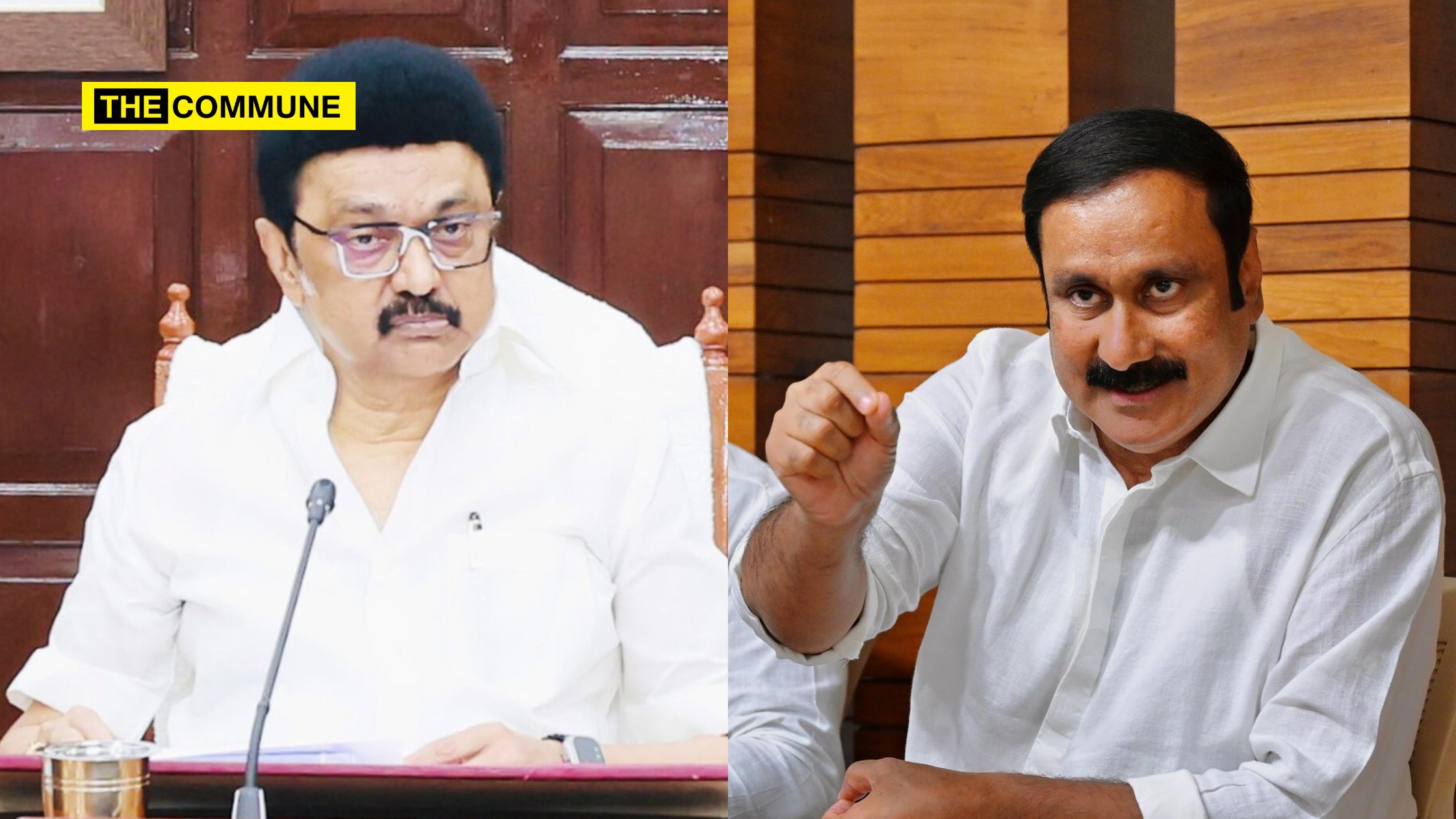
The Pattali Makkal Katchi (PMK), led by Anbumani Ramadoss, on Tuesday released a report accusing the DMK government of betraying the public by “failing” to deliver on the majority of its election promises. The party claimed that after more than four years in office, the government had achieved little beyond rhetoric.
The PMK report, titled ‘Where is the Dawn?’, examined the 505 assurances made in the DMK’s 2021 Assembly election manifesto. It said that only 66 promises (12.94 per cent) had been fully implemented, while another 66 were partially acted upon. A massive 373 pledges remain unfulfilled, along with five additional assurances personally made by Chief Minister M.K. Stalin during the campaign.
According to the PMK, key commitments relating to Sri Lankan Tamils, fisheries development and major irrigation projects had seen no progress. In agriculture, only eight of 56 assurances were implemented. On the sensitive issues of employment and education, the party said the government failed to scrap the NEET exam, cancel educational loans or create the 3.5 lakh government jobs it had promised.
The report also criticised the DMK for backtracking on governance-related reforms. It pointed out that the government had not strengthened the Lokayukta, failed to enact a Right to Services Act, and had not established special courts to tackle corruption.
Employment-related pledges, such as legislating 75 per cent job reservation for Tamils in the private sector and setting up new industrial parks, remained on paper. In healthcare, the report said only three of 18 promises had been delivered, with no progress on super-speciality hospitals or expanded ambulance services.
The PMK further noted that CM Stalin’s seven long-term “vision commitments” in sectors such as the economy, agriculture, water resources, education, healthcare and social justice had seen “no tangible results”.
Concluding its assessment, the party charged that the government had “let down the people who voted for change”. “The DMK promised a new dawn, but what Tamil Nadu has witnessed is a prolonged night of unkept promises and delayed progress,” the report said.
– IANS
Subscribe to our channels on Telegram, WhatsApp, and Instagram and get the best stories of the day delivered to you personally.
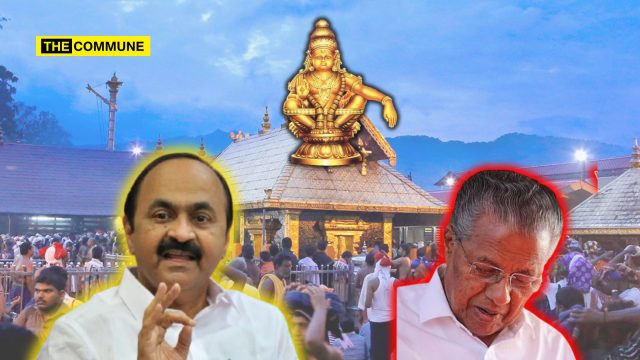
The upcoming Global Ayyappa Summit, planned as part of the platinum jubilee celebrations of the Travancore Devaswom Board (TDB), has triggered a political storm in Kerala. On Tuesday, Leader of the Opposition V.D. Satheesan accused the ruling CPI-M of organising the event to appease majority communal sentiments.
“The CPI-M is using Sabarimala’s name for majority appeasement. This newfound devotion began only after its parliamentary poll defeat. Now they are clinging to Lord Ayyappa, making communalism their political weapon, even moving in tandem with the Sangh Parivar,” Satheesan said. He warned that the CPI-M’s move was “like scratching one’s head with fire”, adding that what happened to the Left in Bengal awaited them in Kerala.
“We know nothing about this so-called Ayyappa congregation,” he said. The Global Ayyappa Summit is scheduled for September 20 on the banks of the sacred Pampa River near Sabarimala. Kerala Chief Minister Pinarayi Vijayan will inaugurate the event, conceived as one of the largest spiritual congregations in South India.
Devaswom Minister V.N. Vasavan formally extended invitations to political leaders, including the Tamil Nadu Chief Minister M.K. Stalin, during a visit to Chennai. However, Chief Minister Stalin later conveyed his inability to attend due to prior commitments. Instead, Tamil Nadu Ministers P.K. Sekarbabu and Palanivel Thiaga Rajan will represent the state government at the event.
Meanwhile, the BJP also sharpened its attack. Kerala BJP President Rajeev Chandrasekhar accused both Vijayan and Stalin of repeatedly insulting Sabarimala traditions and Hindu devotees.
“Pinarayi Vijayan jailed and assaulted Ayyappa devotees, while Stalin and his son Udhayanidhi have called Hindu faith a virus. This Ayyappa event is nothing but an election drama,” Chandrasekhar wrote in a Facebook post. He added that the CPI-M leaders could attend only if they apologised to Hindus and Ayyappa bhakts.
– IANS
Subscribe to our channels on Telegram, WhatsApp, and Instagram and get the best stories of the day delivered to you personally.
The Greater Chennai Corporation (GCC) council meeting on 26 August 2025, witnessed a dramatic walkout by councillors belonging to the Left parties, the Communist Party of India (CPI) and the Communist Party of India (Marxist), in protest against the privatisation of solid waste management in two city zones and the midnight arrest of contract conservancy workers.
CPI(M) councillor R. Jayaraman raised slogans inside the council hall, condemning the civic body’s decision to hand over waste management in Royapuram and Thiru Vi Ka Nagar zones to a private operator. He also strongly objected to the detention of workers under the National Urban Livelihoods Mission (NULM), who had been agitating against the move. CPI councillor M. Renuka supported his stand and joined in the walkout.
The Deputy Mayor, responding to the allegations, clarified that the arrests of the workers were carried out in compliance with a court order. However, the protesting councillors dismissed this explanation and asserted that the Corporation had a responsibility to safeguard the rights of long-serving conservancy workers rather than transferring them to private contractors.
The dispute stems from the Corporation’s decision earlier this month to outsource conservancy operations in the two zones to a private company. NULM contract workers, many of whom have been engaged in garbage collection and related duties for several years, opposed the move, demanding that they be permanently absorbed into the civic body with regularised pay and benefits. The workers staged a 13-day sit-in protest outside the Ripon Building, highlighting their grievances. They argued that while the Corporation had been paying them a monthly wage of ₹22,000 under its contract system, the private operator was offering only ₹16,000. This steep reduction in pay, along with uncertainty over job security, triggered widespread resentment among the workforce.
Councillors of the Left parties said the decision to privatise essential services like solid waste management would not only jeopardise workers’ livelihoods but also weaken the accountability of the civic body. They demanded that waste management remain under the direct control of the Corporation and urged the administration to withdraw cases against the arrested workers. The issue is expected to continue sparking debates within the civic body as the Corporation pursues its waste management restructuring plans in other zones of the city.
– IANS
Subscribe to our channels on Telegram, WhatsApp, and Instagram and get the best stories of the day delivered to you personally.