Home Blog Page 351

ISI Eyes Nepal As New Front Against India, Say Intelligence Reports; Concerns Rise Over Mosque Project And Radicalisation Plans

After making Bangladesh its playground, the ISI is now exploring Nepal and proposes to make it another front against India. There has been a sustained effort to increase the number of Pakistanis living in Nepal, and the larger plan is to convert them into assets who would in turn carry out terror strikes against India.

A report in a local vernacular newspaper, Purbokone, said that an organisation called Alhaj Shamshul Haque Foundation, also known as the Ash Foundation, laid the foundation stone for a Mosque in Nepal in the Inarawa area near Biratnagar of the Sunsari district. Called the Razzak Mosque, the foundation describes it as a religious hub for the local Muslim population.

The groundbreaking ceremony was led by Chairman of the Ash Foundation, Engineer Muhammad Nasir Uddin, on 18 July 2025. During the ceremony, he said that the Mosque would not just serve as a centre for Muslims, but also as a centre for Islamic dawn or proselytisation among the 95 per cent of Nepal’s non-Muslim population. “Razzak Mosque is expected to become a spiritual and communal centre for Muslims in Sunsari, as well as an example of inter-community cooperation and development in Nepal. The foundation is committed to supporting religious and educational infrastructure for underserved communities across South Asia,” the Ash Foundation said in a statement.

The Indian agencies suspect that the ISI is backing this initiative covertly. The initiative is also said to have the backing of some Gulf nations and Turkey. In the long run, the Mosque could not just serve as a religious centre, but also as a logistics hub for the ISI-backed terror groups. The Ash Foundation was formally launched in 2018 and registered as an NGO in Bangladesh in 2022.

Prior to this, the foundation had operated as a joint stock company. However, on 18 July, the foundation gave a public call for donations to fund the construction of the Mosque and also to expand similar projects in Nepal and other neighbouring nations. After the Sheikh Hasina regime in Bangladesh fell, the ISI has pounced on the opportunity to set up its playgrounds in countries bordering India. The Jamaat-e-Islami-backed Muhammad Yunus government has given Pakistan a free hand to operate in Bangladesh.

The ISI, which has set up several training facilities in Bangladesh, is attempting something similar in Nepal as transnational Jihadist expansion plan. Nepal is a Hindu-majority country and has never witnessed any sort of religious terrorism or radicalisation programmes. Nepal has been used as a transit point by the ISI to send terrorists into India. There have been reports that in 2023, terror outfits such as Al Qaeda have been attempting to set up training camps in Nepal.

Terror groups have also used Nepal as a sanctuary to evade scrutiny by various Intelligence agencies. However, the recent developments are worrying, and a clear attempt is being made to demographically change Nepal. Indian Intelligence agencies worry that such centres could be used to propagate extremism. Further, it could also be a strategy to disturb the majority community in Nepal. It is similar to what the ISI has been trying in the northeastern states and parts of West Bengal, an Intelligence Bureau official said.

The idea has been to infiltrate as many immigrants as possible and make sure that the majority becomes a minority. In Nepal, the ISI has been following what several terror groups have done in parts of Africa and Southeast Asia. Mosques and Islamic cultural centres have been set up, and these have operated as Intelligence gathering, radical brainwashing and recruitment units. The agencies worry that a similar project is underway in Nepal, and if not curbed at the earliest, then this could go on to become a major issue. Clearly, an attempt is being made to undermine a Hindu majority nation with a larger plan of fostering armed conflict and total unrest.

-IANS

Subscribe to our channels on TelegramWhatsApp, and Instagram and get the best stories of the day delivered to you personally.

Drug Case Accused Ameer Sultan And Rabid Anti-Hindu YouTuber Attack Justice GR Swaminathan

justice gr swaminathan u2 brutus ameer sultan drug case anti-hindu

In what can be seen as a coordinated attack on Justice GR Swaminathan, the latest to join the bandwagon in the DMK ecosystem are two faces, known for their vitriol and nonsense – drug case accused and ex-DMK office bearer drug lord Jaffer Sadiq’s best friend, Ameer Sultan and rabid anti-Hindu YouTuber U2 Brutus.

Drug Case Accused Ameer Sultan

Ameer has been embroiled in a drug trafficking after getting chargesheeted and summoned by the Enforcement Directorate in the money laundering investigation linked to drug trafficking activities. He joins the DMK ecosystem to bash and slander Justice GR Swaminathan in the case involving Dravidianist lawyer Vanchinathan.

In a book launch event, he said, “Today, former judges have issued a joint statement against the fascist war waged against Advocate Vanchinathan by the Chief Justice of the High Court in Madurai. My brother Kolathur Mani has also recorded his condemnation, and I am also recording mine”

Ameer’s most direct and derogatory remarks came while addressing Justice Swaminathan’s judicial conduct and ideological leanings. He said, “As someone who knows the judge well, he has always spoken in support of Sanatana. When the fact that he has written his judgments in support of Sanatana, the letter was sent to the Supreme Court judge in a sealed envelope, how he (GR Swaminathan) got it, is a matter that needs to be investigated.”

The speech repeatedly characterized Justice Swaminathan’s actions as part of a “fascist war” against Vanchinathan, who is currently facing criminal contempt proceedings. Ameer described the judiciary’s conduct as, “Condemnable… to call Comrade Vanchinathan and talk to him in a threatening manner.”

This insinuation of impropriety and ideological partisanship was followed by a veiled threat, “Although the power to write the verdict is in your hands, the power to rewrite your verdicts is in our hands. I remind the Justice that it is the duty of all of us to stand by Comrade Vanchinathan, no matter how many objections come.”

Rabid Anti-Hindu YouTuber U2 Brutus

U2 Brutus is a YouTube channel run by a person who identifies himself as ‘Minor’, a follower of EV Ramaswamy Naicker (known as Periyar by his followers). The channel is known for supporting the DMK and its allied outfits like Dravida Kazhagam, Viduthalai Chiruthaigal Katchi, etc. In 2022, the channel released a video titled “This is the reason why Nataraja stands with his leg lifted“, in which ‘Minor’ resorts to slandering Hindu God Siva and Goddess Kaali. In the video, he also slandered the Dikshitars, the traditional priests of the Chidambaram Natarajar Temple.

Speaking at an event on Media skills development conducted by United Muslim Progress Party, this Dravidianist “Minor Veeramani(?)” insinuates that Justice GR Swaminathan was “investigating” a matter in which the judge is the aggrieved party and then stretches the analogy to a grotesque comparison meant to delegitimize the court. He also lards the speech with anti‑Hindu/Brahmin slurs and mockery of RSS supporters, framing the media as “slaves of Aryan Brahminism.”

He talked about how to use devices and social media apps as “weapons”. The event topic was supposedly “social media is a weapon for the common man”.

He first began by justifying why EVR was against “God”. He said, “Why did Periyar say that there is no God? He was against untouchability. Why did he oppose it? Where does untouchability come from? It comes from caste. That is why he opposes caste. Where does caste come from? That system called caste comes from the religion called Hindu. Where does this Hindu religion come from? It comes from the temple. Where does the temple come from? It comes from God. So, apart from opposing God, there is no slander between God and Periyar.”

Praising the Dravidianist lawyer Vanchinathan, he said, “I am a common man, not a lawyer or legal expert. But Advocate Vanchinathan of Madurai is a senior advocate in the High Court and a revolutionary legal voice who consistently stands up for the people. He has taken up cases that others shy away from. When two Muslims were arrested by the NIA in Madurai, and concerns arose among Islamic organizations, it was Advocate Vanchinathan who stepped forward, turning a legal matter into a broader social struggle. He was also the first to raise the alarm on the Thiruparankundram issue, filing a case to prevent infiltration by BJP and RSS elements. Vanchinathan has been a constant presence in the Madurai courts, opposing communal and authoritarian forces that threaten public interest. Even in the matter of the “All Castes Can Become Archakas” scheme, where problems surfaced, such as in the Vayalur Murugan temple, it was Advocate Vanchinathan who took these issues to court, standing firm in defence of social justice. He is not just a lawyer, he is a vital legal activist who uses the court to fight for the marginalized and hold power to account.”

Then he goes on to introduce Justice GR Swaminathan. Very mockingly, he says, “An important judge of the Madurai High Court, a social justice fighter who has given many historic judgements and is known to be a neutral judge, GR Swaminathan, why are you laughing? I ask you, why are you laughing? I don’t understand. Why are you making jokes? You really have to believe that he is a neutral judge. If you don’t believe in this, they will put a condemnation of court on us like what happened to lawyer Vanchinathan. He has a condemnation of court case.”

Next he goes on to mock the case. He said, “GR Swaminathan filed a case against Vanchinathan. What is the case against me? I write caste-based judgments. I act caste-based in the courts. This lawyer is pointing to ulterior motives, GR Swaminathan says that about advocate Vanchinathan. Neutral judge GR Swaminathan is filing a case against Vanchinathan. Vanchinathan appeared in this case. Do you know who is investigating this? The same GR who filed the complaint is investigating Swaminathan.”

Then he compares the case to a scene from Tamil films where village panchayat is shown and equates it to a situation where the rape accused is made to sit as a judge for the issue.  He said, “Now, if we see a scene where the person who raped the child is investigating the case, would we all laugh or not? … You are the one who is accusing me. How can you investigate and write a verdict yourself?” 

He then tries to blame “mainstream media” for not raising an issue on this and that it would bite people like him later. Then he explains who such a stance helps. He makes casteist slurs against the so-called mainstream media (and, by extension, Hindus/Brahmins), saying, “You will never be my voice. You will always be a slave and a slave of the Aryan Brahminism. That is why we turned to social media and raised our voices.” 

Later, taking the opportunity to hit below the belt, he said, “Do you know what I really like? This RSS members, Paarpaan, the one who supports this Brahminism, the one who celebrates caste – I really love doing a hit job on them. I like that very much. I like it very much.

Subscribe to our channels on Telegram, WhatsApp, and Instagram and get the best stories of the day delivered to you personally.
21 Hindu Homes Looted & Vandalised In Bangladesh Over Blasphemy Allegation, Human Rights Congress Warns Of Pattern

The Human Rights Congress for Bangladesh Minorities (HRCBM) on 29 July raised serious concerns after violent mobs allegedly attacked, looted, and vandalised at least 21 homes belonging to Hindu families in Gangachara, Rangpur district.

The human rights body mentioned that the violence on 27–28 July  followed a blasphemy allegation against a 17-year-old Hindu boy who is already in police custody. “A devastating episode of communal violence has forced scores of Hindu families to flee their homes in Rangpur’s Gangachara upazila after a 17-year-old Hindu boy was arrested over a Facebook post allegedly defaming the Prophet of Islam. What followed was not an isolated expression of anger but an organized campaign of pillaging, fear, and displacement,” read a statement issued by HRCBM.

“Over the course of two days, mobs rampaged through the Hindu-majority area of Aldadpur village, targeting homes, looting valuables, and terrorizing residents. Local accounts indicate that between 14 and 21 houses were attacked. Eyewitnesses describe the scene as chaotic and violent, with law enforcement either arriving too late or unable to control the crowd,” the statement added.

“I couldn’t sleep the entire night. By morning, we were packing everything we could rice, bedding, goats and fleeing the village. We don’t know if we’ll have a home to return to,” the human rights body quoted Kamalakanta Roy, a local farmer, as saying.

Citing police statements, HRCM stated that 14 Hindu homes were attacked, while local union officials and residents report that at least 21 homes were pillaged, with large amounts of property looted and livestock seized or sold in fear of further attacks. “Victims say the violence was not random but organized, and designed to drive them out,” the rights body stated.

Detailing the violence on Hindu minorities, the human rights body mentioned that on Sunday, after midday prayers, a large mob gathered near Khilalganj market and marched toward the homes of “Sanatan”(Hindu) families. It stated that “chanting religious slogans, they proceeded to loot valuables, destroy property, and terrorise residents who had already seen a similar attack the night before”. Several families were left with no choice but to evacuate. “This was not a spontaneous act of anger. This was calculated. These families were targeted, their homes emptied, and their sense of security shattered,” the HRCBM quoted Union Member Paresh Chandra as saying.

According to the human rights body, tensions remain high in the area after law enforcement officials and army personnel were deployed to the area, in which a police constable sustained serious injuries while attempting to intervene. Earlier on Sunday evening, police arrested the 17-year-old boy and registered a case under Gangachara Model Police Station on charges of blasphemy, the HRCBM stated.

“This is not an isolated event. False pretexts of blasphemy are increasingly used to target minorities, dispossess them, and force them into exodus in Bangladesh,” said the rights body. Raising serious concerns regarding the investigation process, the human rights organisation stated that it is unclear whether the police conducted any digital forensic examination to verify the origin of the alleged post or determine whether the boy’s account had been hacked or misused.

Rights organisations fear that the boy may have been “coerced into admitting guilt” without proper legal representation or oversight. “The events in Gangachara reflect a recurring and intensifying pattern across Bangladesh, where blasphemy allegations frequently originating from questionable or manipulated social media posts are used to justify violence against Hindu minorities. These accusations routinely lead to swift arrests, often without due process, followed by mob attacks on minority neighbourhoods,” the HRCBM emphasised.

According to the rights body in several parts of Bangladesh, from Gangachara to Shalla, from Narail to Abhaynagar, the cycle of persecution of Hindu minorities continues: “allegations, arrests, attacks, silence,” adding that beneath it all lies the “architecture of impunity” a system that offers minorities in Bangladesh neither justice nor protection, but only abandonment.

-IANS

Subscribe to our channels on TelegramWhatsApp, and Instagram and get the best stories of the day delivered to you personally.

DRDO Successfully Tests Full Range Of ‘Pralay’ Missile, Paving Way For Armed Forces Induction

The maximum and minimum range capability of the ‘Pralay’ missile system were successfully tested by the Defence Research and Development Organisation (DRDO) in Odisha over two days, an official said on 29 July 2025.

The User Evaluation Trials of Pralay, an indigenous solid propellant quasi-ballistic missile employing state-of-the-art guidance and navigation, were carried out from Dr APJ Abdul Kalam Island off the coast of Odisha on Monday and Tuesday, said the official. During the tests, the missiles precisely followed the intended trajectory and reached the target point with pinpoint accuracy, meeting all the test objectives, the Defence Ministry said in a statement.

All subsystems performed as per expectations, which were verified using test data captured by various tracking sensors deployed by Integrated Test Range (ITR), including instruments deployed on a ship positioned near the designated impact point, it said. The missile is capable of carrying multiple types of warheads against various targets. The system has been developed by Research Centre Imarat in collaboration with other DRDO labs Defence Research and Development Laboratory, Advanced Systems Laboratory, Armament Research and Development Establishment, High Energy Materials Research Laboratory, Defence Metallurgical Research Laboratory, Terminal Ballistics Research Laboratory, Research and Development Establishment (Engineers) and ITR, etc.; industry partners Bharat Dynamics Limited & Bharat Electronics Limited and many other industries and MSMEs.

The flight tests on both days were witnessed by senior scientists of DRDO, representatives of the users from the Indian Air Force and the Indian Army, as well as industry representatives. Defence Minister Rajnath Singh complimented the DRDO, the Armed Forces and the industry for the successful flight tests. The missile equipped with modern technologies will give a further technological boost to the Armed Forces against threats, he said. Secretary, Department of Defence, R&D, and Chairman DRDO Dr Samir V. Kamat congratulated the teams, stating that the successful completion of this phase-1 flight tests paves the way for induction of the system into the Armed Forces in the near future.

-IANS

Subscribe to our channels on TelegramWhatsApp, and Instagram and get the best stories of the day delivered to you personally.

Bleeding Investment: Over 2,200 Companies Exit West Bengal In Five Years, FDI Stagnates

West Bengal ranks among the most backward states, both in terms of the number of new companies registered and total foreign direct investment (FDI) attracted over the past few years, according to statistics compiled by two key Union Ministries.

According to statistics compiled by the Union Ministry of Commerce & Industry and the Union Ministry of Statistics & Programme Implementation, the statistics on new companies registered nationally over the last three years show a poor performance for West Bengal in this regard.

As per the Central statistics, during the last three years, a total of 5.25 lakh new companies got registered nationally, out of which West Bengal’s figure was just 25,008, which is 4.76 per cent of the national figure. The states far ahead of West Bengal on this count were Maharashtra, Uttar Pradesh, Karnataka, and Telangana, among others. On the contrary, figures show that 2,227 companies shifted their bases or registered offices from West Bengal to other states during the last five-year period from 2019 to 2024.

Out of the 2,227 companies, 39 are listed with the Mumbai Stock Exchange. Under Section 13(4) of the Companies Act, 2013, a corporate entity has the freedom to shift its registration from one office to another, and there are several reasons for this shifting. The most commonly perceived reasons for changes in the base of a company from one state to another are flexibility in operations, smooth management, the cost of company administration, and better infrastructure facilities. As per the Central statistics, even in terms of attracting foreign direct investment, West Bengal cuts a sorry picture.

During the last six years, from 2019 to 2025, West Bengal’s position among the major Indian states in attracting foreign direct investment had been ninth, with the figure standing at just $663 million, as against Maharashtra’s figure of $26,204 million. Maharashtra had been the top among all Indian states on this count.

For quite some time, the economic and industry observers have been critical of two policies which they think pose major hurdles towards attracting big-ticket investment, both in the manufacturing and in the services sector.

First, the land policy of the state government that absolutely nullifies state intervention in procuring land for industries is a hurdle for land procurement for big industries in the manufacturing sector, which requires a huge plot of land in one go, especially in a state like West Bengal with fragmented land holdings.

Secondly, the state government’s announced policy of not allowing special economic zone (SEZ) status to any new entrant is a disincentive for major investment in the services, especially in the IT and ITeS sectors.

-IANS

Subscribe to our channels on TelegramWhatsApp, and Instagram and get the best stories of the day delivered to you personally.

Leftist-Dravidianist Propaganda Outlet TNM’s Dhanya Rajendran Joins DMK Ecosystem In Peddling False Propaganda Against Justice GR Swaminathan

dhanya rajendran tnm justice gr swaminathan dmk

The coordinated assault against Justice GR Swaminathan of the Madras High Court has now found a new participant, none other than their favourite foot soldier, Dhanya Rajendran, the editor of the far-left propaganda outlet The News Minute (TNM). Known for its blatant ideological bias and selective outrage, TNM has now joined the DMK ecosystem in its relentless campaign to malign an independent judge who refuses to bow to political pressure.

Rajendran recently shared an article from TNM, authored by Azeefa Fathima, with a sensationalized caption, “‘You are a comedy piece’: Madras HC judge attacks advocate over caste-bias allegations. Justice GR Swaminathan seems rattled by the allegations against him as he is going the extra mile.”

This framing is deliberately misleading. Dhanya Rajendran joins the DMK to slander Justice GR Swaminathan, forgetting that in 2018 when the same advocate Vanchinathan, was jailed for his role in Sterlite protests and the police was looking to further detain him under the National Security Act (NSA), was granted bail by the same Justice GR Swaminathan, she mocks. The advocate then goes on to file a baseless complaint accusing the judge of caste bias.

Yet, TNM like other DMK-aligned outlets twists this, instead of focusing on the merits of that complaint or the impropriety of casting public aspersions on a sitting judge without due process. Dhanya chose to sensationalize the judge’s courtroom remarks, stripping them of context and nuance.

Justice Swaminathan is not rattled, he is rattling the DMK ecosystem and that includes the likes of Dhanya Rajendran. Hence, she captions the post to make it seem as if the statement made by the judge sends a message as if he is “rattled”. And by whom? A Dravidianist who stood in the way of development by indulging in unnecessary protests.

This is not Dhanya’s or her portal TNM’s first foray into agenda-driven coverage. Over the years, it has given disproportionate coverage to fringe Periyarist voices, often promoting anti-Brahmin rhetoric under the guise of “social justice.”

Now, the target is Justice GR Swaminathan – a judge who has ruled without bias, never vilified anyone; he has even ruled in favor of sanitation workers, upheld constitutional propriety, and refused to be cowed by political pressure. For the Dravidian-Left nexus, that makes him a problem.

TNM has long functioned as a mouthpiece for Dravidianist-leftist propaganda, often whitewashing DMK’s failures while attacking its critics, and continues to do so, as we can see in this case.

Subscribe to our channels on Telegram, WhatsApp, and Instagram and get the best stories of the day delivered to you personally.
“3000 Hours, 1000 Witnesses Interrogated To Bring justice ”: Home Minister Amit Shah Confirms Elimination Of Pahalgam Attack Terrorists

Union Home Minister Amit Shah on 29 July detailed the National Investigation Agency (NIA)’s 3000-hour-long interrogation of over 1,000 people to bring the Pahalgam attack terrorists to justice. He said the bullets seized from the terrorists killed during Operation Mahadev matched 100 per cent with the bullets used in the Pahalgam attack.

This confirmed that the same terrorists were responsible for the deaths of 26 innocent people in Baisaran Valley on 22 April.

HM Shah stated that three Pakistani terrorists involved in the attack have been eliminated in Operation Mahadev. Authorities also seized two AK-47 rifles and one M9 rifle that were used in the incident. Additionally, two locals who provided shelter to the terrorists are in custody.

“NIA had detained the people who gave shelter to the terrorists. When the bodies of the terrorists were brought to Srinagar, four people confirmed their identities as Pahalgam attackers. However, we did not hurry and believe these people,” the Home Minister said during the debate on Operation Sindoor in the Lok Sabha.

FSL report of the cartridge was already with us at the Chandigarh central FSL. And when these terrorists were killed yesterday, we seized three rifles one M9 American rifle and two AK-47s. The cartridges (of the Pahalgam attack) were also of this very type of rifle, but we still did not conclude solely on this,” he said

“These rifles were sent to Chandigarh immediately yesterday, and empty gun shells were generated through them by firing the entire night. Two shells were matched, so were the rifles’ grooves, which confirmed that these were the very rifles used to kill our innocent citizens,” HM Shah added.

Presenting the NIA report, HM Shah said, “I have the report; it has been cross-verified by six scientists. At 4.46 a.m. this morning, they confirmed to me over a video call that these are 100 per cent the same bullets that were used in the attack.”

The Home Minister mentioned that when the offshoot of Pakistan-backed Laskhar-e-Taiba’s outfit, The Resistance Front (TRF), took responsibility for the attack, it was decided to hand over this investigation to the NIA, as it is the world-recognised agency to investigate terror-related incidents. He also stated that all the security forces “did their best to ensure that these terrorists do not cross the borders”.

Stressing the extent of the investigation, HM Shah said, “It was a tiring investigation during which, families of the people who were killed, tourists, ponny walas, employees, shopkeepers, etc., over 3,000-hour-long questioning of 1,055 people was done and recorded in video. Sketches were made according to them, and after an intensive search, people were identified who gave shelter to the terrorist after the attack. Both were detained and are in custody,” he said. “The empty bullet casings we had recovered were sent to the Chandigarh FSL (Forensic Science Laboratory) for testing. And when those were tested at the Chandigarh FSL, it was confirmed that the same rifles had been used in the terror attack,” he mentioned.

“Alongside this, the terrorists involved in another terror killing have also been neutralised. After this, a sketch was prepared, and the mothers of the two arrested associates of the terrorists identified the bodies of all three terrorists. Their associates, who were involved in both terror incidents, also identified them. And today at 4 a.m., this was further confirmed through FSL verification,” he added.

-IANS

Subscribe to our channels on TelegramWhatsApp, and Instagram and get the best stories of the day delivered to you personally.
NPCI Issues New UPI Rules Effective 1st August: NPCI Sets Caps On Balance Enquiries, Reversals And Reversals Request To Curb Spam, Boost Safety

The National Payments Corporation of India (NPCI) has issued fresh guidelines for all members of the UPI ecosystem, including banks and payment apps, which must be implemented by 31 July. Starting 1 August, using UPI will come with a set of new rules aimed at improving transaction speed, reducing system load, and making payments safer.

One of the major changes is a cap on how many times users can check their account balance through a UPI app. From next month, each app will allow a maximum of 50 balance enquiries per customer per day, within a rolling 24-hour period. This limit is per app, meaning a user can still check their balance separately on different UPI apps.

Importantly, these requests must be initiated by the user, not automatically by the app, as per the circular. Banks will also be required to display the available account balance after every successful UPI payment. For auto-pay transactions, NPCI has fixed specific time slots to avoid network congestion. Scheduled payments will only be processed before 10 a.m., between 1 p.m. and 5 p.m., or after 9:30 p.m. Peak hours when UPI usage is highest are defined as 10 a.m. to 1 p.m. and 5 p.m. to 9:30 p.m., during which auto-pay executions will not take place.

The number of times users can view the list of bank accounts linked to their UPI profile will also be limited to 25 times per day. For pending transactions, users can check the payment status only three times, with at least a 90-second gap between each attempt.

Payment reversal requests will also be capped at 10 per month, with a maximum of five per sender. In a step to prevent fraud and payment mistakes, UPI apps will now display the recipient’s registered bank name before a transaction is completed. This will help users verify they are sending money to the right person or business. NPCI has warned that failure to implement these rules could lead to strict action, including penalties, suspension of new customer onboarding, or even restrictions on API access for UPI services.

-IANS

Subscribe to our channels on TelegramWhatsApp, and Instagram and get the best stories of the day delivered to you personally.
Bengaluru Bomb Scare: Police Nab Three In Kalasipalya Explosives Probe

The Karnataka Police have cracked the case involving the planting of explosive materials outside a public toilet at Bengaluru’s overcrowded Kalasipalya bus stop and have arrested three persons.

Confirming the arrests on 29 July, DCP (West) S. Girish stated that as the investigation was ongoing, the names and photos of the accused would be released in due course. Girish said, “The incident took place on 23 July. Taking the matter seriously, the police department formed five teams. These teams conducted investigations, gathered information from sources, and, through technical evidence, apprehended three suspects.”

He further added, “The police have recovered 22 live REX 90 gelatin gel capsules and 30 live electric detonators. We have also obtained information about other individuals involved in the case, and the investigation is still in progress.”

Earlier, panic had gripped Bengaluru’s Kalasipalya bus stop after an unattended bag was found outside a public toilet on 23 July. Acting on information about a suspicious bag, Bengaluru Police rushed to the spot and recovered gelatin sticks and detonators outside a public toilet at the Kalasipalya bus stop. Six (REX 90) gelatin gel capsules and 12 electric detonators, both separately packed, were found in a carry bag outside the toilet located on the premises of the Kalasipalya Bengaluru Metropolitan Transport Corporation (BMTC) bus stand.

The explosive materials were discovered around 2 p.m. They were kept in separate bags near the toilet. The case was filed under Sections 4 and 5 of the Explosive Substances Act, under Sections 6 (A), 9 (B) of the Explosives Act and also under Sections 61 (1)(a), 61 (1)(b) of the Bharatiya Nyay Sanhita. Assistant Traffic Superintendent (ATS) Mallappa R. Katiimani had filed a complaint in this regard. An unknown person and an adult male were named as the accused persons initially in the FIR.

The FIR had stated, “The complainant works as the ATS at the Kalasipalya bus stop and has come to duty at 8 a.m. and inspected the Kalasipalya BMTC bus stop and found nothing at that time. Later, at 1.15 pm, security personnel Prabhvathi and Raju produced a bag saying that an unknown person had left it near the bus stand public toilet. He suspected the presence of the explosive substance and called the police. The police, who arrived at the spot, confirmed it.”

The complainant has stated that the Kalasipalya bus stop is an overcrowded place and urged the police to track down the persons who had left the explosive substances to cause harm to lives and property, and initiate legal action, the FIR stated. Kalasipalya is a communally sensitive and densely populated area in Bengaluru, and the discovery had raised serious concerns among residents and security agencies. Recently, over 40 private schools in Bengaluru received bomb threat messages via email.

-IANS

Subscribe to our channels on TelegramWhatsApp, and Instagram and get the best stories of the day delivered to you personally.
Advocate Or Urban Naxal? From Kudankulam To Sterlite Protest, Who Is This Vanchinathan, That The DMK Ecosystem Is Backing Heavily To Target Justice GR Swaminathan

advocate vanchinathan dmk

The judiciary is often regarded as the last bastion of hope for the common citizen; a pillar designed to stand above political pressures and ideological influence. India’s Constitution-makers, recognizing this vital role, ensured the judicial system was built to function independently. However, in Tamil Nadu, this very principle is under coordinated attack by factions aligned with the Left, Communists, and Dravidianist movements, who appear determined to subvert judicial independence in favor of their political agenda. When verdicts don’t align with their ideology, their strategy shifts from dissent to outright intimidation of judges through propagating malice and defamation.

A glaring instance of this trend is the recent targeting of Justice GR Swaminathan of the Madras High Court, who came under personal and professional attack from advocate Vanchinathan, a Communist, a figure now being aggressively defended by the Dravidianist, Periyarist, and left-wing ecosystem.

Who Is Advocate Vanchinathan? And Why Is He Being Shielded By DMK Ecosystem?

Contrary to the image being painted by his sympathizers, Advocate Vanchinathan is not a dispassionate human rights defender. He has long been associated with the People’s Right Protection Centre, a pressure group with a history of aligning with disruptive causes. He has served as its state organizer and has played a prominent role in campaigns that often appear more politically motivated than rooted in public interest.

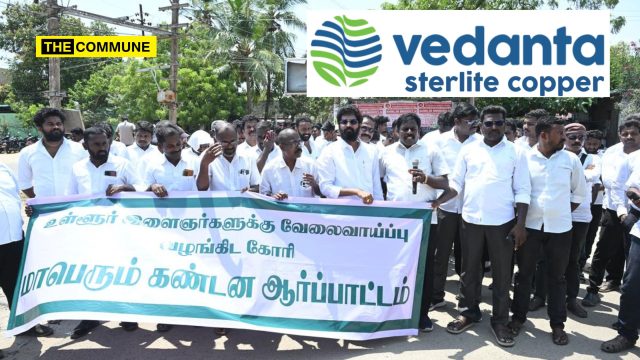
Vanchinathan was a vocal opponent of the Sterlite Copper plant in Thoothukudi, a protest that turned violent and controversial. He has consistently aligned himself against key infrastructure and policy initiatives, from the eight-lane highway project to the Citizenship Amendment Act (CAA) and the National Register of Citizens (NRC). His activism often resembles that of an ideological foot soldier for the DMK and affiliated leftist coalitions, rather than an impartial legal advocate.

The Kudankulam Anti-Nuclear Protests (2012): A Blockade Against Development

In 2012, a group of nearly 20 lawyers led by Advocate S. Vanchinathan practicing at the Madras High Court’s Madurai Bench staged a protest within the court premises. Their demonstration condemned the police action taken against agitators opposing the Kudankulam Nuclear Power Plant in Tirunelveli and urged the central government to halt fuel loading into the reactor.

This protest wasn’t an isolated event. It was part of a broader, well-organized campaign that became one of the most significant attempts to derail a strategic energy project in southern India. The Union Home Ministry eventually revoked the licenses of three NGOs operating in Tamil Nadu, alleging they misused foreign funds to support and intensify the anti-nuclear protests.

This crackdown followed a public statement by then-Prime Minister Manmohan Singh, who suggested that foreign-funded NGOs, particularly from the U.S., were behind the agitation that delayed a major infrastructure project. The first of two 1000-MW Russian-assisted reactors was scheduled for commissioning in late 2011 but was stalled due to the ongoing unrest.

Minister of State V. Narayanasamy later confirmed punitive action against the involved NGOs. Though he did not initially disclose names, he had earlier pointed fingers at organizations linked to Bishop Yvon Ambroise of Tuticorin, who had allegedly received ₹54 crore in foreign funds and was instrumental in mobilizing opposition.

Among those named were the Tuticorin Diocese Association (TDA) and Tuticorin Multipurpose Social Service Society (TMSSS), both Christian organizations under scrutiny for funding and promoting the protests. Other groups like People’s Education for Action and Liberation (PEAL) and Good Vision were also flagged. TMSSS alone had received ₹42 crore over five years, ostensibly for rural development. However, their funds and activities were later found to be intertwined with anti-development protests.

Sterlite Protests: Escalating Dissent Into Violence

In June 2018, Vanchinathan was arrested at Chennai Airport upon arrival from Delhi. He was accused of inciting the violent anti-Sterlite protests in Thoothukudi, where police firing tragically resulted in 13 civilian deaths. Along with fellow lawyer Hari Raghavan, Vanchinathan was booked under various IPC sections including rioting, criminal force against public servants, and for damages under the Tamil Nadu Property Prevention Act.

Following the arrest, a police team conducted searches at his residence in KK Nagar, Madurai, seizing documents and protest material. His role in the protests is viewed by authorities not as advocacy, but as direct involvement in orchestrating unrest.

Ironically, it was Justice GR Swaminathan who granted bail to Vanchinathan during this case.

CAA-NRC Protests And Provocative Speeches (2020): Ideological Rhetoric Disguised As Activism

In early 2020, Vanchinathan again made headlines for his involvement in protests against the Citizenship Amendment Act (CAA) and National Register of Citizens (NRC). He was scheduled to speak at a large rally in Trichy organized by the People’s Right Protection Centre (PRPC), where he serves as a state coordinator. The event was denied permission by local authorities, citing public order concerns. But later was granted permission by the High Court.

Later, in a separate event under the guise of criticizing CAA-NRC his speeches were filled with incendiary political rhetoric. In a seminar at Tiruvannamalai, he accused the Modi government and the RSS of orchestrating violence against JNU students and suppressing intellectual dissent. His statements went beyond critique of legislation; they bordered on personal attacks and conspiratorial narratives, including claims of RSS infiltration in academic institutions and state complicity in campus violence.

His speech, titled “NRC: Are We Becoming Second-Class Citizens in a Hindu Rashtra?” was a tirade against what he described as “Brahminical politics” and “corporate looting” by Adani and Ambani. He claimed that policies like NEET and the New Education Policy were part of a larger agenda to deny education to the underprivileged and to stifle critical thinking.

He also defended controversial statements made by Tamil scholar Nellai Kannan who made contentious remarks against Prime Minister Modi and Home Minister Amit Shah questioning the grounds of his arrest and mocking the intelligence of the Prime Minister in highly derogatory terms.

Targeting Hindu Organizations: Selective Outrage and Legal Intimidation

In an equally revealing move, Vanchinathan filed FIRs against several leaders associated with Hindu organizations, including the Hindu Munnani and members of the RSS and BJP, accusing them of inciting religious discord during the Murugan Manadu event. The list included political figures like Annamalai (BJP), Nainar Nagendran, and senior leaders from the Hindu Munnani.

During the peak of the Thiruparankundram controversy, when certain Muslim fundamentalist groups referred to the hills as “Sikkandar Hills” and asserted the right to perform sacrifices at the hilltop dargah Advocate Vanchinathan actively supported the fundamentalist side and propagated claims that sacrificial rituals had historically taken place on the temple hills. However, the Hindu Religious and Charitable Endowments (HRCE) Department denied these claims, and the individuals from the Muslim community who made them were reportedly unable to provide any documentary evidence supporting the occurrence of such sacrifices at Thiruparankundram Hills. Furthermore, in his speeches, Vanchinathan alleged that Lord Murugan had been appropriated and renamed ‘Subramanian’ under a Vedic identity.

The consistent pattern emerging from Vanchinathan’s actions reveals more than isolated incidents of activism. His legal and public interventions almost exclusively target pro-Hindu, nationalist, or development-centric policies and organizations while routinely defending or being backed by the Dravidianist, Periyarist, and leftist political ecosystems.

Not Just A Lawyer, But A Dravidianist Political Actor

Advocate Vanchinathan’s track record does not reflect that of a neutral human rights defender, but rather of a deeply ideological figure whose activism routinely aligns with a specific political narrative. From Kudankulam to Sterlite, from anti-CAA rallies to aggressive targeting of Hindu groups, his actions suggest a broader agenda designed to challenge the state and national leadership, often using legal tools and public discourse to propagate a one-sided ideological viewpoint.

The repeated defense and support he receives from leftist and Dravidianist groups only underscores that Vanchinathan is not acting in isolation. He is a key player in a larger ideological campaign one that poses serious questions about the politicization of activism, the misuse of legal mechanisms, and the erosion of institutional neutrality in the name of dissent.

Subscribe to our channels on TelegramWhatsApp, and Instagram and get the best stories of the day delivered to you personally.