Former Tamil Nadu BJP president K. Annamalai is set to part ways with the Bharatiya Janata Party (BJP), according to reports by CNN News18, citing sources close to the leader and discussions held with the party’s central leadership. An official announcement regarding his future political plans is expected shortly, with indications that a detailed roadmap may be unveiled in the coming days.
According to the reports, Annamalai had been in discussions with senior BJP leaders, including members of the party’s national leadership, regarding his decision to pursue an independent political path. Sources quoted in the report claimed that Annamalai conveyed that his move was not intended as a bargaining tool or an attempt to secure a larger role within the BJP, but rather reflected his belief that a separate political platform was necessary to advance what he views as a nationalist alternative in Tamil Nadu.
The development comes amid a changing political landscape in the state following the emergence of new political forces and shifting alliances. Reports suggest that Annamalai believes there is space for a movement rooted in nationalism and patriotism that can challenge the state’s dominant Dravidian political narratives while remaining aligned with Prime Minister Narendra Modi’s vision for India. Sources indicated that while he continues to respect the Prime Minister and several aspects of the BJP’s national agenda, he sees the need for a distinct political vehicle tailored to Tamil Nadu’s political realities.
Those familiar with the discussions reportedly said Annamalai sought an amicable separation from the BJP and wanted to avoid damaging relationships with senior leaders. The report claimed that consultations with the party’s leadership were aimed at ensuring that any transition would be smooth and free from public confrontation.
While there is speculation that Annamalai could eventually launch a political party of his own, sources indicated that such a move is unlikely to happen immediately. Instead, he is expected to first focus on building what has been described as a people’s movement before deciding on the formation of a formal political organisation. Reports suggest that any party launch could take place several months from now.
The reported split follows months of speculation regarding differences between Annamalai and sections of the BJP leadership, particularly over the party’s strategy in Tamil Nadu and its alliance decisions. Political observers have also pointed to disagreements over issues such as the BJP’s renewed ties with the AIADMK and certain policy positions affecting the state.
Annamalai, a former IPS officer who entered politics after resigning from the Karnataka cadre, is widely credited with expanding the BJP’s visibility in Tamil Nadu through campaigns such as his statewide “En Mann, En Makkal” yatra. It is noteworthy that he helped establish the BJP as a more visible political force in the state by taking its message directly to voters across districts.
The BJP has not yet issued a formal statement confirming the reported development. However, the anticipated announcement is expected tomorrow to provide clarity on Annamalai’s future plans, his relationship with the BJP going forward, and whether his proposed movement will eventually evolve into a new political party. If confirmed, the development could mark one of the most significant realignments in Tamil Nadu politics in recent years.
Subscribe to our channels on WhatsApp, Telegram,Instagram and YouTube to get the best stories of the day delivered to you personally.
Kejriwal simp and fanboy, propagandist masquerading as a journalist, Saurav Das shared on his X handle that he was thrilled to join the ‘Cockroach Janta Party’ as its Chief Spokesperson, on 3 June 2026.
I am thrilled to join the Cockroach Janta Party as its Chief Spokesperson. There comes a moment when the young of a nation realise they are angry because they were promised a future, and then mocked, moralised, and treated as disposables for asking where that… https://t.co/7X20MDJYkP
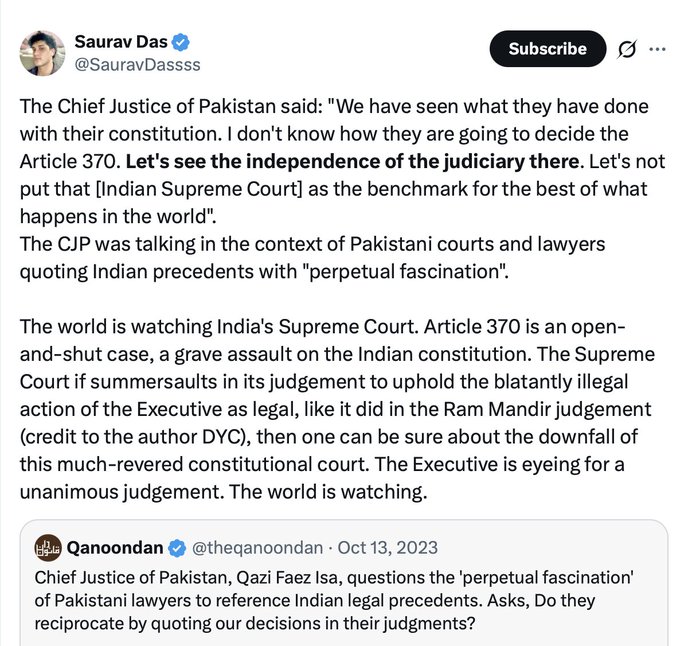
In a 2023 post, Das approvingly quoted then-Pakistan Chief Justice Qazi Faez Isa criticizing India’s judiciary and the impending Article 370 verdict. Das went further, calling the abrogation “an open-and-shut case, a grave assault on the Indian constitution” and warning that upholding it would mark the “downfall” of the Supreme Court. This came even as Pakistan-backed terrorism had plagued Kashmir for decades under the shield of Article 370’s special status.
Image Source: Tushar Gupta X handle
Championing Pakistan-Aligned Narratives On Kashmir
Das’s commentary consistently portrays post-2019 Jammu and Kashmir as a site of “human rights violations” and “muzzling of the free press” by the Indian government. He has amplified stories of journalists facing NIA/UAPA cases, expressed solidarity with those arrested in terror-related probes, and highlighted anonymous reports decrying “normalcy” in the region. While raising legitimate questions about governance is part of journalism, Das’s selective focus — ignoring the sharp decline in stone-pelting, infiltration attempts, and tourist influx post-abrogation — aligns strikingly with Islamabad’s propaganda line that India’s integration move was illegitimate.
He criticized the Supreme Court’s unanimous 2023 verdict upholding the abrogation as a blow to federalism and a sign of judicial decline. In doing so, he framed the full constitutional integration of India’s own territory — long disrupted by cross-border terrorism from Pakistan — as an act of central overreach rather than a necessary correction to a temporary provision that had enabled separatism.
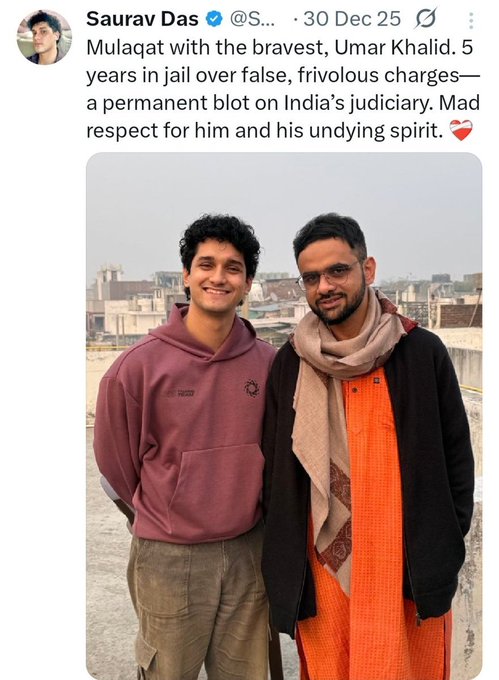
Love For Terror Accused Umar Khalid
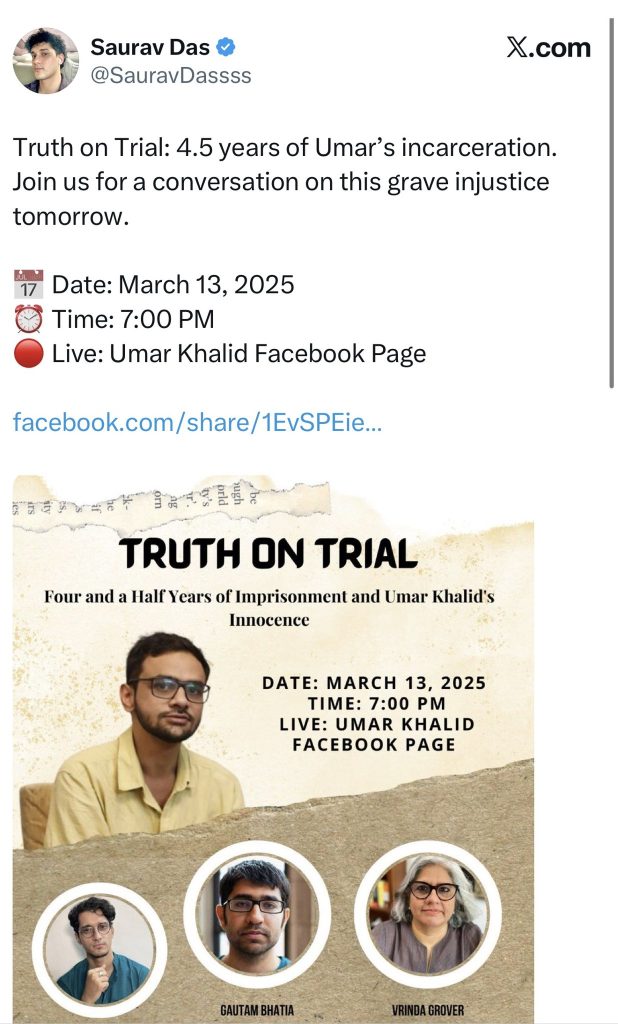
Das has been a vocal advocate for Umar Khalid and others in the 2020 Delhi riots “larger conspiracy” case, repeatedly calling charges “frivolous,” highlighting prolonged incarceration, and questioning UAPA applications — including against Kashmiri students allegedly raising pro-Pakistan slogans.
He has portrayed such cases as misuse of anti-terror laws rather than legitimate security measures against radicalization often stoked from across the border.
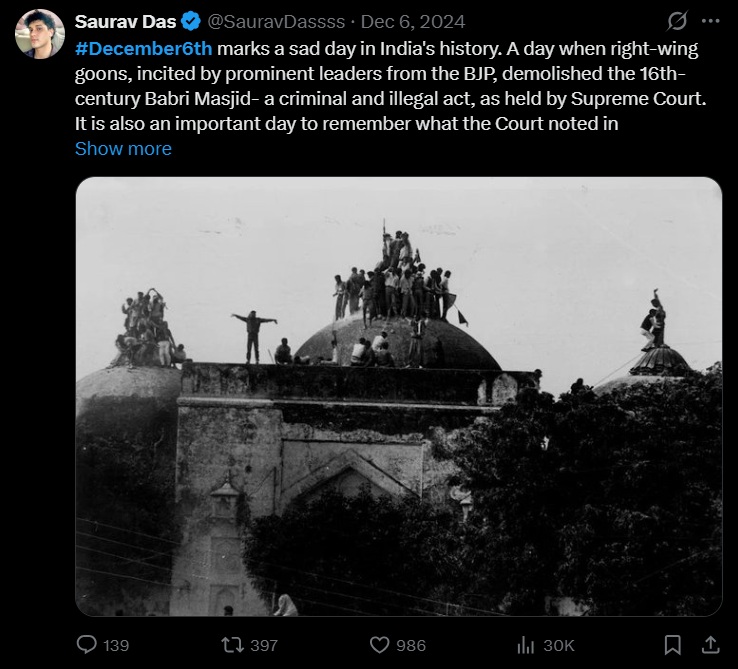
Hate For Ram Mandir
He spoke against Ram Mandir reconstruction too. He called December 6 a “sad day”.
He wrote in leftist magazines and news media. Saurav Das routinely writes for leftist publications like Article 14, Frontline, The Caravan magazine, Al Jazeera, The Wire, The Hindu etc.
Love For Terrorists
He wrote a piece supporting Hamas terrorist group. He also referred to terrorist don Atiq Ahmed as ‘Muslim ex MP’ and raised ‘rights concerns’ over his killing on live TV.
In the same piece, he wrote the attackers chanted Jai Shri Ram and referred it to as a “religious slogan that has now become a war cry for Hindu groups in their campaign against India’s Muslim minority.”
CJP’s chief spokesperson is a writer at Hamas supporter Al Jazeera.
He has written an article in support of Don Atiq Ahmed, and he claimed that he was killed because he was a Muslim.
Saurav Das has also falsely targeted Hindus by spreading fake theory that Hindus are targeting… pic.twitter.com/IhOwY47ol4
— Office Of Vijay Patel (@VijayGajeraO) June 4, 2026
Funding Scrutiny
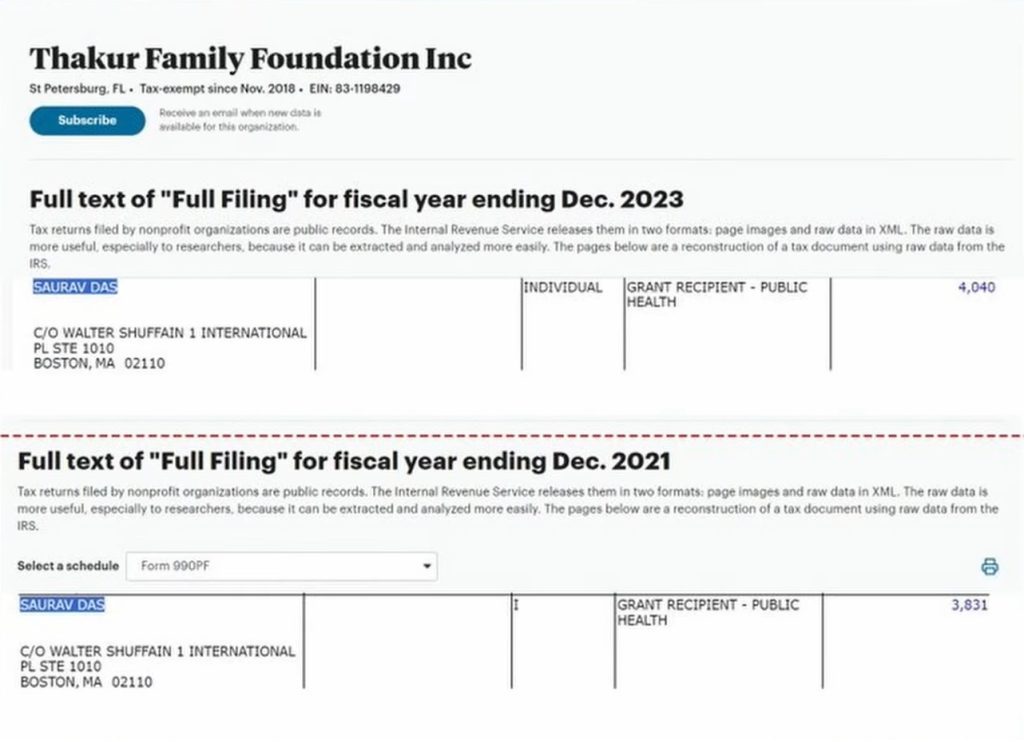
Das has earlier faced scrutiny for funding links to foreign and non-governmental foundations. A 2023 exposé by The Pamphlet showed that he received support from the Thakur Family Foundation for public health reporting, though his published articles reportedly extended to political topics beyond health policy.
Image Source: The Pamphlet
The Thakur Family Foundation (TFF), which presents itself as an organisation promoting “public health and civil liberties,” has funded multiple Indian media outlets and journalists, including individuals associated with Alt News, The Wire, and Moneylife Foundation, under the banner of health-related reporting. These grants coincided with the publication of articles critical of India’s pharmaceutical industry, traditional medicine systems, and domestic COVID-19 response, while appearing to favour Western vaccine and corporate narratives.
TFF has also been linked to the US-based testing firm Valisure, which released reports questioning the quality of Indian-made drugs. The pattern of financial support, editorial influence, and timing of campaigns indicates an organised effort to erode confidence in Indian generics and Ayurveda. During the COVID-19 pandemic, TFF-funded content appeared in The Wire and Alt News, amplifying narratives that portrayed India’s pandemic management and indigenous pharmaceutical initiatives in a negative light.
Saurav Das who seems to write on “public health” only wrote articles that were critical of the government policies in this space and not otherwise.
Additionally, when India banned anti-Hindu website Hindutva Watch, Saurav Das published a propaganda piece in Article 14 about India’s ‘censorship rules’.
Subscribe to our channels on WhatsApp, Telegram,Instagram and YouTube to get the best stories of the day delivered to you personally.
A detailed investigation published by NPOV (Neutral POV run by investigative journalist Ashley Rindsberg) has alleged that a small cluster of Wikipedia editors spent years systematically reshaping the Wikipedia page of the Hindu American Foundation (HAF), turning what had been presented as a Hindu-American civil rights organisation into a dossier of accusations linking the group to Hindu nationalism, academic censorship, caste denialism and even foreign-agent activity.
🚨NEW INVESTIGATION: A Fortune 500 company reportedly cancelled a @HinduAmerican training session after employees circulated its Wikipedia page.
That page tells readers HAF aligns with Hindu nationalism, threatens academic freedom, and has been accused of acting as a foreign… pic.twitter.com/VvMxhbWCt0
According to Neutral POV, the transformation did not happen organically through the actions of hundreds of independent volunteers. Instead, the report claims that four editors – TrangaBellam, Kautilya3, Llightex and Shahinshah121, came to control more than 80% of the content on HAF’s Wikipedia page, while a powerful administrator named Vanamonde93 repeatedly intervened in ways that reinforced the page’s evolving narrative.
The investigation states that the case represents a broader problem with Wikipedia itself. While the encyclopedia is often perceived as a crowdsourced platform that neutralises bias through large-scale participation, Neutral POV contends that controversial subjects are increasingly dominated by small clusters of ideologically aligned editors who shape public narratives that are then amplified through Google search results, journalists and AI systems.
The Narrative Shift Against HAF Begins
Neutral POV traces the beginning of the transformation to early 2021.
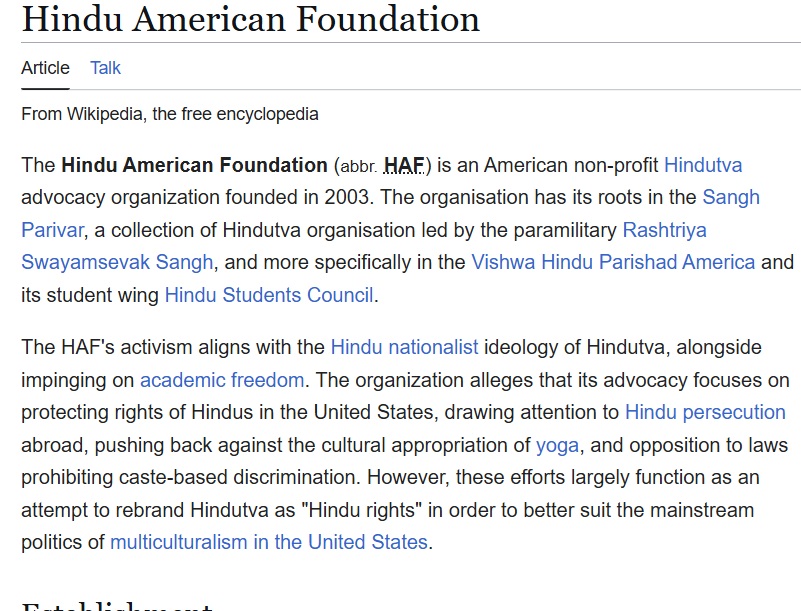
According to the report, the HAF Wikipedia page today opens with claims that the organisation aligns with Hindu nationalist ideology, impinges upon academic freedom, traces its roots to organisations described as nationalist and attempts to repackage Hindutva as Hindu rights.
Screenshot of HAF’s Wikipedia page
Neutral POV argues that these claims are not presented as allegations or disputed viewpoints but are instead written in Wikipedia’s institutional voice, giving readers the impression that they are established facts rather than contested assertions.
The report alleges that this narrative framework was built through a coordinated ecosystem of related pages covering HAF, its critics, advocacy organisations and academics involved in disputes with the foundation.
Audrey Truschke, SASAC and the Construction of a Network
One of the first major developments identified by Neutral POV involves historian Audrey Truschke.
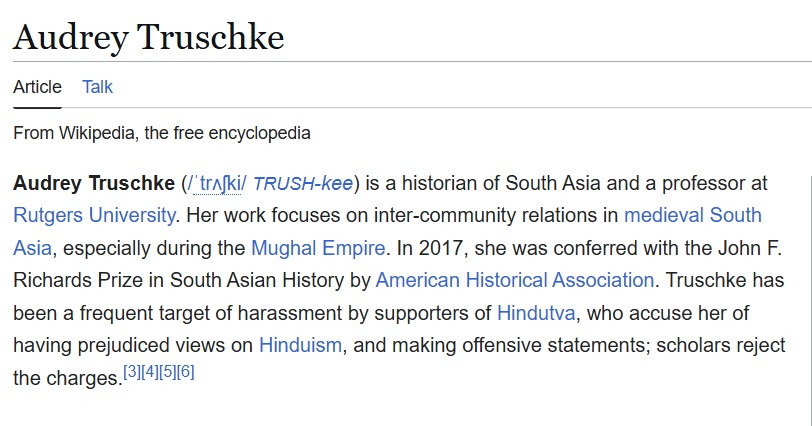
In March 2021, editor TrangaBellam created Truschke’s Wikipedia biography and remains the dominant contributor to that page. According to the report, the article quickly came to emphasize Truschke’s claims that she was being ‘harassed’ by supporters of Hindutva and that she had become a target of the Hindu Right.
Screenshot of Audrey Truschke Wikipedia page
Neutral POV notes that one of the sources used to support these claims was a Washington Post op-ed co-authored by Truschke herself. Another source was the South Asia Scholar Activist Collective (SASAC), an organisation that Truschke co-founded. The report highlights what it considers a remarkable coincidence: references to SASAC appeared on Wikipedia within days of the organisation’s website first going live and shortly after its domain was registered.
The report alleges that editors TrangaBellam and Shahinshah121 aggressively promoted SASAC-related content across multiple pages and attempted repeatedly to establish a dedicated Wikipedia page for the newly formed organisation despite repeated rejections by administrators.
Soon afterwards, both editors began making substantial edits to the HAF page.
The Academic Freedom Narrative
Neutral POV argues that one of the first major narratives introduced onto the HAF page was the claim that HAF’s defamation lawsuit against Truschke, Hindus for Human Rights and the Indian American Muslim Council represented an attack on academic freedom.
The report states that some of the sources used to support this framing came directly from organisations that were themselves defendants in the lawsuit. According to Neutral POV, this violated Wikipedia’s sourcing standards and allowed interested parties to become sources for claims against HAF.
The Foreign Agent Allegation
The report devotes significant attention to what it describes as one of the most damaging claims inserted into HAF’s page.
Neutral POV alleges that editor Shahinshah121 helped establish a narrative suggesting that HAF was operating as an unregistered foreign agent for India’s BJP government. The article states that a sentence was inserted noting that HAF had been named in a complaint submitted to the US Department of Justice alleging that it functioned as an unregistered foreign agent.
According to Neutral POV, the wording created the impression that HAF was facing scrutiny from federal authorities.
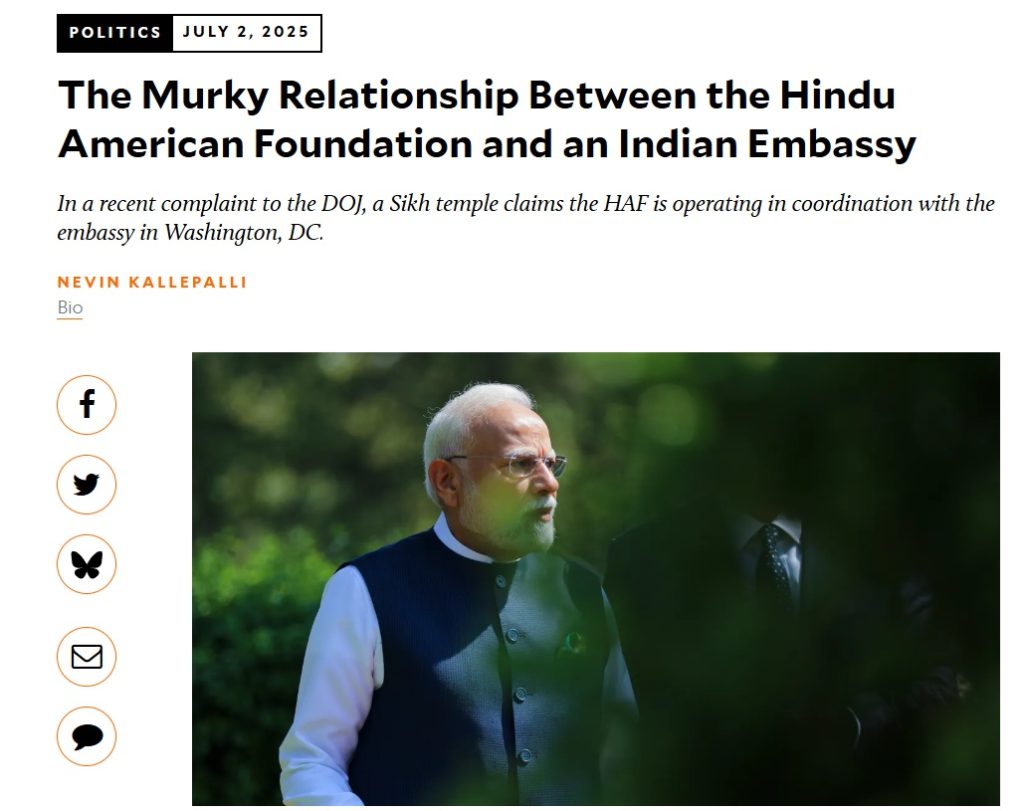
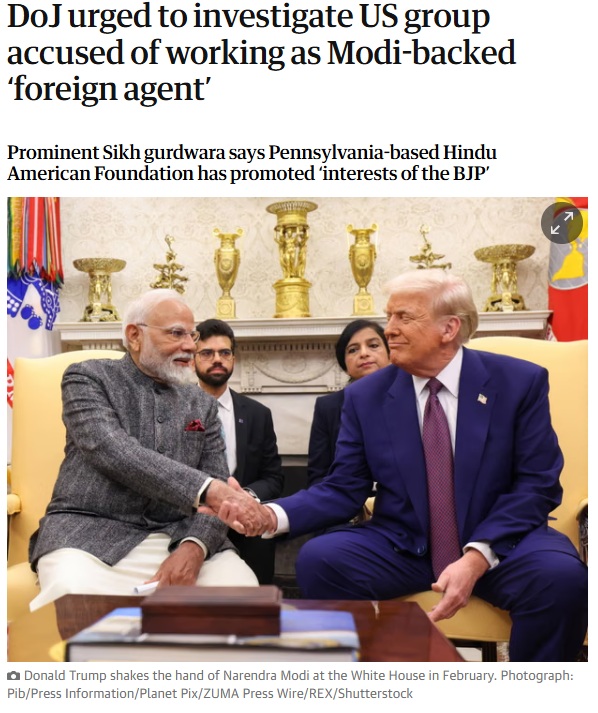
The report argues that the reality was significantly different. It states that the complaint originated from Fremont Gurdwara Sahib, a Sikh organisation in California, which hired a law firm to send an unsolicited letter to the Department of Justice. The group then issued a press release, which was subsequently covered by Mother Jones and The Guardian.
Screenshot of Mother Jones articleScreenshot of The Guardian article
However, Neutral POV notes that the Department of Justice never publicly announced an investigation and never commented on the allegations.
Despite this, the report argues, the Wikipedia entry retained language that many readers would interpret as evidence of federal scrutiny while omitting critical context about the origins of the complaint. Neutral POV further argues that the page failed to explain the broader political context involving Sikh separatist activism and ideological conflicts surrounding Indian nationalism.
Kautilya3 and the Removal of HAF’s Defences
Another central figure in the investigation is editor Kautilya3.
According to Neutral POV, Kautilya3 repeatedly removed material presenting HAF’s responses to accusations made against it. The report points to edits dating back to 2017, including one where Kautilya3 removed balancing content while remarking that Wikipedia was “not the private web site of the Hindu American Foundation.”
In January 2021, Kautilya3 allegedly removed thousands of bytes of material, including statements from HAF representatives denying links to Hindu nationalist organisations.
Neutral POV argues that while HAF’s own responses were removed as self-published or unreliable, activist material critical of HAF often remained on the page. The report describes this as an inconsistent application of Wikipedia policy.
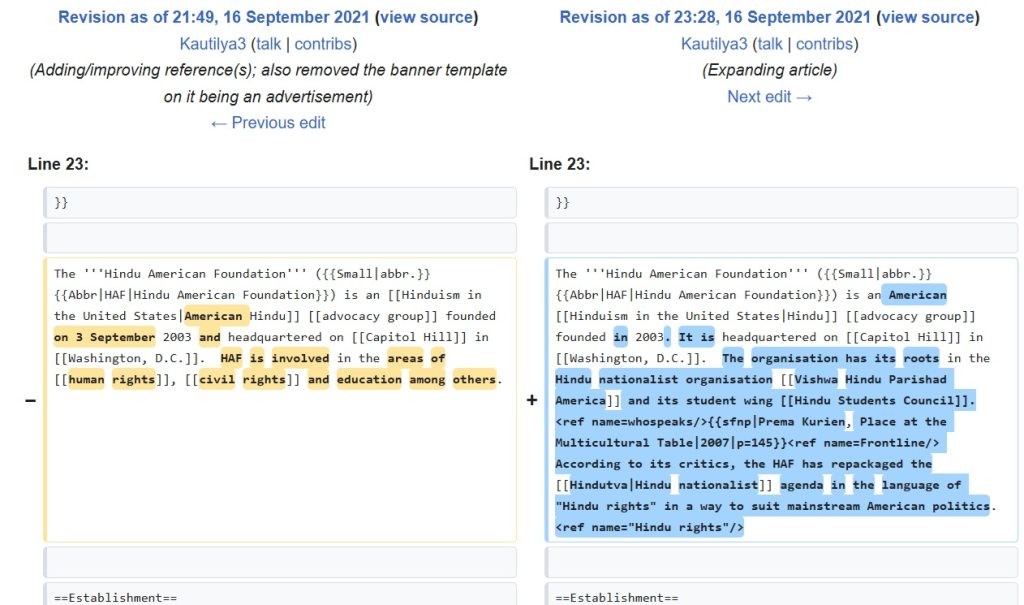
One of the most consequential edits identified by Neutral POV occurred in September 2021. According to the report, Kautilya3 changed the article’s lead so that instead of presenting HAF as a civil-rights organisation, it was rebranded as an organisation that was linked to Hindu nationalist movements having a specific deceitous agenda.
Screenshot of edit page
The report also highlights a later edit in which hyperlinks were changed. Previously, the word “Hindu” linked to a page about Hinduism in the United States. After Kautilya3’s changes, readers clicking through were instead directed to the article on Hindutva. Neutral POV argues that this subtly altered the conceptual framework through which readers understood the organisation.
The Role of Vanamonde93
Neutral POV devotes substantial attention to administrator Vanamonde93, whom it identifies as one of Wikipedia’s most powerful administrators due to his access to both checkuser and oversight privileges.
According to the report, Vanamonde93 intervened at several critical moments. One of the most significant examples cited is the decision to rename a section from “Alleged Hindu Nationalist Ties” to simply “Hindu Nationalist Ties.”
Neutral POV argues that this transformed an allegation into a factual descriptor.
The report also points to Vanamonde93’s edits on Audrey Truschke’s page. It notes that he removed references to criticism made by Berkeley Sanskrit scholar Robert Goldman after Goldman publicly rejected Truschke’s interpretation of a Hindu text. Neutral POV argues that criticism of Truschke received much stricter sourcing scrutiny than criticism directed at HAF.
In 2026, according to the report, Vanamonde93 also removed statements by HAF executive director Suhag Shukla explaining the organisation’s position regarding its defamation lawsuit. Neutral POV states this was another instance in which HAF’s responses were excluded while accusations against it remained.
Llightex and Conflict-of-Interest Questions
Perhaps the most serious allegation in the report concerns editor Llightex.
Neutral POV notes that Llightex publicly disclosed having previously worked with Hindus for Human Rights, one of the principal defendants in HAF’s lawsuit. Despite that disclosure, the same editor subsequently created and became the dominant author of Wikipedia pages for Hindus for Human Rights, its co-founder Sunita Vishwanath and related advocacy organisations.
The report states that Llightex then began extensively editing HAF’s page, restructuring the lead, expanding sections dealing with litigation and reshaping the organisation’s overall presentation.
According to Neutral POV, this meant that an editor who had acknowledged a prior relationship with one side of a legal dispute was simultaneously shaping Wikipedia’s coverage of both the defendants and the plaintiff.
The investigation further alleges that Llightex helped build an interconnected ecosystem of pages covering Hindus for Human Rights, Sunita Vishwanath, the Indian American Muslim Council and the Coalition Against Genocide, all of which were later used as sources or contextual references in discussions surrounding HAF.
The Emergence of “Clustersourcing”
Neutral POV concludes that the HAF case demonstrates what it calls “clustersourcing” – a situation where a small group of editors dominates the production of knowledge on controversial topics.
According to the report, the HAF page evolved from a profile of a Hindu-American civil-rights organisation into a page dominated by accusations involving Hindu nationalism, caste politics, academic intimidation and foreign influence. Neutral POV argues that this transformation was driven not by a broad community consensus but by the sustained efforts of a handful of editors operating across interconnected pages.
The investigation warns that because Wikipedia increasingly serves as a foundational source for search engines, journalists and artificial intelligence systems, editorial battles on the platform have consequences far beyond Wikipedia itself. The report argues that even if problematic editing is later identified, the narrative may already have been absorbed into the broader information ecosystem and propagated across countless downstream platforms.
Neutral POV stated that it contacted Audrey Truschke, SASAC, the Indian American Muslim Council, Sunita Vishwanath and the Wikimedia Foundation for comment but did not receive responses before publication.
For years, major institutions have framed India and Hindus through the lens of nationalism, extremism, and suspicion. But what we’ve uncovered on @Wikipedia raises a deeper question: who gets to write the public record?
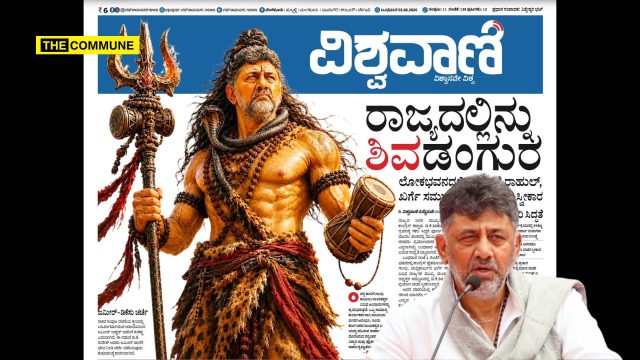
A Kannada newspaper has found itself at the centre of a controversy after publishing an illustration depicting Karnataka Chief Minister (when he was still CM designate) DK Shivakumar as Lord Shiva ahead of his swearing-in ceremony, as reported in OpIndia.
The Bengaluru-based daily Vishwavani carried the artwork prominently on its front page, portraying Shivakumar with iconography traditionally associated with the Hindu deity. The illustration showed the Congress leader with matted locks, a tiger-skin garment, a trishul and a damru.
The image gained wider attention after it was shared on social media by Vishwavani Editor-in-Chief Vishweshwar Bhat.
— Vishweshwar Bhat (@VishweshwarBhat) June 3, 2026
The publication soon faced criticism online, with several social media users accusing it of blurring the line between political reporting and religious symbolism. Critics argued that depicting an elected politician in the form of a revered Hindu deity was inappropriate and offensive.
The illustration came across as blasphemous and netizens questioned the decision to associate a contemporary political leader with a religious figure worshipped by millions.
Several social media users also pointed to Shivakumar’s past legal controversies while criticising the artwork. Some argued that comparing a politician who had faced corruption-related allegations to a deity was inappropriate.
One user specifically referred to Shivakumar’s incarceration in Delhi’s Tihar Jail in 2019 during an Enforcement Directorate investigation into alleged money-laundering, questioning the newspaper’s decision to elevate him through religious imagery.
Others focused on the artistic portrayal itself, mocking the illustration and describing it as an awkward or exaggerated attempt at political image-building.
The controversy unfolded as Shivakumar prepared to assume office as Karnataka’s Chief Minister after taking oath at Bengaluru’s Glass House in Lok Bhavan.
His elevation to the state’s top post came after months of speculation over a possible leadership transition within the Congress government. The Congress high command ultimately intervened to resolve a prolonged power struggle between Shivakumar and outgoing Chief Minister Siddaramaiah, paving the way for Shivakumar to take over the chief ministership.
Subscribe to our channels on WhatsApp, Telegram,Instagram and YouTube to get the best stories of the day delivered to you personally.
A cat fight of sorts unfolded between Chennai Mayor Priya and TVK MLA Pallavi has become the subject of widespread discussion on social media after a series of awkward exchanges during the inauguration of two government school buildings in Chennai’s Thiru Vi Ka Nagar zone.
The controversy unfolded during the inauguration of a new building for the Chennai Urdu Middle School, constructed at a cost of ₹3.24 crore. Chennai Mayor Priya, Thiru Vi Ka Nagar MLA Pallavi, Corporation officials and other dignitaries participated in the event.
According to reports, Pallavi, who had been pregnant during her election campaign, attended the function with her infant child.
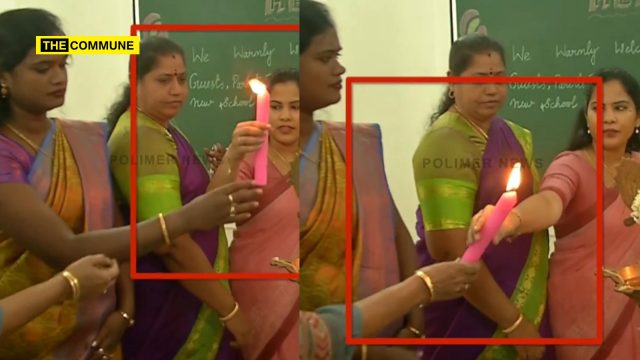
The first flashpoint reportedly occurred during the inauguration of the Urdu school building. Before the building was formally opened, Mayor Priya arrived to cut the ribbon. Sources claimed that Pallavi was made to stand behind the Mayor during the ribbon-cutting ceremony.
After entering the building, Mayor Priya proceeded to light the ceremonial kuthuvilakku. She then reportedly extended the candle in Pallavi’s direction. When Pallavi reached out to take it, the Mayor allegedly withdrew her hand and instead handed the candle to an IAS officer standing nearby.
The move reportedly left Pallavi upset, and she is said to have walked away from the event shortly afterwards.
The two leaders later participated in a second inauguration programme for a Chennai Primary School building in Ward 75, catering to students from LKG to Class V.
According to reports, Pallavi arrived at the venue before Mayor Priya for the second event.
During the lamp-lighting ceremony, Mayor Priya lit the kuthuvilakku and then offered the candle to Pallavi. However, Pallavi reportedly refused to accept it and told the Mayor to light the remaining wick herself.
The incident immediately triggered speculation that Pallavi’s refusal was a response to what had transpired during the earlier function.
When reporters later sought clarification from Mayor Priya regarding the controversy, her camp reportedly maintained that she had merely followed official protocol.
Mayor Priya claimed that once the Mayor lights the ceremonial lamp, protocol requires that the next wick be lit by the senior IAS officer present. She claimed that Pallavi, despite being the local MLA, attempted to take the candle without being aware of the prescribed protocol, following which the candle was handed to the IAS officer instead.
What Mayor @PriyarajanDMK says is completely wrong. (#TVKVijay) MLA @MR_PALLAVI_TVK is an elected representative of the people, while an IAS officer is an appointed civil servant. In the official order of precedence and government protocol, elected representatives generally rank… pic.twitter.com/dFcMosblkt
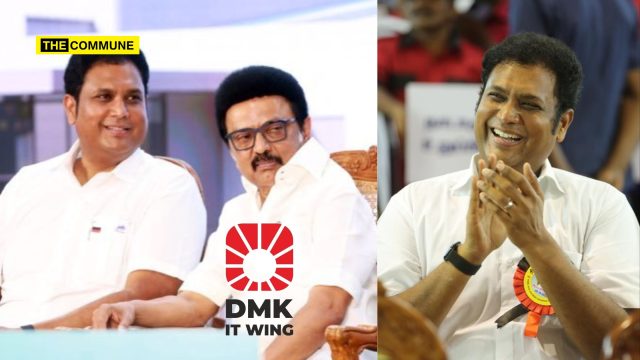
Several former DMK ministers have reportedly complained to the party leadership that the DMK’s Information Technology (IT) Wing was a major factor behind the party’s electoral defeat, following which significant changes are expected within the organisation, according to party sources as reported by Junior Vikatan.
During the recently concluded election, DMK president MK Stalin, Youth Wing Secretary Udhayanidhi Stalin and Deputy General Secretary Kanimozhi undertook extensive campaigning. District secretaries of the party were also actively involved in electioneering. However, Tamilaga Vettri Kazhagam (TVK), relying primarily on social media rather than extensive ground-level campaigning, managed to secure power in an outcome that many had not anticipated.
The development has prompted questions within the DMK over the effectiveness of its social media strategy and the performance of its IT Wing at a time when TVK was making extensive use of digital platforms.
According to party insiders, some senior former ministers met Stalin and expressed concern that the party’s poor performance on social media was largely due to the functioning of the IT Wing under its secretary, TRB Rajaa. They reportedly urged the party leadership to conduct a review and strengthen the party’s social media operations to better compete with TVK in the future.
Sources close to the party said Stalin was upset after hearing the allegations raised against Rajaa.
Party insiders claimed that the IT Wing’s activities had become largely confined to promoting posts made by Stalin, Udhayanidhi Stalin, Kanimozhi and TRB Rajaa on social media platform X. They alleged that the wing failed to effectively convert the field activities of the DMK alliance’s 234 candidates into social media campaigns and was unable to adequately disseminate even Stalin’s speeches among the public.
According to the sources, more than 50 district secretaries have expressed the view that the IT Wing contributed little to campaign efforts in their respective districts. They further alleged that Rajaa focused primarily on X while neglecting Instagram, and that the wing failed to closely monitor the opposition’s social media strategy.
As per the Junior Vikatan report, the sources claimed that even if the IT Wing had recognised in the final ten days of the campaign that TVK’s social media dominance could significantly influence the election, it might have been able to limit the scale of TVK’s eventual victory.
Speaking about the reasons behind the IT Wing’s alleged decline, party functionaries claimed that Rajaa began paying less attention to the organisation after assuming charge as Industries Minister. They alleged that balancing ministerial responsibilities, constituency work in Mannargudi and election-related duties resulted in shortcomings in the wing’s functioning.
The functionaries also argued that while the DMK possesses one of the most extensive IT Wing structures among political parties, the effectiveness of the organisation has been undermined by the composition of its leadership. They said the wing consists of a state secretary, around 20 deputy secretaries and district-level office-bearers across the state but alleged that nearly 75% of them are not active on social media and that 95% are unfamiliar with Instagram algorithms.
As TVK was reportedly using social media very effectively, many within the DMK are now asking: What was the DMK IT wing doing during the election?
According to sources, some senior DMK leaders met Stalin and complained that the party’s poor performance was partly due to the weak… pic.twitter.com/SGNS3EpgSX
According to them, appointments within the IT Wing are often influenced by district secretaries, with no formal mechanism to assess whether candidates are active and effective on social media before being given responsibilities.
Some IT Wing functionaries also alleged interference from PEN, a political consultancy firm run by MK Stalin’s son-in-law, Sabareesan. They claimed that while the IT Wing was issuing instructions to district-level administrators, Pen representatives working alongside candidates on the ground often proposed different strategies, creating confusion within the campaign structure.
Sources close to the party leadership said some former ministers have formally demanded that the IT Wing be taken away from TRB Rajaa. According to the sources, Stalin has expressed agreement with the demand, and major changes within the DMK IT Wing are expected in the near future.
Subscribe to our channels on WhatsApp, Telegram,Instagram and YouTube to get the best stories of the day delivered to you personally.
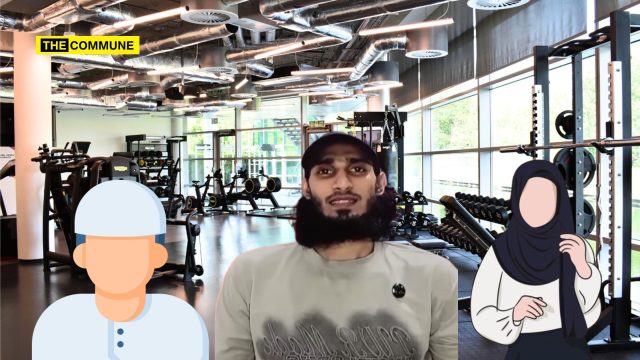
An announcement by a fitness centre in Kerala’s Palakkad district describing itself as an “Islamic-friendly gym” has triggered a controversy, with the concept drawing criticism and sparking debate on social media, as reported in India Today.
The row began after a gym in Puthunagaram released a promotional video featuring its owner, Nawaz Muthu T, who outlined the facility’s operating model. In the video, Nawaz said the gym would function without loud music and would provide separate workout timings and spaces for men and women.
“We are launching an Islam-friendly gym, and I believe it will be the first of its kind in Kerala. Anyone interested is welcome to contact me and visit the facility,” Nawaz said in the video.
WANT TO KNOW WHAT IS AN “ISLAM FRIENDLY” GYM LISTEN TO THE ONWER WHO OWNS A “SHARIA COMPLIANT” SPACE IN PALAKKAD, KERALA
Owner says he follows Sharia rules: separate timings for men women, same gender trainers, no loud filmy music. Claims it doesn’t mean “Muslim only”. It’s a… pic.twitter.com/KX1aDdGWjk
He also clarified that the gym was not a new venture but an existing fitness centre that had been operating for around 15 years and was currently undergoing renovation.
The promotional video, however, drew widespread criticism online, with several social media users questioning the purpose of the initiative and whether the facility was intended exclusively for Muslims.
Following the backlash, the original video was removed. Nawaz subsequently released another video in which he stated that the gym was open to people of all faiths and rejected claims that it was a Muslim-only facility.
“A lot of people say this is a Muslim gym or a gym only for Muslims. I am not saying that. I have never said this is a gym only for Muslims,” he said.
Explaining the concept behind the project, Nawaz said the term “Islamic-friendly” referred to certain operational practices rather than restrictions based on religion.
“When it comes to an Islamic-friendly gym, women and men should not work out together. Women should have a separate time and separate space. Men should have a separate time. There should be no loud music,” he said.
According to Nawaz, many people who strictly adhere to such practices currently avoid gyms because they are uncomfortable with mixed workout environments or facilities that play music.
“A lot of Muslims live according to Islamic principles. They don’t listen to music. There is no gym for them. When you go to a gym, it is not possible to switch off the music. There are women who are uncomfortable working out in mixed spaces. These are people who have not been able to access gyms until now,” he said.
He added that similar concerns existed within his own family and social circle, preventing some individuals from using fitness centres.
“Because I am a Muslim, I know many such people. Even among my relatives, there are people who do not go to gyms. This facility will be useful for them,” he said.
Responding to allegations that the gym was exclusionary, Nawaz reiterated that membership would not be restricted on religious grounds.
“Everyone can come. The only condition is that there will be no open music. Those who want to listen to music can do so through headphones. There is nothing wrong with that,” he said.
Recently, in the alleged Mirzapur gym conversion aka gym jihad racket, Hindu women were targeted through gyms, lured into relationships, blackmailed with compromising material and pressured to convert to Islam. Police stated that more than 50 women were targeted through a network involving gym owners, trainers and associates, with five gyms shut down and multiple accused, including a constable, a maulvi and a bodybuilding champion, currently in jail.
Is the new ‘Islamic-friendly’ gym another route for gym jihad in Kerala? Time will tell.
Subscribe to our channels on WhatsApp, Telegram,Instagram and YouTube to get the best stories of the day delivered to you personally.
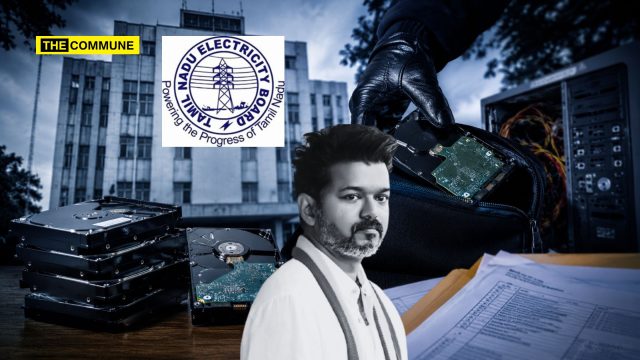
In a major security breach at the headquarters of the Tamil Nadu Electricity Board (TNEB) on Anna Salai, at least 18 hard disks containing confidential official records were reportedly stolen, raising concerns about possible sabotage and attempts to destroy evidence linked to procurement and tender-related matters, as reported in Times of India.
According to officials, the stolen hard disks contained sensitive data relating to tenders, purchases, administrative records and ongoing investigations. Sources indicated that records connected to coal procurement, which were maintained by the material management departments, appeared to be among the primary targets. While hard-copy records remain available, crucial electronic records stored on the missing hard disks have reportedly been lost.
The theft is believed to have taken place during the weekend of May 16 and 17, when staffing levels at the headquarters were minimal. The incident occurred shortly after newly appointed Electricity Minister R. Nirmalkumar visited the department and reportedly warned officials that wrongdoing within the department would not be tolerated.
The disappearance of the data came to light around 20 May 2026 when employees from multiple sections discovered that project files and official records had vanished from their computer systems. Subsequent checks by system administrators reportedly revealed that the hard disks themselves had been physically removed from the computers.
Although at least 18 hard disks are understood to have been stolen, departmental complaints were reportedly filed in connection with only eight of them. Sources indicated that certain departments, including the finance wing, were reluctant to formally report the theft either to the Chairman and Managing Director of TNEB or to the utility’s vigilance authorities. Officials responsible for maintaining the data and hardware were also reportedly unwilling to approach the police directly with complaints.
The losses were reported by officials handling tenders, procurement and administrative functions. Complaints were submitted to senior TNEB authorities by eight officials, including assistant engineers, assistant executive engineers and section officers.
The complaints were initially referred to the TNEB vigilance wing headed by Additional Director General of Police Ayush Mani Tiwari. A special team was subsequently constituted to trace the missing hard disks. The stolen devices were reportedly removed from offices located on the fourth, fifth, seventh and tenth floors of the TNEB headquarters building.
The incident has also drawn attention to the absence of surveillance infrastructure in several sensitive sections of the headquarters. Sources stated that CCTV cameras in many of these offices had been removed more than five years ago. Allegations have since surfaced that the cameras were taken down to ensure there would be no visual record of brokers and intermediaries who allegedly frequented the premises while facilitating deals linked to procurement and contract-related irregularities.
Officials familiar with the matter stated that the vigilance department had repeatedly recommended the installation of CCTV surveillance systems. However, the Superintending Engineer in charge of buildings had reportedly opposed the proposal on the grounds that the expenditure involved was excessive.
Following the discovery of the theft, the Chintadripet police registered a case under Section 305 of the Bharatiya Nyaya Sanhita. A police team headed by Triplicane Deputy Commissioner of Police D. Jayachandran has commenced an investigation into the incident.
The theft has occurred at a time when multiple investigations concerning alleged irregularities in TANGEDCO tenders are underway. Recently, the Madras High Court directed the Central Bureau of Investigation to probe an alleged ₹397-crore transformer procurement scam amid allegations of cartelisation among bidders and inflated pricing.
In addition, central agencies, including the Enforcement Directorate, are reportedly examining financial transactions linked to electricity department tenders awarded between 2021 and 2023. Investigators are expected to examine whether the missing hard disks contained records relevant to any of these ongoing inquiries.
18 HARD DISKS WITH SENSITIVE DATA STOLEN FROM TNEB HQ
IT CONTAINS CONFIDENTIAL DETAILS ABOUT TENDERS, PURCHASES AND INVESTIGATIONS
In a brazen act of sabotage, at least 18 hard disks contai-ning confidential data, particu-larly records related to tenders, purchases and ongoing… pic.twitter.com/frtBGvMUpz
In a shocking incident that has sent ripples across the region, a 14-year-old girl was allegedly drugged, sexually assaulted, and found lying unconscious in the Keeraikadai Bazaar area, which happens to be CM Joseph Vijay’s Trichy East constituency. The accused taxi driver, who was later caught by the public and severely beaten has been booked under the POCSO Act.
The victim remains unconscious and is receiving intensive care at the Mahatma Gandhi Government General Hospital in Trichy, as reported in Tamil Samayam.
The accused, identified as Mariselvan (43), a native of Sivaganga, works as a car driver. According to police reports, Mariselvan had come to Trichy on the day of the incident to visit a transgender person named Aadhira (also known as Aadhi Tamilan) and their friends, who reside in the Kalmanthai Colony near Gandhi Market.
The victim is Aadhira’s younger sister.
At around 5:00 PM, Mariselvan took the girl from Kalmanthai Colony in his car. Approximately an hour and a half later, at 6:30 PM, he allegedly dropped her off in the Keeraikadai Bazaar area.
As reported in OneIndia Tamil, the minor had gone to meet a friend at the friend’s residence. The friend’s mother then called a taxi to travel out of town. The vehicle was driven by a man identified as Mariselvan, aged 43. It is alleged that Mariselvan engaged the girl in conversation and subsequently took her away alone.
As per Tamil Janam report, the minor girl was allegedly gang-raped after being given a sedative mixed with fruit juice while getting into a car. The accused driver then threw her out in the Gandhi Market area. It is also reported that there were 3 more people who escaped the scene.
When passersby and local police personnel noticed the girl lying unconscious on the ground, appearing to be under the influence of a narcotic substance or alcohol, they immediately rescued her and rushed her to the government hospital for treatment.
Outraged by the incident, local residents began searching for Mariselvan. At around 7:30 PM, when he returned to Kalmanthai Colony, the public caught him and assaulted him severely. The attack left Mariselvan with a fractured skull and serious injuries, as reported in Tamil Samayam..
He was later rescued by a 108 ambulance and also taken to the government hospital for treatment.
The Gandhi Market police have registered a case against Mariselvan under the Protection of Children from Sexual Offences (POCSO) Act.
Upon learning about the incident, the victim’s parents and relatives gathered in large numbers in front of the government hospital. They staged a road blockade protest, demanding permission to see the girl and strict punishment for the accused.
Police officials are currently engaged in negotiations with the protesters to resolve the situation.
The victim continues to remain unconscious and is under intensive care. The accused driver is also receiving medical treatment for his injuries.
Subscribe to our channels on WhatsApp, Telegram,Instagram and YouTube to get the best stories of the day delivered to you personally.
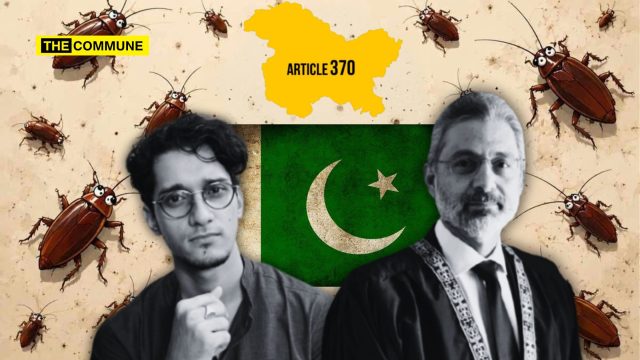
Saurav Das, the freshly appointed Chief Spokesperson for the Cockroach Janta Party (CJP), has a documented history of opposing India’s sovereign decision to abrogate Article 370 — not by relying on Indian constitutional experts or parliamentary debates, but by platforming the Chief Justice of Pakistan, a nation long designated as a terror sponsor and India’s adversary.
In a 2023 post, Das approvingly quoted then-Pakistan Chief Justice Qazi Faez Isa criticizing India’s judiciary and the impending Article 370 verdict. Das went further, calling the abrogation “an open-and-shut case, a grave assault on the Indian constitution” and warning that upholding it would mark the “downfall” of the Supreme Court. This came even as Pakistan-backed terrorism had plagued Kashmir for decades under the shield of Article 370’s special status.
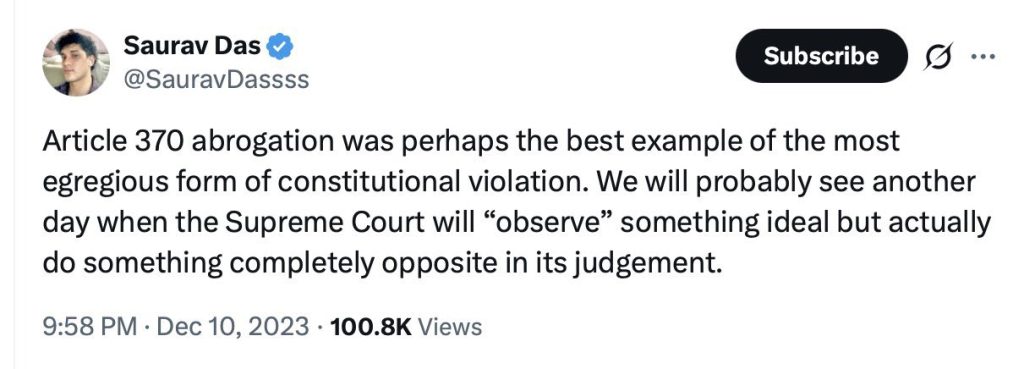
Doing away with Article 370 was a grave assault on the Indian Constitution.
Championing Pakistan-Aligned Narratives On Kashmir
Das’s commentary consistently portrays post-2019 Jammu and Kashmir as a site of “human rights violations” and “muzzling of the free press” by the Indian government. He has amplified stories of journalists facing NIA/UAPA cases, expressed solidarity with those arrested in terror-related probes, and highlighted anonymous reports decrying “normalcy” in the region. While raising legitimate questions about governance is part of journalism, Das’s selective focus — ignoring the sharp decline in stone-pelting, infiltration attempts, and tourist influx post-abrogation — aligns strikingly with Islamabad’s propaganda line that India’s integration move was illegitimate.
He criticized the Supreme Court’s unanimous 2023 verdict upholding the abrogation as a blow to federalism and a sign of judicial decline. In doing so, he framed the full constitutional integration of India’s own territory — long disrupted by cross-border terrorism from Pakistan — as an act of central overreach rather than a necessary correction to a temporary provision that had enabled separatism.
Pattern of Defending Accused In Terror-Linked Cases
Das has been a vocal advocate for Umar Khalid and others in the 2020 Delhi riots “larger conspiracy” case, repeatedly calling charges “frivolous,” highlighting prolonged incarceration, and questioning UAPA applications — including against Kashmiri students allegedly raising pro-Pakistan slogans. He has portrayed such cases as misuse of anti-terror laws rather than legitimate security measures against radicalization often stoked from across the border.
This pattern extends to his broader critique of Indian institutions, including his forthcoming book framing the judiciary as complicit in “quiet suffering” under the current dispensation. As CJP’s chief spokesperson, he now channels this worldview into a movement positioning itself as youth-led resistance.CJP’s Troubling Echo ChamberThe Cockroach Janta Party itself faces accusations of drawing significant support from Pakistan-based accounts. Union ministers have publicly noted demographics showing a heavy foreign following for the group, raising questions about the ecosystem Das now represents.
Pakistan remains a terror state — sheltering extremists, exporting radicalism to Kashmir, and refusing to acknowledge India’s sovereignty over the region. For an Indian journalist-turned-spokesperson to repeatedly echo Pakistani judicial skepticism on core sovereignty issues, defend narratives that weaken anti-terror frameworks, and now lead a political outfit with questionable follower bases is not neutral dissent. It is ideological alignment that undermines India’s national interests.
Subscribe to our channels on WhatsApp, Telegram,Instagram and YouTube to get the best stories of the day delivered to you personally.