Home Blog Page 294

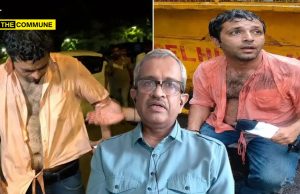
NIA Chargesheets Bihar Labourer Mohammed Akhlaque Working In Tamil Nadu For Lashkar-e-Taiba Links, Was Allegedly Planning Attacks In Tamil Nadu And J&K

The National Investigation Agency (NIA) has filed a chargesheet against a migrant labourer from Bihar for allegedly supporting the banned terror group Lashkar-e-Taiba (LeT) and conspiring to carry out attacks in Jammu & Kashmir and Tamil Nadu.

The accused, identified as Akhalatur alias Mohammed Akhlaque Mujahid, is a resident of Katihar district in Bihar. Officials said he had been working as a daily wage worker at a private construction site in Chengalpattu, Tamil Nadu, when he was apprehended.

According to the NIA, Akhalatur was in touch with LeT handlers based in Pakistan through online platforms. Investigators allege that he shared radical content, discussed plans to attack “Kafirs” (non-believers), and tried to spread extremist ideology among local residents in Tamil Nadu. The agency claims he was “actively conspiring to execute Jihadi-style terror attacks” aimed at destabilising peace in India.

The accused has been booked under Sections 196 and 197 of the Bharatiya Nyaya Sanhita (BNS) and Sections 13(1)(b) and 39 of the Unlawful Activities (Prevention) Act (UAPA).

The investigation further revealed that Akhalatur attempted to contact arms dealers in order to procure weapons for the planned strikes. According to the NIA’s statement, “The accused was in touch with Pakistan-based LeT handlers through cyberspace and conspired with them to target Kafirs in Tamil Nadu.”

Akhalatur was initially arrested by Kayar Police in April this year following intelligence inputs about his involvement in anti-national activities. Given the suspected terror links, the case was subsequently transferred to the NIA for detailed investigation.

Before he could act on his alleged plans, security forces intercepted his communications and foiled the conspiracy, leading to his arrest. The NIA has said that further investigation is underway to trace possible associates and funding channels connected to the network.

(Source: News18)

Subscribe to our channels on Telegram, WhatsApp, and Instagram and get the best stories of the day delivered to you personally.

Karur Stampede Case: Burnt Documents, 32GB Pendrive Found Near SIT Office

Karur Stampede Case Burnt Documents, 32GB Pendrive Found Near SIT Office

The Karur stampede case, which claimed 41 lives during a Tamil Nadu Victory Party (TVK) public meeting led by actor Vijay in Velchamipuram on September 27, has resurfaced in political controversy following the discovery of burnt documents and a 32GB pendrive near the temporary office of the Special Investigation Team (SIT). The SIT, formed to investigate the incident, was dissolved after the Supreme Court verdict, and the documents were reportedly found outside the vacated office premises.

TVK leaders have accused the ruling party of orchestrating a deliberate conspiracy to block Vijay’s political entry, claiming the government failed to prevent the stampede despite prior knowledge and allegedly acted to facilitate the tragedy.

The Tamil Nadu government and police have rejected these allegations, stating that the stampede was caused by overcrowding and the late arrival of the leader. Government sources emphasized that it is routine for SIT offices to burn unnecessary documents when vacated and denied any malicious intent.

The discovery has also raised procedural questions. Opposition parties have highlighted the speed of the autopsies conducted at Karur government hospital, where only two tables were available, yet 39 bodies were reportedly examined in four hours, averaging roughly 12 minutes per postmortem.

The case has intensified political scrutiny in Tamil Nadu, with all parties closely monitoring the handover of documents to the CBI, which is now investigating the stampede. Analysts note that the focus will now shift to the contents of the 32GB pendrive and whether the burnt papers contained key evidence. The incident has reignited debates over political accountability, investigative transparency, and procedural irregularities, making the Karur case a flashpoint in the state’s political landscape.

Following the state government’s decision to transfer the case to the Central Bureau of Investigation (CBI), officials from the agency visited Karur earlier today to conduct further inquiries. Shortly after their arrival, the discovery of charred documents and the pen drive near the SIT office created a stir. Authorities are examining whether the materials are connected to the ongoing investigation.

(Source: Tamizhakam)

Subscribe to our channels on TelegramWhatsApp, and Instagram and get the best stories of the day delivered to you personally.

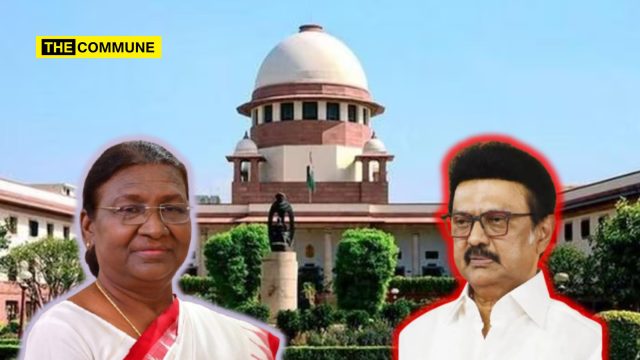
Supreme Court Defers TN Govt’s Plea Against Governor’s Decision To Reserve Bills For President

supreme court tn govt stalin dmk presidential reference appeal bill assent

The Supreme Court on Friday, 17 October 2025, deferred the hearing of the writ petition filed by the Government of Tamil Nadu challenging the Governor’s decision to reserve two state Bills — the Kalaignar University Bill, 2025, and the Sports University Bill — for the consideration of the President of India.

The bench comprising Chief Justice of India B. R. Gavai and Justice K. Vinod Chandran suggested that the State government wait for the outcome of the Presidential Reference currently pending before a Constitution Bench. The reference concerns the timelines for granting assent to Bills by the President and Governors under Articles 200 and 201 of the Constitution.

CJI Gavai observed, “You have to wait hardly for 4 weeks, the reference has to be decided before 21st (November),” while addressing Senior Advocate Dr. A. M. Singhvi, who was appearing for Tamil Nadu. The Chief Justice is scheduled to retire on 23 November 2025.

State Challenges Governor’s Action

The Tamil Nadu government filed the writ petition questioning the Governor’s decision to withhold assent to two state Bills and refer them to the President of India.

The first, the Kalaignar University Bill, 2025, seeks to establish a university that would designate Chief Minister MK Stalin as its first Vice-Chancellor. The second, the Sports University Bill, proposes to amend the Tamil Nadu Physical Education and Sports University Act, empowering the state government to appoint or remove vice-chancellors.

Senior Advocates Dr. A. M. Singhvi and Mukul Rohatgi appeared on behalf of Tamil Nadu, with AOR Misha Rohatgi assisting in filing the plea.

“Governor Cannot Act Like a Judge”

Arguing for the State, Dr. Singhvi contended that the Governor had no authority to assess the contents of a Bill as if adjudicating it judicially. He submitted, “He (the Governor) cannot refer to the President, the issue of repugnancy.”

Supporting this, Rohatgi remarked, “The question today is, can the Governor examine every clause like a judge and say — it’s repugnant?”

Centre Defends Governor’s Authority

Solicitor General Tushar Mehta, appearing for the Union Government, defended the Governor’s role, asserting that the act of examining Bills and referring them to the President formed part of the Governor’s constitutional duty.

He pointed out that between 2015 and 2025, Governors across India had made 381 references to the President of India. He cautioned that if every such reference were to be challenged, it would overwhelm the judiciary.

“If this is to be justiciable, my lords will have two separate benches permanently for deciding,” he submitted.

Responding to the State’s arguments, Mehta said, “The Governor (position) is doing it since independence; that is his job.”

Linked to Pending Constitutional Clarification

The present case is closely tied to the pending Presidential Reference before a five-judge Constitution Bench led by the Chief Justice of India. The reference seeks the Court’s opinion on the scope of Articles 200 and 201, following a two-judge bench’s judgment in the Tamil Nadu Governor case, which had set timelines for constitutional authorities to act on Bills.

That opinion was reserved on 11 September 2025, and the Supreme Court indicated that it expects a decision by 21 November 2025, before the Chief Justice’s retirement.

Until then, the Tamil Nadu government’s plea will remain pending, as the Court signaled that the outcome of the Presidential Reference will directly affect the present petition.

(Source: LiveLaw)

Subscribe to our channels on TelegramWhatsApp, and Instagram and get the best stories of the day delivered to you personally.

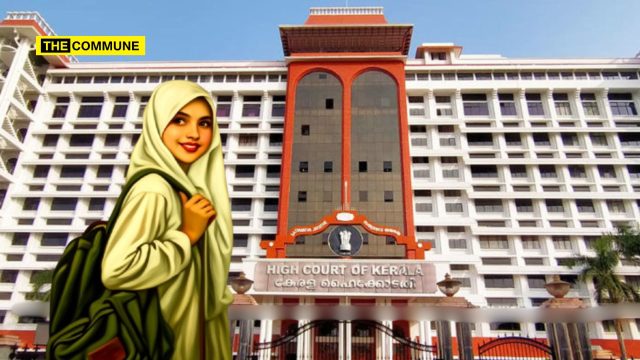
Kerala High Court Refuses To Halt DDE’s Directive Allowing Muslim Girl To Wear Hijab In Class

Kerala High Court Refuses To Halt DDE’s Directive Allowing Muslim Girl To Wear Headscarf In Class

The Kerala High Court on Friday refused to grant an interim stay on a directive issued by the Deputy Director of Education (DDE), Ernakulam, which instructed St. Rita’s Public School, a Christian minority institution affiliated with the Central Board of Secondary Education (CBSE), to permit a Muslim girl student to wear a headscarf in class.

Justice V. G. Arun directed the State Attorney to obtain instructions on the matter, observing that no coercive steps could be taken against the school since it functions under the CBSE. “You know nothing could be done. I am not passing an interim order for the sake of passing one. Let the State Attorney get instructions,” the judge remarked while declining to issue a stay at this stage.

The counsel appearing for the petitioner-school had strongly pressed for an interim order to stay the DDE’s directive, arguing that the instruction interfered with the school’s established dress code and internal regulations.

The school, in its petition, contended that the Government of Kerala has not enacted any legislation permitting the wearing of religious attire in educational institutions. It argued that compelling the school to allow deviations from its uniform policy would undermine the secular and inclusive character of the institution.

According to the petition, officers of the Kerala Education Department, including the DDE, acted beyond their jurisdiction in issuing the order, since St. Rita’s Public School is an unaided minority institution under the administrative purview of the CBSE. The management asserted that state education officers have no authority over CBSE-affiliated schools and that such directives interfere with the autonomy of private minority institutions.

The petitioner also relied on the 2018 Kerala High Court judgment in Fathima Thasneem & Another v. State of Kerala, which held that individual rights cannot override institutional discipline in matters relating to uniforms.

The school further noted that it had earlier approached the High Court seeking police protection for its management, staff, and students after receiving threats and facing mob intrusion over its uniform policy. The High Court had granted protection in that earlier plea.

In the present writ petition, the school has sought the quashing of the DDE’s order, a declaration that the state education authorities lack jurisdiction over CBSE-affiliated schools, and an interim injunction restraining any coercive action against the institution.

Justice Arun posted the matter for further hearing after the State Attorney furnishes instructions on behalf of the government.

(Source: LiveLaw)

Subscribe to our channels on TelegramWhatsApp, and Instagram and get the best stories of the day delivered to you personally.

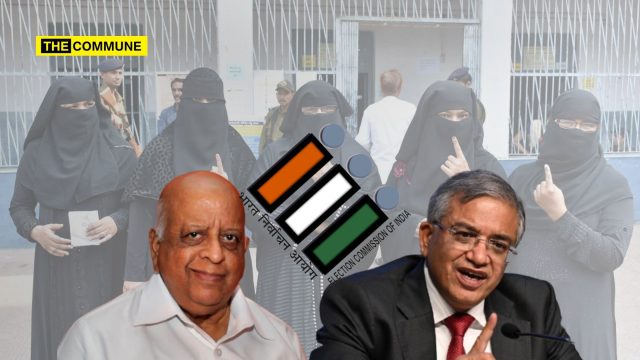
Verification Of Burqa-Clad/Purdah Women For Voting: What TN Seshan Suggested As Chief Election Commissioner, Gyanesh Kumar Is Implementing

A directive from the Election Commission of India (ECI) concerning the identification of burqa-clad women at polling stations has become a flashpoint in Bihar’s political discourse, with the ruling alliance and opposition parties offering sharply contrasting interpretations of the measure.

The instructions to polling officials, which mandate proper verification of purdahnasheen (veiled) women voters to prevent impersonation, have been strongly criticized by the opposition RJD-Congress alliance. Leaders have labeled the move “undemocratic,” arguing it singles out a specific community.

A Long-Standing Provision, Not a New Rule

Contrary to claims that the directive is novel, historical records show the ECI has been concerned with this specific aspect of the electoral process for decades. The current debate echoes a 1994 directive issued by the Election Commission under then Chief Election Commissioner T. N. Seshan.

In Order No. 576/11/ESO24/94-J.S.II, dated 21 October 1994, the Commission recognised that in certain regions, particularly among purdahnasheen women, social and religious customs limited female voter turnout.

Citing Articles 325 and 326 of the Constitution, which guarantee equal voting rights regardless of religion, caste, or sex, the order called for special arrangements to ensure that purdah-observing women could exercise their franchise without hesitation.

It directed that:

Lady polling officers must be appointed in areas with significant numbers of purdah-observing women.

Private enclosures or curtained spaces be set up inside polling stations for discreet voter identification.

Separate queues and facilities be provided to maintain privacy and respect religious sensitivities.

Despite these detailed provisions, election observers acknowledge that implementation has remained patchy over the decades. Many polling stations still lack designated spaces or female staff for secure identification, forcing ad hoc arrangements that vary from state to state.

Officials argue that impersonation and fake voting can undermine democratic credibility, but critics contend that such measures “risk alienating sections of women voters” by creating discomfort or distrust in the process.

Integrity vs. Vote Bank Politics

The vehement opposition from the RJD and Congress is more about protecting a political strategy. The procedure itself is designed to be respectful and private, using female officials to facilitate voting, not prevent it. The core of the issue is not the burqa itself, but the fundamental principle that every voter must be verified to prevent a single person from voting multiple times while disguised.

The opposition’s meltdown suggests that their concern lies not with the dignity of voters, but with the integrity of the voter roll. By opposing a basic anti-fraud measure that has been on the books for 30 years, the RJD and Congress are signaling that their electoral calculations rely on a system where verification is not fully enforced. The controversy has little to do with culture and everything to do with a political ecosystem that has historically benefited from blurred lines in electoral accountability. The ECI’s move simply enforces a rule that should be beyond debate: that every legitimate vote must be protected, and every voter must be who they say they are.

Subscribe to our channels on TelegramWhatsApp, and Instagram and get the best stories of the day delivered to you personally.

Monsoon Arrives In Chennai, City’s Infrastructure Ill-Prepared For Heavy Rains

The northeast monsoon has officially arrived in Tamil Nadu, bringing heavy rainfall and relief from the sweltering heat after weeks of anticipation. The Regional Meteorological Centre (RMC) in Chennai confirmed the onset on Thursday, with widespread showers reported across Chennai and neighboring districts, signalling the start of the state’s critical rain-bearing season.

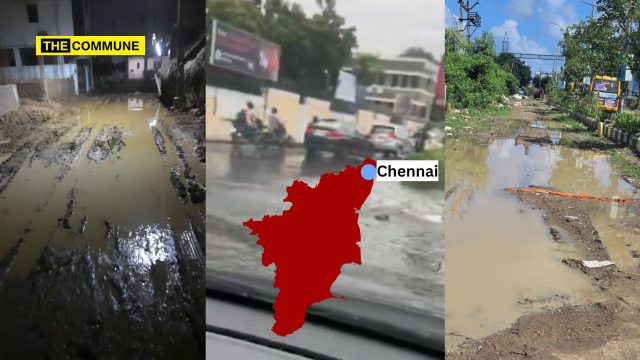
While the rains are welcome, Chennai’s infrastructure remains inadequately prepared to handle the sudden deluge. Reports indicate that several low-lying areas still suffer from poor drainage, inefficient stormwater systems, and recurring waterlogging issues apart from the pathetic condition of the roads. Last year’s monsoon exposed vulnerabilities in city planning, and despite warnings from meteorological authorities, authorities have yet to implement comprehensive flood mitigation measures. Residents fear that without urgent action, the heavy showers may lead to localized flooding, traffic disruptions, and strain on emergency services.

Social media images and videos from across the city show waterlogged roads, clogged drains, and significant traffic snarls. Key areas such as OMR, Radial Road, and parts of South Chennai, including Perumbakkam and Pallikaranai, have already begun experiencing flooding after brief showers. Citizens have highlighted that incomplete drainage systems and poorly maintained roads are exacerbating the impact of rainfall, creating hazards for commuters and disrupting everyday life.

Here is a look at the condition of various parts of the city as rains hit the region:

(Source: Times Now)

Subscribe to our channels on Telegram, WhatsApp, and Instagram and get the best stories of the day delivered to you personally.

Congress ‘Gen Z Rap’ Campaign Against Modi Govt Was Paid Congress Campaign, OpIndia Investigation Reveals

A rap song promoted by the Congress IT Cell as an expression of “Gen Z anger” against the Modi government has been revealed to be part of a Congress-sponsored paid campaign, according to an investigation by OpIndia. The viral rap song, performed by a struggling artist, portrays anti-government rhetoric and has been circulated widely on social media as the voice of India’s youth.

The video, shared by X user Ankit Mayank, who identifies himself as Rahul Gandhi’s “Babbar Sher,” described the song as: “So, Gen Z in India is now using music to expose and speak out against the fascist regime. Fiery rap song, must share. Interesting times are ahead.”

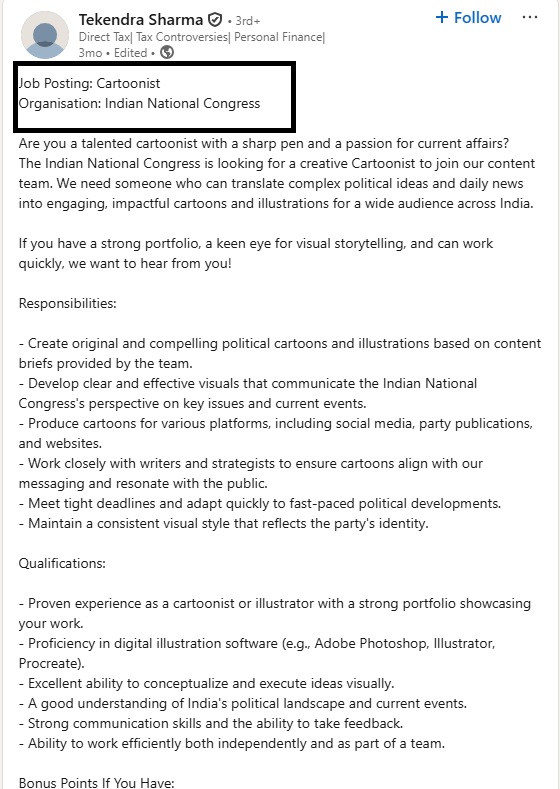
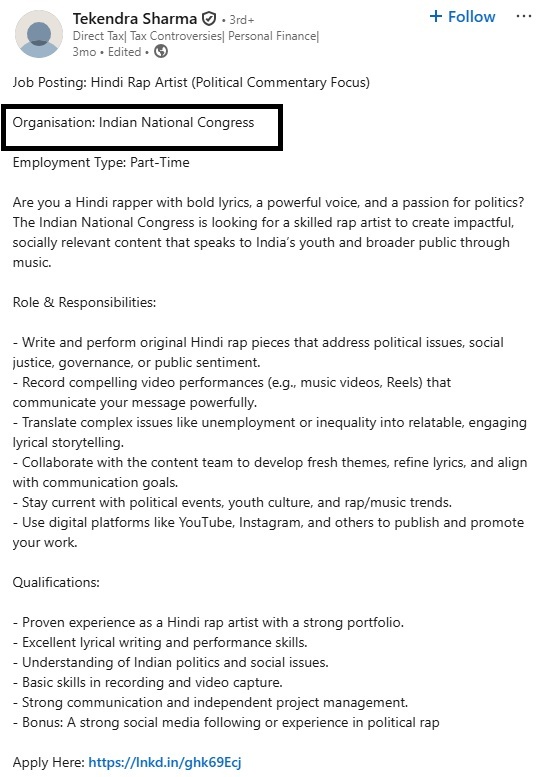
OpIndia’s investigation uncovered that the Congress party has been actively hiring rap songwriters, cartoonists, and influencers, including those in the food and travel niche, for the past three months to produce content critical of the government. The recruitment posts were published on LinkedIn by Tekendra Sharma, who confirmed to OpIndia that he was shortlisting candidates for Congress but is not a member of the party himself. Sharma admitted, “My job is to shortlist CVs and send them to the Congress party,” indicating the positions were directly created to generate anti-government content.

Tekendra Sharma LinkedIn

OpIndia attempted to contact Congress media chief Jairam Ramesh and spokesperson Pawan Khera for clarification regarding the recruitment and the nature of the campaign. More than 24 hours later, no response had been received. The rapper who produced the song remains unreachable.

Following the recruitment of rap songwriters, Congress’s YouTube channel has increasingly uploaded rap songs targeting a variety of issues, including PM Modi’s relationship with former US President Donald Trump.

One such song has gone viral for mocking the Prime Minister and highlighting alleged government failures. Another song, titled “वोट चोर, गद्दी छोड़” (Vote Thief, Leave the Throne), portrays Rahul Gandhi as a leader with a spotless image, reiterates claims of vote theft, and questions the Election Commission’s findings.

According to OpIndia, these examples suggest that Congress hired artists and content creators to produce and distribute anti-government messaging under the guise of authentic Gen Z expression. The outlet noted this is part of a broader pattern of Congress-sponsored social media campaigns, citing a previous “vote theft” campaign in which influencers were paid between ₹20,000 and ₹30,000 to create content amplifying Rahul Gandhi’s claims. Many participants later apologized after the orchestrated nature of the campaign was revealed.

OpIndia concluded that the so-called Gen Z anger showcased in these rap songs is largely manufactured and part of a paid effort by Congress to influence social media narratives, rather than an organic expression of youth sentiment.

(Source: OpIndia)

Subscribe to our channels on Telegram, WhatsApp, and Instagram and get the best stories of the day delivered to you personally.
Karnataka Congress ‘UNESCO Mandram Award’ Moment? The Reality Of CM Siddaramaiah’s London Book Of World Records Claim

Karnataka Congress' 'UNESCO Mandram Award' Moment - CM Siddaramaiah Claims State Won 'Historic World Records'

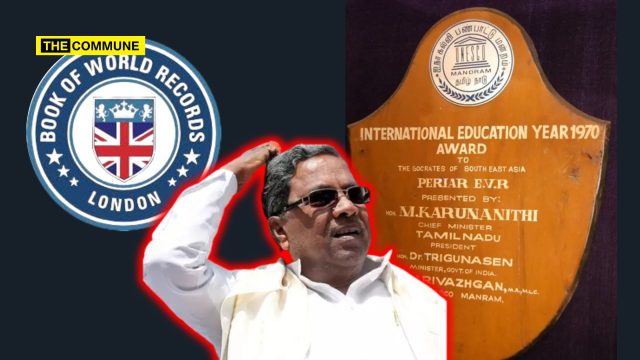
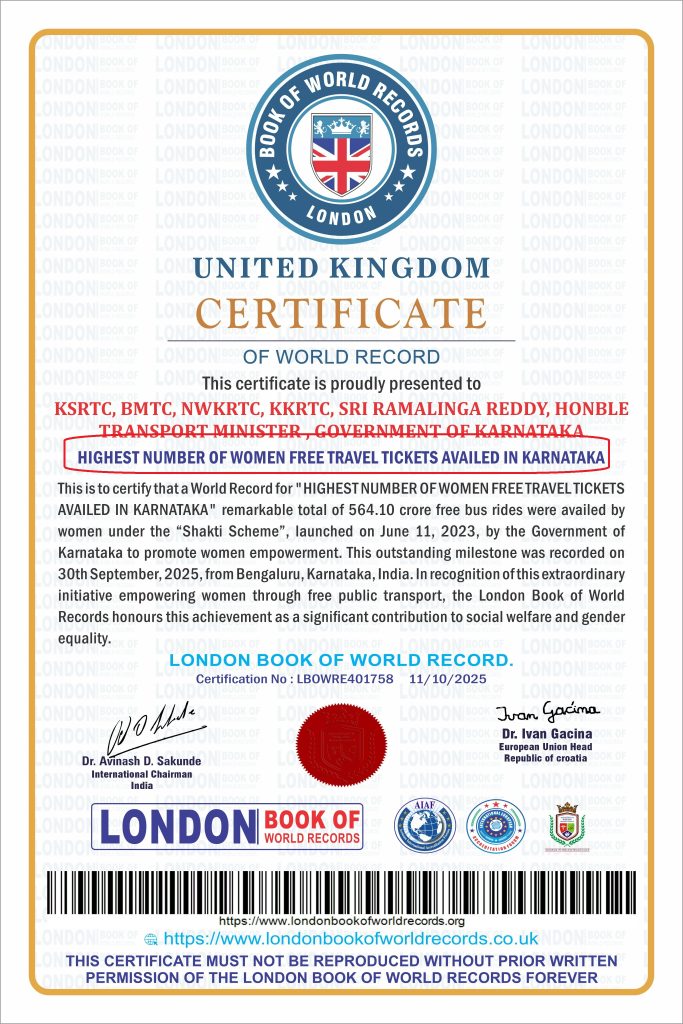
A social media post by Karnataka Chief Minister Siddaramaiah celebrating two world records for the state has sparked controversy, with critics questioning the authenticity of the recognition. The Chief Minister had announced that Karnataka had entered the global stage with two historic achievements certified by the London Book of World Records — one for the Shakti Scheme marking 564.10 crore free bus rides availed by women, and another for the KSRTC as the most award-winning road transport corporation with 464 honours since 1997.

In his post, Siddaramaiah said these recognitions symbolised social justice, women’s empowerment, and inclusive governance. However, critics have claimed the awards are not internationally recognised and that the London Book of World Records is not a legitimate global institution. He wrote, “Karnataka enters the global stage with two historic world records – certified by the London Book of World Records. Shakti Scheme: Largest number of free bus rides availed by women – 564.10 crore journeys, empowering everyday mobility. KSRTC: Most award-winning road transport corporation in the world – 464 national & international honours since 1997. Our governance vision is rooted in social justice, women’s empowerment, and world-class public service. These recognitions are a reflection of what inclusive and compassionate policymaking can achieve.”

Was It A Real Award?

What is interesting in the organisation’s website is that it lists several purchasable “award packages,” ranging from ₹4,000 to ₹10,000, with certificates, medals, trophies, and optional news video releases. The listings also specify that payments are accepted only through online banking, further raising questions about the legitimacy of the awards.

Critics also noted that the certificate wording reads “in Karnataka” rather than “in the world,” suggesting that the award’s claim to world-record status is misleading.

Fact-checkers and political opponents alleged that the company behind the awards was dissolved in the United Kingdom and now operates from India.

Reminds One Of The ‘UNESCO Award’ Claim for EVR

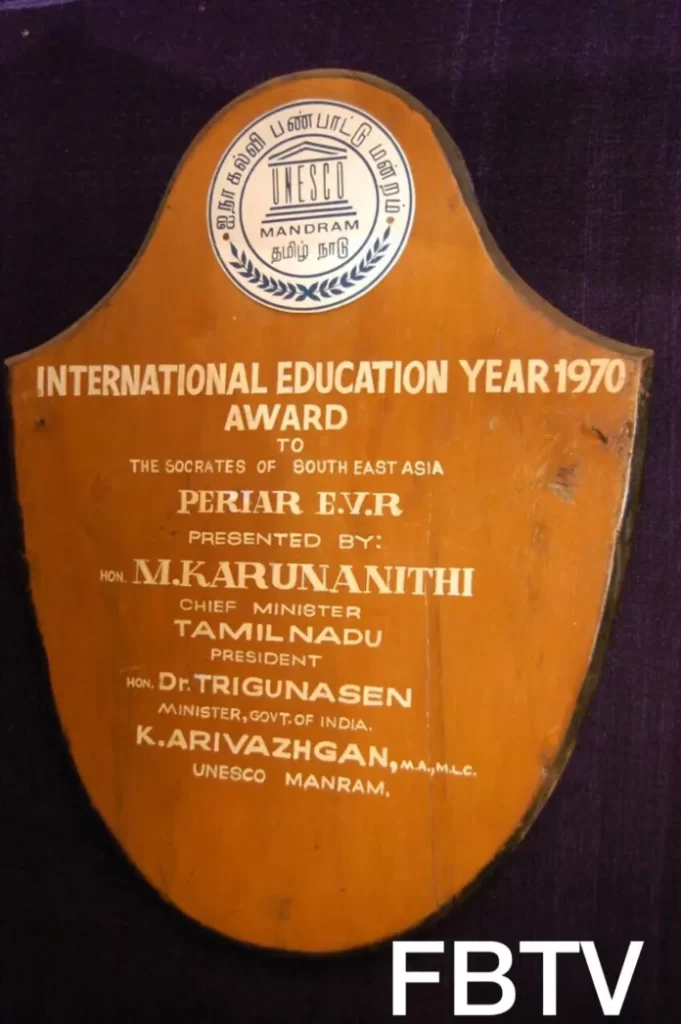
Observers have compared the Karnataka government’s “London Book of World Records” episode with an earlier controversy from Tamil Nadu surrounding the so-called “UNESCO Award” given to social reformer E.V. Ramasamy (Periyar). For decades, it was widely propagated in Tamil Nadu that Periyar was conferred the title “Socrates of South-East Asia” by UNESCO, a claim repeated in school textbooks and public service exam materials.

However, an official email clarification from UNESCO’s Delhi office confirmed that no such award or title was ever given to E.V. Ramasamy. The award was, in fact, presented by late DMK leader M. Karunanidhi in the presence of Dravidar Kazhagam president K. Veeramani, and not by UNESCO.

Critics pointed out that even the fabricated award title contained geographical inaccuracies, as India falls under South Asia and not the South-East Asia region referenced in the award.

Both allies – the DMK and the Congress have been building narratives around unverifiable or misleading accolades to bolster ideological or governance claims – the London Book of World Records recognition claimed by the Karnataka government and the UNESCO award myth associated with Periyar are perfect examples.

Subscribe to our channels on TelegramWhatsApp, and Instagram and get the best stories of the day delivered to you personally.
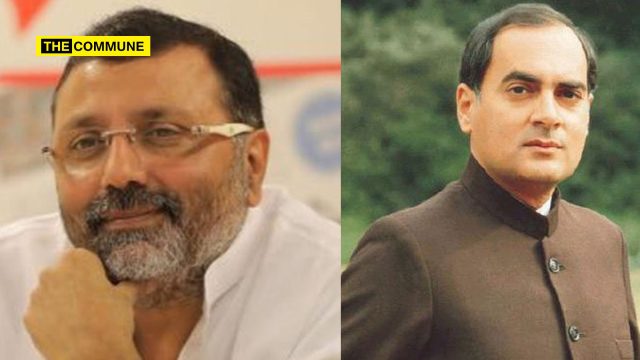
BJP MP Nishikant Dubey Alleges Rajiv Gandhi Acted As Swedish Defence Firm’s Agent In 1970s

BJP MP Nishikant Dubey Alleges Rajiv Gandhi Acted As Swedish Defence Firm’s Agent In 1970s

Bharatiya Janata Party (BJP) MP Nishikant Dubey on Friday, 17 October 2025, levelled a series of allegations against former Prime Ministers Rajiv Gandhi and Indira Gandhi, claiming that Rajiv Gandhi acted as a “middleman” for a Swedish defence company in the 1970s. Citing old diplomatic communications and reports published by WikiLeaks in 2013, Dubey alleged that Rajiv Gandhi was involved in brokerage for the Saab-Scania company, which was seeking to sell Viggen fighter jets to India during that period.

In a post shared on social media platform X on 17 October 2025, Dubey wrote, “Rahul Gandhi ji’s father, former Prime Minister Rajiv Gandhi ji, was an agent of a Swedish military company, meaning he was involved in brokerage in the 70s?”

He had raised this back in July 2025 as well. Dubey alleged that then-Prime Minister Indira Gandhi was guilty of “excessive interference” in defence procurements. He said WikiLeaks cables and related reports had made such claims public in 2013, during the Congress-led UPA government, but no action was taken. He claimed the revelation originated from a 1975 communication between a Swedish diplomat and the American government. According to Dubey, the diplomat had informed the US that Saab-Scania was trying to secure the deal with India through Rajiv Gandhi, who at the time was a pilot and not yet active in politics.

In his post on 4 July 2025, he wrote, “In 2013, WikiLeaks made shocking revelations about former Prime Minister Rajiv Gandhi Ji and Indira Gandhi Ji.

1. On October 21, 1975, a Swedish diplomat informed the US government that the Saab-Scania company wanted to sell Viggen fighter aircraft in India, and then-Prime Minister Indira Ji’s pilot son Rajiv Gandhi Ji was acting as a middleman in this?

2. Then-Prime Minister Indira Ji was interfering excessively in defense deals?

3. This came to light when the Congress government was in power at the center, Manmohan Singh Ji was the country’s Prime Minister—why didn’t the then-Indian government take action against the US government or the Swedish governments?

I wish?”

Continuing his attack then on the Congress leadership, Dubey cited declassified records from the CIA and the Mitrokhin Archive, alleging that during the Cold War era, the Gandhi family had allowed the Soviet Union to exert significant influence in Indian politics. He claimed that under the leadership of the late Congress minister H. K. L. Bhagat, more than 150 Congress MPs were “funded by the Soviet Union,” while Congress candidate Subhadra Joshi allegedly received ₹5 lakh from the German government between 1977 and 1980.

According to Dubey, the US Ambassador Daniel Patrick Moynihan had mentioned in his writings that money had been given to Indira Gandhi twice. He also referred to a 1979 discussion in the Rajya Sabha, which he said concerned the same issue. Dubey alleged that a phone conversation between President Richard Nixon and Secretary of State Henry Kissinger also discussed how funding could be used to “manage” the Indian government.

“The diaries of CIA and Mitrokhin mention that under the leadership of H. K. L. Bhagat, more than 150 Congress MPs were funded by the Soviet Union. It also mentions that a total of 16,000 news articles were published by Russia according to their wish. If you look at it, it seems that our country was sold to Soviet Russia under the leadership of the Gandhi family,” Dubey told ANI.

The BJP MP added that he intends to continue raising the issue publicly, arguing that these historical records demonstrate how the Gandhi family allegedly “compromised national interests” for political and financial gain.

(Source: Economic Times)

Subscribe to our channels on TelegramWhatsApp, and Instagram and get the best stories of the day delivered to you personally.
Supreme Court Declines To Act On Contempt Plea In CJI Shoe Incident, Says ‘Let It Die A Natural Death’

contempt plea supreme court shoe cji

The Supreme Court on Thursday (16 October 2025) declined to act immediately on a request to initiate criminal contempt proceedings against advocate Rakesh Kishore, who allegedly threw a shoe at Chief Justice of India (CJI) B. R. Gavai earlier this month. Despite the Attorney General’s consent for contempt action, a bench of Justices Surya Kant and Joymalya Bagchi said the court preferred to “let the incident die a natural death” rather than fuel further public outrage and social media debate.

The matter came up when Supreme Court Bar Association (SCBA) President and Senior Advocate Vikas Singh informed the bench that Attorney General R. Venkataramani had granted approval to initiate contempt proceedings. “I have taken the consent of the Attorney General and I am seeking a listing tomorrow,” Singh said.

Supporting the move, Solicitor General Tushar Mehta told the court, “Learned Attorney General has given consent. I would also join my learned friend and request your Lordships to take up the contempt. It is constitutional integrity which is under question.”

CJI Gavai’s Calm Response

The incident took place on 6 October 2025 in Court Hall 1 of the Supreme Court, when Kishore allegedly hurled a shoe at the CJI while proceedings were underway. CJI Gavai remained calm, asked the lawyers present to continue with the day’s cases, and refrained from reacting to the disruption. Kishore was reportedly upset over remarks made by the CJI during a hearing on a plea seeking restoration of a Vishnu idol in Khajuraho.

Following the incident, the SCBA removed Kishore from its rolls, while the Bar Council of India suspended his licence to practice pending further action.

Bench Cites CJI’s Magnanimity

On Thursday, Vikas Singh said that discussions about the incident were still circulating on social media, adding that Kishore had claimed to feel remorse. The Solicitor General said that “some people are glorifying the incident,” and urged the court to intervene to protect the institution’s dignity.

However, Justice Surya Kant observed, “Hon’ble CJI has been extremely magnanimous… That shows the institution is not affected by these kinds of incidents.”

Mehta agreed that the CJI’s conduct reflected “a gesture of majesty” but reiterated his concern that “people using social media to justify the act was concerning. It is a matter of institutional integrity.”

Vikas Singh also suggested the court consider issuing a John Doe order, an injunction against unidentified individuals, to curb the glorification of the act online.

Justice Joymalya Bagchi, however, cautioned that such a step could worsen the situation. “A John Doe order will be the next cavalcade of events. It is because of our behaviour in court that we survive and we get the confidence from the people. The Hon’ble Chief Justice exhibited that spirit when he just washed it aside as an act of an irresponsible citizen. Should we now rake up an issue which, for our sake, is complete and finished?” he said.

‘A Waste of Judicial Time’

Justice Bagchi added that there were several important matters before the court and questioned whether reviving the issue would be a waste of judicial time. Singh clarified that he only sought a restraint on the glorification of the act.

Justice Kant remarked, “What my brother is pointing out — and you will also appreciate — is that the moment you (raise it), the media story will continue.”

Justice Bagchi added humorously, “Unfortunately, we have become money-spinning ventures…”

Agreeing, Solicitor General Mehta said, “Social media platforms work on algorithms. People are addicted to them. And these platforms monetise that addiction. We feel we are using social media, but in fact, we are the products.”

Justice Kant responded, “We are the product and the consumer both.”

Justice Bagchi elaborated on the influence of algorithms, saying, “The algorithms are so programmed that things which pertain to the baser instincts of individuals like hate, lust, anger etc… what happens is when this sort of a comment is made and repeated, you will find the number of hits are more. And the algorithm in the social media platform is to promote it so that as soon as you access that platform it will be up on your screen. In these situations, we assure you that your mentioning today is going to be monetised… Please don’t operate to their monetisation. Allow it to have a natural death.”

‘The Bar Has Always Stood for the Institution’

Singh replied, “I understand. We waited for so long. It is only because of the angst of the Bar. It involves the majesty of the institution. If the institution does not have the respect…”

Justice Kant reassured him, saying, “The Bar has always stood for the institution because you are the bridge between the consumer of justice and the court. We understand your predicament, your sentiments.”

Singh requested the matter be listed on Friday, saying, “By then we will also introspect, and Your Lordships will also take a thought about it and may modulate the order accordingly.”

Justice Kant asked whether the issue should be listed the next day or after the Supreme Court’s Deepawali recess next week. Singh replied, “Let it be tomorrow. This is continuing. If something has to be done, it has to be done immediately.”

However, the bench decided to defer consideration until after the recess. “Let us see what will happen in a week. Are they still left with some saleable item!” Justice Kant remarked in a lighter tone.

Justice Bagchi added, “Maybe something new will come for the algorithm.”

To which Solicitor General Mehta concluded, “Yes, it has a shelf life of 24–48 hours, and then something else takes over.”

(Source: Indian Express)

Subscribe to our channels on Telegram, WhatsApp, and Instagram and get the best stories of the day delivered to you personally.