Home Blog Page 217

From Dhurandhar To Gangs Of Wasseypur: 10 Indian Films Banned In Gulf Countries Over ‘Political’ And ‘Religious’ Sensitivities

The film Dhurandhar was released in India and international theatres on 5 December 2025. However, film certification boards in several Gulf countries such as Bahrain, Kuwait, Oman, Qatar, Saudi Arabia and the UAE refused to permit its release, citing alleged anti-Pakistan content and sensitive geopolitical themes.

This report examines ten major Indian films between 2012 and 2025 that were banned in Gulf countries on grounds of Islam-related, religious, or broader social sensitivities.

#1 ‘Dhurandhar’ Banned Over Alleged Anti-Pakistan Content – 11 December 2025

Region: UAE, Saudi Arabia, Qatar, Kuwait, Oman, Bahrain

The film Dhurandhar, released on 5 December 2025, was denied theatrical release across several Gulf countries after certification boards objected to its alleged anti-Pakistan content and sensitive geopolitical themes. Authorities cited concerns that the film could disrupt social harmony, given the large Pakistani and South Asian expatriate population in the region. When the film’s makers approached the censor boards, extensive cuts were reportedly demanded. The team declined, stating the edits would compromise the film’s narrative. As a result, the film was not cleared for release in the Gulf despite its international rollout.

#2 ‘Sky Force’ Barred in Multiple Gulf States – 24 January 2025

Region: UAE, Saudi Arabia, Qatar, Oman, Kuwait

The Akshay Kumar–Veer Pahariya starrer Sky Force was banned in several Gulf countries over its depiction of conflict involving Pakistan. Certification authorities reportedly objected to the film’s portrayal of India–Pakistan military tensions, deeming it politically sensitive. The film, which centred on aerial combat and cross-border hostilities, was not granted theatrical permission in the region. Officials cited the potential for diplomatic and social sensitivities, particularly among expatriate communities, as the reason for refusing certification.

#3 ‘Fighter’ Blocked Over India-Pakistan and IAF Content – 26 January 2024

Region: Saudi Arabia, Kuwait, Qatar, Oman, Bahrain, UAE

Hrithik Roshan and Deepika Padukone-starrer Fighter was denied certification in five Gulf countries less than 24 hours before its scheduled release. Authorities cited politically sensitive content linked to the Indian Air Force and India–Pakistan relations. In the UAE, the film initially received a PG-15 rating but was withdrawn from cinemas the following day. Censor boards stated that the subject matter could trigger political or social tensions among diverse national communities living in the region.

#4 ‘Article 370’ Banned Across Gulf Countries – 26 February 2024

Region: Iraq, Kuwait, Bahrain, Oman, Qatar, UAE

The film Article 370 was banned by Gulf censor authorities due to its focus on the abrogation of Article 370 in Jammu and Kashmir. The boards classified the film as politically sensitive and controversial, citing concerns over its depiction of constitutional and security issues related to Kashmir. As a result, theatrical release permission was denied across several Gulf states, despite the film’s release in India.

#5 ‘Tiger 3’ Restricted Over Portrayal of Muslim Characters – November 2023

Region: Kuwait, Oman, Qatar

Salman Khan and Katrina Kaif-starrer Tiger 3 was banned in Kuwait, Oman and Qatar over allegations that the film portrayed Muslim characters negatively. Authorities raised objections to certain characters and plot elements involving terrorism and geopolitics. The presence of a Muslim antagonist, played by Emraan Hashmi as the leader of a global terror organisation, was cited as a contributing factor. The countries said the content could be politically and religiously sensitive.

#6 ‘Kaathal – The Core’ Blocked Over Homosexuality Theme – 21 November 2023

Region: Saudi Arabia, Kuwait, Qatar

The Malayalam film Kaathal – The Core, which explores a homosexual relationship, was denied release in Saudi Arabia, Kuwait and Qatar. Censor authorities said the film’s LGBTQ theme conflicted with cultural and social norms in those countries. Directed by Jeo Baby, the film was described as a romantic thriller examining personal relationships. Officials stated that the subject matter could challenge prevailing social sensitivities, leading to a complete ban on theatrical screening.

#7 Vijay’s ‘Beast’ Banned in Kuwait and Qatar – 5 April 2022

Region: Kuwait, Qatar

The Tamil film Beast, starring Vijay and directed by Nelson Dilipkumar, was banned in Kuwait and Qatar over its depiction of Islamic terrorism. The film centres on a former RAW agent rescuing hostages from terrorists inside a shopping mall. Authorities objected to what they described as the portrayal of Islamic characters as extremists. The decision triggered controversy and led to the film being barred from release in both countries.

#8 ‘Samrat Prithviraj’ Denied Release in Kuwait and Oman – 2 June 2022

Region: Kuwait, Oman

The historical film Samrat Prithviraj, starring Akshay Kumar, was banned in Kuwait and Oman ahead of its release. Certification boards cited concerns that the film, which depicts King Prithviraj Chauhan’s battles against Muhammad Ghori, could hurt Muslim sentiments. Authorities classified the content as religiously and politically sensitive and declined to permit its theatrical release.

#9 ‘Bell Bottom’ Banned Over Alleged Distortion of History – 23 August 2021

Region: Saudi Arabia, Kuwait, Qatar

Akshay Kumar-starrer Bell Bottom was banned in Saudi Arabia, Kuwait and Qatar. The film, based on a 1980s aircraft hijacking, was accused by censor boards of distorting historical facts and portraying Islam negatively. Authorities said the treatment of the hijacking incident was sensitive and controversial, leading to the denial of certification in the region.

#10 ‘Gangs of Wasseypur’ Banned in Kuwait and Qatar – 22 June 2012

Region: Kuwait, Qatar

Anurag Kashyap’s Gangs of Wasseypur was banned in Kuwait and Qatar due to alleged objectionable content involving Muslim characters, excessive violence and abusive language. The censor boards said the film contained material that could offend religious and cultural sensibilities. Kashyap publicly expressed surprise at the decision, questioning the lack of neutrality, and noted that the film continued to perform well in the UAE without complaints from distributors.

Subscribe to our channels on WhatsAppTelegram, Instagram and YouTube to get the best stories of the day delivered to you personally.
The Environmental And Safety Costs Of Christmas–New Year Celebrations Around The World

Christmas and New Year celebrations are widely portrayed as seasons of joy and festivity. However, behind the celebratory narrative, multiple incidents across the world have repeatedly highlighted serious public safety and environmental concerns. This report compiles seven major incidents linked to Christmas and New Year celebrations between 2021 and 2025, focusing on dangerous air pollution levels, waste accumulation, and health risks caused largely by fireworks, firecrackers, and associated activities.

#1 Makati Records Worst Air Quality on New Year’s Eve

On 2 January 2025, the Department of Environment and Natural Resources (DENR) reported that air pollution levels in Makati City, Metro Manila, reached their highest point during New Year’s Eve celebrations. According to the DENR, the widespread use of firecrackers and fireworks led to a sharp deterioration in air quality, pushing pollution levels into the “very unhealthy” category. Officials attributed the spike primarily to particulate matter released from fireworks.

#2 Hazardous Air Quality in Phoenix Valley After New Year

Air quality in the Phoenix metropolitan area, commonly referred to as the Valley, deteriorated to hazardous levels on New Year’s Day, 2 January 2025, according to local authorities. Officials reported elevated concentrations of fine particulate matter (PM2.5) following New Year celebrations. The pollution was attributed largely to fireworks, residential burning, vehicle emissions, and stagnant weather conditions that trapped pollutants close to the ground. Authorities warned residents of the health risks posed by the hazardous air quality, especially to vulnerable groups, as pollution levels remained elevated at the start of the new year.

#3 Jakarta Sees Surge in Waste After New Year Celebrations

Following the 2025 New Year’s Eve celebrations, the Jakarta Environmental Agency reported the collection of 132 tonnes of waste across the city. While the figure was lower than the initially predicted 150 tonnes, it still marked an increase of two tonnes compared to waste collected after the 2024 New Year’s Eve celebrations. The agency deployed approximately 3,900 cleaning personnel ahead of the festivities to manage the anticipated surge in waste.

#4 Fireworks Push Palos Verdes Air Quality Into ‘Unhealthy’ Range

On 31 December 2024, New Year’s Eve fireworks worsened air quality in the Palos Verdes Peninsula in California, according to the South Coast Air Quality Management District. Following the celebrations, particulate matter levels rose into the “unhealthy” range. Health experts issued advisories urging residents, particularly children, the elderly, and individuals with respiratory conditions, to limit outdoor activities while air quality remained poor.

#5 Fireworks Trigger Severe Pollution Spike Across Germany

On 3 January 2017, reports indicated that New Year’s Eve fireworks caused dangerously high pollution levels across several German cities. In Munich, particulate matter concentrations briefly surged to 1,346 micrograms per cubic metre, approximately 26 times higher than the European Union’s daily limit of 50 micrograms. National data showed that fireworks released nearly 4,000 tonnes of particulate matter during the celebrations, accounting for about 15% of Germany’s annual particulate emissions from vehicles.

#6 Munich Pollution Levels Soar Far Beyond EU Limits

In a related report dated 3 January 2017, Munich recorded particulate matter levels reaching 26 times the EU-recommended daily limit following New Year’s Eve fireworks. According to environmental reports, the celebrations ejected approximately 4,000 tonnes of particulate matter into the atmosphere, equivalent to about 15% of Germany’s annual vehicle-related particulate emissions. The spike was driven by intense fireworks displays across the city.

#7 Beijing Suffers Heavy Pollution During New Year Celebrations

Beijing experienced one of its worst New Year pollution episodes on 1 January 2017, as heavy smog engulfed China’s capital following New Year celebrations. Concentrations of hazardous particles were reported to be 20 times higher than acceptable levels. PM2.5 readings in many areas of Beijing, as well as parts of Tianjin and Hebei Province, exceeded 200 as early as the afternoon of 30 December 2016.

Last Word

These incidents collectively underline how Christmas and New Year celebrations have evolved into a global event of mass waste generation and environmental stress. What is marketed worldwide as a season of joy now routinely results in severe air pollution from fireworks, mountains of plastic and packaging waste, and short-term but intense public health risks across cities in Asia, Europe, and North America. The pattern is not confined to one country or culture; it is replicated annually wherever large-scale, consumer-driven celebrations take place. The data shows that modern Christmas festivities are no longer just cultural or religious observances, but industrial-scale events that leave behind polluted air, overburdened waste systems, and lasting environmental damage—raising serious questions about the sustainability of how the season is celebrated globally.

Subscribe to our channels on WhatsAppTelegram, Instagram and YouTube to get the best stories of the day delivered to you personally.
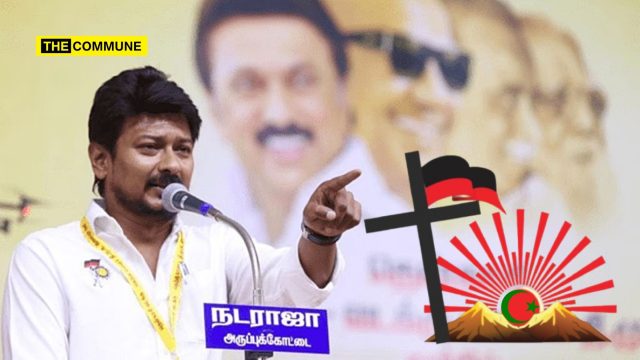
DMK’s Divisive Politics: Calls For ‘Eradicating Sanatana Dharma’ But Lists Crores-Worth Schemes For Christians And Muslims

A recent speech by DMK scion Udhayanidhi Stalin at a gathering organised by the party in line with Christmas celebrations, shed light on the range of welfare schemes and financial assistance programmes targeted at various minority communities, especially the Christian and the Muslims.

Let us take a look at all the schemes offered by the DMK government under the Dravidian Model of governance for these minorities.

Christian Community

Educational Scholarships and Student Support

Udhayanidhi Stalin stated in the speech that the state government has provided ₹7 crore in educational scholarships to around one lakh minority students, including Christians, over the past 4.5 years. However, existing documents do not establish this.

In addition, students from families of members of the Christian Priests and Church Employees Welfare Board receive ₹1,000 per month as educational assistance.

Pension and Welfare Board Benefits

The Christian Priests and Church Employees Welfare Board, established in 2022, offers a range of welfare benefits. Old-age pension is provided at ₹1,000 per month. The annual pension amount for church employees who are board members has been enhanced from ₹12,000 to ₹15,000, as mentioned by Udhayanidhi Stalin, however, there is no proof of this increment.

Assistance for natural death has been increased to ₹30,000 as claimed by Udhayanidhi Stalin, while compensation for accidental death goes up to ₹1,00,000. The claim of ₹30,000 is available to landless agricultural workers and not Christians specifically.

The board also provides:

  • Educational assistance for children of members (₹1,000–₹1,750 for school students and ₹1,500–₹8,000 for college students depending on the course),
  • Marriage assistance (₹3,000 for men and ₹5,000 for women),
  • Maternity assistance of ₹6,000 (₹1,000 per month for six months),
  • Funeral assistance of ₹5,000, and
  • Medical reimbursement of ₹500 for spectacles.

Pilgrimage and Religious Travel

Christian pilgrims are eligible for a ₹37,000 subsidy for pilgrimages to Jerusalem. Nuns and sisters receive enhanced assistance of ₹60,000. The scheme covers 600 pilgrims annually, with 50 seats reserved for nuns and sisters.

Institutional Recognition and Infrastructure

The government has granted permanent recognition to all minority educational institutions, including Christian institutions. Funding for church renovation has been substantially increased under revised guidelines:

  • Churches aged 10–15 years: ₹10 lakh (earlier ₹2 lakh),
  • Churches aged 15–20 years: ₹15 lakh (earlier ₹4 lakh),
  • Churches over 20 years old: ₹20 lakh (earlier ₹6 lakh).

Currently, 44 churches are undergoing renovation at an estimated cost of ₹3 crore.

Muslim Community

The Muslim community has been the recipient of several welfare measures of the Tamil Nadu government.

Educational Support

After the Union government discontinued pre-matric scholarships for classes 1–8 in 2022–23, the Tamil Nadu government stepped in to provide scholarships to Muslim girl students in classes 1–8 through the Tamil Nadu Waqf Board, benefiting around 1,26,256 students. Minority students are also eligible for educational loans up to ₹5 lakh through cooperative banks.

The Pudhumai Penn scheme, which provides ₹1,000 per month to support girls’ higher education, has been extended to government-aided minority schools, benefiting Muslim girls as well.

Ulema and Religious Worker Welfare Board

The Ulema and Religious Worker Welfare Board, established in 2009 and reconstituted in 2024, covers Aalims, Pesh-Imams, Arabic teachers, Mothinars, Bilals, Mujawars and other mosque and madrasa employees. The board has 14,696 registered members.

Benefits include:

  • Accident relief: ₹1,25,000 for death and ₹10,000–₹1,00,000 for disability,
  • Natural death assistance: ₹30,000,
  • Funeral expenses: ₹5,000,
  • Scholarships ranging from ₹1,000 to ₹8,000 depending on course level,
  • Marriage assistance: ₹3,000 for men and ₹5,000 for women,
  • Maternity assistance: ₹6,000 (₹1,000 per month for six months),
  • Old-age pension: ₹1,000 per month,
  • Two-wheeler subsidy of ₹25,000 or 50% of the cost, whichever is less.

For 2024–25, ₹78.76 lakh has been allocated to this board.

Ulema Pension Scheme

A separate pension scheme, in place since 1981, provides ₹3,000 per month (enhanced from ₹1,500) to retired Pesh-Imams, Mothinars, Arabic teachers and Mujawars aged 60 and above with 20 years of service, or aged 40 and above with 10 years of service in the case of differently abled beneficiaries. Around 1,461 Ulemas receive this pension, with a 2024–25 allocation of ₹540 lakh.

Pilgrimage Subsidy

For the Haj pilgrimage, the state government provides a ₹25,000 subsidy per first-time pilgrim. In 2025, ₹14.12 crore was allocated to support 5,650 first-time Haj pilgrims.

Muslim Women Aid Societies

The government supports 43 Muslim Women Aid Societies across districts, which assist destitute widows and elderly women. Matching grants of up to ₹20 lakh per society per year are provided. In 2023–24, ₹658.99 lakh was sanctioned for these societies.

Waqf Board and Property Rights

The government has granted 30-year lease permissions to the Waqf Board to promote educational, medical and social initiatives. A Waqf Tribunal has also been established in Madurai to handle disputes related to Waqf properties.

Hindu Community

The DMK government maintains that it has implemented various schemes for the Hindu majority, though these are structured differently from religion-specific minority schemes. The benefits are largely disbursed reportedly based on caste.

In its 2021 election manifesto, the DMK promised ₹1,000 crore for temple renovation. However, actual allocations have been significantly lower. For 2024–25, the state budget earmarked ₹100 crore for the renovation of ancient temples.

Pension/Wedding Benefits

Since assuming office, Chief Minister MK Stalin has rolled out a series of welfare and incentive schemes aimed at temple priests.

In September 2021, he launched an incentive scheme under which 12,959 archakas and bhattachariars were provided a monthly honorarium of ₹1,000.

In January 2022, the Chief Minister unveiled a further set of welfare measures, including marriage assistance with 8-gram gold coins for women and an enhanced pension for retired temple priests.

This was followed in January 2022 by the formal launch of the enhanced pension scheme, which was extended even to retired priests not under the control of the Hindu Religious and Charitable Endowments (HR&CE) Department, benefiting a total of 1,904 retired priests across the State.

In May 2022, the State government issued a standard operating procedure (SOP) for archakas, stating that 60% of the archanai ticket fare collected in temples administered by the HR&CE Department would be paid to priests performing archanai in Tamil, a move announced in the name of promoting Tamil in temple rituals.

Religious Tourism Fund

The 2021 manifesto also promised to support up to one lakh Hindu devotees annually with ₹25,000 per person for pilgrimages to major temples such as Rameswaram, Kasi, Kedarnath, Badrinath and Tirupati. The current status of implementation and disbursement figures for this scheme remain unclear.

The scheme has since been expanded to include Buddhist, Jain and Sikh pilgrims, who receive ₹10,000 each.

Together, these measures reflect the DMK government’s approach to welfare and financial assistance especially towards minority communities, with distinct schemes, allocations and implementation mechanisms tailored to the two main groups.

Subscribe to our channels on WhatsAppTelegram, Instagram and YouTube to get the best stories of the day delivered to you personally.
Red Economics, Red Alert: Communist Model Drives Kerala To The Brink As Mounting Debt Forces Centre To Cut State’s Borrowing

Centre Cuts Kerala’s Borrowing After State Nears Legal Debt Limit

The Union government has sharply reduced Kerala’s borrowing limit for the January–March quarter, triggering a political and financial dispute between the State and the Centre over fiscal discipline and development spending.

Kerala Finance Minister KN Balagopal said the Union finance ministry had cut the State’s borrowing permission by ₹5,944 crore, reducing it from the earlier approved ₹12,515 crore to ₹5,672 crore for the last three months of the financial year. This effectively limits Kerala’s monthly borrowing capacity to around ₹2,200 crore, which the State says is far below its operational needs.

Balagopal described the move as a major blow, especially at a time when the final quarter typically sees high government spending. He said Kerala requires nearly ₹20,000 crore to clear pending public works bills and around ₹15,000 crore to meet salary and pension commitments. He warned that welfare schemes, including recently enhanced social security pensions, could also be affected.

Centre’s Position: FRBM Rules Apply To All States

From the Centre’s perspective, the borrowing cut is linked to compliance with the Fiscal Responsibility and Budget Management (FRBM) Act, which caps a state’s net borrowing at 3% of its Gross State Domestic Product (GSDP). Open market borrowings are part of this overall ceiling.

Kerala’s GSDP is about ₹14.27 lakh crore, which allows a maximum annual borrowing of roughly ₹42,800 crore under FRBM norms. According to fiscal data, Kerala has already used or been approved borrowings close to this limit, leaving little room for additional market loans in the final quarter.

Kerala’s fiscal deficit is estimated at around 3.2% of GSDP, already above the FRBM benchmark, while its net borrowing level is close to 2.86% of GSDP, limiting further headroom under central rules.

The Centre has also included off-budget borrowings, such as loans raised by the Kerala Infrastructure Investment Fund Board (KIIFB) and Social Security Pension Ltd, while calculating the State’s borrowing capacity. This “netting out” approach, introduced earlier, has been strongly opposed by the Kerala government but is defended by the Centre as necessary to present a realistic picture of state debt.

Additional Financial Pressures

Apart from borrowing limits, Kerala has flagged other financial pressures. It estimates a potential loss of ₹8,000–₹10,000 crore in the next financial year due to GST rate rationalisation. Changes in MGNREGS funding, which reduce the Centre’s share from 90% to 60%, could impose an additional burden of ₹1,600–₹2,000 crore annually on the State.

The Centre has also withheld about ₹3,300 crore linked to public sector undertaking guarantees, pending procedural clearances, despite Kerala setting up a “Redemption Fund” to meet central requirements.

Red Alert

While the Kerala government has accused the Centre of “squeezing” state finances and undermining federal principles, critics argue that the State’s repeated fiscal slippages and reliance on borrowing have pushed it close to the FRBM limit, leaving the Centre with little choice under existing law.

As the financial year draws to a close, the dispute has intensified, with Kerala warning of administrative stress if funds remain constrained, and the Centre maintaining that fiscal discipline norms apply uniformly to all states, regardless of political considerations.

Source: The New Indian Express

Subscribe to our channels on WhatsAppTelegram, Instagram and YouTube to get the best stories of the day delivered to you personally.
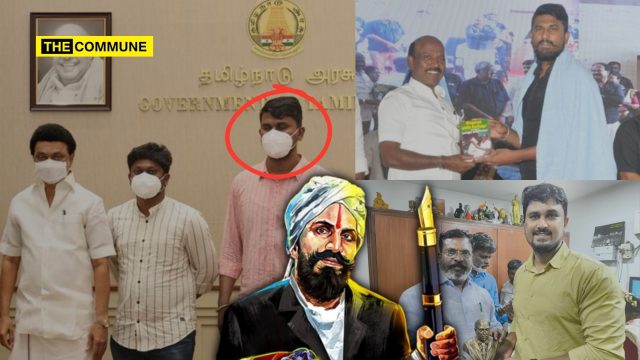
How Anti-Hindu Hate-Spewing Dravidianist YouTuber Whom Stalin Met, And Was Felicitated By DMK Govt, Has Been Abusing Bharathiyar

The recent resurfacing of a vile monologue by a Dravidianist YouTuber, known as “Minor” of the U2 Brutus YouTube channel, is a damning indictment of how the Dravida Munnetra Kazhagam (DMK) ecosystem actively enables, legitimises, and rewards systematic denigration of Hindu faith and icons, particularly Brahmins while pretending to occupy the moral high ground of rationalism and social justice.

Calling Bharathiyar A Coward, ‘Ganjakudiki’

In his videos, ‘Minor’ does not offer historical criticism or ideological disagreement. Instead, he descends into gutter-level slander against Subramania Bharathi, one of India’s most revered nationalist poets. Bharathiyar is mocked as a ‘ganja addict’, a ‘coward who trembled at the sight of khaki’, and a hypocrite on women’s emancipation. His revolutionary poetry is reduced to intoxicated hotel-bill rage, his courage to farce, and his ideals to fraud.

He says, “Bharathiyar is a ganjakudiki (ganja addict), and this fellow (Seeman) is a OC (free) drinker. Both of them match correctly. Nivedita asks “What Subramani? You have come alone? Did you not invite everyone at home and bring them? You are a big women’s empowerment hero, right? Did your wife not come? Did your mother, elder sister, younger sister, uncle’s wife, aunt, mother‑in‑law, sister‑in‑law, all of them not come?’ he was asked so. ‘No, no, all that is just empty talk, bro; you are expecting actions. You are talking here the way it is in your country. In our house we will not allow all that. According to them, beyond a certain point, women are like “pathinis” (chaste wives).’ This is what Bharathiyar has spoken. For us, even Bharathiyar is a salli (cheapo). Bharathiyar is a (sappa) useless piece; Who is this Seeman for us?”

Further denigrating Bharathiyar, Minor says that Bharathiyar wrote “Accham Illai Accham Illai Achham Enbadhillaiye” (No fear no fear, there’s no fear at all) when he was ‘hiding’ in Pondicherry ‘fearing’ arrest by British. “Think and see: while he was writing that, if the police had come there, how would he have reacted?”, he says.

He also goes below the belt to slander saying that Bharathiyar would get so afraid that he would piss in his pants. “Ticket examiners, inspectors will get in and get down, passengers will get in and get down. When the train stops and someone gets in, Bharathi would get terribly, terribly scared; he would shiver and tremble all over, it seems. He would keep watching: ‘Ayyo, who is coming? If by chance someone in khaki uniform climbs in, that’s it, everything is finished.’ It would be like that whole carriage has been sprayed with cold water, like how our Vadivelu is bathed in that comedy scene. ‘Hey, why is it stinking! I thought it would get camouflaged with the water flow’ – like that scene you have seen in the film. In that way, that whole carriage would feel like it had been soaked and stinky. Good thing nobody in khaki shirt got in.”

Further denigrating him, he says “You would have seen the film ‘Pudhupettai’. You would’ve seen how Dhanush travels in that right? Afraid that someone might see him, he sits near the bus window and travels. You would have seen him sitting like that, right? Like that, until he (Bharathiyar) got down from that train, he travelled in fear. This is not something that we are saying, Chellamma: his wife has recorded this.

Adding to the slander he says ‘If there is no food for a single man, we will destroy the whole world’ — do you know when he actually wrote that? Actually, when he was hiding in Pondicherry, after “Savukku” Shankar supplied him nicely with good stuff to smoke, you know after blowing well, you feel hungry. People who take ganja will say, ‘After smoking ganja, you will feel terribly hungry.’ After rolling it well and smoking well, in that hunger he must have gone to a hotel in Pondicherry and eaten. When he came out, the shop owner was sitting on a stone. He will ask for money, right? He will give the bill, right? The moment he gave the bill, the leader got angry in that intoxicated state, and then he said, ‘If there is no food for a single man, we will destroy this world.’ That era’s Kishore K Swami is exactly Bharathiyar, no one else. You are following one Kishore K. Swami, right?”

Continuous Hate Propaganda Against Bharathiyar 

In a recent speech, he is seen peddling lie after lie about Bharathiyar and quoting random documents and articles. Let us take a look at his lies one by one.

On “சாதிகள் இல்லையடி பாப்பா” (There are no castes, dear child), Minor says that “Bharathiyar did not write “சாதிகள் இல்லையடி பாப்பா” (There are no castes, dear child).”

He says he allegedly wrote “சாதி பெருமை இல்லையடி பாப்பா” (There is no caste pride, dear child). The version “சாதிகள் இல்லையடி பாப்பா” is claimed to be a printing error introduced in 1917 by Nellaiyappar Press. According to Minor, the original poem was published in 1913 in Gnana Bhanu magazine as “சாதி பெருமை இல்லையடி பாப்பா”. The 1915 March collected edition (pages 287–288) allegedly also carries “சாதி பெருமை”.

Therefore, Minor claims that Bharathiyar accepted the existence of caste but opposed only caste pride.

On Bharathiyar being a caste-abolition leader

Minor says, “Writing a few anti-caste lines does not automatically make Bharathiyar a caste-abolition leader. You cannot elevate someone to the status of a full social justice warrior only on that basis. Bharathiyar is excessively glorified as a radical reformer without proportional evidence. There were reformers in the same period who spoke far more sharply and extensively on caste”

On Bharathiyar’s alleged references to Paraiyars

Minor alleges that Bharathiyar used the term “ஈனப் பறையர்கள்” (“low/ignoble Paraiyars”). Minor claims this shows derogatory language toward Paraiyar communities. He cites Ayothithassa Pandithar as having directly questioned Bharathiyar on this usage.

Minor adds, “If Bharathiyar had written “low Brahmins,” Brahmins would never accept it. Then why should Paraiyars accept being described that way? Anger from Paraiyar communities toward Bharathiyar is therefore justified. Celebrating Bharathiyar ignores this insult.”

On Bharathiyar and Brahmin identity

Minor denies that Bharathiyar is criticised only because he was a Brahmin. He insists, “Bharathiyar is not criticised merely because he was a Brahmin. However, he never fully detached himself from a Brahminical worldview. His writings do not dismantle caste structure at the root. He retained caste consciousness even while speaking about equality.”

On Bharathiyar and Hindu scripture (Vedas)

On this, Minor says, “Bharathiyar lamented that the British did not respect the Vedas. He feared that foreigners would insult Vedic texts. He portrayed this as a civilisational loss. But British rejection of Vedas enabled education, rights, and reforms. Bharathiyar seeing this as a tragedy shows attachment to Vedic authority. This places him closer to religious orthodoxy than liberation politics.”

On Bharathiyar’s portrayal of “foreigners”

Minor claims Bharathiyar reportedly used the term “மிலேச்சர்” (Mleccha / barbarian / foreigner) for the British. He says, “Bharathiyar referred to the British as “mlecchas” (foreign barbarians). He framed them as a threat to civilisation. This framing mobilised people through fear. It did not focus on dismantling internal caste oppression.”

On Bharathiyar and beef / cow symbolism

Minor claims Bharathiyar portrayed cow slaughter as a civilisational danger. He says, “Bharathiyar warned that foreigners would slaughter cows. He portrayed cow slaughter as a civilisational danger. This reflects hostility toward beef consumption. Beef was historically consumed by Dalits and Muslims. Bharathiyar showed no sensitivity to those communities. His rhetoric positioned them implicitly as cultural outsiders.”

On Bharathiyar and temple destruction rhetoric

Bharathiyar wrote lines warning that temples would be destroyed by foreigners, says Minor. He adds, “Bharathiyar warned that temples would be destroyed by foreigners. This was used to instil fear and mobilise people. It is fear-based politics, not social reform. This mirrors later Hindu mobilisation narratives.”

On Bharathiyar’s selective praise of historical figures

Minor claims Bharathiyar was selective in his praise of historical figures. He says, “Bharathiyar wrote extensively praising Shivaji. He did not write poems praising Kattabomman, Maruthu brothers, Tipu Sultan, VO Chidambaram Pillai, When praising Shivaji, Bharathiyar focused on military strength and kingdom. He did not highlight Shivaji’s humiliation by Brahmins. He did not present Shivaji as an oppressed Shudra. This reflects ideological selectivity.”

On Bharathiyar vs Periyar/Ambedkar

Minor claims Bharathiyar never attacked Hinduism’s internal hierarchy. He says, “Bharathiyar never attacked Hinduism’s internal hierarchy. He never challenged the Vedas. He never attacked Manusmriti. He never questioned the religious foundations of caste. His anxiety resembles Savarkar’s—uniting Hindus against outsiders. Periyar and Ambedkar attacked internal oppression; Bharathiyar did not.”

On how Bharathiyar should be treated today

Minor says, “Bharathiyar is not sacred. Bharathiyar can and should be criticised. No leader is beyond criticism. If any of these claims are proven false with evidence, correction is possible. Counter-books and evidence are invited.”

It is these kind of people that the DMK government praises and felicitates. Remember in 2022, at a Dravidar Kazhagam–aligned event, Minor was felicitated alongside other ideologically aligned YouTubers and presented with an idol of EV Ramasamy. The event carried political legitimacy because it was endorsed by a serving DMK minister Ma. Subramanian.

This matters because Bharathiyar is not just a poet. He is the symbol of Tamil self-respect, linguistic pride, anti-colonial resistance, and social awakening. He wrote in Tamil when English education was the elite norm. He sang of women’s liberation, national freedom, and spiritual confidence when submission was fashionable. DMK politics routinely appropriates this Tamil pride—while honouring someone who tears Bharathiyar down using gutter language.

The message is unmistakable: Celebrating Tamil is acceptable only when it fits Dravidian orthodoxy. A Tamil icon who does not fit that frame can be mocked, defamed, and erased.

This pattern does not stop with Bharathiyar. The same YouTuber publicly abused Lord Shiva, mocked Goddess Kaali, vulgarised the Nataraja form of Chidambaram, said Vedas had porn and insulted temple priests. None of this triggered moral outrage within the DMK ecosystem. Instead, the offender was elevated.

The contrast is revealing. Others have faced police action, arrests, and even preventive detention for far less, sometimes for content involving Hindu deities that did not align with party ideology. Here, open abuse was not merely tolerated but rewarded.

Subscribe to our channels on WhatsAppTelegram, Instagram and YouTube to get the best stories of the day delivered to you personally.

When Newslaundry Does Bootlicking It Is Gold Standard Of Journalism

Indian “independent media” has perfected the art of moral exhibitionism. It preaches ethics, scolds television journalism, and positions itself as the last remaining conscience of the profession. But scratch the surface and a far uglier truth emerges: its principles are conditional, its outrage selective, and its ethics partisan. Nowhere is this rot more clearly exposed than in Newslaundry’s shameless double standards on so-called “soft” questions.

When India Today Asked Putin If He Was Tired

When India Today reporters asked Vladimir Putin whether he ever gets tired after long days of work, Newslaundry went into full sneer mode. On NL Tippani episode 264, the hosts mocked the exchange as cringe, servile, and emblematic of “godi media” sycophancy.

The host said, “First, listen to sister Anjana Om Modi.”

Anjana is seen saying to Kalli Purie, “So this is the strength of the India Today Group [music] that we don’t stop anywhere. We don’t get tired anywhere. And even after midnight, if you see the entire team standing strong in front of you like this, there is a passion behind it, which you and Arun ji have created with great hard work at the India Today Group. And before this, India Today Group owner Kalli Purie was surrounded by questions about fatigue.”

Purie asks Putin, Sir, we have been shadowing you for three days and we see how hard you have been working, as hard as our Prime Minister. Do you ever take a break? And are you going to get a break in the New Year and Christmas?”

The fatigue question was framed as proof of journalists prostrating themselves before power, mistaking flattery for inquiry. The message was unambiguous: this is not journalism; this is bootlicking.

Yet when Newslaundry’s own reporter asked KK Shailaja, a sitting CPI(M) cabinet minister and global Left darling, “are you a little tired by any chance?”, the entire moral framework flipped. The very same kind of question — personal, empathetic, bordering on admiration — was suddenly recast as sensitive, humanising, even courageous journalism. Her exhaustion was treated as proof of virtue. Her workload became a badge of sincerity. Audiences were told they were witnessing “truth to power”.

Amazing hypocrisy:

The ridicule was relentless. The implication was clear: asking a powerful leader about fatigue is not journalism – it is fawning.

A fatigue question does not magically transform from sycophancy into journalism depending on the accent, ideology, or party affiliation of the person being asked. It becomes one or the other solely based on who is in the chair. When the subject is a BJP leader, a foreign strongman, or a geopolitical adversary, such questions are derided as grovelling. When the subject is a Left icon or a progressive mascot, the same questions are celebrated as empathy. In Newslaundry’s universe, power is not defined by office, authority, or responsibility — it is defined by political convenience.

What makes this hypocrisy especially grotesque is Newslaundry’s relentless posture of moral superiority. This is an outlet that has built its brand on ridiculing others for access journalism, for soft framing, for admiration disguised as inquiry. And yet, when it interviews its ideological allies, it cushions them with reverence, context, and emotional warmth. Even when serious issues arise — such as political killings in Kerala — accountability is blurred into abstractions, responsibility dissolved into history lessons, and power gently excused as circumstance. The questions may sound tough, but the answers are never cornered. Scrutiny is simulated, never enforced.

Contrast this with the standards Newslaundry applies to everyone else. A television anchor nods too much and is accused of selling his soul. A foreign leader is asked about exhaustion and it becomes a punchline. But when Newslaundry itself indulges in the same rhetorical tenderness, it is applauded as feminist, independent, brave journalism. This is not a minor contradiction. It is a structural lie at the heart of its editorial identity.

Even The Wire’s Karan Thapar, whose interviews often lean sympathetic in framing, does not pretend otherwise. His recent interview on Zohran Mamdani seems to drift into soft hagiography.

Newslaundry does. It condemns in others what it excuses, even celebrates, in itself.

This is not “speaking truth to power”. It is deciding which power deserves scrutiny and which deserves sympathy. Friendly power is humanised. Unfriendly power is moralised against. And the audience is expected not to notice.

But once you notice it, the entire performance collapses.

What remains is not independent media, but ideological media with better branding, enforcing one standard for enemies and another for friends and calling that ethics.

Subscribe to our channels on WhatsAppTelegram, Instagram and YouTube to get the best stories of the day delivered to you personally.
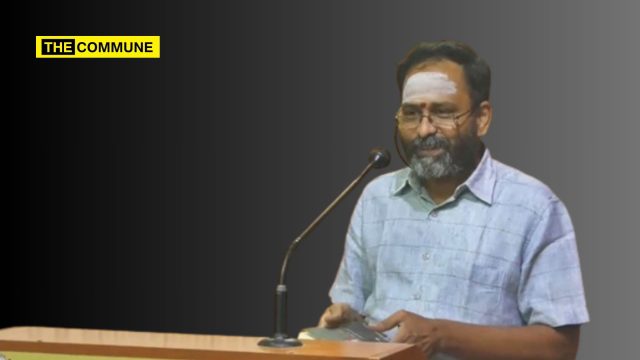
Justice GR Swaminathan Quotes Prophet Mohammed In Judgement Flagging ‘Scandalously High’ Fees To Law Officers

justice gr swaminathan

For all the talk about Madurai Bench of Madras High Court’s single judge Justice GR Swaminathan being a ‘sanghi‘, RSS man, and what not, here comes a judgement where he quoted the Prophet Mohammed (PBUH).

Justice GR Swaminathan on Friday (19 December 2025) directed the Madurai City Municipal Corporation to settle long-pending professional fee claims of its former standing counsel, while sharply criticising the practice of appointing a large number of Additional Advocate Generals and paying exorbitant legal fees from the public exchequer.

Pronouncing orders in W.P.(MD) No. 26707 of 2022, the judge began by invoking a saying attributed to Prophet Muhammad (PBUH), stating that a worker should be paid before his sweat dries. He said, “Pay the worker before his sweat dries” is an instruction attributed to the Holy Prophet (PBUH).”

The court held that this principle, rooted in fairness, was applicable not only in labour jurisprudence but also in cases involving unpaid professional dues.

The petitioner, who had served as standing counsel for the Madurai City Municipal Corporation for over 14 years between 1992 and 2006, had approached the court seeking payment of ₹13.05 lakh, claiming that while his total bills amounted to over ₹14 lakh, only about ₹1.02 lakh had been paid. Earlier directions issued in 2006 required the Corporation to consider his representation, following which an adverse order was passed, prompting the present writ petition.

During the hearing, the Corporation submitted that it was willing to honour the claim provided the fee bills were supported by certified copies of judgments and decrees. It was alleged in the counter affidavit that non-submission of such documents had caused losses to the local body in certain cases, leading to the petitioner’s removal from the panel.

Justice Swaminathan noted that the petitioner had appeared in as many as 818 cases and recorded submissions that he was in penurious circumstances and unable to afford the cost of obtaining certified copies. Accepting this position, the court directed the Legal Services Authority attached to the Madurai District Court to verify the list of cases, obtain certified copies, and provide them to the petitioner within two months. Upon submission of the verified fee bills, the Corporation was directed to settle the dues within a further two months, without interest, citing the long delay in raising the claim and procedural deficiencies in earlier submissions.

While disposing of the petition, the judge made strong observations on the broader issue of legal fees paid by government and quasi-government bodies. He remarked that the petitioner’s claim appeared to be a pittance when compared to the volume of work performed and expressed concern over what he described as “scandalously high” fees paid to certain law officers and senior counsel.

Referring to instances from his judicial experience, Justice Swaminathan noted that institutions pleading financial distress had paid several lakhs of rupees per appearance to senior counsel. He also disapproved of the routine appearance of Additional Advocate Generals in minor matters, observing that such cases could be handled by junior government counsel.

The judge stated that good governance required public funds to be spent in a measured manner and not distributed capriciously to a favoured few. He further observed that Tamil Nadu currently had close to a dozen Additional Advocate Generals, contrasting this with the position when he entered the Bar in 1991, when there was only an Advocate General.

Justice Swaminathan expressed hope that such practices would cease at least in the Madurai Bench from 2026 and referred to similar concerns raised earlier by the Allahabad High Court. The writ petition was disposed of accordingly, with no order as to costs, and connected miscellaneous petitions were closed.

Source: Madurai Bench of Madras High Court Order

Subscribe to our channels on WhatsAppTelegram, Instagram and YouTube to get the best stories of the day delivered to you personally.
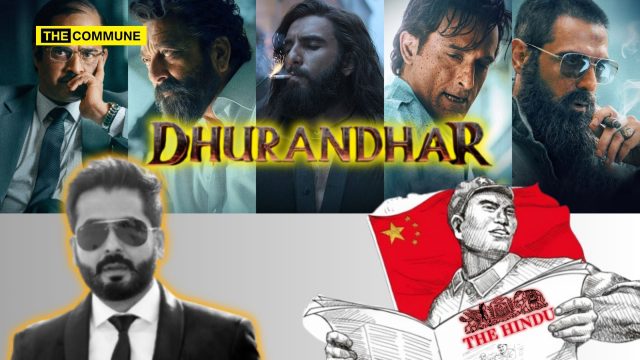
Irony Died A Million Deaths: Mount Road Mao, The Hindu, Which Embeds Chinese Government Talking Points, Cries ‘Propaganda’ Over Dhurandhar

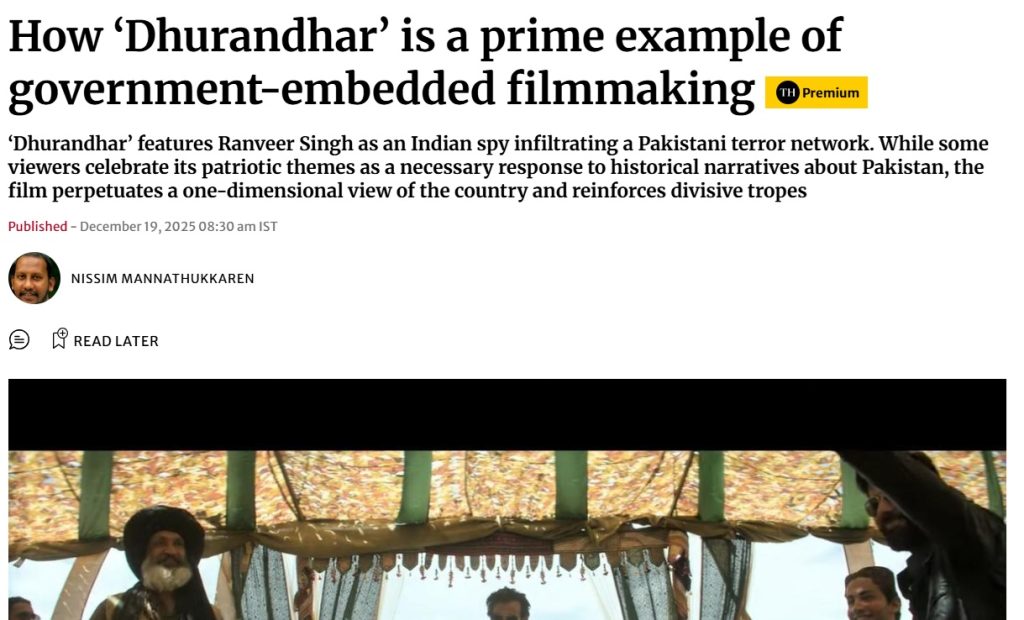
On 19 December 2025, The Hindu published a long, self-righteous critique of the Hindi film Dhurandhar by Nissim Mannathukkaren, branding it a “prime example of government-embedded filmmaking.”

The paper borrows a term from American writer Peter Maas to accuse the film of reproducing the ideological narrative of the present Indian government, even when it appears subtle, technically polished, and commercially driven.

On the surface, the argument sounds sophisticated. Look closer, and it collapses under the weight of The Hindu’s own record.

Because if “government-embedded narratives” are the standard, The Hindu is the master of it.

Embedded Filmmaking Vs Embedded Journalism

The newspaper’s critique rests on the claim that Dhurandhar normalises the worldview of the Indian security state: muscular counter-terrorism, Pakistan as a hostile adversary, internal enemies, and a decisive nationalist leadership. According to The Hindu, this becomes propaganda not because it lies blatantly, but because it aligns seamlessly with the political imagination of the ruling establishment.

But this raises an obvious question: Who audits the auditor?

For decades, The Hindu has functioned as one of India’s most consistent platforms for foreign-state-embedded narratives, particularly when it comes to China.

Here are instances when The Hindu propagated Chinese propaganda.

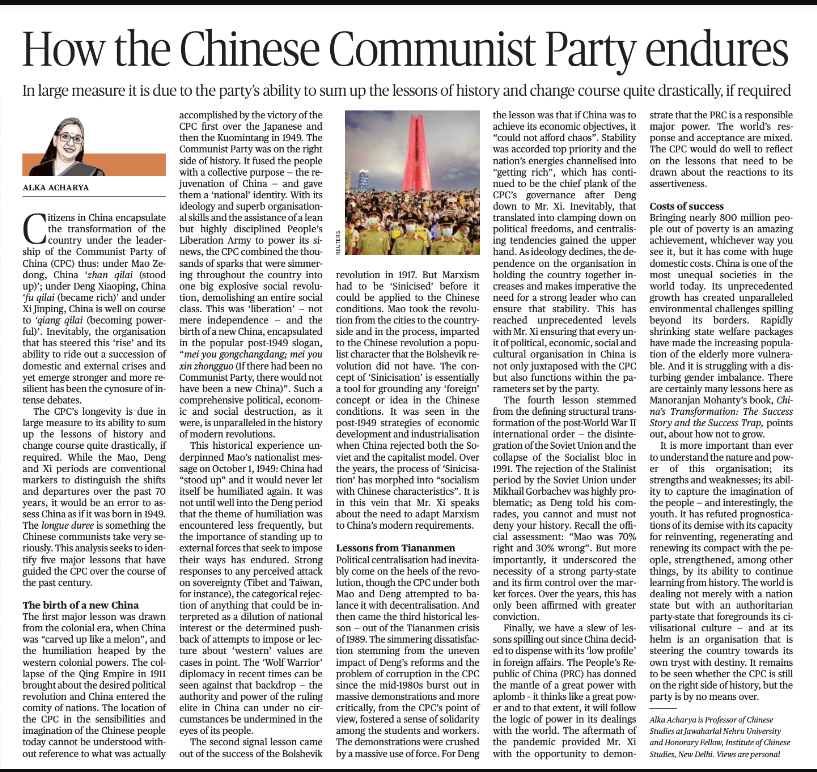
The Hindu Glorifies Communist China On CPC’s 100th Anniversary

On the centenary of the Communist Party of China (CPC), The Hindu, a known left-leaning outlet, published a piece that read more like praise for Beijing’s authoritarian regime than objective journalism.

The article, authored by Alka Acharya, a professor of Chinese Studies at JNU and often presented as a “China expert,” lauded the CPC under Xi Jinping, describing it as Qiang Qilai—a “rising power.” She credited the Party for effectively overcoming internal and external challenges and positioning China as a global force to reckon with.

In the piece, Acharya celebrated the CPC’s role in shedding China’s so-called “colonial mindset” and promoted the narrative of a ‘resurgent China’ ready to challenge global powers—a vision tightly aligned with Beijing’s propaganda.

That The Hindu chose to publish such a glowing endorsement of China’s totalitarian regime on a landmark occasion for the CPC raises serious concerns about the outlet’s editorial leanings and its willingness to amplify Chinese state narratives.

The Hindu Runs Full-Page Chinese Advertorial Celebrating 100 Years Of Communist Rule

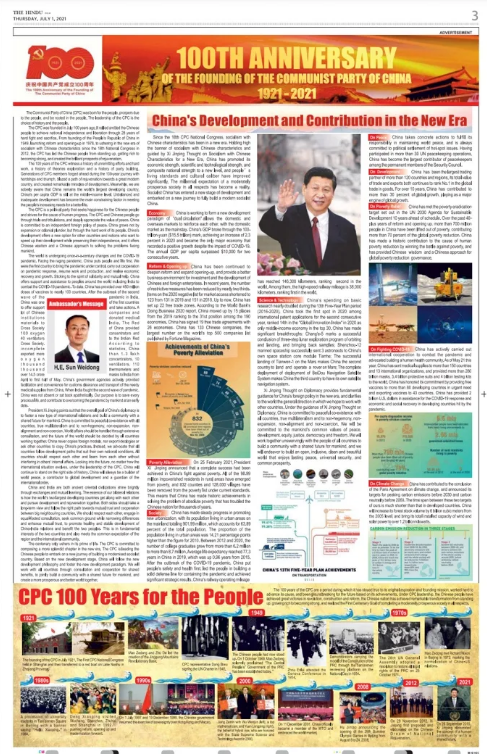
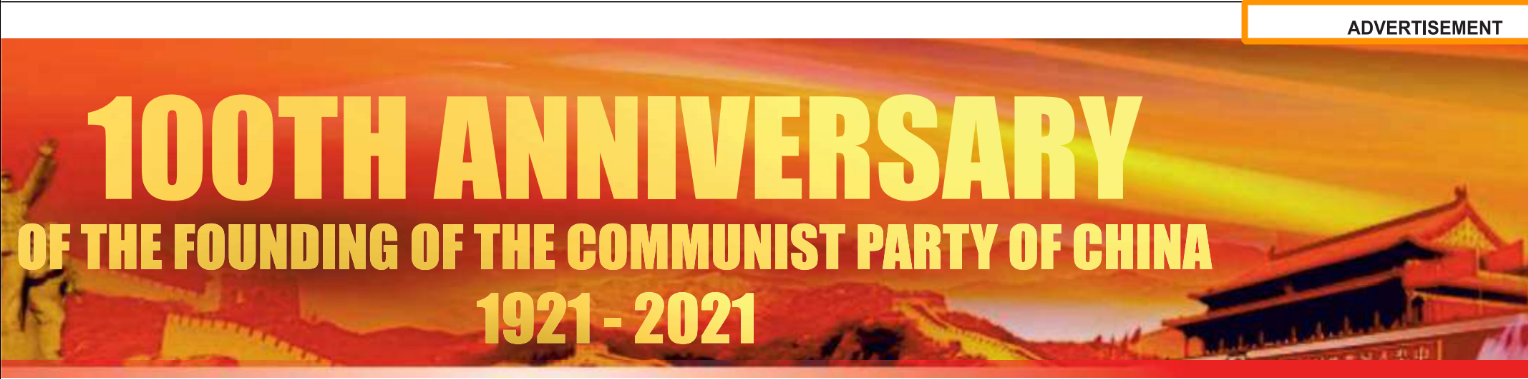
On 1 July 2021, The Hindu published what can only be described as a glaring example of soft propaganda—a full-page advertorial paid for by the Chinese government, marking the 100th anniversary of the Communist Party of China (CPC).

This sponsored content appeared on Page 3 of the newspaper, blending seamlessly with regular editorial content, making it difficult for casual readers to recognize it as a paid promotion. However, a closer look revealed that it was clearly planted by Chinese interests, designed to celebrate the CPC’s rise and present it in a flattering light.

(Image Credit: OpIndia)

Adding to this coordinated media push, The Hindu also released a podcast discussing the CPC’s achievements, growth, and global influence—further amplifying China’s narrative through a platform widely seen as sympathetic to left-wing ideologies.

By offering its space and credibility to Beijing’s state-funded propaganda, The Hindu raised serious ethical concerns about its editorial independence and willingness to serve foreign influence under the guise of journalism.

The Hindu Glorifies China’s Political Evolution Under The Communist Regime

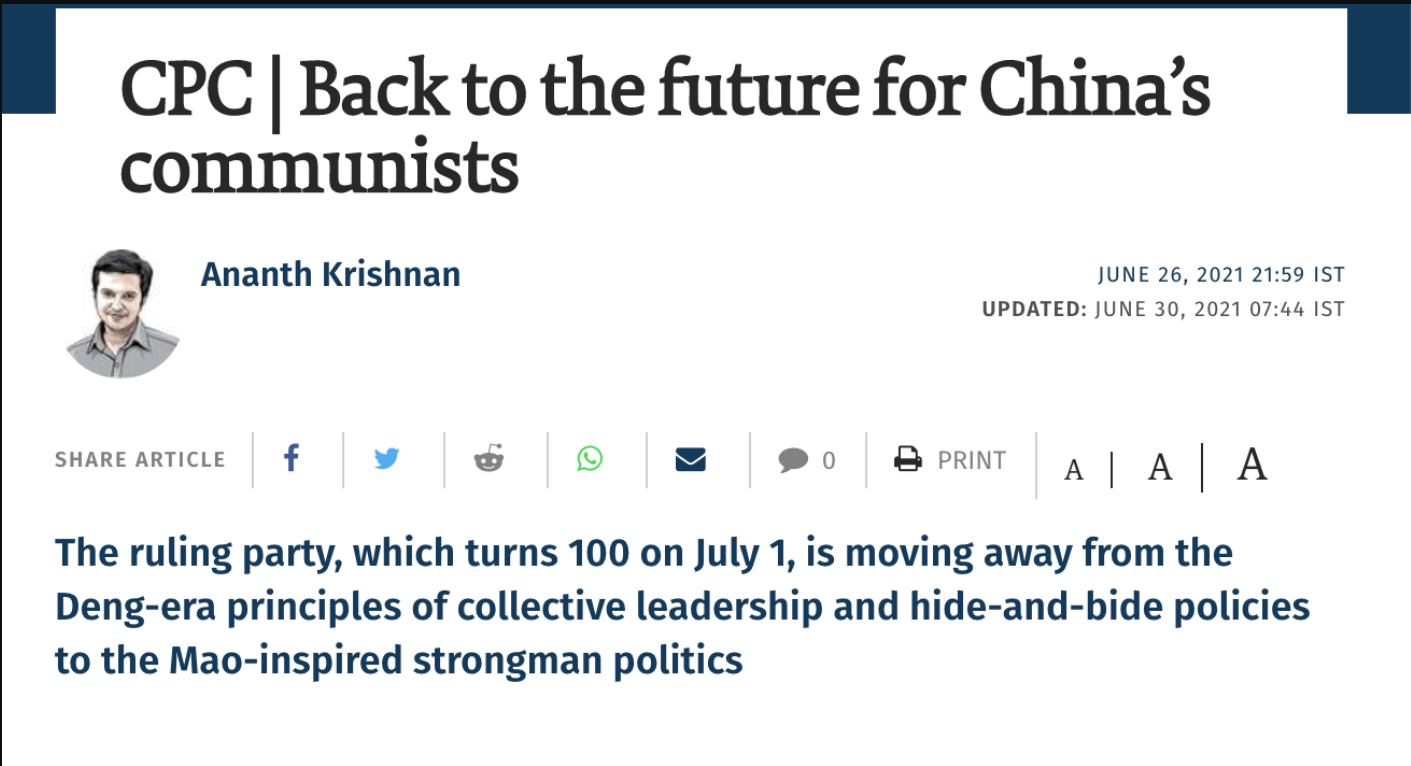
On 26 June 2021, The Hindu published an article titled “CPC Back to the Future for China’s Communists,” authored by Ananth Krishnan. The piece paints a glowing narrative of the Communist Party of China (CPC), portraying its political transformation as a sign of strength and adaptability.

The article highlighted how the CPC has shifted from the era of collective leadership under Deng Xiaoping to a centralized, authoritarian model under Xi Jinping, which the piece describes as a revival of Mao-style strongman rule. Rather than critiquing this consolidation of power, the article frames it as a natural and effective evolution of China’s political structure.

In simple terms, the article attempts to legitimize the CPC’s increasingly autocratic governance, presenting its journey from 1921 to the present as a model of resilience and strategic leadership—downplaying the lack of political freedom, human rights concerns, and international criticism surrounding China’s regime under Xi.

Once again, The Hindu appears to champion Beijing’s narrative, raising questions about its editorial intentions and alignment with Chinese interests.

The Hindu Publishes Distorted India Map Omitting Sikkim, Faces Backlash, Issues Apology Later

In a glaring and controversial oversight, The Hindu published a map of India that completely omitted the state of Sikkim in its 13 May 2025 edition. The map accompanied an article titled “With a New Pope, an Understanding of Catholicism in India” and appeared in the newspaper’s Data Point section. The state’s boundaries were missing, effectively erasing Sikkim from the national map.

Following a wave of public backlash and criticism over this “grave error,” The Hindu issued an official apology the next day, on 14 May 2025. The editorial team acknowledged the mistake and attempted to downplay the incident as a technical glitch. Their corrigendum read, “Due to a data input error, the India map in the article, ‘With a New Pope, an Understanding of Catholicism in India’, which appeared in the Data Point section on May 13, 2025, was incorrectly presented with the contours of Sikkim State being shaded out. We apologise for the error. The map and the references have been removed from the story online and corrected in our e-paper editions.” — The Editor.


Despite the correction, the incident added to growing concerns about The Hindu’s editorial integrity and its recurring tendency to mishandle sensitive national subjects, reinforcing its image as a publication pushing questionable narratives under the guise of journalism.

The Hindu Spreads False Report On Crash Of Three Indian Fighter Jets

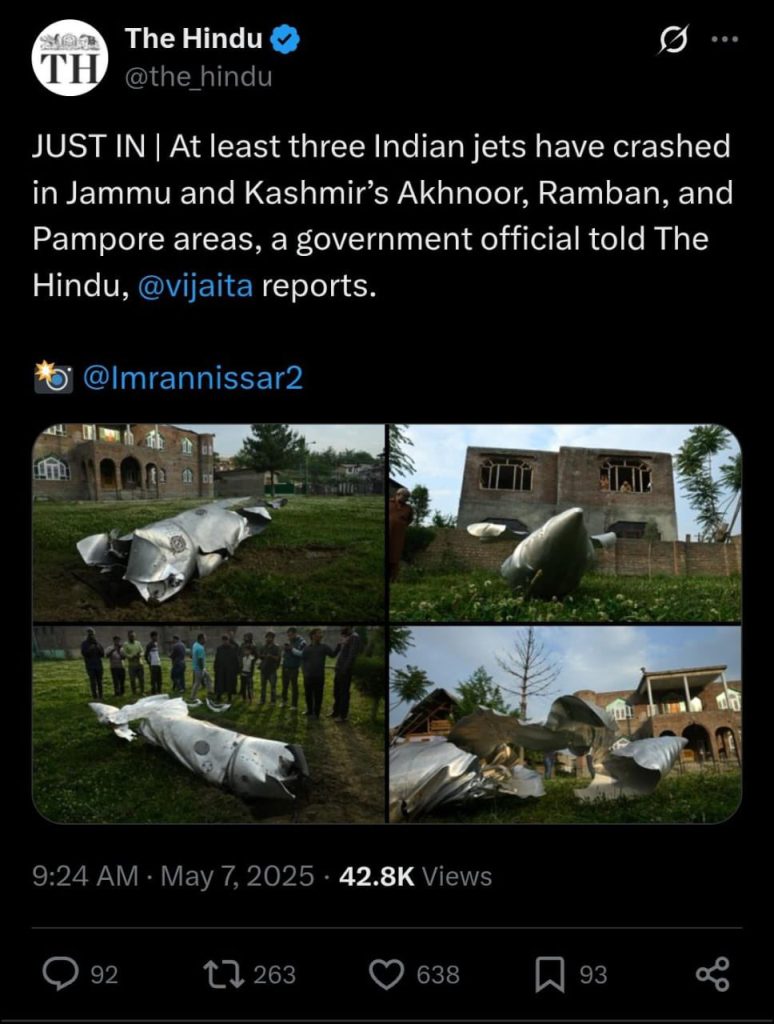
On 7 May 2025, The Hindu published a misleading report falsely claiming that three Indian Air Force aircraft had crashed in different parts of Jammu and Kashmir — specifically in Akhnoor, Ramban, and Pampore. The report included photographs to support the claim, suggesting that the debris belonged to downed jets.

However, the images used by The Hindu were later revealed to be misleading — the so-called “crashed jets” were actually external fuel tanks, not aircraft wreckage. The publication failed to verify basic facts before running the story, leading to widespread confusion and panic.

Once the false claim was exposed, The Hindu quietly deleted the article from its platform and issued a weak clarification, merely expressing “regret” for the confusion caused.

This incident further solidified The Hindu’s growing reputation as a purveyor of unchecked and irresponsible journalism — a media house increasingly accused of spreading misinformation, especially when it involves India’s defense and security matters.

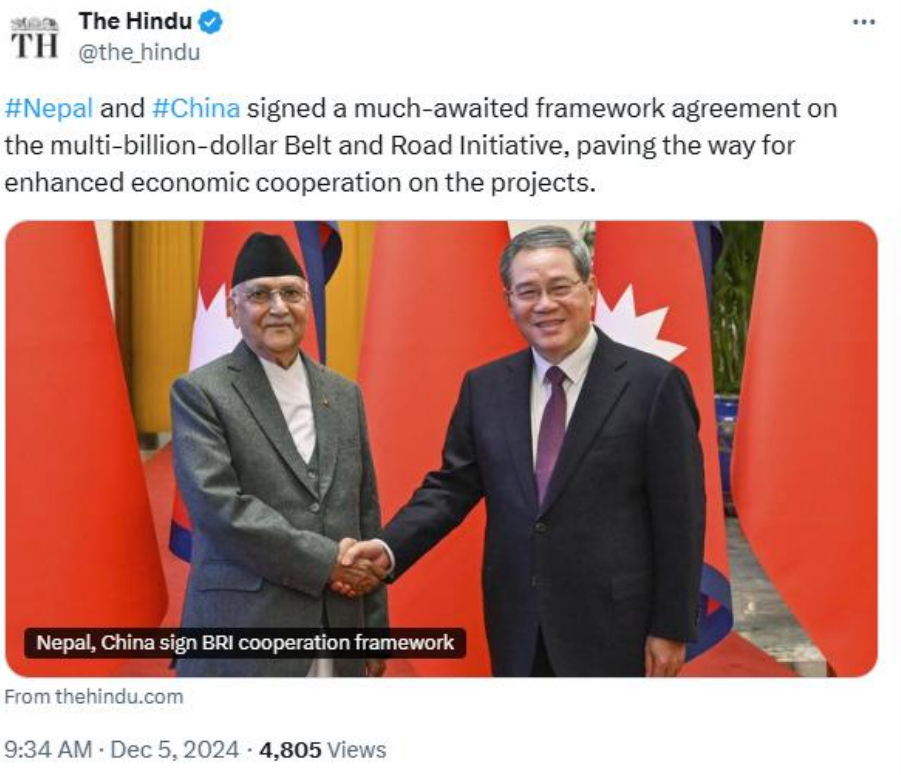
The Hindu Echoes Chinese Talking Points On BRI Deal With Nepal

On 4 December 2024, The Hindu published an article that openly praised China’s Belt and Road Initiative (BRI) following the signing of a cooperation framework between Nepal and China. Instead of offering a critical or balanced perspective, the piece amplified pro-China narratives, portraying the BRI as a game-changing opportunity for Nepal’s economic development.

The article highlighted supposed benefits of the BRI, including improved infrastructure and regional connectivity, while praising China’s influence in Nepal—particularly under the leadership of former Prime Minister KP Sharma Oli, known for his Beijing-friendly stance. It even echoed the Chinese propaganda line that BRI could help transform Nepal from a “landlocked” to a “land-linked” nation.

By uncritically promoting China’s strategic initiative—which many countries and experts have criticized as a debt-trap diplomacy tool—The Hindu once again demonstrated its inclination to align with China’s geopolitical agenda, further fueling concerns about its editorial loyalties and its role in shaping public opinion in favor of foreign interests.

These are just 3 instances; here is the entire list.

The N Ram Problem That The Hindu Never Resolves

Under the long stewardship of N. Ram, former Editor-in-Chief, current director, and an unapologetic, self-described communist, The Hindu cultivated editorial positions that routinely mirrored Chinese Communist Party talking points, has even been seen participating in events organized by communist-affiliated groups and political figures.

Comrades should stfu https://t.co/nDDF2RjEjn pic.twitter.com/9bYzS4By3p

This was not an occasional lapse. It was a pattern.

In its coverage of the deadly Galwan Valley clash, where 20 Indian soldiers were martyred in a brutal confrontation with Chinese troops, The Hindu appeared to amplify Beijing’s version of events rather than India’s official stance.

The article gave prominence to statements issued by the Chinese People’s Liberation Army (PLA) and the Chinese Ministry of Foreign Affairs (MFA), which accused India of breaching prior agreements and provoking the skirmish. It went so far as to reiterate China’s claim that “the sovereignty of the Galwan Valley has always belonged to China”—a position that India categorically denies.

Instead of fairly presenting India’s viewpoint or underlining the loss suffered by Indian forces, The Hindu seemed to minimize India’s position by focusing heavily on China’s diplomatic protests and its portrayal of the incident as a defensive response. This coverage reflected a pattern of favoring adversarial narratives over national interest, even in matters of national security and territorial integrity.

If Dhurandhar is accused of embedding the Indian government’s worldview, what exactly should we call a newspaper that spent years embedding a rival authoritarian state’s worldview into Indian elite discourse?

Selective Outrage Is Not Critique – It Is Politics

The Hindu’s review of Dhurandhar is not objectionable because it critiques nationalism. Criticism is legitimate. The problem is selective moral outrage.

The review objects to Pakistan being portrayed largely through terror networks, absence of “good Pakistani Muslims” in the film to counterbalance terrorists. It also feels that the film echoes slogans associated with the Modi government (meh) and has security officials resembling present-day power centres!

Yet the same paper has normalised Chinese state narratives without demanding “good CCP dissidents” in every report, treated an authoritarian one-party state with kid gloves while lecturing India on pluralism, shown no comparable anxiety about propaganda when it aligns with its ideological comfort zone.

You think this is media ethics? Naah, it is ideological policing.

Dhurandhar unsettles The Hindu not because it is propaganda, but because it is not their propaganda.

The Real Discomfort: Loss Of Narrative Monopoly

For decades, The Hindu enjoyed disproportionate influence over how India’s English-speaking elite interpreted national security, foreign policy, Pakistan, China, Kashmir and the Indian state itself.

Films like Dhurandhar, and the popular response to them, represent a loss of that monopoly. A cultural product is now shaping public memory and emotion outside the paper’s ideological frame.

Calling it “government-embedded filmmaking” is a way to delegitimise that loss.

Subscribe to our channels on WhatsAppTelegram, Instagram and YouTube to get the best stories of the day delivered to you personally.
Thirupparankundram Karthigai Deepam Row: After Madurai Bench Declines Repetition Of Rejected Submissions, Advocate Moves Chief Justice Alleging ‘Insult’

Advocate S. Arunachalam, with 29 years of standing at the Bar, has submitted a written representation to the Hon’ble Chief Justice of the Madras High Court, alleging that he was insulted and forcibly removed from court during the hearing of writ appeals connected to the Thirupparankundram Karthigai Deepam dispute.

The representation relates to proceedings arising from a common order dated 1 December 2025, passed by Justice GR Swaminathan, in a batch of writ petitions concerning the lighting of the Karthigai Deepam on 3 December 2025 at Arulmigu Subramania Swamy Thirukoil, one of the most sacred shrines of Lord Muruga in Tamil Nadu.

In his petition to the Chief Justice, Arunachalam stated that the learned single judge had disposed of the writ petitions in haste, allegedly in violation of rules governing writ proceedings under Article 226 of the Constitution and in breach of principles of natural justice. He further pointed out that Karthigai Deepam on the hill is an annual festival and that the next observance would only fall due on 29 November 2026, contending that there was no urgency warranting expedited appellate hearings.

He noted that multiple writ appeals arising from the common order including W.A.(MD) Nos. 3188, 3189, 3204, 3211, 3212, 3213, 3217, 3218, 3219, 3220, 3221, 3222, 3223, 3225, 3226, 3227, 3229, 3230, 3231 and 3232 of 2025 were being heard by a Division Bench of the Madurai Bench on a day-to-day basis. He further stated that certain writ appeals filed with leave applications were not being listed along with the other appeals.

According to Arunachalam, when he mentioned C.M.P.(MD) No. 20137 of 2025 on 16 October 2025, seeking leave to file a writ appeal, the presiding judge, Justice G Jayachandran, became angry, asked for his name and enrolment number, and subsequently directed the CISF personnel to remove him from the courtroom. He alleged that an order was also dictated to be addressed to the Bar Council.

In his representation, the advocate stated that judges enjoy immunity, but advocates are officers of the court and have a responsibility to espouse the cause of justice. He claimed that the incident had affected his dignity and professional reputation.

Arunachalam further outlined the credentials of his client, Dr. D. Senthilnathan, stating that he holds a Ph.D. in Quantum Chemistry, has worked as an R&D scientist at the Centre for Nuclear Energy Association in Grenoble, France, and at the University of Jerusalem, Israel, has published 14 research articles in reputed international journals, and is presently working as an R&D Professor at PRIST University, Thanjavur.

He stated that his client is a follower and scholar of Saiva Siddhanta and that the litigation was intended to bring to the court’s notice that the Thirupparankundram temple follows Saiva Siddhanta, and that its sacred tenets and rituals should not be sacrificed to satisfy the ego of certain individuals or to create communal disharmony for political reasons. He alleged that the impugned order had been passed without adequate consideration of the temple’s rites and ceremonies and would adversely affect the Hindu public.

Arunachalam requested the Chief Justice to transfer four writ appeals, W.A.(MD) SR Nos. 108684, 108550, 106983 and 107683 of 2025, along with connected miscellaneous petitions, to any other Division Bench.

Advocate S. Arunachalam, with 29 years of standing at the Bar, has complained to #MadrasHighCourt Chief Justice that he was insulted during the hearing of the writ appeals related to the Tirupparankundram Deepam issue. pic.twitter.com/EXBtpUa4Sg

However, legal sources familiar with the proceedings stated that, in substance, there was no material difference between the arguments Arunachalam sought to advance and the submissions already placed before the Division Bench by the Tamil Nadu government in the Tirupparankundram Deepam matter.

According to these sources, reiterating the same arguments would amount to a waste of judicial time. Once the Bench had expressed its unwillingness to entertain the petition, it was incumbent upon counsel to explore other legal remedies available in law. Persisting with the same submissions and continuing to argue with the Bench despite clear judicial disinclination, they said, could not be justified.

They further cautioned that permitting such conduct and allowing repeated arguments on identical grounds would set an unhealthy precedent and undermine orderly court proceedings.

In the #Tiruparankundram issue, there is no material difference between the arguments he seeks to advance before this court and those already placed by the government before the Division Bench. Reiterating the same submissions amounts to a waste of the court’s time. Once the… https://t.co/d92JfDkHcY

Subscribe to our channels on WhatsAppTelegram, Instagram and YouTube to get the best stories of the day delivered to you personally.
“Indian Muslim” Student In Qatar Says She Doesn’t Feel ‘Belonging To India’, Anti-India Propaganda Channel Al-Jazeera Laps It Up

Al-Jazeera

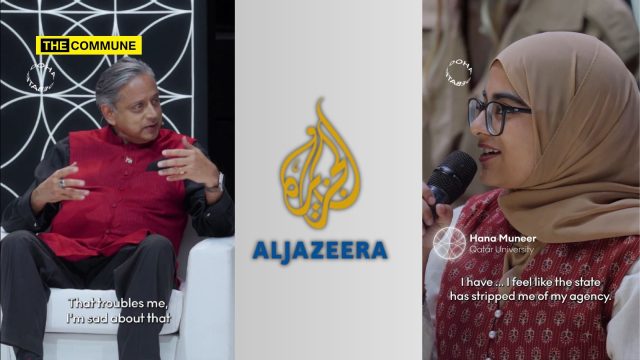
A short clip shared by Al Jazeera from its programme Doha Debates has triggered sharp reactions on social media after an Indian student, Hana Muneer, stated that she does not feel a sense of belonging to India as a Muslim and claimed that the Indian state had “stripped” her of agency.

In the clip, Muneer said, “Whether I feel belonging to India or not, I would say, a quite crisp no, because as a Muslim… I feel like the state has stripped me of my agency,” adding that she was interested in exploring a “universal moral order”.

Her remarks were responded to by Congress MP Shashi Tharoor, who expressed concern over her sense of alienation and said such exclusion ran contrary to the foundational idea of India.

Tharoor said that his understanding of India was one where no citizen should feel excluded on grounds of religion, language, ethnicity or region. He added that if she had been made to feel that way, it was regrettable. Pointing to recent events, Tharoor cited India’s military briefings during Operation Sindoor, which were led by two women officers, including a Muslim officer, as an example of India publicly asserting its pluralism and framing the conflict as one against terrorism rather than religion.

The clip has since drawn criticism from commentators who argue that such debates selectively amplify narratives of alienation while ignoring countervailing realities on the ground. Critics have pointed out that Muneer currently resides in Qatar, a country whose state-owned media is the same Al Jazeera that has been seen making biased regional political positioning, raising questions about the platform and framing of the debate.

Critics highlighted that during Operation Sindoor, Indian Muslim officers and personnel played visible and substantive roles across the armed forces. Muslim women officers addressed the nation from official podiums, and Muslim pilots flew combat missions alongside Hindu, Sikh and Christian colleagues, supported by the Army and Navy. They argue that these facts complicate claims that Indian Muslims are institutionally excluded or unrepresented by the state.

Observers have also criticised what they describe as a recurring pattern in certain international debate formats, where individual grievance narratives are presented without sufficient context or factual balance, potentially feeding into broader perception-shaping efforts rather than genuine dialogue.

While debates on identity and belonging remain legitimate and complex, critics argue that selective framing and omission of counter-examples risk turning nuanced discussions into oversimplified political messaging, particularly when broadcast on globally influential platforms.

Subscribe to our channels on WhatsAppTelegram, Instagram and YouTube to get the best stories of the day delivered to you personally.