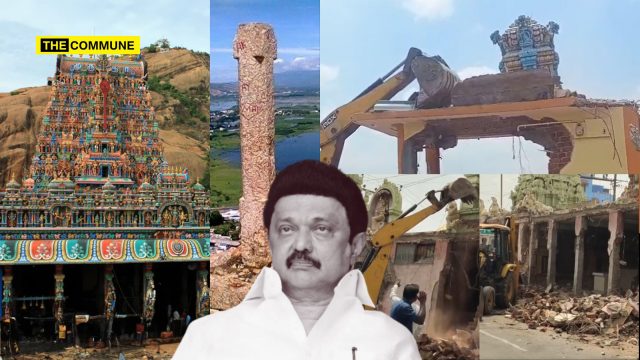
When DMK scion Udhayanidhi Stalin called for the “eradication of Sanatana Dharma,” it signalled an ideological position. What is now visible is how that position reflects in governance—particularly in how the state responds to court orders involving Hindu religious practices versus other cases.
The Thiruparankundram Karthigai Deepam issue is not an isolated incident. It fits into a broader pattern of selective enforcement.
A High Court order permitted the lighting of the Deepam at the Deepa Thoon. Under the Constitution, the executive is duty-bound to implement judicial directions. This is not optional—it is central to the rule of law.
Yet, the order did not translate into immediate action on the ground.
Historical records show that a 1996 agreement relating to the Thiruparankundram hill recorded no objection to Hindu religious practices. Despite this, the state has allowed shifts in usage and narrative around the site without intervention.
In Nellikuppam, public statements regarding animal slaughter saw no administrative response. Only after devotees approached the court did a restraining order emerge in October 2025. The court itself recorded that the state had not objected.
Now examine enforcement in temple demolition cases.
The former BJP state chief alleged that since the DMK came to power on 6 May 2021, more than 161 Hindu temples across Tamil Nadu had been demolished. He cited locations including Muthaanamman Temple in Coimbatore city, Vedavinayagar Temple on Mint Road in Chennai, Vasudevar Temple in Sulur, Kubera Vinayagar Temple in Thanjavur, Adi Mariamman Temple in the Keezhavasal area, Shani Bhagavan Temple in Ariyalur district, and temples in Mettupalayam, Tiruvallur, and Perambur.
Annamalai questioned the basis on which several of these demolitions were carried out, stating that in many cases there were no clear court orders or documented sources authorising the action. He alleged that in some instances, court orders were cited after the fact, and that temples were demolished within hours of judgments being delivered, including demolitions carried out in the early hours of the morning.
Case Pattern: Caution in Non-Temple Structures
In contrast, multiple cases involving mosques, churches, or waqf-linked properties show a different administrative approach—marked by delay, caution, or deferment.
1. Avadi–Pattabiram Belt (Chennai outskirts)
Encroachments involving religious structures, including non-temple sites flagged on government land, have seen prolonged inaction despite complaints and local-level directives. Authorities have repeatedly cited “sensitivity” and law-and-order concerns.
2. Chromepet Church
In 2023, the Madras High Court directed that the India Evangelical Church, located on Hasthinapuram Rajendra Prasad Road in Annanagar, Chrompet be demolished.
The administration challenged this before the Supreme Court, but the appeal was dismissed, leaving the High Court’s demolition order intact.
Since the building remained standing, a contempt petition was later filed. Hearing the matter urgently, the High Court’s writ division bench ordered that the church must be completely demolished by 5 December 2025, warning that if the directive was not carried out, the CMDA Secretary and the Tambaram Corporation Commissioner would be required to appear in person on 8 December 2025.
However, demolition efforts have been stalled due to protests.
2. Vellore & Ranipet District Clusters
Highways and PWD land encroachments involving religious structures have seen staggered enforcement. In several instances, removal drives have been paused or modified after representations, unlike the swift clearance seen in temple cases.
3. Waqf Land Disputes (Statewide)
Disputes involving Tamil Nadu Waqf Board properties frequently enter prolonged legal-administrative cycles. Even where encroachments are acknowledged, resolution is often delayed through negotiations, status quo orders, or extended proceedings rather than immediate enforcement.
4. Tiruchirappalli & Delta Districts
Encroachments involving non-temple religious structures on public land have seen phased or partial action, often spaced over months, citing local tensions.
The Contrast Is Structural
- Temple cases: Immediate action, rapid demolition
- Other cases: Delay, negotiation, caution
Article 14 does not permit such selective application of the law. If encroachment is illegal, it must be treated uniformly, irrespective of religion. The response in Madurai during the Deepam issue further reinforces this pattern, with heavy police deployment, arrests, and disruption of normal life, indicating a shift from facilitating compliance with a court order to controlling the situation. The original demand at Thiruparankundram was limited—it did not challenge ownership of the hilltop dargah or reopen settled claims, but merely sought permission to light the Karthigai Deepam at the Deepa Thoon below the hill. Even this required judicial intervention, and even after judicial approval, implementation did not follow.
Subscribe to our channels on Telegram, WhatsApp, and Instagram and get the best stories of the day delivered to you personally.