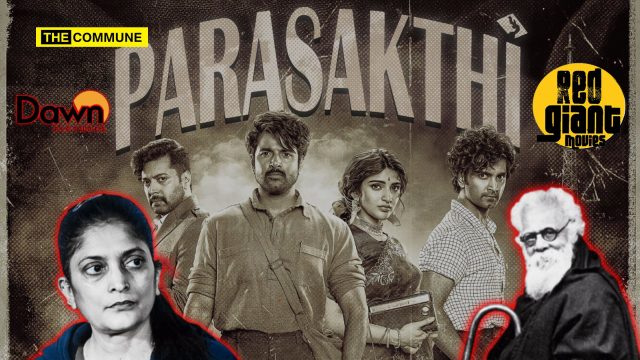
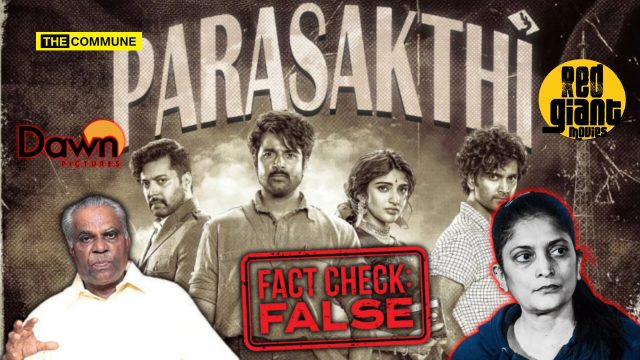
The disaster of a film called Parasakthi, directed by Sudha Kongara, have reignited debates around Tamil identity, anti-Hindi politics, and the ideological legacy of the Dravidian movement. While the film positions itself as a politically conscious narrative engaging with the Hindi imposition question, it selectively presents history, omitting crucial aspects of EV Ramasamy (EVR/Periyar)’s own documented positions during the 1965 anti-Hindi agitation.
The omission does not seem to be accidental, but that of politically convenience.
What EVR Said In 1965 – And What The Film Avoids
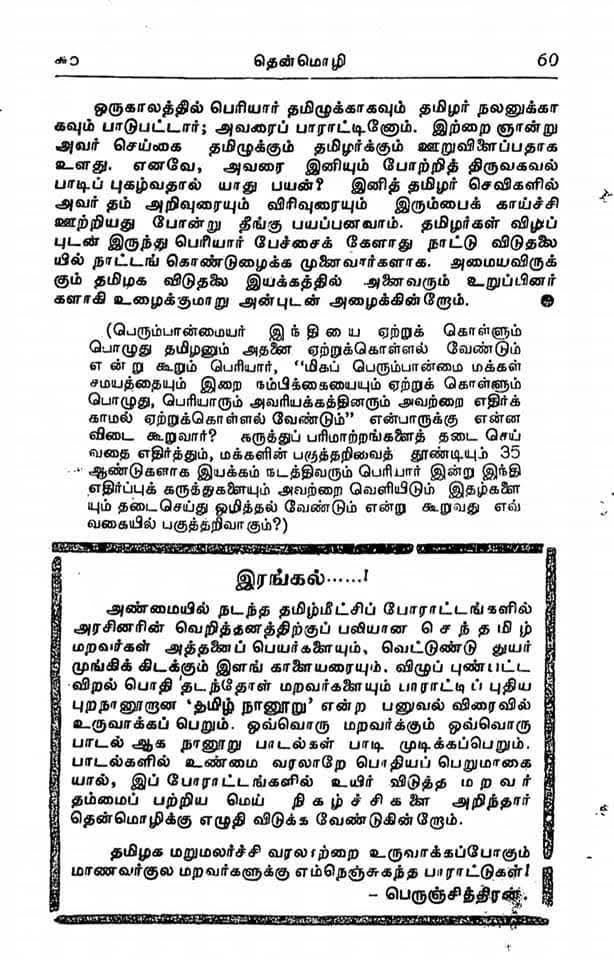
During the second anti-Hindi agitation in January-February 1965, student-led protests swept Tamil Nadu, eventually escalating into statewide unrest. While present-day Dravidian narratives often portray EVR as an unambiguous ideological force behind the agitation, contemporaneous records indicate a more complicated and controversial stance.
EVR Supported Hindi
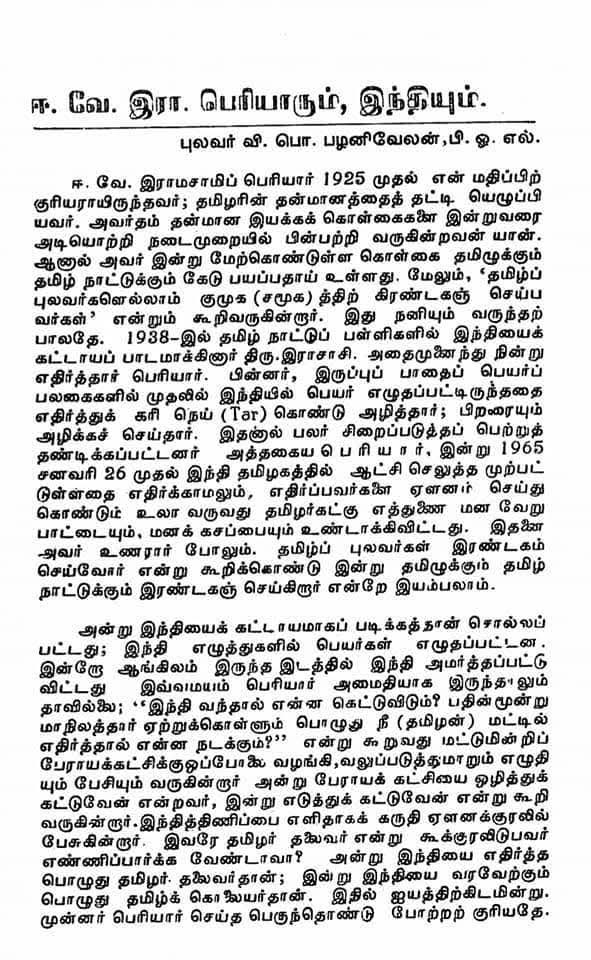
EVR is on record questioning the logic of opposing Hindi when other states had accepted it. In responses published at the time, he reportedly asked: “What harm will Hindi cause? When thirteen states have accepted it, how can you alone oppose it?” These statements drew sharp criticism from Tamil scholars and activists who were at the forefront of linguistic resistance.
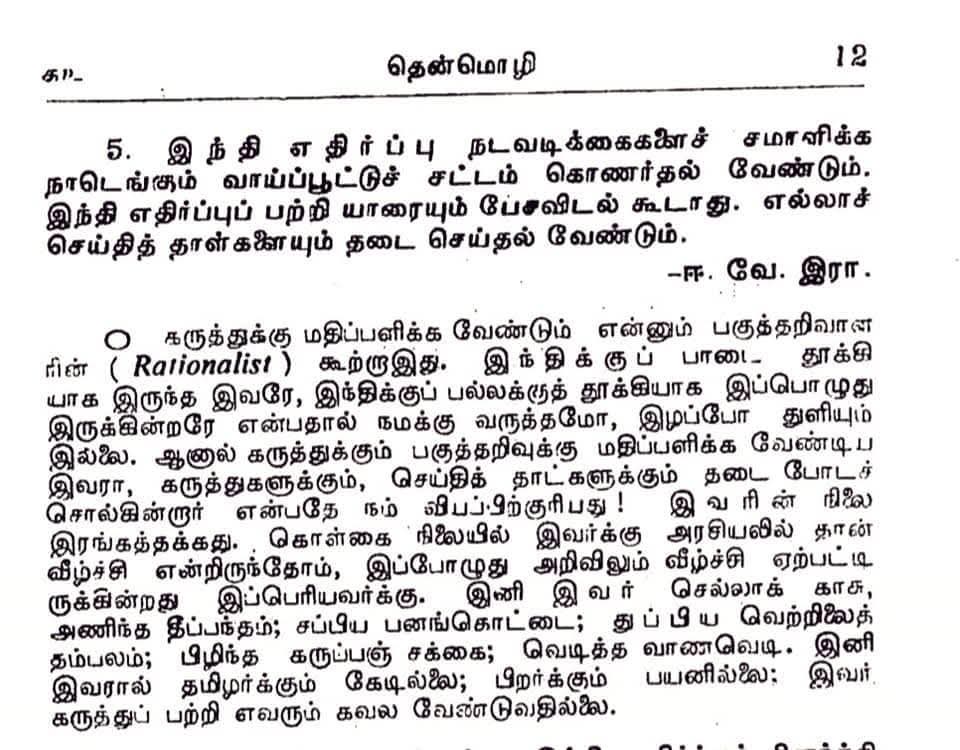
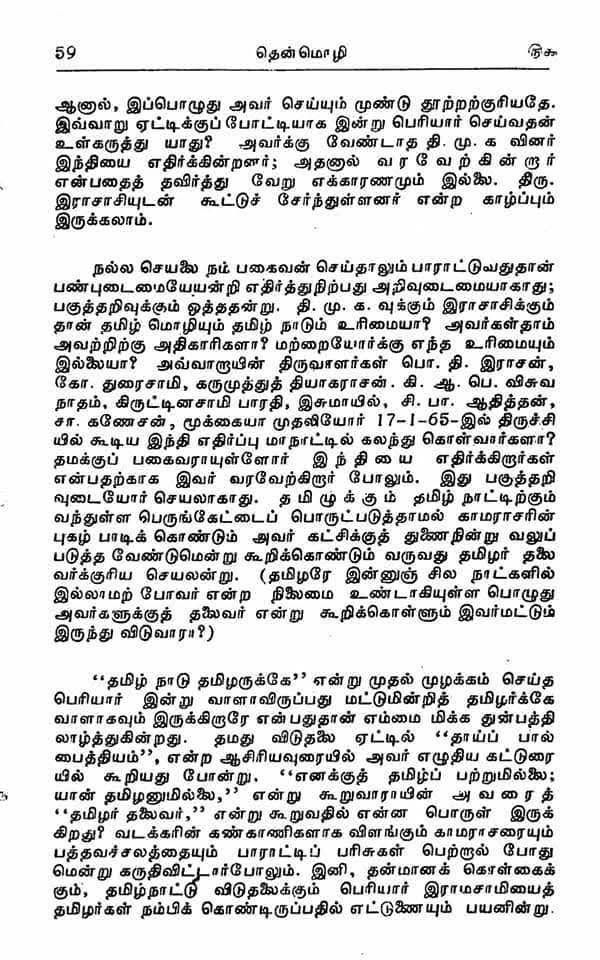
The Tamil journal Thenmozhi, edited by Devaneya Pavanar and Perunchithiranar, published sustained rebuttals to EVR’s position. Scholar Pulavar VP Palanivelan, writing in the same period, reportedly dismissed claims that EVR could be considered a Tamil nationalist leader, calling such portrayals misleading.
Students As “Rowdies”: EVR’s Characterisation Of The Agitation
In a 1965 Pongal special issue of Kurinji, edited by Nedumaran, EVR was asked about the reasons behind student unrest. According to K.P. Neelamani’s book Thanthai Periyar, EVR attributed the agitation not to Hindi imposition but to what he described as governmental weakness and the spread of indiscipline and “rowdyism” among students.
While Congress leader K Kamaraj is reported to have cautiously suggested that northern leaders viewed the agitation as politically motivated, EVR went further, openly describing the protests as a “movement of rowdies” and criticising the Congress government for failing to suppress them effectively.
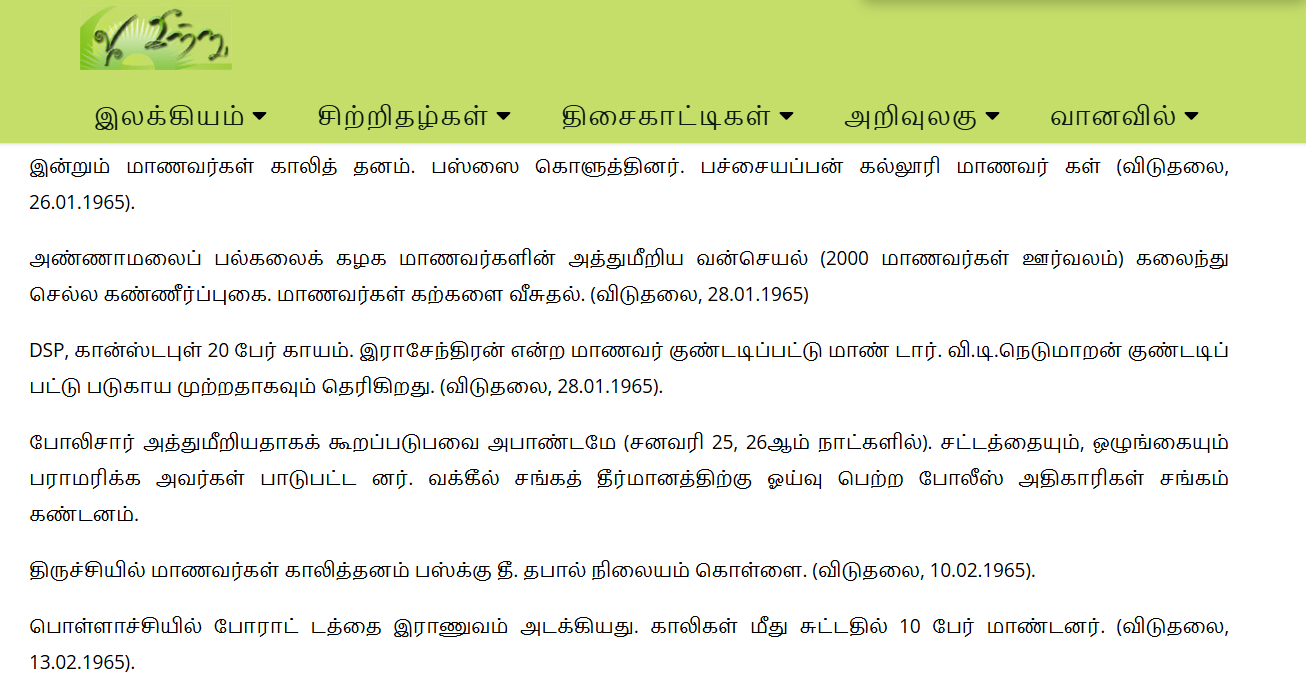
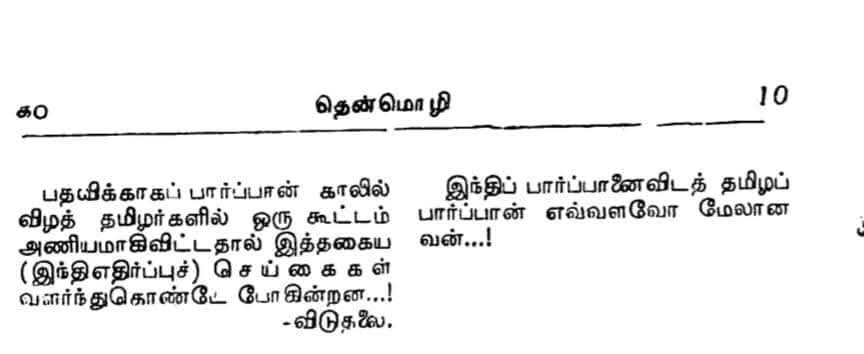
Archives of DK’s own mouthpiece Viduthalai from the period show that it was EV Ramasamy (hailed as ‘Periyar’ by his followers) who openly criticised the protesting students, referring to them as hooligans and questioning the political motives behind the agitation.
இன்றும் மாணவர்கள் காலித் தனம். பஸ்ஸை கொளுத்தினர். பச்சையப்பன் கல்லூரி மாணவர் ள் (விடுதலை, 26.01.1965).
“Today also students indulged in hooliganism. They burnt buses. Pachaiyappan College students” (Viduthalai, 26 January 1965)
திருச்சியில் மாணவர்கள் காலித்தனம் பஸ்க்கு தீ. தபால் நிலையம் கொள்ளை. (விடுதலை, 10.02.1965).
“In Trichy, students indulge in hooliganism. Bus set on fire. Post office looted.” (Viduthalai, 10 February 1965)
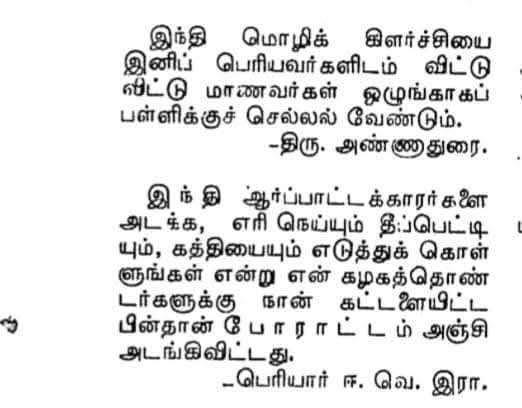
EVR, through his ‘Viduthalai’ newspaper, supported the brutal repression carried out by the police against the protestors.
He even went to the extent of instigating violence against the protestors saying “The hooliganism has increased. Comrades! Keep kerosene in your hands ready. Keep a matchbox. When I point, you light the fire.”
Source: Keetru
This position stands in stark contrast to the moral framing of student resistance that later Dravidian narratives and now Sudha Kongara’s Parasakthi, appear to endorse.
Clash With Rajaji And Escalation Of Rhetoric
The period also witnessed a public exchange between EVR and C. Rajagopalachari (Rajaji), who argued that English, not Hindi, was the most practical link language for India and warned that developments in Tamil Nadu risked deepening internal divisions.
EVR responded sharply in Viduthalai, criticising the DMK and Tamil movement supporters and accusing them of political opportunism. Thenmozhi countered by accusing EVR of effectively aligning with North Indian dominance while attacking Tamil voices within the state. The exchanges reportedly intensified EVR’s hostility toward the agitation.
Calls For Suppression And Extraordinary Measures
According to Thenmozhi and R. Muthukkumar’s History of the Dravidian Movement, EVR went on to advocate extreme measures, including banning political parties such as the Swatantra Party and the DMK, shutting down newspapers, and imposing gag orders to prevent discussion of the anti-Hindi agitation.
As the protests spiralled into violence marked by police action, arson, firing on students, and suicides – DMK leader CN Annadurai issued a statement distancing the party from student violence and calling for restraint.
EVR’s response, however, proved even more controversial. In a 1965 issue of Viduthalai, he reportedly claimed that the agitation subsided only after he instructed party cadres to take up incendiary materials, knives, and fire implements to intimidate and suppress protesters.
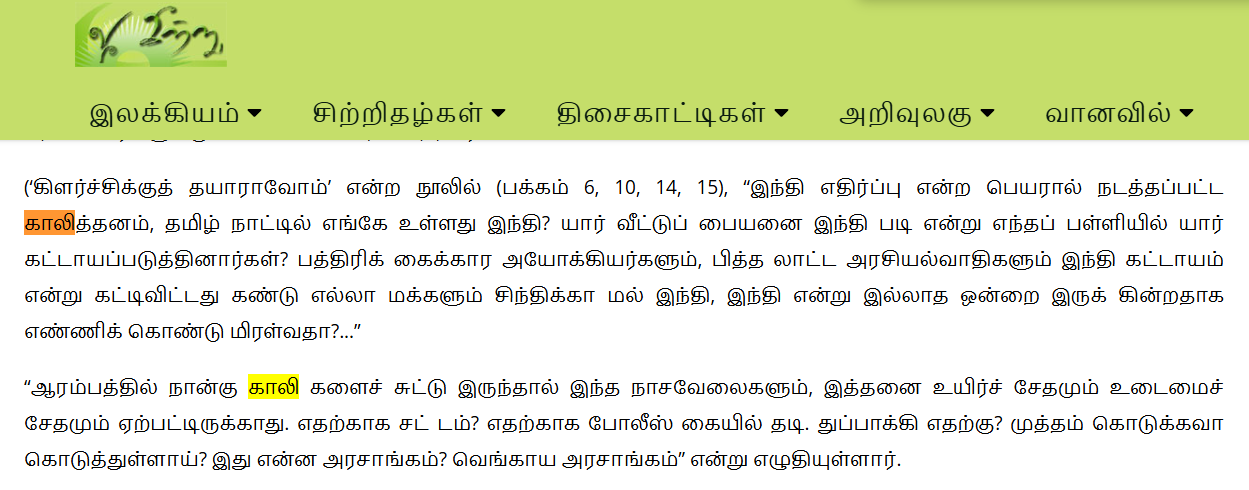
In the book “Kilarchiku Thayaaraavom! (Let’s Prepare For The Uprising)”, EVR wrote “The vandalism carried out in the name of anti-Hindi! Where is Hindi in Tamil Nadu? Which school mandated any student to study in Hindi? The newspaper scoundrels and crazy politicians who are peddling about ‘mandatory Hindi’, you people without thinking are being scared about imaginary ‘Hindi’ which doesn’t even exist!”
He further went on to say “If four hooligans had been shot in the beginning itself, all this vandalism and so much loss of life and property would not have occurred. Why is there a law? Why does police have lathis? Why do they have guns? Have they been given to kiss? What kind of a government is this!”
Source: Keetru
Bhaktavatsalam’s government, officially treated the protests as a law-and-order issue. His administration repeatedly warned against violence, threatened “stern action,” and deployed police and paramilitary forces, while blaming opposition parties like the DMK and Left groups for large-scale destruction of public property.
There are no official documents to prove that at any point Bhaktavatsalam publicly used the language attributed to him in the trailer. Transferring EVR’s words onto a Congress leader is a clear attempt to sanitise and distort EVR’s actual position.
Rejection Of Tamil Sentiment Itself
Beyond the Hindi question, EVR repeatedly criticised Tamil emotionalism. In a 1967 Viduthalai article dated 16 March, he warned the public against those who, in his words, sought to “survive by exploiting Tamil sentiment,” dismissing slogans about protecting Tamil or sacrificing one’s life for the language as deceptive tactics aimed at misleading ordinary people.
Cinematic Convenience
Sudha Kongara’s Parasakthi engages with the symbolism of anti-Hindi resistance while excluding EVR’s own scepticism, denunciations, and calls for suppression during the 1965 agitation. By doing so, the film seems to reinforce a streamlined political narrative rather than engaging with the historical record in its entirety.
This form of cinematic storytelling – selective, sanitised, and ideologically aligned that serves present-day Dravidian politics by preserving a morally consistent lineage, even if that consistency requires erasing inconvenient facts.
Tamil Nadu’s debt crisis is usually hidden behind crore-and-lakh figures that sound distant and technical. But break it down to the most basic unit of the Dravidian welfare state, the ration card, and the picture becomes brutally clear.
As per the 2025-26 Budget, Tamil Nadu’s outstanding liabilities are projected to touch about ₹9.30 lakh crore by 31 March 2026. With around 2.24 crore active ration cards in the state, this translates to over ₹4 lakh of debt per ration-card–holding household.
This is the real cost of the “Dravidian model”.
Every family that stands in line for subsidised rice is also, unknowingly, being handed a ₹4-lakh debt note, issued in its name, to be serviced through future taxes, reduced public spending, and shrinking fiscal space.
Welfare Branding, Borrowing Reality
The Dravida Munnetra Kazhagam government sells itself as the guardian of the poor, but its fiscal behaviour tells a different story. Instead of tightening finances after COVID-era shocks, the state has doubled down on borrowing as a governing strategy.
Interest payments, salaries, and pensions already consume a majority of revenue receipts. Yet the borrowing spree continues, less to build long-term productive assets, and more to sustain an expensive political ecosystem built around subsidies, cash transfers, and administrative expansion.
The result is not empowerment, but quiet fiscal mortgaging.
Debt That The Poor Did Not Choose
Schemes like the Tamil Nadu Assured Pension Scheme (TAPS) add massive, open-ended liabilities to the state’s balance sheet, primarily benefiting a relatively small, organised government-employee class. These commitments run into tens of thousands of crores over time.
The irony is stark. The ration-card holder does not gain from these pension guarantees. Yet it is precisely this household that absorbs the long-term cost through debt accumulation.
The poor get the optics. The bill goes elsewhere.
A Generational IOU Dressed Up As Welfare
Debt is not morally neutral. Every additional rupee borrowed today becomes a claim on tomorrow’s children – on their schools, hospitals, transport systems, and job opportunities.
By accelerating borrowing rather than correcting course, the current regime is effectively issuing an inter-generational IOU without public consent. Social justice rhetoric cannot disguise the fact that rising interest payments crowd out future developmental spending.
Seen through the ration-card lens, the numbers are unambiguous:
Total debt: ~₹9.3 lakh crore
Active ration cards: ~2.24 crore
Debt per household: ~₹4.1 lakh
That is the DMK’s most consequential welfare delivery – an invisible family card stamped not with free rice or cash, but with a long-term debt obligation that ordinary Tamil households will keep servicing for decades.
The question is no longer whether Tamil Nadu is borrowing.
It is who pays and who benefits.
Subscribe to our channels on WhatsApp, Telegram,Instagram and YouTube to get the best stories of the day delivered to you personally.
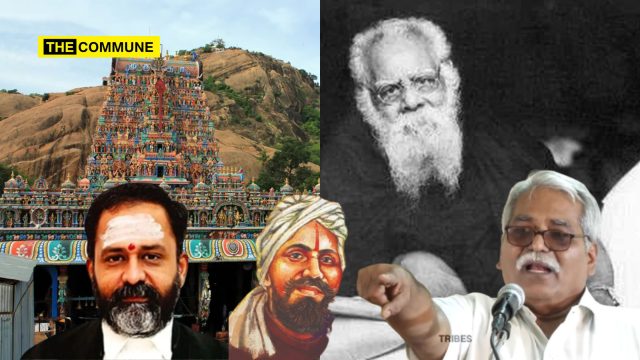
The recent happenings in Tamil Nadu seem to have unnerved the Dravidianist ecosystem. On the one hand, we have the Thirupparankundram judgement given by Justice GR Swaminathan and on the other, we have NTK Chief Seeman who praised Bharathiyar at a VIGIL event.
Both these instances have left the Dravidianists fuming and the aftermath of this is seen as meltdowns. One such meltdown was suffered by Dravidianist ‘anti-methane’ professor Jayaraman. Add to this, the perennial fear of the BJP-RSS.
Here is the transcript of the speech given at a recent event.
He began by claiming that Hindu organisations are intentionally trying to create a communal situation. He said, “There is so much fear and tension. We all ran and took shelter inside a gate—20 or 30 people together. We did not know whether they were Muslim or Hindu. Creating tension among people who live together like this, provoking violence, inciting unrest—this is something some people have been doing for a very long time.”
He added, “They have an agenda behind it. Just like that, many people would have seen with their own eyes what I am about to say. In 1990, there was a riot. In the name of a Vinayagar procession, drums were beaten in front of a mosque and provocation was carried out. All this happened. There was police firing, and two people were killed. I want to point this out here.”
He further said, “I say this because those are bitter memories of the past—things that should never happen again. If we all believe that such things should never happen on this land, then look at what they are saying today. H. Raja is saying, “We will turn Thirupparankundram into Ayodhya.” H. Raja is saying this openly. That gang’s intention is exactly that. “
Speaking further, he said, “But fundamentally, we must understand some things. Whether they are Muslims or Hindus, they are all people of this land, sons of this soil. Even if Muslims may have come from outside at some point in history, today their way of life and their language is Tamil. Urdu-speaking Muslims will also be there. But they are Tamilians, they belong to the Tamil national community, because their life language is Tamil.”
Speaking on ‘racism’, he said, “About 700 years ago-when it was 14th century, Telugus came here during the Vijayanagara Empire. If they have been living here for 700 years, is it right to say, “You are Telugu, I will not accept you as Tamil, you don’t deserve equality”? Aren’t all of them Tamils? We all speak Tamil. We all live in Tamil. Does it mean that only you are Tamil, and your ancestors must also have been Tamils for generations? This is called racism. Hitler said the same thing: that one must be racially pure Aryan for three generations. He was a fascist. If someone says your ancestors for three generations must be natives of Tamil Nadu, saying, “Tell me your caste, then I will decide whether you are Tamil or not” – that person is mentally sick, a fanatic, someone who must be rejected by society. That is the situation today.”
He further said, “There is no such thing as Muslims here and Hindus there. This is their religion, that is their method of worship. Using this to divide people is a crime. We will never allow this—not now, not ever. They raise slogans like “We will reclaim Tamil virtue.” For Tamils, from the very beginning, the first lesson itself is about virtue, isn’t it – Aram Seyya Virumbu (Have the desire to do good / righteous deeds)? “Aaruvadhu Sinam – Anger must subside/one must restrain anger”—that is what our school lessons teach us. We are taught “pirappokkum ellaa uyirkkum sirappovvaa seydhozhil vetrumai yaan” meaning “Birth is the same for all living beings / all people are equal by birth.” We were also taught, “Yaadhum oorey yaavarum kelir” meaning “Every place is my town/homeland, all people are my kin.” That is our value system. Tamils have always had a distinct ethical way of life. That must be protected forever.”
Linking the Thirupparankundram to the RSS, he said, “Why are we talking about Thirupparankundram today? Because according to their calculations, they are trying hard to see if they can create a Hindu–Muslim riot using Thirupparankundram. The case is ongoing. Advocate Vanchinathan—our beloved advocate—is directly arguing in that case. He has presented excellent, accurate information with precise data. That is something that gives everyone clarity and usefulness, and we must thank him for that. Friends, Thirupparankundram does not need much explanation. But think carefully. In every department, they have filled positions with RSS people. IAS officers—most of them today are RSS. Senior police officers—RSS. Senior Army officers are RSS. Not just the executive, even the judiciary now has many RSS sympathisers. Academics are RSS. Archaeology department—RSS. Journalists, media persons—mostly RSS. In all North Indian parties, including the Congress, RSS cadres are present. RSS is what rules. BJP is merely the political wing of RSS.”
He added, “Rajagopalachari once said Tamil Nadu is a separate island—because this land does not accept religious fanaticism. Along with natural Tamil ethics, Periyar’s contribution in the past stands today as a fortress guarding this land. Having said this, I must say one more thing. They have now taken up the project of isolating Muslims. They want to separate Muslims from those atheists and believers who stand with them as family, as mother and child. RSS has taken this up as a mission.”
Pointing to the latest speech given by NTK chief Seeman on a VIGIL platform, he said, “An RSS organisation called “Vigil” is holding meetings. They invite leaders who shout “Tamil, Tamil.” They put them on stage and ask them to abuse Periyar. They abuse the word “Dravidianism.” What is Dravidian? It means opposition to Aryan dominance, opposition to Brahminism, opposition to the Vedas, opposition to Puranas, opposition to epics, opposition to Sanskrit, opposition to Hindi, opposition to the political face of Brahminism operating under Indian nationalism. They know that without destroying Dravidianism, they cannot create a Hindu Rashtra. So they call anyone willing to beat drums for money, put them on stage, and make them abuse Periyar and Dravidianism. That abuse doesn’t matter—we know it. But the crucial point is this: Periyar and Dravidianism have stood as a protective shield for Muslims. They treat them as relatives—uncles, nephews—live with them as family. Hindus pull the chariot at the Sandhanakoodu Dargah festival. Muslims serve jigarthanda, at the Kallazhagar festival. You cannot tell who is Muslim and who is Hindu unless there is a skullcap or beard—otherwise everyone is the same. In such a situation, RSS puts up stages and not only abuses Dravidianism and Periyar but also brings Muslim women and makes them abuse Periyar and Dravidianism in filthy language. Today they may not feel resentment, but tomorrow, when Muslim women are made to publicly insult Periyar and Dravidianism, what guarantee is there that bitterness will not arise? I believe this is a calculated attempt to remove the protective shield Muslims have and isolate them. Look at North India. Muslims cannot walk freely in Uttar Pradesh, Madhya Pradesh, Uttarakhand. Christians cannot celebrate Christmas in Assam, Uttarakhand, Madhya Pradesh, Odisha. Attacks happen during Christmas. Santa Claus capsellers are beaten. All this is happening. This cannot be done in Tamil Nadu. So the strategy is to attack the shield protecting minorities by making Muslim women abuse Periyar and Dravidianism. Friends—Muslim friends, comrades from other organisations—must understand this conspiracy before it is too late.”
Taking aim at Justice GR Swaminathan, he said, “They speak about Justice G.R. Swaminathan. Advocate Vanchinathan explained clearly his mindset, approach, and the case. We have serious doubts. Does a judge have the authority to order CISF—a force meant to protect courts—to escort someone with 67 personnel and two trucks to light a lamp? Can a judge become both adjudicator and executor? Is this not a violation of law? Is this not blatant misconduct? Because the judgement is wrong we go for an appeal. So if he makes a wrong judgement, executes it with paramilitary forces and our state police forces are stopping them, what is this game? Can we not file a case against GR Swaminathan? What GR Swaminathan did is a blatant mistake. It is a violation of the law, violation of the constitution. If anyone else did this, we would call it criminal. Why should it be different because it is a judge? Everyone knows that there is no judgment anywhere that says the pillar near the Dargah is the Deepathoon. Even the petitioner Rama Ravikumar did not use that word. The judge invented it. He is trying to implement their schemes.”
He added, “There is a 2021 judgment stating courts should not interfere in ritual practices. When I myself know it, won’t Swaminathan know about it? How can it be justified when he does it knowingly. He has been doing a lot of mischief. Survey stones exist everywhere. The hills are like this. Just like how we name places as Ice House, Triplicane, similarly they have identified the hill where Sikandar dargah exists as Sikandar Hill. They then create a problem saying we must not call it Sikandar Hill. These people have a list – to destroy 3000 mosques across India. There are some 100+ such places from TN. In that list, Sikandar Dargah is there, there is Madurai Kasiyar Mosque, Arcot Mosque. They are creating a list to destroy everything. In such a situation, it is our duty to prevent this from happening. Vanchinathan told us. That stone is a survey marker from the Great Trigonometrical Survey initiated in 1802 by the British under William Lambton and later George Everest. All this is documented. But ignoring facts and provoking conflict is the problem.”
Taking aim again at the RSS, he said, “They have a plan. RSS was founded in 1925. This is its 100th year. Their goal is to establish a Hindu Rashtra. Hindu Rashtra means Brahmins live in power, everyone else lives as Shudras. There is no Vaishya or Kshatriya, all are shudras. Muslims and Christians have no place—they must convert and become a Shudra – no you cannot become a Brahmin or leave the country. They have kept people in TN to do that, to speak on their behalf. This is why they say “return to your mother religion.” Muslims are Satan’s children. We understand their language very clearly and also their roots. We also know whose voice this is. This must be understood by Muslims. This is the time to stand united. You cannot survive alone. Citizenship stripping is their next step. Then there will be nothing. My name is Jayaraman, I will be spared. But if your name is Abdul kadar, they will ask the certificates of your father, grandfather, ancestors. If you cant show them that, they will say you have come from outside and ask you to leave. See what a great act of wickedness this is. Till the tsunami came, no one knew what it was. Only after it came, we knew that we will be pushed into the sea. That is their plan. He says he will change it to Ayodhya. What does that mean? It means that with the judiciary in their grasp, they will snatch everything. That is what happened.”
Speaking about the Ayodhya issue, he said, “In 1528, Babar, his commander Mir Baqi built that mosque. Read the Babarnama. Babur ruled only five years. He preached religious tolerance to Humayun. A very great man. He did not have even a shred of religious intolerance. His commander built it. There is no proof that a temple was demolished to build the mosque. People lived in the 12th century. There is proof that Jain monastries existed there. But the mosque was built on that. Only that evidence was found. There is no archaeological evidence to prove a temple existed. They locked the Babar Masjid after creating a problem in 1948. In 1949, they brought some idols and kept it inside. They claimed Lord Rama appeared, he burst open and came? They said that and only then you will understand what the judiciary is. Faizabad judge KK Nair was the GR Swaminathan of that day and age. When Jawaharlal Nehru said we must remove it, Nair said there will be communal riots and the idols must not be touched. KK Nair was Faizabad magistrate. Then at one point, they closed it. They opened it and allowed people to worship. They instructed Muslims to worship on the other side. In 1986, the order to open the temple was also a judge, Justice Pandey. Even that was done by a judge. In 1992, the mosque was demolished. After that the Allahabad court asks the archaeological survey to be conducted. There was no evidence for the existence of a temple during the survey. When an archaeologist went to survey and asked for the details, they refused to give it to him. ASI refused to give it to him, DN Jha.”
Speaking about RSS Sarsanghchalak, he said, “Now RSS chief Mohan Bhagwat came to Trichy and said the Thirupparankundram verdict must favour Hindus. When Bhagwat speaks, they will obey. If he speaks, demolition follows sooner or later. There’s also the question of what we are going to do to prevent that, isn’t there? Mohan Bhagwat himself has said that a Hindu nation will be established. Friends, the term ‘Hindu nation’ is a bad word, a dangerous word. Ambedkar warned us: if Hindu Rashtra ever comes, it must be stopped at any cost. He knows what a Hindu kingdom means; it’s the same thing, a Hindu kingdom is a Hindu nation. He has said that 100 years have passed and we haven’t done it yet, but we will in another 15 years. He says that a Hindu nation is needed and they will establish it at all costs. Mohan Bhagwat says, “Our vehicle has started; don’t get in the way. Our vehicle only has an accelerator, no brakes. You will be destroyed.” Mohan Bhagwat is a powerful man today. His henchmen are forming and running political parties in Tamil Nadu, aren’t they? Auditor Gurumurthy has formed a party and obtained political party status for it, hasn’t he? You can search for it online. Read D. Balasubramanian Adithan’s article. Please understand what is happening. In this situation, we cannot remain silent with our hands tied. Everyone must be vigilant. Everyone must stand together hand in hand. Islam is their religion; worshipping Jesus is the way of worship for Christians; worshipping local deities and other gods is the worship of Hindus. Friends, we cannot stay silent. Everyone must awaken. Everyone must stand together.“
Subscribe to our channels on WhatsApp, Telegram,Instagram and YouTube to get the best stories of the day delivered to you personally.
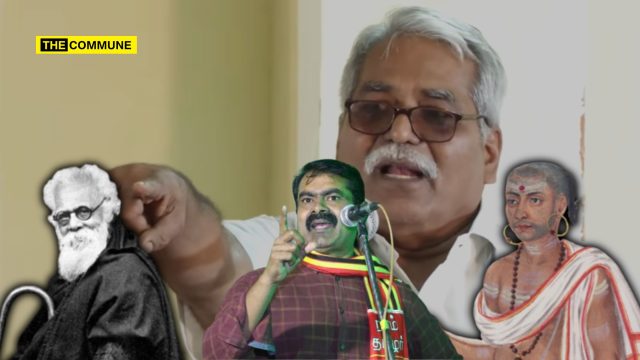
When society does not speak the language of the Dravidianists, but that of nationalism and Dharma, the Dravidianists panic. They abuse the Brahmins in their anxiety. That is what happened when Dravidianist Prof Jayaraman made a speech recently in the aftermath of NTK Chief Seeman giving a speech about Mahakavi Subramaniya Bharathiyar.
Here is a transcript of the speech:
Attacking Seeman without naming him, he said, “If someone cannot distinguish between Tamil nationalism and livelihood-based opportunist politics, then that person should not run a party. That party should be dissolved. Otherwise, it is nothing but deception. In the evening, a man buys four kilos of jaggery. The next day, he stuffs it into an old asafoetida tin and sells it as medicine. That is called fraud. That is a crime. If you don’t know what Tamil nationalism is, you should learn it. You should not stand on a stage and say, “Tamil nationalism” without understanding it.”
He continued, “This nation has fought for its liberation from the past. Didn’t Periyar ask for Tamil Nadu’s liberation? When he said, “Tamil Nadu for Tamils,” what did that mean? Everyone thought he meant a state. Periyar meant an independent nation. A long struggle happened. It has continued till today. Periyar, Pavalar Perunchithiranar stood firm. Fighters like Thozhar Thamizharasan, Pulavar Kaliyaperumal stood in the field. Their organisation functioned until 2002. Even today, that spirit exists. If people can be cheated by falsely defining Tamil nationalism, whose fault is that? Where is the mistake? We do not know.”
Explaining what nationalism was, he said, “Just remember this: the word “nationalism” appears only in 1772. Nations existed before that. When nationalism was born, it had a meaning. That is why today we speak of French nationalism, Scottish nationalism, Tamil nationalism. Nationalism is the liberation ideology of a nation. Tamil nationalism is the liberation ideology of the Tamil national people. The foundational slogan of Tamil nationalism is liberation. It cannot have any other meaning. Does a dog have another name? A dog is a dog. A tiger is a tiger. Can we all sit together and decide to call a street dog a tiger? No. Tamil nationalism is extremely fundamental. These youngsters must become clear. Don’t lecture me too much. There is a word “nation.” Nation does not mean land. It does not mean map. Nation refers to a people — a national people. So, what is nationalism? Nationalism means nation becoming a nation-state. That is the definition.”
He continued, “So what is Tamil nationalism? What is nationalism? Nationalism means a nation becoming a nation state. This is the definition. Tamil nationalism means the Tamil national people creating a sovereign Tamil nation. That alone is Tamil nationalism. Don’t twist it and say something else. Speak with some sense of responsibility. Such tricks cannot be ideology. Mobilising a people, awakening their historical unity, and guiding them towards creating a sovereign nation — that is Tamil nationalism.”
Bringing EV Ramasamy into the topic, he said, “From 1938 onwards, what Periyar spoke and practised was Tamil nationalism. That essence is what later came to be called Dravidianism. Now people deliberately confuse by inserting Dravidianism. I won’t speak much about the word Dravidian. First, Dravidian refers to South Indian geography. Second, it refers to a language in South India. Thayumanavar in the 18th century said, “If someone fluent in Sanskrit comes, I will speak in Dravidian.” If a scholar of Tamil comes, he says he will speak some things in Sanskrit. If you say there was a language called Dravidian, it is Tamil. Telugu is not called Dravidian, and Telugu people are not called Dravidians. We must be very, very clear about this. The name Dravidian belongs only to the Tamil language. “Ava” (indicating Brahmins) said the language they speak was Dravidian and we, in the lower strata, called Tamil as Tamil.”
He continued, “In 1899, Tamil scholar Sabapathi Navalar published a book titled History of the Tamil Language. Its name was Dravida Prakasikai. One thing having two names – like food is called soru and saadham. Some people used “Dravidian” as a prestige term and “Tamil” as inferior. Robert Caldwell in 1856 scientifically proved that South Indian languages belong to one family. He had to name the family of Dravidian languages. He said he couldn’t find a better term than “Dravidian.” Tamil speakers are Tamils; speakers of the Dravidian language family are Dravidians. So, a person who speaks Tamil,
when it comes to the language family, is a Dravidian, and when speaking Tamil, he is also a Tamilian.”
Further, he said, “Then anthropology came. Sir William Jones classified Sanskrit, Greek and Latin as Aryan languages. Similarly, Thomas Huxley in 1865 classified South Indian people anthropologically as Dravidians. Now the problem is over. The term referred to the land, and the language referred to Tamil and its linguistic sphere. The term ‘Dravidian language’ refers to all of them together: Tamil, Telugu, Malayalam, and Kannada. Besides this, another meaning emerges, and that’s what the Dravidian movement adopts. If you ask how, it’s based on the idea that Aryans are in the northern part of India, Dravidians in the southern part, and Mongolians in the northeastern region, including Manipur; all these groups are present there. Regarding the people in South India—that is, the Dravidians—Robert Caldwell writes that they are a distinct race, that they were made Shudras, and that the Aryan Brahmins came to South India and made them Shudras. Robert Caldwell, in his 1856 comparative grammar of the Dravidian languages, writes about this, and that’s when they get intensely angry. They understood that it was these Aryans who had called them Shudras and subjected them to such humiliation; this didn’t happen naturally, nor did God create them that way. After that, as you well know, it comes up in Manonmaniam Sundaranar’s poem, where he praises Tamil, the southern language that will not perish and be destroyed like the Aryan language. That’s how it comes about.”
Pushing the Aryan-Dravidian theory, he continued, “Then, who takes this up? Ayothidasa Pandithar takes this up. It was Ayothidasa Pandithar who identified himself as Dravidian and brought this identity to the forefront. I must tell you that what I’m saying now is a very important point, because it was Ayothidasa Pandithar who did this for the first time. How did he do it? Look here, we all call ourselves Dravidians and Tamils now, but in the 18th century, there was no such name as Tamils, nor was there a name like Dravidians. There were only castes; people were identified only by their castes. Many people think that we were born wearing pants and shirts, and with pullingo hairstyles. That’s not the case. The word that identifies all Dravidians did not exist then. The word ‘Tamils’ existed, but it didn’t include all Tamils. This is a very important point, please understand. So, what happened was, Ayothidasa Pandithar took up that word. In 1885, Ayothidasa Pandithar and Reverend John Rathinam together established an organization called the Dravidar Kazhagam. The Dravidar Kazhagam was established in 1885 by Ayothidasa Pandithar. The word ‘Dravidian’ appealed to everyone. Did you read Robert Caldwell? Yes, I did. We are all Dravidians, not Aryans. Tamil did not originate from Sanskrit, he clearly stated. Not only that, he said that the Aryan Brahmins had insulted us by calling us Shudras, and he wrote that we are the sons of this soil. Caldwell and other scholars discussed this among themselves. See how that change comes about.”
He continued, “The important point in that, comrades, is that Robert Caldwell, after examining comparative grammar, didn’t say, “What’s in this? What’s in that? Everything originated from one language, from the Dravidian language, from Tamil.” In his time, even Tolkappiyam wasn’t available in print. The Indus Valley Civilization excavations and research hadn’t taken place then. Based solely on Nannool, which was the only text available to him, he conducted his research. I am amazed by Robert Caldwell’s contribution. We haven’t discussed his extensive work. People might think, “Couldn’t he have simply said it’s a South Indian language family?” Ellis did refer to it as the South Indian language family. But he didn’t stop there. He searched in North India, even in present-day Pakistan, where the Brahui language, a Tamil language, exists. So, the term “South Indian language family” wasn’t sufficient. He says that he wandered around in places like Siberia in Russia, where it’s covered in ice, where wolves roam and tear apart and devour their prey, searching among the people of those regions to see if any roots of this South Indian, this Dravidian language family, were evident. It was very easy for me to get lost, he says. It was with such effort that he wrote “A Comparative Grammar of the Dravidian Languages.”
He continued, “If it took the Tamil University three years just to translate it, then such a magnificent work might have its flaws, but dismissing it so casually is wrong. However, what I wanted to say was from a different perspective. When the second edition came out in 1875, that’s when he did something significant. He wrote that there are people called Paraiyars here, and these Paraiyars are ostracized and treated like some other race. He said that he has written about the Dravidian race, and that the Paraiyars are also Dravidians, belonging to the same race. People would ask, “He is very dark-skinned,” and he addresses that too. If someone works in the sun all day, day after day, they will naturally be dark-skinned. If he stays in the shade, he will become fair. Who is saying this? Caldwell. The anger stemming from that hasn’t subsided yet. For Brahminism, there needs to be a reason for every resentment, right? You say that you can forgive someone for saying that these Paraiyars, these lower castes, belong to the same family. Robert Caldwell had already said this. Comrade Pozhilan also mentioned something. Comrades, understand this clearly: the Tamil Lexicon was created by the University of Madras. The work was completed in 1937. In that 1937 edition, if you look up what is written about Tamils, it gives three meanings: one, two, three. One of the meanings is “Tamil castes excluding the Paraiyars.” Paraiyars are not Tamils. So, understand, they didn’t include the Paraiyars in the definition of Tamil. That’s how it was. Today, thinking that people don’t know, understand how much work has been done. This generation doesn’t know, and we haven’t taught them either. So what happened? I started talking about Ayothidasa Pandithar. From there, Ayothidasa Pandithar, other scholars, and Periyar, all said that they were Dravidians, and that Dravidians are non-Aryans, and that non-Brahmins are Dravidians. And in that context, Rettamalai Srinivasan coined the term ‘Adi Dravidar’ in 1892. In 1891, Ayothidasa Pandithar and Rettamalai Srinivasan created the Adi Dravida Mahajana Sabha. There was a person called Thanthai Periyar, and from 1928 onwards… Between 1938 and the following 10 years, he conducted 25 Adi Dravidar conferences. Take that list and understand from it that the credit for uniting and bringing everyone together under the single word ‘Tamils’ belongs to Periyar and other leaders whom we respect. Today, everyone is a Tamil. Even back then, Tamil Nadu had already come into existence, hadn’t it? We are all Tamils, aren’t we? Then why, when someone says ‘Dravidian’, do some people take off their shirts, put on sacred ash all over their bodies, wear a garland, and stand submissively before Brahmins, begging for sacred ash and applying it? He might be a Tamil then. But when he defiantly twirls his mustache, his name is Dravidian. When a Tamil stands tall with self-respect, he is called a Dravidian, that’s all. When he was speaking at a place that day, Comrade Minor and others were also present. I think it was during that time that I asked a simple arithmetic question. I asked, “What is four minus two?” Comrades would easily say six. “What is five minus two?” They would say three. There’s no doubt about that. Tamils minus Brahmins equals what? This was the question. Tamils minus Brahmins equals Dravidians. That’s what Periyar said. What? How can you call me a Dravidian? That’s the only way I can explain it. Whether you like it or not, if you have the sacred thread, you are a Dravidian.
He added, “There was a magazine called Dravida Abhimani in 1884, a journal called Dravida Varthamani, also in 1884, Dravida Pandiyan, run by John Rathinam in 1885, Dravidar Kazhagam in 1885 by Ayothidasa Pandithar and John Rathinam, Dravida Nesan, a Saivite journal in 1891, Dravida Manthiri weekly in 1893, Dravida Bhanu in 1895, Dravida Pandiyan weekly in 1896, Dravida Kokilam in 1899, Dravida Mahajana Sabha by Ayothidasa in 1891. The term Dravidian is the name given to the anti-Aryan ideology established by Tamils. There is no need to be confused about this. So, these Dravidians, Dravidians mean non-Aryans. How to identify Aryans? They wear the sacred thread. Those who don’t wear it… I saw a video clip this morning, a small clip. A Brahmin religious preacher was saying, “My grandfather was there, there were grave diggers and village watchmen. A Nadar boy came into the street. They tied him upside down and skinned him alive,” he says. They tied a Nadar boy upside down and skinned him alive for coming into the street. A Brahmin is giving this testimony today, right? Do you see how much things have changed from that time to today? Who brought about this change? You think, “What did Periyar do?” You haven’t lived in a world without Periyar.”
Rubbishing the temple entry movements led by Brahmins, he said, “They say that in 1936 and 1939, Vaidyanatha Iyer was the one who took people inside the temple. All that came much later. In 1926, Periyar’s Self-Respect Movement, in 1925, they entered the Suchindram temple. Temple entry happened in 1927. I’m from Mayiladuthurai. In Mayiladuthurai, the Self-Respect Movement members entered the temple. Many temples followed suit. In 1929, in Periyar’s hometown, Erode, under the leadership of Kuthusi Gurusamy, the oppressed people entered the Kottai Eswaran temple. The doors were locked from the outside. They stayed inside for two days. Periyar, who was out of town, came and released them. Understand what all happened. We need to understand that we were under a massive system of caste-based oppression. So, who brought the word ‘Dravidian’ into the field? It was Ayothidasa Pandithar. After that, almost 59 years later, the Dravidar Kazhagam was formed in 1944. You can’t oppose the word Dravidian in the name of opposing Periyar.”
Once again, taking aim at Seeman, he said, “To be precise, I’ll tell you why this ‘Brahmin crowbar’ term came about. The ‘Brahmin crowbar’ didn’t come to oppose Periyar; it came to oppose Ayothidasa Pandithar. He couldn’t tolerate that oppressed caste. The anti-Dravidian campaign they are conducting today is a campaign against the downtrodden people, against the Dalits. That’s how it has been happening. See how subtly the Brahmins are doing it today. Because in 1924, Periyar marched in Vaikom. In Vaikom, he marched for the right of people to walk on the roads. The oppressed people did not have that right. But what happened after that? The Dravidian movement continued to fight little by little. Then what happened? They entered the temples. After that, Dr. Ambedkar guaranteed some rights in the constitution. But in 1925, the RSS started. Today it’s been 100 years. What they want is to create a Hindu nation in 100 years. They don’t want a Hindu nation for everyone. The Shudras here should only do Shudra work. They can wear pants, they can study, but they should only do Shudra work. They should only do their caste-based occupations. That’s why they say, “Wear pants, do you want to study?” If you keep saying that, they’ll quickly take away everything. Do you know the salary? Why are you only sending your child to a big international school? Will they study in an international school in English medium? Don’t the children of ordinary people need education? Periyar considered everyone as his own children.”
Winding up, he said, “Two people stood there challenging. Brahminism stood there challenging. They asked, “What is your name?” RSS, Rashtriya Swayamsevak Sangh, they asked, “What is your name?” He said, “My name is E.V. Ramasamy, some affectionately call me Thanthai Periyar.”
He continued, “Both of them started their work at the same time. In 1924, he was dragging everyone onto the streets, and he was jailed twice. At the same time, the RSS started its work there. In 1970, Periyar said, “This is a thorn in my heart. They are going everywhere, but we, the Shudras and Panchamas, cannot enter the sanctum sanctorum. I am going to conduct a protest,” said Periyar. Kalaignar Karunanidhi was the Chief Minister at that time. He said, “No, no, I will enact a law that people from all castes can become priests,” and he enacted the law. But they stopped that law using the court. After that, they gave training to everyone. Then in 2006, they made it a law. In 2015, they said that if they are qualified, they can be appointed. However, they have stopped it in the Supreme Court. This government came to power in 2021. What they have done is, since women are more oppressed than men, they appointed three women – Ranjitha, Ramya, and Krishnaveni – as assistant priests. What’s more, Ranjitha is a Dalit girl, Ramya is from the MBC community, and Krishnaveni is a girl from the Valluvar community. They have appointed 90 women as temple singers (Othuvars). They have stayed this using the Supreme Court by filing a case. That bearded man is looking and smiling. Hey RSS, you and I started our work at the same time. Now do you see? He’s saying, what is he saying? You said that no one could climb Mount Everest except Tenzing Norgay, but so many people have climbed it. You said that no one could set foot on the moon, but Armstrong and Aldrin set foot on the moon; Collins was the only one who remained in the rocket. What did you say? You can set foot on Mount Everest. You can set foot on the moon. You said that we couldn’t put our foot inside the garbagruha? Look at our children, he says, and the bearded man is stroking his beard, and he sends a man from there, giving him a crowbar. I’m coming with a crowbar, a Brahmin’s crowbar. When these crowbars come here, they don’t just get dented, they get shattered, they get crushed. A great war is going on. He says, the leader of this party says it’s a Dravidian-Tamil war. How can there be a Dravidian-Tamil war? It’s an Aryan-Dravidian war that’s happening, it’s an Aryan-Tamil war that’s happening. You’re saying that Brahmins are taking up crowbars, but we are removing the Brahmins from among the Tamils, and we, as Dravidians, are standing in the battlefield. No matter who you are, if you come as a mercenary for the Brahmins, you will be crushed. You will have no place; you will be disgraced in history. You go back to selling your herbal remedies as usual. There’s a crowd that will believe anything you say.
He added, “I only talk about principles, that’s all I talk about. Instead of expecting him to understand by listening to that, someone commented below the writing, which I thought was very well-written, “Oopi 200.” I didn’t know what Oopi 200 meant. For a long time, I thought it meant Uttar Pradesh, because in history, isn’t UP Uttar Pradesh and MP Madhya Pradesh? I didn’t know the meaning of 200. Then they said it means “comrade,” that you’re writing this after taking 200 rupees. Is that what it means? They don’t understand one thing: there are people who cannot be bought even with 200 crores, who will stand on the battlefield. They don’t know that. But my language is not understandable to them. My language is not understandable to them. Now, in computers, there are Java, JavaScript, Ruby, and all sorts of languages. I don’t know all that. Who knows? Only the computer knows. And then the computer people know. So, my language is not understandable to them. But there are two people who know how to speak in a language that is understandable: Comrade Manoj and Comrade Minor. I think they understand now. We need to be a little clearer about political history and these ideological concepts. We need to train the next generation.”
Read The Commune’s counter to Prof. Jeyaraman here.
Subscribe to our channels on WhatsApp, Telegram,Instagram and YouTube to get the best stories of the day delivered to you personally.
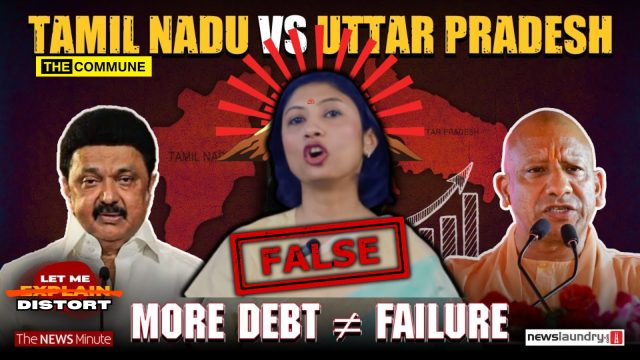
The claim that Tamil Nadu’s debt cannot be compared to Uttar Pradesh’s has emerged as the latest talking point in The News Minute’s Let Me Explain series. The episode asserts that those citing Tamil Nadu’s higher total debt are “misleading” the public and that, once “context” is applied, the State emerges not just fiscally sound but unfairly targeted by number-twisting critics.
A closer look at data however, reveals TNM’s propaganda style – selective framing, casual handling of numbers, and a typical leftist strategy – pre-empting legitimate scrutiny by declaring it “meaningless”.
Manufacturing a Victim Narrative
From the opening minute, the video frames the issue not as a fiscal debate but as a moral confrontation. Critics who point to Tamil Nadu’s higher debt are cast as peddlers of a “simple story of fiscal failure”, while the anchor positions herself as rescuing viewers from bad faith statistics.
Cross-state comparison itself is portrayed as inherently political and dishonest rather than a routine analytical tool used by the RBI, Finance Commission, PRS Legislative Research, and credit-rating agencies.
Instead of asking an obvious and legitimate question of whether Tamil Nadu’s debt trajectory comfortable and sustainable, the episode pivots to a defensive posture:
Tamil Nadu is richer, more diversified and socially advanced than Uttar Pradesh.
Debt is merely a “tool”, and richer states can naturally carry more of it.
Therefore, highlighting absolute debt numbers is either economic illiteracy or deliberate misrepresentation.
So, questioning policy is treated as questioning Tamil Nadu. The show abandons analysis and assumes the role of advocate.
Sloppy Numbers, Blurred Timelines
Any serious explainer must first get the numbers right. This is where the episode falters badly.
The video cites Tamil Nadu’s debt at ₹9.29 lakh crore and its GSDP at ₹35.6 lakh crore, producing a debt-to-GSDP ratio of about 26%. But ₹9.29 lakh crore is not the 2024–25 actual debt—it is the projected outstanding debt by March 2026, as per the 2025 budget.
At the same time, the GSDP figure used is from earlier projections. The 2024–25 budget places nominal GSDP closer to ₹31.6 lakh crore.
This mixing of future debt, with older, higher GSDP estimates artificially softens the ratio. The viewer is never told which year these figures correspond to, or that they are projections rather than actuals.
For Uttar Pradesh, the episode uses round figures – ₹9.03 lakh crore debt and ₹30.8 lakh crore GSDP – which align with 2025–26 projections, again without disclosure. Crucially, PRS data shows that UP, like Tamil Nadu, is also targeting fiscal deficits within the 3% FRBM band. That similarity is conveniently ignored.
For a show that repeatedly accuses politicians of “reading numbers out of context”, this casual blending of timelines and estimates is not a minor oversight, it undermines the entire argument.
One Yardstick for Tamil Nadu, Another for UP
The episode insists that debt must be judged relative to economic size, growth potential, and revenue capacity.
This is sound economics. But it is applied selectively.
Tamil Nadu is praised for keeping its fiscal deficit near 3% of GSDP and raising roughly three-quarters of its revenue from own sources.
Uttar Pradesh, meanwhile, is reduced to a caricature: a poor state surviving on Union transfers. There is no discussion of:
UP’s own FRBM compliance,
its recent capex push,
or improvements in tax effort—all documented in PRS and budget analyses.
If FRBM compliance and debt ratios are the benchmarks, they must apply equally. Instead, Tamil Nadu is acquitted under rules that UP is never even tested against. What is sold as “context” increasingly resembles narrative management.
Airbrushing Tamil Nadu’s Debt Risks
The video reassures viewers that Tamil Nadu’s debt ratio has “stabilised and is slowly declining”, citing projected marginal improvements from 26.6% to 26.4%.
What it does not mention:
Tamil Nadu’s debt-GSDP ratio had already climbed sharply before COVID-19, a trend flagged by the 15th Finance Commission as a medium-term concern.
Interest payments and committed expenditure viz, salaries, pensions, interest, consume a growing share of revenue, squeezing fiscal flexibility. This is documented in Tamil Nadu’s own budget papers.
COVID-19 is used as a moral alibi: borrowing limits were relaxed, states had to borrow, therefore post-2020 debt accumulation is treated as morally neutral.
But serious fiscal analysis does not end with COVID. It begins with what comes after structural costs, welfare commitments, and political competition. These are precisely the issues the episode avoids.
A neutral analysis need not claim Tamil Nadu is on the brink. It only needs to insist that being richer than UP does not exempt the State from scrutiny. The video refuses that nuance.
Declaring Scrutiny “Meaningless”
The choice of words is deliberate. The episode could have argued that cross-state debt comparisons are incomplete without context. Instead, it repeatedly calls them “meaningless” and “misleading”.
But comparisons of debt-to-GSDP, interest-to-revenue ratios, and contingent liabilities are exactly how fiscal stress is identified by bodies that monitor such risk. These metrics are not meaningless; they are starting points.
By declaring them meaningless, the show effectively immunises the Tamil Nadu government from benchmarking. That is not explanation, it is insulation.
Welfare, Outcomes, and the Cost Question
The episode’s strongest segment highlights Tamil Nadu’s genuine achievements: lower infant and maternal mortality, better health outcomes, higher school enrolment, and a higher HDI.
It argues, correctly, that these outcomes require sustained public spending, and that low debt elsewhere can signal under-investment rather than prudence.
But here again, nuance is abandoned. All spending is treated as productive and virtuous. There is no distinction between long-term, high-return investments, and recurring subsidies and politically timed schemes with unclear returns.
To even ask whether some schemes carry fiscal risk is implicitly treated as hostility.
Explanation or Advocacy?
There is a real and necessary conversation to be had about how state debt is discussed in India. Politicians routinely cherry-pick numbers. Citizens are rarely told what FRBM rules mean. Explain-style journalism can play a valuable role here.
But rebutting spin with counter-spin helps no one.
A good-faith explainer would clearly separate actuals from projections, apply the same benchmarks to all states, acknowledge both strengths and risks, and stop framing scrutiny as an attack on the State itself.
The News Minute episode gets one thing right: context matters more than raw numbers. But in its eagerness to defend Tamil Nadu from criticism, it slips into its own form of narrative control – framing legitimate fiscal questions into a morality tale of a misunderstood, virtuous government under siege. Explainers are meant to illuminate trade-offs and risks.
Regular readers of The Commune will recognise the pattern immediately – Let Me Explain is less about explanation and more about arranging the facts to suit a predetermined narrative.
Subscribe to our channels on Telegram, WhatsApp, and Instagram and get the best stories of the day delivered to you personally.
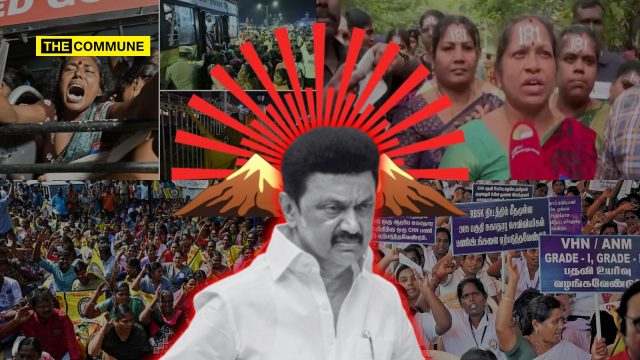
When the Dravida Munnetra Kazhagam (DMK) returned to power in May 2021 under Chief Minister MK Stalin, it did so on the back of sweeping promises to government employees, contract workers, and frontline service providers. From restoring the Old Pension Scheme (OPS) to regularising contract labour and improving healthcare worker pay, the DMK manifesto was framed as a social-justice corrective to what it described as the “anti-worker” policies of the AIADMK.
Five years later, Tamil Nadu is witnessing one of the largest and most persistent cycles of labour unrest in its history. More than 30 lakh government employees and their dependents have been affected by protests, strikes, hunger fasts, police crackdowns and long-running agitations, many of them directly linked to unfulfilled DMK manifesto commitments.
What has emerged is not a series of isolated disputes, but a systemic breakdown of trust between the state and its workforce.
Government Employees & Pensioners: The Old Pension Scheme Betrayal
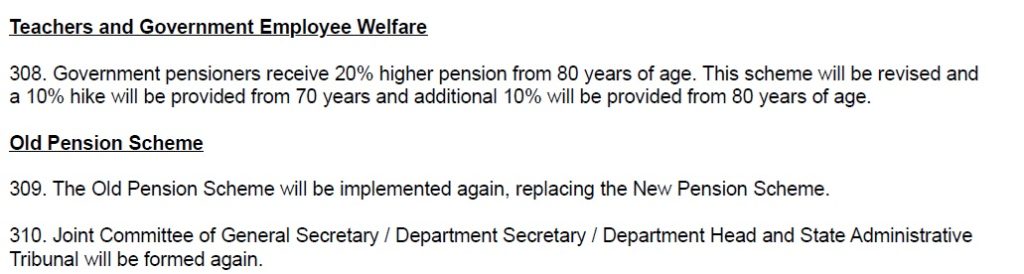
No promise was more central to the DMK’s 2021 campaign than the restoration of the Old Pension Scheme (OPS). Here is what they said in their 2021 manifesto.
Under OPS, retired employees receive 50% of their last drawn salary for life without contributing from their own wages. In 2003, the AIADMK replaced this with the New Pension Scheme (NPS), forcing employees to contribute 10% of their salary to a market-linked pension fund.
The DMK pledged to reverse this. For 11 lakh government employees, OPS was not a technical issue, it was the foundation of their retirement security.
Yet for nearly four years after taking office, the Stalin government did nothing. Union after union, including the powerful JACTO-GEO, wrote memorandums, held meetings, staged district-level protests and organised hunger strikes. Each time, the government responded with vague assurances and fiscal excuses.
By late 2025, patience snapped. With no movement from the state, unions announced an indefinite statewide strike from 6 January 2026, a move that would have shut down revenue offices, transport departments, schools and local bodies.
Facing paralysis, Stalin announced a last-minute compromise: the Tamil Nadu Assured Pension Scheme (TAPS). It promised 50% of last salary as pension but only after employees contributed 10% every month, just like under NPS. OPS had required no contribution.
Unions accepted TAPS only to avert chaos, but they did so under protest. The central promise that had brought millions of votes to the DMK was, in substance, never delivered. Read here what TAPS is all about.
Teachers: Equal Work, Unequal Pay
Tamil Nadu’s education system is quietly bleeding because of a policy discrimination that has lasted over 16 years.
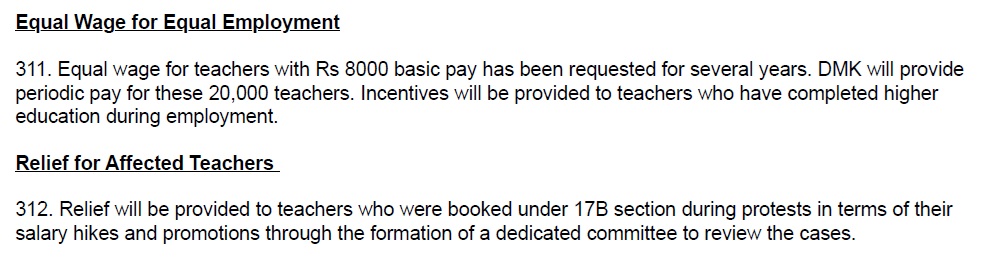
Secondary Grade Teachers (SGTs) appointed after June 2009 are paid ₹3,170 less per month than teachers appointed earlier, even though they do the same work, teach the same students, and hold the same qualifications. Over a career, this amounts to more than ₹6.4 lakh stolen from each teacher.
The DMK promised to correct this injustice. Here is what they said in their manifesto.
It did not. By December 2025, thousands of teachers were back on the streets. Demonstrations spread across districts, accusing the government of institutionalising discrimination inside public education. Many teachers are now approaching retirement without ever receiving pay parity.
Despite years in power, the DMK has refused to issue a simple administrative correction.
Nurses & Doctors: Frontline Workers Treated as Disposable
The DMK rode to power on the moral capital of the COVID-19 crisis, where nurses and doctors had risked their lives. But its treatment of healthcare workers since then has been devastating.
Contract Nurses
Tamil Nadu runs its hospitals on the backs of nearly 8,000 contract nurses. They earn less than permanent nurses, lack job security, and are denied full maternity benefits. Meanwhile, only 723 nurses are on permanent government rolls.
In December 2025, hundreds of nurses launched a hunger strike in Chennai, demanding regularisation and maternity leave. After police arrests and public pressure, the government regularised only 723 nurses, leaving over 7,000 still trapped in contract labour.
Community Health Officers: Overworked and Underpaid
More than 4,000 Community Health Officers (CHOs) run rural primary health centres. They are the backbone of maternal care, vaccinations and disease prevention, yet they are paid just ₹18,900 per month, less than half of what their counterparts earn in Kerala and Haryana. In December 2025, CHOs marched on Chennai demanding salary parity, maternity leave, and permanent status. They called off their protest after the government acknowledged their demands but offered no timeline.
Sanitation Workers: Dalit Labour and Corporate Contracts
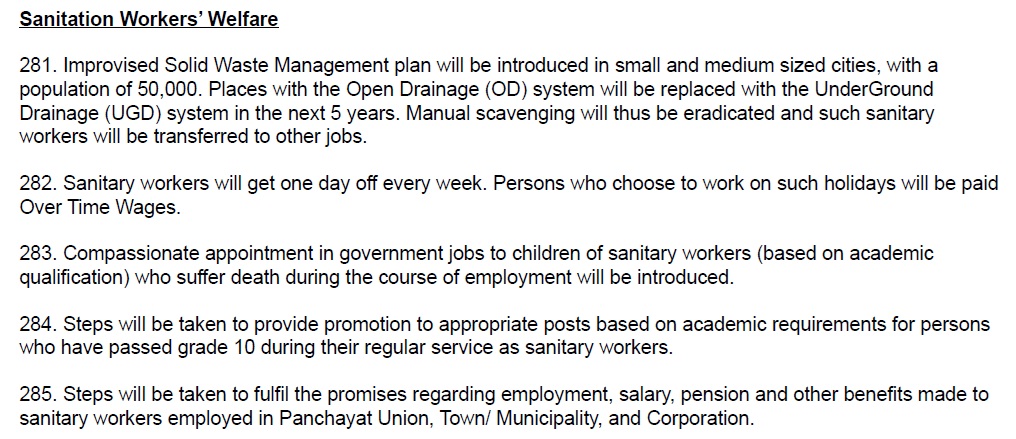
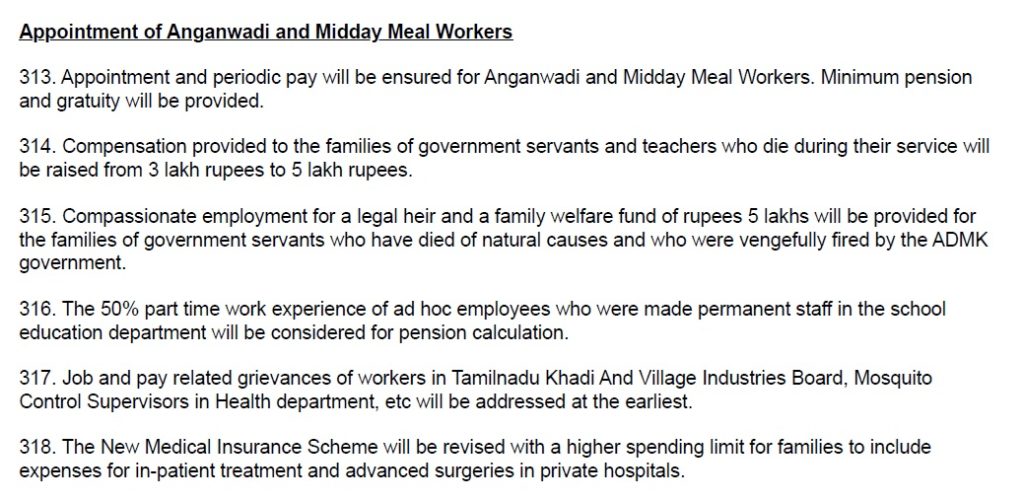
Nowhere is the DMK’s betrayal starker than in Chennai’s sanitation sector. Mostly Dalit women, sanitation workers were promised permanent government jobs by Stalin in opposition. This is what was there in the manifesto.
Instead, after coming to power, the DMK expanded corporate outsourcing of garbage collection.
From August 2025, 2,000 sanitation workers sat in protest for over 74 days outside the Greater Chennai Corporation. They lost ₹46 crore in wages, pulled children out of school, skipped medical treatment, and were beaten and detained by police. Their demand was simple: regularisation and an end to privatisation.
The protests continued till January 2026 and only on 12 January 2026, after DMK Minister Sekar Babu met them and promised to resolve their grievances, did they call of their protest. However, it is not clear if they will have all their concerns addressed.
Anganwadi Workers: 4 Lakh Women Still Waiting
Anganwadi workers run Tamil Nadu’s nutrition and childcare programmes – feeding infants, monitoring pregnant women, and preventing malnutrition. Yet they earn just ₹5,000 to ₹8,000 per month.
The DMK made several promises as below.
Five years later, nothing has changed. District-level protests began in May 2025, they continued protesting even in December 2025, but the government has not moved.
Midday Meal Workers Go On Indefinite Strike
Midday meal workers across Tamil Nadu are on an indefinite strike from 20 January 2026, demanding the implementation of assurances made by the DMK government during the last Assembly elections. The decision was taken at a preparatory conference held at Thomas Club Hall near Coimbatore Railway Station, presided over by Noon Meal Workers’ Union district president Banulatha and inaugurated by Aranganathan, State Vice President of the All Departments Pensioners’ Association. District secretary Latha said key demands remained unfulfilled, including time-scale pay, promotions for cooking assistants after five years, a minimum family pension of ₹9,000, and filling of vacancies. Over 200 workers attended the meeting and warned the strike would go ahead if demands were ignored.
Dravidian Model – A Government That Only Responds to Pressure, But Just Partially
Across every sector, the pattern is the same grand promises before elections, delay and denial in government, concessions only when protests become explosive, and police action against the weakest workers.
From pensioners to nurses, from teachers to sanitation workers, Tamil Nadu’s workforce is no longer asking for favours, it is demanding what was promised. The DMK did not inherit this unrest. It created it.
Subscribe to our channels on Telegram, WhatsApp, and Instagram and get the best stories of the day delivered to you personally.
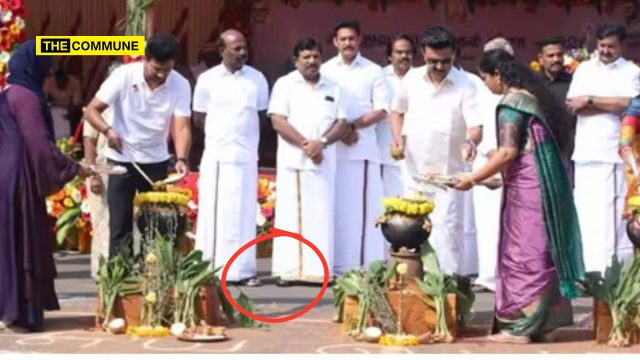
A Pongal celebration held at the Tamil Nadu Secretariat under the leadership of MK Stalin has triggered shock and disquiet among Secretariat employees, after it emerged that Pongal was not cooked on-site, but instead sourced from a private catering firm and ceremonially served from blackened clay pots.
The government-organised Pongal event was held at the Secretariat campus in Chennai, where decorative pandals were erected at the Parade Ground. Four traditional Pongal pots were placed on stage, and firewood was lit in advance to give the appearance of ritual preparation. However, according to employees present at the venue, pre-cooked sakkarai pongal brought in from a catering company was poured into the pots shortly before the Chief Minister’s arrival.
Once MK Stalin arrived, he, along with Udhayanidhi Stalin, served the Pongal using ladles to attendees, creating the impression of a traditional celebration. Secretariat staff later expressed surprise and disappointment that the customary act of cooking Pongal was replaced with a symbolic exercise.
It is noteworthy that the Chief Minister, his son or the other DMK members/ministers present wore slippers/shoes during the auspicious event.
The event comes amid mounting expectations from government employees and teachers’ associations, who have been agitating for over four years on various demands. With Assembly elections expected in April, the State government recently announced concessions including changes to pension schemes, heightening scrutiny over official conduct.
Addressing the gathering, Stalin said Tamil Nadu was celebrating “Samathuva Pongal” across the State and reiterated that the DMK government was working towards the goal of “everything for everyone,” adding that government employees were partners in governance. Ministers, senior bureaucrats, and employee union representatives were present at the event.
In sharp contrast, a Pongal celebration held the same day in New Delhi at the residence of L Murugan saw Narendra Modi participate in traditional rituals with visible devotion. The Prime Minister lit the hearth, cooked Pongal in a new pot, performed aarti, fed decorated cattle, and ensured that footwear was removed by all attendees as a mark of reverence.
Observers noted that while the New Delhi celebration reflected ritual sincerity and cultural reverence, the Secretariat event in Chennai appeared procedural and symbolic, with footwear worn throughout and tradition reduced to optics.
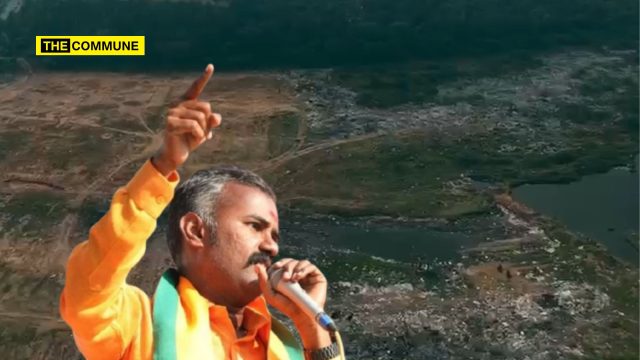
Ashvathaman, State Secretary of the Bharatiya Janata Party in Tamil Nadu, announced that the proposed “Save Kedilam” protest that was scheduled for 9 January 2026 had been temporarily postponed following assurances given by the Panruti municipal administration on stopping garbage dumping into the Kedilam River.
Addressing the media, Ashvathaman said BJP workers had planned a major agitation to highlight the issue of waste being dumped into the Kedilam river. The protest involved collecting garbage from the riverbed and depositing it at the Panruti Municipality office. However, over the past two days, municipal authorities had begun clearing the waste using JCB machinery.
He said that a peace meeting was held at the Tahsildar’s office, where BJP representatives were invited, and it was decided that garbage dumping into the river would be stopped immediately. According to the assurances given, all waste already dumped in the river would be removed within 30 days.
Ashvathaman stated that it was also agreed that any future dumping of garbage into the Kedilam river, whether by private individuals or government officials, would attract a fine of ₹10,000.
He further said that under the Swachh Bharat Mission, treatment plants would be set up at an estimated cost of ₹13–14 crore. The project is expected to be completed within eight months, after which sewage water would be treated and reused for agricultural purposes instead of being released into the river.
Existing bio-manure centres in Mani Nagar, Netaji Nagar and Devaraj Nagar would process the collected waste through incineration, converting it into manure for agricultural use, he added. An estimate for the project has already been sent to the government for funding approval.
Based on these assurances given by the Municipal Commissioner, Ashvathaman said it was decided to postpone the protest march planned from the Kedilam riverbanks to the municipality office on 9 January 2026 at 10 AM. He described the development as a major victory for the “Save Kedilam” agitation launched by BJP workers.
Subscribe to our channels on Telegram, WhatsApp, and Instagram and get the best stories of the day delivered to you personally.
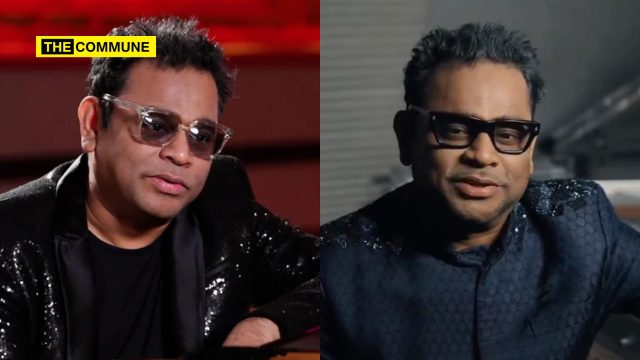
AR Rahman has released a video statement addressing the controversy surrounding his recent comments on alleged communal biases in the Hindi film industry. In the statement, Rahman emphasized that India remains his “inspiration, teacher, and home,” while expressing regret over any unintended pain caused by his words.
The uproar began after Rahman’s interview with BBC Asian Network, published earlier this week, where he discussed a perceived decline in Bollywood opportunities over the past eight years.
Reflecting on his career, Rahman noted, “The past eight years, maybe, because a power shift has happened, and people who are not creative have the power now. It might be a communal thing also… but it is not in my face.”
He described hearing about lost projects through “Chinese whispers,” such as instances where he was initially booked but later replaced by other composers.
Rahman, who is Muslim and hails from Tamil Nadu, also critiqued the film Chhaava for what he called “cashing in on divisiveness.”
These remarks quickly drew criticism online and from industry figures, with some accusing Rahman of playing the “victim card” despite his storied success, including Academy Awards for Slumdog Millionaire and iconic contributions to films like Roja, Dil Se, and Lagaan. Conservative outlets labeled it a “Muslim victimhood narrative,” arguing it rings hollow given Rahman’s ongoing high-profile projects, such as scoring the upcoming Ramayana alongside Hans Zimmer—a film rooted in Hindu mythology—and Chhaava, which chronicles the life of Maratha warrior Chhatrapati Sambhaji.
“I understand that intentions can sometimes be misunderstood, but my purpose has always been to uplift, honour and serve through music. I have never wished to cause pain and I hope my sincerity is felt.”
He highlighted his recent multicultural initiatives, including nurturing the track Jala presented at the WAVES Summit before Prime Minister Narendra Modi, collaborating with young Naga musicians on a string orchestra, mentoring the Sunshine Orchestra, building India’s first multicultural virtual band Secret Mountain, and his work on Ramayana.
The video concluded with footage of crowds singing his patriotic anthem Maa Tujhe Salaam (also known as Vande Mataram) during a cricket match.
Subscribe to our channels on WhatsApp, Telegram,Instagram and YouTube to get the best stories of the day delivered to you personally.
Sudha Kongara’s cinematic falsehoods have now been publicly dismantled by a man who was actually on the ground during the 1965 anti-Hindi agitation. The director’s claim in Parasakthi that nearly 200 civilians were gunned down by the Army in Pollachi has been exposed as a fabrication, with first-hand testimony contradicting the film’s sensationalist narrative.
In an interview to The Hindu, M.G. Devasahayam—who was serving in the Madras Regiment during the period—rejected the film’s portrayal as outright untrue. He underscored a crucial detail conveniently erased by Dravidian propaganda: the Madras Regiment was composed overwhelmingly of South Indians, largely Tamils, not a mythical “Hindi Army” unleashed to brutalise Tamil civilians.
The reality of February 1965, as recalled by Devasahayam, was far removed from the blood-soaked fantasy presented on screen. While parts of Coimbatore city did witness serious unrest—including arson and mob violence that forced the Army to be placed on high alert—the worst brutality occurred in Tiruchengode, where a sub-inspector and three policemen were burned alive by rioters. The Army’s role there was to restore order, not to carry out mass executions.
Pollachi, which Parasakthi projects as the site of an Army massacre, tells a very different story when stripped of propaganda. When troops were called in to assist the civil administration, the mob did not disperse—as is usually the case—but instead launched an attack on both the police and the Army column. With no opportunity to issue warnings, troops opened fire briefly. The death toll, according to Devasahayam, stood at around 8 to 10, with a similar number injured—not the hundreds invented for cinematic and political effect.
Equally false is the film’s insinuation that the Army used Light Machine Guns. Devasahayam clarified that the regiment carried bolt-action .303 rifles, firing one round at a time. Had automatic weapons been deployed, casualties would have been exponentially higher. In total, only about 35 rounds were fired, and even among the roughly 90 soldiers present, firing was carried out strictly on command by named personnel.
Devasahayam also noted that an official inquiry by Army Headquarters was conducted at the time, further puncturing the film’s claims.
My story today. I speak to former Army officer, who was a part of the Madras Regiment and posted in Coimbatore region during the anti-Hindi agitation in Feb 1965. He tells me that claim of 200 people being killed in firing is false. pic.twitter.com/Ltx57ltlOM
Sudha Kongara, notorious for bending and distorting historical facts in her films, has traded historical truth for ideological convenience, mutilating the history of the 1965 anti-Hindi imposition agitation to peddle a present-day Dravidian political narrative.
As The Commune has consistently pointed out, this is not an isolated lapse but part of a broader pattern in which Parasakthi repackages the 1965 agitation through selective amnesia and political distortion—whitewashing mob violence, demonising institutions, and manufacturing atrocities where none occurred.
There’s a scene in which protesting students are described as “kaali payaluga” (good-for-nothing chaps). The framing strongly implies that this contemptuous description came from Bhaktavatsalam and the Congress establishment.
Archives of DK’s own mouthpiece Viduthalai from the period show that it was EV Ramasamy (hailed as ‘Periyar’ by his followers) who openly criticised the protesting students, referring to them as hooligans and questioning the political motives behind the agitation.
The film also shows Tamil Brāhmī being used as a secret code scribbled into a Hindi document.
Tamil Brāhmī was barely known in 1964. While KV Subramanya Iyer conducted pioneering work in the 1930s, it was not pursued systematically. Serious academic focus began only in 1961, when K A Nilakanta Sastri encouraged Iravatham Mahadevan to take up the subject.
Mahadevan published his first major findings only in 1965–66, based on the Pugalur and Mangulam inscriptions. Even then, Tamil Brāhmī did not enter wider academic or public consciousness until the 1990s, when Mahadevan resumed extensive research.
When propaganda takes centre stage, facts tend to go missing. Tamil Brāhmī was barely known in 1964. Although K. V. Subramanya Iyer had carried out some pioneering work in the 1930s, it was not pursued systematically thereafter. It was only in 1961 that K. A. Nilakanta Sastri… https://t.co/uADqanxGna
The idea that Tamil Brāhmī was being widely understood,or covertly used as a “code” within government circles in 1964, has no historical basis.
In her previous film Soorarai Pottru, Sudha cunningly inserted the Dravidianist ideology into the film – he was depicted as a Periyarist fighting for social justice and the villains in the film were all, no prizes for guessing, Brahmins!
Hindi version of Soorarai Potru’s song just dropped.
Black shirt during wedding, EVR images in the background aren’t there in the Hindi version.
Maximum Puratchi is in signing the registration documents on site.
Interestingly, the Hindi version of the film’s song in Soorarai Potru was released on 4 July 2024. Comparing it with the Dravidianist Tamil version featuring EVR’s picture and a black shirt-borne Suriya, the Hindi version had nothing revolutionary.
That such demonstrable falsehoods are being passed off as historical truth in a mass-market film is not merely irresponsible—it is dangerous. When cinema is weaponised to launder political mythology, facts become the first casualty, and history is reduced to a propaganda tool.
Subscribe to our channels on WhatsApp, Telegram,Instagram and YouTube to get the best stories of the day delivered to you personally.