Home Blog Page 1165

How Pinarayi Vijayan Is Dividing The Muslim Community To Reap Their Votes

Recently reports had emerged that Jamaat-e-Islami Hind a top Muslim body has been engaged in talks with RSS. However, a top leader of the Jamaat-e-Islami Hind has refuted reports of discussions with the Rashtriya Swayamsevak Sangh (RSS). His clarification comes in response to the CPM targeting the Hindutva outfit over the alleged parleys with the Islamic outfit. But embroiled in many controversies including the recent allegations of misuse of Chief Minister’s Relief Fund, Chief Minister Pinarayi Vijayan has sprung a surprise, when he himself criticised the Jamaat-e-Islami Hind for its decision to hold talks with the Rashtriya Swayamsevak Sangh in New Delhi. 

The Political Game By Pinarayi

Just when it seemed that bread and butter issues raised by the Opposition were seriously troubling the LDF government, Chief Minister Pinarayi Vijayan sprung a surprise. He has revived a social mobilisation strategy that had done wonders for the LDF during the 2021 Assembly elections.

Instead of the targeting entire Muslim population, he has demonised a fringe religious outfit, Jamaat-e-Islami Hind (JIH). This way he hopes to secure not just the support of Hindus but Christians and Muslims, too. What has come in handy for Pinarayi is the closed-door meeting held by RSS and BJP leaders with certain Muslim outfits, including Jamaat-e-Islami Hind, at the residence of the former Lieutenant Governor of Delhi, Najeeb Jung, on January 14.

On February 17, more than a month after the meeting, the Chief Minister put up a Facebook post asking the JIH to come clean on what transpired during the meeting with the RSS. “The JIH’s logic that the RSS was a kind of organisation that could be reformed and modernised through dialogues is like hoping that a thorough wash could turn a spotted leopard into a spotted deer,” the Chief Minister said, and threw a pointed question: “Who gave the JIH the authority to represent minorities in India.”

The logic of CM is that by demonising whoever comes in to contact with RSS even if those from minorities, they shall be attacked and demonised. It is a ploy to keep the communities in his state divided and to garner himself votes in the upcoming elections, considering the hate of Muslim parties towards RSS in the state. By lambasting an organisation which held talks with RSS, Vijayan hopes to garner support of these Muslim elements and ‘Left-Liberal’ Hindus in the state. 

The Chief Minister followed this up with a grander political rhetoric while flagging off the People’s Resistance March led by CPM state secretary M V Govindan in Kasaragod on February 20. He asked whether the Congress and the Indian Union Muslim League had anything to do with JIH’s secret negotiations with the RSS. He also reminded Kerala of the UDF’s electoral understanding with the Welfare Party, the political wing of the JIH, Kerala.

The JIH Kerala assistant emir, P Mujiburahman, called a press conference and accused the Chief Minister of spreading “Islamophobia”. Even before Pinarayi had raised the issue, both the Samastha factions that together have a near complete sway over the Muslim community in Kerala — the E K faction led by Muhammad Jifri Muthukkoya Thangal and the AP faction led by Kanthapuram Aboobacker Musliyar had publicly questioned the JIH’s decision to hold talks with the RSS. “We have strongly disapproved of the JIH’s move to hold talks with the RSS,” said Abdusamad Pokkottoor, a prominent leader of the E K faction (Samastha Kerala Jem-iyyathul Ulama), the most influential Muslim religious body in Kerala. “How can any well-meaning organisation have a discussion with a group that does not believe in Indian secularism and still continues to justify the assassination of Mahatma Gandhi,” he told.

So, when he asked whether the Muslim League and the Congress had any role to play in the talks the JIH held with RSS, Pinarayi was not just trying to sow the seeds of suspicion in the Muslim community against the UDF, the League in particular, but was also projecting the CPM as the sole anti-Hindutva force. Pinarayi’s leadership role in the anti-‘Citizenship Amendment Act’ struggle had won him many admirers in the Muslim community. The 2021 election results testify to his increased popularity among Muslims. According to Lokniti-CSDS’s post-poll survey data, nearly two-fifths (39%) of Muslims had voted for the LDF in 2021 as opposed to about one-thirds (35%) in 2016.

The Vijayan government is also stepping up its attack on Hindu community in the state. The left also displays the dangerous trend of associating anything Hindu as RSS or BJP.  For example, recently, Kerala Police directed temple authorities in Thiruvananthapuram’s Vellayani to take down saffron decorations put up for the Bhadrakali temple festival and use multi-colour ones instead. Before that, there was the instance wherein Communist leader and Minister MB Rajesh passed distasteful comments against Adi Shankaracharya to please the party’s pseudo secular followers.  

Pinarayi’s Divide And Rule

CPM is playing a dangerous politics in Kerala. By alleging that the JIH is trying to strike a deal with the RSS with the League’s blessings and also by stepping up its attack on Hindus, the CPM is trying to enhance rift between communities for vote bank politics. Relentless and sharp attacks on a fringe Muslim outfit like the JIH seems like a safe bet. It will keep the fake Hindu liberals happy but would not bother the mainstream Muslim community. But the question is whether the dirty politics by Pinarayi will break the very social fabric in the state? 

Click here to subscribe to The Commune on Telegram and get the best stories of the day delivered to you personally. 

Startup Tenkasi: A New Initiative To Cultivate Entrepreneurship Among Tenkasi Youth

In a one-of-its-kind initiative, Ananthan Ayyasamy, the State Vice President of Tamil Nadu BJP Other States & Overseas Tamil Development Cell (OOSTD Cell), has invited young local entrepreneurs in and around Tenkasi to come up with business ideas and proposals to be incubated under ‘Startup Tenkasi’.

The event being held on 12 March 2023 at Esakki Mahal in Tenkasi is happening with the partnership of We The Leaders Foundation, Zoho and median group Dinamalar.

Union Minister of State for Electronics, IT and Skill Development Rajeev Chandrasekhar will preside over as chief guest and deliver the keynote address. BJP Tamil Nadu President K. Annamalai who is also the founder of We The Leaders Foundation and founder of tech company ‘Zoho’ Mr. Sridhar Vembu are the other dignitaries.

Under Startup Tenkasi, entrepreneurs with a convincing scalable business model can submit their pitch deck here before 3 March 2023. The top 5 selected will be given an opportunity to pitch their ideas before the panel and the first 3 winners will be given a cash prize of ₹1 lakh, ₹50,000 and ₹25,000 respectively.

The Startup Tenkasi initiative is being touted as an effort to make Tenkasi the Estonia of India. Estonia is a country in northern Europe which ranks among the most digitally advanced societies in the world. It is known for its innovative education model, virtual business and digital citizenship. Its capital Talinn is known for a thriving start-up ecosystem. Skype, the free video service, was created in Estonia which revolutionized how the world communicates. Likewise, Zoho Desk, a successful software product of Zoho Corporation was built in Tenkasi.

Click here to subscribe to The Commune on Telegram and get the best stories of the day delivered to you personally.
What EVR Said About Communists

There were heated exchanges between Tamil Nadu BJP President K. Annamalai and DMK Minister Ponmudi, who slammed Tamil Nadu governor RN Ravi for his remarks on Karl Marx. Others like PMK founder Dr. Ramadoss and the Commumist parties too joined the bandwagon in pouncing against the Governor. But what did he say that has angered these people?

Speaking at the book launch of Deenadayal Upadhyay’s Dispersion of Thought and Integral Humanism at the Raj Bhavan in Chennai, Tamil Nadu Governor RN Ravi said that “colonised minds controlled India’s intellectual space,” and that Karl Marx, Rousseau, and Abraham Lincoln were “worshipped” at the expense of Indian scholars such as Deendayal Upadhyaya.

In his rebuttal to governor RN Ravi, DMK Minister Ponmudi said, “Tamil Nadu Governor RN Ravi made inappropriate remarks about Karl Marx, the father of socialism. Periyar was the first to publish the Communist Party Manifesto in Tamil, which was written by economist Karl Marx and his friend Friedrich Engels. Periyar and Anna were the ones who worked for the ultimate goal of the Dravidian movement, classless equality, as advocated by socialism.”

However, Tamil Nadu BJP President Annamalai was quick to point out that the founding father of Dravidar Kazhagam, EV Ramasamy, was himself critical of communism and communist.

Here is a list of instances and quotes from EV Ramasamy Periyar in which he criticised Communists and communism. The majority of the quotes were taken from the book “Collected Works Of Periyar E.V.R” by Dravidar Kazhagam’s current president, Ki Veeramani.

He claimed that Brahmins dominate trade union leadership positions, saying, “The leader of the Congress party is a Brahmin. The leader of the socialists is a Brahmin. The leader of the communists is a Brahmin. The leader of the Hindu Maha Sabha is a Brahmin. The leader of R.S.S is a Brahmin. The leader of the Trade Union is a Brahmin. The President of India is a Brahmin. They are all one in the heart of hearts.”

EV Ramasamy Naicker described Communists as exploiters, similar to foreigners, saying,”The communists have their office at a foreign place like Bombay or Delhi, they are only interested in exploiting us like the other foreign controlled parties. Janaskthi’s [CPI journal] editors are Brahmins and wherever Brahmin goes he is likely to support caste differences.”

EV Ramasamy Naicker stated that Communism is a useless ideology, saying, “Talking Communism without eradicating caste is like discussing higher education without the rudiments of learning.”

He claimed that the introduction of Communism into India would result in the exploitation of people who did not own land. “There can be no scope for Communism in a country, where there is absence of common ownership and rights. If attempts are made to bring in Communism in a country, which does not have common ownership and rights, it will only give room for those who already enjoy more rights to reap the benefits of Communism,” EV Ramasamy Naicker said.

He went on to say that the cooperative spirit will reign in the future, propelling society forward, and that communism is not required to teach this. EV Ramasamy Naicker stated, “One day or other the co-operative spirit will reign supreme making the society march on towards progress. It is not necessary that Communism should be fostered for that. Without talking a word about communism, you can make the society progressive with the help of mere co-operation.”

He went on to say that communism is a sham and that their only agenda is to criticise the rich while ignoring Brahminism and Varnashrama Dharma, which are promoted by people like Rajaji and political parties like the Congress.

In his speech delivered at Trichy on 21-2-1943, EV Ramasamy Naicker said, “All the talks on communism in our country is bogus. Our youths must keep away from such talks. What is the work they do? Their eyes are always on the leaders of the Justice Party (In 1944, Periyar transformed the Justice Party into the social organisation Dravidar Kazhagam and withdrew it from electoral politics). Their work is to criticise the Muslims and rich people. They are not worried about the evil casteism or reactionary propaganda of Gandhi. They are not worried about Rajaji who wants only the Brahmins to live happily. They are not worried about the Congress party that upholds the Varnasrama Dharma. They are not worried about khadhi being symbolic of barbarous age. The communists are dominated by the evil forces cited above. So I appeal to the youth to be aware of these communists. Communism here, as it is, is a sugar coated poisonous pill. Beware!”

On December 25, 1968, under the rule of DMK Chief Minister Annadurai, Tamil Nadu witnessed the worst massacre of Dalits, who were protesting for the pay hike. However, instead of criticizing the perpetrators of the crime EV Ramasamy Naicker criticized Communists who were with the Dalits during the protests.

During the Sembanur Kovil public meeting on January 12, 1968, just a few days after the massacre, EV Ramasamy Naicker said, “The Communists were responsible for the Nagai Taluk massacre (referring to Keezhvenmani). They were responsible for the deaths of 42 people.”

Blaming the Communists and asking Dalits to live within their means rather than protest for pay raises, EVR said, “Without telling you how the workers should live with what they have, the Communist comrades are trying to create riots and revolutions in Tamil Nadu and overthrow this regime.”

Aside from what EV Ramaasamy Naicker said about communists and communism, there are a number of accounts written by various authors about the atrocities committed by Communists.

A book titled “Famine, Murder, and Disaster (பஞ்சம்,படுகொலை, பேரழிவு)” written by Aravindan Neelakandan has exposed the true face of communism and Karl Marx, which substantiates what Governor RN Ravi said about Karl Marx during his speech.

“It is from India culture, the science and technology was exported to Europe. Karl Marx did not see the destruction of the technologies of Indian culture as a loss to humanity. Instead, he welcomed it and referred to it as a historical necessity.”, the book notes.

The author of the book Aravindan Neelakandan quotes Karl Marx as saying,”The destruction of Indian industries was revolutionary. Destruction of the age-old industries of Indians is a necessity to destroy the self-reliance of Indian villages.” This tendency of Karl Marx was referred to as a “white European cultural tilt” by sociologist Joyce A. Lautner, he added.

Similar to the Dravidian Stockist, communists have a tendency to demand free speech when they are not in power, but to crush dissent with brutal force when they are elected. The legal action taken by the Communists in Kerala and DMK in Tamil Nadu against dissenting YouTubers and for social media posts is evidence of their hypocrisy and cruel intentions. To summarize, EVR and Karl Marx have nothing in common other than their long unkempt beard.

Therefore, instead of lecturing on what Governor RN Ravi should say, DMK Ministers should introspect on what their own ideologue had said about Communists and Communism.

Click here to subscribe to The Commune on Telegram and get the best stories of the day delivered to you personally.
“P*nda, I’ll Cut It Off”: TN Police Officer Hurls Abuses And Threatens RSS Worker

A video has gone viral in social media in which a Tamil Nadu police officer can be seen verbally abusing and threatening a Rashtriya Swayamsevak Sangh (RSS) worker.

The incident happened at Dharapuram Road, Tirupur near the Kottai Mariamman Temple where the temple festival was being celebrated. Manoj Kumar, son of Chidambaram and an RSS worker of the area had gone with his friends to the temple at 11 PM. They were allegedly stopped by a police officer at that time asking them why they were coming now.

In the video, the police officer can be heard abusing and pushing Manoj.

He says “If you don’t want me to push you, behave accordingly. If you don’t like me keep my hand on you, behave accordingly. Bug off. I know which broom comes to temple and worships god. Get lost. A broom which came to worship god.”

“You should be with your wife and children now, what business do you have here at 11 PM? Go stand there. What plucking work you have here?”, the policeman says pushing the RSS worker.

When Manoj requests the officer not to manhandle him, the police officer threatens saying “What will you do man? What will you do? What will you do? P*nda (Tamil cuss word denoting for female genitalia). Look at you, P*unda. I’ll cut it off. Keep your shenanigans with someone else.”

Manoj Kumar later went home and subsequently filed a complaint with the Tirupur Police Commissioner. The police are currently looking into the matter.

(With inputs from Mediyaan)

Click here to subscribe to The Commune on Telegram and get the best stories of the day delivered to you personally.
Reigniting The ‘Aryan Invasion’ Debate

The last thirty years, there have been plenty of lectures, papers and now online videos promising to “debunk the Aryan Invasion Theory” (AIT). Their impact has been very poor, essentially limited to Hindu students, not even Hindu politicians. But outsiders, particularly the champions of that same AIT, have barely noticed this wave of attempted refutations, and certainly haven’t felt moved by them to rethink their assumptions.

Let us first get our terminology straight. Squeamish AIT scholars are making everyone toe their line that instead of an “invasion” there was an “immigration”. They have to, for unlike in Europe, where the “Aryan” (meaning Indo-European-speaking, IE) invasion from the steppes ca. 2800 BCE was a dramatic and sometimes genocidal event, India presents no evidence at all of such foreign conquest in the period considered. So they shifted to the thesis of a subtle infiltration under the archaeological radar, yet revolutionary in its impact: unlike the Scythians, Greeks, Huns or Kushanas, these intruders succeeded in not just conserving their language and religion, but imposing both on the far more numerous natives. Well, the word “invasion” is not about the means used, but the resulting power equation: it’s an “immigration” if the foreigners adapt, but an “invasion” if they take power. And this is clearly what the supposed Aryan invaders did. So it was definitely an invasion, but we won’t insist: even with an “immigration”, it remains the “AIT”.

The IE language family was discovered by a French Jesuit living in South India, Gaston-Laurent Coeurdoux. In 1767, he sent a paper to the Academy in Paris in which he showed the close kinship of Sanskrit with Latin and Greek. The French freethinker Voltaire soon publicized it and concluded that European culture and its treasures had originated on the banks of the Ganga. This was taken over by other leading intellectuals like Immanuel Kant, and note that they spontaneously assumed India as the land of origin of the IE family. The Out-of-India Theory (OIT) is not a recent “concoction” by Hindu Nationalists, as widely alleged, but was thought up by 18th-century Europeans.

In India, the new insight was given currency by justice William Jones speaking in Kolkata 1786. Note about his speech what admiration he expresses for the Sanskrit language, deemed superior to Latin and Greek. Indomania was widespread at the time, best represented by Friedrich Schlegel’s 1808 book Language and Wisdom of the Indians. This goes completely against the widespread Hindu rumour that IE linguistics stemmed from “racist colonialism”. Most of India was not a colony yet, and the heyday of racial thought contaminating “Aryan” studies had yet to arrive.

However, another consideration started to undermine the dominant position of the OIT. Linguists realized that Sanskrit was not the mother but merely an elder sister of the other branches. There was a distance between the putative language of origin (Proto-Indo-European, PIE) and Vedic Sanskrit, and this translated into a possible distance between the Homeland and India. Not really compelling logic, for languages can evolve while staying in the same place; but this change of opinion won through.

What made the scales tip was probably August Schlegel’s proposal in 1834 that the Homeland lay in or near the Caucasus mountains. Bible-thumpers had already thought of Armenia, where Noah’s Ark had landed: the Aryans were deemed the descendants of Noah’s son Jafeth. Successive Homeland theories after this would rarely move away sharply from the Caucasus area. Since Gordon Childe’s choice in 1926 for the Don-Volga region, this area has mostly remained the favourite, today known as the Yamnaya (“pit-grave”) culture.

But the OIT school did not give up. The defence was taken up again by Europeans living in India. The most prominent and surprising figure here is Mountstuart Elphinstone, a proverbial colonialist. After his retirement as governor of Bombay, he wrote a History of India. Among his arguments, the most compelling is that no Hindu scripture gives any indication of a foreign origin: “There is no reason whatever for thinking that the Hindus ever inhabited any country but their present.” (1841)

Yet this could not save the OIT. In the mid-19th century, two developments served as nails in its coffin. One was the start of Linguistic Paleontology, the “science” of discovering a language’s habitat from its vocabulary. Thus, it was realized that PIE flourished in a society familiar with wheeled transport: six words for the cart and its parts exist throughout the daughter languages and must have existed in PIE. Now for the Homeland question, it was deemed significant that there were words for cold-climate species like birch tree, wolf and bear. This doesn’t really refute the idea of an Indian Homeland, for these species also occur in India, which has islands of cold climate. Recently, OIT mastermind Shrikant Talageri has shown that hot-climate species like ape, lion and elephant are equally present in the PIE lexicon, and they are hard to reconcile with a northern climate zone. But back then, the exclusion of India as a Homeland candidate won the day.

The other factor was the appearance of Veda translations which followed the then-emerging racial paradigm. Thus, in the Rg-Vedic description of the Battle of the Ten Kings, it was commonly pretended that the enemies were “black aboriginals”. In reality, the names of the kings and of their tribes (most notably DâsaDasyu) are recognizably Iranian, and their characterization as “the black tribe” is a mistranslation. The word Asiknī does not refer to a skin colour, but to the area they come from, the basin of “the Black River”, the Vedic name of the Chenab. This way, several racialist distortions, perhaps made in good faith because of the racialist Zeitgeist, created the impression that an Aryan invasion into India had been described by the Vedic composers themselves. It thus became futile to deny the AIT.

The ensuing political abuse of the AIT by the British colonialists and even by the National-Socialists could not inspire the Indo-Europeanists to a rethink. After 1945, the “Aryan” political discourse went out of fashion in the West, but in India its political use by Christian missionaries, Ambedkarites (though not BR Ambedkar himself, an articulate opponent of the AIT), Dravidianists and Nehruvians continued. In the West, this has not been noticed till today. Hilariously, the few Western scholars who have heard of the OIT at all, claim that it is “a politicized concoction”, when in fact it is their own AIT that has played a poisonous role in Indian politics all along.

The OIT started a second life in 1982, when KD Sethna published the book Karpasa (cotton), showing that cotton was common in the Harappan cities (starting 2600 BCE), and in Sanskrit writings younger than them, but not yet in the Rg-Veda. He concluded that the Rg-Veda largely predated them. This high chronology is detrimental to the AIT, which postulates an Aryan invasion (importing the Vedic language) only in the 2nd millennium.

In 1984 the US archaeologist James Shaffer showed that there is zero archaeological proof for an Aryan invasion, including a peaceful immigration. Indian archaeologists became more outspoken about their findings to the same effect. Even BB Lal, long the main archaeological supporter of the AIT, shifted to the position: “Vedic and Harappan are two sides of the same coin.” Several linguists and historians joined in, and latterly some geneticists: people of the same academic rank as any pro-AIT professors you can cite.

Until the millennium year 2000, there had been many voices doubting or plainly rejecting the AIT, and contributing many little arguments from linguistics or archaeology, all indirect evidence, but a clear alternative was lacking. Shrikant Talageri, after a preparatory book in 1993, then broke through the wall of ignorance about the enigmatic Vedic age. In The Rigveda, an Analysis, and its 2008 sequel, The Veda and the Avesta, he pioneered a convincing OIT, which should henceforth count as the OIT.

This work is, as I have been able to verify at Indo-Europeanist conferences, completely unknown in the West and also in India’s AIT camp. Whereas the mere handful of OIT thinkers know the AIT quite well and often write answers to it, the well-established AIT doesn’t really get beyond derogatory comments on the OIT and stonewalls all arguments in its favour. Around the year 2000 there was a little bit of dialogue, mostly thanks to the American scholar Edwin Bryant (the coiner of the term “OIT”), but this has remained a blip.

Today, the AIT camp is a happy valley protected from the rising waters of counter-evidence by a protective dam. But the waters keep rising, and the time can’t be far off when the waters will overcome the dam and drastically impact the cosy life in the valley.

The above article by Dr. Koenraad Elst is part of the Conference on The Homeland Debate: A Definitive Case Against The Aryan Invasion Theory, Chaired by Dr. Koenraad Elst organized by Sangam Talks on 18.02.2023 in the India International Centre, New Delhi.

(This was originally published in Bharat Voice and has been republished here with permission.)

Click here to subscribe to The Commune on Telegram and get the best stories of the day delivered to you personally.
The Regime Change Operators Working To Topple Modi

Since 2016, the Modi government has embarked on a relentless crackdown on foreign funded NGOs and other organisations.

FCRA (Foreign Contribution (Regulation) Act, 2010) licences of 6677 NGOs stand cancelled between 2017 and 2021, as per a statement by the Union Minister of State for Home Nityanand Rai in the Lok Sabha last year. Between 2011 and 2019, registrations of over 19,000 voluntary organisations has been cancelled by the Union Home Ministry.

But The Lede has found that George Soros’ Open Society Foundation, Pierre Omidyar’s Omidyar Network as well as The Ford Foundation founded by Henry Ford’s son, continue to route funds into India circumventing the FCRA laws.

The three foundations have been put on a prior watchlist by the Centre – meaning that they can only donate if the Indian government scrutinises their funding and green signals the same.

Due to these severe restrictions, the foundations have now adopted a new strategy. They build and fund layers upon layers of organisations, through which their money is routed.

Which begs the question – why are foreign foundations so desperate to keep investing in Indian NGOs and other organisations? Why are these foundations willing to break the law of the land just to send money to NGOs and other organisations?

The Lede analysed a large number of NGOs who are funded either directly or indirectly by these foundations and found a number of interesting connections. In effect, the foundations are linked to two ultimate goals:

  1. To support activities that are against the Indian government. 
  2. To sponsor and fund media publications that write against the Indian government. 

But first, for the uninitiated, let us quickly introduce the foundations.

The Big Three

Open Society Foundation: This is billionaire hedge fund investor George Soros’ “political philanthropy project”, by his own admission. The foundation’s stated aim is to “work to build vibrant and inclusive democracies whose governments are accountable to their people.” The foundation is run by 92-year-old George Soros and his son Alexander Soros.

The Ford Foundation: This foundation was founded by Edsel Ford, son of famous car-maker Henry Ford in 1936. Their vision is one “of social justice—a world in which all individuals, communities, and peoples work toward the protection and full expression of their human rights; are active participants in the decisions that affect them; share equitably in the knowledge, wealth, and resources of society; and are free to achieve their full potential.” This foundation is run by a 16-member board led by president Darren Walker.

Omidyar Network: This is a foundation founded by Pierre Omidyar, who is a French born Iranian-American billionaire founder of eBay. His wife Pamela Omidyar also runs the foundation jointly with him. The network calls itself a “social change venture that reimagines critical systems, and the ideas that govern them, to build more inclusive and equitable societies—for the benefit of the many, not just the few—across the globe.”

These three foundations intersect in their goals and in their methods of functioning, as we shall see later on in this piece.

Modus Operandi To Impose Policy, Effect Regime Change 

Catch ‘Em Young & Embed 

All three foundations offer fellowships and scholarships for students in India wanting to study abroad. These students are meticulously handpicked and eventually, they form part of a network of organisations, advocacy groups and NGOs that are lavishly funded by the three foundations.

Sound familiar? It is akin to indoctrination. In line with the stated goals of the foundations, these students are also echo chambers that continually drive narratives against countries which are viewed as “totalitarian” or “autocratic” by those who run these foundations.

A glaring instance is that of George Soros’ recent speech at the Munich Security Conference on February 16. “Adani is accused of stock manipulation and his stock collapsed like a house of cards. Modi is silent on the subject, but he will have to answer questions from foreign investors and in parliament. This will significantly weaken Modi’s stranglehold on India’s federal government and open the door to push for much-needed institutional reforms. I may be naive, but I expect a democratic revival in India.”

It was an unexpected speech but one that sent the Indian government into punch throwing mode with the External Affairs Minister S Jaishankar referring to Soros as an “old, rich, opinionated and dangerous billionaire”. The Minister for Women and Child Development, Smriti Irani, termed Soros’ speech an “attack on India.”

The reaction was not surprising, since Soros has, in the past, criticised what he viewed as “totalitarian regimes” in Russia, China, Israel, Hungary and many other countries. He is also widely accused of using his wealth to fund organisations that fuel protests and spread disinformation in order to effect regime change.

The Ford Foundation and Omidyar Network are, however, more careful and do not speak out as Soros does. Their actions across countries, however, mirror and mimic those of the billionaire.

In this context, it is hardly surprising that the students and young professionals who get fellowships from the Open Society and the other foundations, pack specific narrative punches consistently. Here is an example below.

These young men are recipients of the Open Society Fellowships and as is evident, tweet along similar lines. Twitter OSINT user @thehawkeyex has compiled the tweets and points to a trend. This is only an example – more in-depth research into the other fellowship recipients points to the same trend.

These young professionals, as discussed before, become embedded in an ecosystem where the narrative decided by the foundations reign supreme. They are then deployed across the world to “troubled countries” to act as advocates of the foundation’s mission.

Why Should Indians Be Concerned? 

The Lede reached out to NGO Monitor, a research institute based in Israel, which fact-checks NGOs and their funders in the context of the Arab-Israeli conflict. The NGO Monitor has had a special consultative status with the UN Economic and Social Council since 2013.

Speaking specifically on Soros’ and Open Society Foundation’s modus operandi, NGO Monitor’s representative (who did not want to be identified for security concerns) said – “He (Soros) has a very clear political philosophical ideology – open society. Humans are most important and borders don’t matter. When policy change happens, people need to rise from the ground and give them the tools to make change. That’s why he funds education and universities – he believes change should come from the grassroots.”

The representative stated that they had found clear evidence of Soros’ interference in the political situation of countries such as Ukraine, Russia, Hungary, Croatia and the Eastern Bloc. “Soros tried the same thing in Arab countries but civil society is not so developed there so his success was limited. For example, the Arab Spring became an Islamic Winter. NGOs played a large role in the Arab Spring – they did things to gain headlines. But when you look closely at the work of Soros-funded organisations, their claim to democracy is hollow. Why didn’t any one of these NGOs push for more women participation in the movement? Why was there no talk about women’s rights? This is because all their work was aimed at grabbing headlines.”

“The next generation will be the bureaucrats and the journalists and the policy makers who will bring about “change” as per Soros’ ideas. That is the reason he funds them from a young age and places them in organisations linked to him. He claims he put money to throw out former US President Donald Trump and funded the Black Lives Matter protests as well,” he said.

Soros, particularly, is credited with the infamous “breaking of the Bank of England” in 1992 when he shorted the British pound, the 1997 Asian Financial Crisis when he shorted the Thai Baht sending Asian economies into freefall, and has expressed little remorse for his actions that resulted in huge human cost. Similarly Hungary and Israel, apart from Russia, have criticised the billionaire and taken steps to prevent him from interfering in their respective countries.

The Foundations In India: Conduits & Conspiracies 

In order to shine a light on how these foundations work in India, The Lede focusses on three organisations which have received funding directly from the three foundations over the years.

These are:

  1. Commonwealth Human Rights Initiative (CHRI)
  2. National Foundation of India (NFI)
  3. Centre for Policy Research (CPR)

We will see more about these organisations in Part 2 of the series. 

(With additional reporting by Sandhya Sridhar, Abhijit Iyer-Mitra, Twitter OSINT user @thehawkeyex and The Lede’s research team)

(This article was originally published in The Lede and has been republished here with permission.)

Click here to subscribe to The Commune on Telegram and get the best stories of the day delivered to you personally.
DMK Min Slams TN Guv For Remarks On Marx, BJP TN Prez Annamalai Quotes EVR To Hit Back

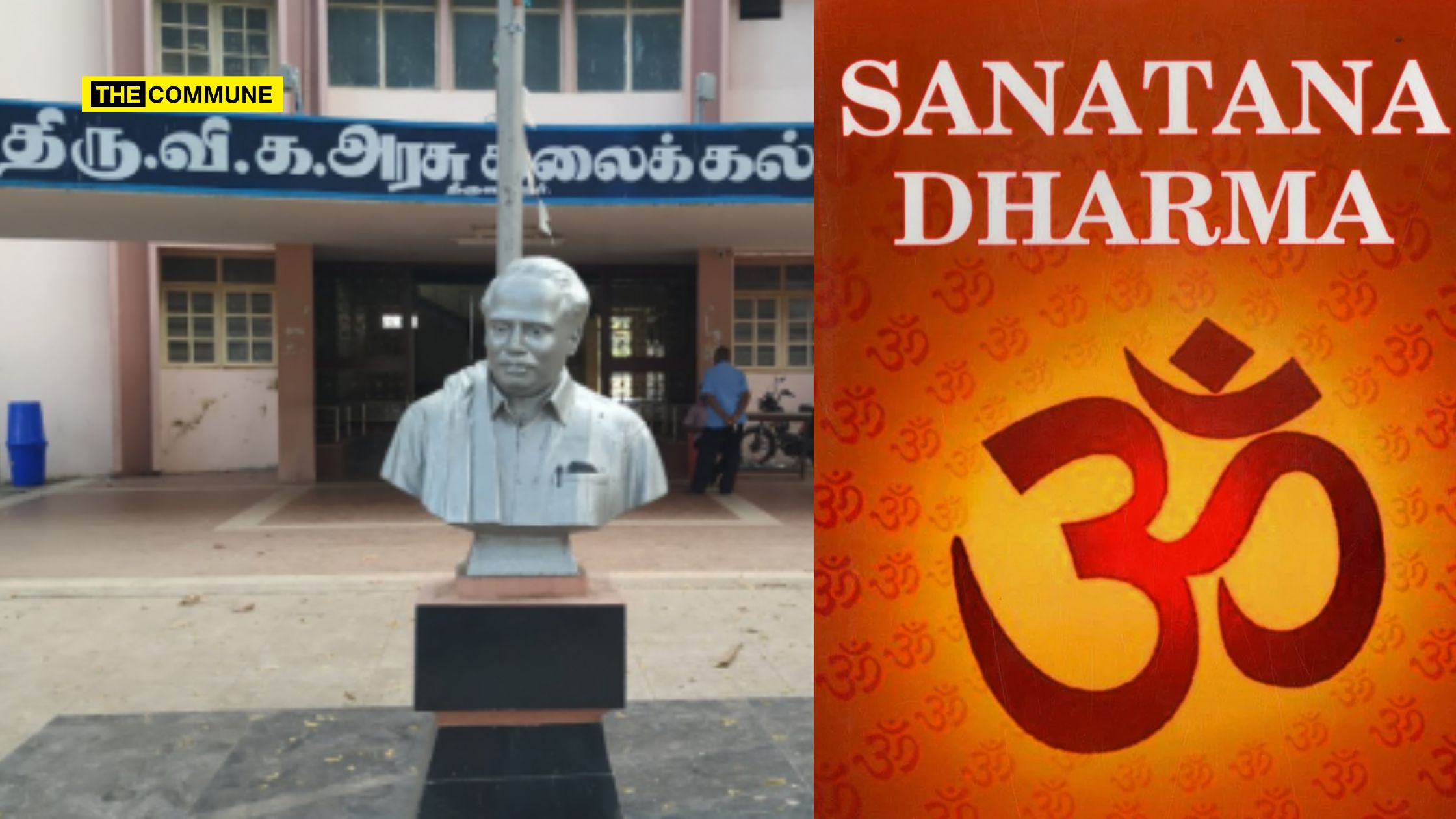
Speaking at the book launch of Deenadayal Upadhyay’s Dispersion of Thought and Integral Humanism at the Raj Bhavan in Chennai, Tamil Nadu Governor RN Ravi said that “colonised minds controlled India’s intellectual space,” and that Karl Marx, Rousseau, and Abraham Lincoln were “worshipped” at the expense of Indian scholars such as Deendayal Upadhyaya.

Following the event, DMK Minister Ponmudi issued a statement on February 22 criticising RN Ravi’s speech on Karl Marx.

He said, “The people of Tamil Nadu are paying attention on RN. Ravi, who has been appointed as the Governor of Tamil Nadu, but continues to behave as a political party figure rather than as a non-partisan governor for the state. The Governor, who has accepted the position and responsibility under the Constitution, is acting like a propaganda secretary of the party, talking about Sanatana Dharma, which is contrary to the secularism principle emphasised by the Indian Constitution.”

He added, “Tamil Nadu Governor RN Ravi made inappropriate remarks about Karl Marx, the father of socialism. Periyar was the first to publish the Communist Party Manifesto in Tamil, which was written by economist Karl Marx and his friend Friedrich Engels. Periyar and Anna were the ones who worked for the ultimate goal of the Dravidian movement, classless equality, as advocated by socialism.”

In this scenario, Tamil Nadu BJP President Annamalai slammed DMK Minister Ponmudi for his comments on Tamil Nadu Governor RN Ravi, citing instances when EV Ramasamy Naicker (hailed as ‘Periyar’ by his followers) expressed his opposition to the Communist Party of India.

Annamalai asked in a series of Tweets, “Would Ponmudi comment on Periyar’s criticism that youth should be wary of communists?”

He said, “I read Tamil Nadu Higher Education Minister Ponmudi’s statement criticising Tamil Nadu Governor RN Ravi. As usual, DMK’s statement is full of false pride and self bragging. Ponmudi has criticized the Governor’s comments on Karl Marx on February 21. But, will Ponmudi comment on DMK’s founding father Periyar’s remark in Trichy on February 21, 1943 that ‘Communism is a sweetened poison pill and that youth should beware of communists’?”

He further said, “If the minister has any doubts, he should read the book “Collected Works of Periyar EVR,” written by DK President K.Veeramani. I’m not sure why the minister is upset when Governor RN Ravi speaks proudly about the Tamil heritage, Thirukkural, and the freedom fighters. Why does the minister become enraged when Governor claims that GU Pope’s Thirukkural translation is incorrect?”

He went on to say, “Minister Ponmudi, who made one of his sons as a Member of Parliament and another as the president of the Cricket Association, talking about socialism is a DMK-specific irony. In his statement, Minister Ponmudi has somehow admitted the killing of an army soldier by a ruling party councilor. By failing to take action against that councillor on behalf of the party, the DMK has insulted the entire army. You continue to treat the Coimbatore suicide squad attack as a cylinder blast, so why are you exaggerating the moral outrage of the patriotic ex-soldiers who lost their brothers?”

“Whenever people raise questions about your administration’s problems, law and order failures, etc., I urge you not to engage in dirty attempts to divert the people’s attention by blaming the governor,” he said.

Click here to subscribe to The Commune on Telegram and get the best stories of the day delivered to you personally.
 

Hindu Munnani Condemns DMK For Exempting Urdu Muslim Students From Studying Tamil, Urges To Make Tamil Compulsory For All

Hindu Munnani State President Kadeswara Subramaniam came down heavily on the DMK government led by MK Stalin and Tamil Nadu Education Minister Anbil Mahesh Poyyamozhi for exempting Muslim students studying Urdu from studying Tamil. He has demanded the government to make Tamil compulsory for all students in Tamil Nadu.

On 23 February 2022, the Hindu Munnani State President in a press release said, “Dravidian politicians, who have produced a generation of Tamil students who cannot read or write Tamil, celebrated International Mother Language Day on Tuesday (February 21). Chief Minister Stalin has stated that the Tamil language will be protected. However, Tamil Nadu School Education Minister Anbil Mahesh Poiyamozhi has promised the Muslim community that Urdu students will be exempted from Tamil exams. This religious exemption has existed for many years. The Dravidian parties have succeeded in creating a generation that cannot read or write Tamil.”

He added, “In the neighboring states, it is not possible to complete school education without knowing the local language. The announcement by the state education minister to exempt students studying Urdu to forego Tamil sheds light on their intentions.”

He further added, “Does Tamil Nadu Chief Minister MK Stalin want to encourage a society that takes pride in not knowing how to read and write Tamil? Dr. Ramadoss, the founder of the PMK, embarked on a journey titled ‘In Search of Tamil’ yesterday. If they want to protect Tamil, shouldn’t they support the central government’s New Education Policy, which emphasises mother-tongue and mother-tongue education? But they will not support it.”

Kadeswara Subramaniam, expressing his rage, said, “When they support convent education, which promotes ‘mummy and daddy culture’, where else should we look for Tamil language? We need to look for it in the Bay of Bengal.”

He concluded by saying, “Tamil people should be aware of the politicians who are doing politics using Tamil language. We urge politicians to not use Tamil for politics anymore. On behalf of Hindu Munnani, we request that Tamil Nadu Chief Minister Stalin ensure that all students study Tamil and that education is provided in Tamil.”

Click here to subscribe to The Commune on Telegram and get the best stories of the day delivered to you personally.

Srilankan Tamil Drug Smuggler Sneaks Into Mandapam Camp To Escape Legal Proceedings In Sri Lanka

On Tuesday (21 February 2023), police apprehended a Sri Lankan Tamil who had illegally migrated into Tamil Nadu in order to avoid criminal charges in Sri Lanka. The man was arrested under the Passport Act the same day following an investigation by Mandapam law and order officers.

The accused has been identified as S Sinthujan, 22, hailing from the Mannar region in Sri Lanka.

The Marine police arrived at the Mandapam camp and nabbed the accused after receiving a tip-off about a Sri Lankan Tamil arriving at the Mandapam refugee camp.

After being wanted in multiple cases by Sri Lankan law enforcement authorities, the accused Sindhujan fled Sri Lanka and arrived in India via illegal ferrying in order to avoid legal proceedings.

Sinthujan arrived in Tamil Nadu on February 17 and sneaked into Paramathivelur’s Sri Lankan Tamils camp without being noticed. Earlier, his father Selvaraj, who had arrived at Dhanushkodi, was apprehended by the Marine police and lodged at the Mandapam refugee camp after an investigation. Sinthujan arrived at the Mandapam refugee camp after learning that his father was staying there.

According to police, the accused person was found to have illegally migrated to India in order to avoid legal action for the criminal cases in which he was involved in Sri Lanka. Sinthujan was arrested by Mandapam Law and Order police under Section 14 (c) of the Foreigners Act 1946 (r/w), Section 3 (a), and Section 6 (a) of the Passport (entry into India) Rules 1950. The accused will be placed in a special prison after being brought before the court.

Click here to subscribe to The Commune on Telegram and get the best stories of the day delivered to you personally.
TN Govt School Prohibits Students From Wearing Sacred Ash Or Bindi On Forehead, HM Cites GO When Confronted By Parents

A video has gone viral on social media in which a head mistress of a Tamil Nadu government school can be seen arguing with parents of the children over wearing of Hindu identities like sacred ash, bindi and sacred threads around the wrists.

The incident happened at KR Government School located near Oddanchatram in Tamil Nadu’s Dindigul district.

In the video, the parents of the children can be seen confronting the school Head Mistress Nirmala for prohibiting children from wearing Hindu marks like sacred ash, sandhanam, Kumkum, bindi and sacred threads.

“I only said that there is a government rule not permitting it which we’ve pasted there. Won’t I say daily during the prayer? You tell me haven’t I said or not? I am not threatening you. Didn’t I say that we’ve received a government order not permitting wearing a ‘pottu’ (bindi)? How many times have I told?”, the Head Mistress can be seen the questioning the student with many other elders around.

When a person interrupts if the GO specifically states that pottu should not be worn, the HM states that pottu and sacred threads are not allowed.

An India Today report stated that the State Education Department have denied any such stringent GO not permitting students from wearing holy ash or kumkum.

Click here to subscribe to The Commune on Telegram and get the best stories of the day delivered to you personally.