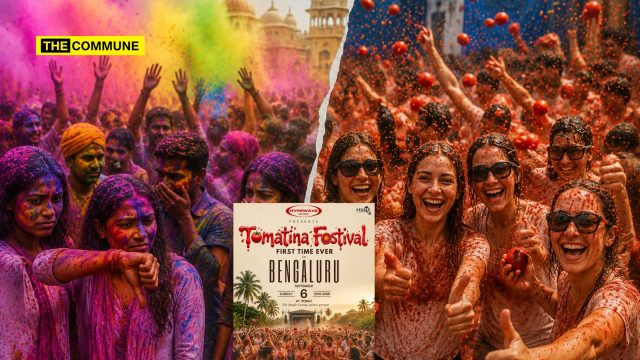
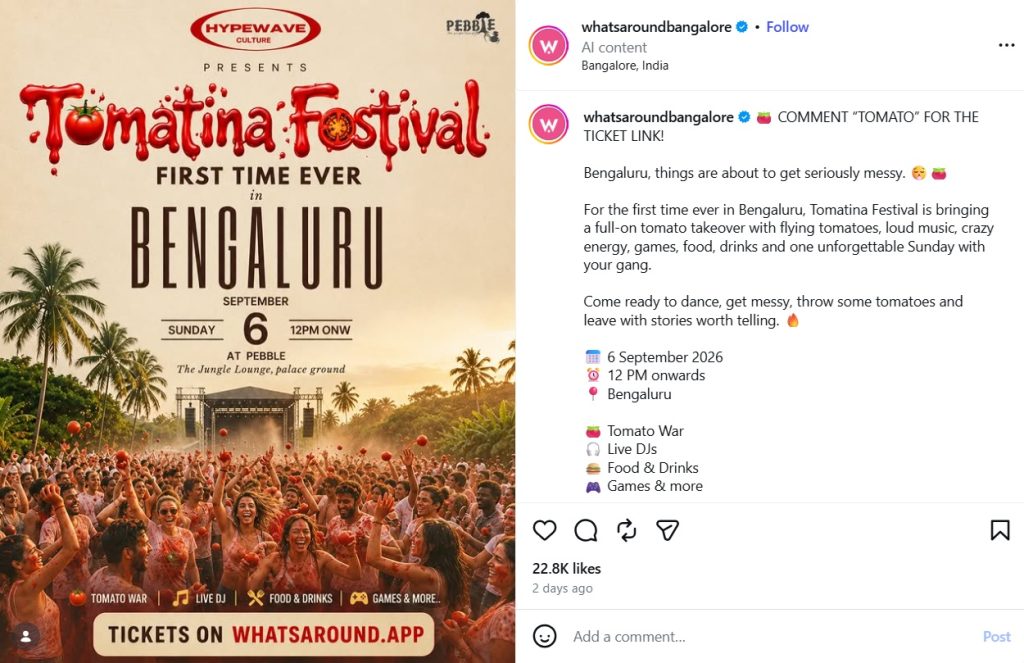
On 6 September 2026, Bengaluru wants to host its first-ever Tomatina Festival – a direct copy of Buñol, Spain’s La Tomatina, where crowds throw overripe tomatoes at each other for an hour, packaged as fun. The organizers are billing it as a first, complete with a live DJ, games, and food and drinks at “The Jungle Lounge, Palace Ground.”
People will queue in like crazy. That is not the question. What is worth asking: why does a country with the richest, oldest, most spectacular civilizational festival calendar on the planet need to import a Spanish tomato fight to feel like it’s celebrating something?
We Didn’t Run Out of Festivals
India does not have a shortage of colour, water, fire, harvest or any festival under the sky. The entire year is sprinkled with festivals, be it Holi or Onam, Pongal, Bihu, Durga Puja, Deepavali – every one of these already delivers what Tomatina is chasing: community, catharsis, a break from routine. We are not a culture starved for festivity. If anything, we have more festivals than any calendar can hold.
So, when an event management company decides Bengaluru needs a tomato-throwing festival lifted wholesale from a Spanish town of 9,000 people, the honest question is: what is actually being celebrated here? Not a harvest. Not a deity. Not a season. Just the aesthetic of a “festival”: imported, branded, ticketed, and stripped of any meaning beyond a photo dump and a DJ set.
The Hypocrisy Is the Real Story
Here’s where it gets rich. The same crowd that will queue up in white T-shirts to get pelted with tomatoes at Palace Ground has, for years now, called Holi a “rape festival” at the drop of the hat. We’ve had leftists and its ecosystem write tirade after tirade reducing India’s most joyous colour festival to a pretext for groping and harassment.
Suddenly, when it’s tomatoes instead of colour, and Spain instead of Mathura, the same act of strangers throwing things at each other in a crowd, bodies pressed together, clothes ruined, becomes “fun,” “quirky,” “first time in Bengaluru.” Nobody is writing think-pieces about consent and crowd safety for Tomatina. Nobody is warning women to stay indoors. The Tomatina and the tomato pulp is fine but Holi and gulal is a problem.
That’s not a coincidence. It’s says a lot. The objection was never really about safety or “consent” at Holi. It was about which festival gets treated as suspect and which gets treated as sophisticated. A Hindu festival with a name that “sounds Hindu” is dismissed as backward and regressive; Holi gets branded a ‘rape festival’, other festivals and rituals are dismissed as patriarchy, regressive and whatnot. A Spanish import with a DJ and a ticket price gets celebrated as cosmopolitan, liberating, and empowering.
In this case, it would be the same crowd contact, same drenched clothes, same chaos, but a different verdict, depending on whose tradition it is.
Do We Have That Many Tomatoes to Waste?
Then there’s the plain economics of it. Buñol’s La Tomatina uses somewhere around 150 tonnes of tomatoes in a single afternoon — tomatoes grown specifically for the event because they’re not fit for eating. Bengaluru’s version will need truckloads of its own, at a time when tomato prices in Karnataka regularly swing hard enough to make national news, and when farmers here have been pushed to dump unsold produce on highways in protest after price crashes wiped out their margins.
Paying a ticket price to stand in a pit of pulped tomatoes, for the aesthetic of a Spanish street party, while the very farmers who grow this crop are fighting for a fair price on it, is not harmless fun. It’s tone-deaf, dressed up as a lifestyle event.
Ape the West, Mock the Rest
None of this is really about tomatoes. It’s about a pattern. Indians, often the most Westward-facing, most online, most “progressive” segment of Indians, the brown sepoys, will manufacture enthusiasm for any import wearing a European label, while treating their own festivals as backward, dangerous, or in need of reform. Oktoberfest nights, Halloween parties, and now Tomatina, get marketed as edgy and fun. Holi gets a trigger warning. Other Indian festivals are regressive.
You don’t need to travel to Buñol or pay Palace Ground prices to throw something at a stranger and call it culture. Walk into any Holi gathering in this country and you’ll find the same colour, same chaos, same joy, rooted in something older than the marketing calendar, and free of the borrowed cool that a Spanish label apparently buys.
Indians don’t need to ape the West to have a festival worth showing up for. The festivals we already have don’t need a Spanish label or a ticket price to be worth celebrating.
Subscribe to our channels on WhatsApp, Telegram, Instagram and YouTube to get the best stories of the day delivered to you personally.