On 10 June 2026, Prime Minister Narendra Modi entered the history books as India’s longest-serving continuously elected Prime Minister, completing 4,399 consecutive days in office and surpassing the record held by Jawaharlal Nehru since the first general elections of independent India.
Political longevity, however, is not an achievement in itself. What makes this milestone remarkable is that it offers an opportunity to assess the transformation India has undergone during more than a decade of Modi’s leadership.
Few leaders in modern history have altered the trajectory of a nation as comprehensively as Modi has transformed India since assuming office in 2014.
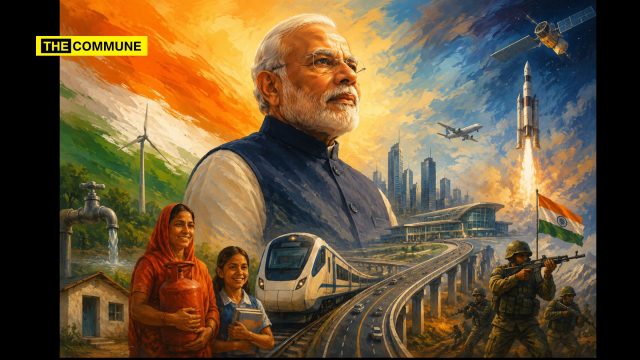
The foundation of the Modi era has been a governance revolution built on scale, technology, and delivery. Through the JAM Trinity – Jan Dhan, Aadhaar, and Mobile connectivity, hundreds of millions of Indians were integrated into the formal financial system. Direct Benefit Transfers ensured welfare reached citizens directly, reducing leakages and making government more accountable and efficient.
Among the most impactful social initiatives were the Swachh Bharat Mission, which transformed sanitation across the country; the Ujjwala Yojana, which brought clean cooking fuel to millions of households; Saubhagya, which accelerated household electrification; Pradhan Mantri Awas Yojana, which enabled millions to own homes; and the Jal Jeevan Mission, which delivered tap water to rural households on an unprecedented scale. Together, these programmes improved the quality of life for hundreds of millions of Indians.
Healthcare received a major boost through Ayushman Bharat, widely regarded as the world’s largest government-funded health insurance programme. For vulnerable families, access to healthcare became more affordable and accessible than ever before.
India’s infrastructure story under Modi has been equally remarkable. The country witnessed record expansion of highways, expressways, airports, ports, metro systems, and logistics corridors. Indian Railways underwent significant modernization through electrification, station redevelopment, dedicated freight corridors, and the introduction of Vande Bharat trains. Infrastructure became not merely a development priority but a national mission.
Perhaps no achievement has been more globally admired than India’s digital transformation. The rise of UPI revolutionized payments and made India a world leader in digital transactions. Combined with Digital India initiatives, this created a technology-driven ecosystem that is now studied by governments across the world.
Programmes like Make in India, Startup India, Mudra loans, and Production-Linked Incentive schemes boosted entrepreneurship, manufacturing, innovation, and investment. India emerged as one of the world’s fastest-growing major economies and a leading destination for global capital.
Farmers benefited from initiatives such as PM-KISAN, expanded irrigation projects, crop insurance schemes, and greater use of technology in agriculture. These efforts sought to strengthen rural incomes and improve resilience in the agricultural sector.
In national security and governance, Modi demonstrated a willingness to take decisions that previous governments had avoided. No one can deny that there have been no major terrorist attacks inside India except for a few in J&K. This means that Modi has been successful in keeping the nation relatively secure. With him at the helm, India became a country that will not hesitate to enter into the homes of the enemies to teach them a lesson for their wrongdoings. Operation Sindoor was a great example of the attitude of new India, naya Bharath. The abrogation of Article 370 fully integrated Jammu and Kashmir into India’s constitutional framework. The abolition of instant Triple Talaq was hailed as a significant step toward gender justice. These measures reflected a leadership style defined by decisiveness and political conviction.
India’s standing in the world rose substantially during Modi’s tenure. Through active diplomacy and strategic partnerships, India emerged as a leading voice on global issues. The successful G20 Presidency highlighted India’s growing influence and reinforced its role as a representative of the Global South.
The Modi years also witnessed a resurgence of cultural confidence. International Yoga Day became a global phenomenon, Indian heritage received renewed prominence, and the inauguration of the Ram Mandir in Ayodhya marked a defining civilizational moment for millions of Indians.
In science and technology, India reached new heights. Chandrayaan-3’s successful landing near the Moon’s south pole demonstrated the country’s technological capabilities, while advances in space exploration strengthened India’s reputation as a major scientific power. During the COVID-19 pandemic, India executed one of the world’s largest vaccination driaves and supplied vaccines to numerous countries, reinforcing its image as a responsible global partner.
The expansion of renewable energy, particularly solar power, further reflected Modi’s vision of combining economic growth with environmental responsibility.
Modi has also redefined how politics is done in India. He has excelled in the art of fighting elections smartly. He has created strong leaders who are getting ready to lead the country after his tenure. The fact that BJP and its allies govern 21 out of India’s 31 states and union territories compared to just 7 before 2014 is a testament of the support and love that Modi has got from the public in his 12 years of stint as the Prime Minister so far. It was in Modi’s regime that we heard about the concept of pro-incumbency so much. Lot of world leaders are at awe of this great achievement, and it has become a global case study in itself.
In a vast country like India, there will of course be several areas where things can be done better but given only 12 years in power, Modi’s achievements outshine the gloomy narratives that his detractors try painting every single day.
What makes Narendra Modi’s tenure exceptional is not any single initiative but the breadth of transformation across welfare, infrastructure, technology, healthcare, economic reform, national security, diplomacy, and culture. Few leaders in independent India have attempted change on such a scale, and fewer still have translated ambition into implementation so consistently.
As Narendra Modi becomes India’s longest-serving elected Prime Minister, his most enduring achievement is the creation of a New India – more connected, more confident, more aspirational, and more influential on the world stage than ever before. History will remember 10 June 2026, not merely as the day a record was broken, but as a moment to reflect on one of the most consequential leadership tenures in modern India.
M. Ananth Narayan is a political commentator.
Subscribe to our channels on WhatsApp, Telegram, Instagram and YouTube to get the best stories of the day delivered to you personally.