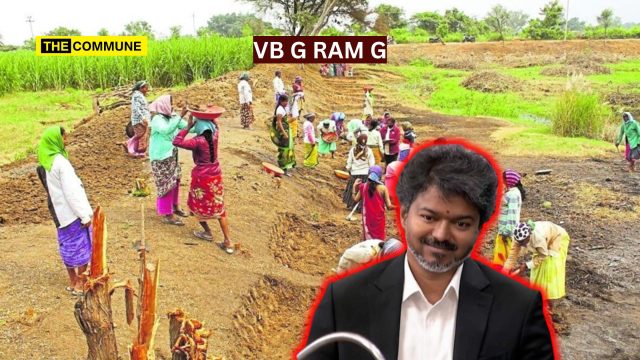
The Tamil Nadu government has decided to implement the Centre’s VB G RAM G (Viksit Bharat Guarantee for Rozgar and Ajeevika Mission) scheme from 1 July 2026 despite expressing concerns over the increased financial burden and certain operational provisions introduced under the revised funding framework, as reported in DT Next.
Under the new funding pattern introduced by the Union government, the scheme will be implemented on a 60:40 cost-sharing basis, with the Centre bearing 60% of the expenditure and states contributing the remaining 40%.
According to officials, the Union government has allocated ₹7,585.49 crore for Tamil Nadu under the scheme. However, the State will have to contribute ₹3,034.19 crore during the remaining nine months of the current financial year to facilitate its implementation.
A senior government official stated that Tamil Nadu has been at the forefront of implementing rural employment and livelihood programmes over the past two decades and that the government had therefore decided to continue participation in the scheme under the revised funding structure. The official, however, acknowledged that the State’s financial commitment under the new arrangement remained a major concern.
Officials indicated that Tamil Nadu’s annual expenditure under the revised formula could range between ₹4,500 crore and ₹5,000 crore. For the current financial year alone, the State’s share is expected to exceed ₹3,000 crore.
Government sources noted that the previous funding mechanism imposed a significantly lower burden on State finances. They pointed out that concerns regarding changes to the funding structure of centrally sponsored rural employment programmes had also been raised with the Union government during the previous DMK administration.
Apart from the financial implications, Tamil Nadu has reportedly expressed reservations about certain operational guidelines incorporated into the new framework.
Officials stated that restrictions on undertaking work for up to 60 days in specific districts could adversely affect rural livelihoods and employment generation. They argued that such restrictions may not adequately account for regional variations in agricultural seasons and local employment requirements.
Despite these concerns, the State government has decided to proceed with the rollout of the scheme from July 1 and has begun administrative preparations for its implementation.
It is noteworthy that the DMK government fought tooth and nail to not implement this scheme.
The VB G RAM G scheme is one of the central government’s flagship rural livelihood and employment initiatives, and Tamil Nadu’s participation under the revised funding pattern is expected to involve a substantial increase in the State’s financial contribution in the years ahead.
Subscribe to our channels on WhatsApp, Telegram, Instagram and YouTube to get the best stories of the day delivered to you personally.