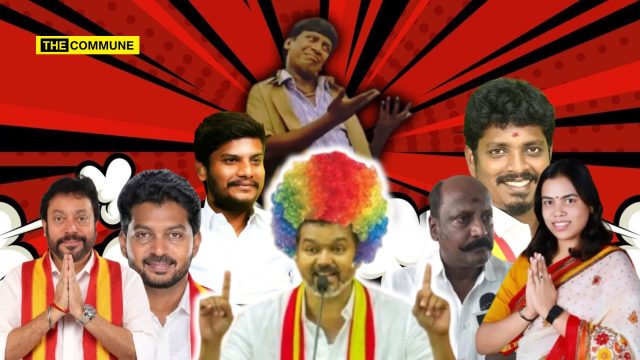
For a government elected on promises of change, an uncomfortable pattern has begun to emerge. Since assuming office, several ministers and MLAs in Chief Minister Vijay’s TVK administration have attracted attention not for landmark policy decisions or governance initiatives, but for a series of remarks, social-media stunts and controversial statements that have raised serious questions about the experience, competence and preparedness of the government’s new faces.
Industries Minister Keerthana: Reels Over Industrial Policy?
Among the most discussed incidents involved Industries Minister Keerthana, who drew criticism after posting a social-media reel inviting investors to Tamil Nadu.
Tamil Nadu is not waiting for the future, we are building it.
From single-window approvals and faster clearances to AI cities, green hydrogen, advanced manufacturing, and the space economy, Tamil Nadu is creating an ecosystem where innovation meets execution.
Under the… pic.twitter.com/d0Ipoc4BVR
— Virudhai Magal Keerthana (@Keerthana4VNR) May 27, 2026
To any fairly educated person, it is clear as day that attracting industrial investment requires sustained engagement with companies, review of existing MoUs, infrastructure planning, workforce development and policy execution rather than short-form promotional videos. One wonders whether the minister’s focus on social-media branding was overshadowing more substantive industrial policy discussions.
The criticism was amplified because industrial development remains concentrated in the Chennai-Hosur-Coimbatore corridor, while regions such as Madurai, Virudhunagar and Sivakasi continue to seek larger investments and infrastructure support. Ideally, addressing these structural challenges should take precedence over image-building exercises.
Mines Minister: Governance Or Public Relations?
TVK minister for Natural Resources, Minerals, and Mines also came under attack after videos circulated showing him interacting with members of the public in highly produced social-media clips.
Cutest video on Internet today 😻♥️ pic.twitter.com/LR4Bhm0YIP
— Priyanshhh🤫 (@heypriyanshere) May 26, 2026
Surprise inspections and public interactions were being packaged primarily as content for social media rather than serving as genuine oversight exercises.
What the youngsters & #TVK can do – Here is a sample 👏@drtkprabhu_TVK seems to be one of the most humble, well mannered, professional, mature & yet sharp youngster in TVK.
He is & will be a terrific asset for TVK & TamilNadu 👍 pic.twitter.com/ZIl2ifF562
— Star South – Overseas (@StarSouthEnt) May 27, 2026
View this post on Instagram
With regard to the announcements regarding quarry closures, the government had not fully disclosed the specific violations, entities involved or long-term enforcement plans.
Transport Minister Vijay Parthiban And The Volvo Controversy
One of the most widely discussed exchanges involved Transport Minister Vijay Parthiban.
When questioned about the operation of Volvo buses, the minister reportedly responded that people should ask Volvo about the issue.
MLA Parthiban : over ah pesuringa VOLVO bus varalana volvo kitta poi kelunga!
Makkal : VOLVO bus SETC kitta dha sir irukku🤦🏼♂️
MLA Parthiban : apdiyaaaaa? 😂#TVK | #Tamilnadu | #TVK | #TVKVijay | #DMK | #TVKVijayFails pic.twitter.com/L0MJU0v6ON
— Alpha ! (@DMK662000) May 28, 2026
The remark attracted ridicule because Volvo is merely the manufacturer, while the operation and maintenance of government-run buses fall under the transport department itself. The exchange was a classic example of poor understanding of departmental responsibilities.
In another video, he is seen ‘pacifying’ a passenger using pity – he claimed he had not eaten but seemed like the passenger had eaten to his full and indicating that he must cut the minister some slack.
A passenger questioned #TamilNadu #Transport Minister A Vijay Tamilan Parthiban over a delayed bus during an inspection at #Kilambakkam sbus terminus. The Minister’s response to him, “I haven’t even eaten yet… but you seem to have eaten well,” has drawn criticism online.#DTNext pic.twitter.com/MAoqkEsh2A
— DT Next (@dt_next) May 28, 2026
The minister was also criticised for remarks suggesting that even passengers with reservations could be asked to vacate seats to accommodate others during periods of heavy demand, a statement that has raised concerns about passenger rights and administrative planning.
❤️🔥Brilliancy at its peak by #TVK Transport Minister Mr. Vijay Tamizhan Parthiban !
Mastermind idea…
He could’ve made the reserved passengers travel on top of bus. This would have saved time, fuel and efficiency. pic.twitter.com/Rgs7wvA6ha
— Studio Flicks (@StudioFlicks) May 28, 2026
MLA Navalpattu Vijay And The Garbage Disposal Proposal
Thiruverumbur MLA Navalpattu Viji drew criticism after proposing that the nearly seven lakh metric tonnes of waste accumulated at Tiruchirappalli’s Ariyamangalam dump yard be transported and dumped into a deep rocky quarry pit.
Defending the proposal, Viji argued that the waste could be shifted to a rocky pit near Valithangal Thogu Kudi without affecting groundwater or causing significant environmental damage. He claimed the move would be safer than allowing the garbage to remain in a densely populated residential area and described it as a practical solution to a problem that successive governments had failed to address.
The proposal, however, triggered criticism on how relocating waste to a quarry pit could be considered a long-term waste-management solution. Modern waste-management practices focus on segregation, recycling, biomining and scientific processing rather than simply moving garbage from one location to another.
HR&CE Minister And Temple Product Debate
During a temple inspection, the HR&CE Minister sparked criticism after questioning how anyone could verify the manufacturing date printed on a food product’s packaging.
“They have put a date. What proof do you have that it was manufactured on that date?” the minister asked, suggesting that the printed date alone was insufficient evidence.
இந்த முறுக்கு 15 ஆம் தேதி Manufacturing பன்னுனம்முனு Date இருக்கு…..
சரி….
இது 15 ஆம் தேதிதான் Manufacturing பன்னுதுக்கான ஆதாரம் உங்ககிட்ட என்ன இருக்கு……
😀😀😀😀என்ன ஒரு புத்திசாலித்தனம்….கககபோ..
வக்காளி..உலகத்துல யாரும் கேட்காத கேள்வி…இந்த வருடம் நோபல் பரிசை… pic.twitter.com/e08MjvLsDz
— Black Panther (@Ranjith_Rayappa) May 24, 2026
The remarks were widely mocked that the minister appeared more preoccupied with questioning packaging labels than addressing larger issues facing the department. The comments generated considerable attention despite offering little clarity on any actual violation or irregularity discovered during the inspection.
The episode became yet another example of ministers creating controversies through public statements rather than policy initiatives.
TVK MLA Explains Why Vijay Loves Fishermen
In a video that has gone viral, a TVK MLA is seen pacifying a fisherman saying the CM loves fishermen because he acted in a film called Sura where he plays a fisherman named Sura!
தலைவருக்கு மீனவர்களை ரெம்போ பிடிக்கும்…
எப்படி சொல்ற ?
சுறா படம் பாத்துருப்பீங்க…
யாருமில்ல, அமைச்சர் தான் 😂 pic.twitter.com/ZRwCUwawHk
— Renu Gopal V (@RenugopalV) May 28, 2026
Prohibition And Excise Minister Vignesh And The TASMAC Closure Debate
Prohibition and Excise Minister Vignesh also attracted attention for his remarks on demands to shut down TASMAC liquor outlets across the state.
Responding to calls for the closure of liquor shops, the minister questioned whether shutting outlets would actually solve the problem, asking, “If closing these shops solves the problem, then we can close all 4,000 shops, right?” He further argued that prohibition could lead to unintended consequences, stating that illicit liquor and narcotics such as ganja could become more prevalent if legal liquor outlets were shut down.
The remarks triggered criticism that the minister appeared to be defending the continuation of state-run liquor sales rather than addressing concerns about alcohol addiction and the social impact of TASMAC outlets. Now, one wonders whether the government’s Prohibition and Excise Minister should be framing the debate around the impossibility of closure rather than outlining a long-term strategy to reduce alcohol dependence and related social harms.
Fisheries Minister Srinath And The Katchatheevu Question
Fisheries Minister Srinath also found himself facing criticism after declining to comment on what steps the Vijay government was taking to retrieve Katchatheevu, despite the issue having been one of TVK’s most aggressively campaigned causes before the elections.
When asked what measures the government was taking to reclaim the island, Srinath responded with a brief, “I cannot speak about that right now. No comments.”
The response drew attention because Chief Minister Vijay had repeatedly raised the Katchatheevu issue while in opposition. Before the elections, he had demanded that the Union government assert India’s sovereignty over the island, proposed a 99-year lease as an interim measure, and accused successive governments of abandoning Tamil Nadu fishermen affected by arrests and boat seizures near Sri Lankan waters.
The minister’s refusal to answer stood in sharp contrast to TVK’s earlier rhetoric on the issue. The controversy was further amplified by the fact that TVK is now allied with the Congress party, under whose government Katchatheevu was ceded to Sri Lanka in 1974.This is evidence that TVK’s once-aggressive position on Katchatheevu had become noticeably muted after assuming office.
Fun guarantee 😂 pic.twitter.com/13y4wMiQuX
— Trollywood 𝕏 (@TrollywoodX) May 28, 2026
The Reality Check For TVK’s Promise Of Change
For a party that came to power promising a new political culture, the early signs are hardly encouraging.
Running a government is not the same as running an election campaign. Viral clips, social-media engagement and catchy one-liners may win attention online, but they do not solve industrial stagnation, transport failures, waste-management challenges, fishermen’s concerns, temple administration issues or the social consequences of alcohol addiction.
What makes these incidents noteworthy is not any single gaffe in isolation. It is the pattern.
Vijay sought votes on the promise that his government would be different from the parties he criticised for years. But what Tamil Nadu is increasingly witnessing is not change, but the consequences of handing enormous responsibilities to people, who were his fan club members for the longest time, who are unprepared for them. The longer this pattern continues, the greater the risk that today’s viral clips become tomorrow’s governance failures.
Subscribe to our channels on WhatsApp, Telegram, Instagram and YouTube to get the best stories of the day delivered to you personally.