The University of Madras Academic Council meeting held on 25 November 2026 at the Centenary Building, Chepauk, exposed a sly attempt to push Christianisation deeper into the public university’s distance education system. Item No. 16 in the original Final Agenda, issued under the orders of Registrar Prof. Dr. Rita John on 18 November 2026, proposed two new certificate courses in the Institute of Distance Education (IDE): a Certificate Programme on Franciscan Spirituality and a Certificate Programme on Pentecostal Theology, both in English and Tamil medium, to begin from the academic year 2027-2028.
The item stated that the Syndicate, at its meeting on 1 April 2026, had accepted the recommendations of the Board of Studies in Christian Studies, IDE. The Standing Committee of the Academic Council recommended the proposal, with Dr. K. James Ponniah (Head of the Department of Christian Studies) to move it for approval by the Senate, complete with regulations and syllabus (APPENDIX-8). This came on top of the university’s existing Department of Christian Studies, which already runs M.A. programmes, diplomas, and certificates, and recent moves to expand an M.A. in Christian Studies to affiliated colleges.
The courses focus on specific Christian traditions—Franciscan spirituality (tied to the Catholic order founded by St. Francis of Assisi) and Pentecostal theology (a major Protestant evangelical stream emphasising direct experience of the Holy Spirit). Introducing them through the IDE, which reaches a large number of students across Tamil Nadu, raised questions about whether a state public university, funded by taxpayers of all communities, should be prioritising confessional Christian formation programmes.
Only after intervention by the Governor of Tamil Nadu (Chancellor of the University) was the entire Item No. 16 scrapped. A revised agenda circulating for the same meeting omitted the proposal entirely. Subsequent items were renumbered—what had been Item 17 on Sociology diplomas became the new Item 16—confirming that the Christian Studies certificates were dropped before the Academic Council could deliberate on them. The Governor’s warning to Registrar Rita John halted the move at the last stage.
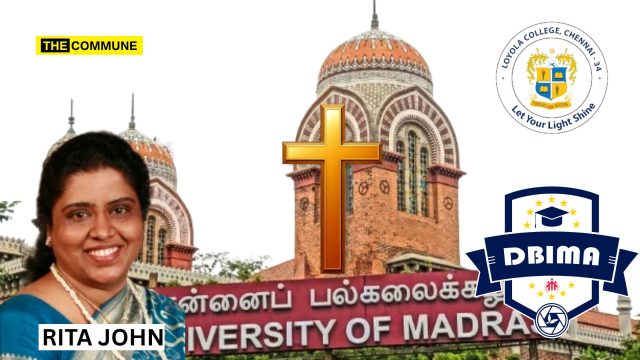
This episode fits a broader pattern of preferential treatment extended by Registrar Rita John to certain Christian-managed institutions affiliated to the University of Madras, particularly Loyola College, Chennai, and Don Bosco International Media Academy, Paris.
Loyola College has faced repeated scrutiny over unapproved foreign collaborations. This includes its Pondicherry University twinning programmes and, more recently, a Diploma in Filmmaking linked to Don Bosco International Media Academy (DBIMA) in Paris. RTI replies from the University of Madras itself confirmed that no affiliation or approval had been granted for certain such programmes. Complaints were filed with the UGC, the University, and the Governor’s office highlighting violations of UGC academic collaboration regulations, risks to students’ credentials, and potential visa issues. Despite these red flags and formal complaints, Registrar Rita John’s administration has taken no meaningful action against the college. Instead of initiating inquiries or withholding approvals pending compliance, the university has largely left the institution to respond on its own, effectively shielding it.
While the Registrar’s office moves swiftly to place Christian Studies certificate courses on the Academic Council agenda, it has consistently failed to act against well-documented irregularities involving Loyola College and Don Bosco-linked institutions. The pattern suggests a clear bias: expansion of confessional programmes inside the public university on one side, and protection of erring minority institutions on the other.
Subscribe to our channels on WhatsApp, Telegram, Instagram and YouTube to get the best stories of the day delivered to you personally.