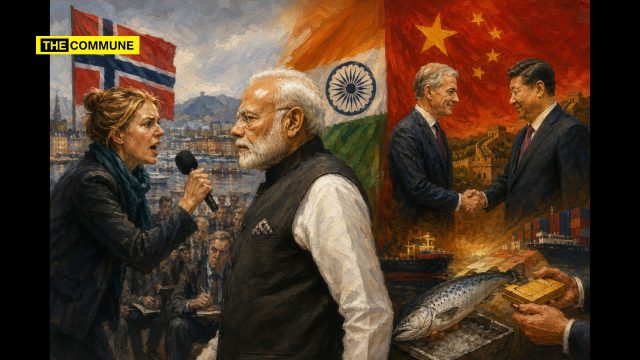
When a Norwegian journalist shouted at Prime Minister Narendra Modi in Oslo asking why he would not take questions from “the freest press in the world”, India’s opposition ecosystem instantly elevated the moment into an international morality play.
View this post on Instagram
But before Norway lectures India on democracy, press freedom and human rights, perhaps Oslo should first explain its own record especially its extraordinary willingness to bend before Beijing whenever trade and diplomatic interests are at stake.
The viral moment itself was misleading from the very beginning. PM Modi was not walking away from a press conference. It was a joint statement with Norwegian Prime Minister Jonas Gahr Støre where questions were never scheduled. A separate Ministry of External Affairs briefing was already planned later that evening, and the Indian Embassy publicly invited the Norwegian journalist, Helle Lyng, to attend and ask questions there.
She did attend. She asked her questions. And MEA Secretary Sibi George answered them in detail. But none of that mattered to the outrage industry because the objective was never journalism. The objective was spectacle.
Norway’s Own China Record Destroys Its Moral Posturing
The irony becomes impossible to ignore once one examines Norway’s actual conduct toward China.
Norway Formally Agreed Not To Challenge China’s “Core Interests”
In 2016, Norway signed a normalization agreement with China after diplomatic ties had frozen for six years. The deal included an extraordinary pledge from Oslo stating that Norway “attaches high importance to China’s core interests and major concerns” and “will not support actions that undermine them.”
Why was Norway punished in the first place? Because the Norwegian Nobel Committee awarded the Nobel Peace Prize to Chinese dissident Liu Xiaobo in 2010.
China retaliated aggressively. Diplomatic ties froze. Trade talks stopped. Norwegian salmon exports suffered. And eventually, Norway folded.
Norway did not meet the Dalai Lama in 2014 so as to not anger China.
Even Norway’s own youth political organizations criticised the agreement as a surrender of Oslo’s moral independence and its willingness to avoid criticism of Beijing in exchange for restored trade relations.
So the same establishment now invoking “the freest press in the world” against India had no problem formally reassuring an authoritarian state that it would respect Beijing’s “core interests”.
Norway Claimed Ignorance About Xinjiang In 2018
The hypocrisy deepened further in 2018 when Norway’s King Harald and Queen Sonja visited China.
At that point, international reporting on Xinjiang’s internment camps was already widespread. Documentation regarding mass detention, surveillance systems, and re-education camps had become a global issue.
Yet Norway’s royal family reportedly claimed they were unaware of the Xinjiang camps.
This was not ignorance. It was diplomatic convenience.
When trade and state relations are involved, “human rights” suddenly become flexible, vague and selectively applied.
Norway Ignored Calls To Pressure China Over Xinjiang
In 2022, Norway’s own Helsinki Committee urged the government to take a stronger stand against China over Xinjiang abuses.
The Norwegian government did not comply.
There were no dramatic confrontations. No viral performances. No moral grandstanding at podiums. No public lectures directed at Beijing.
The contrast with the performative outrage directed at India could not be sharper.
PM Støre Praised China In Beijing In 2024
The same Norwegian Prime Minister whose government now presides over lectures on democracy travelled to Beijing in September 2024 and met Chinese President Xi Jinping.
The visit ended with China granting 15-day visa-free access to Norwegian citizens.
The official Chinese readout quoted PM Støre praising China’s development as being “full of vitality” and possessing “significant successful experience.”
Norway once again reiterated respect for China’s “core interests.”
Human rights concerns reportedly received little more than a token mention.
Apparently, “critical questioning” becomes optional when sitting across from Beijing.
Even Norwegian Media Faced Chinese Pressure
Norway’s own newspaper of record, Aftenposten, acknowledged that China blocked its website whenever it published articles critical of Beijing or supportive of Taiwan.
The paper reportedly stated that its website would become inaccessible in China for roughly two weeks after such coverage.
Did Norway escalate the matter diplomatically? Did Oslo launch a global campaign on press freedom? Did Norwegian journalists publicly confront Chinese leaders demanding answers about censorship? No. Because everyone understood the geopolitical realities involved. Yet the same ecosystem expects India to accept theatrical heckling as some sacred democratic test.
The Manufactured Anti-India Spectacle
The controversy itself appeared carefully stage-managed for virality.
Helle Lyng, who worked for the lesser-known Norwegian publication Dagsavisen, had barely discussed India in her previous reporting. Her X account had minimal activity before the Oslo episode suddenly transformed her into a celebrity within India’s opposition ecosystem.
Within hours, Congress leaders, left-liberal influencers, propagandists and anti-Modi commentators amplified the clip across social media as proof of democratic decline in India.
But the actual sequence of events told a very different story.
The Indian Embassy publicly invited Lyng to the official press briefing. MEA Secretary Sibi George answered her questions extensively, speaking about India’s constitutional framework, democratic processes, Covid vaccine assistance, G20 leadership, Global South outreach and the inclusion of the African Union into the G20 framework.
When Lyng repeatedly interrupted him and attempted to dictate the format of his answers, George firmly pushed back, reminding her that she had asked a question and he had the right to answer it properly.
The exchange ultimately exposed the gap between performative activism and actual journalism.
Norway’s journalist invoked the ‘freest press in the world’ at PM Modi in Oslo. Before Oslo lectures New Delhi on accountability, take a look at their own record.
-In 2016, Norway signed a normalization pact with China that included a formal government pledge that it “attaches…
— Gaurie Dwivedi (@GaurieD) May 19, 2026
Press Freedom Cannot Be A Selective Weapon
Press freedom is not a geopolitical prop to be waved selectively against countries one dislikes while remaining silent before powerful authoritarian states.
A journalist from a country whose government formally pledged not to challenge China’s “core interests”, whose royal family pleaded ignorance about Xinjiang, whose Prime Minister praised Xi Jinping’s governance model, and whose media institutions adjusted themselves around Chinese pressure, invoking press freedom as a unilateral moral standard against India is hypocrisy of the highest order.
India is not above criticism. No democracy is. But before Oslo lectures New Delhi about accountability, Norway must first explain why its own principles seem to disappear whenever Beijing enters the room.
Subscribe to our channels on WhatsApp, Telegram, Instagram and YouTube to get the best stories of the day delivered to you personally.