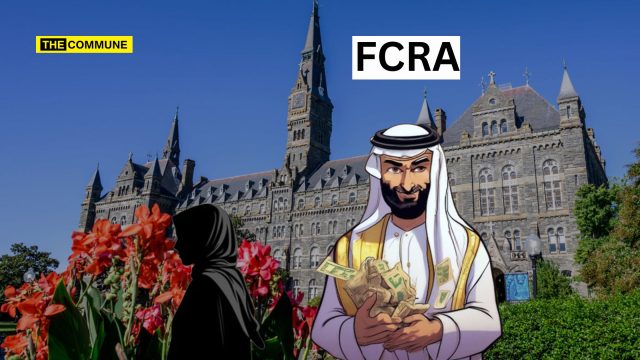
What happens when foreign money begins shaping not just campuses, but the worldview of an entire generation? According to Dr. Charles Asher Small, Executive Director of the Institute for the Study of Global Antisemitism and Policy (ISGAP), that is precisely what has been unfolding in the United States. Small alleges that more than $100 billion linked to Qatar and the Muslim Brotherhood has quietly flowed into American universities over the past two decades, fuelling concerns over foreign influence, ideological capture, and national security.
Small argued that these funding networks have extended beyond research partnerships and philanthropy to influence academic discourse, curricula, and campus politics, contributing to what he described as an ideological shift on Western campuses.
Billions Flowed Into Elite Universities
According to Small, ISGAP’s “Follow the Money” project uncovered over $10 billion in Qatari funding to Cornell University, more than $1 billion to Georgetown University, and approximately $1.3 billion to Texas A&M University, much of which, he claims, was not properly disclosed under U.S. reporting requirements.
Small alleged that Georgetown, which hosts one of the world’s most influential diplomatic training programmes, received substantial Qatari funding, raising concerns about foreign influence over institutions that educate future diplomats and policymakers.
At Texas A&M, ISGAP claims it identified 504 research projects linked to Qatar, including dozens with alleged dual-use military applications. Small noted that shortly after ISGAP published its findings, Texas A&M announced it would close its Qatar campus, although the university did not publicly attribute the decision to ISGAP’s report.
Influence Beyond Universities
Small also pointed to the Choices Program at Brown University, a K-12 educational curriculum reportedly used in over 8,000 schools across the United States.
According to ISGAP, the curriculum presented Middle East history in a manner that omitted Israel from maps and downplayed Jewish and Christian historical ties to the region. Following criticism and ISGAP’s report, Brown University ended its relationship with the programme.
Small claimed that ISGAP subsequently received calls from parents across the United States who believed the findings explained concerns they had already raised about what their children were being taught.
Funding Linked to Campus Radicalisation
Small argued that decades of foreign funding have coincided with a broader ideological transformation across Western universities.
Referring to the pro-Palestinian campus protests that followed the October 7 Hamas attack on Israel, he stated it was no coincidence that students at elite institutions organised encampments and demonstrations supporting groups aligned with Hamas, which he described as the Palestinian branch of the Muslim Brotherhood.
According to Small, foreign influence in universities has long-term consequences because today’s students become tomorrow’s academics, journalists, bureaucrats, diplomats and political leaders.
“Our enemies understand that if you influence universities, you influence society,” Small said during the interview.
Muslim brotherhood is infiltrating USA
Home Minister Amit Shah knows this
That’s why he is tightening FCRA laws
— Kreately.in (@KreatelyMedia) July 12, 2026
The India Parallel: Why FCRA Scrutiny Has Intensified
The concerns raised by ISGAP echo debates that have long existed in India regarding foreign funding and ideological influence.
Unlike the United States, India has progressively tightened oversight of overseas funding through the Foreign Contribution (Regulation) Act (FCRA).
Successive amendments under the Modi administration introduced stricter disclosure requirements, limited administrative expenses, prohibited the transfer of foreign funds between NGOs, and increased government scrutiny of organisations receiving overseas contributions.
The Indian government has consistently argued that foreign funding should not be used to influence public policy, education, religious activities, or political discourse, citing concerns over national security, sovereignty, and social stability.
Officials have maintained that tighter FCRA enforcement is intended to improve transparency and prevent foreign entities from indirectly shaping India’s domestic institutions.
A Growing Debate
This also casts India’s FCRA regime in a different light. Leftists have often portrayed stricter scrutiny of foreign funding as excessive regulation. But if universities can become vehicles for ideological influence through opaque overseas funding, as Small states in the American context, the question is no longer whether governments should demand transparency, but whether they can afford not to. Democracies have every reason to encourage international collaboration; they have an equal responsibility to ensure that foreign funding does not quietly shape their intellectual, political and civilisational discourse.
Subscribe to our channels on WhatsApp, Telegram, Instagram and YouTube to get the best stories of the day delivered to you personally.