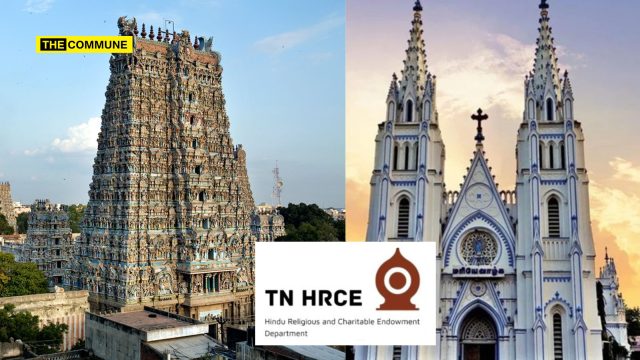
Since the Karur Inam lands are in the news, we will also take a look at a similar forgotten piece of history that the Dravidianist government buried and handed it over to a church.
For over 120 years, 49 acres of prime Madurai land, worth an estimated ₹600 crores today, has been in the hands of the Roman Catholic Mission. The Supreme Court gave it back to the Meenakshi Sundareswarar Temple in 1966. The Tamil Nadu government never implemented the order. Instead, a DMK-era Tehsildar quietly handed it over to the Church, citing a colonial-era sale deed, as reported in PGurus.
The story of the Meenakshi Sundareswarar Devasthanam (MSD) land is not a tale of legal ambiguity. It is a chronicle of bureaucratic betrayal, a constitutional bench verdict ignored, and a government that chose to look the other way while a temple was systematically looted.
Ancient Origins: A Gift to the Gods
It all began centuries ago, when the then rulers granted the land, then known as Melapappathu and Keelapappathu, comprising 49 acres in total as an inam to the temple. The grant was clear in purpose: it was Devadayam, God’s income, meant for the performance of archaka service. A 1863 Inam Fair Register, cited extensively in the Supreme Court‘s 19-page judgment, confirms this, describing the land as “Stalathar inam Poruppa manyam, conducted for Meenakshi Sundareswaral Temple.” The names of the Bhattars, the priest family, were entered not as owners but as athakinama (perpetual beneficiaries or trustees) of the temple. Their job was to till the land, pay the temple its due, and keep a portion for their services. The land was never theirs to sell. Let us trace the sequence of events.
1894: The Illegal Transfer
In October 1894, the Roman Catholic Mission of St. Mary’s Church purchased the land from the Chettiars, who had earlier acquired it from the Bhattars. The sale was illegal from the start—the Bhattars had no title to transfer. The Mission has remained in possession since that time, but the legal ownership was never rightfully theirs.
1948: Revenue Divisional Officer Orders Restoration
On 9 April 1948, the Revenue Divisional Officer of Madurai, acting under Section 44B of the Madras Hindu Religious Endowments Act, 1926, held that the inam comprised both melwaram and kudiwaram and, as the lands had been alienated, they were liable to be resumed. The lands were resumed and regranted to the Meenakshi Sundareswarar Devasthanam. The Roman Catholic Mission, which was in possession, promptly appealed.
1949: District Collector Upholds the Ruling
On 13 March 1949, the District Collector dismissed the Mission’s appeal, upholding the 1948 ruling. The Collector also held that the inam comprised both the warams.
1954-1959: The Legal Battle Intensifies
The Roman Catholic Mission then filed suits in the court of the Subordinate Judge, Madurai, seeking a declaration that the inam consisted only of the melwaram and that the inam was a personal inam outside the scope of Section 44B. The Mission also challenged the section itself as ultra vires the Provincial Legislature.
The District Judge dismissed the first suit but, in the second suit, held that the inams were personal inams and, therefore, the order of resumption was invalid and without jurisdiction. He granted a declaration to that effect and issued an injunction against the Devasthanam.
The High Court, on 14 December 1959, reversed the District Judge’s findings on both aspects. It held that the inam was of the melwaram only, a finding that favoured the Mission, but held that the inams were not personal and were liable to be resumed, thus favouring the Devasthanam and the State. The High Court also repelled all contentions about the ultra vires nature of Section 44B.
1966: The Supreme Court Verdict – Land Belongs to the Temple
The Supreme Court, in its 1966 judgment, meticulously examined the evidence and categorically stated that the inam comprised only the melwaram (revenue right) and that it was a service inam for the temple, not a personal grant to the Bhattars. The Bench, led by Chief Justice P.B. Gajendragadkar and Justice M. Hidayatullah, held that the inam was “granted for the service of the Devasthanam” and was thus “liable to resumption” upon alienation.
The Court concluded that by transferring the inam, “the temple was deprived of a benefit, and the transferee had no right to hold that benefit. What was done was to restore to the temple what it had lost, and this was not putting a denominational religious institution at an advantage.” The verdict was clear: the land belongs to the Madurai Temple.
1966: The Tehsildar’s Dubious Decision
However, justice never reached the temple. Despite the Supreme Court’s order, the land has remained in the possession of the Roman Catholic Mission. And the person responsible for this travesty, as unearthed through a Right to Information (RTI) application in 2013, is none other than a DMK-era Tehsildar, K. A. Karuppaiah.
In 1966, the very year of the Supreme Court verdict, the Inams Settlement Tehsildar conducted inquiries. The official, K.A. Karuppaiah, overruled the Supreme Court and, in a decision that reeks of contempt of court, cited the 1894 purchase by the Church and concluded that the Roman Catholic Mission was the rightful beneficiary. He simply ignored the 1966 Supreme Court judgment.
The problem wasn’t just that the Supreme Court had spoken, but that the DMK government under whose rule this happened never approached the Supreme Court to recover the property. The government effectively buried the verdict.
1982: MGR Government Gives Patta to Church
Further revelations from the RTI expose the depths of the mismanagement. In 1982, the M.G. Ramachandran government officially gave the patta to the Roman Catholic Mission, fixing a pathetic fasal (harvest) amount of just ₹8,406.24. For a 49-acre prime property located in the heart of Madurai, worth crores, the Tamil Nadu government was charging a pittance and even that was never paid to the temple.
A Systematic Pattern of Betrayal
This is not an isolated incident of the Tamil Nadu Hindu Religious and Charitable Endowments (HR&CE) Department’s abject failure. It is a systemic rot. Time and again, the state government has shown a consistent pattern of anti-Hindu bias, prioritizing churches and other institutions over temple properties.
One only needs to look at the recent controversy where the TVK government has been accused of handing over 3,085 acres of temple land worth ₹25,000 crores to encroachers in Karur district to see the pattern. And in a stunning reversal of its own claims, the HR&CE initially told the Madras High Court that the Podhu Dikshitars of Chidambaram’s Natarajar Temple sold 2,000 acres of land, only to later revise the figure down to a laughable 18 acres – a fraud that Temple Activist TR Ramesh called out.
The state has shown contempt for court orders. Hindu Munnani has repeatedly pointed out that while temples are demolished on the flimsiest grounds of encroachment, illegal churches and mosques are left untouched, even when court orders call for their removal. In Kallakurichi, the government tried to usurp 40 acres of Sri Nareeswarar Temple land worth ₹88 crores for a paltry ₹1.98 crores to build a Collectorate complex, a move stopped only by the Madras High Court. And in a move straight out of the DMK playbook, a Murugan temple in Tiruppur was demolished by revenue officials even as devotees protested, while the government turned a blind eye to unauthorised structures of other faiths.
The Question That Remains
The story of the Meenakshi Temple land is a shocking testament to the double standards of successive governments in Tamil Nadu. A 1966 Supreme Court verdict was overturned by a state bureaucrat. The HR&CE Department, the very institution meant to protect temple properties, was complicit in the theft. And the political class, from the DMK to the TVK, has colluded in this loot.
The same controversy has returned in the form of the Karur inam lands issue. It remains to be seen whether the TVK government will pay heed to the Hindus and reverse its GO and also correct this great historical wrong or will it pander to the evil forces and betray Hindus once again like its Dravidianist counterparts.
Subscribe to our channels on WhatsApp, Telegram, Instagram and YouTube to get the best stories of the day delivered to you personally.