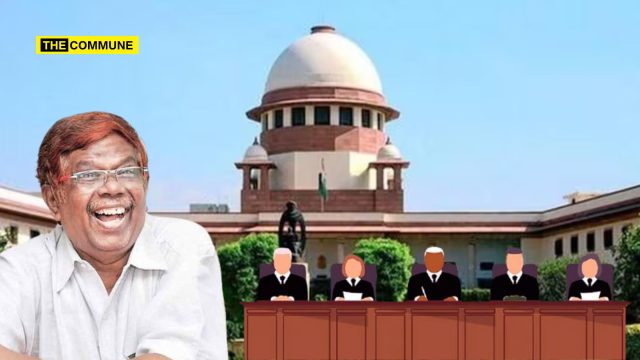
Former Madras High Court judge K Chandru, a former full-time worker of the Communist Party of India (Marxist) and a vocal proponent of Dravidianist politics, has alleged that India’s judicial appointments system has become a mechanism of political collusion, accusing the judiciary of increasing “saffronization” and Prime Minister Narendra Modi of benefiting from a secret “barter” arrangement under the collegium system, as reported in LiveLaw.
Chandru made these remarks while delivering the keynote address titled “The Collegium System of Appointment is a Constitutional Coup” at a colloquium on “Who will Judge the Judges”, organised by the Asian College of Journalism.
Chandru, who has frequently appeared in public debates and political controversies over judicial appointments, Hindu religious practices and the conduct of sitting judges, has previously faced criticism over his remarks about Union Finance Minister Nirmala Sitharaman and his interventions concerning Justice GR Swaminathan. The Commune has reported on these controversies in its coverage of Chandru’s public statements and political positions.
Chandru Claims Modi Benefits From Collegium System Instead Of Establishing NJAC
Speaking at the event, Chandru criticised both the executive and the judiciary for failing to establish a permanent system for appointing judges. He argued that although the Narendra Modi-led Union Government had attempted to introduce the National Judicial Appointments Commission (NJAC) after coming to power in 2014, the Supreme Court struck it down, and the government subsequently continued with the collegium system instead of pursuing another legislative amendment.
Chandru argued that the government could have amended the law to address the basis on which the Supreme Court had invalidated the NJAC. He claimed that the existing system was more advantageous to the government because judicial appointments could be made through a process that lacked public transparency.
“Now you may ask me, after the National Judicial Appointments Commission was struck down, why is that Modi did not go to the Parliament and seek for amendment. You cannot overrule a judgment. You can remove the basis of a judgment. If you say 3 is an unequal balance, you may make it seven – 4:3. You can still bring it. But he did not choose going to the parliament, bring another amendment, and bring an appointment commission, which is a permanent commission. On the other hand, from 2014 to 2026, in the last three terms, if you see, in the Supreme Court today there are 37 judges. All 37 judges were appointed by Modi,” Justice Chandru said.
He further alleged that the present arrangement suited the Prime Minister better than a formal appointments commission that would assess candidates according to objective criteria.
“If Modi can appoint 37 judges and happily sit there, why should Modi worry about the National Judicial Appointments Commission. This is much better. In my book, I have mentioned that this system of collusion, which is done behind the scene which is more profitable than the system of NJAC which is uncertain because there’ll be some objective assessment. People can see. Nothing is secret. Therefore Modi feels this secret barter is much more better,” he added.
Cites Justice Victoria Gowri And Advocate John Sathyan Appointments
Chandru also cited the appointments of Justice Victoria Gowri and advocate John Sathyan to support his criticism of the collegium system.
He pointed to Justice Gowri’s appointment despite her having made speeches attacking minorities, according to his characterisation, and contrasted it with the continued delay in clearing the appointment of Advocate John Sathyan, whose name the collegium had reiterated.
Chandru argued that the contrasting outcomes illustrated what he viewed as ideological considerations influencing judicial appointments.
Alleges “Increasing Saffronization” Across High Courts
Chandru further alleged that the judiciary was witnessing increasing “saffronization”, claiming that candidates associated with a particular ideological group were more likely to have their appointments cleared while other recommendations remained pending.
“Increasing saffronization. Every High Court there is a person belonging to that saffron group. How did it happen? Do they all represent a great number of cases or they are exceptionally brilliant. Today, I’m telling you there is an unwritten SOP that if you are a saffron member, your list will go through otherwise your list will get stalled, it’ll continue to be stalled,” Justice Chandru said.
His remarks formed part of his broader criticism of the collegium system and its lack of publicly accessible criteria for selecting judicial candidates.
Questions Why Law Professors And Jurists Are Not Appointed As Judges
Chandru also criticised what he described as the judiciary’s preference for direct recruitment over other routes to judicial appointments.
He argued that the Constitution provided for several sources from which judges could be appointed, including jurists, but alleged that law professors and legal scholars were not being considered for judicial office in India.
“The Constitution provides for several sources. One source is a jurist. Why have you never appointed a jurist? In America, they appoint a Harvard professor. In India, you don’t appoint any law professor. You don’t appoint any jurist. Even in service law, if there are several sources of appointment, you will have to exhaust every source, not confine to only one source, direct recruitment or some other service,” he said.
Calls Existing System A “Constitutional Coup”
Concluding his address, Chandru argued that judicial appointments were an issue of national importance that required a permanent solution rather than an ad hoc arrangement. He also questioned the legitimacy of introducing a method of appointment that he believed was not expressly provided for in the Constitution.
“Now this is a very important issue. An issue which concerns everybody in this country. It is not as if it’s for some people to shout. We will have to take up that issue. First we need a permanent solution, not an ad hoc solution. Secondly, when the Constitution does not provide a particular method, how do you bring in through back door? That’s what we talk about constitutional coup. This is a constitutional coup,” Justice Chandru said.
Chandru’s address placed the collegium system, the NJAC judgment and allegations of ideological bias in judicial appointments at the centre of his criticism, with the former judge calling for a permanent mechanism to replace what he described as a secretive and politically advantageous arrangement.
Subscribe to our channels on WhatsApp, Telegram, Instagram and YouTube to get the best stories of the day delivered to you personally.