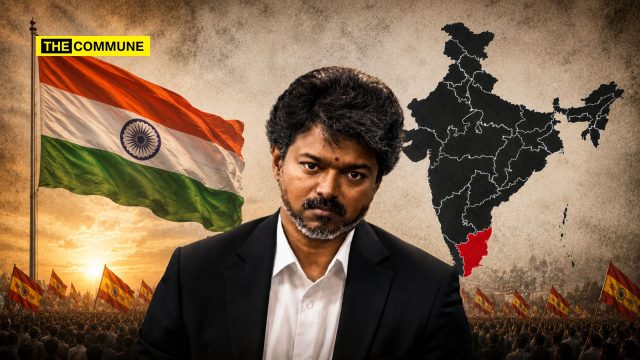
Joseph Vijay’s TVK government has made a deliberate linguistic shift by referring to the Centre as the “Indian Government” in official communications and public discourse.
TVK has gone one step above the DMK in its dangerous game of regionalist politics.
While the DMK spent decades slyly referring to the Centre as the “Union Government” to keep its old separatist itch alive, Joseph Vijay’s TVK government has escalated it further by openly calling it the “Indian Government” — treating the national government as something alien, external, and almost foreign to Tamil Nadu.
This is not mere semantics. It is a calculated narrative shift that, when seen in the larger picture of TVK’s early rule, reveals a deeply disturbing agenda of fragmentation and soft separatism.
From Periyar’s Dravidar Kazhagam demanding Dravida Nadu to the early DMK’s pre-1963 secessionism, the “Union” phrasing framed India as a loose contractual arrangement of states rather than one indivisible nation. Even after the 16th Constitutional Amendment curbed open separatism, the “Union” rhetoric preserved that itch — treating the Centre as an external, almost adversarial entity. DMK’s version was bad enough. But TVK has discarded even that thin constitutional veil. By normalising “Indian Government” in official communications, the new regime is fostering a mental separation far more potent and populist than anything the DMK achieved.
The Larger Picture: Identity Engineering and Anti-India Optics
This choice of words must be judged against TVK’s other aggressive moves. The Indian Union Muslim League (IUML) abandoned its decades-old alliance with the DMK to join the TVK government and bag the minorities welfare portfolio. Almost immediately, the same TVK government released official welfare material describing Christians as a separate “race” — not a religious community, but a distinct racial entity. This state-sponsored racialisation of faith is toxic and unprecedented. It carves Tamil society into ethnic-racial silos instead of uniting them as Indians.
Vijay, himself a Christian, may speak of harmony, but these actions scream vote-bank politics and identity fragmentation at the cost of national cohesion.
The danger peaked when US Ambassador Sergio Gor met Chief Minister Vijay and tweeted about cooperation “between our two nations.” A senior American diplomat framing a state of India as a separate nation is outrageous. In the context of TVK’s “Indian Government” language, IUML alliance, and racial framing of Christians, this remark — whether careless or calculated — gives legitimacy to the speculations about separatist undertones of TVK.
Opposes Vande Mataram
TVK rushed to object to the national song Vande Mataram being accorded its due place at government functions. The party has publicly declared it will disregard the Centre’s protocol in future functions and revert to starting with the state song.
Is Singing National Anthem Before Tamil Thai Vazhthu A Crime?
Even in the Tamil Nadu Assembly, TVK has continued this disturbing pattern. Chief Minister Vijay sharply attacked the DMK over criticism of the sequence in which the National Anthem and Tamil Thai Vazhthu were rendered during the Governor’s Address. However, in attempting to highlight DMK’s hypocrisy, Vijay’s own speech repeatedly portrayed the act of singing the National Anthem before Tamil Thai Vazhthu — or singing it twice — as though it were a serious transgression requiring elaborate explanation and justification.
He cited a 2021 DMK-era event with the President of India to counter them, yet the very need to justify the National Anthem’s primacy only amplified the message: under TVK, national symbols are treated as optional or secondary, always needing political defence when they take precedence. Such episodes keep national symbols contested and distant, normalising the idea that loyalty to Tamil Nadu stands apart from, and above, loyalty to India.For decades, this brand of mental separation — viewing the national government as “them” and prioritising sub-national identities — was largely limited to Kashmir and parts of the Northeast, often ending in violence and alienation. Tamil Nadu, long integrated into India’s economic and cultural mainstream, is now being dragged down the same path
TVK’s Dangerous Path
For decades, this brand of mental separation — viewing the national government as “them” and prioritising sub-national identities — was largely limited to Kashmir and parts of the Northeast, often ending in violence and alienation. Tamil Nadu, long integrated into India’s economic and cultural mainstream, is now being dragged down the same path by a celebrity-driven government armed with mass appeal.
Subscribe to our channels on WhatsApp, Telegram, Instagram and YouTube to get the best stories of the day delivered to you personally.