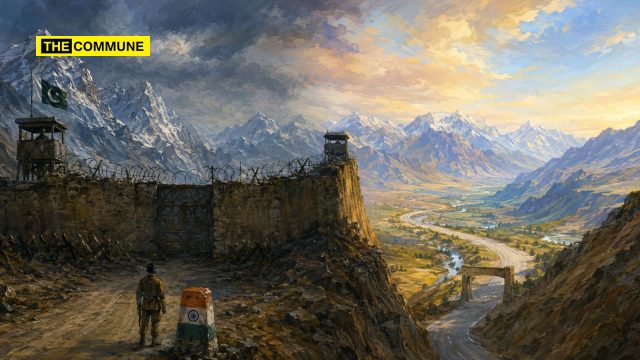
“Geography is destiny, but borders are often drawn by the arrogance of empires. True national sovereignty is the courage to redraw them towards justice.”
In the digital age, cartography often reveals the stark, unspoken truths of global geopolitics. Recently, a cartographic paradox circulating on social media has sparked a profound awakening among Indian geopolitical observers.
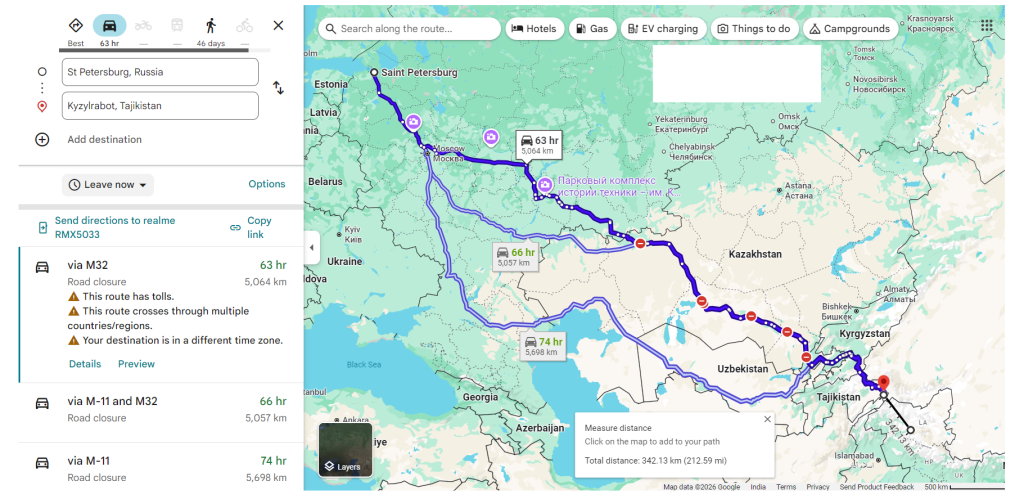
See this Map. This map illustrates a sprawling, intercontinental road journey from St. Petersburg, Russia, to Kyzylrabot, Tajikistan. Spanning over 5,064 kilometers, this route winds through multiple sovereign nations, diverse time zones, and complex terrains, achievable in approximately 63 hours of driving. It is a testament to the marvels of modern Eurasian connectivity.
Now, contrast this with the below map. This map zooms in on the distance between that same Tajik city of Kyzylrabot and India’s Kargil region in Ladakh. The straight-line distance is a approx 300 kilometers.
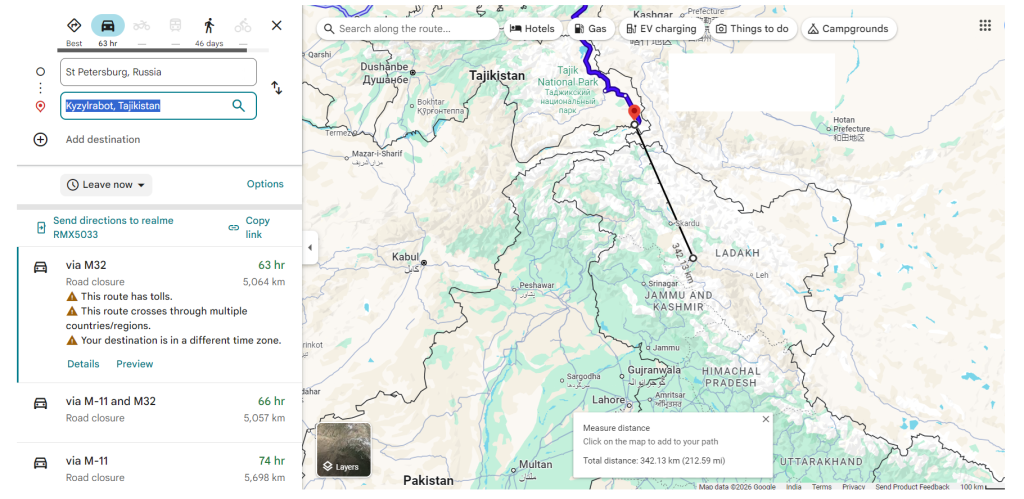
Yet, this incredibly short leap across our immediate northern frontier is an impossible journey for any Indian citizen or trade vehicle.
We live in a world where India can successfully land a rover on the lunar south pole, yet we are physically barricaded from traversing a trivial 340-kilometer stretch of our own historical backyard to reach Central Asia. Even with a willing Afghanistan ready to open its Wakhan Corridor, India remains geographically landlocked from the north. This is not a failure of engineering or a cruel trick of the Himalayan terrain; it is the calculated result of a decades-long international conspiracy, sustained by the arrogance of global superpowers.
The Wakhan Corridor and the Echoes of the “Great Game”
To understand this blockade, one must look at the Wakhan Corridor – a narrow, high-altitude panhandle in northeastern Afghanistan, roughly 310 kilometers long and anywhere from 10 to 60 kilometers wide. Historically, this treacherous but vital stretch was the beating heart of the Silk Road, facilitating the flow of goods, ideas, and cultures across the entirety of Asia.
However, the borders of the Wakhan Corridor were not drawn by natural cultural divides, but by the imperial paranoia of the 19th century. During the “Great Game,” the British Indian Empire and the expanding Russian Empire deliberately carved out this strip of land in 1895 to serve as a geographic buffer zone, ensuring their military forces would never directly meet.
Today, the physical barrier that prevents India from accessing this historical corridor and by extension, the whole of Central Asia, is Pakistan Occupied Kashmir (POK) and the region of Gilgit-Baltistan. As an integral, constitutional part of India, Gilgit-Baltistan shares a direct northern border with the Wakhan Corridor and China’s Xinjiang province. Because this territory languishes under the illegal occupation of Pakistan, India’s natural, overland access to Eurasia is entirely choked off.
The Hypocrisy of the Anglo-American “World Order”
The perpetuation of this geographical isolation is no mere accident of post-colonial history. The imperial tactics of the British have simply been inherited and modernized by Anglo-American forces under the sanitized banner of maintaining a “rules-based international order.”
The Illusion of Western Benevolence: Western powers frequently position themselves as the ultimate arbiters of democracy, territorial sovereignty, and human rights. Yet, they have maintained a calculated, decades-long silence regarding Pakistan’s illegal military occupation of Indian territory in Gilgit-Baltistan.
Strategic Containment: The geopolitical calculus is brutally simple. If India, a rapidly rising civilizational state of over 1.4 billion people, gains direct, overland access to Central Asia, Russia, and Europe, its reliance on Western-dominated maritime choke points (like the Suez Canal) would plummet. To prevent the emergence of an uncontainable Asian superpower, Western nations have historically preferred a fractured subcontinent.
Enabling the Aggressor: By periodically arming, funding, and diplomatically shielding Pakistan over the decades, these global powers have deliberately sustained a state of permanent volatility in South Asia. This ensures India remains bogged down in regional border disputes, rather than projecting its rightful logistical and economic power across the Eurasian landmass.
The Dragon’s Shadow: China’s Vested Hegemony
While Western powers use POK to contain India geopolitically, China utilizes it to secure its economic hegemony. Beijing is acutely aware of the strategic goldmine that is Gilgit-Baltistan.
To bypass its own maritime vulnerabilities (the “Malacca Dilemma”), China has routed its flagship multibillion-dollar Belt and Road Initiative (BRI) project, the China-Pakistan Economic Corridor (CPEC), straight through occupied Indian territory. Nearly 500 kilometers of this infrastructure artery relies entirely on the occupation of Gilgit-Baltistan.
For Beijing, a geographically unified India is an economic nightmare. If India were to reclaim its northern territories, China’s monopolistic grip on Asian land trade would be shattered. Therefore, China relentlessly props up the Pakistani state, defending its illegal occupation at the United Nations and pouring billions into occupied lands, all to ensure India’s overland routes remain permanently blocked.
In the current geopolitical reality, India is physically landlocked from Central Asia and Eurasia, forcing an over-reliance on maritime routes that remain highly vulnerable to Western control, all while facing a Chinese monopoly over regional trade via the CPEC route. However, the future post-POK reclamation promises a radical transformation. Once this territory is reclaimed, India will share direct, contiguous borders with Afghanistan and Central Asia, paving the way for the creation of a sovereign, massive overland road and rail logistics corridor. Ultimately, this monumental shift will establish a democratic, Indian-led alternative that powerfully challenges Chinese economic hegemony in the region.
Reclaiming POK: The Dawn of a New Eurasian Artery
The narrative surrounding Gilgit-Baltistan and POK must shift from emotional rhetoric to hard geopolitical reality. These are not merely disputed mountains; they are the severed arteries of the Indian economic engine.
The eventual reclamation and full reintegration of POK is not just a matter of national pride; it is a geopolitical inevitability that will redraw the global economic map.
Imagine the logistical revolution: An Indian freight train or a convoy of cargo trucks departing from Kargil, crossing a reclaimed Gilgit, traversing the Wakhan Corridor into Tajikistan, and rolling seamlessly through Uzbekistan and Kazakhstan all the way to St. Petersburg.
This direct land logistics corridor would bypass the volatile Middle East, circumvent the increasingly unreliable Suez Canal, and neutralize the maritime dominance of Western naval fleets. It would slash freight times, reduce transit costs, and establish a new Silk Road – one anchored not in authoritarian debt-trap diplomacy, but in the transparent, democratic rise of the Indian Republic.
Conclusion
The 342-kilometer cartographic gap staring back at us from our screens is the physical manifestation of a historical injustice. It is a monument to the arrogance of a “World Order” that seeks to dictate the boundaries of a civilizational state.
The Anglo-American powers and their Chinese counterparts must recognize a shifting tide: India’s rise cannot be contained by artificial borders or proxy occupations forever. The reclamation of Gilgit-Baltistan is the key that will unlock India’s Eurasian destiny. When that 340-kilometer wall finally falls, the road from Kargil to St. Petersburg will not just be a highway on a map, it will be the spine of a new global economy.
Ganesh Kumar is a geo-political analyst.
Subscribe to our channels on WhatsApp, Telegram, Instagram and YouTube to get the best stories of the day delivered to you personally.